Europe is rapidly rewriting its security architecture. Faced with Russian aggression, mounting doubts about long-term American commitment and growing pressure to shoulder more of its own defense burden, European states […]
fjo3 shares a report from Defense One: A small but growing number of European officials and analysts are saying what four years ago was unthinkable: Ukraine isn't just surviving its grueling war with Russia, it is in some ways thriving and may even be on a path to victory. This isn't yet captured in headlines -- for example, about last weekend's barrage of Russian drones and missiles around Ukraine -- but in the details, like how some 90 percent were intercepted. Several long-term trends have shifted in Ukraine's favor, and the core reason is its fierce focus on AI and robotics.
In the crucible of war, Ukraine has developed drones and ground robots that can hold territory -- even take it back. Some are fully controlled by humans, like supply robots and medical-evacuation vehicles. But an increasing number are controlled in at least some aspects by dozens of AI products, from guidance packages on aerial drones to decision aids at the highest levels. [...] Just as important as the tech are the new tactics. Given unusual latitude to experiment, Ukrainian fighters began to develop robot-forward infantry concepts, like combined-arms attacks by airborne and ground systems, "more than a year ago. Right now, we're massively starting to implement this," said Davyd Aloian, deputy secretary of the National Security and Defence Council of Ukraine, the coordinating body on domestic and international security, in an interview.
Ukraine and its partners are also steaming ahead on new concepts for highly autonomous defenses against Russian drones, combining ISR sensors and AI to detect and identify enemy drones in less time and with more certainty. "All of the systems are being linked with each other and with people" to create a distributed network with interceptor drones at various locations to be activated when needed, Aloian said. "One day we will have only like 10 guys who are just going to be responsible for approving interception. And it will automatically go direct to the target." The human operators will be dispersed as well. "Everything can be controlled from Kyiv, Lviv, from cities in other countries," he said. "It's not what happened to Ukraine" (referencing Russia's barrage of Shahed drones) that "should scare us in Europe," said Swarmer CEO Serhii Kupriienko. It's how quickly Ukraine's "middling" military evolved to counter Russia's invasion.
"We are behind by literally 10 years or 20 years" in some defense-technology areas, such as satellite imagery, Kupriienko said, and yet his country has climbed a capability curve that just two years ago seemed insurmountable. So could others, he said. "The answer is always AI solutions and integrating the AI into even the daily routine work within the bureaucracy," he said.
"We have evolved since 2022, the industry has and our defense has as well. Right now we are able to provide not only [large quantities of drone] assets but everything what is needed to build out the ecosystem," including parts and production, training, modification, etc. Aloian said.
The wreck of an American submarine from World War II has been found off the coast of Matsua Island, Japan. The USSHerring (SS-233) currently rests over 300 feet down in the Pacific Ocean, where it is sitting upright and “maintains a high degree of integrity,” according to United States Naval History and Heritage Command (NHHC). The discovery was announced exactly 82 years after the vessel sank, based on evidence collected from an international team of researchers.
Herring’s final mission
The Herring was first launched from Portsmouth Naval Shipyard in Maine on January 15, 1942, and officially commissioned on May 4, 1942. The vessel completed eight war patrols in both the Atlantic and Pacific Oceans during the war. Herring sank seven enemy ships, including four Japanese cargo ships during what would be the submarine’s final patrol.
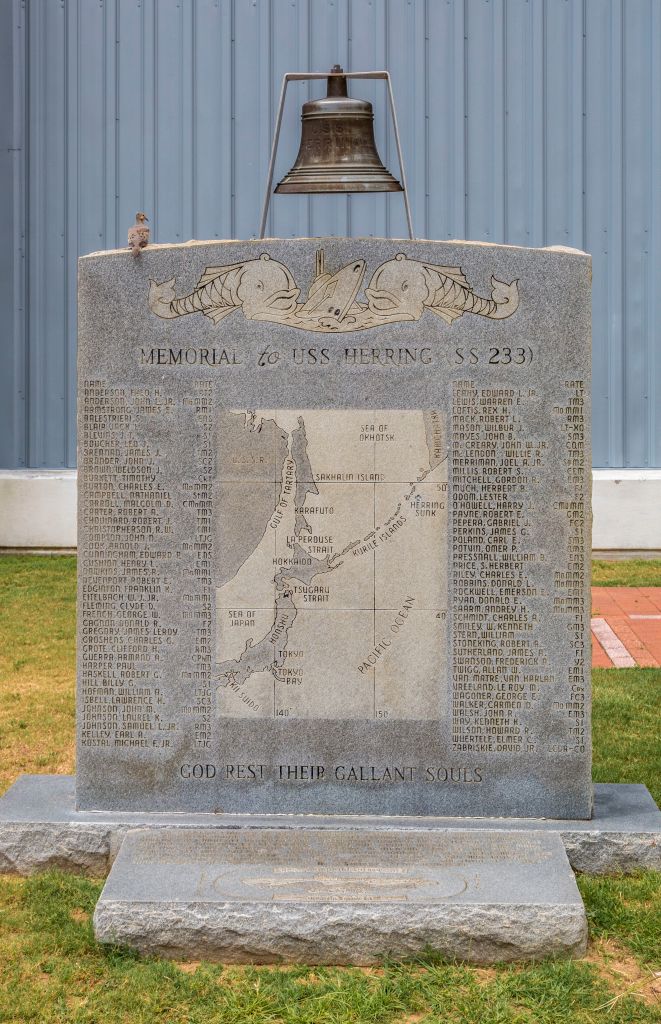
Herring was last seen by the crew of the USS Barb during the evening of May 31, 1944. The submarines met to determine who would patrol areas off the Kurile Islands, an archipelago east of Japan. Early on June 1, 1944, Barb’s crew recorded hearing the sound of weapons designed to attack a submarine from a ship or aircraft called depth charges exploding in the distance.
Japanese historical records also confirm that Herring was struck in two direct hits during a counterattack by a shore battery. The strikes ultimately sank Herring and the vessel was presumed lost when Herring failed to report to Midway on July 13, 1944. The sinking killed all 83 crewmembers.
USS Herring Memorial statue at the Battleship Memorial Park in Mobile, Alabama. Image: Ron Buskirk/UCG/Universal Images Group via Getty Images Ron Buskirk
A protected final resting place
In 2017, a joint expedition between Russian Geographic Society (RGS) and the Russian Military reported a submarine wreck in the area. Based on its location and appearance, the RGS reported that the wreckage was Herring. A subsequent joint expedition returned to the wreck in 2022 to document its status and honor the lost crew. The expedition team also placed a plaque on site. The data collected and shared by the RGS was analyzed by two U.S. volunteer researchers and one researcher in Japan. NHCC confirmed the wreckage on June 1, 2026–82 years to the day after Herring is believed to have sunk.
Importantly, the wreckage shows battle damage around the submarine’s conning tower. This tower is a raised platform from which an officer can conn (conduct or control) a vessel. This damage, along with evidence of grounding at the submarine’s bow, correlates with the historical record of the Herring’s sinking.
The wreckage is currently protected by U.S. law and under the jurisdiction of the Department of the Navy. The Navy allows some non-intrusive activities on sunken military craft, but any activity that may disturb the sunken vessel must be coordinated with NHHC.
“Most importantly, the wreck represents the final resting place of Sailors who gave their lives in defense of the nation and should be respected by all parties as a war grave,” the NHHC wrote in a press release.”
In today’s newsletter: Its software is used from health services to militaries. But controversies and criticism of the $375bn company are leading some to ask if Palantir is too powerful
Good morning. The Peter Mandelson story keeps unfolding. Peter Walker explains here what is in the latest release of documents, and Henry Dyer takes a look at the key papers missing from the latest disclosures. Today we are covering another major story: Palantir.
Few companies attract controversy more than Palantir. Since the pandemic, the US data analytics company has grown voraciously, using its AI-driven software to make sense of intractable datasets for customers around the world. For the NHS, it analyses patient records; for the US military, it’s focused on targets in Iran. Palantir’s products are widely used, with the business now worth $375bn.
UK politics | Peter Mandelson was receiving sensitive security briefings about the Foreign Office’s work, and was in discussions with the head of MI6, before he had completed the developed vetting process, documents reveal.
Ukraine | Russian air raids on major Ukrainian centres including Kyiv, Dnipro and Kharkiv killed at least five people and wounded dozens by early morning on Tuesday, authorities said.
Environment | More than a million jobs, higher wages, nearly half a trillion pounds in investment in the pipeline – the UK’s green economy is powering ahead, according to research by the country’s leading business organisation.
US news | Donald Trump is reconsidering whether to keep pressing for a $1.8bn fund to compensate his allies, a person familiar with his thinking said, as the justice department paused the program to comply with a court order.
UK news | Sir Alan Bates has said that the schemes set up to compensate post office operators over the Horizon IT scandal have been an “utter disaster” and that the government should not be involved in running them.
The Los Angeles-based startup manufactures standardized satellite buses designed to be produced more quickly and at lower cost than traditional government spacecraft
It seems like every week there’s another example of a new robot modeled after a real creature in the animal kingdom. From dogs and bats, to roaches and desert lizards, the natural world is a constant source of inspiration for engineers. But while most robotics researchers use animals as a base for their machine’s movement, an ambitious team of Duke University engineers set out to make something entirely new: a robot whose form factor and movement aren’t derived from biology, but from the universe’s underlying physics.
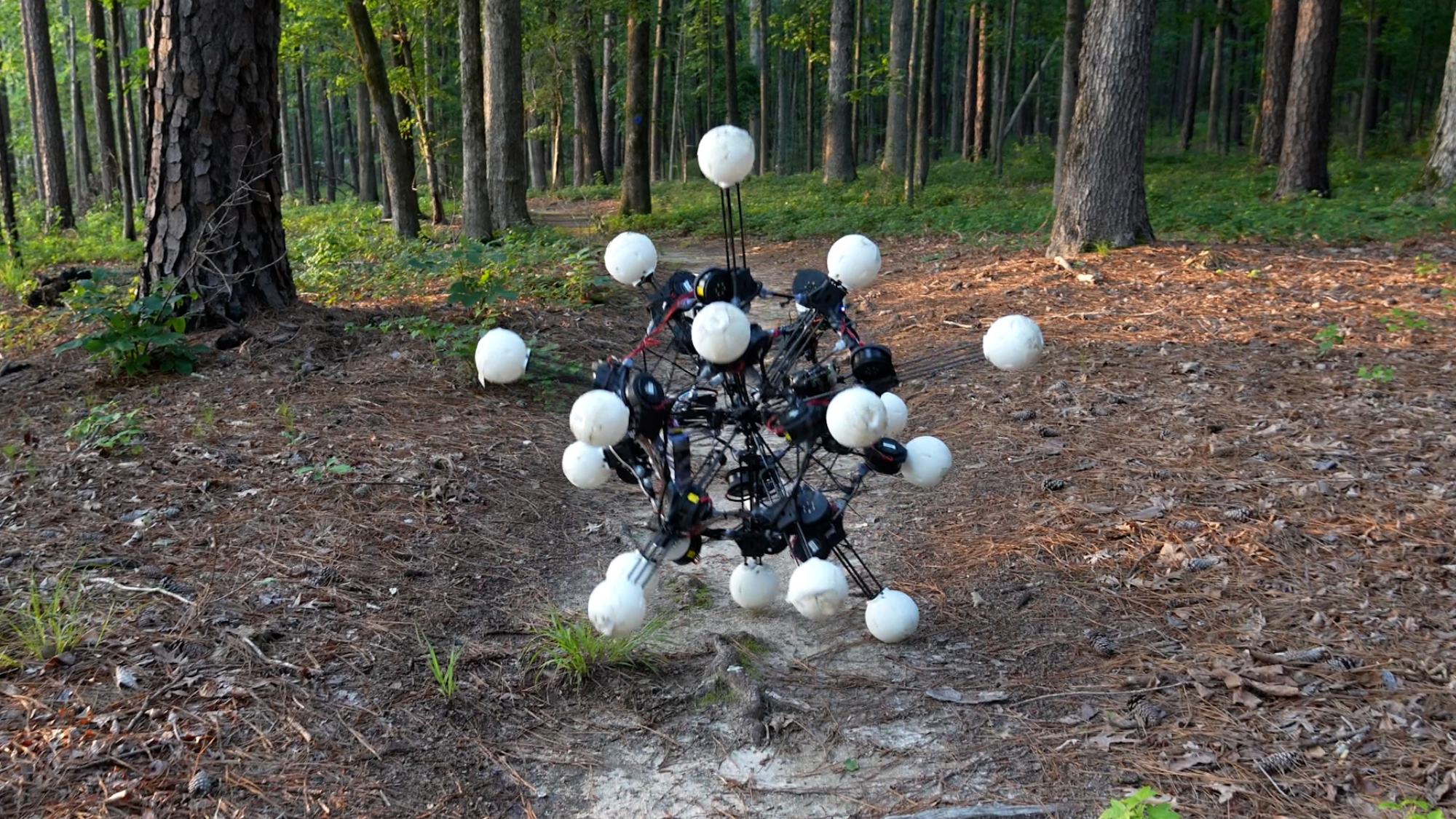
Say hello to Argus, a 20-legged, blob-looking robot capable of seeing in all directions at the same time and able to move almost instantly in any direction. The amorphous-looking sphere has no top or bottom, no left or right, and will keep trekking through sand, dirt, and gravel even when some of its legs are destroyed. It can also use its many legs to shimmy up narrow walls, a move similar to a wall jump in “Super Mario.”
The engineers behind Argus say their intriguing, if not slightly terrifying, creation isn’t just another incremental step forward in robotics. It’s the first member of a totally new category of “dynamically symmetric machines.” The findings were published this week in the journal Science Robotics.
“Watching Argus move is unlike watching any other robot we’ve worked with,” study co-author and Duke PhD student Jiaxun Liu said in a statement . “The first time we saw it navigate among trees and rough terrain, even under heavy collisions, we knew this was something different.”
Biological tradeoffs
Though somewhat human-looking, upright bipedal robots from companies like Figure and Tesla are all the rage these days, engineers have long looked to other animals to inspire their machines, because animals are simply better than Homo sapiens at certain tasks. Dogs and other quadrupeds are more agile, bats can fly, and bugs can scurry into hard-to-reach places.
However, at least in terms of movement, each of the pluses of these specific animals has also come with some minuses. Dogs and other quadrupeds are remarkably fast and nimble when moving forwards, but ask them to replicate that movement when moving backwards and you’re in for a problem.
With those inherent biological tradeoffs in mind, the team at Duke’s General Robotics Lab set out to make something completely different. Taking inspiration from underlying physics, they wanted to see if they could make a robot based around “dynamic symmetry,” which they define as the ability to generate forces and acceleration with uniform magnitude in all directions.
In other words, such a robot would take the idea of left or right and up and down and throw them out the window. Instead, it would be capable of moving in any direction, at any time, without any privilege given to one particular direction. The goal was essentially to build possibly the world’s first “omnidirectional” robot.
Argus keeps on coming—even when you break its legs
The design team eventually settled on a spherical core, or base, with a bunch of legs sticking out of it. They made multiple versions in a simulation, one with as few as eight legs and another with as many as 40. Eventually they settled on an even 20 legs for the physical build. Each of those legs is tipped with a camera that serves as one of Argus’ many eyes. Fitting, then, that it’s named after a many-eyed giant in Greek mythology. The researchers describe Argus as visually similar to a sea urchin, but even that’s selling it short. It doesn’t really look like anything in nature, which makes its uncanny movement in real-world testing all the more unsettling.
In testing, Argus could move in any direction just as quickly and comfortably as any other. The upside of that is that the blob is actually quite adaptable to different terrain despite its unusual appearance. It can easily traverse forest, wet surfaces, and sand, and could climb over certain obstacles. Argus’ ability to rapidly redistribute its weight also meant that it excelled at recovering when researchers tried to shove it off course. While Argus isn’t the first robot to right itself after getting pummeled by a researcher, what makes it unique is that it can redistribute its weight even if some of its legs get damaged or fail altogether.
In other words, you can chop off Argus’ legs and it will just keep coming.
Argus joins a family of DARPA-backed robots
The Duke researchers frame their interest in building this new category of machine as primarily motivated by pushing the boundaries of what’s possible in mechanical science. Still, it’s hard not to ignore the researchers’ most notable funder: the Pentagon’s Defense Advanced Research Projects Agency. Known for incubating some of the military’s most notorious research and development projects, DARPA is responsible for everything from Boston Dynamics’ beef Atlas humanoid to a massive, experimental manta ray inspired uncrewed underwater vehicle.
So, while it’s still not clear what exactly Argus will ever be used for, paper coauthor and postdoctoral researcher at Duke’s General Robotics Lab Boxi Xia says the experimentation and exploration was success in itself.
“Argus is an existence proof,” Xia said in a statement. “It shows that designing for dynamic symmetry isn’t just a theoretical curiosity. It produces a robot you can deploy in the wild, on uneven ground and in clutter, even in low-gravity settings. It changes what’s possible.”
We are in the geospatial era of warfare in which information derived from satellites is as strategically critical as territorial control. The progressive dissolution of the distinction between the civil […]
AMSTERDAM — A senior German military official said Europe needs a coordinated approach to military space operations and proposed the creation of a European Space Component Command hosted by Germany […]
HASC 2027 NDAA supports realignment of the Space Development Agency and the Space Rapid Capabilities Office under a portfolio-based acquisition structure
AMSTERDAM – A former senior Ukrainian defense official called on SpaceX to tighten controls on Starlink terminals that she said are reaching Russian forces through third-party countries or intermediaries. Kateryna […]

 Login
Login