Normal view

Scientists identify a cell type in the brain that was previously ignored and it may explain why human memory has no known upper limit

The human brain contains roughly 86 billion neurons. That number appears in almost every popular account of memory and intelligence, and it tends to carry an implicit argument: that the scale of human cognition follows from the scale of this cell count. What is less often mentioned is that the brain contains a roughly comparable number of a different cell type entirely, one that researchers have treated, for most of the history of neuroscience, as little more than biological scaffolding.

A paper published on 23 May in the Proceedings of the National Academy of Sciences puts forward a new hypothesis about what those cells, called astrocytes, might actually be doing. The work comes from a team at MIT: lead author Leo Kozachkov, Jean-Jacques Slotine, a professor of mechanical engineering and brain and cognitive sciences, and Dmitry Krotov of the MIT-IBM Watson AI Lab, who is the paper’s senior author. Their claim is not that astrocytes have been misunderstood in any dramatic sense; it is the more careful suggestion that they may be doing computational work that neurons, on their own, cannot account for.

This is a hypothesis supported by a mathematical model. The experimental work needed to test it has not yet been done.

The storage problem

The standard model for thinking about memory storage in neural networks is the Hopfield network, formalised by John Hopfield in his influential 1982 paper and drawing on earlier independent work by Shun-Ichi Amari in the early 1970s. Hopfield networks store information as patterns across connections between neurons, and they have been used as a working model for how the brain encodes and retrieves memories. The problem is that they can only store a limited amount of information, far less than what the human brain demonstrably holds. A modified version, known as dense associative memory, can store considerably more, but it requires couplings between more than two neurons at a time. Conventional synapses connect exactly two neurons: one presynaptic, one postsynaptic. There is no obvious biological mechanism for the higher-order coupling that dense associative memory requires.

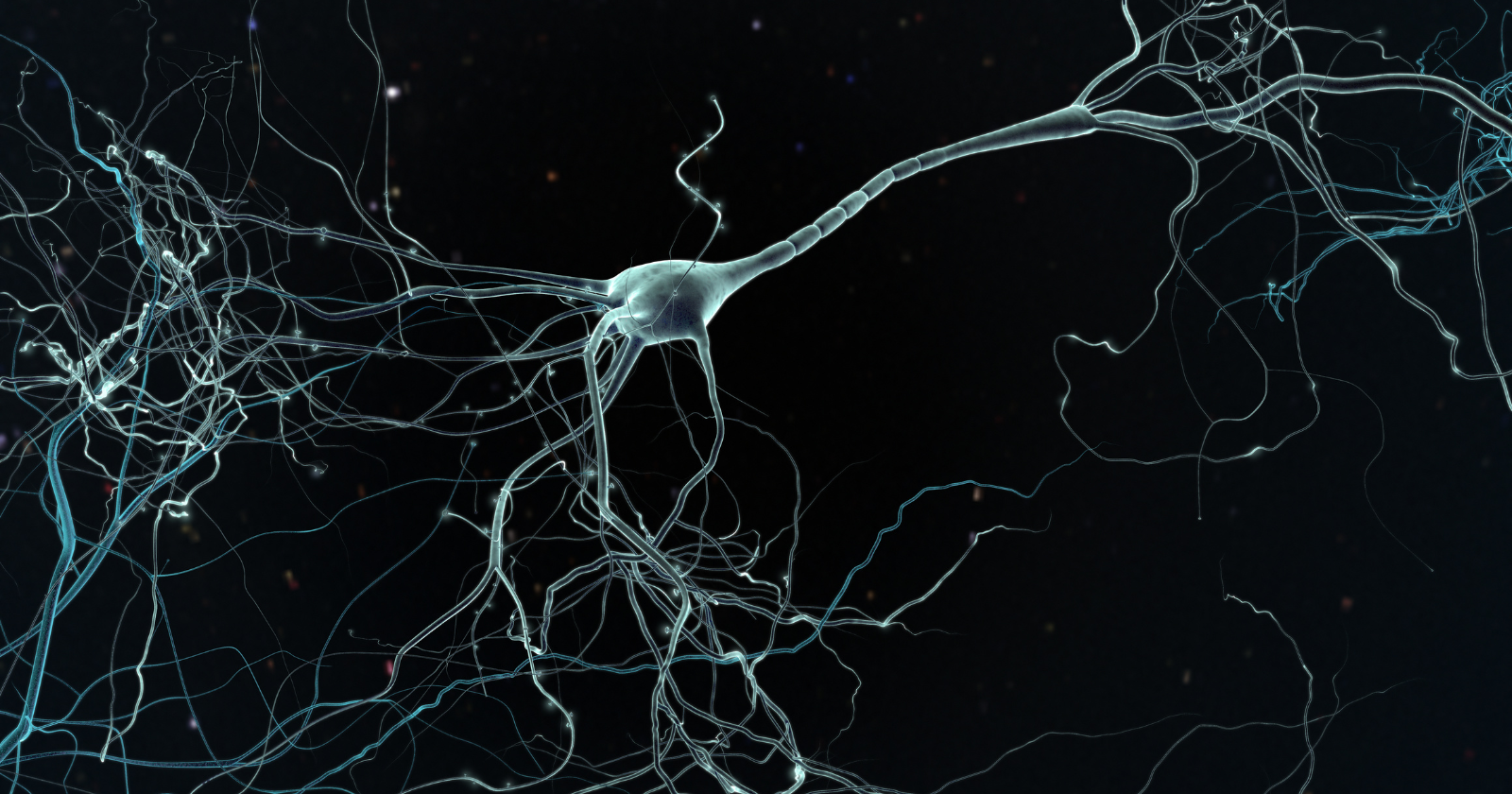
Astrocytes are where the MIT team’s argument begins. These are star-shaped cells with long, thin extensions called processes, each of which can wrap around an individual synapse. An astrocyte can contact hundreds of thousands of synapses. When an astrocyte process wraps around a synapse, it creates what is called a tripartite synapse: a three-way junction involving the astrocyte process, the presynaptic neuron, and the postsynaptic neuron. Astrocytes cannot fire electrical action potentials the way neurons do, but they communicate through calcium signalling and can release signalling molecules called gliotransmitters into the synaptic junction.

The key move in the MIT model is to treat each tripartite synaptic domain not as a passive structural unit but as a computational one. Rather than thinking of an astrocyte as a single entity, the researchers treat it as a collection of semi-independent processes, each capable of sensing neural activity and feeding information back. The coupling this creates is not between two neurons but between the astrocyte process and the two neurons it connects. That is precisely the higher-order coupling that dense associative memories require.

What the model actually shows

“By conceptualising tripartite synaptic domains as the brain’s fundamental computational units,” says Maurizio De Pitta, an assistant professor of physiology at the Krembil Research Institute at the University of Toronto who was not involved in the study, “the authors argue that each unit can store as many memory patterns as there are neurons in the network. This leads to the striking implication that, in principle, a neuron-astrocyte network could store an arbitrarily large number of patterns, limited only by its size.”

The phrase “arbitrarily large” is worth pausing on. It does not mean infinite. It means that the model does not hit the ceiling that traditional neuron-only networks hit, and that the practical limit appears to scale with the network’s own dimensions. In this reading, the reason human memory has no known upper bound is not that the brain has found some exotic mechanism; it is that the brain may be exploiting a storage architecture that neuroscience has not, until recently, thought to look for.

The model also has something to say about energy efficiency. Because the ratio of stored information to computational units is high, and grows with network size, the system stores more per unit than a conventional Hopfield architecture. The authors suggest this fits with what is known about the brain’s actual energy budget.

What recent neuroscience has supported

The case for taking astrocytes seriously as more than support cells has been building for some years, though it has not yet hardened into consensus. Within the past few years, experimental work has begun to suggest a more active role. Studies disrupting astrocyte-neuron connections in the hippocampus have reported impairments in both memory storage and retrieval, and advances in calcium imaging resolution have made it possible to observe astrocytes and neurons coordinating their activity in real time. These findings establish that something is happening without settling what, and the field has not yet reached consensus on their interpretation.

“Originally, astrocytes were believed to just clean up around neurons,” Slotine says in the MIT release, “but there’s no particular reason that evolution did not realise that, because each astrocyte can contact hundreds of thousands of synapses, they could also be used for computation.”

The question the Kozachkov et al. paper is trying to answer is a narrower one: given what astrocytes do, what kind of computation could they plausibly be performing? The answer the model gives is memory encoding via dense associative memory, with information stored in the spatiotemporal patterns of calcium flow within the astrocyte, conveyed back to neurons through gliotransmitter release.

What the paper does not establish

The authors are direct about the speculative status of their work. “We hope that one of the consequences of this work could be that experimentalists would consider this idea seriously and perform some experiments testing this hypothesis,” Krotov says. The path from a plausible model to a confirmed mechanism is long, and many plausible models do not survive experimental contact. There is currently no way to test this hypothesis by reading the paper; what the paper does is make the case that testing it is worth the effort.

There is also a risk in reading the model too expansively. The dense associative memory architecture predicts certain mathematical properties of memory storage, but mapping those properties onto the full range of human memory, its emotional colouring, its selectivity, its susceptibility to distortion, requires considerably more work. The model addresses storage capacity. It does not address what gets stored, or why some memories persist, and others do not.

The Hopfield network context is worth keeping in mind here. John Hopfield received the Nobel Prize in Physics in 2024, shared with Geoffrey Hinton, for foundational work on artificial neural networks — work recognised for shaping the development of modern machine learning. The MIT paper extends that framework into a domain Hopfield’s original model could not reach. Whether the extension accurately describes what the brain is doing is, as yet, an open question.

The implication for how the brain is studied

There is a tendency in accounts of the brain to treat it as a neuron-first system, with everything else as secondary infrastructure. The attention given to neurons is not arbitrary; they are the cells that fire, that carry electrical signals, that form the visible substrate of perception and movement and speech. But a brain that uses half its cell count for functions that remain poorly understood is a brain with an incomplete accounting.

What the Kozachkov et al. paper adds to that picture is a specific, testable claim: that the three-way synaptic junction formed by an astrocyte and two neurons may be doing memory work that neuron-to-neuron connections alone cannot. If experiments bear that out, the implication is not just that astrocytes matter. It is that the unit of computation we have been studying, the synapse between two neurons, is not the brain’s actual basic unit of memory storage.

That would require some revision to a great deal of what has been written about the brain. It would not require discarding it.

The post Scientists identify a cell type in the brain that was previously ignored and it may explain why human memory has no known upper limit appeared first on Space Daily.

A study of adults aged 62 to 92 found that basic motor control — drawing lines, placing dots — remains almost identical between people with and without cognitive impairment, meaning the hands stay capable long after the processes that organise thought have started to change

There is something quietly striking in the image. An older adult — perhaps 86, perhaps older — sits before a digitizing tablet and draws horizontal lines. The pen moves steadily across the surface. The lines come out clean and even. The hand does not falter. The hand, it turns out, does not know.

A new study published in Frontiers in Human Neuroscience has examined what happens to handwriting and motor control in older adults with and without cognitive impairment, and one of its most arresting findings is precisely this: when it comes to basic pen-motor tasks — placing dots on a surface, drawing horizontal lines — the two groups are effectively indistinguishable. The degradation of cognitive function that researchers can detect through standardized assessments leaves no measurable trace in the elementary mechanics of holding and moving a pen.

The basic motor infrastructure holds. What begins to separate the groups is something more demanding: the cognitive work that handwriting also requires.

What the study measured, and how

The research, led by Ana Rita Matias and colleagues at the Universidade de Évora and collaborating Portuguese institutions and published in May 2026, recruited 58 institutionalised older adults ranging in age from 62 to 99. Thirty-eight participants had been classified as cognitively impaired, with a mean age of 86.05 years. Twenty were cognitively healthy, with a mean age of 84.35 years. Cognitive status was established using two standard clinical instruments: the Mini-Mental State Examination and the Clock Drawing Test.

Each participant completed a series of tasks on a Wacom digitizing tablet fitted with an inking pen — a device that captures not just what is written but the kinematics of how it is written: pen velocity, pressure, the duration of strokes, the number of discrete movements, the pauses between them. This is the critical advantage of digital capture over conventional paper-based assessment. What the eye cannot see, the tablet records.

The tasks fell into two categories. The first were simple motor tasks: a dots task, in which participants were asked to place at least ten dots on the tablet surface within twenty seconds, and a lines task, in which they were asked to draw at least ten horizontal lines in the same time. These tasks required control of the pen but little else. No language processing. No memory retrieval. No composing of meaning.

The second category was more demanding: four handwriting-speed tasks involving the copying and dictation of sentences. Copying a sentence allows the writer to keep the source text in view. Dictation does not. The words arrive as sound, must be held in working memory, parsed for meaning, translated into motor sequences, and then committed to the page — all while the auditory trace is already fading.

Where the difference appears — and where it does not

The dots and lines tasks did not significantly discriminate between the two groups. This is the finding worth pausing on. Cognitive impairment, at the level where it is detectable by standard clinical tools, has not yet disrupted the peripheral motor system. The hand moves. The pen responds. The basic loop between intention and execution remains functionally intact.

The dictation tasks told a different story. Here the researchers found statistically significant differences between the cognitively impaired and cognitively healthy groups. One task in particular — referred to in the paper as WS3, a dictated sentence — produced the strongest discriminatory signal. Two features of the kinematic data were especially predictive: Duration, the total time taken to complete the task, and Number of Strokes, the count of discrete pen movements. Both variables significantly predicted cognitive group membership.

Participants with cognitive impairment took longer and produced more fragmented output — more individual pen movements to accomplish the same written result. The hand was still moving. But the coordination between the cognitive processes that organise language and the motor processes that execute it had become less fluent, more effortful, more interrupted.

As the authors write in their conclusion: “Handwriting kinematics, especially temporal and stroke-related features, are sensitive indicators of cognitive impairment when assessed under high cognitive–motor load.”

Why handwriting carries cognitive signal

Handwriting has attracted sustained interest from researchers studying cognitive decline precisely because it occupies a peculiar position: it is both a motor act and a cognitive one, and the two are difficult to disentangle by observation alone. The digitizing tablet changes that. By capturing kinematics in real time, it makes visible the hesitations, the micro-pauses, the multiplying strokes that a simple reading of the finished text would never reveal.

What the tablet captures, in effect, is cognitive load expressed through movement. When a task places high demands on working memory — as dictation does — the motor system has fewer resources available to it. The result is not necessarily illegible handwriting. The result is handwriting that takes longer, that requires more individual pen lifts, that shows the seams of the effort it took to produce.

The distinction between copying and dictation is not incidental to this research — it is the mechanism. Copying a sentence is primarily a perceptual-motor task. The writer looks at words and reproduces them. Dictation requires the writer to be, briefly, a language processor: receiving, holding, decoding, and transcribing without the safety net of visible text. That additional cognitive burden is where the between-group difference becomes measurable.

Earlier research in this area has identified kinematic features — pen velocity, in-air time, the ratio of time spent writing to time spent pausing — as markers that correlate with cognitive status in conditions including mild cognitive impairment and Alzheimer’s disease. What the Matias study adds is a careful separation between tasks that load the motor system alone and tasks that load the cognitive-motor system together. The separation clarifies which element of handwriting carries the diagnostic signal.

The case for handwriting-based screening

The researchers position their findings as support for digitally mediated handwriting tasks as screening tools for cognitive decline. The argument has practical force. A digitizing tablet is low-cost relative to neuroimaging and requires no specialist clinical infrastructure. Handwriting is, for most older adults, a deeply familiar act — ecologically valid in the language of assessment research, meaning it does not require participants to learn a new task or adapt to an unfamiliar paradigm. It is something people have done for decades, and the act of doing it again in a clinical or care context carries little of the anxiety or performance pressure that some formal cognitive assessments introduce.

For populations in institutional care — the population this study recruited — such considerations are not trivial. Fatigue, unfamiliarity, and distress can all contaminate cognitive assessment data. A brief handwriting task, completed at a table with a pen in hand, is a different kind of ask than a sustained battery of memory and attention tests.

The study also raises the possibility of longitudinal monitoring: repeated handwriting assessments over time could track subtle kinematic changes before they manifest as detectable impairment on conventional screening tools. The tablet captures what the eye misses. Over months or years, the data might record the earliest drift in the coordination between thought and hand.

What the hand does not know

The human detail at the centre of this research is the one that stays. An older adult draws horizontal lines on a tablet. The hand moves cleanly. The pen does not hesitate. By the measure of the task — ten lines in twenty seconds — the performance is equivalent to that of someone whose cognition, by clinical assessment, remains fully intact.

The hand, performing that task, is not reporting on what is happening elsewhere. The motor infrastructure is preserved. The elementary act of guiding a pen across a surface — the muscle coordination, the proprioceptive feedback, the fine motor loop that learned to hold a pen in childhood and has held one ever since — continues to operate as it has always operated.

What changes, and what the digitizing tablet can detect, is the integration. The moment handwriting becomes more than a motor act — the moment it requires the writer to hold language in mind, to compose and convert and commit — the kinematic signature of cognitive change begins to appear in the data. Not as tremor. Not as a loss of motor control. As duration. As the number of strokes it takes to get the words down.

The hands stay capable. The research is careful to say so. What shifts is the coordination between capability and the cognitive processes that direct it. That coordination, it turns out, is where cognitive impairment first makes itself legible to a machine that is paying close enough attention.

Produced with AI assistance. Reviewed by the Space Daily editorial team before publication.


The post A study of adults aged 62 to 92 found that basic motor control — drawing lines, placing dots — remains almost identical between people with and without cognitive impairment, meaning the hands stay capable long after the processes that organise thought have started to change appeared first on Space Daily.

The IKEA effect in the age of AI

3 June 2026 at 19:00

I have a drawer at home full of leather offcuts I cannot bring myself to throw away. They are scraps, most of them, the edges trimmed off wallets and card holders I made by hand back when I was teaching myself leathercraft and slowly turning it into a small side business. Objectively they are waste. To me they are the evidence of something. I worked for those scraps, and that work changed how I see them.

If you have ever kept a wonky mug a child made, or refused to bin a piece of furniture you built badly, you already know the feeling I am describing.

And there is a name for it.

A quick note before I go further. I am not a psychologist or a neuroscientist, just a writer who makes things and reads widely. What follows is reflection on a handful of studies, most of them observational or small, not advice about how you should work or think.

The IKEA effect is the tendency to place a disproportionately high value on things you helped make. It was named and documented by Michael Norton, Daniel Mochon and Dan Ariely in a 2012 paper with the lovely title “The IKEA Effect: When Labor Leads to Love”. Across four studies using IKEA boxes, origami and Lego, people consistently rated their own clumsy creations as “similar in value to experts’ creations”. 

The number that tends to get repeated comes from the first experiment in the paper. Builders bid an average of $0.78 for the plain storage boxes they had assembled themselves, while non-builders bid an average of $0.48 for the identical pre-built box, a premium of roughly 63 percent. 

The authors are blunt about it. They write that “labor alone can be sufficient to induce greater liking for the fruits of one’s labor: even constructing a standardized bureau, an arduous, solitary task, can lead people to overvalue their (often poorly constructed) creations”. Note the “can.” This is a tendency, not a law.

And there is one important catch, and it matters for where I am going. The effect only showed up when the labor succeeded. When people failed to finish, or built something and then took it apart, the extra value vanished. Effort that goes nowhere does not buy attachment. Completed effort does.

Now sit that next to the thing reshaping how a lot of us work. Generative AI is, broadly, a labor remover. It takes much of the cognitive grind out of writing, coding, summarising, drafting. Or at least it’s supposed to. The output arrives, often decent, and the effort that used to produce it simply did not happen.

If the IKEA effect is right that we love what we labor over, the obvious question is what we feel about what we did not labor over at all.

A 2025 study looked at this. In “Your Brain on ChatGPT”, researchers had 54 people write essays using an LLM, a search engine, or nothing but their own heads, while measuring brain activity. The people who leaned on the LLM reported the lowest sense of ownership over what they had written, and showed the weakest brain connectivity of the three groups. Many of them struggled to quote back the essay they had just produced.

And this seems to show up on the other side too: not just in how creators feel about AI-assisted work, but in how audiences judge it. In a 2023 study, “Humans versus AI: whether and why we prefer human-created compared to AI-created artwork”, researchers found that people tended to prefer artworks they believed were human-made over artworks they believed were AI-made. Part of that preference came down to the qualities people associated with human creation: intention, emotion, effort, and a sense that someone was actually behind the work.

That matters because the Ikea effect is not really about furniture. It is about ownership. We do not only value the finished object. We value the effort we believe went into it. And when that effort feels absent — whether we are the maker or the audience — something in the value seems to drop.

I notice this in my own days. I use AI for parts of my writing work: the research, the lookup, the first-pass structuring, the awkward sentence I cannot quite untangle. But the pieces I feel most attached to are still the ones where I had to wrestle with the idea myself. The ones where I got annoyed, deleted half of it, walked away, came back, and finally found the line I was looking for.

The other risk here is not just that AI-made things feel less ours. It is that the effort we skip might have been doing something for us beyond producing the object.

A 2025 study by Michael Gerlich found a significant negative correlation between frequent AI use and critical thinking. This one study so but put beside the IKEA finding about failed labor and a pattern suggests itself. The value, in both the products study and our own heads, seems to live in the completed effort, not the finished result. Skip the effort and you may keep the result while losing what the effort was quietly building.

I do not buy the idea that AI is something to refuse. I use it. It is genuinely useful. What the leather drawer and the writing work both tell me is that the value was never really in the object. It was in the doing.

So the practical move, for me at least, is not to do everything the hard way out of nostalgia. It is to be deliberate about which labor I keep. Let the machine carry the parts that are pure friction with no learning in them. Hold onto the parts where the effort is the point, where struggling through is what builds the skill or the judgment or the sense that the thing is mine.

The post The IKEA effect in the age of AI appeared first on Space Daily.

The Great Wall of China is not actually visible from space with the naked eye — astronauts from Apollo to the ISS have confirmed it — and the popular myth that it is predates space travel itself, with the best-known version coming from a 1932 Ripley’s Believe It or Not cartoon

“The Great Wall of China is not visible from orbit with the naked eye. It’s too narrow, and it follows the natural contours and colours of the landscape.” So wrote the Canadian astronaut Chris Hadfield from the International Space Station during his five-month tour in 2012-2013. Hadfield’s posting was one of dozens of public statements from astronauts who have attempted, and failed, to see the Great Wall from orbit. The consensus among people who have been to space is unambiguous. The wall is not visible from the International Space Station, was not visible from any Apollo mission, was not visible from the Soviet Salyut and Mir stations, and was not visible to China’s first astronaut, Yang Liwei, who spent 21 hours in orbit on the Shenzhou V mission in October 2003.

The result has produced a small but durable embarrassment for the popular fact that “the Great Wall of China is the only human-made object visible from space.” The claim is one of the most widely-repeated pieces of geographical trivia in modern circulation, taught in textbooks, repeated in documentaries, and frequently invoked in casual conversation. It is wrong on at least three counts. The wall is not visible. It is not the only human-made object. And the claim itself predates the technology that would have been needed to verify it.

What astronauts actually report

According to BBC Sky at Night Magazine’s review of the question, the issue with the Great Wall is straightforward: it is too narrow and too poorly differentiated from its surroundings to be visible at orbital distances. The wall averages roughly 5 to 9 metres in width along most of its length. The International Space Station orbits at approximately 400 kilometres altitude. At that scale, the wall is far below the resolving power of the unaided human eye. The wall is also constructed largely of local materials — stone, rammed earth, brick — that share the colour of the surrounding landscape, eliminating the contrast that would be necessary to pick out a narrow feature against its background.

Yang Liwei was direct about the matter when he returned from orbit in 2003. According to Al Jazeera’s coverage of his post-flight interview, Yang told China Central Television that “the scenery was very beautiful, but I didn’t see the Great Wall.” The statement was politically inconvenient enough that Chinese state media reported it carefully, and the country’s geography textbooks were subsequently revised to remove the claim that the Great Wall was visible from space. The American astronaut Leroy Chiao, then commander of the International Space Station, took what is generally considered the first verifiable photograph of the wall from orbit on 24 November 2004, using a digital camera with a 180mm telephoto lens. A second, more famous Chiao photograph followed on 20 February 2005, taken with a 400mm lens in favourable conditions with snow cover and shadows helping to identify the position of the wall against the landscape. Even with the better lens, only short sections of the wall could be identified, and only after extensive comparison with maps.

The Apollo astronauts addressed an even stronger version of the claim. The original popular framing held that the Great Wall was visible from the Moon, a claim several Apollo crews had the opportunity to test directly. Alan Bean of Apollo 12 famously said: “The only thing you can see from the Moon is a beautiful sphere, mostly white, some blue and patches of yellow, and every once in a while some green vegetation. No man-made object is visible at this scale.” Neil Armstrong, Buzz Aldrin, Michael Collins, Jim Lovell, and Jim Irwin all confirmed the same observation. From lunar distance, Earth is a marble. No surface features of any kind, natural or artificial, can be distinguished.

What is visible from orbit

The interesting part of the story, often lost in the popular framing, is what astronauts can in fact see. According to NBC News’s coverage of the question, which interviewed astronaut Ed Lu of Expedition Seven aboard the ISS, astronauts in low Earth orbit can readily see cities, highways, airports, bridges, large dams, ships at sea, and the wakes of large vessels. At night, the artificial lighting of major cities is visible from orbit as bright patterns against the dark sides of continents. Sufficiently large vehicles — aircraft on runways, container ships — can be made out with the naked eye. The list of human-made objects visible from the International Space Station with no optical aid runs to dozens of categories.

The reason these things are visible and the Great Wall is not has to do with size and contrast, not with the impressive scale or fame of the structure in question. The Great Pyramid of Giza, much shorter than the Great Wall but far wider — about 230 metres on each side — is closer to the threshold of orbital visibility, particularly at low sun angles when the play of light and shadow distinguishes it against the surrounding desert. Astronauts have attempted to see the Pyramid with the naked eye and have produced inconsistent reports. The Great Wall, despite being orders of magnitude longer, is at least an order of magnitude too narrow to compete.

Where the myth came from

The most widely-circulated modern version of the claim is generally traced to a Ripley’s Believe It or Not cartoon published in 1932, which stated that the Great Wall of China was “the mightiest work of man, the only one that would be visible to the human eye from the Moon.” Ripley’s was, at the time, one of the most popular newspaper features in the United States, syndicated to hundreds of papers with a combined readership in the tens of millions. The cartoon planted the claim firmly in mid-20th-century popular consciousness, and from there it propagated through textbooks, encyclopaedias, and casual conversation for the next several decades.

The 1932 cartoon was not the earliest version of the idea. The English antiquarian William Stukeley, in a letter dated 1754 about Hadrian’s Wall and later published in his Family Memoirs (1887), wrote that “this mighty wall of four score miles in length is only exceeded by the Chinese Wall, which makes a considerable figure upon the terrestrial globe, and may be discerned at the Moon.” Stukeley’s remark, written more than two centuries before any human had been to space, is the earliest documented version of the claim. The English journalist and travel writer Henry Norman repeated a similar assertion in his 1895 book on the Far East, calling the wall “the only work of human hands on the globe visible from the Moon.” Both of these earlier sources existed in obscurity until historians traced the popular myth backward. Ripley’s, in 1932, brought the claim out of antiquarian obscurity and into the mass cultural mainstream.

The Ripley’s organisation has, in the decades since, hosted on its own website a careful debunking of the claim that originated in one of its cartoons. The Great Wall, the modern Ripley’s article notes, cannot be seen from the Moon, cannot reliably be seen with the naked eye from the International Space Station, and required favourable conditions and a long telephoto lens for even the most successful orbital photograph of it. The claim that survived in popular culture for seven decades was never tested against orbital observation until orbital observation became possible, and the moment it was tested, it failed.

The post The Great Wall of China is not actually visible from space with the naked eye — astronauts from Apollo to the ISS have confirmed it — and the popular myth that it is predates space travel itself, with the best-known version coming from a 1932 Ripley’s Believe It or Not cartoon appeared first on Space Daily.

I’ve been studying emotion regulation for 6 years, and I think the most practical skill you can learn is to notice your nervous system before your mind starts writing tragic fiction.

3 June 2026 at 16:00

Six years of studying emotion regulation has not given me what people tend to assume it would.

I am not unflappable. I don’t move through difficult days with particular grace. I still get activated by things that are, in the cold light of later, not as catastrophic as they felt in the moment. I still spiral sometimes. And I’ve made peace with the fact that the academic literature — as dense and illuminating as it is — doesn’t deliver anything resembling immunity from the ordinary turbulence of being a person.

What it has given me is something smaller and, I’ve come to think, considerably more useful: a particular kind of noticing. Not the dramatic insight that reorganises your inner life but the unglamorous, repeatable skill of catching something a fraction of a second earlier than you used to. That fraction of a second turns out to matter more than I would have predicted when I started this work.

The insight that keeps recurring across the research, across my own practice, and across everything I’ve read and studied is this: there is a gap between what your body does first and what your mind does with it. And most of us spend our lives living almost entirely in the second half of that sequence — in the story the mind has already written by the time we arrive — without ever clearly registering that the sequence has two distinct parts.

What the body does before the story begins

Here is what happens, physiologically, when you perceive a threat. Your nervous system registers something — a shift in tone, an unexpected message, a door that closes too firmly — and it responds before you have consciously processed what you’ve encountered. Heart rate changes. The chest tightens. Breath becomes shallower. These are not symptoms of a problem. They are the nervous system doing its job, providing information in the form of sensation.

The problem is not the signal. The problem is what the mind immediately does with it.

Given a physiological cue it cannot yet explain, the mind does not sit with the sensation and wait. It begins writing. It reaches for a narrative — quickly, efficiently, with remarkable confidence — and the narrative it reaches for tends toward worst-case. It assumes the threat is as large as the feeling suggests. It assumes permanence. It reads a single data point as evidence of a pattern. It extrapolates. And because the mind is very good at its job, the story it writes is coherent and internally consistent and feels, in the moment, like perception rather than interpretation.

By the time the spiral is well underway — by the time you’re three or four chapters into the tragedy the mind has constructed — the nervous system is no longer responding to the original cue. It is responding to the story. The story has become the signal. And so the physiological activation intensifies, which gives the mind more material to work with, which deepens the narrative, which intensifies the activation.

This is not pathology, though. This is the mind doing precisely what it evolved to do in environments where threat assessment needed to be fast and errors in the direction of danger were cheaper than errors in the direction of safety. But in contemporary life, the fictional elaboration often becomes more frightening than the initial cue ever was.

The science of intervening early

James Gross, whose process model of emotion regulation is among the most replicated and cited frameworks in the field, identified something that sounds obvious in retrospect but has profound practical implications: the earlier in the emotion-generative sequence you intervene, the less effort the intervention requires and the more effective it tends to be.

Gross distinguishes between antecedent-focused strategies — things you do before the emotional response has fully unfurled — and response-focused strategies, which are efforts to manage an emotion that is already in full expression. His research consistently shows that cognitive reappraisal, which involves changing how you interpret a situation and is largely antecedent-focused, is both more effective at reducing distress and less taxing to deploy than suppression, which attempts to manage the emotional response after it has already arrived.

Suppression works, after a fashion, but it costs more — physiologically, cognitively, over time.

The implication of this model is not complicated, but it is demanding: if you want to regulate emotion more effectively, you need to catch the process earlier. And you cannot reappraise something you haven’t yet noticed.

You cannot reappraise something you haven’t yet noticed. The gap between sensation and story is where the leverage lives — and most of us skip it entirely.

What state is the nervous system in?

Stephen Porges’s polyvagal theory — a framework that remains the subject of active scientific debate around its neurophysiological foundations, though its clinical applications are widely used — adds another layer to this that I find practically useful. Porges proposed that the autonomic nervous system operates in distinct states — not simply a binary of calm and aroused, but a more nuanced hierarchy. Ventral vagal activation is the state of felt safety, social engagement, openness. Sympathetic activation is the mobilised state: fight or flight, high energy, urgency. Dorsal vagal activation is the collapse state: freeze, shutdown, disconnection. These states are not chosen. They arise. But they are also not fixed — movement between them is possible, and specific practices can facilitate that movement.

What matters for the skill I’m describing is this: you cannot move deliberately between nervous system states if you don’t know which one you’re in. Noticing which state has been activated — and recognising it as a state, a physiological condition with a duration, rather than a permanent truth about your situation — is a prerequisite for everything else. It doesn’t resolve the difficulty. But it opens the possibility of a different relationship to it.

The body as the place to begin

Interoception — the capacity to notice and interpret internal bodily signals — is the underlying mechanism that makes any of this possible. Research has shown that interoceptive awareness is trainable, and that for many people, higher interoceptive accuracy is associated with better emotional regulation outcomes, including greater emotional clarity — though the research also notes that for those prone to anxiety, increased attention to bodily sensation requires care and is not straightforwardly beneficial. The ability to notice that the chest is tight, that the breath has changed, that the jaw is held — these are not trivial observations. They are, in a real sense, the data.

What the research also shows is that many people have spent decades being more attuned to what is happening around them than what is happening in them. The orientation outward — toward other people’s states, toward environmental cues, toward what is needed or expected — often develops at the expense of attunement inward.

The result is that the body’s signals arrive, but they arrive without being clearly received. They get interpreted directly as emotion, or as evidence of a problem, rather than as sensation that the mind is then working with. The sequence collapses into a single event, and the gap — the few seconds between physiological response and narrative elaboration — gets bypassed entirely.

The practical skill, specifically

The skill is not to stop the narrative. Stopping the narrative is hard, and it is largely unnecessary. The mind will write its stories. That is what minds do. The skill is to notice, in that brief window before the story has fully taken hold, that the nervous system fired first — and that what comes next is interpretation, not raw perception.

This window is small. A few seconds, sometimes less. It requires a kind of attention that has to be built, because it runs counter to the natural momentum of emotional activation, which pulls awareness into the content of the story rather than its origins. But the window exists. And locating yourself in it, even imperfectly, changes something about your relationship to both the sensation and the narrative that follows.

You are not trying to be unmoved. You are not trying to assess whether the threat is real. You are simply noting the sequence: the body fired first, and the story is subsequent. That noting — which sounds minor and possibly is — has the effect of creating a small distance from the narrative. Not dissociation. Not detachment. But enough space to recognise that what you are experiencing is a nervous system response plus a story the mind has constructed around it, and that these are two different things that can be considered separately.

How I came to know this in my body, not just my head

I want to be honest about something, because I think it matters. I understood this framework intellectually for a long time before it became practically useful to me. I could have explained Gross’s process model to you with accuracy and reasonable fluency well before I had any reliable ability to catch myself in the window he describes. Academic understanding and embodied practice are not the same thing, and in this area the gap between them is particularly wide.

What changed it for me was treating this as a body practice rather than a cognitive one. Not analysis during the activation — I was already doing that, and it wasn’t landing — but something slower and more physical: breath-based practices, body scanning, the deliberate cultivation of the habit of checking in with physical sensation at neutral moments throughout the day, so that the recognition of a bodily state became available as a skill when activation made it harder to access. The academic framing gave me the map. The practice gave me some ability to actually navigate.

I can now often catch the nervous system firing before the story has fully begun. Not always. There are days when I am well into the tragic fiction before I realise that’s what’s happening, and the best I can do is notice it mid-chapter rather than before the first line. But often enough that it changed something real about my relationship to difficult emotional experiences. The storms don’t pass faster, necessarily. But I am less confused about what I’m in the middle of, and that confusion, it turns out, was doing a significant amount of the damage.

The data and the interpretation

I want to close with this, because I think it is the part that matters most. The tragic fiction the mind writes in the wake of a threat signal is not necessarily wrong. The threat might be real. The fear might be warranted. The relationship might be in trouble, the situation might be genuinely precarious, the worst case might arrive. I’m not arguing for optimism as a regulatory strategy, and the research doesn’t support that either.

What I’m arguing for is a clearer relationship to the sequence. The nervous system gives you data. It tells you something registered as significant, something that warranted mobilisation, something that your body assessed as requiring a response. That is real information. But the mind gives you a narrative — an interpretation, a story built from the data and from memory and from pattern and from fear, woven together with remarkable speed and presented as obvious truth.

Both of these things matter. Neither should be dismissed. But they are not the same thing, and conflating them — treating the mind’s story as if it were the raw sensation — is where much of the unnecessary suffering lives.

Not all of it. But enough that the distinction seems worth making. The body told you something.

What the mind makes of that is a second step. And in between those two steps, for a few seconds that are easy to miss, there is a window that is worth learning to find.

The post I’ve been studying emotion regulation for 6 years, and I think the most practical skill you can learn is to notice your nervous system before your mind starts writing tragic fiction. appeared first on Space Daily.

The more I work with AI, the less interested I am in whether it’s conscious and the more interested I am in what happens to human consciousness around it

3 June 2026 at 15:00

Today, I came across a note on Substack by Karly V Studio that stopped me mid-scroll.

It was a single sentence: The more I work with AI, the less interested I am in whether it’s conscious and the more interested I am in what happens to human consciousness around it. 

That was it. No elaboration. Just the sentence sitting there. I read it three times, put my phone down, and spent the next hour thinking. This piece is the result.

There was a period when the question of AI consciousness felt genuinely live to me.

I have a background in psychology, I’ve spent years thinking about cognition and inner experience, and the question — does anything like experience accompany what these systems do? — seemed like one of the most interesting open problems of our moment.

I read the papers. I followed the debates. I found myself, occasionally, genuinely unsure.

At some point, without quite deciding to, I stopped. Not because the question got answered — it didn’t, and it may not for a very long time. But because a different question had started to feel more urgent, more observable, more real in my day-to-day life. Less philosophical, more immediate. The question I couldn’t stop turning over wasn’t about what’s happening inside AI. It was about what’s happening inside us when we’re around it constantly.

The question that displaced the other one

What happens to human consciousness when it operates alongside AI — not in the speculative sense, not the sci-fi sense, but in the specific, textured, daily sense? What happens to attention? What happens to the capacity to sit with uncertainty long enough to let it resolve into something? What happens to the experience of thinking something through, fully, from start to finish, when you know that a machine can generate fifty variations of your half-formed idea in the time it takes you to finish a sentence?

These aren’t rhetorical questions. I notice things now that I didn’t notice three years ago. A faint impatience when my own thinking feels slow. A slight deflation when I’ve worked something out and find that the AI had already gone there. A recalibration — gradual, unannounced — in what I expect thinking to feel like, and how long it should take.

Nicholas Carr documented something adjacent to this in The Shallows, his examination of how internet use rewires the neural pathways involved in reading and sustained attention. His argument, drawing on neuroscience and media theory, was that the medium isn’t just a vessel for content — it actively reshapes how the brain processes information. We adapted to search engines. We adapted to hyperlinks. The adaptation happened quietly, at the level of habit and expectation, and most of us noticed the change only in retrospect, if at all. AI is a different order of tool, but the principle holds — and may hold more sharply.

Cognitive offloading, turbocharged

There’s a well-established phenomenon in cognitive science called cognitive offloading — the tendency to stop retaining information you know you can retrieve later. We’ve done this with phone numbers for twenty years. We do it with dates, addresses, facts that used to live in memory and now live in a search bar. The research on this has been building for years, examining how external memory storage affects internal cognition and what we lose (and gain) when we outsource recall to devices.

What AI introduces is something more radical than retrieval offloading. It’s what I’d call reasoning offloading. You can now hand off not just “what is the capital of Portugal” but “work through the implications of this argument for me” or “tell me what I’m probably missing here.”

The cognitive steps between question and answer — the searching, the synthesizing, the holding of multiple possibilities in tension — can be skipped. The result arrives. The journey doesn’t happen.

I don’t think this is simply bad. There are genuinely liberating things about having a capable thinking partner available at all times. But I’d be lying if I said I hadn’t noticed a change in the texture of my own reasoning on the days I lean into AI heavily versus the days I work without it. There’s something different about the feel of an idea you arrived at slowly, on your own, compared to one you arrived at quickly, with assistance. I can’t prove that difference matters. But I notice it, and I think the noticing is worth something.

AI as an unexpected mirror

Here is the thing that has surprised me most, working with these tools as extensively as I do: being around AI has made me more aware of my own cognition, not less. The consciousness debate about AI centers almost entirely on whether the machine has inner experience. But there’s an underexplored symmetry at play. Being around something that processes, generates, retrieves, and responds at speed — without (apparently) any of the friction of genuine uncertainty, any of the experience of reaching for a word and not quite finding it — throws your own processing into relief.

I have started to notice the seams in my own cognition in ways I didn’t before. The moments where I’m genuinely generating something versus where I’m retrieving a cached response I’ve given a hundred times. The difference between thinking through a problem and pattern-matching to a solution I already hold. I had, before this, a vague sense that these were different activities. Working with AI has made the distinction feel specific and detectable. The tool, unexpectedly, became a mirror.

The observer the tool created

There’s something else specific that I’ve noticed, and it’s difficult to articulate without sounding either precious or alarmed, when really it’s neither. It’s more like: a thing worth paying attention to.

When you use AI for thinking tasks regularly, you start to notice the moment just before you think — the moment when you’re about to engage with a problem — and you catch yourself reaching for the AI instead. That pause, that noticing, is a form of metacognitive awareness that many people didn’t have access to before. The friction created the observer.

Metacognition — thinking about thinking — has a substantial research base linking it to better learning outcomes, improved self-regulation, and stronger decision-making, particularly when explicitly developed. What’s interesting about AI as a metacognitive prompt is that it’s not deliberate at all. It’s incidental. You reach for the tool. You notice yourself reaching. You get a brief, clear view of what you were about to do and why. That view is new. It wasn’t forced by a therapist or a mindfulness practice. It was forced by the availability of an alternative.

I don’t want to romanticize this. The pause doesn’t always lead anywhere useful. Plenty of times I notice it, ignore it, and hand the task over anyway — because that’s the right call, because the AI will do it better, because I have seventeen other things competing for the same attention. But sometimes the pause leads to a realization that I actually want to think this one through myself. That I’d lose something by not doing so. That the thinking is the point, not just the output.

What I’m watching

I’m not worried, exactly. I find all of this more interesting than alarming. The relationship between humans and cognitive tools has always been generative and strange — writing changed memory, printing changed authority, the internet changed attention, and we’re still sorting out what those changes mean. AI is the next chapter of that story, not a rupture from it.

But I’d rather pay attention to it than not. Because if the tool is changing the nature of thinking — changing what it feels like to have an idea, what it means to understand something, what we expect from our own minds — and we’re not watching that happen, we’ll notice the change only after it’s already settled in. Only after the new baseline has become invisible, the way all baselines eventually do.

The question of whether AI is conscious is still genuinely open. Smart people are still working on it, and I don’t dismiss it. But it has, for me, become the less pressing question. The pressing one is what’s happening in here — in the human mind that now has, available to it at all times, something that thinks alongside it, faster and without fatigue. What that does to attention, to patience, to the felt sense of cognition. What it makes visible that was always there. What it quietly changes that we won’t see clearly for years.

I’d rather be watching now.

And I’m grateful to the author of the Subtstack note for putting it into one sentence so cleanly that I had no choice but to think it through.

The post The more I work with AI, the less interested I am in whether it’s conscious and the more interested I am in what happens to human consciousness around it appeared first on Space Daily.

Thought of the day from French philosopher Blaise Pascal: “The sole cause of man’s unhappiness is that he does not know how to stay quietly in his room”

3 June 2026 at 14:00

I came across Pascal’s line again the other day and did the thing you do with a good quote: nodded, felt a little seen, moved on. Then it followed me out the door.

I went for a walk that evening, the way I usually do, and somewhere along the way I noticed the phone in my pocket. I wasn’t looking at it. But it was there, the way it’s always there, and it occurred to me that I couldn’t remember the last time I sat in a room with nothing in it. No screen, no book, no podcast, no plan. Just me, staying put.

What Pascal wrote, in his Pensées, felt relevant, modern even: “The sole cause of man’s unhappiness is that he does not know how to stay quietly in his room.” But he was writing in the 1600s, long before notifications and screens.

I suppose, the uncomfortable thing about silence is that it does not feel productive while it is happening. Nothing is being consumed. Nothing is being answered. Nothing is being crossed off a list.

But that does not mean nothing is happening. 

When the mind is not being fed by a screen, a podcast, a book, or another little hit of instruction, it starts doing something we rarely give it time to do: wander, sort, connect, and return to whatever has been sitting underneath the noise. Research on mind-wandering, by Akina Yamaoka and Shintaro Yukaw, has suggested that this kind of mental drifting can help with creative problem-solving, especially when we are doing something simple enough to leave part of the mind free.

Walking seems to do something similar. A 2014 Stanford study titled “Give Your Ideas Some Legs: The Positive Effect of Walking on Creative Thinking” found that people produced more creative ideas while walking and shortly afterward.

So maybe silence is not just the absence of distraction. Maybe it is one of the few conditions in which the mind gets to catch up with itself.

I would like to tell you I have this one figured out. I don’t. The closest I get is the walk, and the walk has a phone in it. The other thing I reach for is coffee in the morning before I touch a screen, which I manage some days and lose on others. It comes and goes. There are mornings I am halfway through an email before the kettle has boiled. So when I read Pascal, my honest reaction isn’t agreement so much as recognition. He is describing me.

It turns out I am not unusual. University of Virginia psychologist Timothy Wilson ran a series of studies that asked people to sit alone in a bare room for a few minutes with nothing to do but think.

They did not enjoy it.

Given the option, many chose to give themselves a small electric shock rather than sit there quietly: twelve of eighteen men in one version, and one of them pressed the button 190 times. People would rather be jolted than be left alone with their own heads.

You would think the lesson is to march yourself into the empty room and stay until you get good at it. But the part that stuck with me came from Wilson himself. He was careful to say he did not yet have the evidence but admitted he remained convinced that “the mind may be freed up if it’s mildly engaged in the world, such as going for a walk or looking out a window.”

That stopped me, because it is more or less the only version of this I actually do. Not the empty room. The walk. The window. The cup of coffee where the only thing happening is the coffee. I had been filing these under cheap substitute, the thing you settle for when you can’t manage the real, monkish article. Maybe they are not the substitute. Maybe, for a mind that was never trained to sit in a void, a little motion is the way in rather than a way around.

What the phone takes from me isn’t really the grand stillness Pascal had in mind. I was never going to sit cross-legged in an empty room anyway. What it takes is the small stuff: the walk where my thoughts get to wander instead of being handed something to look at, the ten minutes with a coffee before the day starts talking. Those are the gaps where whatever I have been avoiding tends to surface, and I notice I have gotten very good at filling them before they can.

I am not going to pretend I am about to become a person who sits in silent rooms. But I have started leaving the phone in the pocket on the walk on purpose now, instead of by accident, and trying to win the morning coffee more often than I lose it. Pascal would probably consider this a low bar. He might be right. But at least it is a bar I can actually reach.. 

The post Thought of the day from French philosopher Blaise Pascal: “The sole cause of man’s unhappiness is that he does not know how to stay quietly in his room” appeared first on Space Daily.
Neuroscientists found a region of the brain specialized for recognising faces that activates in as little as 50 milliseconds and it develops even in people who have been blind since birth

brain decision making

Somewhere on the ventral surface of the temporal lobe, in a region called the fusiform gyrus, there is a small area of cortex that responds far more strongly to faces than to almost anything else. The area is known as the fusiform face area, and two papers published roughly six years apart have each added something precise and somewhat counterintuitive to what we know about it.

The first finding, from a 2014 paper in Nature Communications, concerns timing. Using electrodes placed directly on the fusiform face area of four patients undergoing epilepsy monitoring, neuroscientist Avniel Singh Ghuman and colleagues at the University of Pittsburgh recorded electrical activity while participants viewed images of faces, bodies, houses, hammers, shoes, and phase-scrambled faces. What Ghuman’s team found was that the region was responding selectively to faces within 50 to 75 milliseconds of a face appearing on screen. That is faster than this region had previously been shown to respond to any visual category in humans, and faster than most other categories reach the temporal cortex at all.

The second finding, from a 2020 paper in the Proceedings of the National Academy of Sciences by N. Apurva Ratan Murty, Nancy Kanwisher, and colleagues at MIT, concerns development. When people who have been blind since birth handle three-dimensional printed models of faces, the fusiform face area becomes active. Visual experience with faces, it turns out, is not what builds the area’s preference for them.

These are findings from two separate papers, each with its own design, sample, and limits. Neither should be read as a settled account of how face perception works. But together they describe something worth sitting with.

What the Ghuman paper actually measured

The electrode method Ghuman’s team used is called intracranial electrocorticography, or ECoG. It involves recording directly from the brain’s surface at very high temporal resolution, far finer than what fMRI allows. The four participants in the study were epilepsy patients who already had electrodes implanted as part of their clinical care. The researchers used a machine learning algorithm to decode, on a trial-by-trial basis, whether the brain signal from the fusiform face area at any given moment was consistent with the participant viewing a face.

Face-selective activity appeared in the 50-to-75-millisecond window after stimulus onset and remained distinguishable from responses to other categories through to about 350 milliseconds. Crucially, phase-scrambled faces, which preserve the spatial frequency structure of a face but destroy its recognisable shape, did not produce the same early signal. This argues against the early response being driven simply by the visual statistics of a face-shaped image rather than by something more specific to face recognition.

The study was conducted on four participants. That is a small sample by the standards of most research, though the intracranial recording method compensates partly for sample size with signal precision that non-invasive imaging cannot approach. The authors are careful about what they claim: the early activity shows that face-specific information is present in the fusiform face area at 50 to 75 milliseconds, and they argue this is consistent with the region playing a role in initial face detection. They do not claim to have resolved all debates about the temporal architecture of face perception. There is ongoing disagreement in the field about when and where in the brain face selectivity first arises, and this paper contributes to that debate rather than closing it.

Beyond face detection, the same paper also found that the fusiform face area encodes which specific face someone is viewing, but this individuation happened considerably later, between 200 and 500 milliseconds, and was stable across changes in facial expression. And a late-sustained signal, broadband gamma activity lasting more than 500 milliseconds, tracked how long it took participants to respond in a gender-classification task. Longer gamma activity corresponded to slower responses. The area appears to be doing several different things at different moments, and not all at once.

A feature the area may not need to acquire

The MIT study took a different approach to a different question. Kanwisher and her colleagues wanted to know whether the fusiform face area develops its preference for faces because people spend years looking at faces, or whether the region has something more like a predetermined role that does not depend on that visual history.

To test this, they recruited people who had been blind from birth and had therefore never had visual experience with faces or anything else. Using fMRI, they scanned participants while they handled 3D-printed objects including faces, hands, chairs, and mazes. The fusiform face area was active during face handling, in roughly the same location it occupies in sighted people, and the selectivity for faces over other objects was comparable.

The finding does not mean visual experience is irrelevant to how the area functions in sighted people. Kanwisher has been quoted in MIT News as saying precisely that: visual input probably does play a role in sighted subjects. What the study shows is that visual experience is not necessary for the area to develop face selectivity in the first place. The researchers propose that long-range connectivity, the area’s structural relationships to other parts of the brain, may be what positions it to become selective for faces regardless of the sensory route through which face information arrives.

This finding builds on earlier work. A 2017 study from researchers in Belgium, published in the Proceedings of the National Academy of Sciences, scanned congenitally blind participants while they listened to face-related sounds such as laughing or chewing, and found elevated activity in the vicinity of the fusiform face area compared to non-face sounds. The MIT paper extended this with the more direct test of haptic face recognition.

What these two findings put together

Reading these papers alongside each other draws out something the standard account of the fusiform face area tends to flatten. It is easy to describe the area as a face-recognition module and leave it there. But Ghuman’s data show it operating at least three distinct processing stages, on three different timescales, doing different things with face information at different moments. And Murty and Kanwisher’s data show the area claiming its face selectivity without any visual faces ever having been seen.

What the area appears to have is something like a structural commitment to faces as a category, one that exists prior to, and independent of, a lifetime of looking. That does not mean it is a rigid or fixed processor. The late gamma activity Ghuman’s team found appears tied to working memory and task demands, suggesting the area is also responsive to what someone is trying to do with a face, not only to the presence of one.

The question of what this means for people with face recognition difficulties, or for understanding how face perception varies across individuals, is not something either paper directly addresses. Neither is clinical in that sense. Both are asking about the fundamental architecture of a region, not about what goes wrong when it malfunctions.

The limits worth naming

Ghuman et al. worked with four participants. That is small. The electrode placement was determined by clinical need, not experimental design, which means the precise location varied across subjects. The authors acknowledge their method is more sensitive to information encoded in temporal patterns than to information encoded spatially, so absence of a signal in their analysis does not necessarily mean absence of processing in the region.

The MIT haptic study relied on fMRI, which captures activity integrated over seconds rather than milliseconds. It tells us that the fusiform face area is involved when blind people handle face-shaped objects; it does not tell us precisely what computations are occurring or at what speed. The researchers are also working with a small group of congenitally blind participants, a population that is difficult to recruit in large numbers. The finding is worth taking seriously, but replication and extension will matter.

The broader question about what specifies the location and function of cortical areas is active and not resolved. The connectivity hypothesis is plausible and consistent with the data; it is not yet a confirmed account of development. Future work may complicate or qualify it.

What the research does not do

Neither paper suggests that the 50-millisecond finding represents the full story of how quickly the brain begins to recognise a face. Other regions contribute to face perception, and the signal Ghuman’s team recorded is from one area of the processing network. The fusiform face area appears to be unusually fast compared to how quickly the temporal cortex responds to non-face categories, but the authors are careful to frame this as a finding from this dataset with this method, not a universal statement about the speed of human face recognition.

Similarly, the MIT result about blindness does not mean the fusiform face area functions identically in people who have and have not had visual experience. Kanwisher says explicitly that visual input probably does shape the area in sighted people; the study only shows that such input is not required for face selectivity to emerge. These are different claims, and the difference matters.

The region continues to be studied, and the picture that has accumulated is more layered than a simple face-recognition box in the temporal lobe. It is active very early, it handles individual faces later, it maintains information in support of decisions, and it manages to do all of this without requiring the owner ever to have seen a face. How those capacities fit together is still being worked out.

The post Neuroscientists found a region of the brain specialized for recognising faces that activates in as little as 50 milliseconds and it develops even in people who have been blind since birth appeared first on Space Daily.
The case for jotting down a few things we are grateful for

3 June 2026 at 11:00

The image most of us have of a gratitude journal is a little precious. A leather notebook, a quiet corner, a candle maybe, and a person carefully composing several lines about the sunset and the smell of coffee. It looks like a ritual you have to earn the time for.

This was the image I used to have of it at least, and I think because it looks like that for some, many of us never start, or start once and quietly let it go.

When I went looking at the actual research on this, I expected it to be flimsier than the hype. It was, in fact, sturdier than I thought, and also much smaller and less precious than the candle version suggests.

A quick note before we go further: I am a curious generalist, not a psychologist. What follows is my reading of the research, not advice for your situation. The studies here are observational or short experimental trials, and population-level patterns are not promises about what any one person will feel.

The modern science of this traces back to a 2003 paper by Robert Emmons and Michael McCullough, “Counting Blessings Versus Burdens.” As put by the researchers, across three experiments, “gratitude-outlook groups exhibited heightened well-being across several, though not all, of the outcome measures across the 3 studies, relative to the comparison group.” The findings suggested that taking account of what we have in life has emotional and interpersonal benefits. 

The benefits are also well backed up by experts like those at UCLA Health who not that gratitude can help to reduce depression and anxiety, relieve stress and even improve heart health. 

But here’s the twist. Doing it more often does not always appear to be better. A frequency study led by Sonja Lyubomirsky, reported by the Greater Good Science Center, found that people who journaled once a week for six weeks felt happier afterward, while people who did it three times a week did not. The likely reason is the thing that quietly undermines most good feelings. As Emmons puts it, “We adapt to positive events quickly, especially if we constantly focus on them. It seems counterintuitive, but it is how the mind works.” That single line reframes the whole thing for me. The instinct, if you believe something is good for you, is to do it harder and more often.

The writing is something I think we should touch on, too. It’s not just a way of recording the gratitude, it seems. It might be where a lot of the work happens. Emmons describes it this way: “Writing helps to organize thoughts, facilitate integration, and helps you accept your own experiences and put them in context.”

I think most of us already feel grateful for things in a vague, passing way. The dog is fine, the work email got sorted, a friend texted back. These thoughts float by and dissolve. Putting one of them into a sentence forces you to decide what it actually was and why it mattered, and that small act of naming is what seems to give it weight. The guidance that has settled out of this body of work leans toward depth over breadth, one thing properly felt rather than ten things listed flat.

The reassuring thing is that the experts do not ask for the candle. Emmons is blunt about it: “You don’t need to buy a fancy personal journal to record your entries in, or worry about spelling or grammar.” And against all the tidy tips, he keeps one honest caveat in play, that “there is no one right way to do it.” That line matters more than any of the prescriptions around it, because it takes the pressure off getting it right.

So the version I would actually defend is almost embarrassingly small. A few lines, once or twice a week, on whatever is at hand. Not a ritual, not a system, just the act of jotting down a few things we are grateful for. 

If the reason you are reading about gratitude is that things have felt heavy lately, that is worth taking seriously. A journal is a fine thing, but a good therapist is a better one when the weight is real.

The post The case for jotting down a few things we are grateful for appeared first on Space Daily.

The first fax machine was invented in 1843 — more than thirty years before the telephone — which means that for a 22-year window in the mid-1800s, a Japanese samurai could have theoretically sent a fax to Abraham Lincoln, since the samurai class was not formally abolished until 1867 and Lincoln died in 1865

On 27 May 1843, the Scottish clockmaker Alexander Bain was granted British Patent No. 9745 for what he called an electric printing telegraph: a device that used synchronised pendulums to scan a flat metal surface and reproduce its markings, line by line, at a receiving station over a telegraph wire. The patent describes the basic working principle of a fax machine. Bain had invented one. The same year, Charles Dickens was publishing A Christmas Carol, Queen Victoria was six years into her reign, and Alexander Graham Bell, the eventual inventor of the telephone, was minus 4 years old. The fax machine predates the telephone by more than three decades.

The corresponding window of chronological overlap produces one of the more peculiar facts about nineteenth-century technology. The fax existed from 1843. Abraham Lincoln lived until 1865. The Japanese samurai class, despite the popular impression of belonging to a distant feudal past, was still a recognised legal caste in Japanese society throughout Lincoln’s lifetime and was not formally dismantled until well into the 1870s. There was, therefore, a 22-year window — from 1843, the patent of Bain’s machine, until Lincoln’s assassination in April 1865 — during which a samurai could, in theory, have sent a fax to the sitting president of the United States. As a Truth or Fiction analysis of the popular version of this claim documents, the fact has circulated as an internet meme since July 2021 and the underlying chronology checks out, with the kind of practical qualifications that the word “theoretically” exists to cover.

Alexander Bain’s machine

According to Britannica’s biography of Alexander Bain, Bain’s invention came less than seven years after Samuel Morse had patented the electric telegraph. Bain was a clockmaker who had already patented the world’s first electric clock in 1841, and his fax machine grew directly out of his clockwork expertise. The patent describes a system in which two pendulums, one at the transmitting station and one at the receiving station, are synchronised by an electric clock and made to scan their respective metal surfaces line by line. According to HowStuffWorks’s history of the fax machine, the transmitting station’s metal surface was covered with raised metal type. As the pendulum’s stylus passed over the type, it closed an electrical circuit, sending a pulse down the telegraph wire. At the receiving station, the pulse caused a corresponding stylus to mark a piece of chemically treated paper that had been impregnated with a solution. The marks built up, line by line, into a reproduction of the original document.

Bain’s machine was rudimentary by modern standards. The pendulums drifted out of synchronisation, the printed images were faint, and the transmission speed was slow. But it worked, and the principle was sound. The Englishman Frederick Bakewell improved on it in 1848 with a rotating cylinder, and the Italian Giovanni Caselli took the technology to commercial maturity in 1865 with his pantelegraph, which operated a regular commercial fax service between Paris and Lyon between 1865 and 1870. Several thousand documents were transmitted over Caselli’s system, including business correspondence and the signatures on financial instruments. By the time Lincoln was inaugurated as president in 1861, fax technology was no longer experimental. It was a working communications medium in commercial use in Europe.

Why the samurai had not yet been abolished

The popular image of the samurai as a figure from medieval Japan obscures the fact that the samurai class survived until well into the modern industrial era. The transition began with the Meiji Restoration of 1868, which overthrew the Tokugawa shogunate and restored imperial rule, but the dismantling of the samurai class itself was a gradual process that played out over the following decade. According to KCP International’s overview of the abolition of the samurai class, the relevant landmarks were the 1871 abolition of the han domain system, the 1873 Conscription Ordinance that ended the samurai’s military monopoly by establishing a Western-style national army, and the 1876 Haitōrei Edict that prohibited the samurai from carrying their characteristic two-sword set in public. The 1877 Satsuma Rebellion, led by the disaffected samurai Saigō Takamori, was the last armed resistance to the new order, and its defeat marks the practical end of the samurai as a political force.

For the full duration of Lincoln’s life and presidency, none of this had yet happened. When Lincoln was assassinated at Ford’s Theatre on 14 April 1865, the Tokugawa shogunate was still nominally in power, the samurai were still the legally recognised warrior class, and the Boshin War that would dismantle the old regime was still three years away. The viral meme’s specific date of 1867 is an approximation of when the Meiji process began, rather than when the samurai class actually ended, but the broader point holds: the samurai class as a feudal institution was still intact throughout the Lincoln presidency, and the chronological overlap with the fax-machine patent is real.

What “theoretically” is doing

The word “theoretically” in the popular framing of the fact is doing important work. The fax machine existed. The samurai existed. Lincoln existed. All three overlapped in time. What did not exist, during this same window, was the infrastructure that would have been required for an actual transmission. Bain’s machine, like every 19th-century fax system, required a continuous telegraph wire connecting the sending and receiving stations.

Japan did not have a working domestic telegraph network until 1869, four years after Lincoln’s death. The first transpacific telegraph cable connecting Japan to North America was not completed until 1906. A samurai in Japan attempting to fax Washington in 1864 would have faced the immediate problem that there was no wire connecting his country to anything beyond its shores. The technology of the fax existed. The wires necessary to use it across an ocean did not.

The qualification extends further than people who have not looked into it tend to assume. According to a History.com account of the first transatlantic telegraph cable, the first cable was completed in August 1858, with Queen Victoria sending the inaugural message to President James Buchanan on 16 August, but the cable failed within weeks and went silent. A second attempt in 1865 broke during the laying and was abandoned. The first reliable, continuously-operating transatlantic telegraph cable was not in service until 27 July 1866 — more than a year after Lincoln’s assassination. For the full duration of Lincoln’s presidency, from March 1861 to April 1865, no electric signal could be transmitted across the Atlantic Ocean by any means. All communication between Europe and North America during the American Civil War travelled by ship, taking roughly two weeks each way. A samurai in Paris with full access to Caselli’s pantelegraph and the entire European telegraph network of 1864 would still have been unable to send a fax to Washington. The wire to do so did not exist.

The chronology, in other words, is more concrete than it sounds, and the impossibility of the actual transmission is more concrete still. Bain’s 1843 patent is a real document. The samurai’s continued legal existence through the 1860s is a real fact. Lincoln’s presidency overlapped both. The 22-year window in which all three coexisted is the kind of fact that resists easy mental categorisation, because the popular images of “samurai” and “fax machine” sit in mental boxes that do not normally touch. The boxes touched, briefly, in the middle of the nineteenth century. They just happened to do so on opposite sides of an ocean that, for the duration of the overlap, no electric signal could yet cross.

The post The first fax machine was invented in 1843 — more than thirty years before the telephone — which means that for a 22-year window in the mid-1800s, a Japanese samurai could have theoretically sent a fax to Abraham Lincoln, since the samurai class was not formally abolished until 1867 and Lincoln died in 1865 appeared first on Space Daily.

In 1938, Harvard researchers began following a group of young men to learn what makes a good life. Almost nine decades on, the strongest finding in their data is not wealth or achievement, but something quieter.

What follows is reflection on a long-running piece of research, not advice. We are writers and editors reading the literature, not clinicians, psychologists, or therapists. The study at the centre of this piece is observational, and patterns drawn from one cohort are not prescriptions for any single reader’s life.

In 1938, what became the Harvard Study of Adult Development began with the Grant Study, which followed 268 Harvard sophomores. It was later combined with the Glueck Study, which followed 456 boys from Boston. The study not now includes these mens’ offspring. 

The aim was modest and a little vague: to watch ordinary lives unfold and learn what kept people healthy. Nearly nine decades later, it is still running, now with a broader participant base. 

When the researchers pooled what they had collected and looked for what predicted a good old age, the obvious candidates underperformed.  The study director, Robert Waldinger has put it this way:  “When we gathered together everything we knew about them about at age 50, it wasn’t their middle-age cholesterol levels that predicted how they were going to grow old. It was how satisfied they were in their relationships.”  This is a finding from one cohort, not a universal law of medicine, but within this group the relationship measure carried more predictive weight than the markers people tend to worry about.

The pattern appeared elsewhere in the data too. Participants who reported good relationships were, according to summaries of the work, associated with less heart disease, diabetes, and arthritis.

Still, the direction was consistent enough that Waldinger has summed up the headline plainly: good relationships, in his telling, keep us happier and healthier. That is a confident line, drawn from a largely white, male sample, and worth reading as one researcher’s framing of a correlation rather than a settled verdict on everyone.

Waldinger has described the result as a “surprising finding,” that our relationships and how happy we are in them appear to have “a powerful influence on our health.” Influence, not cause. The study cannot prove the arrow runs only one way, and it doesn’t claim to.

Perhaps the strangest thing about the result is how badly it travels. Waldinger’s 2015 TED talk on the study has been viewed more than 29 million times on Youtube alone, and the message is not complicated: tend your close relationships. Anyone who has let a relationship lapse because work felt more urgent has run the small experiment the study runs at scale. The advice is easy to nod at and hard to act on, partly because it competes with everything louder, salaries, titles, the next achievement.

The study’s limits are worth stating plainly, even while taking it seriously. The original cohorts were men, mostly white, and both groups were unusually narrow slices of mid-century America. The headline is a correlation built on that sample, expanded now to spouses and offspring who now number  well over a thousand, but still rooted in one long, specific thread of lives. What it offers is a clue with unusual staying power, not a formula.

If the question of who you are close to, and how that is going, lands somewhere tender, a qualified counsellor or therapist is a good person to talk it through with.

The quiet implication of the study’s own length is the part that stays. It took the better part of a century, four directors, and decades of near-precarious funding to arrive at an answer many people could have guessed at the start. The difficulty was never in finding it. The difficulty is in believing something that ordinary could be the thing that matters most.

The post In 1938, Harvard researchers began following a group of young men to learn what makes a good life. Almost nine decades on, the strongest finding in their data is not wealth or achievement, but something quieter. appeared first on Space Daily.

Almost all the gold on Earth — every wedding ring, every coin, every gram in every bank vault — was forged in the collision of dead stars billions of years ago, in events so violent that a single one can produce hundreds of Earth-masses of gold, and the heavy elements were then scattered across the galaxy before our sun was even born

On 17 August 2017, two neutron stars in a galaxy called NGC 4993, about 130 million light-years from Earth, completed a spiral inward that had taken them millions of years and ended in a collision lasting fractions of a second. The gravitational waves from that collision reached Earth and were detected by the LIGO and Virgo observatories. Within hours, telescopes around the world had identified the afterglow of the event across the electromagnetic spectrum, from gamma rays to radio waves. The event, designated GW170817, was the first confirmed observation of a neutron-star merger. It also resolved one of the longest-standing open questions in astrophysics: where the universe’s gold comes from.

According to the 2017 paper in Nature by Daniel Kasen of UC Berkeley, Brian Metzger of Columbia, and colleagues, the GW170817 event produced and ejected heavy elements totalling approximately 6 percent of a solar mass — roughly 20,000 Earth-masses of material — including about 200 Earth-masses of gold and nearly 500 Earth-masses of platinum, plus comparable quantities of uranium and other elements heavier than iron. The team’s models, developed over the preceding decade in anticipation of exactly this kind of observation, matched the optical and infrared afterglow of the event with sufficient precision to characterise the composition of the ejected material. The colliding neutron stars had assembled, in the violence of their merger, hundreds of times more gold than exists in the entire mass of Earth.

Why ordinary stars cannot make gold

The elements heavier than iron — including silver, gold, platinum, lead, mercury, and uranium — present a problem for the standard theory of stellar nucleosynthesis. Ordinary stars fuse hydrogen into helium, then helium into carbon, and continue fusing progressively heavier elements all the way up to iron. The process releases energy, which is what makes stars shine. But fusion stops working at iron. Combining iron nuclei into heavier elements requires an input of energy rather than producing one, so ordinary stellar fusion cannot proceed past iron. Some heavier elements form slowly in giant stars via a process called slow neutron capture, or s-process, which can build elements up to bismuth. The heaviest elements, including gold, require something else.

The “something else” turned out to be a process called rapid neutron capture, or r-process. In r-process nucleosynthesis, atomic nuclei are bombarded with so many free neutrons in such a short time that they absorb neutrons faster than they can decay, building up to extremely heavy and neutron-rich isotopes which then beta-decay into stable heavy elements. The conditions required — enormously high neutron densities, sustained for fractions of a second — exist almost nowhere in the universe. For decades, the leading candidates were rare types of supernovae and the collisions of compact stellar remnants. The 2017 detection settled at least part of the question. Neutron-star mergers really do produce heavy elements via r-process nucleosynthesis, and they do so in quantities sufficient to enrich entire galaxies.

What a neutron-star merger looks like

A neutron star is what remains when a massive star runs out of fuel, collapses, and explodes as a supernova, leaving behind a dense core. A typical neutron star contains roughly 1.4 times the mass of the Sun, compressed into a sphere about 10 kilometres across. A teaspoon of neutron-star material weighs roughly a billion tonnes. The density is comparable to that of an atomic nucleus, because the star is essentially a single giant nucleus made of densely-packed neutrons. When two neutron stars exist in a binary system, they slowly lose energy through gravitational wave emission and spiral inward over geological timescales. The final phase of the inspiral, when the two stars are within a few kilometres of each other, can complete in fractions of a second. The GW170817 neutron stars were spinning around each other more than 300 times per second in the final moments before merger.

The collision itself is described in the literature as a kilonova — a term coined by Brian Metzger and colleagues in 2010, who calculated that the light from a neutron-star merger would be approximately one thousand times brighter than a typical nova explosion but much fainter than a typical supernova. According to Lawrence Berkeley National Laboratory’s coverage of the GW170817 detection, the radioactive decay of the freshly synthesised heavy elements in the ejected debris is what makes a kilonova glow. The team’s models had predicted that this glow would be “tinged red if heavy elements were produced,” distinctive enough to identify the kilonova by its colour signature. The 2017 observations matched the predictions in detail, providing the first direct spectroscopic evidence of r-process nucleosynthesis as it happens.

What this means for the gold on Earth

The gold in any wedding ring, any coin, any bar of bullion sitting in any bank vault on Earth, was produced in events like GW170817 that occurred long before the Solar System existed. The Sun and its planets formed approximately 4.6 billion years ago, from a cloud of interstellar gas and dust that had been enriched, over previous billions of years, by the ejecta of supernovae and kilonovae from the prior generations of stars in the Milky Way. The heavy elements in that cloud, including all the gold, had been scattered across hundreds of light-years by the violence of their original production. The cloud collapsed under its own gravity, the Sun formed at the centre, and the remaining material accreted into the planets. Earth inherited its share of pre-existing heavy elements from this enriched cloud.

The Earth as a whole contains roughly 1.6 × 10²¹ grams of gold, most of it in the planet’s core, where it sank during the molten phase of Earth’s early history. The gold accessible at Earth’s surface, and therefore the gold that has been mined throughout human history, represents a small fraction of the total — itself the result of a late veneer of asteroid impacts that delivered fresh heavy elements to the crust after the core had finished forming. Every gold atom in human possession spent billions of years in interstellar space before it became part of Earth, and was produced billions of years before that in the collision of two dead stars somewhere in the early Milky Way or one of its progenitor galaxies.

The 2017 confirmation also left an open question, which is still under active investigation. According to a 2024 analysis by the astrophysicist Ethan Siegel, the rate of observed neutron-star mergers may be too low to fully account for the abundance of gold and other heavy elements in the present-day universe. Other mechanisms — including a rare type of supernova called a collapsar, in which a massive star’s core collapses directly to a black hole, and magnetar giant flares, in which the magnetic fields of highly magnetised neutron stars rearrange catastrophically — may contribute additional r-process production. The 2017 event confirmed that neutron-star mergers produce gold. It did not settle whether they produce all of it. What is settled is that most of the gold on Earth was forged in events of cosmic violence whose like has not been seen near our solar system since long before our solar system existed.

The post Almost all the gold on Earth — every wedding ring, every coin, every gram in every bank vault — was forged in the collision of dead stars billions of years ago, in events so violent that a single one can produce hundreds of Earth-masses of gold, and the heavy elements were then scattered across the galaxy before our sun was even born appeared first on Space Daily.

❌