In the realm of scientific innovation, the Boyce Thompson Institute (BTI) has long been synonymous with groundbreaking research and visionary entrepreneurship. With a history spanning over a century, BTI continues to ignite transformative ideas, propelling advances that resonate well beyond its Ithaca, New York campus. The Institute’s culture of curiosity-driven inquiry and rigorous mentorship has nurtured countless scientists whose work shapes global scientific landscapes. Among its most recent and compelling success stories is PrecizionIQ, an India-based health technology startup that exemplifies the intersection of advanced science and impactful healthcare solutions.
PrecizionIQ, co-founded by Pedro Rodrigues, a BTI alumnus and former postdoctoral researcher, is pioneering a revolutionary approach to prenatal diagnostics. The company’s mission centers on developing a non-invasive, highly accurate, and accessible methodology for early fetal chromosomal abnormality detection. This initiative has the potential to redefine prenatal care paradigms globally, offering earlier and clearer diagnostic insights through a straightforward blood or urine test. Their cutting-edge platform uniquely integrates high-resolution mass spectrometry with artificial intelligence-driven biomarker discovery, pushing the boundaries of existing prenatal screening technologies.
The roots of PrecizionIQ’s innovations trace back to Rodrigues’s formative research experience in the laboratory of Frank Schroeder at BTI. This scientific tutelage instilled a robust foundation in metabolomics and analytical chemistry, crucial for discerning subtle biochemical alterations tied to chromosomal anomalies in expectant mothers. While PrecizionIQ operates independently of BTI, the intellectual rigor and interdisciplinary collaboration cultivated within the Institute have left an indelible mark on the company’s ethos and strategic direction. This synergy underscores the enduring impact of academic research institutions on startup ventures aimed at real-world problem solving.
Recently, PrecizionIQ garnered significant acclaim by securing the top startup accolade at the PanIIT Bangalore Summit 2026. This prestigious recognition awarded the company the sought-after “Golden Ticket” to feature in Bharat Ke Super Founders, an Amazon series spotlighting India’s foremost deep-tech innovators. This milestone not only celebrates the company’s technological prowess but also highlights the vibrant ecosystem nurturing frontier scientific endeavors in India. Such platforms amplify the visibility of innovative startups, facilitating broader dissemination and adoption of revolutionary health technologies.
The scientific foundation of PrecizionIQ is deeply innovative. Employing mass spectrometry, the technology profiles maternal metabolic markers with unparalleled resolution, identifying nuanced biochemical shifts indicative of chromosomal disorders such as Down syndrome (Trisomy 21), Edwards syndrome (Trisomy 18), Patau syndrome (Trisomy 13), Turner syndrome, and Klinefelter syndrome. By capturing these physiological signatures as early as six weeks into pregnancy, the technology promises to revolutionize prenatal genetic screening by offering early, actionable information without the risks associated with invasive procedures like amniocentesis or chorionic villus sampling.
Furthermore, the implementation of AI algorithms fortifies biomarker analysis, enabling the discernment of complex metabolic patterns unrecognizable through traditional diagnostic means. This AI-enhanced biomarker discovery facilitates higher specificity and sensitivity in fetal risk assessments, reducing false positives and inconclusive results that often incite anxiety among expectant parents. The integration of data science with metabolomics manifests a new frontier in clinical diagnostics, paving the way for personalized, non-invasive prenatal care tailored to diverse populations, including those in resource-limited regions.
BTI’s influence extends beyond scientific training to fostering long-standing professional mentorship and collaborative networks, as evidenced by the ongoing involvement of former BTI faculty and staff in PrecizionIQ’s advisory team. Murli Manohar, a former BTI researcher, serves as a scientific and operational advisor, while emeritus professor Daniel Klessig, with his extensive background in BTI’s research environment, provides strategic insights. These enduring partnerships highlight how academic institutions can be vital incubators for sustained innovation, blending technical expertise with entrepreneurial acumen.
At its core, PrecizionIQ embodies a commitment to democratizing prenatal healthcare. The startup recognizes the disparities inherent in current prenatal diagnostic practices, which are often invasive, costly, or logistically unavailable in many parts of the world. By devising a scalable, non-invasive blood or urine-based test accessible at home, the company envisions bridging this gap, making early fetal health risk assessment universally attainable. This objective aligns with a broader global health ethos that prioritizes equity, early intervention, and precision medicine.
The company’s work carries a profoundly human dimension, driven by an acute awareness of the emotional and psychological toll ambiguous prenatal results impose on families. By delivering clearer, earlier diagnoses, PrecizionIQ aims to alleviate uncertainty and foster peace of mind during a critical period of pregnancy. This emphasis on patient-centric benefits underscores the transformative potential of scientific innovation when paired with compassionate healthcare frameworks.
Beyond its immediate technological ambitions, PrecizionIQ represents a testament to the power of interdisciplinary collaboration. The convergence of expertise in metabolomics, analytical chemistry, AI, and clinical medicine creates a robust platform capable of tackling complex biological questions. Such convergence is crucial in addressing multifaceted healthcare challenges, signifying a shift towards integrated research methodologies that transcend traditional disciplinary boundaries.
Looking ahead, PrecizionIQ plans to launch its pioneering prenatal risk test product in 2027. This upcoming release will mark a significant advancement in prenatal diagnostic capabilities and introduce a new standard for early, accessible fetal health screening globally. The anticipated product launch is poised to stimulate continued research and innovation, inspiring further technological advancements in prenatal care and beyond.
The journey of PrecizionIQ from a laboratory concept to an internationally recognized deep-tech startup highlights the potent role of academic alumni networks and cross-institutional mentorship in fostering successful scientific entrepreneurship. The collaboration among former BTI members and founders underscores how sustained academic relationships can translate into impactful innovations with global health implications.
In sum, PrecizionIQ’s evolution exemplifies the symbiotic relationship between cutting-edge scientific research and entrepreneurial vision. Fueled by BTI’s legacy of fostering curiosity, rigorous training, and interdisciplinary problem-solving, the company is poised to revolutionize prenatal diagnostics. As it moves toward commercial deployment, PrecizionIQ stands at the vanguard of a health technology movement striving to deliver earlier, more reliable, and more equitable prenatal testing worldwide, embodying the profound societal impact that science, mentorship, and innovation can jointly achieve.
Subject of Research: Development of non-invasive prenatal diagnostic tests using metabolomics and AI-enhanced biomarker discovery.
Article Title: From Laboratory Insight to Global Health Innovation: PrecizionIQ’s Revolutionary Leap in Prenatal Diagnostics
EPFL researchers are developing AI models that could one day enable vision prosthetics able to restore meaningful, object-level sight for the blind. The research, from the NeuroAI Lab of Martin Schrimpf, part of EPFL's Schools of Computer and Communication Sciences and Life Sciences, uses AI models to predict exactly where to stimulate the brain to evoke images of faces and specific objects in the users instead of simply evoking spots of light.
From heatwaves to extreme rainfall, the impact of climate change is rapidly becoming a reality in our daily lives and a danger to our planet. But physicists are in a great position to help, with physics-based research bringing about practical, real-world solutions, whether it’s more efficient solar cells, better climate models, or novel materials for capturing carbon dioxide from the atmosphere.
There are huge economic and commercial benefits from such work too. A 2023 report from the Institute of Physics (IOP), entitled Physics Powering the Green Economy, estimates there are almost 1800 companies in the UK and Ireland taking green technologies to market with a combined turnover of £750bn.
Last year a follow-up IOP Impact report entitled Unleashing Physics to Power the UK Energy Sector identified the most promising physics technologies for transforming the UK’s energy system. These fall into three main areas: energy generation (nuclear power, photovoltaics), storage (batteries) and transmission (high-temperature superconductors).
The clean-energy revolution will not be easy, however. As the IOP report points out, the UK has a strong research base, good international collaborations, and a growing pipeline of spin-out and early-stage companies. But the country doesn’t invest enough in technology scale-up facilities, faces critical skill shortages, and isn’t great at recycling either.
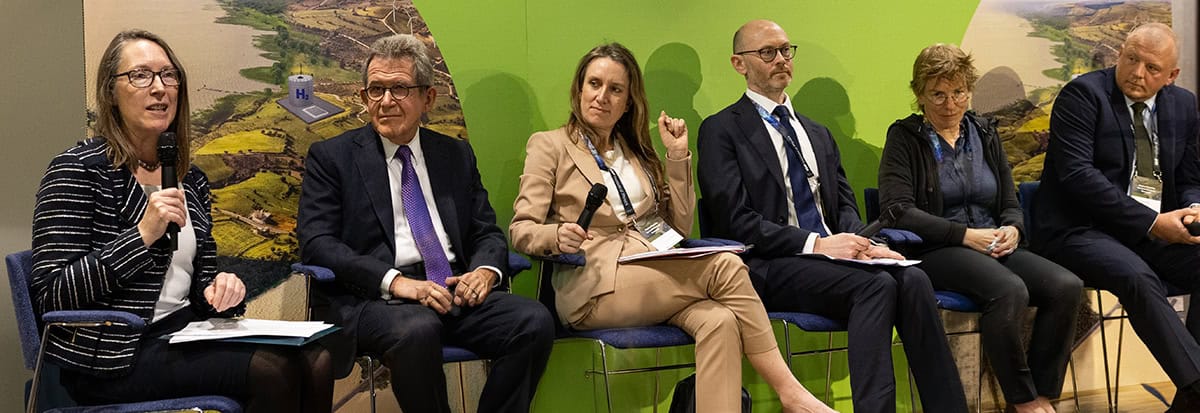
To discuss how physicists are supporting the green economy – and what more they can do – a panel debate was recently held at the IOP in central London. Attended by Prince Edward, the Duke of Edinburgh, as well as about 100 business leaders, policy chiefs, senior physicists, and IOP and IOP Publishing staff, it was chaired by Tara Shears, the IOP’s vice-president for science and innovation.
The panel featured ex-BP boss John Browne, who now works in green energy, Emily Nurse from the UK’s Climate Change Committee, former Sizewell C energy-strategy director David Cole, solar-cell physicist Jenny Nelson from Imperial College, and Nellie Technologies founder Stephen Milburn. The following is an edited extract of the discussion.
Physicists for a greener future
Green game-changers Tara Shears (far left) chairing the panel debate at the Institute of Physics in London on how physics can support the green economy. It featured (from left to right) John Browne, Emily Nurse, David Cole, Jenny Nelson and Stephen Milburn. (Courtesy: Carmen Valino)
John Browne is chair of BeyondNetZero, a climate-growth equity venture firm. He was group chief executive of energy giant BP from 1995–2007, having joined the firm in 1966 after studying natural sciences.
Emily Nurse, who was originally an experimental particle physicist, is the director of net zero at the UK’s Climate Change Committee, which advises the UK government on reducing emissions and adapting to the impacts of climate change.
David Cole, an engineer by training, was at the time of the discussion director of energy strategy at the Sizewell C nuclear-power plant, which is being built in Suffolk in the UK. When complete, it is expected to meet up to 7% of the UK’s total electricity demand. He is now executive president, consulting, at energy firm Wood.
Stephen Milburn is a physicist who is founder and chief executive of the firm Nellie Technologies in South Wales. It removes carbon dioxide form the atmosphere using biomass, which can then be used as animal feed or construction material.
What role are physicists currently playing in our quest for a greener economy?
John Browne: I made a wonderful decision 60 years ago, when I was 18, which was to read physics. After graduating, I became an engineer, but over the last 30 years physics has come back in to my life as I’ve found myself doing something very important – trying to get to net zero. Physics, you see, touches absolutely everything.
All that I’ve ever done – whether it’s renewable energy or “old energy” [fossil fuels] in my old life – starts with physics. Whether you’re involved in chemistry, biology, electronics or engineering, it could not exist without a much deeper understanding of physics. We have to make sure everybody knows that – but I don’t think people currently do. They tend to think engineering is the only enabler for commercialization, but physics is there.
Emily Nurse: I started out as a particle physicist working at CERN on the Large Hadron Collider but for the last four years, I’ve been involved in climate policy and now work with the UK’s Climate Change Committee. We are the UK government’s official advisers on its climate targets – and assessing progress towards meeting those targets. As we celebrate global decarbonization to date, we need to remember it’s all underpinned by physics.
Take the rise of solar power for example, which has been the fastest growing source of global electricity generation for the last 20 years in a row. Solar installations in 2024 were double those in 2022. Along with wind, solar has led to a reduction in electricity from fossil fuels. We’re seeing the costs of solar plummeting and they just keep falling further.
In the UK, solar power has been growing more slowly, but it’s starting to pick up and is going to be a really important part of the electricity mix. We’ve also got a lot of wind here in the UK – it’s a very windy island after all. I would also like to give a shout out to heat pumps: as a physicist, how can you not love their efficiency?
David Cole: I am an engineer, not a physicist, but I’ve spent my career in lots of different sectors and been fascinated with the role that energy plays in creating a better society. What’s really interesting at Sizewell C is the ownership structure, which involves both state and private investment. It’s the first time private investment has been used for a new nuclear build in the UK.
I hope it leads to a virtuous circle, in which the more plants we build, the more we can reap from that investment
David Cole
Getting this hybrid financial structure over the line was not trivial – it took a lot of effort – but I think it will drive great performance. We’re also trying to use as much UK content in the plants as possible, whether that’s materials, skills or technology. I hope it leads to a virtuous circle, in which the more plants we build, the more we can reap from that investment. Sizewell C will, in other words, bring down energy costs, which is fundamental to economic growth.
Jenny Nelson: I have been active in research into solar photovoltaic (PV) materials and devices for over 30 years and we should celebrate how much has happened in the field during that time. In the last 10 years, we have seen capacity increase globally by more than a factor of 10, we’ve seen the efficiency of solar cells increase, and we’ve seen the cost come down almost by a factor of eight, all of which is remarkable.
Those innovations are firmly rooted in physics – whether it’s changes in device structure… or of the optical properties of materials
Jenny Nelson
The cheapest form of electricity globally, in other words, is now from solar PV, which was not the case 30 years ago. These developments have come partly from economies of scale and partly from technological innovations that have now fed through into production. Those innovations are firmly rooted in physics – whether it’s changes in device structure due to our understanding of semiconductor physics or new developments in the optical properties of materials.
The next generation of PV cells, which are likely to be silicon-based tandem devices, will also depend on scientific breakthroughs and innovations.
Stephen Milburn: I’m chief executive of Nellie Technologies, which is based in South Wales on the site of a former chemical-weapons storage facility. We’re using biomass waste for removing atmospheric carbon dioxide, and if you visit us, you’ll see all kinds of activity: in one corner there’s chemistry, in another engineering and in the next there’s biology and biochemistry. But physics is at the heart of the technology. Physicists are a bit arrogant when we say we think we can do everything, but the fact is we probably can.
But we should also celebrate the work that has gone on to create a market in which carbon-emission credits can be bought and sold. Trading carbon credits has been a bit of a dark activity over the last 10 years, with double counting and bad things happening purely by firms wishing to make a profit. However, the market does have the power to regulate itself – in fact the alignment we’re starting to see between the UK and the EU will help greatly.
Challenging times Technologies to store, generate or transmit energy are rooted in physics. (Courtesy: iStock/Galeanu Mihai)
What are the biggest growth opportunities for the green-economy sector?
John Browne: First, we can do much more with what we’ve already got – for example we could increase our offshore wind or rethink whether we should go back into onshore wind. Second, we can improve what we’re doing – for instance, by increasing the efficiency of solar panels to their theoretical maximum, which would make rooftop solar economically attractive. Third, there are new opportunities, such as metallic organic frameworks and nuclear fusion.
What we do here in the UK needs to move the needle globally, which means thinking about how to scale and finance it properly
John Browne
However, the UK needs to avoid doing things that others are doing much better. The race for the best battery in the world is, for example, probably going to be won elsewhere. What we do here in the UK needs to move the needle globally, which means thinking about how to scale and finance it properly. The UK shouldn’t end up as a secondary player.
Emily Nurse: The UK has made a lot of progress in our quest to reach net zero by 2050. Since 1990, for example, we’ve halved our carbon emissions, mainly by decarbonizing electricity – phasing out coal, reducing gas generation, while significantly increasing wind, solar and other renewables. Electricity generation now accounts for only around 7% of UK emissions, which are dominated by transport (cars and vans) and heating (oil and gas boilers).
Reducing emissions still further will predominantly come from moving to electric technologies, including electric vehicles and heat pumps, and by further decarbonizing the electricity supply. There will be a backbone of wind and solar, but to ensure a secure supply, we’ll need nuclear, carbon capture and storage, hydrogen and batteries. We’ll have to reduce emissions from agriculture and land use too.
A report from the Confederation of British Industry (CBI) last year estimated that the net-zero economy grew by 10% in 2024, which is three times faster than the rest of the UK. But we’ll need more innovations to continue to bring costs down – and we’ll also need to provide incentives to boost the take-up of electric technologies. If we do that, there’ll be an overall saving to the UK economy in about 15 years’ time, our analysis suggests. There are huge opportunities for green growth to come from this investment.
David Cole: I agree that for the UK to be competitive, the cost of energy has to come down – not just for domestic customers but businesses too. In fact, there are two main opportunities First, we have to adopt a “whole-systems” approach. If we’re building a power station, for example, can we use every bit to its maximum potential?
Let’s say I’m running a direct air-capture plant operating at 25–30 ºC – can I use the waste flow from my coolant system to encourage new industries? Can it support nearby hydrogen generation plants or companies making, say, synthetic aviation fuel? Those questions involve thinking about physics and engineering as well as materials science, which is also super important.
Whichever way you look at it, we’re talking about building a lot of hardware, which involves materials. How much energy per unit mass are they using? Can we recycle those materials? What can we do with the waste products? Ultimately, what is really important is energy security: where does your energy come from, who made it and what impact does it have on the environment?
Jenny Nelson: The net-zero economy is growing significantly faster than the rest of the economy and I think that will continue. But decarbonizing the power sector only addresses part of the problem and we’re going to see a big transition across the rest of industry, agriculture and elsewhere that will generate a wide range of opportunities and stimulate the economy too. I’m not just talking about rolling out more renewables, but about integration – bringing together the generation and storage of energy, ensuring that we are managing demands and have the right infrastructure.
As for my area of photovoltaics, we’ve seen great ideas and technologies come out of the UK that are very likely going to be developed outside the UK because the manufacturing capacity isn’t here. Nevertheless, those ideas and innovations can still benefit the country through licensing, partial manufacturing and new technology.
One thing to remember about solar power is it’s distributed. You can have solar generation without being connected to the grid. That not only opens some markets for certain applications where you want to generate electricity locally, but it also provides a route to energy security through back-up generation, towards which solar power will be an important part.
Stephen Milburn: Having a strong green-technology manufacturing base is a huge opportunity for the UK. My company is based in South Wales, where we have lots of highly skilled people who used to work in traditional industries but now don’t have many places to go. Yes, there’s a fantastic semiconductor industry here, but when it comes to deploying green technology we cannot outsource that responsibility to other parts of the world.
Green tech needs to be deployed in the UK’s industrial heartlands… if we don’t nurture jobs and skills here there’s a real risk they will be gone forever
Stephen Milburn
Green tech needs to be deployed in the UK’s industrial heartlands to take advantage of the skills we already have, but which we are at risk of losing. In fact, if we don’t nurture those jobs and skills here there’s a real risk they will be gone forever. Having a strong green-technology manufacturing base is a huge opportunity for the UK.
Deep thinkers Combining analytical minds with great problem-solving skills, physicists are well placed to tackle the challenges of climate change. (Courtesy: iStock/MTStock Studio)
What needs to happen so that these opportunities can be put into practice?
Stephen Milburn: Many science graduates leave university equipped with solid academic rigour and a great scientific understanding, but they often lack practical green-technology skills. This summer my company is therefore hoping to launch a climate apprenticeship programme, which will allow graduates to pick up those skills. We need to build green-tech skills in the real economy, in particular those that will deal with climate change.
Jenny Nelson: The UK must do more to support its own innovations. We need better regulations to avoid unnecessary bottlenecks. We need to invest in infrastructure like the grid. We should completely avoid subsidizing fossil fuels and instead divert any subsidies into alternative economies. Finally, we need to train and educate people, showing the public the potential of green technology so that they become part of the transition, for example by generating their own electricity.
David Cole: We need to integrate our policies on industry, energy, land use and AI so that we can invest in them all as growth areas. In particular, I’d like to see a long-term nuclear programme in which we build a fleet of new reactors all of the same design, which will drive down costs by letting us replicate a particular technology. It’s also vital that we get a high proportion of UK content and technology into these reactors, which will lead to a virtuous circle, with money coming back into the economy that we can re-invest in industrial and academic partnerships.
Emily Nurse: What’s vital is consistency in policies; we need certainty. In the UK, we are fortunate to have world-leading climate legislation in the form of the 2008 Climate Change Act, which does not just make it a legal requirement to reach net zero by 2050 but also gives us targets along the way. It means we know what we need to do in both the medium- and long-term, which gives certainty to investors, businesses, innovators and consumers.
What’s really important is communication – supporting communities through the transition and making sure they realize the benefits
Emily Nurse
So the first thing we need to do is keep the Climate Change Act. Then, of course, we’ve got to address barriers to delivery, including having the right incentives to electrify the economy. And what’s really important is communication – supporting communities through the transition and making sure they realize the benefits, not just in terms of reducing carbon production but of having cleaner, better and more efficient technologies too.
John Browne: First, we must never stop investing in people who can discover things and translate them into real commercial products. Second, we need to understand how to scale things, which means focusing on the winners and getting rid of things that are “nice to have” but aren’t going anywhere. That’s not easy because you have to push people to say, “You’ve done great work, but you’ll have to stop”.
What’s more, to scale new technology, people have to learn what it takes. When I’m in the US, I often speak to chief executives who can explain their technology to the financier who’s supporting it, whereas here in the UK that often doesn’t happen.
Third, we need to maintain confidence in what we’re doing. I often talk to people who think that it’ll be really expensive to get to net zero, but in fact estimates suggest that each household would only have to spend an average of about £150 a year to get there. So it’ll be less than the cost of a TV licence to get to net zero.
Of course the investment needed will be “lumpy” – it’s not as simple as just levying a fee – but the point about governments is that they can smooth things out. That is what they have done in the past and it’s what they should continue to do.
For more information about the IOP’s work on the green economy, click here. You can also keep up to date with the all latest research in the field through IOP Publishing’s series of open-access Environmental Research Journals at this link.

 Login
Login