Quantum technologies are undoubtedly going to have a large impact on our world, potentially revolutionizing everything from healthcare and the environment, boosting the economy and helping with large-scale optimization challenges. But for them to deliver on these many promises, it will be vital for many countries to train and build a quantum-ready workforce.
There are four pillars to the quantum sector – quantum computing; quantum simulation; quantum communication; and quantum sensing and metrology. But in each case there is a lack of trained individuals who can take on jobs across the board. Indeed, statistics in both the UK and the US suggest there is only one qualified worker for every three quantum jobs. With governments continuing to invest lots of money into national quantum programmes; a growing number of new quantum start-ups being launched; and ever more multi-national firms zoning in on quantum, the shortage of those with the right skills to work across the sector is expanding.
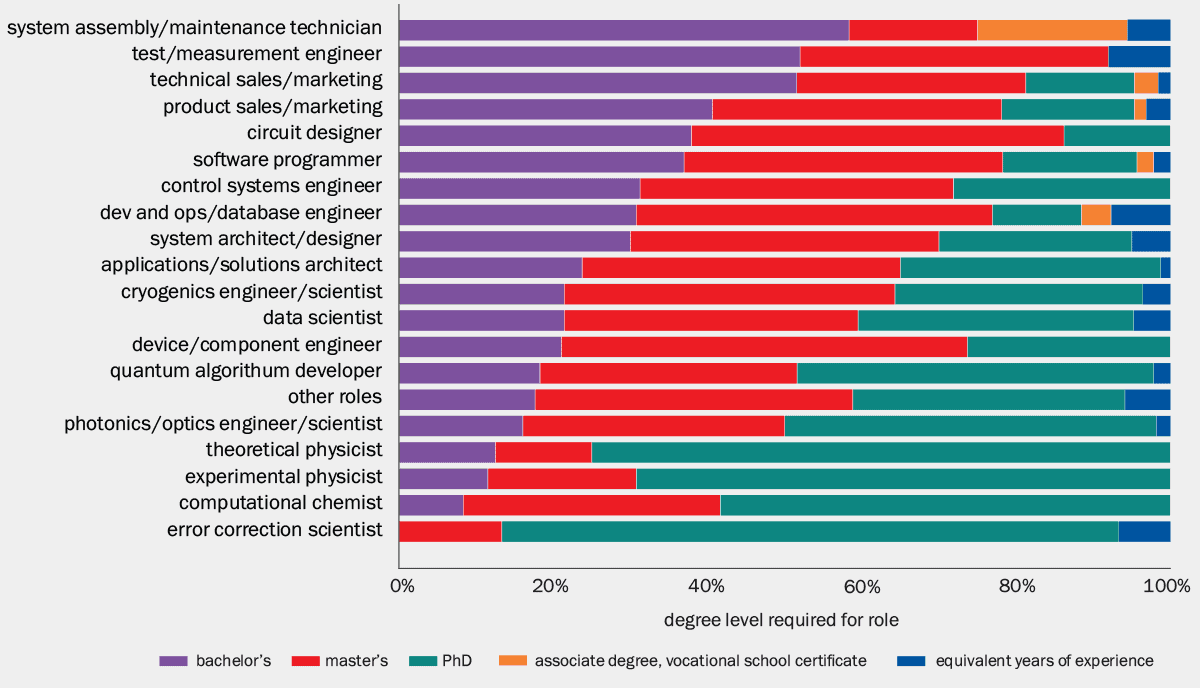
The Colorado School of Mines in the US is now trying to remedy this situation by launching the country’s first bachelor-level quantum systems engineering degree programme, due to start this autumn. An undergraduate degree specializing in quantum and systems engineering might, at first glance, seem odd. But 2021–2023 data from the Chicago Quantum Exchange show that 55% of quantum tech jobs only require a BSc or two-year associate degree. For instance, roles that ask for just a BSc include systems assembly and maintenance, measurement engineers, technical sales and marketing.
“Industry demand especially values engineers with a systems-level understanding of quantum devices, and there is also a need for quantum technicians who can build and maintain quantum hardware,” says Frédéric Sarazin, director of the quantum programme at Colorado School of Mines. As the first standalone bachelor’s degree in quantum systems engineering in the US, the programme is designed specifically to supply industry-ready graduates.
True requirements Distribution of degrees needed for different job roles in the quantum industry. (CC BY 4.0 IEEE Transactions on Education65 592)
The main focus for Sarazin and colleagues was to bring into the programme key aspects of systems engineering – which involves understanding and overseeing all aspects of a complex system, from its inception through to practical production, and even managing the final product. The goal: to help companies get their products and technologies out of the lab and into the marketplace. Rather than focusing on isolated components, systems engineers are trained to understand how complex technologies behave as integrated entities.
“A quantum computer, for example, is more than just its qubits,” says Sarazin. “It’s cryogenics, optics, electronics, control software, signal processing and the user interface, all interacting with each other.” Companies are keen to hire people who can understand and help develop their quantum product as an end-to-end system, bridging the gap between the physics and engineering aspects, as well as making sure the end product is robust, scalable and manufacturable.
The physics may be what Sarazin calls the “secret sauce” – but turning it into a device that is reliable, manufacturable and maintainable is an engineering problem “with a quantum flavour to it”. “What companies want is people who understand the product as a system, from beginning to end,” Sarazin explains.
Quantum hotspot
Colorado, in America’s mid-west, is a quantum innovation hotspot, with quantum companies employing more than 3000 people across the state. To develop the new programme, Sarazin and colleagues carried out an extensive consultation process with companies, institutions and organizations that all look to hire quantum engineers, to get a clear idea of the skills that students should have at the end of their course. They also collaborated with Elevate Quantum – a consortium of 120 organizations advancing quantum workforce development and commercialization in Colorado, New Mexico and Wyoming – to design an interdisciplinary course that will integrate physics, electrical and mechanical engineering, computer science and engineering design.
While the students will learn plenty of foundational quantum physics, they won’t cover the full curriculum of a traditional physics degree. “You’d be talking about a six-year degree if we covered everything,” says Sarazin. Certain advanced topics, such as quantum error correction, remain overwhelmingly in the domain of PhD-level jobs and so are deliberately excluded.
The lab is meant to be a signature experience. It’s where students start interacting with industry in a meaningful way
A key feature of this degree will be hands-on practical engineering experience in the lab. Plans are under way to build a dedicated quantum device laboratory for the students, allowing companies to bring in their tech and partner with the on-campus facilities. “The lab is meant to be a signature experience,” says Sarazin. “It’s where students start interacting with industry in a meaningful way.”
That connection is reinforced through internships and a year-long design project in the final year, with project topics supplied directly by quantum companies. “The junior-to-senior year is when internships really matter,” explains Sarazin. “That’s often what leads directly to a job.”
Future prospects
Although the programme is firmly industry-focused and aims to get graduates straight into the job market, students can progress to the Colorado School of Mines’ existing master’s programme in quantum engineering, launched in 2020. “At the bachelor’s level, you’re building breadth,” says Sarazin. “If students want to specialize further, they absolutely can.”
Many of the skills that the students will develop – from electronics and embedded systems to control software and algorithms – are highly transferable too. “Looking beyond the quantum sector, our systems engineering students will have acquired a set of skills that is highly applicable in other industries,” says Sarazin.
The first cohort will likely be around 15–20 students this year. Looking ahead, Sarazin has a clear benchmark for success: “a near-100% placement in industry at the end of the degree – that’s what we’re aiming for”.
Beyond that, success will mean continuously refining the programme in response to industry feedback. “This isn’t static,” Sarazin says. “If companies tell us something needs adjusting, we want to respond.” For students still hesitant to take the leap into a specialized BSc or the quantum sector, Sarazin’s message is clear: quantum careers are here to stay and the direct path into the industry is starting earlier than ever before.
It might not seem obvious at first glance, but physics and finance have much in common – especially at the frontiers of quantitative analysis. Both fields use mathematics, data and computational models to tackle complex systems. Physicists are trained to build models that test hypotheses, all while embracing the idea of inherent uncertainty and a rapidly changing environment.
Financial markets are much the same, as they constantly change and evolve as data flows in, feedback loops are formed, and fast-paced decisions are made. As a physicist, there is a natural overlap between the skills that finance firms are looking for, and your academic training and abilities.
The idea of using physics to make sense of financial markets is not even that new. It has been around for over a century, with one of the earliest examples being attributed to French mathematician Louis Bachelie developing his “Theory of Speculation” in 1900, which used the concept of a random walk to analyse fluctuations in the Paris stock exchange.
Modern quantitative finance covers a wide range of subjects, all of which involve using mathematical and statistical methods. Most physicists can therefore adapt to working in this sector, provided they have some additional training. Traditionally, “quants” – quantitative analysts working across investment, markets, research and risk – get involved in option pricing and risk, requiring stochastic calculus, Monte Carlo techniques, and solving partial differential equations. Today’s quant roles more commonly involve supporting algorithmic or systematic trading; using data analytics, machine learning, and statistical and optimization methods.
Almost every one of these roles does require coding skills, especially when implementing models and algorithms in specific areas. Furthermore, the use of generative artificial intelligence (GenAI) to drive or enhance software development is now becoming standard. Physicists in the finance sector may also end up working as software developers, traders, risk managers and investment bankers.
To get a better idea of what it means to make this move from physics to finance, Physics World caught up with five professionals who went from the lab to the trading floor – some recently, some many decades ago. Antonia Lim, Ashreya Jayaram, Han Lee, Benjamin McRoberts and Sean Chang reflect on how their careers evolved, and explain the skills they carried over from physics. They also look back on the trade-offs they encountered along the way and offer advice to today’s graduates seeking to carve out their own careers in the sector.
Antonia Lim
(Courtesy: Impact Cubed)
Antonia Lim is chief investment officer (CIO) at global investment advisory firm Impact Cubed, which she joined in 2024. With 25 years of experience transforming investments and businesses, Lim began her career at Kleinwort Benson and Dresdner Bank (now Commerzbank), before going on to become global head of quantitative research at Barclays and then head of quantamental investments at Schroders. Lim holds an MPhys (masters of physics), specializing in theoretical and quantum physics, from the University of Oxford, UK. She is also independent chair of Weatherbys Private Bank’s investment committee and board advisor, and a member of theCFA Research and Policy Centre’s technical committee.
I loved the four years I spent at Oxford, as well as the sheer intellectual breadth of physics: it trained me to move between abstract ideas, mathematical models and real-world questions, which is something that has stayed with me throughout my career. To me, physics is a wonderful mix of understanding how things really work, puzzles, maths and creativity.
The move into finance was not part of a grand plan. With hindsight, it started with my MPhys research project within a very popular part of the condensed-matter department, affectionately known at the time as the “Chaos Lab”, which was essentially the financial modelling department in physics. I was interested in the modelling and coding, and my dissertation focused on option-hedging strategies [techniques used to reduce investment risk] with transaction costs.
It was my first real exposure to the idea that methods rooted in physics could also be used within markets and decision-making under uncertainty. What appealed to me most was the modelling itself: taking a messy real-world problem, making sensible assumptions, and then testing how well the model works. After graduating, I ultimately chose to join a private bank because I thought it would be interesting and fun, though I was very close to accepting a role in defence engineering.
I’m now CIO at Impact Cubed, where we develop customized indices, analytics, tools and data capabilities with a strong sustainability focus. Although I do not use the specific content of my physics degree day to day, I use the methods and habits constantly: mathematical reasoning, structured problem-solving, comfort with complexity, and the discipline to test whether an answer is plausible before trusting it.
Physics also taught me to properly define a problem before trying to solve it. That sounds simple, but in finance it is incredibly important, whether you are building an index, designing an investment process, or challenging a model that is elegant mathematically but too far removed from the real world.
On the softer-skills side, physics gave me confidence in tackling unfamiliar problems and explaining technical ideas clearly. Over the years I have worked with people from many different disciplines, and one of the most valuable skills has been translating between technical precision and practical decision-making.
Finance can be intellectually stimulating because the problems are constantly evolving, and impact society at large. I’ve held the very serious responsibility of investing the livelihoods of millions of people. Within the quant sphere, there is a really strong community of people who enjoy models, evidence and rigorous thinking, so in that sense it can feel very familiar to physicists. Indeed, when I joined the London Quant Group decades ago, it felt like home straight away.
The pointy end of finance is shaped by market cycles and commercial pressure, which creates a degree of individual uncertainty that some can find draining. But if you enjoy solving practical problems and working at the intersection of theory, data and human behaviour it is an exciting place to build a career.
My advice to graduates looking to join finance today would be to not worry too much about making a perfectly linear plan. Physics gives you a very transferable toolkit, and there are already many physicists in finance, particularly in quantitative roles, so it is a move that can feel surprisingly natural.
Han Lee
(Courtesy: Han Lee)
Han Lee is co-founder of RLXPartners, a technology-startup venture consulting and investment firm. He has a PhD in theoretical physics from the University of Cambridge, UK, where he worked on quantum many-body problems in condensed matter. Lee has previously had numerous leadership roles in finance, most recently as global head of quantitative strategies and automated trading for the fixed income division at Morgan Stanley. Before that he was global head of quantitative analytics at RBS.
When I started in the financial sector in the early 1990s, quantitative and mathematical finance was still a relatively new field, albeit one that was rapidly growing. It coincided with a major expansion of the financial markets, in particular the increasing complexity in financial derivatives. These changes provided many opportunities and challenges, which sounded interesting to me.
At the same time, the industry was actively seeking to find quantitative analysts with physics, maths or engineering backgrounds, which made the decision for me to move into finance straightforward. The sector still looks to hire physicists and those with a scientific background, but it has become much more competitive.
When it comes to skills from my physics background, both problem solving and scientific intuition are very transferable. Having the ability to harness familiar mathematical methods or programming techniques – or quickly learning new ones – to solve problems is a core component of the work. Physics also teaches a powerful combination of rigour when required, and an understanding of how and when to use approximations and estimations. Critical soft skills include communication and teamwork.
The pros and cons of a career in finance are straightforward. People are usually aware of very high starting salaries, especially in banking and hedge funds, as compared to staying in academia. Less well-known is how quickly this can increase once you progress and gain experience.
It can also be a very exciting and stimulating work environment, and can be very rewarding to see your work leading directly to results that have immediate impact. Potential challenges or downsides are that there is a relatively intense and competitive working culture, which can bring stress and some uncertainty; which won’t suit everyone.
Furthermore, not all physics graduates and postgrads might want to move to a completely different field. Although finance can have interesting and complex problems to work on, the focus is quite different from working in academia. The latter would allow for a much higher degree of intellectual freedom, and some would consider this not only intrinsically valuable but also capable of having a significant and wider positive impact.
Ashreya Jayaram
(Courtesy: MRM Photos)
Ashreya Jayaram is a quantitative strategist in the corporate and private bank division of Deutsche Bank. She did her PhD in physics at the Johannes Gutenberg University of Mainz, Germany, focusing on the theory of biologically-inspired nonequilibrium systems. After a postdoc at the University of Stuttgart, Jayaram moved to a career in quantitative finance at Wells Fargo, before taking on her current role at Deutsche Bank.
My decision to move from physics to finance came when I realized I was not suited to an academic career and instead I began looking out for options in industry. I was looking into avenues where I could continue to build useful models that capture real-world observations, which was a part of my academic career that I most enjoyed. This led me to quantitative finance.
To understand if quantitative finance was my cup of tea, I used online resources to educate myself about financial markets and the kind of models practitioners use to describe them – and here I am today. A key skill that I developed during my physics degree that is applicable in my job now is the ability to break down complex problems into simpler and more tractable forms. It’s also important to identify the vital elements that drive the behaviour of observables of interest (for example, profits) – a skill that is systematically developed in theoretical physics.
Another useful skill is the ability to manage multiple projects simultaneously with different collaborators. I also have to communicate effectively with diverse audiences of varying backgrounds, which is an ability I developed during the course of my PhD and I believe helps me in my current role.
What excites me most about my job today is the dynamic and unpredictable nature of financial markets. Their far-reaching impact on everyday life creates a high-energy work environment, which I find both engaging and enjoyable.
If you’re looking to move into the field, my advice would be to find out more about the different roles in the financial world and the diverse range of skills they demand. For physicists with no exposure to finance, it would beneficial to read about what you might enjoy working on, and look into some self-formulated projects and internships to see if it does align with your interests.
Benjamin McRoberts
(Courtesy: Benjamin McRoberts)
Benjamin McRoberts is head of European power engineering at Citadel. He spent the last decade working at Goldman Sachs, most recently as the head of EMEA Commodities Strats. McRoberts studied mathematics and physics the University of Bristol in the UK. He also completed an MSc in financial mathematics at the University of Warwick.
During my BSc at Bristol, I realized pretty early on that I preferred the theoretical side over the practical, and I switched to the joint honours MSci mathematics and physics course after my first year. This allowed me to replace some of the experimental physics courses with more of a mathematical physics focus so I could study concepts such as applied partial differential equations, fluid dynamics and quantum information theory.
My final year master’s dissertation focused on the “weak measurement” quantum mechanical phenomenon, and while I explored the idea of doing a PhD after my master’s, I ultimately fancied a change of scenery. I also found the open-ended nature of pursuing further academic research a little bit daunting, and I wasn’t ready to commit another four years or so to something I wasn’t totally sure about.
I had a sense that finance might provide some interesting quantitative problems that I could use my educational background for, and I was likely influenced by a careers fair hosted by my university. I did consider a few other avenues such as technology consulting and teaching, but ultimately the large annual graduate intake for investment banking in London appeared to provide the most opportunity.
After applying for a series of summer internship programmes at the end of my third year, I secured an offer from the Australian investment bank Macquarie. That summer I worked within their infrastructure funds business, which raised investment capital from large asset managers and pension funds, investing it in infrastructure projects across Europe, such as airports, toll-roads and utilities. That internship led to a full-time graduate offer that I gladly accepted, kicking off my graduate career in finance.
I worked at Macquarie for a year but decided to build my skills with a master’s in financial mathematics at Warwick. While I was contemplating if this was the right path for me, I read a book by particle-physicist turned quant Emanuel Derman, titled My Life as a Quant: Reflections on Physics and Finance. It really captivated me and I still highly recommend it, especially for those with a physics background considering a career in finance.
During that degree, I built on some of the basics of probability and statistics I’d learned on my undergraduate course, to cover new topics like stochastic calculus and derivatives pricing. I also got more of a taste of computer programming, through a module focused on C++ which I really enjoyed. I quickly realized that I had made a good career choice by going back to university.
After leaving Warwick, I spent two years as a quantitative analyst at a commodities trading firm before joining Goldman Sachs in their “commodity strategies” group in London. Over the last decade I’ve worked across their commodities complex – from precious and base metals to power and gas, and oil products – covering derivatives pricing/modelling, trading tools and analytics, as well as automated trading.
Last year, I had the opportunity to join the US-based multinational hedge-fund and financial services company Citadel. I was extremely impressed by the calibre of people I met during the interview process, and similarly since joining the company. This, together with the firm’s reputation for its rigorous and sophisticated investment approach, gave me the confidence that it was the right move for me.
Since finishing my master’s, I’ve consistently made use of my technical educational background. Sometimes that’s been explicitly – using skills from linear algebra, calculus and differential equations – but sometimes indirectly from generally learning to be better at abstract problem solving and not giving up when faced with a difficult intellectual challenge.
What I’ve loved the most about working in the commodities markets is having the ability to use sophisticated mathematical techniques to solve problems in the real world. On the flip side, it’s a demanding and fast-paced environment, which requires commitment and tenacity to succeed.
What has sustained me throughout is a real passion and enjoyment for what I do. You typically get to work with a group of talented and motivated individuals. There is a strong feeling of camaraderie and shared pride in your work, which is something I’ve always appreciated.
For physics graduates looking to get into the finance, remember that physicists typically make great quantitative finance professionals. I’ve worked with and hired many and they tend to do very well – partly thanks to their willingness to find creative and varying solutions to any problem. Your formal scientific training coupled with an appreciation for a whole swathe of real-world applications gives physicists a fantastic foundation for such a career.
Sean Chang
Sean Chang is a quantitative researcher at Citadel Securities. Chang completed a PhD in condensed-matter physics at the University of British Columbia, Canada before moving into the financial sector.
My PhD focused on low-dimensional condensed-matter theory, and while I enjoyed the research, my advisor was not very supportive, and I decided not to take on a postdoc. While I was struggling to find what to do after I graduated, I met someone from my department who had graduated the year before.
He introduced me to the idea of being a quantitative analyst, as the role mostly involved solving partial differential equations. He recommended some books I could read on the topic and then offered me a job at a local financial software company FINCAD (now Numerix) as a quant. After a few years at the company, I spent the next decade or so at Citibank and later at Bank of America Merrill Lynch. Six years ago, I joined my current company, Citadel Securities in the UK.
The whole quant industry changed profoundly after the 2008 financial crisis. Before the crisis, it was mainly about how to price a complicated financial contract using fancy models. But now the industry has moved towards algorithmic electronic trading on simple vanilla products. So at the beginning of my career, there was a lot of focus on pricing theory. Now it’s more data analysis and how we can improve algorithms.
I don’t use any technical skills from my physics degree in my day-to-day job (although maybe one day we will find some practical quantum field theory application to finance). Most of my work instead involves software engineering, which I didn’t learn much about during my physics degree. But the skills that are much more useful and transferable revolve around scientific thinking and the ability to tackle a hard problem.
Many people think that a job in finance is stressful and that we have a bad work/life balance. I personally feel it’s a lot less stressful and much better balance for me personally – in fact, I realized soon after my first job that most of us don’t work during the weekend, which was great.
If you’re considering a career as a quant, I would recommend doing your research to find out more about the whole sector in general and see if it aligns with your abilities and your needs. And never stop learning!

 Login
Login