Data are at the core of science, but traditional journal articles normally deliver a distillation of the raw data gathered by the authors. While the movement towards open access to data is widely supported by researchers and funding agencies, a 2024 study by IOP Publishing revealed that many scientists still encounter a wide range of practical, ethical and technical barriers when it comes to sharing their data.
As a result, the publisher has launched a free online course that aims to give early-career researchers the practical skills and confidence they need to share and manage research data effectively.
To talk about the course and IOP Publishing’s open data policy I am joined by Laura Feetham-Walker, who is head of publishing strategy and performance at IOP Publishing.
IOP Publishing is a wholly owned subsidiary of the Institute of Physics and it publishes Physics World.
We’ve congregated outside the main physics lab at the University of Dschang in Cameroon when a shouting match ensues about the two red cards issued in last night’s football match. It’s as dark as night inside and the lecture on LAMMPS-GUI, a molecular dynamics modelling software, hasn’t started yet because it’s been raining. The power is out and the prof, who has access to the generator, has delayed his trip to work so as not to get wet.
These are typical scenes in central Africa, where learning is a challenge. There is no WiFi in the university so we have come armed with routers to get online. Students can’t use the university toilets due to lack of running water and researcher professors have to provide their own batteries for the much-needed generators that run the projectors and overhead lights.
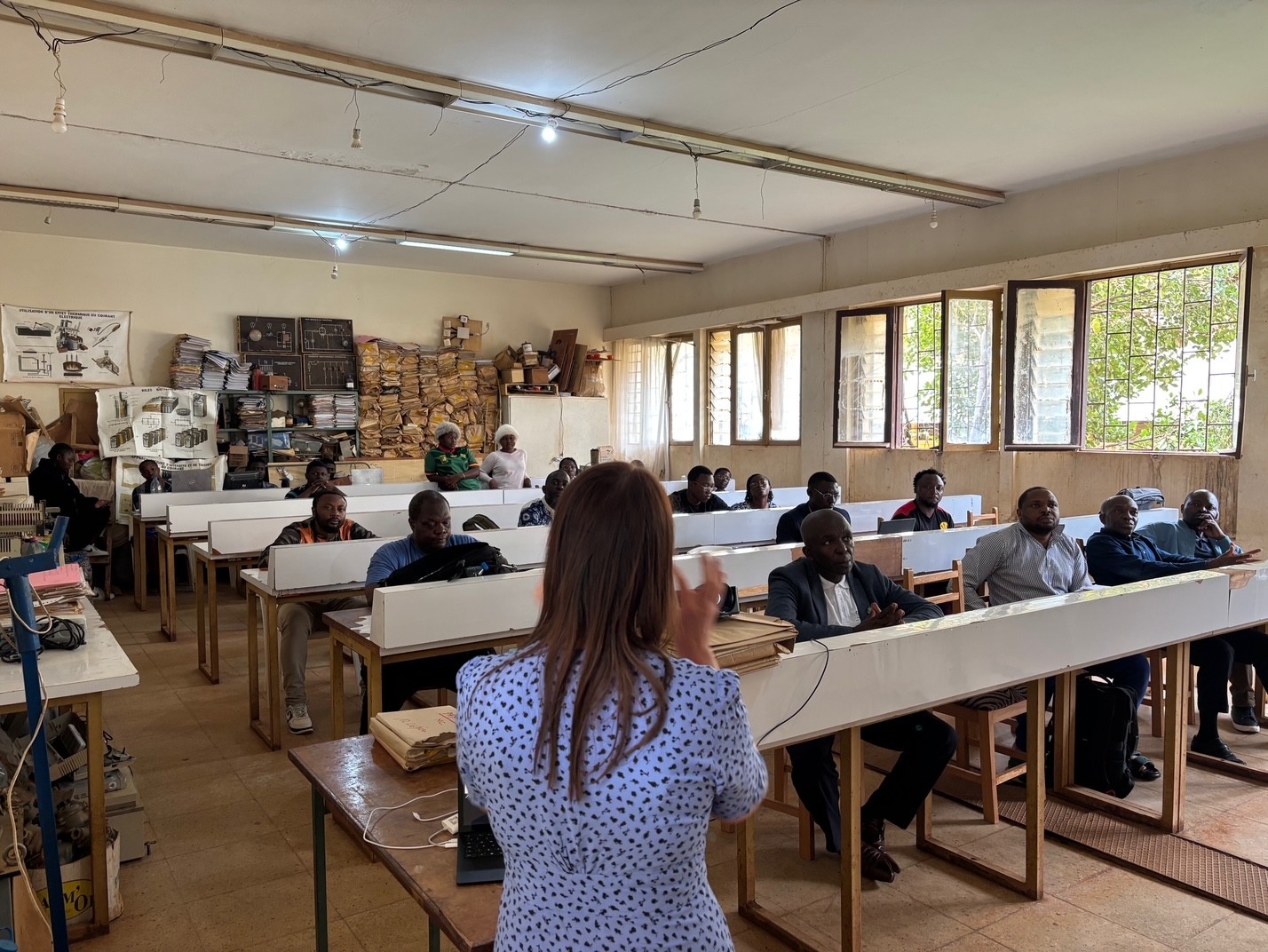
Victoria Merriman outlines the principles of publishing. (Courtesy: Stephane Kenmoe)
I’m here to attend the seventhCentral African School on Electronic Structure Methods and Applications, which is being held alongside one of 23 satellite events to the Global Physics Summit (GPS) in Denver, Colorado, US. Organized by the American Physical Society (APS), the GPS is the world’s biggest physics conference, with 14,000 delegates, but not everyone has the time, money or visa paperwork to attend in person.
That’s why it’s great that the APS, along with AIP Publishing and IOP Publishing – which together form the Purpose-led Publishing (PLP) coalition – are hosting satellite events across Africa, Asia, the Middle East and South America to expand participation in this year’s GPS.
I’ve made the journey on behalf of the PLP to hold an editorial school at the university, teaching a variety of topics from artificial intelligence publishing policies to how to review academic papers. In my session with senior-career researchers at the university, I’m swamped with questions every time I pause to take a breath. They range from philosophical queries about funding access in the region, to funny misunderstandings, including when my pronunciation of “ORCID” misaligns with theirs.
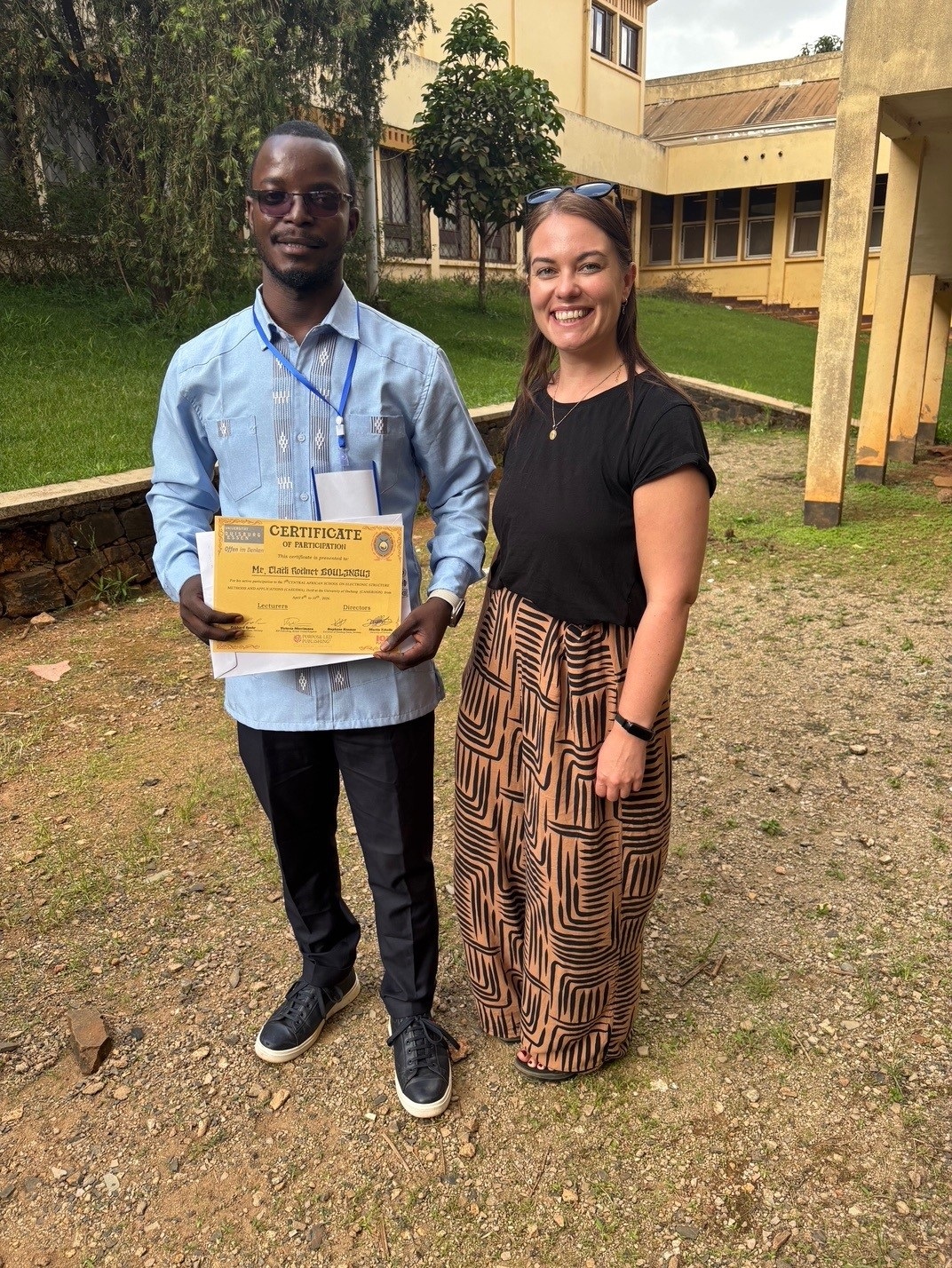
Victoria Merriman (right) with Cladi Rodnet Boulingui, who had spent three days travelling to Dschang by bus. (Courtesy: Victoria Merriman/IOP Publishing)
The University of Dschang is a highly regarded institution in central Africa, so for Boulingui, whose visit is sponsored by the Universität Duisburg-Essen in Germany, it’s been worth it.“Dynamic simulations are highly relevant to my work, it’s worth the journey to access the specialist lecturer,” he tells me.
The organizing director, Stephane Kenmoe, has joined from Germany, where he is an associate professor at the faculty of chemistry at Duisburg-Essen. He regularly visits his alma mater, and current students benefit from connections he’s made around the world. He brings his entrepreneurial spirit with him: Kenmoe is an active promoter of the APS satellites in Africa, has made award-winning films about science, and is a champion of community engagement.
This collegiate spirit extends to the heads of department who have been called upon to write PhD curricula for neighbouring Francophone countries where scientific funding is lacking.
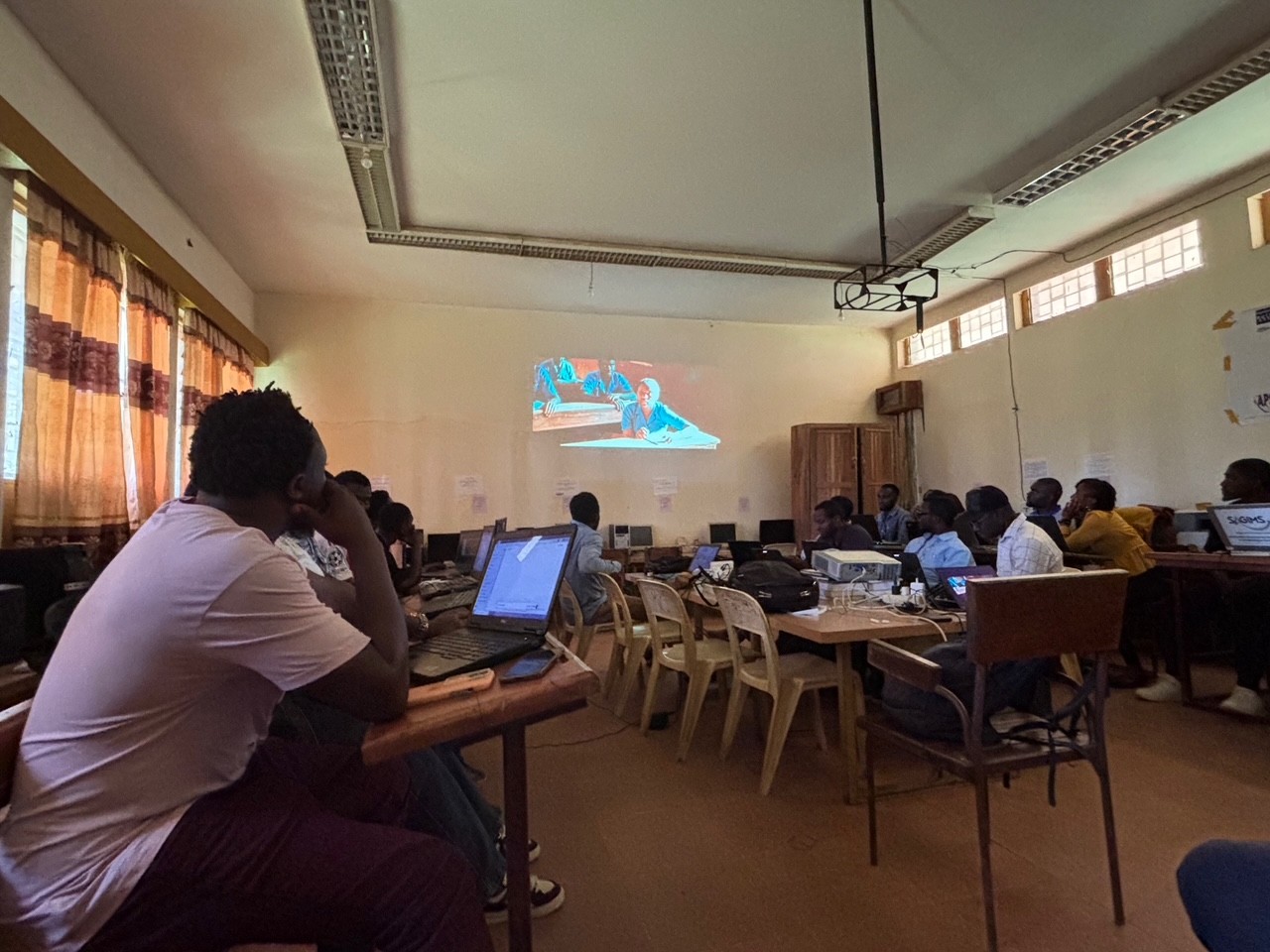
We end the week watching a film that Kenmoe has worked with the local film industry to produce, Seeds of Science. The film shines a light on the high percentage of child labour and child marriage in the region. The actress playing the young girl who is forced to marry instead of continue her studies has joined us from nearby Bafoussam to watch the showing.
Thankfully, Aisha is still studying, particularly enjoying economics, geography and English. There is a sombre mood in the room, only interrupted by laughter when the power fails. The power may be out but the joy and passion for learning continue to burn here in Dschang.
Participants watching the movie Seeds of Science. (Courtesy: Victoria Merriman/IOP Publishing)
Scientists in the US have unveiled a new machine-learning tool that, they claim, can identify disruptive scientific breakthroughs. They say their method, which assesses how much a paper reshapes its field, is better than other techniques at spotting such disruptions even if they are simultaneously discovered by independent research groups (Sci. Adv.12 eadx3420).
The work examined 55 million papers listed by Web of Science and the American Physical Society (APS) published between 1893 and 2019. The papers were mapped using a machine-learning technique known as neural embedding, with each publication represented by two vector points. The first vector characterizes the body of work the paper builds on while the second represents the research it inspires.
Papers that disrupt tend to cause future research to depart significantly from previous work in the field, making these “past” and “future” vectors diverge sharply. The greater the divergence, the higher the paper’s so-called Embedding Disruptiveness Measure (EDM) score.
The team, based at Indiana and Binghamton universities, tested their EDM technique against Nobel-prize-winning papers and milestone publications as selected by APS editors. The EDM identified these landmark contributions as being highly disruptive.
The researchers discovered that the EDM was more consistent at spotting such papers than similar metrics, such as the “disruption index”, which focuses more on a publication’s closest citations. While this makes it sensitive to individual citations, it can miss the bigger picture, the researchers found.
The team discovered that the 10 papers with the biggest difference between the EDM and the disruption index were all examples of “simultaneous disruption”. This is where multiple papers have independently reached the same conclusion, or scientists have published their work across publications. Citations that linked these simultaneous disruptive papers weakened their disruption index.
One notable example is the two 1974 papers announcing the discovery of the J/ψ meson. As both groups cited each other, the disruption index ranked these publications in the bottom 1% of disruptive papers while the EDM placed them both in the top 10%. A similar pattern was seen for the two 1964 papers – one by Peter Higgs and the other by François Englert and Robert Brout – on the Higgs mechanism.
The team claims that the EDM also provides a new way to detect simultaneous discoveries, finding that papers that report the same breakthrough tend to be cited in similar contexts by later work, meaning their “future” vectors cluster together.
“By having more accurate metrics, we can actually investigate where the disruption is happening in the map of science,” says data scientist Sadamori Kojaku from Binghamton University.
The researchers say their tool could help science funding and policy to drive transformative breakthroughs. “It can have significant implications for science policy and it’s also helpful for prioritizing funding,” adds Kojaku. “We now have the quantitative metrics to investigate at which stage of research the disruptive work occurs and matters most.”
More than 1600 researchers from 74 different countries have won “outstanding reviewer awards” from IOP Publishing, with researchers from China making up almost a third of awardees. The annual award recognises scientists who have delivered exceptional peer-review reports for IOP Publishing journals over the past year.
Reviewer feedback to authors plays a crucial role in the peer-review process, boosting the quality of published papers for the benefit of authors and the wider scientific community. Awards such as those from IOP Publishing are an attempt by publishers to raise the importance of courteous and constructive peer review.
This year’s recipients were selected from about 35,000 reviewers who submitted peer-review reports to IOP Publishing journals in 2025. Journal editors evaluated nominees based on the volume, timeliness and quality of their reviews.
A total of 1621 individuals have been honoured with a 2025 award. China makes up 30% of awardees followed by 16% from the US and just over 6% from India. Some 10% of this year’s award winners are also based in lower middle-income countries or territories.
“High quality peer review is essential to maintaining trust in science as it safeguards the quality and integrity of academic work,” notes Laura Feetham-Walker, IOP Publishing’s reviewer engagement manager. “I’d like to thank this year’s winners, whose thoughtful and rigorous reviews help advance scientific discovery and strengthen the communities we serve.”
The IOPP’s outstanding reviewer programme has been awarded annually since 2016. The IOPP also recently introduced a peer review excellence certification programme that provides free peer review training and certification. In 2025, more than 1500 reviewers took the initiative.
My guest in this episode of the Physics World Weekly podcast is Liz Martin, who is sustainability lead at IOP Publishing. We chat about how the scholarly publisher has reduced its carbon emissions by 36% when compared to a 2020 baseline – and the challenges and opportunities for achieving further reductions.
Martin talks about the importance of cooperation and partnerships – both internal and external – to achieving environmental goals. This includes engaging with both suppliers and employees on how to reduce carbon emissions.
IOP Publishing is a wholly owned subsidiary of the Institute of Physics, which is the professional body and learned society for physics in the UK and Ireland. It produces over 100 scholarly journals, around half of which are published jointly with or on behalf of partner societies and research organizations. Physics World is also brought to you by IOP Publishing.
You can download a PDF of IOP Publishing’s Sustainability Report 2025 here.

 Login
Login