
Normal view

Why the Arctic’s Rivers Are Turning Rusty

1 June 2026 at 22:17

Scientists have uncovered the twin mechanisms behind the alarming transformation of once-pristine Arctic rivers into rust-colored waterways burdened with toxic iron particles that threaten aquatic ecosystems. A groundbreaking study published in Communications Earth & Environment has provided conclusive evidence linking permafrost thaw to widespread contamination and deterioration of river water quality across Alaska’s remote Brooks Range. This research not only confirms long-suspected processes but also elucidates how warming temperatures trigger distinct geochemical and microbial pathways that release iron and other harmful substances into river systems.

The Arctic’s permafrost, a thick subsurface layer of soil frozen solid for millennia, is thawing rapidly as global temperatures rise. This thaw initiates chemical reactions and biological activity previously locked in stasis, drastically altering water chemistry at both high and low elevation zones. Earlier work pointed toward permafrost thaw as the root cause of river discoloration and toxicity; the new findings decisively close gaps by demonstrating precisely how and where these processes unfold, and how they collectively degrade river environments.

At the higher elevations of the Brooks Range, pyrite-bearing bedrock—a mineral also known as fool’s gold—has remained chemically inert due to being locked in frozen ground. However, thawing activates a well-documented process called acid rock drainage, typically associated with mining operations. As pyrite interacts with water and oxygen, it undergoes oxidation, releasing iron and sulfur compounds while generating sulfuric acid and sulfate ions. These reactions impart the water with high concentrations of dissolved metals and acidity, causing the iron to precipitate out as bright orange rust particles visible throughout the riverbed.

In contrast, the lower elevation wetlands present a radically different picture. These zones, characterized by waterlogged and oxygen-poor soils, harbor microbial communities that respire using iron rather than oxygen. As thaw progresses, these microbes mediate the conversion of solid-phase iron into soluble forms that leach into streams. Once exposed to oxygenated surface waters, this dissolved iron oxidizes, producing suspended rust-colored particles. Unlike acid rock drainage, this microbial iron mobilization does not generate sulfate or sulfuric acid, underscoring a crucial geochemical distinction between the two iron release mechanisms.

The comprehensive multi-scale approach adopted by the research team allowed them to link large-scale landscape patterns to localized geochemical dynamics. By studying a broad swath of the mountain region, focusing on specific river systems, and examining minute creek-level processes, the scientists painted a detailed picture of how permafrost thaw acts as the ultimate driver of iron release. This integrative methodology revealed not only active zones but also anticipated sites poised for contamination, signifying that the rusting phenomenon is far from isolated.

Moreover, the study identified a temporal lag between peak soil thaw depth and river contamination peaks, opening a window for predictive modeling. Iron trapped within the active soil layer during summer thaw can become mobilized and transported to streams in subsequent seasons. By analyzing long-term ground temperature profiles alongside water chemistry data, the researchers demonstrated that monitoring subsurface thermal dynamics offers a reliable way to forecast future metal influxes into river networks, providing valuable early warnings.

Partnerships with mining operations at the Red Dog zinc mine supplied deep borehole temperature measurements and long-term stream chemistry records, enhancing the team’s ability to correlate underground warming with surface water quality changes. These data were pivotal in confirming that the rusting and toxicity are natural but directly caused by anthropogenic climate change through permafrost thaw, rather than localized pollution sources. This revelation underscores that even the most remote Arctic streams are vulnerable to global warming’s silent impacts.

The ecological repercussions of iron-enriched waters are profound and multifaceted. Fine iron particles persist suspended for tens of kilometers downstream, imparting a cloudy orange hue to the rivers. This turbidity smothers periphytic algae critical for aquatic food webs, disrupts insect populations fundamental to ecosystem function, and compromises fish respiratory health by clogging gills. In Alaska and adjacent Canadian territories, these combined stresses jeopardize salmon and other keystone species dependent on clear spawning grounds and healthy aquatic vegetation.

Alarmingly, the phenomenon is not limited to Alaska’s Brooks Range. Similar permafrost-rich regions with sulfide-laden geology exist throughout northern Canada, the European Alps, and the Andes, where analogous rusting of waters is expected or already occurring. Early evidence from Russia corroborates this expanding threat, demonstrating the global reach of permafrost thaw-driven iron release as a new facet of climate change’s multifarious environmental impacts.

Unlike point-source contamination typical of mines, this rusting process is diffuse and challenging to mitigate, occurring across vast wilderness expanses devoid of direct human disturbance. The study’s co-author Tim Lyons emphasized the paradox that the Arctic, often considered a pristine refuge, is now becoming a bellwether signaling planetary ecological upheaval without safe havens. This emergent crisis compels a reassessment of how remote natural systems are monitored and conserved in an era of rapid environmental change.

Nonetheless, the newly established capacity to anticipate water quality declines through ground temperature monitoring offers some hope. By forecasting where and when rusting rivers will appear, scientists and policymakers can prioritize the protection of vulnerable habitats and support subsistence communities reliant on clean water and fisheries for sustenance and cultural heritage. Communication of these risks may enable preemptive action to safeguard critical wildlands and aquatic species before irreversible damage occurs.

In summary, this landmark research elucidates the physical, chemical, and biological mechanisms by which climate-driven permafrost thaw mobilizes iron and toxic metals into Arctic rivers, turning clear waters into hazardous rusty flows. These insights broaden our understanding of climate change’s cascading impacts on freshwater resources and ecosystem health. As global warming accelerates, the urgent need to incorporate permafrost thaw effects into environmental management strategies becomes paramount to protect the future resilience of Arctic landscapes and communities.


Subject of Research: Impacts of permafrost thaw on iron flux and water quality in Arctic river ecosystems

Article Title: Permafrost thaw controls iron flux from wetlands and sulfide-bearing rocks to Arctic rivers and streams

News Publication Date: 27-May-2026

Web References:
https://www.nature.com/articles/s43247-026-03450-x

References:
Lyons, T., Dial, R., Sullivan, P., et al. Permafrost thaw controls iron flux from wetlands and sulfide-bearing rocks to Arctic rivers and streams. Communications Earth & Environment, 27-May-2026.

Image Credits: Tim Lyons/UCR

Keywords: Permafrost thaw, Arctic rivers, iron flux, acid rock drainage, microbial iron reduction, water quality, climate change impacts, Brooks Range, freshwater ecosystems, toxic metals, ecological consequences, environmental prediction
Two Decades of Data Reveal Climate Change Transforming Biscayne Bay, Study Finds

1 June 2026 at 22:15

Two Decades of Monitoring Reveal Alarming Climate-Driven Transformations in Biscayne Bay

For over twenty years, scientists have meticulously monitored Biscayne Bay, Florida’s largest estuary along the Atlantic Coast, unveiling striking evidence that climate change is reshaping this critical marine environment. As data accrued from 2001 to 2021 reveal, the bay has undergone substantial shifts in its fundamental physical and chemical properties—including temperature, salinity, and acidity—profoundly altering the ecosystem dynamics and jeopardizing the natural heritage and economic resources upon which South Florida relies.

This longitudinal study, conducted by researchers at the University of Miami’s Rosenstiel School of Marine, Atmospheric, and Earth Science in collaboration with Miami-Dade County’s Department of Environmental Resources Management, confirms a worrying trajectory: Biscayne Bay’s waters are progressively warming, becoming saltier, and demonstrating increased acidification. Published in the esteemed journal Estuarine, Coastal and Shelf Science, these findings underscore the profound and multifaceted consequences of accelerating climate change and rising sea levels on coastal estuarine systems.

The intricate observations span 34 strategically located monitoring stations distributed throughout the bay, capturing monthly measurements of salinity, temperature, dissolved oxygen, and pH levels. By analyzing these parameters over two decades, the researchers discerned robust climate-driven trends transcending spatial and temporal scales, thus delivering a comprehensive understanding of the bay’s evolving environmental baseline. The integration of long-term datasets allowed for the detection of subtle yet persistent shifts indicative of systemic ecological change.

Among the most significant results was the marked increase in salinity observed in numerous regions, particularly proximal to canal mouths, where researchers detected pronounced saltwater intrusion penetrating the bay’s bottom waters. This phenomenon reflects the complex interplay between rising ocean levels and altered freshwater inflows, reshaping the estuarine salinity gradients essential for maintaining aquatic biodiversity. The resulting shift proposes a gradual displacement of historically brackish, estuarine conditions towards more marine-like environments.

Concurrently, sea surface temperatures across Biscayne Bay have risen consistently, with the northern sectors experiencing the greatest warming trends. Over the latter decade of study, median water temperatures escalated by approximately 0.5 degrees Celsius—a seemingly modest increase with substantial ecological implications. Elevated temperatures impose physiological stress on aquatic organisms, disrupt reproductive cycles, and can catalyze harmful algal blooms, thereby destabilizing the intricate food webs sustaining the bay ecosystem.

Accompanying these changes is a decline in pH levels across much of the bay, signaling an intensification of ocean acidification effects. Reduced alkalinity compromises the calcification capacity of shell-forming organisms such as mollusks and corals, undermining structural habitat complexity and biodiversity. This acidification dynamic, driven by increased atmospheric CO₂ absorption, poses a grave threat to the bay’s vital seagrass meadows, coral reefs, and associated fauna, further exacerbating the vulnerability of marine communities already pressured by rising temperatures and salinity.

The combined consequences of these environmental stressors—unprecedented warming, elevated salinity, and increasing acidity—signal a fundamental alteration of Biscayne Bay’s ecological identity. Transitioning from a historically fresher estuarine system to one increasingly akin to open ocean conditions has far-reaching repercussions for native species adapted to specific salinity and pH ranges. Such transformations could precipitate shifts in species distributions, disrupt fisheries, and impair vital ecosystem services that local human populations depend upon.

Biscayne Bay’s ecological significance cannot be overstated; spanning approximately 429 square miles, the bay supports a diverse array of habitats crucial for regional biodiversity, recreation, fisheries, and economic vitality. Notably, recent research highlights the bay’s indispensable role as a nursery habitat for the critically important juvenile great hammerhead sharks. The estuary’s extensive seagrass beds furnish essential shelter and nutrition for myriad fauna including invertebrates, fish, sea turtles, manatees, and marine mammals, forming a foundation for the broader trophic networks.

Moreover, the bay contributes substantially to coastal resilience in Miami-Dade County, serving as a buffer against storm surge and sea level rise impacts. However, the documented increases in salinity and temperature compound existing environmental pressures, potentially diminishing the bay’s capacity to provide these protective ecosystem services. As climate change intensifies, the urgency of understanding and mitigating these stressors becomes paramount to safeguarding both natural habitats and human communities.

The research team emphasizes the vital importance of sustained, systematic environmental monitoring to elucidate local climate impacts and inform adaptive management strategies. Comprehensive datasets enable resource managers and policymakers to anticipate future changes, optimize restoration initiatives, and implement coastal protection efforts with scientific rigor and foresight. Strategic interventions based on robust empirical evidence can enhance the bay’s resilience against ongoing and future climate challenges.

This seminal study, entitled “Climate Change Influence on Salinity, Temperature, Dissolved Oxygen and pH in Biscayne Bay (Florida): Two Decades of Observations (2001–2021),” represents a critical advance in estuarine science, integrating long-term observational data to decode complex climate-related dynamics in a vulnerable coastal system. The collaborative research effort, authored by Valentina Caccia, Elizabeth Marie Janz, Maria Estevanez, and M. Josefina Olascoaga, exemplifies interdisciplinary approaches essential for addressing pressing environmental issues at the nexus of climate science, marine ecology, and resource management.

As Biscayne Bay transforms amidst the inexorable forces of global change, the insights gleaned from this study underscore a broader imperative to confront climate impacts with urgency, innovation, and informed stewardship. The subtle yet persistent alterations documented herein are harbingers of ecological shifts echoing throughout the world’s coastal estuaries, highlighting the need for intensified research, adaptive governance, and robust conservation to ensure the vitality of these indispensable ecosystems for generations to come.

Subject of Research: Not applicable

Article Title: Climate change influence on salinity, temperature, dissolved oxygen and pH in Biscayne Bay (Florida): Two decades of observations (2001–2021)

News Publication Date: 9-Apr-2026

Web References:
– https://www.sciencedirect.com/science/article/pii/S0272771426001563
– http://dx.doi.org/10.1016/j.ecss.2026.109861
– https://ocean-sciences.earth.miami.edu/index.html
– https://news.miami.edu/rosenstiel/stories/2025/06/juvenile-great-hammerhead-sharks-rely-on-south-floridas-biscayne-bay.html

References:
Caccia, V., Janz, E. M., Estevanez, M., & Olascoaga, M. J. (2026). Climate change influence on salinity, temperature, dissolved oxygen and pH in Biscayne Bay (Florida): Two decades of observations (2001–2021). Estuarine, Coastal and Shelf Science. https://doi.org/10.1016/j.ecss.2026.109861

Keywords:
Climate change effects, Estuarine transformation, Biscayne Bay, Ocean acidification, Salinity increase, Temperature rise, Coastal ecosystems, Marine ecology, Long-term environmental monitoring, Seagrass habitats, Juvenile shark nursery, Coastal resilience

Radar identifies insect species via reflections from wingbeats

28 May 2026 at 09:00

Pollinating insects form a vital part of any ecosystem, enabling the biodiversity that we see on Earth today. However, biodiversity is in rapid decline around the world, and monitoring insect species is a difficult task that often requires some insects to be killed. To support the conservation of biodiversity, which is critical to ensure the sustainability of human civilization, more robust monitoring is required. In a study published in PNAS Nexus, researchers have developed a new method to identify and classify individual insects, based on radar imaging and machine learning.

Radar has long been used to study migrating insects that fly at high altitudes and in large numbers, but such systems typically perform wide-area, long-range monitoring. However, thanks to a combination of millimetre-wave radar and machine learning, narrow focused identification is now possible, by detecting changes in the radar reflection of insects caused by the flapping of their wings.

“Having a background in antenna engineering, there was always the question of whether this technology can be used to address some of the environmental challenges that we’re facing,” says co-lead author Adam Narbudowicz from the Technical University of Denmark. “Some five or six years ago, we started talking with [co-author] Ian [Donohue] about those possibilities, and eventually the idea of micro-Doppler emerged, which seemed feasible from an engineering point of view and could provide some useful data on biodiversity.”

The approach taken in this study doesn’t focus on morphological features of the insects, as these are difficult to detect with radar. Instead, it uses the harmonic patterns generated by the micro-Doppler effect of an insect beating its wings as a detection strategy. Millimetre-wave radar can provide insight into biomechanical characteristics not visible with cameras, and these characteristics are encoded in the harmonic patterns of the wingbeat.

The team used machine learning to improve the accuracy of the identification and incorporated a SHAP (SHapley Additive exPlanations) analysis – an explainable AI tool that interprets and explains key outputs and prioritizes key features – to identify which signal features are the most critical for differentiating insect species. The SHAP analysed each insect across the full spectrum of micro-Doppler harmonics, extracting key features including fundamental wingbeat frequency, energy distributions, cepstral coefficients (sound signals) and how quickly an insect’s wing movement change. These data were then used to train the machine learning model.

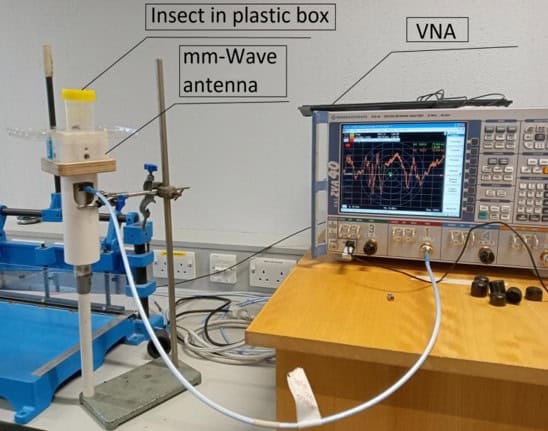
Training the model The radar system used to collect data from insects. (Courtesy: Linta Antony)

The actual process of obtaining this data from the insects involved capturing insects at the Trinity College Dublin campus and placing them in a plastic box on top of a millimetre-wave antenna that recorded their radar signatures. The researchers then released the insects back into the wild. After data capture, the relevant micro-Doppler features were extracted from the data for model training.

The model allowed non-invasive monitoring of different insects and could distinguish between bees and wasps with 96% accuracy. The model also classified five key pollinating insect species – red-tailed bumblebee, buff-tailed bumblebee, moss carder bumblebee, western honeybee and common wasp – with an accuracy of 85%.

“I think the most impressive thing is that we can detect and classify them with such an accuracy. From a biological point of view, it’s impressive how different species beat their wings in different manner, and from an engineering point of view it’s fascinating how different wingbeats affect harmonics of radar micro-Doppler reflections,” says Narbudowicz. “Those differences are of course impossible to see just by looking at spectrograms, but it appears that a sufficiently trained machine learning algorithm can see them.”

Narbudowicz points out that the current study used precise lab-grade transceivers and a relatively controlled set-up, and that the natural next step is to move this technology to outdoor field deployment. “This requires a number of steps,” he explains. “Firstly, the device needs to be miniaturized, and battery operated; the transceiver will be less accurate than the one used in the lab, but a big problem is the ground truth verification, since in the field it can be difficult to verify exactly which species flew over the sensor.”

Despite the greater challenge with deploying the technology in the field today, the researchers suggest that this radar reflection approach could be utilized in the future in a fly-through device, which would make it much easier and cheaper to achieve non-lethal monitoring of insect biodiversity in different environments.

The post Radar identifies insect species via reflections from wingbeats appeared first on Physics World.

❌