Login
Login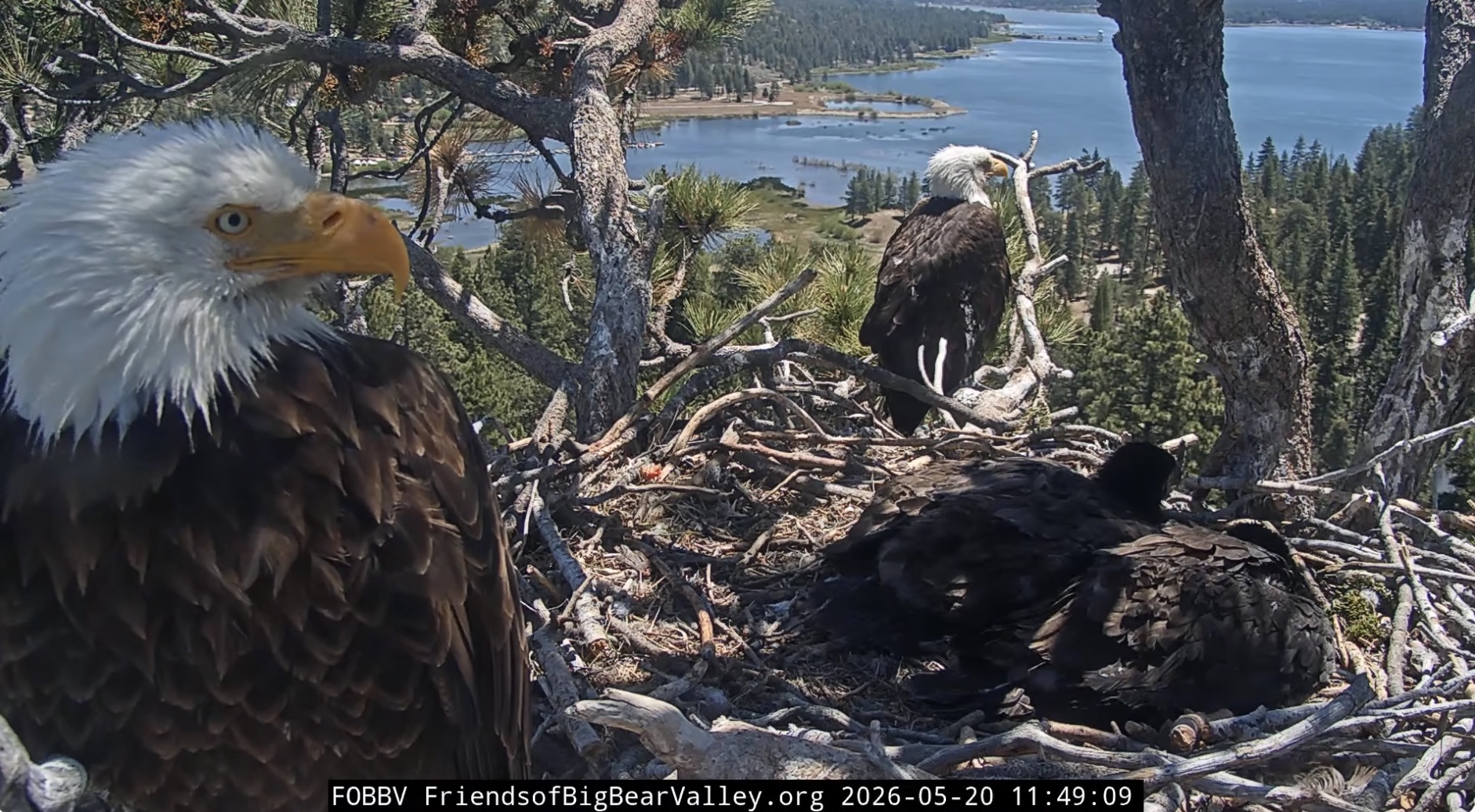

Jackie and Shadow’s chicks no longer sleep with mom in the nest bowl
If you’ve ever shared a bed with your child, you know the pain of flailing limbs at 3am. Bald eagle parents can relate.
Jackie and Shadow‘s 2026 eaglets, Sandy and Luna, have reach near-adult size, which has made sharing the nest bowl at night a difficult task. Viewers of the eagles’ 24/7 livestream have noticed that the parents no longer sleep right next to the young pair, instead resting on a nearby branch while the chicks doze at night.
“While it looks like she just needs a break from the kids, one of the most practical reasons is space management,” Friends of Big Bear Valley (FOBBV), the non-profit behind the livecam, explains. “By the time the chicks are 6 to 7 weeks old, they are nearly adult-sized. If you’ve ever tried to share a bed with someone who flails, kicks, and unexpectedly opens a 6-foot wingspan in the middle of the night, you would know exactly why Mama moves out!”

To us humans, sleeping in a cozy nest likely seems more comfortable than catching zzzzzs while standing, but we don’t have bird legs. Bald eagles roost on branches thanks to a natural adaptation called a tendon locking mechanism. This mechanism allows the majestic birds to clamp onto a branch or prey without needing to constantly flex their muscles. By doing so, the birds conserve energy and reduce fatigue—think about how weak your puny human legs would feel after standing all night.
Mama Jackie still remains close to Sandy and Luna to watch for predators, but also far enough away to avoid random talon jabs.
Jackie and Shadow’s 2026 babies: Everything you need to know
It’s been another roller coaster nesting season for Jackie and Shadow, a pair of internet-famous bald eagle parents living in San Bernardino National Forest in Southern California. After two of their eggs were destroyed by ravens in January, Jackie and Shadow laid two new eggs that have successfully hatched.
Chick 1 hatched on April 4 at 9:33 p.m. PDT, while Chick 2 followed on April 5 at 8:30 a.m. Their large nest in Big Bear Valley east of Los Angeles is livestreamed 24 hours a day by nonprofit Friends of Big Bear Valley (FOBBV) and has captivated millions.
On May 1, FOBBV announced the chicks’ names: Sandy and Luna.
How long will the chicks stay in the nest?
Chicks usually stay in the nest until 10 to 14 weeks of age. This year’s chicks will likely fledge sometime between mid-June and mid-July.
What challenges do the eaglets face?
Before leaving the nest, the chicks face threats from other birds of prey, including hawks, ravens, other eagles, and owls. Inclement weather can also present challenges for the chicks. In 2025, a March snowstorm resulted in the death of one of Jackie and Shadow’s three chicks.
During fledging, only 70 percent of eaglets survive. One of the greatest threats is from cars that can injure or kill the birds while they scavenge for food on roadkill.
Who are Jackie and Shadow?
The pair first got together in 2018 and successfully raised chicks in 2019 and 2022. However, their eggs failed to hatch in 2023 and 2024. Only 50 percent of eagle eggs successfully hatch, so this pair has already beaten the odds.
What happened to Jackie and Shadow’s 2025 eaglets?
In 2025, Jackie laid three eggs that all hatched in early March. On March 13, a strong snowstorm dumped up to two feet of snow and battered the nest with strong winds. Only two of the chicks were visible on the live cam when the storm passed by the next morning. FOBBV later confirmed the passing of one of the chicks. The two surviving chicks were later named Sunny and Gizmo after 54,000 names were submitted by fans.
What happens after chicks fledge?
Young eagles usually fledge–or leave the nest and fly–when they can flatten their wings and have feathers capable of flight. This typically occurs when the birds hit 10 to 14 weeks of age. Males also tend to take their first flight a little sooner than females.
According to FOBBV, fledglings from Southern California have been spotted as far south as Baja California, as far north as British Columbia, and as far east as Yellowstone National Park.
About 70 percent of bald eagles survive the fledgling stage. FOBBV does not tag their eagles, so it’s not possible to follow the chicks’ journeys after they flee the nest.
Can I help Jackie and Shadow?
Yes. Environmental groups are currently fundraising $10 million to protect Jackie and Shadow’s foraging area from development. Learn more at SaveMoonCamp.org.
The post Jackie and Shadow’s chicks no longer sleep with mom in the nest bowl appeared first on Popular Science.