A San Francisco robotics startup is being taken to court by an Airbnb host who claims the company’s “robotic prototype testing” caused extensive damage to his home.
In the lawsuit filed on May 26, 2026, Sean Donovan is seeking more than $12,000 in damages from the Bay Area startup The Bot Company. The court case was first reported by SFGate, which also interviewed Donovan about the unprecedented mess he encountered after the startup’s employees supposedly rented his former childhood home through Airbnb.
The first clue that the guests were not typical tech startup employees needing a temporary crash pad came when Donovan was taking care of the trash during the guests’ stay. He told SFGate about seeing “bundles of wires” throughout the house and a robot he described as a 6-foot-tall “Roomba with treads” that also resembled the cybernetic Borg from the Star Trek universe.
A San Francisco robotics startup is being taken to court by an Airbnb host who claims the company’s “robotic prototype testing” caused extensive damage to his home.
In the lawsuit filed on May 26, 2026, Sean Donovan is seeking more than $12,000 in damages from the Bay Area startup The Bot Company. The court case was first reported by SFGate, which also interviewed Donovan about the unprecedented mess he encountered after the startup’s employees supposedly rented his former childhood home through Airbnb.
The first clue that the guests were not typical tech startup employees needing a temporary crash pad came when Donovan was taking care of the trash during the guests’ stay. He told SFGate about seeing “bundles of wires” throughout the house and a robot he described as a 6-foot-tall “Roomba with treads” that also resembled the cybernetic Borg from the Star Trek universe.
Entre proezas acrobáticas e demonstrações de força em preparação para o trabalho em fábricas, o robot Atlas da Boston Dynamics também tem tempo para dar uns toques na bola e para aprender a ser um craque no futebol.
It seems like every week there’s another example of a new robot modeled after a real creature in the animal kingdom. From dogs and bats, to roaches and desert lizards, the natural world is a constant source of inspiration for engineers. But while most robotics researchers use animals as a base for their machine’s movement, an ambitious team of Duke University engineers set out to make something entirely new: a robot whose form factor and movement aren’t derived from biology, but from the universe’s underlying physics.
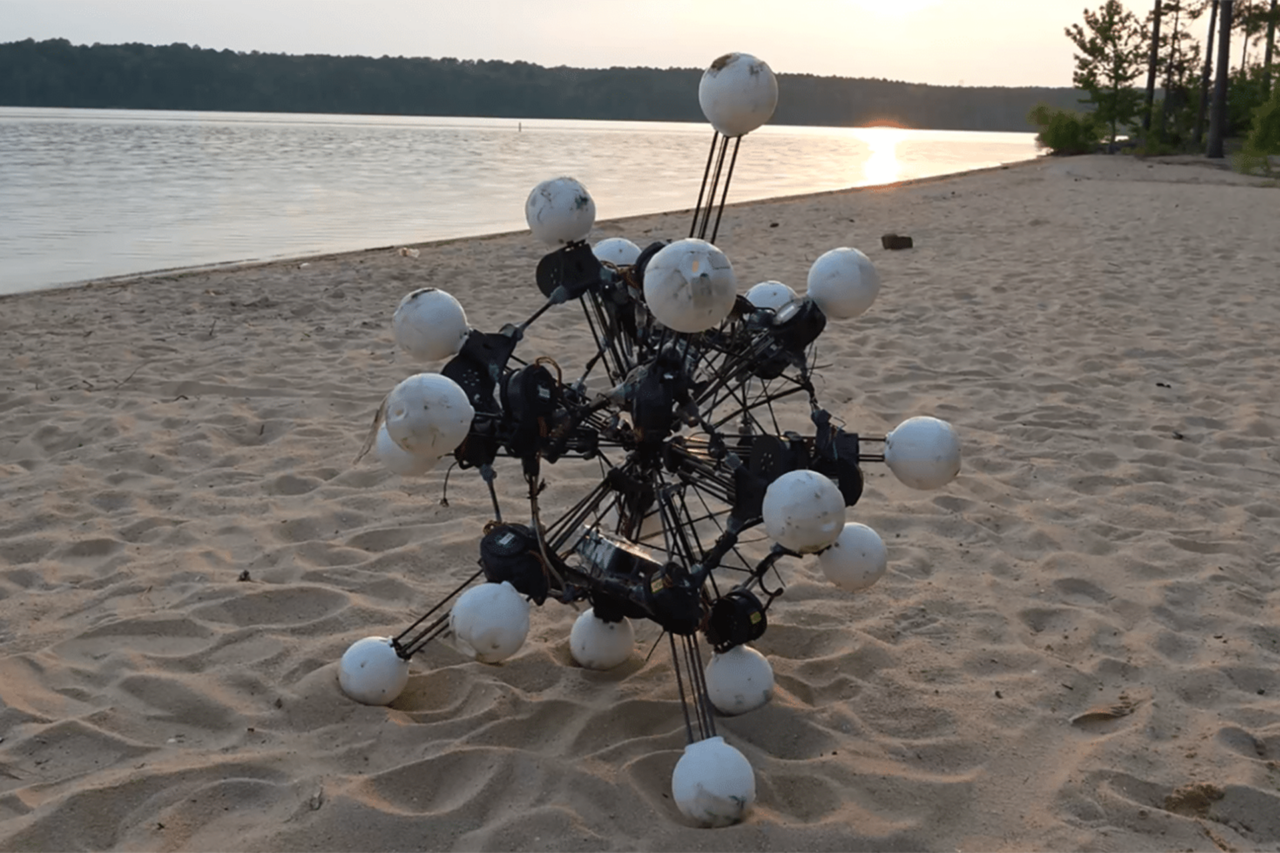
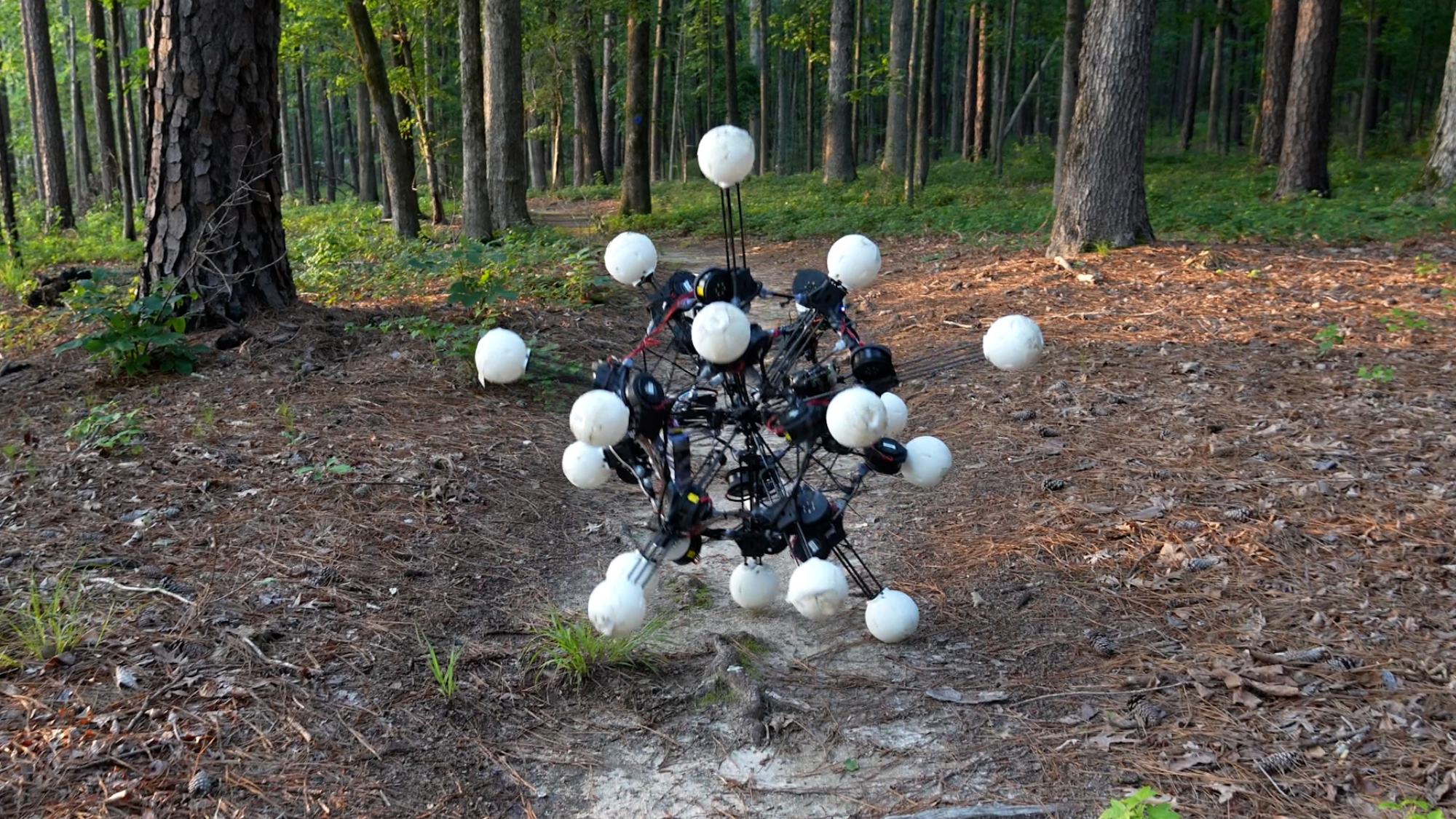
Say hello to Argus, a 20-legged, blob-looking robot capable of seeing in all directions at the same time and able to move almost instantly in any direction. The amorphous-looking sphere has no top or bottom, no left or right, and will keep trekking through sand, dirt, and gravel even when some of its legs are destroyed. It can also use its many legs to shimmy up narrow walls, a move similar to a wall jump in “Super Mario.”
The engineers behind Argus say their intriguing, if not slightly terrifying, creation isn’t just another incremental step forward in robotics. It’s the first member of a totally new category of “dynamically symmetric machines.” The findings were published this week in the journal Science Robotics.
“Watching Argus move is unlike watching any other robot we’ve worked with,” study co-author and Duke PhD student Jiaxun Liu said in a statement . “The first time we saw it navigate among trees and rough terrain, even under heavy collisions, we knew this was something different.”
Biological tradeoffs
Though somewhat human-looking, upright bipedal robots from companies like Figure and Tesla are all the rage these days, engineers have long looked to other animals to inspire their machines, because animals are simply better than Homo sapiens at certain tasks. Dogs and other quadrupeds are more agile, bats can fly, and bugs can scurry into hard-to-reach places.
However, at least in terms of movement, each of the pluses of these specific animals has also come with some minuses. Dogs and other quadrupeds are remarkably fast and nimble when moving forwards, but ask them to replicate that movement when moving backwards and you’re in for a problem.
With those inherent biological tradeoffs in mind, the team at Duke’s General Robotics Lab set out to make something completely different. Taking inspiration from underlying physics, they wanted to see if they could make a robot based around “dynamic symmetry,” which they define as the ability to generate forces and acceleration with uniform magnitude in all directions.
In other words, such a robot would take the idea of left or right and up and down and throw them out the window. Instead, it would be capable of moving in any direction, at any time, without any privilege given to one particular direction. The goal was essentially to build possibly the world’s first “omnidirectional” robot.
Argus keeps on coming—even when you break its legs
The design team eventually settled on a spherical core, or base, with a bunch of legs sticking out of it. They made multiple versions in a simulation, one with as few as eight legs and another with as many as 40. Eventually they settled on an even 20 legs for the physical build. Each of those legs is tipped with a camera that serves as one of Argus’ many eyes. Fitting, then, that it’s named after a many-eyed giant in Greek mythology. The researchers describe Argus as visually similar to a sea urchin, but even that’s selling it short. It doesn’t really look like anything in nature, which makes its uncanny movement in real-world testing all the more unsettling.
In testing, Argus could move in any direction just as quickly and comfortably as any other. The upside of that is that the blob is actually quite adaptable to different terrain despite its unusual appearance. It can easily traverse forest, wet surfaces, and sand, and could climb over certain obstacles. Argus’ ability to rapidly redistribute its weight also meant that it excelled at recovering when researchers tried to shove it off course. While Argus isn’t the first robot to right itself after getting pummeled by a researcher, what makes it unique is that it can redistribute its weight even if some of its legs get damaged or fail altogether.
In other words, you can chop off Argus’ legs and it will just keep coming.
Argus joins a family of DARPA-backed robots
The Duke researchers frame their interest in building this new category of machine as primarily motivated by pushing the boundaries of what’s possible in mechanical science. Still, it’s hard not to ignore the researchers’ most notable funder: the Pentagon’s Defense Advanced Research Projects Agency. Known for incubating some of the military’s most notorious research and development projects, DARPA is responsible for everything from Boston Dynamics’ beef Atlas humanoid to a massive, experimental manta ray inspired uncrewed underwater vehicle.
So, while it’s still not clear what exactly Argus will ever be used for, paper coauthor and postdoctoral researcher at Duke’s General Robotics Lab Boxi Xia says the experimentation and exploration was success in itself.
“Argus is an existence proof,” Xia said in a statement. “It shows that designing for dynamic symmetry isn’t just a theoretical curiosity. It produces a robot you can deploy in the wild, on uneven ground and in clutter, even in low-gravity settings. It changes what’s possible.”
To effectively travel on Mars, rovers need to deal with a lot of sand. German engineers have created a new kind of ground rover that uses swimming motions to push through sand that may otherwise cause the wheels to get stuck. Its inspiration: the African sandfish (Scincus scincus), a lizard known for burrowing into the Sahara Desert and literally swimming through its sand like a fish. It’s one of the animal kingdom’s strangest methods of propulsion, but it may help shape the future of Mars exploration.
A video of the rover, released this week by the University of Würzburg, shows a mini-fridge-sized, silver rover making its way through a sandy, Martian-mimicking test floor. Rather than rolling forward, each of its four wheels cuts through the sand in what looks like a figure-eight motion. The rover pushes on several yards and then cuts a corner and returns to where it started.
“The wheels mimic the animal’s [sandfish’s]characteristic interaction with the ground, generating both longitudinal and lateral forces,” University of Würzburg researcher Amenosis Lopez said in a statement. “The rover leaves sinusoidal tracks in the sand.”
The sandfish: nature’s cute solution to slippery sand
Though most people likely associate space rovers with round wheels or tracks reminiscent of those on WALL-E, neither design is ideal for dealing with Mars’s uniquely harsh and sandy environment. Sand is unique because it’s a material with both solid and liquid-like qualities. On top of sand’s mixed texture, rovers roaming on the Red Planet have to deal with steep slopes and uneven terrain, where varying levels of slipperiness can cause imbalance. Patches of softer sand are also a nightmare for wheels, making the prospect of a rover getting stuck never far from mind
But nature figured out a solution to this issue millions of years ago, and it’s called the sandfish. Contrary to its name, the Sahara Desert native is a lizard in the skink family. Above ground, the sandfish uses its tiny legs to scrabble around much the same as any lizard. Things get more interesting when it burrows down into the sand. X-ray imaging shows the sandfish propelling itself forward under the sand, using a powerful waving motion to generate thrust and overcome drag. The result looks like an animal swimming through the sand, remarkably similarly to how a fish would oscillate its body to move through water
Engineers at Georgia Tech took those observations and used them to create their own sandfish robot in 2011. Testing with their robots showed that the little lizard’s oddly wedged shaped head may also help it generate lift forces and more easily swim through sand.
Sink or swim: new rover did both
Researchers working on the sandfish-inspired robot said it outperformed a wheeled version when navigating through a sandy test track. Where the round wheels would wobble and weave, the oscillating wheels stayed relatively stable. That’s not to say the new approach worked right out of the gate. Early models of the design were reportedly so heavy that the rover literally sank into the sand. The team went back to the drawing board and made a second version, this time increasing each wheel’s width and reducing overall mass
It’s unlikely these oddball new wheels will become the main chassis system for NASA rovers, at least not in the immediate future. More work still needs to be done to increase their overall controllability and account for slippage that can occur in complicated, real-world environments. There are also the added variables of accounting for scientific instruments and other cargo a rover might have to carry.
More than anything, the wheel design is a testament to the sandfish’s innate ingenuity and evolutionary gifts. Many scientists only recently began to truly appreciate these traits and what other technology they could inspire.
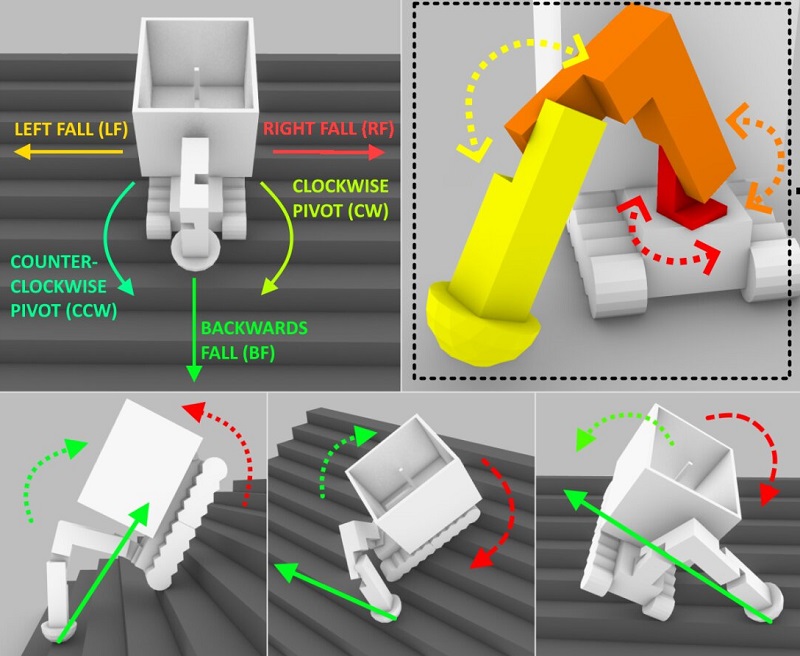
Stairs are one of the most difficult environments for robots to navigate safely. Even robots specifically designed to climb stairs can lose balance, and when they do, the results can be serious. A heavy robot tumbling down a staircase can damage itself, damage property, and potentially injure nearby people. Now, researchers at the Singapore University […]
A tech startup is offering New York City residents free home cleaning with a twist—it will send “professional cleaners” wearing cameras to record everything they do. All that data will supposedly be used to train AI-driven robots.
The unusual pitch comes from the German startup MicroAGI, whose website describes the company as a “team of engineers, researchers, and operators on a mission to accelerate embodied AI.” It began publicizing the free home-cleaning service run through its newly launched Shift app on May 28, with posts on social media sites such as X and LinkedIn featuring a video set to the upbeat piano notes of the Jay-Z and Alicia Keys song “Empire State of Mind.”
The Shift app website claims it “connects New Yorkers with free, trusted professional house cleaners” in exchange for recording “first-person cleaning footage to help train the next generation of household robots.” The “book a free cleaning” link directs clients to enter information such as a phone number, email address, and home address, along with access instructions, before booking an appointment that lasts an estimated two hours.
A tech startup is offering New York City residents free home cleaning with a twist—it will send “professional cleaners” wearing cameras to record everything they do. All that data will supposedly be used to train AI-driven robots.
The unusual pitch comes from the German startup MicroAGI, whose website describes the company as a “team of engineers, researchers, and operators on a mission to accelerate embodied AI.” It began publicizing the free home-cleaning service run through its newly launched Shift app on May 28, with posts on social media sites such as X and LinkedIn featuring a video set to the upbeat piano notes of the Jay-Z and Alicia Keys song “Empire State of Mind.”
The Shift app website claims it “connects New Yorkers with free, trusted professional house cleaners” in exchange for recording “first-person cleaning footage to help train the next generation of household robots.” The “book a free cleaning” link directs clients to enter information such as a phone number, email address, and home address, along with access instructions, before booking an appointment that lasts an estimated two hours.
Last month at Beijing’s half marathon, a robot named Lightning beat the human world record by nearly seven minutes. It’s the latest in a string of AI-powered milestones that have got people wondering whether robots are about to enter our everyday lives, just as chatbots have. And the country leading the charge is China, where the government has pledged to invest more than £100bn in robotics over the next 20 years. To find out how robots are already entering the workforce, and what needs to happen to get them cleaning our homes and weeding our gardens, Ian Sample hears from the Guardian’s senior China correspondent, Amy Hawkins, and from Nathan Lepora, professor of robotics and AI at Bristol University, who researches how robots can achieve human-like dexterity

 Login
Login