Korean researchers have developed a new catalyst design technology that can improve the performance of batteries and hydrogen fuel cells while reducing energy loss.
Modern sails on large ships are becoming increasingly common to save fuel—and also the climate. Now a research team is looking at how to maximize their benefits, and that turns out to be more complicated than anticipated.
Drones operating in a swarm can perform a range of different tasks and exchange information with one another. Up until now, civilian drone swarms are often controlled centrally via a mobile communications link. In the case of autonomous operations, this means that the individual drones are only able to communicate in a star topology via a central node—usually a mobile phone mast.
Space is a vacuum. Heat therefore cannot be transferred to the surroundings by thermal conduction. This poses a problem for any type of space-capable electronics, which can quickly overheat under these conditions. The only way to dissipate heat in space is through radiation into space. A radiator converts the heat into thermal radiation. The material used must emit as much thermal radiation as possible for the process to work efficiently.
Demand for batteries for electric vehicles and energy storage systems is growing exponentially. Fraunhofer ITWM relies on digital simulation tools and innovative measurement systems to ensure that manufacturing processes function reliably and efficiently. The researchers develop models for key steps throughout the battery production chain, such as mixing, coating or drying electrodes.
In its 2022 condition assessment, the German Federal Ministry for Digital and Transport (BMDV) classified 8,000 highway bridges as requiring rehabilitation. In other words, it is time to start continuously monitoring Germany's bridges. With the COMOBASE modular acoustic emission monitoring system, the Fraunhofer Institute for Ceramic Technologies and Systems IKTS presents an innovative solution for continuous infrastructure monitoring, specially customized for the respective requirements and significantly more economical than conventional technologies.
A new study from National Taiwan University reports a single-layer zigzag-type metallic glass film with precisely tunable emissivity for thermal infrared camouflage technology. A glancing-angle deposition method was used to fabricate the zigzag-type structure. According to the infrared lossy characteristics of metallic glass and the strong optical anisotropy induced by the zigzag microstructure, the absorptance/emissivity of the film is sensitive to the in-plane rotation angle and sample-tilt angles.
A new race to the moon is emerging between the United States and China. Unlike fifty years ago, the goal is no longer just about landing and leaving, but establishing a base that allows for a sustainable presence and extended stays on the surface of our natural satellite. The objective is now to use the […]
It seems like every week there’s another example of a new robot modeled after a real creature in the animal kingdom. From dogs and bats, to roaches and desert lizards, the natural world is a constant source of inspiration for engineers. But while most robotics researchers use animals as a base for their machine’s movement, an ambitious team of Duke University engineers set out to make something entirely new: a robot whose form factor and movement aren’t derived from biology, but from the universe’s underlying physics.
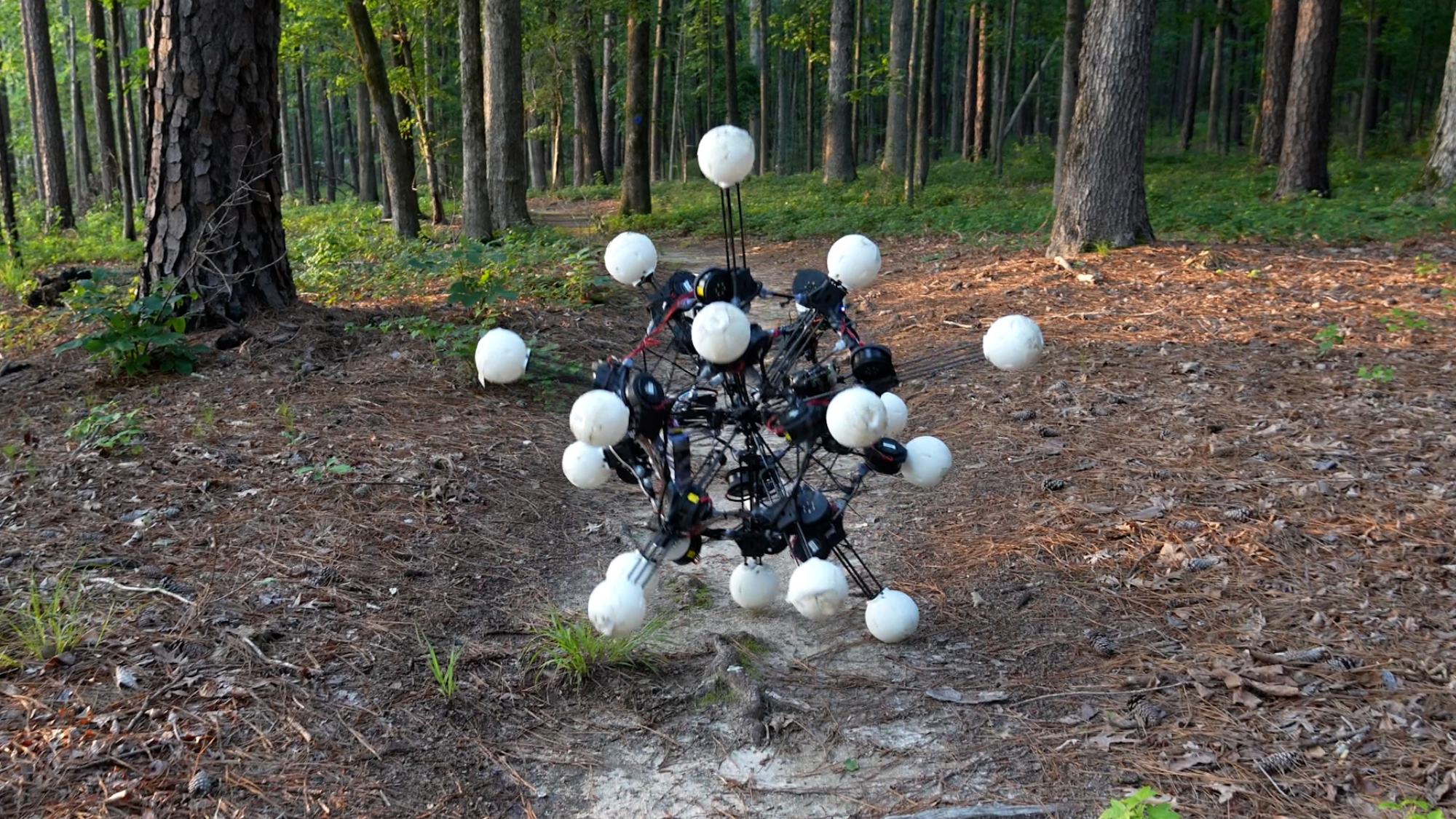
Say hello to Argus, a 20-legged, blob-looking robot capable of seeing in all directions at the same time and able to move almost instantly in any direction. The amorphous-looking sphere has no top or bottom, no left or right, and will keep trekking through sand, dirt, and gravel even when some of its legs are destroyed. It can also use its many legs to shimmy up narrow walls, a move similar to a wall jump in “Super Mario.”
The engineers behind Argus say their intriguing, if not slightly terrifying, creation isn’t just another incremental step forward in robotics. It’s the first member of a totally new category of “dynamically symmetric machines.” The findings were published this week in the journal Science Robotics.
“Watching Argus move is unlike watching any other robot we’ve worked with,” study co-author and Duke PhD student Jiaxun Liu said in a statement . “The first time we saw it navigate among trees and rough terrain, even under heavy collisions, we knew this was something different.”
Biological tradeoffs
Though somewhat human-looking, upright bipedal robots from companies like Figure and Tesla are all the rage these days, engineers have long looked to other animals to inspire their machines, because animals are simply better than Homo sapiens at certain tasks. Dogs and other quadrupeds are more agile, bats can fly, and bugs can scurry into hard-to-reach places.
However, at least in terms of movement, each of the pluses of these specific animals has also come with some minuses. Dogs and other quadrupeds are remarkably fast and nimble when moving forwards, but ask them to replicate that movement when moving backwards and you’re in for a problem.
With those inherent biological tradeoffs in mind, the team at Duke’s General Robotics Lab set out to make something completely different. Taking inspiration from underlying physics, they wanted to see if they could make a robot based around “dynamic symmetry,” which they define as the ability to generate forces and acceleration with uniform magnitude in all directions.
In other words, such a robot would take the idea of left or right and up and down and throw them out the window. Instead, it would be capable of moving in any direction, at any time, without any privilege given to one particular direction. The goal was essentially to build possibly the world’s first “omnidirectional” robot.
Argus keeps on coming—even when you break its legs
The design team eventually settled on a spherical core, or base, with a bunch of legs sticking out of it. They made multiple versions in a simulation, one with as few as eight legs and another with as many as 40. Eventually they settled on an even 20 legs for the physical build. Each of those legs is tipped with a camera that serves as one of Argus’ many eyes. Fitting, then, that it’s named after a many-eyed giant in Greek mythology. The researchers describe Argus as visually similar to a sea urchin, but even that’s selling it short. It doesn’t really look like anything in nature, which makes its uncanny movement in real-world testing all the more unsettling.
In testing, Argus could move in any direction just as quickly and comfortably as any other. The upside of that is that the blob is actually quite adaptable to different terrain despite its unusual appearance. It can easily traverse forest, wet surfaces, and sand, and could climb over certain obstacles. Argus’ ability to rapidly redistribute its weight also meant that it excelled at recovering when researchers tried to shove it off course. While Argus isn’t the first robot to right itself after getting pummeled by a researcher, what makes it unique is that it can redistribute its weight even if some of its legs get damaged or fail altogether.
In other words, you can chop off Argus’ legs and it will just keep coming.
Argus joins a family of DARPA-backed robots
The Duke researchers frame their interest in building this new category of machine as primarily motivated by pushing the boundaries of what’s possible in mechanical science. Still, it’s hard not to ignore the researchers’ most notable funder: the Pentagon’s Defense Advanced Research Projects Agency. Known for incubating some of the military’s most notorious research and development projects, DARPA is responsible for everything from Boston Dynamics’ beef Atlas humanoid to a massive, experimental manta ray inspired uncrewed underwater vehicle.
So, while it’s still not clear what exactly Argus will ever be used for, paper coauthor and postdoctoral researcher at Duke’s General Robotics Lab Boxi Xia says the experimentation and exploration was success in itself.
“Argus is an existence proof,” Xia said in a statement. “It shows that designing for dynamic symmetry isn’t just a theoretical curiosity. It produces a robot you can deploy in the wild, on uneven ground and in clutter, even in low-gravity settings. It changes what’s possible.”
A team of engineers at the University of California San Diego (UCSD) have developed a humidity-based image encoder that looks straight out of James Bond’s Q-Lab. The postage stamp-sized chip can store a hidden message that is only revealed when exterior humidity levels surpass 60 percent. The image can then be concealed again by bringing humidity back down. In practice, that means someone handed an object with the chip on it could simply breathe on it to unveil its secret message.
While it’s a potentially nifty tool for an undercover spy, the researchers say the encoder could also be used to reveal a security code on a credit card, or even serve as a visual indicator of climate changes in a particular area. In all of these cases, humidity essentially acts as a key. The findings were recently published in the journal Light: Science & Applications.
“You can imagine using this as a built-in security feature with the environment acting like a key that unlocks different pieces of information,” study co-author and UC San Diego electrical and computer engineering postdoctoral researcher Asad Nauman said in a statement.
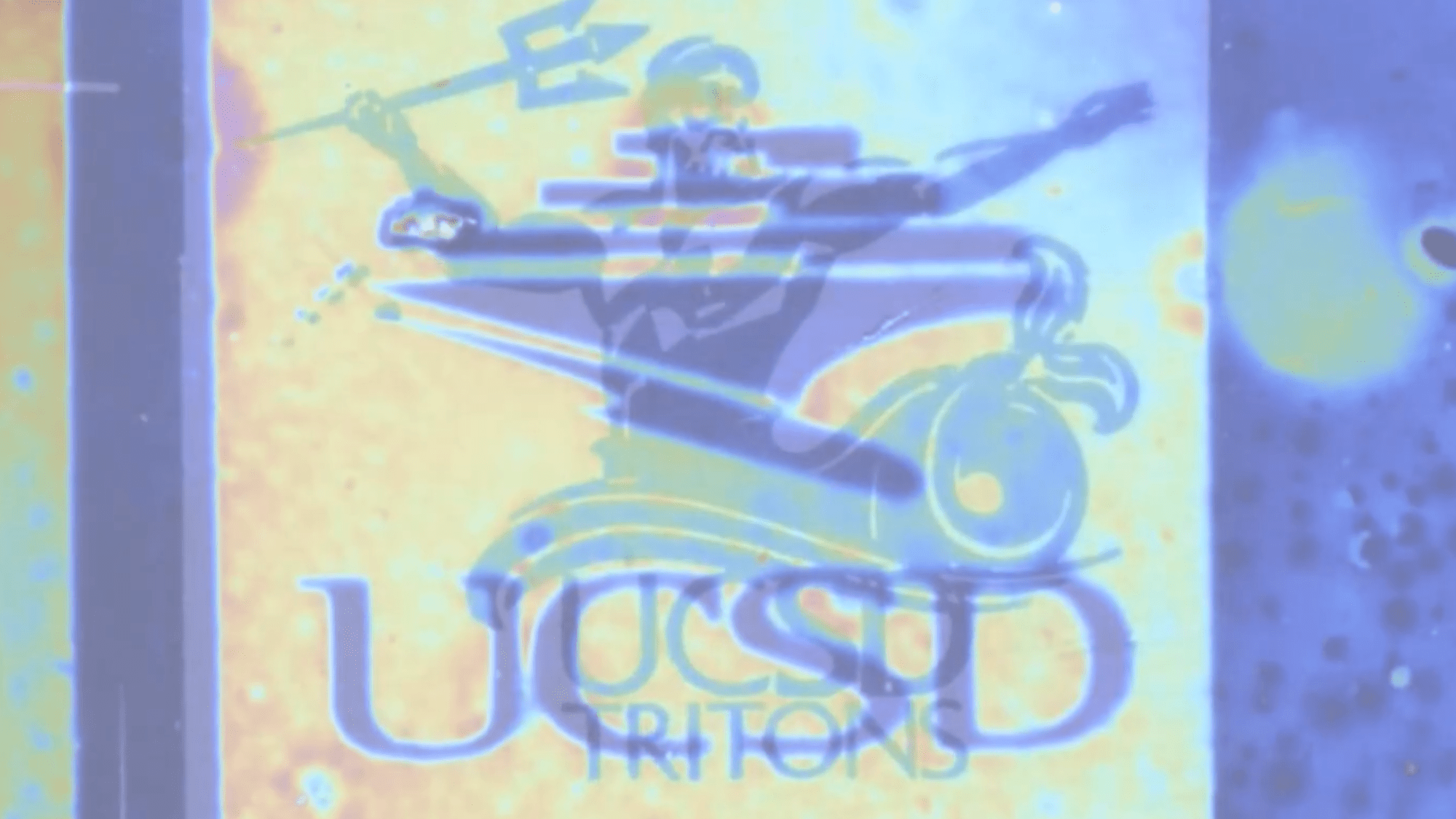
In a video demonstration, a clear blue image of a UCSD trident logo appears and then quickly begins to fade as the area around it brightens. After only a few seconds in, the UCSD library logo emerges. The image then fades back to the man with the trident before switching back once more to the library logo.
Hiding a message in plain sight
The chip consists of two separate hydrogel layers. The bottom layer, made of a phase-changing material called antimony trisulfide, essentially acts as a canvas onto which lasers can etch messages. These can be text or, as in the example above, full images. The top layer is made of a softer hydrogel material called azido-grafted carboxymethyl cellulose. This layer swells in humid conditions and shrinks in dry ones, which is why the hidden message becomes visible.
The transformation of the UCSD Triton logo to the UCSD library logo. Left to right: The UCSD Triton logo is visible at a 40% humidity level; the UCSD library logo begins to appear and overlap the Triton logo at a 60 percent humidity level; the UCSD library logo is solely visible at an 85% humidity level; and both images are overlapped at a 95 percent humidity level. Image: NDAO Lab
The first, low-humidity image or message is visible when humidity levels are at or below 40 percent. As humidity levels approach 60 percent, the hidden message starts taking shape. It is then fully visible at 80 percent humidity. The image reveal is also accompanied by a color shift due to small gaps between the two hydrogel layers. When the top layer swells and expands, the increased space between the layers alters the way light reflects off them, resulting in a shift from blue to red.
Of course, for any of this to work, a spy or other user would need to operate in an area with a predictable climate. Blowing on a message in a tropical environment where the air is already thick with moisture probably won’t do the trick. Still, in a pinch, it might beat having to write out long, intricate messages on finicky invisible ink.
Popular YouTuber and aircraft enthusiast Ramy RC built and flew what he’s calling the world’s largest remote-controlled (RC) version of a Boeing 777-9X jet. It’s not just big for an RC toy, it’s big, period.
With a wingspan of 33 feet and weighing 630 pounds, it’s roughly the same size as a human-piloted Cessna 150. The RC Boeing 777-9X may look identical to the real aircraft on the outside, but the plane is made mostly out of CNC-milled foam and carbon fiber. It has five actuators controlling the flaps, working landing gear, and is fully electric. In testing, the behemoth was able to taxi around a tarmac, lift off, and land several times.
Ramy has made a bit of a name for himself in the over-the-top RC plane-building world. He started off building models on his kitchen floor with limited time and resources, and videos of those early builds took off online. His audience has helped him scale up and pursue increasingly ambitious RC plane designs full-time. To date, he has over 200 videos showcasing massive RC versions of a ViperJet, a Boeing 787-9, and a C-17 Globemaster. Ramy’s most recent build prior to the new Boeing was the world’s largest RC Airbus A380, which came in at a staggering 800 pounds with a 32-foot wingspan.
The entire plane was built out of sections and 3D molded foam and attached together. Image: Ramy RC.
The Boeing 777-9X build started, like others, with a digital 3D model scaled down to 1/7 the size of the actual jet. With the proportions locked in, Ramy and his team then used a CNC mill to cut out separate foam parts for the plane’s fuselage, nose, and wings. Each section was reinforced with carbon fiber sheeting and sprayed with a thin layer of plastic for protection. Long runs of wiring were threaded through the plane to power systems like the wing flaps and landing gear doors. The whole aircraft is propelled by a pair of large electric ducted fans mounted where the real jet’s engines would sit.
Ramy decided to take a ride on top of his plane, Flintstones style. Image: Ramy RC .
Once assembled, Ramy used a remote control to taxi the plane around his outdoor tarmac. To drive home just how absurdly large the thing is, Ramy himself climbed on top and straddled his creation as it rolled around the facility. Once the team felt confident it was airworthy, they painted it white and blue with bold Boeing lettering along its side.
Ramy entrusted the plane’s maiden flight to a surprise guest: filmmaker Tyler Perry. The director is also an avid RC enthusiast and has credited these jumbo models like Ramy’s for helping him conquer his fear of flying. With the controller in his hands, the RC Boeing slowly powered up and its ground wheel started churning. It drove toward the end of the tarmac, then pitched up and went airborne, the buzz of its electric fans heard from the ground. Perry flew the plane for a few passes before bringing it down for a smooth landing worthy of a movie.
Around the mid-20th century, trains were in trouble. After the first rail lines were laid in 1804 England, the locomotive’s steamy forward chug seemed unstoppable. For over a century, trains were the unmatched champion for anyone looking to get somewhere further than a short horse ride away.
But by the late 1950s, that all started to change. The automobile’s rapid technological ascent meant more commuters were opting to get behind the wheel than on commuter trains. Air travel, propped up by significant government backing in the U.S. and Europe, shed rail’s ridership further by making long-distance travel faster. On top of all that, vast stretches of rail infrastructure across France, Belgium, and the Netherlands lay in rubble, casualties of World War II German bombing runs.
With rail’s future in limbo, ambitious engineers came to the rescue…or at least tried to. The post-war period produced some radical design gambles, but none were quite as conceptually ambitious as France’s short-lived Aérotrain.
It looked like a striking, comic-book-evoking silver tube, featuring a curved nose, reminiscent of a jetliner cockpit. The shiny steel body looked like a glistening cross between a train car and an Airstream camper, with bold red lettering streaked along its side.
Maybe most eye-catching of all though was its tail, which featured another giant rotating propeller or a jet engine, depending on the model. The Aérotrain hovered above the ground without wheels and propelled itself forward using an aircraft engine capable of churning out up to 12,000 pounds of thrust, roughly equivalent to the roar of a small jet engine at takeoff. That powerful engine meant the Aérotrain could reach speeds approaching 270 miles per hour, fast enough to leave conventional rail in the dust. In December 1969, Popular Sciencecalled the train-plane hybrid “the first guided vehicle to ride on air instead of wheels.”
An unfinished section of the Aérotrain rail sits in a rural French field. Image: Shutterstock PHILIPPE MONTIGNY
The first hovertrain: fast, floating, and loud
The Aérotrain was the brainchild of French inventor Jean Bertin, who founded the firm Bertin & Cie after studying aeronautics. His concept (initially called the Terraplane) adapted hovercraft technology recently developed in Britain and applied it to a fixed-track train. The vehicle rode atop a cushion of pressurized air pumped downward between it and a concrete track shaped like an inverted T, lifting it so it never made physical contact with the surface.
That absence of friction from the ground meant it could reach top speeds faster than a typical rail car. It also meant less wear and tear from contact with the Earth which, in theory at least, meant less need to constantly repair degrading parts.
Bertin essentially borrowed this “ground effect” principle, where compressed air between a low-flying wing and the ground surface builds up pressure leading to upward lift, from the aviation industry. And that wasn’t its only similarity to planes. Instead of using a traditional motor to push itself forward, it used aircraft propellers powered by powerful turboshaft engines mounted on top of the cabin.
One of the later Aérotrain prototypes, which set a record for train speed at the time, used the same engine found on early Boeing 727 commercial airliners. That meant it was shockingly fast, but also head-rattlingly loud. The result was something like a ground level airplane that moved along a track.
Cohen says that resemblance to an airplane wasn’t accidental. Bertin had a background as an aeronautical engineer. On a broader level, academics and scientists at the time were fascinated with recent advances in airplane and jet propulsion showcased during WWII and wanted to apply it anywhere they could.
“There was this sense that airplane technology could be applied on the ground or overwater and underwater and you could get kind of frictionless or semi-frictionless transportation at high speeds, very high speeds and it was not seen as pie in the sky,” Cohen says. “It was seen as a viable form of technology that could transform ground transportation.”
Several prototypes were developed, but the most successful of the bunch carried 80 passengers in two rows of two seats. The design intrigued members of the French government who viewed it as a quick way to connect the city center to airports. Though Bertin had proposed versions meant for suburban travel, the train’s noisiness and need for purpose-built concrete guide paths made it a hard sell for more urban areas.
But after years of trial and error, Bertin did eventually receive a contract to build out a line connecting Paris’s La Défense business district with the town of Cergy-Pontoise. Despite multiple prototypes, the Aérotrain would never transport passengers along the route, or any route for that matter.
The Aérotrain was bred from a culture of science and tech optimism
The Aérotrain, and a handful of international copycats that would follow it, were a product of their environment. Kennesaw State College Professor and train historian Albert J. Churella tells Popular Science the fact that hovertrain concepts gained traction was in large part a byproduct of postwar optimism. There was a sense that recent advances in science and technology could reliably reshape the world around us, and quickly. Journalists and newscasters drawn to the sleek, sci-fi looking designs were also more than willing to amplify that optimism further.
The July 2000 issue of Popular Science describes how researchers at Tohoku University Institute of Fluid Science in Sendai, Japan, were designing a modern Aerotrain that could go 310 mph. Image: Popular Science, July 2000 issue
“Interest in hovertrains must be seen in the context of the technological enthusiasm of the post-World War II period—a time when many Americans believed that science and technology could work miracles,” Churella said. That same optimism also applied to European countries across the Atlantic.
“After all, they had grown up alongside impressive new developments, including Nylon, Rayon, penicillin, jet aircraft, and nuclear power that promised to generate electricity that was ‘too cheap to meter.’”
Cohen echoes that point.
“Both in France and in the US at this time, there’s tremendous optimism about the power of technology to transform lives,” he says.
But the Aérotrain’s single contracted route never actually came to pass. Ballooning costs and development delays dampened public support. A global recession and oil crisis in the 1970s left the French government, whose funding was essential, with increasingly little appetite for large, time-consuming infrastructure gambles.
Shifting attitudes away from flashy, high tech bets and towards more practical utilitarian solutions also reportedly played a role, as did a perception of these projects that they catered particularly to the wealthy. With daily expenses climbing, the average French citizen simply stopped seeing the value in cool but unproven technology they may never personally experience, a feeling captured by city planner Pierre Merlin, quoted by researcher Vincent Guigueno in the journal Technology and Culture:
“It will not be the average Jean-Claude Z who takes the Aérotrain, but his CEO who will travel either to Orly Airport or his factory in the new town of Trappes from the company’s head office located in the Tour Main-Montparnasse,” Merlin wrote.
John Volpe, President Nixon’s Secretary of Transportation, detailed some of those prototypes in a 1969 issue of Popular Science. Rohr’s Aerotrain showed promise, and even received a Department of Transportation contract to test an experimental version in Pueblo, Colorado, but like its French forefather, it died under the weight of mounting costs.
And while a $90 million investment (especially in the 1960s) might sound like a decent chunk of change, Churella says the funding was never sufficient to make a radically new rail technology viable. Worse, spreading the investment across multiple competing approaches doomed any single one from gaining real momentum. Plus, aside from eye-grabbing news reports, Churella says everyday commuters simply weren’t all that interested in the hovertrain’s success, one way or the other.
“Hovertrains were an idea without an application, and a concept without a viable market,” Churella says. “It was something that very few people wanted, and no one needed.”
A prototype of French inventor Jean Bertin’s Aérotrain was exhibited in 2013 in Paris. Image: Siren-Com / CC BY-SA 3.0
“The story of the hovertrains shows the dangers of technological exuberance,” Churella says. “It is all well and good to propose innovative new technologies, but they must serve a purpose.”
In the end, the upfront cost of building entirely new concrete or electromagnetic guideways made the economics of hovertrains nearly impossible to justify. Prior assumptions about the limitations of traditional rail also proved premature.
Incremental advances in conventional wheel-on-rail technology produced today’s high-speed trains—not quite as fast as the Aérotrain, but close enough, and crucially compatible with over a century of existing infrastructure. Today, France’s TGV (Train à Grande Vitesse) high speed rail system is essentially a lightweight, highly refined version of the classic locomotive designs from the early 1800s.
Still, Cohen notes that viewing Bertin’s Aérotrainand the subsequent exploration of hovertrains as a total failure misses a broad point. Refinements of that underlying technology did eventually seed the development of maglev trains, which hover using powerful electromagnets rather than compressed air.
Today, a handful of maglev lines operate in China, Japan, and South Korea at incredible speeds. The most famous of them, Shanghai’s Transrapid, covers roughly 19 miles between Pudong International Airport and Longyang Road station in eight minutes, and is capable of 268 miles per hour—though its cruising speed is capped at around 186 mph.
And maglev tech, initially pitched as a commuter rail solution, has arguably had an even larger impact in other, unexpected applications, from airport luggage transportation and wind turbine parts to numerous military uses. If you peel back the onion far enough, all of those can be traced back to Bertin and his whack train-plane hybrid.
“That’s my lesson,” Cohen said. “to say [new technologies] are wacko is missing the point.” Despite where an individual invention ends up, new tech is “going to have all sorts of other applications”—applications we might not be able to see for decades to come.
In That Time When, Popular Science tells the weirdest, surprising, and little-known stories that shaped science, engineering, and innovation.
For a few select evenings in the late spring and early summer, sunlight aligns with Manhattan’s grid. The city’s bustling streets are washed with golden light as the sun sets, while tourists and locals alike flood the streets to snap that perfect picture. This event is nicknamed Manhattanhenge and it will begin on May 28 and continue through July 12.
However, you don’t need to live in the Big Apple to see a “henge” like Manhattanhenge. They actually pop up in a few places and a website called Hengefinder can help you find the closest henge.
Meet Hedgefinder
Data scientist and engineer Victoria Ritvo created the website, while software engineer John Pribyl built the accompanying app. Ritvo wrote about creating Hedgefinder in her blog, and details the three basic steps that scientists can use to find a henge. First, find the angle of the road, or its bearing relative to true north. Second, find the angle of the sun at sunset, or its azimuth. Third, find the dates when those two angles match.
While you don’t have to do any of that high-level math, you can read about how Rivoto and Pribyl made their calculations. You simply put in an address or city and can get a calculation for the closet henge near you.
“Having Hengefinder active means henges are now explorable outside of Manhattan, and I’ve been searching for them using the app,” Ritvo writes. “My favorite one so far, I haven’t actually seen. I’m intrigued by the Haarlemmertrekvaart, a canal which traces the southern edge of Westerpark in Amsterdam.”
Interestingly, much of Europe is left out of henge mania due to medieval street design. Amsterdam’s famed canals do offer an option, where sunlight can reflect off of the water. Henges may have been occurring twice a year for the past 400 years on the Haarlemmertrekvaart.
How henges work
The sun does not set in the same place every day. Its position changes along the horizon with the seasons. While the angle does not usually match the directions of a street, it will on a few days each year if the street is angled correctly.
In 1997, the term Manhattanhenge was first coined by Neil deGrasse Tyson, an astrophysicist and director of the Hayden Planetarium at New York’s American Museum of Natural History. Tyson noted that the setting sun framed by Manhattan’s building was comparable to how the sun’s rays strike the center of England’s Stonehenge on the solstice. The Neolithic humans who built the stone circle in stages between 3100 BCE and 1600 BCE intended for the light to shine that way on the solstice. But the builders of Manhattan? Not so much.
Chicagohenge in Illinois and Baltimorehenge in Maryland both occur when the sunset lines up with the grid systems in those cities around the spring and fall equinoxes in March and September. In Canada, Torontohenge occurs in February and October.
When Sachita Shah sent her cardiologist brother an ultrasound of her patient’s heart, he was very confused. The heart was huge, and the left ventricle incredibly muscular. His confusion was warranted, as the ultrasound was not of a human heart. It belonged to another primate—a gorilla. Shah, emergency physician and VP of Global Health at medical equipment manufacturer Butterfly Network, tells Popular Science that if she had shown an ultrasound of a gorilla fetus to a radiologist, they would have assumed it was a human baby.
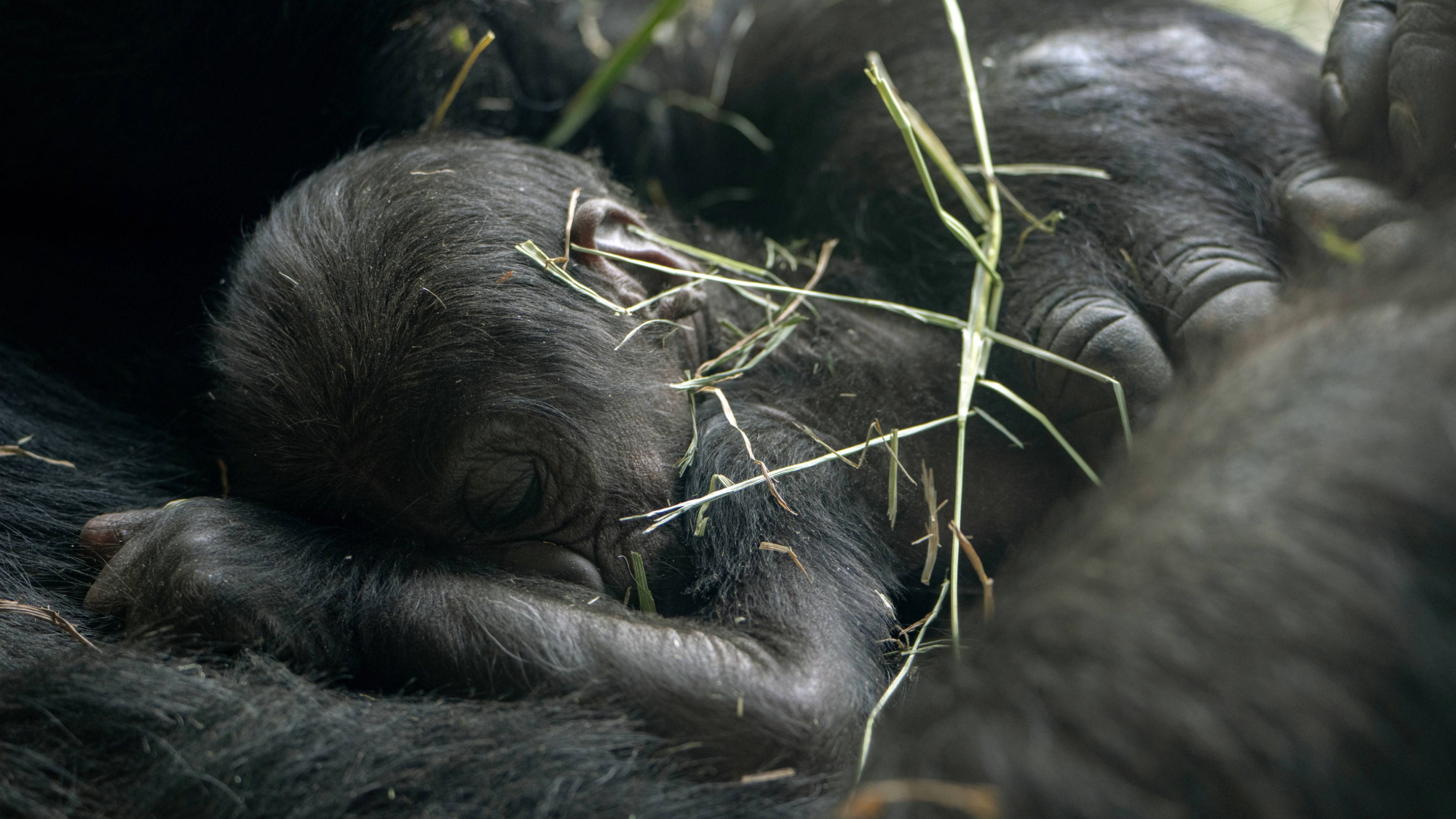
Shah is on the gorilla care team currently looking after Jamani and Olympia, two western lowland gorillas (Gorilla gorilla gorilla) mothers at Woodland Park Zoo in Seattle, Washington. Jamani gave birth on Monday May 18, and Olympia is expected to deliver her new baby imminently. Shah and her colleagues’s work involves conducting ultrasounds of Jamani and Olympia’s baby bump—though now probably just Olympia’s—to keep an eye on the baby’s growth and position.
“We got a really pretty baby face,” Shah says, speaking of the ultrasounds. “We could see nose and lips and fetal breathing movements and heartbeat and drinking fluid, opening mouth and swallowing. For all intents and purposes, it was very much the same [as a human baby].”
The endangered gorilla mothers were trained to take part in the exams and procedures conducted by the gorilla care team, and they could choose whether to participate or not. The gorillas put their bellies against the edge of the enclosure for the scan (and received snacks), where there is a small opening through which the care team can reach through with the ultrasound probe.
As such, the zoo needed a small and portable imaging device. That’s where Butterfly Network and their all-in-one ultrasound probe came in.
“When you think of an ultrasound, you might think of a big cart with lots of different probes—a different probe if you wanted to do a pregnancy scan, or a heart scan, or a pediatric scan might have a tiny probe,” Shah says.
Instead, the Butterfly probe they use at Woodland Park Zoo is a handheld ultrasound that plugs into a smart phone. It is around as big as an electric shaver, and it functions with a number of different softwares for either veterinarian or human health use. Notably, an app allows the team to use it for different types of scans—from a pregnant gorilla to a child’s lungs—that would traditionally require distinct probes and machines.
Jamani’s baby was born on May 18 at 5:50 a.m. Image: Jeremy Dwyer-Lindgren / Woodland Park Zoo.
Shah and her colleagues also used the Butterfly ultrasound device to scan the heart of Nadaya, the silverback gorilla father of both babies. In fact, the heart ultrasound Shah sent to her brother belonged to Nadaya. They used human software for that scan, even though their vet software is optimized for fur. Fortunately, Nadaya’s chest isn’t very furry.
Shah, who has gone through a pregnancy herself, was most moved by working with the gorilla mothers.
“We could tell the baby’s head had dropped and we thought, ‘oh man, she must be so uncomfortable.’ And she was waddling and walking a little differently. I was like, ‘oh, I remember that, girl.’ It was just amazing to remember that we’re all connected in that way,” she says.
Western lowland gorillas are critically endangered, so babies are always excellent news.
UPDATE May 27 8:19 a.m EDT
On Sunday, May 24, at 1:44 p.m. PDT, Olympia’s baby was delivered by an emergency C-section performed by a medical team who typically works on humans. This 5.4-pund boy is the western lowland gorilla’s second baby.
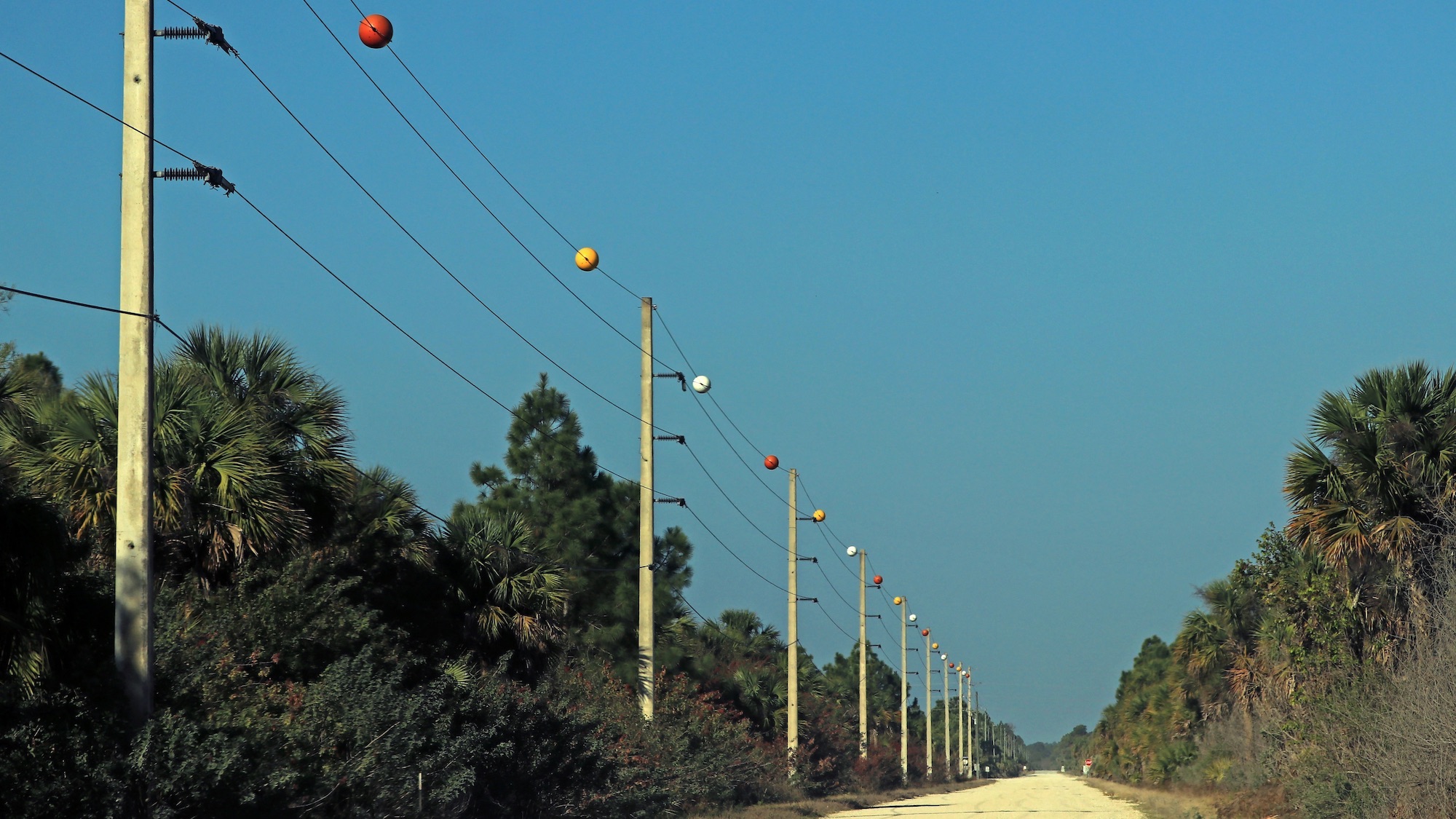
What are those orange balls on some power lines? – Maggie, age 8, West Chester, Pennsylvania
Have you ever looked up while driving on a highway and spotted those big orange balls hanging on power lines? They look a bit like giant toy beads strung along the electric wires.
What in the world are those overgrown basketballs doing up there?
Those big orange balls don’t help with electricity flow or improve the efficiency of the power lines, but they do have a very important job. Officially called aviation marker balls or spherical markers, they’re there to help pilots see power lines so airplanes and helicopters don’t crash into them. They’re like bright warning signs in the sky, protecting pilots, passengers and people on the ground below.
Big round warning signs in the sky
Power lines can be very hard to see from an airplane or helicopter, especially when pilots are flying low. Thin metal wires can visually blend into the background of nature.
The orange balls help the lines stand out. You can think of them as being like reflective tape on a bike – just a little something simple that helps people notice a danger before it’s too late.
Orange isn’t a random choice. This vibrant color is very visible to the human eye and especially stands out against the more muted colors of nature – blue sky, green trees or gray clouds. Sometimes the balls are red or white, or even striped, but orange is the most common because it works well in most lighting conditions.
Aviation safety rules in many countries explain which colors should be used so pilots can quickly recognize hazards. Organizations like the U.S. Federal Aviation Administration publish guidelines you can check out about marking obstacles near flight paths.
These balls may look like slightly oversized ping-pong balls from your perspective on the ground. But most are actually much bigger, about the size of a large beach ball, roughly 2 to 3 feet (0.6 to 1 meter) across. Each one can weigh 10 to 25 pounds (4.5 to 11 kilograms), about as heavy as a large backpack full of books.
They’re usually made from strong plastic or fiberglass, similar to materials used in boats or playground equipment. That way, they can survive years of sun, rain, snow, wind – and even the occasional bird landing on them.
Even though they sit on wires that carry huge amounts of electricity, the balls themselves are not energized. They’re made of insulating materials, so electricity does not flow through them.
The wires are strung between sturdy metal towers or wooden poles that are very tall to keep dangerous high-voltage electric wires high up in the sky, far away from people on the ground. This design makes it safe to walk, play and drive underneath them. Some transmission towers, especially for very high-voltage lines, can be as tall as a 15-story building.
If you look closely at big transmission lines, you’ll often see three thick wires, sometimes with an additional thinner one on top that’s called a shield wire. Because the shield wire sits higher, lightning is more likely to hit it first, protecting the other wires from a strong blast of electricity that can damage equipment or cause power outages. The shield wire is connected to the ground, so a lightning strike’s electricity can flow safely down the tower and into the earth.
The three main wires work together to carry electricity in a steady rhythm. By sharing the job among three wires instead of one, the system can move more energy with less waste, making it more efficient.
Installing the aviation marker balls is a job for specially trained crews, often working from helicopters. The power line usually stays turned on while the work is being done, so safety rules and careful planning are critical. The ball comes in two halves that clamp around the wire and bolt together tightly.
Once installed, these balls can last 10 to 15 years, depending on weather and conditions. They don’t need much maintenance, but utilities inspect them from time to time to make sure they haven’t cracked or faded too much.
Not every transmission line needs the markers. Usually only places where aircraft are more likely to fly low – such as near rivers, valleys, airports or helicopter routes – will use these brightly colored balls. Most neighborhood power lines are too low to need markers.
Next time you spot those bright orange dots in the sky, you’ll know: They’re not electrical equipment, and their color isn’t random. They’re simple, clever tools helping keep our busy world a little safer.
Hello, curious kids! Do you have a question you’d like an expert to answer? Ask an adult to send your question to CuriousKidsUS@theconversation.com. Please tell us your name, age and the city where you live.
And since curiosity has no age limit – adults, let us know what you’re wondering, too. We won’t be able to answer every question, but we will do our best.
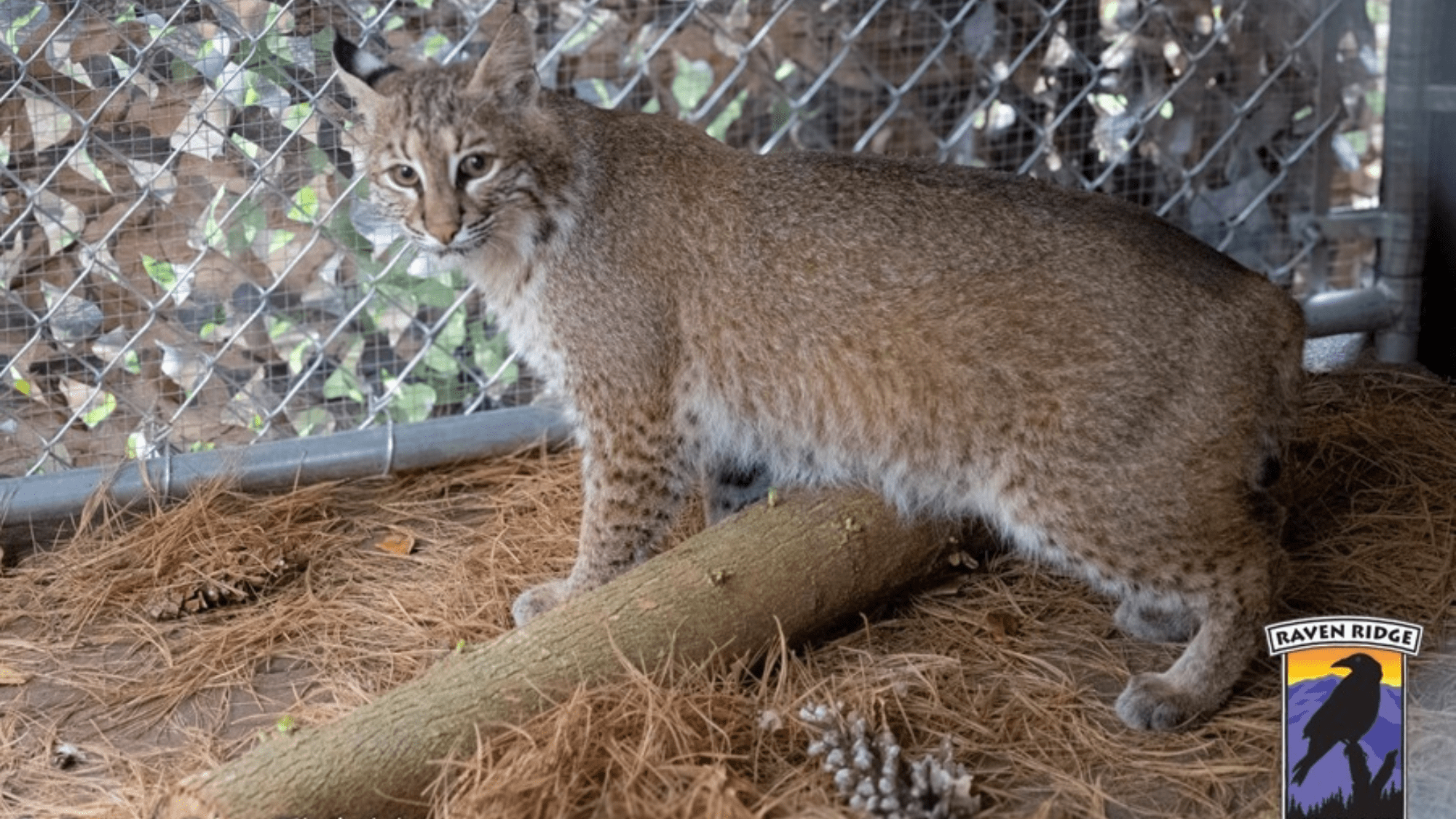
In March, we reported on a wild bobcat that had been hit and dragged by a car, who also got her head stuck in the car’s grill. As if things could get any worse, the wild feline arrived at Raven Ridge Wildlife Center in Pennsylvania on a Sunday, and the nearby veterinary practice was closed. But thanks to two lucky acquaintances, a mobile x-ray machine was brought in, revealing that the bobcat had broken two legs.
Thanks in part to the fact that her bone fractures were clean breaks, her team decided to risk a surgery. The next morning, two surgeons operated on the bobcat contemporaneously. After the operation, Tracie Young, director of the Raven Ridge Wildlife Center, told Popular Science that she was doing “fantastic” and “starting to act like a bobcat.”
The female feline has been healing atRaven Ridge Wildlife Center for two months. Image: Dawn Rise Ekdahl / Raven Ridge Wildlife Center.
In her great misfortune, the cat has been rather lucky—and it seems like the luck is holding. Two striking coincidences have now come together to get her a custom-made cage for her rehabilitation.
“After two months of recovery, the bobcat now needs to be moved outside for exercise and to begin building muscle tone,” the wildlife center wrote on social media. “We had to devise a safe and creative way to get her outdoors, necessitating the construction of special caging. We determined that a custom dog kennel would be the only viable option.”
However, the problems were twofold: time and money. The dog kennel builders the wildlife center contacted needed at least eight months to build the rehab cage, and the project would cost thousands of dollars. But then Raven Ridge’s photographer Dawn called her neighbor Glen for suggestions, who turned out to be the owner of a kennel-building business and could build the kennel in two weeks.
The custom-built kennel was made for the bobcat in only two weeks. Image: Dawn Rise Ekdahl / Raven Ridge Wildlife Center.
And if you think that’s enough of a coincidence, it gets even better. The very day construction commenced, Raven Ridge Wildlife Center received a letter with a generous donation. A woman named Raven Minervino has passed away, and her husband wrote that she had consistently supported the wildlife center. After she died, her husband had asked that rather than getting flowers, people make donations in her memory. The letter had a donation in her memory large enough to pay for the custom bobcat cage.
“Thanks to all this support, we successfully moved the bobcat to the new enclosure, where she is now exploring, exercising, and much happier,” reads the social media post. Raven Ridge plans to (or perhaps already has) put a plaque in Minervino’s memory on the cage.
Both of the bobcat’s broken legs have healed, and since having the custom cage, she has put on ten pounds, bringing her to the much healthier total of 19 pounds. Adult female bobcats weigh approximately 15 to 20 pounds on average
To effectively travel on Mars, rovers need to deal with a lot of sand. German engineers have created a new kind of ground rover that uses swimming motions to push through sand that may otherwise cause the wheels to get stuck. Its inspiration: the African sandfish (Scincus scincus), a lizard known for burrowing into the Sahara Desert and literally swimming through its sand like a fish. It’s one of the animal kingdom’s strangest methods of propulsion, but it may help shape the future of Mars exploration.
A video of the rover, released this week by the University of Würzburg, shows a mini-fridge-sized, silver rover making its way through a sandy, Martian-mimicking test floor. Rather than rolling forward, each of its four wheels cuts through the sand in what looks like a figure-eight motion. The rover pushes on several yards and then cuts a corner and returns to where it started.
“The wheels mimic the animal’s [sandfish’s]characteristic interaction with the ground, generating both longitudinal and lateral forces,” University of Würzburg researcher Amenosis Lopez said in a statement. “The rover leaves sinusoidal tracks in the sand.”
The sandfish: nature’s cute solution to slippery sand
Though most people likely associate space rovers with round wheels or tracks reminiscent of those on WALL-E, neither design is ideal for dealing with Mars’s uniquely harsh and sandy environment. Sand is unique because it’s a material with both solid and liquid-like qualities. On top of sand’s mixed texture, rovers roaming on the Red Planet have to deal with steep slopes and uneven terrain, where varying levels of slipperiness can cause imbalance. Patches of softer sand are also a nightmare for wheels, making the prospect of a rover getting stuck never far from mind
But nature figured out a solution to this issue millions of years ago, and it’s called the sandfish. Contrary to its name, the Sahara Desert native is a lizard in the skink family. Above ground, the sandfish uses its tiny legs to scrabble around much the same as any lizard. Things get more interesting when it burrows down into the sand. X-ray imaging shows the sandfish propelling itself forward under the sand, using a powerful waving motion to generate thrust and overcome drag. The result looks like an animal swimming through the sand, remarkably similarly to how a fish would oscillate its body to move through water
Engineers at Georgia Tech took those observations and used them to create their own sandfish robot in 2011. Testing with their robots showed that the little lizard’s oddly wedged shaped head may also help it generate lift forces and more easily swim through sand.
Sink or swim: new rover did both
Researchers working on the sandfish-inspired robot said it outperformed a wheeled version when navigating through a sandy test track. Where the round wheels would wobble and weave, the oscillating wheels stayed relatively stable. That’s not to say the new approach worked right out of the gate. Early models of the design were reportedly so heavy that the rover literally sank into the sand. The team went back to the drawing board and made a second version, this time increasing each wheel’s width and reducing overall mass
It’s unlikely these oddball new wheels will become the main chassis system for NASA rovers, at least not in the immediate future. More work still needs to be done to increase their overall controllability and account for slippage that can occur in complicated, real-world environments. There are also the added variables of accounting for scientific instruments and other cargo a rover might have to carry.
More than anything, the wheel design is a testament to the sandfish’s innate ingenuity and evolutionary gifts. Many scientists only recently began to truly appreciate these traits and what other technology they could inspire.
There are over 283 million cars cruising the United States, and over 90 percent of them are still guzzling gas. Apart from the obvious environmental problems, fuel prices also continue to skyrocket thanks to the ongoing war in Iran. The average price for gas is currently around 33 percent higher than it was before the crisis, and there is little sign that those numbers are going down anytime soon.
The strain is forcing many drives to reconsider how they get around—and they’re getting creative with it. In Georgia, a 30-year-old handyman is showing everyone how to properly adapt to uncertain times. According to a recent Reuters profile, Mali Hightower has retrofitted a discarded, bright pink Power Wheels Barbie Dream Camper with a two-gallon, one-piston engine for his shorter commuting needs.
“I drive this when I can,” Hightower said on May 19.
To get it going, a driver simply pulls the rip cord that’s attached to the former power washer engine. At less than four-feet-tall, the Dream Camper may not be the most comfortable ride for a full-grown adult,but it’s definitely cheaper. Hightower likely still prefers driving his 1996 Mercedes-Benz convertible, but with a full tank costing him around $90 right now, he’s more than willing to use his Power Wheels alternative for errands like grocery runs.
While somewhat surreal to see at a gas pump, the DIY solution underscores a more important issue: the need for more people to divest from fossil fuel rides in favor of public transportation and electric vehicles (EVs). Unfortunately, that’s easier said than done for many people. The U.S. is dramatically underfunded when it comes to options like commuter bus routes and trains, while EVs are still out of many people’s price ranges. The Dream Barbie Camper may be one-of-a-kind right now, but there’s a good chance that similar, intentionally constructed alternatives are on the way. At least those will be able to comfortably fit the driver.

 Login
Login