News that large language models (LLM) have made major advances in solving Erdős problems – a set of problems formulated by the renowned 20th-century mathematician Paul Erdős – has created an amalgamation of uproar and interest among mathematicians. The past month alone has seen two significant LLM-generated solutions. The first relates to prime sets, a generalization of prime numbers, and was solved after Liam Price, an amateur mathematician from the US, fed the problem statement into GPT-5.4 Pro without other information. The second came last week when the company behind ChatGPT, OpenAI, announced that it had used artificial intelligence to disprove Erdős’ planar unit distance conjecture.
LLMs have solved Erdős problems before, but the one Price chose wasn’t just any Erdős problem. It was one that human mathematicians had worked on for 60 years without success. The nature of the solution was also unusual. While previous LLM solutions to Erdős problems used standard techniques, this one took an entirely different approach. Rather than starting from Erdős’ original probability-theory-based framing of the problem, as human mathematicians had, the LLM found an alternative route – one that led naturally, in less than a page, to a correct proof.
“Paul Erdős had a concept of ‘Proofs from The Book’, meaning that the argument is so compact and elegant that this is the proof God would’ve written down in ‘The Book’,” Jared Lichtman, a mathematician at Stanford University in the US, wrote on the social media site X after the proof was announced. “After reading the GPT5.4 proof of Erdős #1196, I would say this is a Book Proof of the result.”
The planar unit distance conjecture, meanwhile, concerns a deceptively simple question: if you have n points in a plane, how many pairs of points can be exactly one distance unit apart? Erdős thought the limit was n1+C/log log(n) where C is a positive constant, but OpenAI’s model identified a higher bound. What’s more, the company claims it did so not by rehashing prior work, but by “bring[ing] unexpected, sophisticated ideas from algebraic number theory to bear on an elementary geometric question”.
Some members of the mathematics community have greeted these proofs, and the advent of AI in mathematics in general, with enthusiasm. OpenAI’s announcement quotes Arul Shankar, a number theorist at the University of Toronto, Canada, as saying that the new proof “demonstrates that current AI models go beyond just helpers to human mathematicians – they are capable of having original ingenious ideas, and then carrying them out to fruition”.
Others, however, are more cautious. David Bessis, a mathematician-turned-science writer who previously worked on algebra, geometry and topology, claims that even such apparent successes stem from a misconception of mathematics as a logically direct process of churning out theorems, given some rules. Writing in his Substack newsletter, Bessis argues that the method used to verify AI-generated proofs, which involves a computer program called Lean, may reduce the benefit the mathematics community gains from proofs. Notably, proofs that are verifiable in Lean are not always parse-able by humans, which detracts from (and in certain cases removes) the insights researchers typically get from new proofs.
How AI is being used in mathematics…
To evaluate the merits of these arguments, it’s useful to understand how AI is currently used within mathematics research. The first strategy is the one Price used to solve Erdős #1196: directly prompting an LLM. “Large language models have proven their worth at literature search: finding similar instances of a problem, or a proof, in past literature,” notes François Charton, an AI engineer at the California-based start-up AxiomMath, which is using AI to accelerate mathematics research.
The second strategy is to use AI models trained on other types of data. According to Charton, these models are especially good at spotting “weak signals and correlations” and thereby uncovering patterns in data that might be too laborious or convoluted for humans to identify.
Both methods have shown promise for generating new results, but they are not universal – at least, not yet. “It [AI] seems to do a lot better at certain types of maths than others,” says Thomas Bloom, a mathematician at the University of Manchester, UK, who maintains a webpage that tracks solutions to Erdős problems. In particular, Bloom says that to the best of his knowledge, AI “hasn’t done anything interesting in category theory” – a field whose reputation for abstraction is only matched by its track record of bridging supposedly distinct areas of mathematics.
Monumental thinker: The grave of Paul Erdős (Erdős Pál) in Budapest, Hungary. (Courtesy: Varga József, CC-BY-SA 3.0)
Another challenge is that with AI systems churning out new proofs at scale, there are simply not enough people with the skills needed to check them. A process called autoformalization could solve this problem by turning human proofs into what Bessis calls “bulletproof, machine-verifiable logical derivations” expressed in Lean or other specialized languages. At that point, AI-generated proofs could be checked automatically. The question is, what knowledge will humans gain in the process?
For doubters like Bessis, who refers to autoformalization (at least as practiced by certain firms) as “AI slop”, the answer is very little. But within the broader mathematics community, there is considerable interest in autoformalization, if done correctly. “I see autoformalization as the bridge in both directions, as important as proving itself,” Charton argues. “We can use Lean to translate between these two languages so that a Lean proof can be reverse-translated into a sketch, lemmas or natural language a human mathematician can engage with. That bidirectional translation preserves and extends mathematical knowledge at scale.”
…and how it isn’t
In the 18th century, when Leonhard Euler began arranging the logical thought processes of mathematics into theorems, definitions and proofs, mathematicians were primarily interested in solving problems with underpinnings in the physical world: questions of volume and distance, and, more generally, geometry and counting. Since then, though, mathematics has become a discipline that is at least as concerned with coming up with interesting problems as it is with solving them.
Two aspects of this change seem relevant to debates over AI’s utility. The first is that posing problems requires a broader skillset than solving them. The second is that solving posed problems sometimes requires mathematicians to invent new structures, tools or objects. Fermat’s Last Theorem, which posits that there are no three positive integers a, b, and c that satisfy the equation an + bn = cn for any integer value of n greater than 2, is a good example. At face value, this nearly 400-year-old theorem seems simple. However, proving it was the life’s work of a modern mathematician, Andrew Wiles, who won the Abel Prize in 2016 for developing the numerous new tools required, as well as for the proof itself.
Coming up with such tools – or indeed whole new frameworks – is a challenging and hugely creative endeavour. There are no rules as to the kinds of objects you are allowed to create, and unlike a proof (which is either correct or incorrect), there is no finality, either. If the new framework is a good one, it will crop up frequently and naturally in various branches of mathematics, and other mathematicians will incorporate it into their own work. If it isn’t, they won’t.
Currently, not even AI enthusiasts like Charton think machines are capable of such leaps. “Theory building is completely out of reach right now,” he tells Physics World. “Models, especially generative models, can provide a mathematician with interesting examples, or discover surprising relations that may bring a theoretical breakthrough, but the breakthrough still depends on the mathematician. I believe this will remain the case for some time.”
A new tool for scientists and mathematicians alike
In many areas of science, AI works in a way that is entirely distinct from human thinking. In physics, for example, machine learning algorithms are trained to analyse large amounts of data, find patterns and use them to infer underlying laws. This strategy could advance our understanding of some of the most fundamental questions in physics, but it is very different from how a human scientist would do it, and therefore perhaps more likely to be seen as a welcome new tool.
On the theorem-proving side of mathematics, the distinction between methods a human might use and those an algorithm might use is more blurred. Yet in some ways, Bloom thinks incorporating AI into mathematics could bring the field closer to other sciences. In particle physics, for example, “you don’t go in and take these individual recordings [of data]. It’s all automated,” he tells Physics World. “Until now, there has been no equivalent for maths. It takes time and attention to prove theorems, and maybe this had been a bottleneck.”
AxiomMath’s Charton agrees. “Every new math tool in history has automated something that used to be the work of a human mathematician – from the abacus all the way to symbolic algebra,” he says. “With each new tool, the role of the mathematician evolved rather than disappeared. Tasks got automated, and problems that felt impossible became trivial – but mathematicians just keep moving up the stack to the next set of questions. I see AI as the latest shift rather than a categorical break from history.”
Pollinating insects form a vital part of any ecosystem, enabling the biodiversity that we see on Earth today. However, biodiversity is in rapid decline around the world, and monitoring insect species is a difficult task that often requires some insects to be killed. To support the conservation of biodiversity, which is critical to ensure the sustainability of human civilization, more robust monitoring is required. In a study published in PNAS Nexus, researchers have developed a new method to identify and classify individual insects, based on radar imaging and machine learning.
Radar has long been used to study migrating insects that fly at high altitudes and in large numbers, but such systems typically perform wide-area, long-range monitoring. However, thanks to a combination of millimetre-wave radar and machine learning, narrow focused identification is now possible, by detecting changes in the radar reflection of insects caused by the flapping of their wings.
“Having a background in antenna engineering, there was always the question of whether this technology can be used to address some of the environmental challenges that we’re facing,” says co-lead author Adam Narbudowicz from the Technical University of Denmark. “Some five or six years ago, we started talking with [co-author] Ian [Donohue] about those possibilities, and eventually the idea of micro-Doppler emerged, which seemed feasible from an engineering point of view and could provide some useful data on biodiversity.”
The approach taken in this study doesn’t focus on morphological features of the insects, as these are difficult to detect with radar. Instead, it uses the harmonic patterns generated by the micro-Doppler effect of an insect beating its wings as a detection strategy. Millimetre-wave radar can provide insight into biomechanical characteristics not visible with cameras, and these characteristics are encoded in the harmonic patterns of the wingbeat.
The team used machine learning to improve the accuracy of the identification and incorporated a SHAP (SHapley Additive exPlanations) analysis – an explainable AI tool that interprets and explains key outputs and prioritizes key features – to identify which signal features are the most critical for differentiating insect species. The SHAP analysed each insect across the full spectrum of micro-Doppler harmonics, extracting key features including fundamental wingbeat frequency, energy distributions, cepstral coefficients (sound signals) and how quickly an insect’s wing movement change. These data were then used to train the machine learning model.
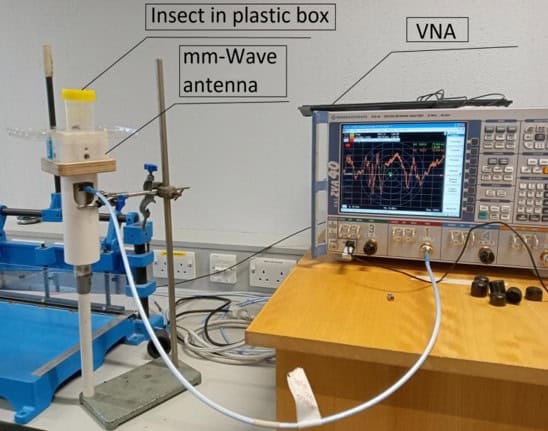
Training the model The radar system used to collect data from insects. (Courtesy: Linta Antony)
The actual process of obtaining this data from the insects involved capturing insects at the Trinity College Dublin campus and placing them in a plastic box on top of a millimetre-wave antenna that recorded their radar signatures. The researchers then released the insects back into the wild. After data capture, the relevant micro-Doppler features were extracted from the data for model training.
The model allowed non-invasive monitoring of different insects and could distinguish between bees and wasps with 96% accuracy. The model also classified five key pollinating insect species – red-tailed bumblebee, buff-tailed bumblebee, moss carder bumblebee, western honeybee and common wasp – with an accuracy of 85%.
“I think the most impressive thing is that we can detect and classify them with such an accuracy. From a biological point of view, it’s impressive how different species beat their wings in different manner, and from an engineering point of view it’s fascinating how different wingbeats affect harmonics of radar micro-Doppler reflections,” says Narbudowicz. “Those differences are of course impossible to see just by looking at spectrograms, but it appears that a sufficiently trained machine learning algorithm can see them.”
Narbudowicz points out that the current study used precise lab-grade transceivers and a relatively controlled set-up, and that the natural next step is to move this technology to outdoor field deployment. “This requires a number of steps,” he explains. “Firstly, the device needs to be miniaturized, and battery operated; the transceiver will be less accurate than the one used in the lab, but a big problem is the ground truth verification, since in the field it can be difficult to verify exactly which species flew over the sensor.”
Despite the greater challenge with deploying the technology in the field today, the researchers suggest that this radar reflection approach could be utilized in the future in a fly-through device, which would make it much easier and cheaper to achieve non-lethal monitoring of insect biodiversity in different environments.
Colliding oxygen nuclei could briefly recreate one of the most extreme states of matter in the universe – according to evidence gathered by physicists working on the CMS Collaboration at the Large Hadron Collider at CERN. Their analysis suggests that when smashed together, even relatively small atomic nuclei can produce a tiny droplet of quark–gluon plasma (QGP). This is a superhot “soup” of elementary particles that is believed to have filled the universe just after the Big Bang.
Under normal conditions, quarks – the particles that make up protons and neutrons – are tightly bound together by gluons, which carry the strong nuclear force. But at extremely high temperatures, matter changes into a radically different form in which quarks and gluons move freely in a dense fluid-like state called a QGP.
Scientists believe the entire universe existed in this form for a tiny fraction of a second after the Big Bang. To recreate it here on Earth, physicists smash atomic nuclei together at nearly the speed of light.
One of the main ways researchers study this strange state of matter is by observing the fast-moving particle sprays created during the collision. In the absence of a QGP these energetic particles would travel outward freely. But if they pass through QGP, they lose energy, somewhat like a bullet slowing down in water. Physicists call this effect jet quenching.
“Jet quenching is one of the main tools we use to study the QGP,” explains Jiangyong Jia of Stony Brook University in the US, who was not involved in the CMS study. “When a high-energy collision produces a QGP droplet, energetic quarks and gluons created in the same collision have to travel through it, and they lose energy along the way.”
For many years, this energy-loss effect had only been clearly observed in collisions involving very heavy nuclei such as lead or gold. Lower mass systems, including collisions between protons and heavier nuclei, showed hints of unusual behaviour but no convincing evidence that particle jets were being slowed down.
A clear signal
The new CMS study examined collisions between oxygen nuclei, which are much smaller than lead nuclei. Oxygen contains just 16 protons and neutrons, compared with 208 in lead. This allowed researchers to investigate how small a droplet of QGP can become while still affecting energetic particles passing through it.
The collisions were performed in 2025 at an energy of about 5 TeV – the highest energy ever for oxygen ions. The CMS Collaboration measured how many high-energy particles emerged from the collisions. This was compared to simpler proton–proton collisions, which are not expected to result in jet quenching.
The physicists found a clear reduction in the number of energetic particles produced. At some energies, the suppression reached about 30%, far beyond what could be explained by random statistical fluctuations. The pattern looked remarkably similar to what researchers had previously observed in much larger lead–ion collisions, although the effect was weaker overall.
“Oxygen-16 has only 16 nucleons compared to 208 in lead, but it appears to produce a medium that absorbs jet energy in a qualitatively similar way to much heavier systems,” Jia explains. “The shape of the suppression curve in oxygen–oxygen collisions resembles what is seen in lead–lead, which suggests the underlying physics is the same.”
Understanding fireballs
The team compared its measurements with several theoretical models. Models that included energy loss caused by QGP generally matched the data better than models without it. Still, some uncertainty remains. Part of the observed effect may come not from a QGP itself, but from differences in how quarks and gluons are distributed inside oxygen nuclei before the collision even occurs.
“The main limitation right now is the nuclear parton distribution functions,” Jia says. These describe how quarks and gluons are arranged inside atomic nuclei. According to Jia, uncertainties in these distributions “can account for roughly half of the observed suppression on their own”.
Future experiments involving proton–oxygen collisions are expected to help clarify the picture. The findings may also reshape how physicists think about the minimum size needed to create QGP.
“It shows that QGP formation is not limited to heavy nuclei,” Jia says. “It can occur in collisions of nuclei as light as oxygen.”
Researchers now hope to compare oxygen with other light nuclei such as neon to understand how the properties of QGP change as the colliding systems become larger or smaller. The work could eventually help physicists build a more complete picture of how ordinary matter behaved in the universe’s earliest moments – and how the strong nuclear force operates under the most extreme conditions known in nature.
The lines between separate scientific disciplines are becoming more blurred. Solving today’s problems often requires teams of scientists from a range of specialisms. But multidisciplinary collaboration also has challenges, in particular the need to “speak the same language”, ask the “right” questions and be familiar with techniques and knowledge that exist in other fields.
To see the importance of finding a common language look no further than the rapid uptake of large language models (LLMs) such as ChatGPT. LLMs can be convenient research aids, but the information provided by them is not always accurate. We can ask LLMs questions about another field, but without existing domain knowledge we cannot always tell if the answers are reliable.
Getting up to speed with a new research field can be tricky – it’s difficult to understand everything fully, but tempting to think that you do. There’s a parallel with sport where it might sound reasonable, say, to assume that mixed martial arts (MMA) fighters can easily become boxers. However, the evidence suggests that MMA fighters often struggle against professional boxers even though fist fighting uses a subset of the skills needed to be successful in MMA.
Back in academia, it’s common to get pushback from “real experts” whenever grant proposals or papers drift too far outside one’s own comfort zone. Nevertheless, discipline mixing is needed more than ever. Today’s problems often straddle different scientific disciplines: how to treat large, complex datasets, for example, is a common challenge in many different fields.
Look up at the stars and not (just) down at your tea
We realized this recently in our work at Queen’s University Belfast, which has been pushing for researchers to share their data analysis strategies with colleagues in other fields. In our case, we had been collaborating with Yicong Li at the Institute for Global Food Security on infrared and ultraviolet-visible spectroscopy and machine-learning models for monitoring the freshness of fish, which required only a few samples for analysis.
However, many food studies need hundreds or thousands of samples to be analysed and class imbalances can quickly arise in which some types of foodstuff have more examples than others. This can then lead to training datasets that do not produce predictive models. One example is tea, which Li has been investigating recently, again via spectroscopy and machine learning, using many samples from all over the world.
Li was trying oversampling, which creates synthetic data to equalize class imbalances. Yet over in the Queen’s physics department, we discovered another strategy was being used to classify problems in astrophysics. Matt Nicholl and PhD student Xinyue Sheng had been working on predicting the classes of energetic cosmic explosions, based on an image of the galaxy where they occurred. They wanted to train their model to find particularly rare classes, so their training set had the same problem: there were only a handful of examples of some classes of interest.
In addition to oversampling, they were also using a “weighted loss function” in their training, in which weights were inversely proportional to the number of examples in a given class. Their approach led to a substantial improvement in their astrophysics application, but it turns out the basic idea is completely general in nature and can be just as easily applied to tea.
Sleeping beauties
Knowledge exchange does not only concern data, but sometimes a whole set of ideas. An interesting study of citation metrics in 2015 by researchers at Indiana University found that there is a class of papers that receive very little attention for years before suddenly shooting skywards with a deluge of citations. Notably, these “sleeping beauty” papers include Albert Einstein, Boris Podolsky and Nathan Rosen’s work in 1935 examining non-locality in quantum mechanics, which led to John Bell’s theorem in 1964 and ignited significant interest in the original “EPR” paper.
Such citation trends can arise because the papers’ findings are adopted by researchers in a different field. Other similar instances include work in the 1930s and 1940s on hydrophobic theory, which describes how certain substances minimise their contact with water. Yet perhaps the sleepiest of sleeping beauties is the principal component analysis (PCA) work by Karl Pearson, which slumbered for over 100 years before “awakening” in the early 2000s.
PCA – a technique that simplifies complex datasets by reducing the number of variables while minimizing information loss – had already been gaining traction during the 1980s and 1990s when matrix calculations became easy for computers alongside the development of statistical software packages and open scripting environments. In research papers published today it would be unusual not to see PCA used as an exploratory tool for multivariate dataset analysis.
As these examples show, it’s crucial that communication channels are open between varying fields. However, too many academic researchers can get siloed. Interdisciplinary science hubs are one way to break down barriers, acting as spaces to exchange ideas between scientists.
One example that we have been involved with is Smart Nano NI, which is a consortium of universities and photonics-based companies in Northern Ireland. It recently released TITAN, a bio-process analysis system based on gold nanostructured chips, for real-time bio-analysis. Smart Nano NI is now moving from benchtop to backpocket, looking to develop fully miniaturized sensing devices by integrating different kinds of photonic components like lasers, filters and detectors, all on the same chip.
Elsewhere, centres for doctoral training – such as the Photonic Integration and Advanced Data Storage programme with the University of Glasgow – bring together groups of PhD students to work on various projects under a common theme. These schemes not only foster new ideas with the student cohort but bring together academics to bridge different parts of research. Either way, we are getting people talking and interested in emerging scientific questions.
So if you are sitting on a problem, there might be a chance that someone in a different field has solved it or at least offered the tools to do so. As our sky-gazing friends might say, “There is nothing new under the Sun.”
A bolometer that can measure absorbed energy at a resolution of less than a zeptojoule (10−21 J) has been unveiled by Mikko Möttönen and colleagues at Finland’s Aalto University. Their device could soon enable researchers to measure the energy of individual lower-energy photons – leading to new opportunities in quantum computing and information processing.
A bolometer detects radiation using two main components: an absorber, which heats up as it captures incoming radiation, and a thermometer, which converts this temperature rise into a measurable electrical signal. Bolometers are some of the most sensitive radiation detectors in use today.
Indeed, high-performance bolometers based on nonlinear oscillators, superconducting qubits or Josephson junctions are sensitive enough to detect individual microwave photons with energies of about 10−23 J. However, these devices are not able to resolve photon energies very well and only work over certain photon energy ranges.
Normal sandwich
A Josephson junction comprises a normal (non-superconducting) material sandwiched between two superconductors. Thanks to the proximity effect, superconducting Cooper pairs of electrons can penetrate some distance into the normal material. So, if the normal material is narrow enough, a supercurrent will flow across the junction.
“We started to build bolometers based on so-called proximity superconductivity around 2010 when I obtained my European Research Council Starting Grant,” says Möttönen.
In the team’s previous bolometer design, the normal material (a metal) absorbs photons, thereby increasing the temperature of the Josephson junction. This results in a shift in the impedance of the junction – and this shift is measured and related to the amount of energy absorbed. A key feature of this approach is the integration of the absorber and thermometer functions into a single structure.
In their latest study, Möttönen’s team has expanded their design to include multiple junctions. “We used gold-palladium (AuPd) and aluminium as the materials such that we can independently engineer the absorber part of the device from the thermometer part,” he describes. “We can optimize the strength of the superconductivity in the thermometer for high sensitivity.”
Impedance match
Their design consists of a AuPd nanowire (a normal metal), split into two segments. The first acts as an absorber and is tuned to match the impedance of the transmission line delivering microwave photons. This ensures that the highest possible amount of microwave power is transferred to the nanowire, across a broad range of photon energies.
The other nanowire segment acts as the thermometer. Superconducting aluminium islands are placed next to the nanowire, creating a series of Josephson junctions. By measuring inductance shifts across the junctions the team determined the energies of single photons at resolutions smaller than 1 zJ.
The researchers are hopeful that their design will be developed to create practical detectors of single lower-energy photons – and potentially other types of particle. This would be especially useful for calibrating the components of quantum computers.
“We will use this sensor in what I refer to as an autonomous quantum processing unit to measure qubits at millikelvin temperatures and feed back to information through millikelvin controllers and microwave sources,” Möttönen says. “This will dramatically reduce the price of quantum computers in the future.” The detector design could be also adjusted to receive telecom signals at the single-photon level – providing an ideal platform for the ultra-secure communication method of quantum key distribution.
Engineering light transmission through opaque media is possible thanks to the development of a classical wavefront shaping technique first reported in 2007. Researchers have now demonstrated a quantum entanglement-based method that enables selective image transmission through complex disordered materials.
“We discovered that there might be a way to use quantum properties of light to actually help or improve the problem of imaging through scattering media,” explains Hugo Defienne, a quantum optics researcher at the Paris Institute of Nanosciences (CNRS/Sorbonne University).
In two new research papers, Defienne and his colleagues show how to leverage quantum correlations to engineer incoming light to overcome the scrambling that occurs when it passes through “opaque” scattering materials. The approach could point towards alternatives to the solution pursued so far for unscrambling such light – and could even provide a route towards secure communications, by rendering channels transparent to entangled photon pairs, while remaining opaque to a classical light.
“These works offer a particularly elegant perspective, showing that for spatially entangled photons, the space of wavefront corrections that can compensate scattering is significantly larger than in the classical case,” comments Yaron Bromberg, head of the Complex Photonics Lab at the Hebrew University of Jerusalem in Israel.
Quantum opportunities
In 2007, Allard Mosk and Ivo Vellekoop, both then at the University of Twente in the Netherlands, reported how measurements of the intensity spatial distribution of light distorted by transmission through an opaque scattering material could be used to control the propagation of light and refocus it at the output, effectively turning the scattering material into a lens.
Building on this, in 2010 Sébastien Popoff and Sylvain Gigan showed that they could identify a transformation matrix between the original beams and the transmitted beams, such that applying the inverse to the initial wavefront using a spatial light modulator would allow the original beams to emerge undistorted. Later developments have applied the technique to quantum light. However, being based on intensities of the transmitted light alone, these have not actually exploited light’s quantum properties.
Defienne was working on both the quantum properties of light and the challenge of unscrambling scattered light signals when he began to mull over how to leverage quantum properties in this feedback approach. “We discovered that when you use quantum light, there are many ways of actually unscrambling the light that do not exist when you use a classical system,” he tells Physics World.
Correlation correction
To understand how solutions to the problem multiply for the quantum scenario, it helps to consider a certain type of quantum entanglement that leads to spatially correlated photons. Measure the end point of a photon that’s spatially correlated with another, and the end point of its partner photon will be dictated by the correlation. While scattering media also scramble spatial correlations, a spatial modulator can also invert the scrambling process to retrieve the original spatial correlations.
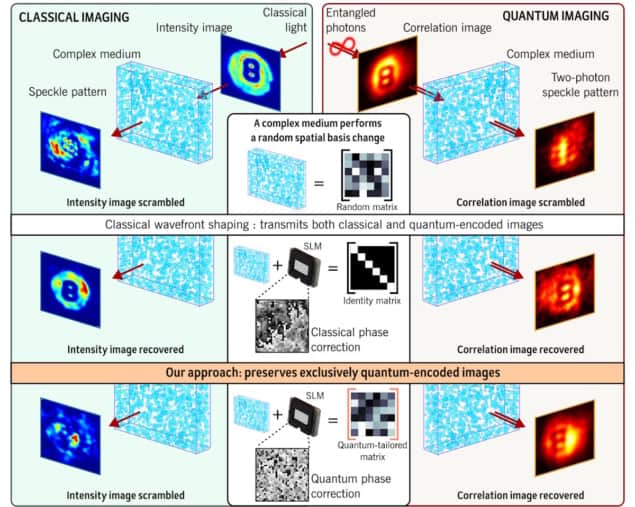
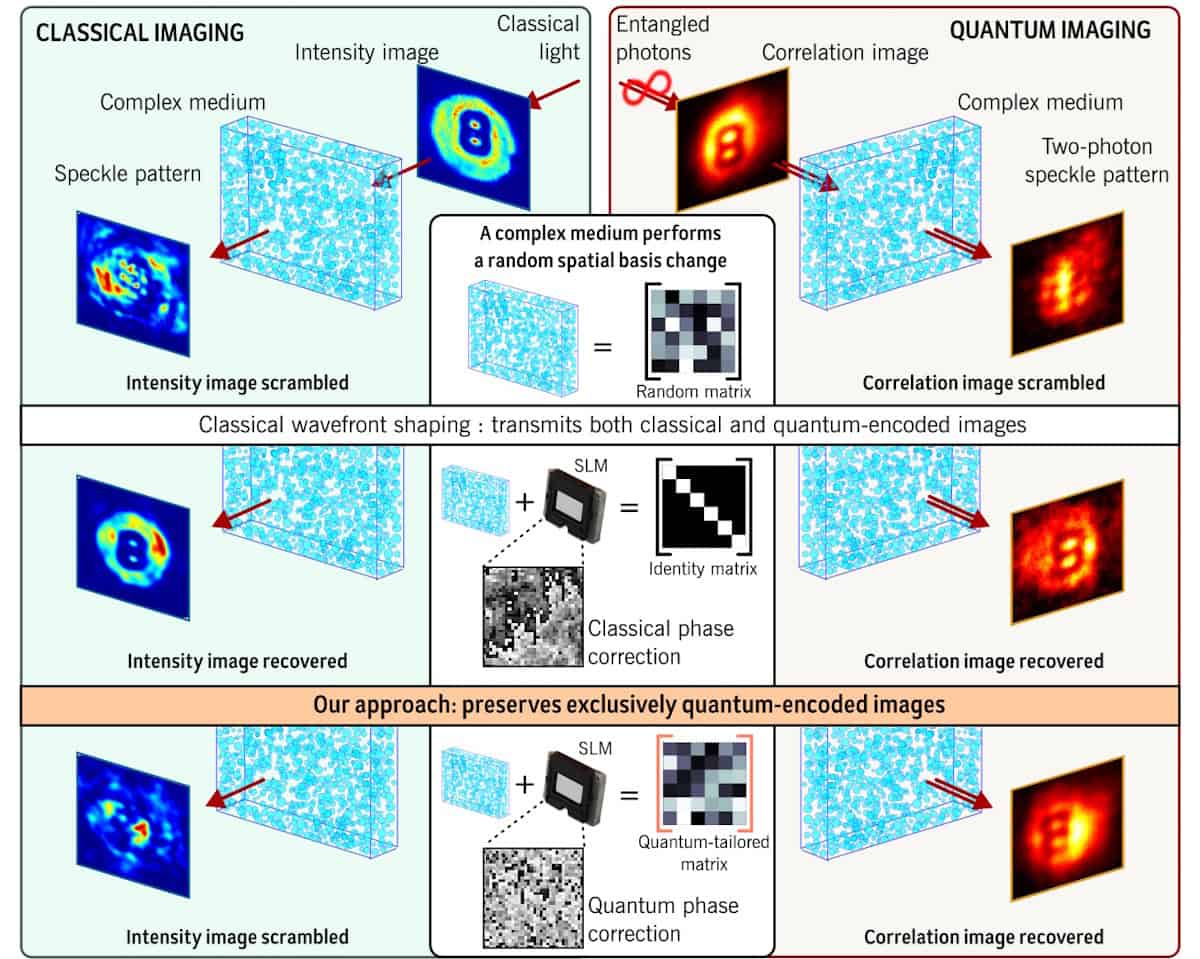
The quantum bonus comes because whereas with classical light the scattering medium only appears transparent when a one-to-one correspondence between incoming beam and output beam is achieved, there are additional solutions that return an apparently identical spatial correlation distribution between incoming and output entangled photons.
Defienne and his colleagues report the derivations for the quantum approach in Optica. They also demonstrate the approach using a single photon avalanche diode to detect the quantum correlations of light transmitted through a film of paraffin, before feeding it back into a spatial light modulator that adjusts phases to manipulate spatial correlations.
Entanglement-enabled image transmission The new approach transforms optical disorder into an active, programmable filter separating classical and quantum light. (Courtesy: Hugo Defienne and Chloé Vernière)
“Conceptually, it’s exactly the same idea,” says Defienne. Nonetheless, almost 20 years on from Mosk and Vellekoop reporting their approach for unscrambling light, this is the first time it has been successfully applied to the quantum properties of light. “It’s just very complex,” Defienne adds. The weak photon pair source, scattering losses in the medium and imperfect detection all pose challenges, such that it can take a long time to have enough data for the required statistics.
“In fact, this is only possible because now we have single-avalanche diode cameras,” says Defienne, noting that these became available with the required sensitivity and frame rate about five years ago. “With any previous camera technology, this is totally impossible.”
Leveraging the quantum properties in this way means that the spatial light modulator unscrambles the quantum correlations while leaving the classical beam still scrambled. The researchers suggest this could serve as a quantum filter that might be useful for blocking nefarious signals intended to muddle transmitted data – by encoding data in quantum correlations it’s possible to block fake data, so long as it is classically encoded. They demonstrate this filtering process in their Nature Physics paper.
“These results mark a significant breakthrough achieved in experimental samples,” says Sushil Mujumdar from the Tata Institute of Fundamental Research in India, who was not directly involved in the current research. Mujumdar has been working on optimizing wavefront shaping algorithms for quantum light, in particular where the incoming photon count is low. He adds: “The logical segue to this work would be the application of these techniques to thicker and realistic media, which, as acknowledged in the paper, become challenging because of drastically low signal photons, characteristic of the quantum domain.”
Indeed, Defienne and his colleagues are already looking into “some new shaping approach that could be better” for quantum correlated photons passing through, for example, a layer of paint instead of paraffin. They are also looking at the potential to leverage the optical nonlinearity of entangled photon optics for quantum reservoir computing.
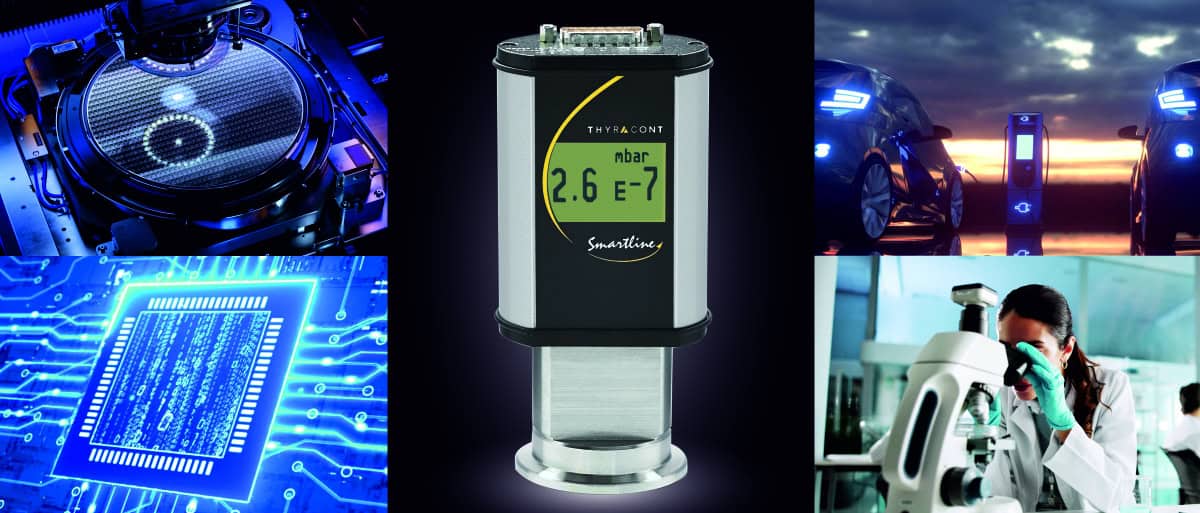
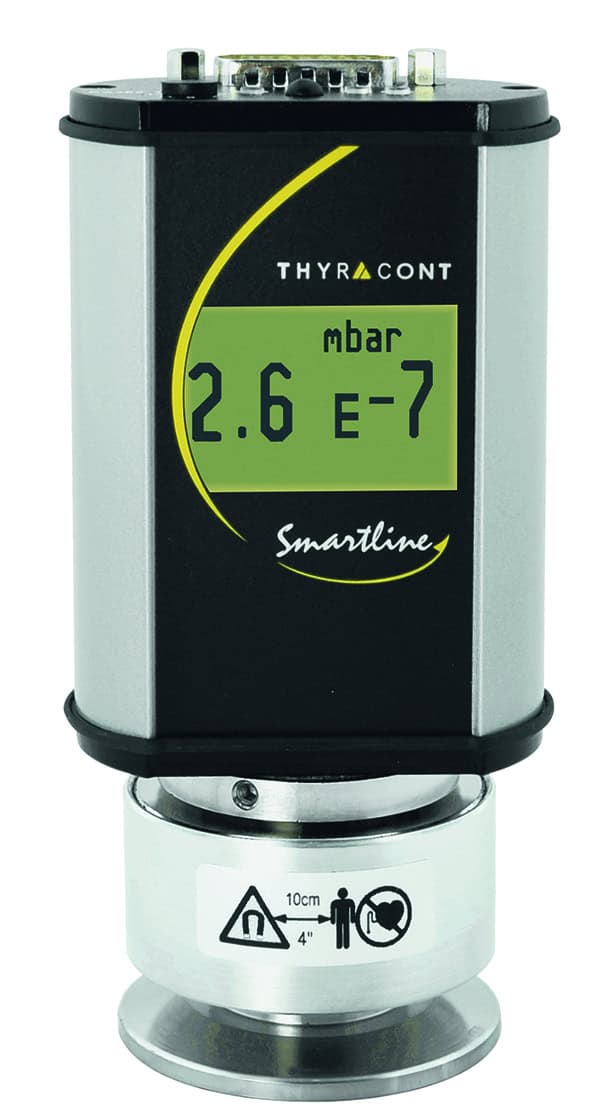
High-precision vacuum measurement Thyracont’s instruments are used in industrial and laboratory applications. (Courtesy: Thyracont Vacuum Instruments GmbH. Composite image including proprietary product photography and licensed stock footage used under valid usage rights)
Life sciences: reliable conditions for pharmaceutical freeze drying
Freeze drying (lyophilization) plays an important role in the manufacture of pharmaceuticals extending shelf life by removing water via sublimation under vacuum conditions. Because these processes run over long cycles, stable and contamination-resistant vacuum measurement is essential.
Thyracont’s VCP transducer is designed for such applications. Its platinum-rhodium filament provides high resistance against corrosion and contamination, supports sterilization and reliable operation under thermal stress. Operating in the fine vacuum range (1000 to 5 × 10−⁴ mbar), it ensures stable process control in freeze-drying systems.
“Long-term stability and resistance against corrosive process media are decisive factors in freeze-drying processes. The VCP was specifically engineered to maintain reliable performance even withstanding steam sterilizations,” explains Frank P Salzberger, CEO of Thyracont.
High-tech and research: enabling analytical precision
Many of the cutting-edge instruments used in analytics and R&D operate under vacuum – including those used for mass spectrometry and materials testing. In applications such as beverage gas analysis, the VSP63MV Pirani transducer enables precise monitoring in the 1000 to 10−4 mbar range, supporting zero adjustment of the mass spectrometer, which is essential for the reliable detection of trace contaminants at very low concentrations.
The analysis of the thermomechanical properties of materials is necessary for the development of cryogenic technologies including those used in quantum technologies. This involves cooling materials and devices to very low temperatures and measuring how their physical properties change. Thyracont vacuum gauges such as the VSP63DL and VSM77D cover fine and high vacuum ranges down to ultra-high vacuum conditions, enabling stable thermomechanical characterization of materials at extreme temperatures.
Semiconductor and coating processes: stability in complex systems
Smartline VSM transducers These provide reliable monitoring from atmospheric pressure to ultra-high vacuum. (Courtesy: Thyracont Vacuum Instruments GmbH)
In semiconductor manufacturing, wafer bonding requires tightly controlled vacuum conditions to ensure contamination-free and uniform layer formation. During initial evacuation, Thyracont’s VSC43MA4 is used to monitor roughing and bypass pumping stages.
In subsequent high-vacuum stages, Smartline VSM transducers provide reliable measurement from atmospheric pressure to ultra-high vacuum, combining Pirani and cold cathode technologies with optimized range switching for stable operation.
“In semiconductor wafer bonding, it is essential to maintain stable measurement across the full pressure range – from roughing to ultra-high vacuum. Our Smartline VSM series ensures exactly this seamless transition,” says Salzberger.
In optical coating applications, this approach ensures continuous monitoring while protecting sensitive sensor components.
Industrial vacuum processes: distillation and thermal treatment
Short-path distillation relies on precise vacuum control (typically 1 × 10−³ to 1 mbar) to enable gentle separation of heat-sensitive substances such as fragrances. A thin film is formed inside the chamber, and evaporation occurs at reduced temperatures, preserving delicate compounds.
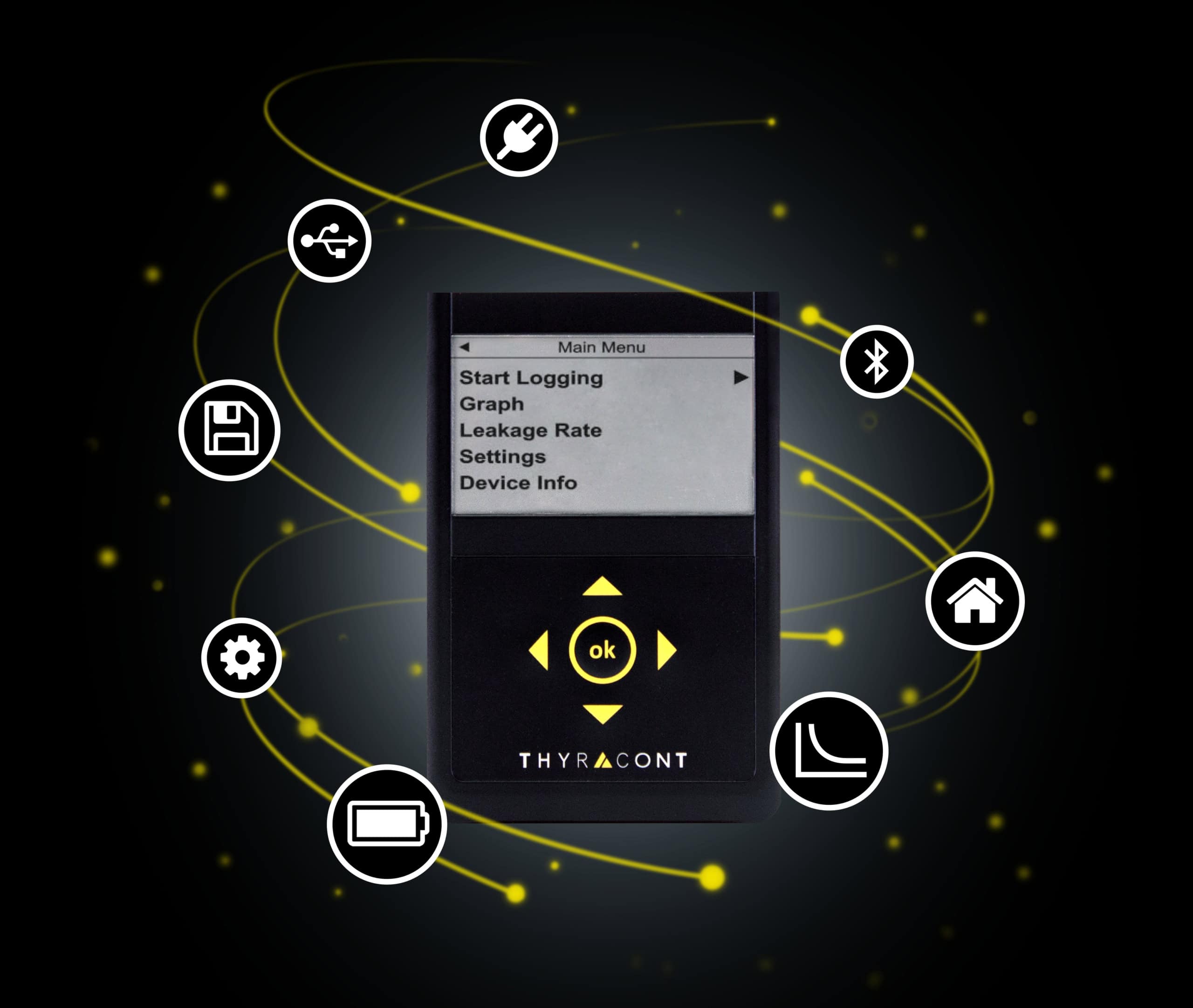
VD850 digital compact vacuum meters These are equipped with a data logger and USB-C interface. (Courtesy: Thyracont Vacuum Instruments GmbH)
Stable pressure control is essential to ensure consistent product quality. Devices such as the VD64P and VD850 support monitoring and control functions including switching outputs, leak detection, and integrated data logging for process documentation.
Peter Gerlesberger, development manager at Thyracont explains, “Reliable leak testing ensures that vacuum chambers and systems meet the required process conditions. With the VD850 users can quickly and reliably determine the magnitude of the leak rate”.
Vacuum furnaces face similar requirements under high-temperature and contamination conditions. The VD850, as well as VSH transducers (Pirani/hot cathode), enable reliable pressure measurement across furnace inlet and outlet zones.
Packaging applications: quality control in food safety
Vacuum packaging plays a crucial role in in the food industry, extending shelf life and reducing food waste. Ensuring consistent vacuum levels is critical for product safety and quality.
Testing is performed by replacing the food with a vacuum gauge and monitoring the pressure after sealing. The compact VD810 can be temporarily integrated directly into packaging, thereby simulating real-world process conditions.
The built-in piezo-ceramic sensor measures absolute and relative pressure in a rough vacuum and records pressure curves with timestamps. The recorded measurement data can be downloaded via USB or, optionally, via Bluetooth LE and used for process analysis and quality documentation.
The common thread
Across industries, from life sciences to semiconductor manufacturing, Thyracont vacuum measurement technology enables precise, stable, and reliable process control under demanding conditions. By combining robust sensor design with wide measurement ranges and intelligent system integration, these instruments contribute to the performance and quality of modern industrial and research applications.
Ultra-precise electron beams can rearrange atoms in a 3D crystal lattice and create structures not found in nature, an international team of researchers has shown. The work could have implications for quantum simulation and atomic-scale manufacturing.
The 1986 Nobel Prize for Physics was divided between three researchers. Half was split between Gerd Binnig and Heinrich Rohrer of IBM’s Zurich laboratory for their development of the scanning tunnelling microscope (STM). The STM’s ability not just to image but to move atoms was famously demonstrated three years later, when Don Eigler and Erhard Schweizer of IBM Almaden in California produced a picture of 35 xenon atoms precisely placed on a crystal of nickel to spell out the letters “IBM”. STMs have become widely used in surface analysis. However, they can only manipulate 2D surfaces, are painstakingly slow and require high vacuum and ultracold temperatures.
The other half of the 1986 prize went to Ernst Ruska of Germany’s Max Planck Society for his invention of the electron microscope – which can image samples with atomic resolution. Until now, however, electron microscopes had not been able to deterministically manipulate atoms because their high-energy electron beams tend to break bonds randomly within a crystal.
Now researchers in the group of Frances Ross at Massachusetts Institute of Technology led by Julian Klein, together with Kevin Roccapriore of Oak Ridge National Laboratory and others, used Oak Ridge’s ultra-precise, extremely stable, focused electron beam to penetrate around 13 nm into a crystal of the layered van der Waals material chromium sulphide bromide.
Interesting crystal structure
“The material has a very interesting crystal structure,” says Klein; “One individual layer has a mixture of sulphur and chromium atoms, but then on both sides of this layer there are bromine atoms sticking out in both directions. And when you stack those crystals you create atom-sized gaps between the layers.”
When the electron beam is positioned within 20 pm of its target and then moved slightly in a specific direction, the electrons in the beam can nudge the chromium atoms in the line of fire out of their original positions into the target unoccupied sites. This creates lattice defects called vacancy–interstitial complexes. Computer simulations suggest that, owing to interlayer interactions, movement of the chromium atom in one layer should encourage the transformation of layers above or below. Ross says that “[the transformed layers] do form in a timed sequence, but we can’t tell in what order they’re transforming”.
By carefully manipulating the electron beam across the surface of the crystal, the researchers can create an array of vacancy–interstitial complexes: “Julian and Kevin have a series of images at different times,” says Ross; “You can see the quality of the result just gets better and better…The beam has to be exactly on that column of atoms because otherwise some of the energy is going to go into the wrong place and disrupt the rest of the lattice.”
More robust crystals
The resulting 3D crystal is much more robust than an STM-created surface. “The defects created in the interior of the crystal are protected from the environment,” Ross explains. This allows measurements of different properties in different laboratories without needing cryogenic refrigeration or vacuum.
This could also ease the path to practical application for what is, say the researchers, an emergent many-body state. “That’s where the fun stuff comes in,” Ross says. “I’m excited because of the scalability of this that allows us to look at the interactions between the defects rather than just creating a defect itself. The stability of the microscopes that allows us to keep going and create a huge array is really exciting.” The researchers are examining various possible applications in, for example, quantum simulation and the manufacturing of matter with atomic-scale precision.
“It’s a fascinating paper,” says materials scientist and STM expert Ludwig Bartels of the University of California, Riverside. “It’s definitely above the scale of what scanning tunnelling microscopy could do…and, as they discussed in their paper, it’s probably a really interesting scale in which they can think about electronic states extending between the different defects they are making.”
He says that, while he does not believe this will ever be the way computer chips are made “it is definitely an order of magnitude above what was possible before”. Moreover, he says that the ideas used in the paper to monitor the motion of the atoms remind him of those developed 30 years ago for STM. “They are not exactly the same, but they are reminiscent, and they are just as ingenious,” he says.
In the arena of public engagement, astronomy holds one distinct advantage over other areas of physics: the ability to generate an endless supply of pretty pictures. But not all astronomers benefit equally from this superpower – when it comes to capturing the punter’s imagination, it is optical astronomy that reigns supreme. Whether it’s the latest image of the Horsehead Nebula from the Euclid telescope or Voyager’s “Pale Blue Dot” photograph, this narrow band of the electromagnetic spectrum dominates public discourse on outer space.
Chapman takes us on a cosmic tour, starting with planet hopping across our solar system, before diving through the spiral arms of the Milky Way to explore black holes, neutron stars and the origin of our universe. At each stop, our tour guide outlines all that radio wavelengths have taught us about these phenomena, with humour and endearing appreciation. She also highlights some of the uphill battles for recognition fought by radio astronomers over the years.
Throughout the book, Chapman effectively outlines distinct advantages of radio waves over the visible spectrum. For starters, they are unattenuated by Earth’s atmosphere and dust in the intergalactic medium. This allowed radio astronomers to see further into both space and time; and with less expensive instruments. Moreover, a radio telescope’s ability to make observations is not hampered by bad weather – indeed, they can happily continue collecting data at day or night.
As Chapman explains, many of humankind’s biggest achievements are indebted to the radio wave. When astronauts first walked on the Moon in 1969, they relied on radio communications to keep them on course, while their safe landing site had already been selected from detailed maps of the lunar surface assembled by radar (radio detection and ranging).
As we fly with Chapman through the inner solar system, some of radio’s biggest strengths are highlighted in contrast to other means of exploration. Take Venus. Scientists in the Soviet Union admirably sent wave after wave of space probes (14 in total) as part of the Venera programme (1966–1982). Each one lasted mere minutes or hours on the surface before being crushed by the hellish pressures and temperatures of the Venusian atmosphere. Meanwhile, radar facilitated far more efficient surveys of the surface by both Russian and US spacecraft in orbit around the planet.
Chapman also explains how, in 1956, radio astronomers provided the first realistic (and apocalyptic) picture of life on Venus. This was in stark contrast to the earlier infrared-based measurements, which had suggested a tranquil and potentially life-supporting environment. It was later clarified that the infrared waves originated from the top of the Venusian atmosphere, whereas the longer wavelengths of radio revealed the nightmarish conditions below.
Chapman goes on to outline in astonishing detail all that radio waves have taught us about the best places to set up camp on Mars. Radar surveys of the Red Planet have uncovered secret caverns below the surface, which will provide future colonisers with access to subterranean water deposits and shelter from high-energy solar particles. Her coverage of this topic, in particular, is a masterclass in making science engaging, with Chapman playing the role of a Martian real-estate agent – “Valles Marineris is a very up-and-coming area, don’t you know?” – and I for one think she could be up for employee of the month.
A consistent and thought-provoking theme that emerges in Radio Universe is “seeing is believing”. On several occasions in history, we find radio-based discoveries requiring confirmation with some other “more visible” means of investigation as a prerequisite for widespread acceptance by the field. For example, it was not until we saw the first waveform of a gravitational wave detected by the LIGO detectors, in 2016, that these predictions of general relativity were considered confirmed. This was despite the indirect detection of gravitational waves through radio observations of pulsars more than four decades earlier.
Chapman highlights the emotional impact on the astronomy community, and the world as a whole, of the first image of a supermassive black hole, assembled with radio interferometry and unveiled in 2019 by the Event Horizon Telescope. Even with all of the faith we as scientists place in Einstein’s theory of gravity, the photographic proof of these unimaginable phenomena still resonated. As Chapman aptly puts it, “a picture tells a thousand equations”.
The book also highlights the ideological battles fought by radio practitioners over the years, from confirming the temperature of Venus to validating the Big Bang theory itself. One can’t help but wonder if this visible-centric view of the world is to blame for the apparent “radio scepticism”. Or is just a case of new kid on the block, given that radio astronomy only began in the mid 20th century, while optical imaging dates back much further?
Whatever the reason, this optical astronomer comes away from Chapman’s latest book with a newfound respect and appreciation for the longer wavelengths. And as far as Martian real-estate ventures go, sign me up for one of the new builds on Utopia Planitia. After all, the property prices can’t be as bad as inner-city UK living, can they?
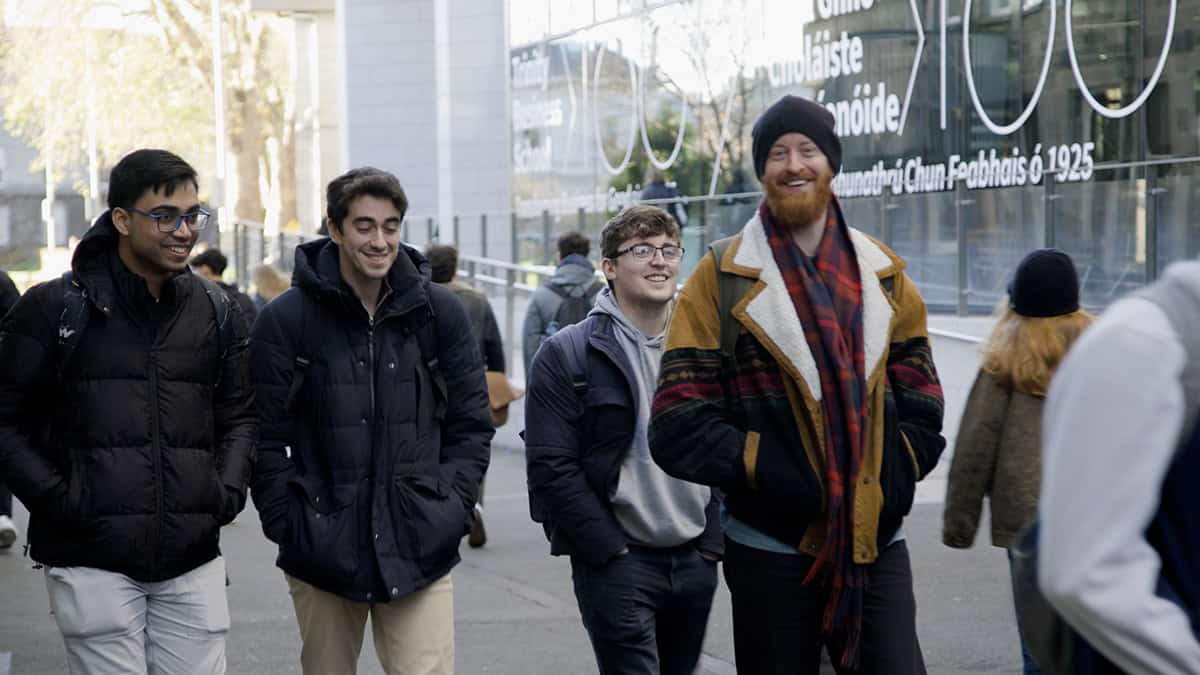
Graduate students at Trinity College Dublin. (Courtesy: Matt Boyd/Mahoo)
The impact of quantum science and technology is going to be profound, with quantum computing in particular – but also quantum sensing, simulation and communication – set to be a major driver of economic growth and sustainable development in countries around the globe.
Ireland is no exception. It is already home to some of the world’s largest technology companies, many of which are heavily investing in quantum technologies. Moreover, the country’s quantum research and innovation community demonstrates a significant level of expertise in fundamental quantum science and quantum technology.
But to ensure Ireland is not only a user of quantum technologies but an active contributor to its development long into the future requires both strong partnerships with industry and public research bodies across borders, and the consistent production of people with the talent and skill to push quantum science forward.
Transferable skills across academia and industry
Founded in 1592, Ireland’s oldest university Trinity College Dublin hosts a future-focused MSc Quantum Science and Technology programme that fits this remit perfectly. The one-year master’s course is the ideal stepping stone into a career in quantum research, whether students want to advance fundamental knowledge in academia or develop the next world-leading quantum technology in industry.
Professor Felix Binder Course Director of Quantum Science and Technology MSc, Trinity College Dublin. (Courtesy: Matt Boyd/Mahoo)
“Unlike other fields, for many of the exciting positions in industry, the skills are very similar to what would be required of a PhD student,” explains quantum information theory expert Professor Felix Binder, who directs the course. “It’s a level of scientific rigour, it’s having a broad knowledge base and coding skills, it’s being confident to independently work on a project – these are what we focus on.”
This is why the course very much leans into helping students develop the fundamentals. Topics such as quantum computation, quantum information theory and open quantum systems are covered in depth. This provides the foundation for exploring more advanced and specialized topics, like quantum materials or tensor network theory.
The combination of fundamentals and highly specialized knowledge is designed to equip students with skills that are relevant for the long term, says Binder. Though he acknowledges that now is an exciting time when many quantum technologies are maturing and being commercialized, the course generally looks beyond the latest fads.
“If students are choosing quantum as their profession, realistically they’re looking at a potential 40-year career,” he says. “As this is their last part of formal lecture-based education, we want to be sure that we set them in good stead for at least many years, and not just the immediate future.”
Career insights
In addition to preparing students with the knowledge they will need, the course also exposes students to people working at the cutting-edge of the subject, providing them with an understanding of the types of careers available and contacts to build their network and take the first steps towards their chosen quantum profession.
For instance, world-leading academic and industry experts deliver a range of short mini-modules and specialist lectures. Some of these experts come from companies involved in the Trinity Quantum Alliance. “The Trinity Quantum Alliance is a unique space on campus where fundamental quantum science and research meets real-world applications,” says the Alliance’s Director Professor John Goold. “Here, multinational companies, SMEs and start-ups come together to work on projects with Trinity academics.”
The founding industry partners are Microsoft, IBM, Moody’s, Horizon Quantum Computing and Algorithmiq. Each partner shares research and regularly presents talks to faculty and students, and most have a presence on or near the Trinity campus. This arrangement offers students direct access to the people shaping the quantum revolution, as well as potential internship opportunities.
Microsoft Ireland scholarship awardees2023/24 Srishti Nautiyal, Grainne Eager and Nana Werther. (Courtesy: Gary Ashe/SHARPPIX)
Further experts who have given guest lectures and shared their experiences are alumni. Several are completing PhDs at various universities dotted across the world, from the EU to the US and Australia. Many have gone on to become full-time researchers and even team leads in quantum companies, including Quandela, Horizon, Algorithmiq and EleQtron, as well as companies traditionally not associated with quantum technology, such as MasterCard. Others have taken positions at government labs across European countries, including a Max Planck Institute in Germany and a national research centre in the UK.
Although this alumni network may be relatively small – with the course having only been running for five years and graduating 60 students – it is extremely useful for the current cohort, showcasing the different paths potentially available to them and providing contacts who can offer support and advice on how to enter and thrive in those careers.
A quantum future for the Emerald Isle
Looking forward, Binder envisions even closer integration of the MSc degree and doctoral training into the European quantum ecosystem. This will be enabled through a new EU-wide training network: the European Quantum Academy. Trinity is one of the lead institutions of this new training academy, which was launched in May 2026. Composed of more than 70 partner institutions from across Europe, it will open new opportunities to students in Ireland in terms of industry interaction, international exchange and advanced training beyond the degree’s core modules.
In addition, there are ongoing plans for further research investment in Ireland, bringing together the different schools within Trinity, and other universities and industry players to work more closely together.
The result of these efforts should be a thriving quantum ecosystem that takes advantage of Ireland’s unique position within the EU and close ties with the US and UK to provide ever more new and varied opportunities in quantum science and technology, as Binder succinctly summarizes: “The field is young and growing – Ireland is a very exciting space for quantum right now”.
MSc students in Dublincity centre Trinity College campus, in close proximity to many of the world’s largest tech companies. (Courtesy: Matt Boyd/Mahoo)
Applications for Trinity’s MSc Quantum Science and Technology are now open for the next academic year. Find out more and apply: www.tcd.ie/physics/quantumtech/
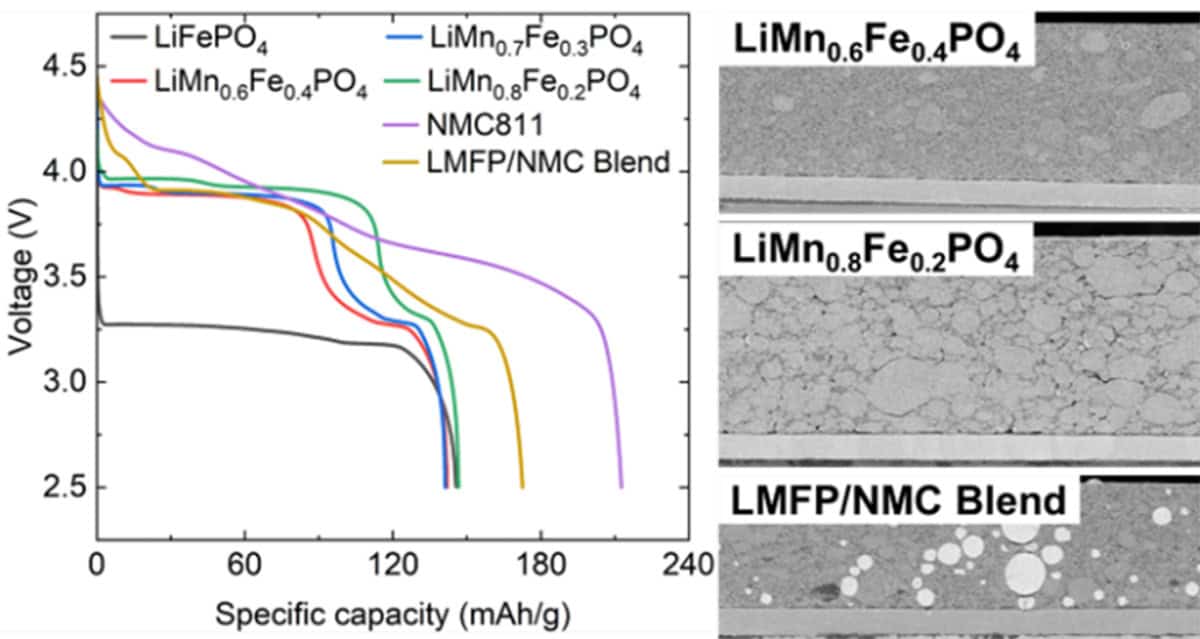
While LiMnxFe1-xPO4 (LMFP) cathode materials have been investigated academically for decades, they have been adopted by dominant battery manufacturers only in the past three years. What has prompted this sudden commercial interest? What market share might LMFP gain, can it outpace LFP and NMC? What are the outstanding limitations, and how might these be overcome?
In this webinar, we aim to answer these questions, covering challenges ranging from the fundamental characteristics of LMFP to large-format cell manufacture and industry trends. We will also showcase recent research carried out at WMG to better understand LMFP behaviour and how AI can be used to design improved LMFP electrode microstructures to enable fast charging.
Join this webinar to find out how this emerging material may alter the EV and battery manufacturing landscape.
Gerard Bree
Gerard Bree is an assistant professor in the battery materials and cells (BMAC) research group at WMG at the University of Warwick, where he carries out research to better understand how lithium-ion battery performance can be improved so that batteries provide more energy over a longer lifetime at a lower cost. He is interested in the interaction between academia and the battery industry and works on many projects supporting companies to build a battery supply chain in Europe. Bree received his undergraduate degree from Trinity College Dublin and his PhD from the University of Limerick.
The prestigious Cavendish Laboratory at the University of Cambridge in the UK has an iconic status in the history of science.
The university’s physics department was initially based in central Cambridge. It is where Francis Crick and James Watson famously worked on the double-helix structure of the DNA molecule.
Yet in 1974 – 100 years after its foundation – the Cavendish moved to a new home on the outskirts of the city.
The building was built in a drab style, covered in grey-brown pebble dash, and featured a maze of interconnected blocks. It was home to generations of physicists, and many thousands of students over the last 50 years.
But the outdated and crammed structure is no longer deemed fit for use and in October last year the lab moved to the nearby larger, brighter and airy purpose-built Ray Dolby Centre. The new centre has been designed to encourage meetings and exchanges with a single entrance, common foyer and centralized café, which are also open to the public.
The move to the Dolby Centre took almost a year to complete, during which time about 180 truckloads moved 3000 m3 of research equipment, crates and furniture belonging to the lab’s 31 research teams.
This included specialized equipment such as 47 cryostats, 98 optical tables, various molecular beam epitaxy set-ups as well a teaching laboratory and museum collection, which includes the model of DNA created by Watson and Crick as well as the cathode ray tube that was used to discover the electron.
Pending chemical and asbestos decontamination, the old building will now be demolished by third-party contractors.
Once complete, the site will host a cycle route until plans are developed for the future use of the site.
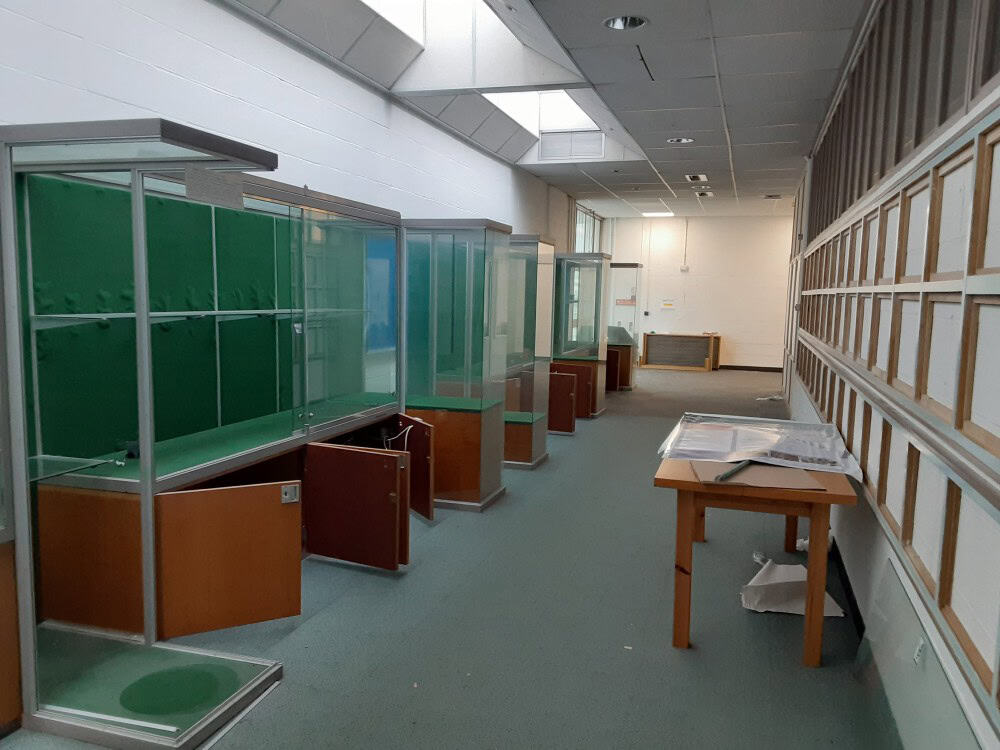
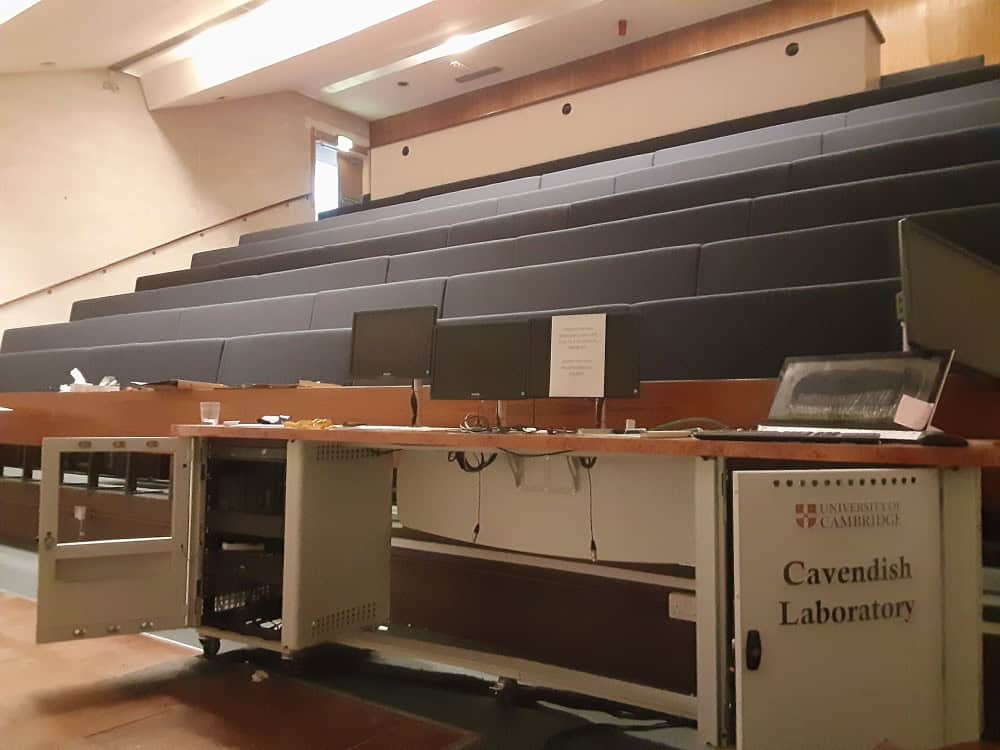
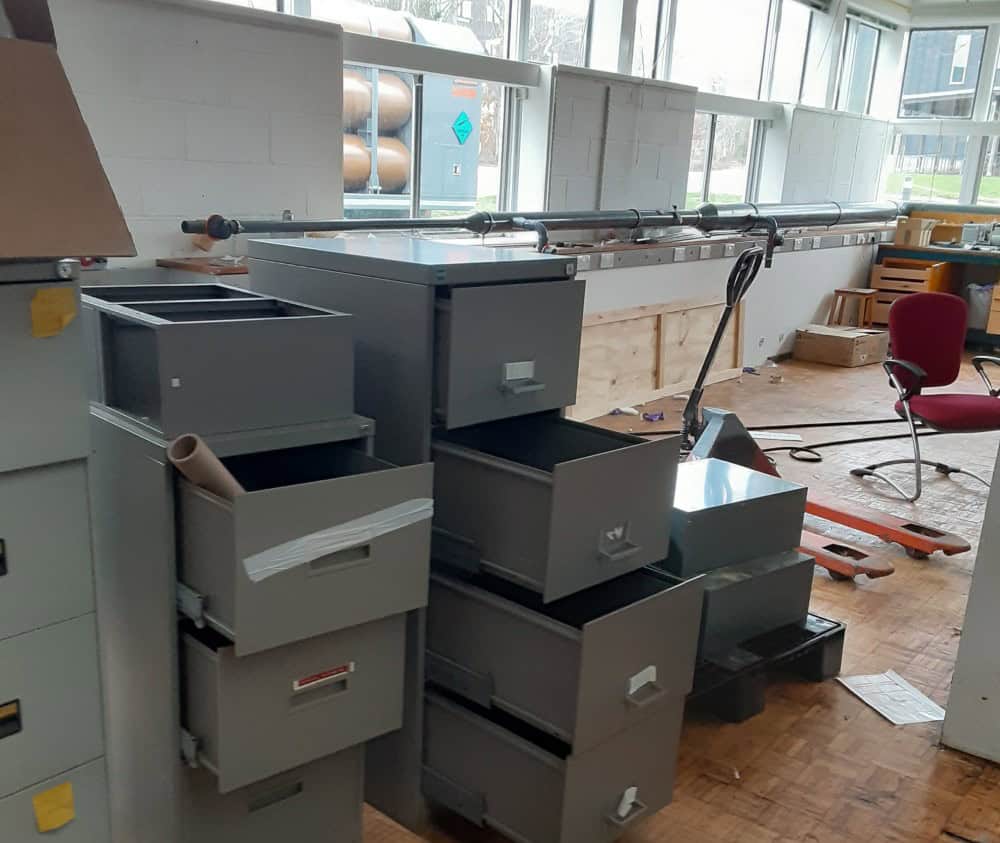
Physics World visited the old building in February and this article presents a selection of images from the site.
Empty cabinets and picture frames at the Cavendish Museum. (Courtesy: Mićo Tatalović)
“An eerie” feel to what was once a bustling world-class laboratory
Following the move to the state-of-the-art Dolby Centre, it’s unlikely that the old building of the Cavendish Laboratory will be missed, except perhaps for its picturesque park and pond.
When I visited the building in February, a few bikes clung to the racks to be disposed of if unclaimed, while a sooty barbecue stood in a corridor.
The silent, empty library and still glowing “lecture in progress” sign in a long-abandoned lecture theatre lent an eerie atmosphere to the place.
Among the emptied, abandoned labs a few areas seemed untouched by the move.
Some offices were still adorned with books, pictures and lab coats, while white boards were filled with equations.
Some of the old equipment left by researchers has been donated to schools and charities, with remaining materials destined for the skip that is placed at the main entrance.
A couple of areas were wet, with water dripping from the ceiling – an indication that it is time to move on.
As I entered a communal area, half-empty liquor bottles line up on a windowsill, a reminder that good times were once had.
Mićo Tatalović
The small lecture theatre. (Courtesy: Mićo Tatalović)Empty cabinets at one of the workshops. (Courtesy: Mićo Tatalović)
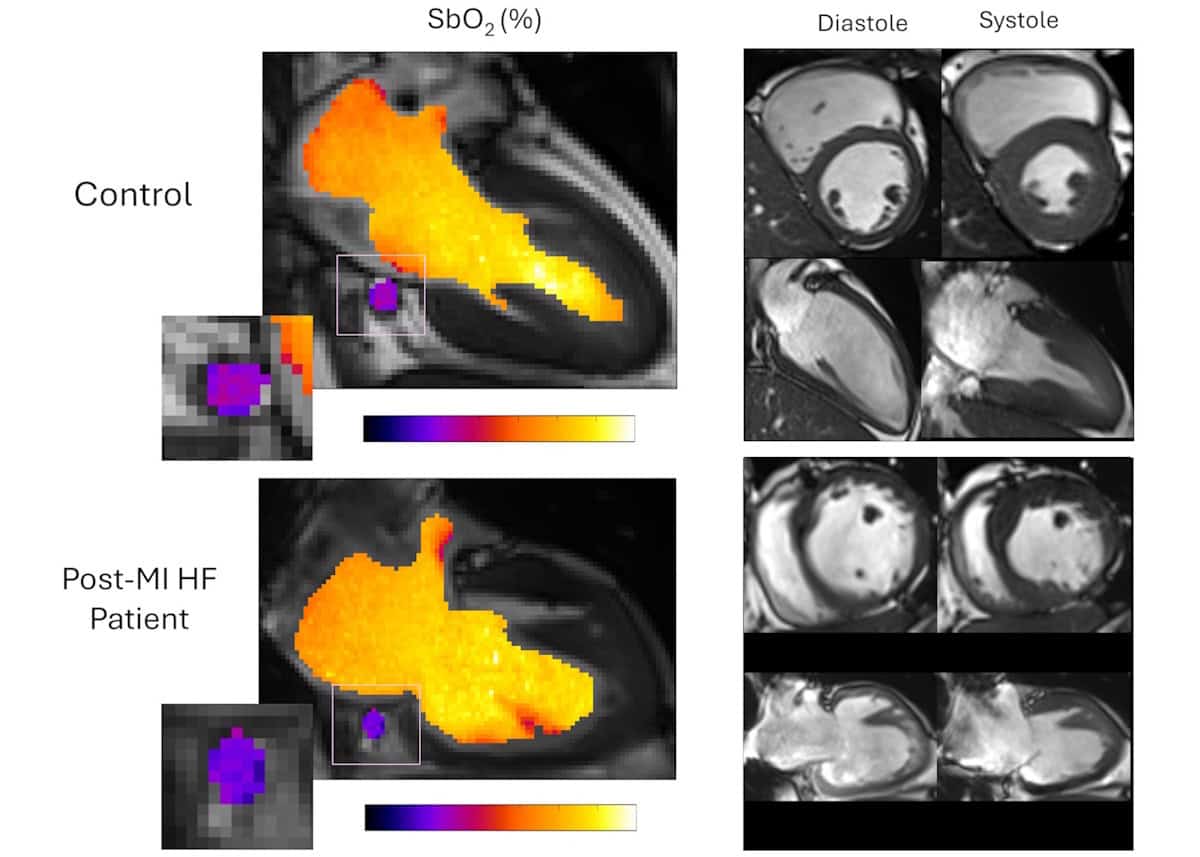
MRI measurements Representative blood oxygen saturation (SbO2) maps and left ventricle (LV) geometry images from a control participant and a patient with heart failure, demonstrating reduced coronary sinus SbO2 and impaired LV contractility in the patient. The colour scale indicates SbO2 of 20 to 100%. (Courtesy: Ting Huang et al. Sci. Trans. Med. 18 eady6269 (2026))
The amount of oxygen that a heart consumes is a key indicator of its health. If the heart is not receiving or using enough oxygen, heart tissue can be damaged, contributing to future heart failure.
With abnormal myocardial oxygen consumption an indicator of potential cardiac dysfunction, its measurement could help in the early detection and treatment of heart failure. And as one in four individuals are likely to develop heart failure in their lifetime, this is of critical importance. But measurement of myocardial oxygen consumption is not a simple process. The gold standard for determining the heart’s oxygen use is cardiac catheterization. But this test – which involves threading a catheter from a patient’s neck or groin into the coronary sinus (CS), the largest coronary vein – is highly invasive, time-consuming and comes with a level of risk.
A new MRI technique may soon offer a rapid, non-invasive alternative. Developed by an international research team headed up at Cedars-Sinai Health Sciences University, the high-resolution MRI method can assess the heart’s oxygen consumption in just three minutes. In an initial study of 22 patients with heart failure, reported in Science Translational Medicine, the team validated its accuracy, feasibility, performance and repeatability.
Principal investigator Hsin-Jung Yang is director of cardiac imaging research in the Biomedical Imaging Research Institute at Cedars-Sinai Medical Center.
MRI is sensitive to blood oxygenation via the blood oxygen level–dependent (BOLD) signal, originally developed for mapping brain activity. Use in the heart remains challenging, however, due to the need for complex calibration, motion sensitivity and long acquisition times. Hsin-Jung Yang, of the Biomedical Imaging Research Institute at Cedars-Sinai, and collaborators overcame these obstacles by developing a rapid, self-calibrated cardiac MRI framework that enables free-breathing blood oximetry (measurement of blood oxygen saturation) in the CS and quantification of whole-heart myocardial oxygen extraction, without requiring contrast agents or pharmaceutical stress.
The researchers’ primary objective was to determine the accuracy and precision of MRI-derived measurements of CS blood oxygenation, compared with those obtained by invasive CS catheterization. They also aimed to perform non-invasive quantification of global myocardial oxygen consumption and myocardial oxygen efficiency, with comparisons between healthy controls and patients with heart failure.
To achieve this, they developed a motion-resolved reconstruction algorithm for cardiac BOLD MRI that enables clear imaging of the moving heart during breathing and heartbeats. The team first validated the method in pigs, and then applied it to a group of 22 patients with heart failure and a history of previous heart attack, as well as 11 healthy volunteers.
The researchers acquired clinical cine images to define the cardiac anatomy, localize the CS and measure ventricular function for estimating the oxygen–mechanical work coupling efficiency. Using this approach, they identified impaired myocardial oxygen consumption in the patient group, including those with preserved ejection fraction (how much blood the left ventricle pumps out with each contraction, a low value of which can indicate a heart problem). The finding that impaired oxygen consumption was measurable even before detectable structural or functional decline may facilitate the early detection of cardiac dysfunction.
The researchers note that their self-calibrated MRI framework directly addresses the difficulty of performing quantitative oximetry of the CS – a mobile blood vessel that undergoes marked displacement throughout the cardiac cycle. “Our framework directly addresses these challenges with a continuous, free-breathing, motion-resolved 3D acquisition that retrospectively sorts data across cardiac and respiratory phases, ensuring stable CS tracking despite its complex motion and size variation,” they write.
By eliminating the dependence on gating and calibration, the method could be applied across diverse clinical populations, including those with arrhythmias, intolerance of breath-holding or physiologic stress, for whom conventional gated acquisitions are unreliable. The team suggests that the framework also holds promise for extending oxygen consumption imaging to other moving organs, such as the liver and kidney, and that in the future, the motion-resolved BOLD framework could be applied to tissue-based quantification.
The researchers are performing ongoing clinical studies to evaluate the MRI technique in aortic stenosis (narrowing of the aortic valve) and hypertrophic cardiomyopathy (thickening of the heart muscle), where altered oxygen extraction and metabolic efficiency have revealed disease severity, risk and treatment response beyond conventional imaging.
More broadly, the Yang Lab is extending this approach to characterize oxygen utilization in all cardiometabolic diseases and associated emergent therapies, with the goal of noninvasively defining myocardial energetic supply–demand balance, identifying therapy–response phenotypes, and monitoring disease progression and metabolic remodelling over time.
“By enabling a fast, non-contrast, non-ionizing radioactive method for measuring cardiac oxygen metabolism, [this MRI method] can unlock frontiers for early diagnosis, personalized therapy, and the development of next-generation cardiometabolic treatments to combat the global heart failure epidemic,” the team concludes.

 Login
Login