Normal view

Physicist John Hill takes the helm at Brookhaven National Laboratory

28 May 2026 at 12:57

John Hill has become director of the Brookhaven National Laboratory in Long Island, New York, after serving as interim lab director since September. Hill will now oversee Brookhaven’s 3000-strong team of scientists, engineers and technicians as well as manage the lab’s annual $900m budget.

Brookhaven opened in 1947 as one of the first three US national labs, the others being Argonne and Oak Ridge. Brookhaven carries out a wide range of research in the physical, biomedical and environmental sciences and is home to seven Nobel-prize-winning discoveries.

Brookhaven operated the Relativistic Heavy Ion Collider (RHIC) until it shut down in February. RHIC collided heavy nuclei such as gold and copper to produce a quark-gluon plasma – a state of matter thought to have been present in the very early universe.

In 2020, Brookhaven was chosen to host the next-generation Electron-Ion Collider (EIC). Costing about $2bn, the EIC will smash together electrons and protons to probe the strong nuclear force and the role of gluons in nucleons and nuclei.

Building the EIC involves revamping the RHIC accelerator as well as adding an electron ring and other components with the first experiments starting the 2030s.

As well as RHIC and the EIC, Brookhaven is also home to other big-science projects including the National Synchrotron Light Source II, which opened in 2015 at a cost of $912m.

A Brookhaven career

With a PhD in physics from the Massachusetts Institute of Technology, Hill joined Brookhaven as a postdoc in 1992 before leading the lab’s X-ray scattering group from 2001 to 2013.

He then became deputy associate laboratory director for energy and photon sciences until becoming the lab’s deputy director for science and technology from 2023 to 2025.

In September 2025 he became interim director following the resignation of the theoretical physicist JoAnne Hewitt.

In the role, Hill will also become president of Brookhaven Science Associates – a partnership between Stony Brook University and the science and tech firm Battelle – that manage and operate Brookhaven on behalf of the US Department of Energy.

Hill notes that he is “very excited” to lead the lab in the coming years. “Brookhaven is entering a defining decade, and I’m honoured to take on this role at this time,” he says. “The vision we have for our future is a powerful one, including delivering the nation’s next particle collider and advancing science across a range of critical areas.”

The post Physicist John Hill takes the helm at Brookhaven National Laboratory appeared first on Physics World.

Nottingham physics redundancies ‘an act of academic sabotage’, warn scientists

19 May 2026 at 14:00

Almost 2000 scientists have signed an open letter criticising planned redundancies at the University of Nottingham in the UK. The signatories, which includes six Nobel laureates, call on the university to reverse its plan to reduce the number of staff members in the physics department from 71 to 51.

News of the possible job losses emerged on 12 May, when 2700 Nottingham staff were sent letters saying they were at risk of redundancy as part of plans to slash more than 600 academic posts throughout the university. The university says it is making the move because it could otherwise run out of money within the next five years.

Nottingham is a member of the “Russell Group” of 24 leading, research-intensive universities in the UK, with its school of physics and astronomy ranking seventh out of 44 UK physics departments in the most recent REF assessment. It is famous for its work on magnetic resonance imaging, through the contributions of the Nottingham Nobel-prize-winning physicist Peter Mansfield.

From the 2700 staff receiving letters, 56 are in physics and represent academic and technical staff across all levels. Antonio Padilla, a particle theorist at Nottingham, told Physics World that putting almost all members of physics staff at risk is an “act of academic sabotage”.

It takes years of dedication to build up a world-class reputation. I worry that it can be destroyed much more quickly

Antonio Padilla, University of Nottingham

“This is a school brimming with creativity and innovation,” he says. “There is excellence in all areas of physics, from particles to astronomy, from condensed matter to medical imaging. It takes years of dedication to build up a world-class reputation. I worry that it can be destroyed much more quickly.”

The open letter created by researchers at Nottingham in response to the cuts says that the proposals will cause “long-lasting damage” to what they claim is a “globally respected physics department”. It urges senior leaders at Nottingham to work with the University and College Union (UCU) to create “a more sustainable vision for physics and astronomy at the university”.

Stating that the job cuts will lead to fewer students applying to the university due a “decline in its reputation”, as well as a loss of student income, the letter has so far been signed by six physics Nobel laureates – Andre Geim, Andrea Ghez, Konstantin Novoselov, Roger Penrose, Didier Queloz and Brian Schmidt. Geim was once a postdoc at Nottingham.

“Physics underpins current and future economic developments; from AI, through quantum technologies to new medical imaging techniques,” the letter states. “Cutting the university’s strength in these areas is a short-sighted move that will deprive Nottingham students and the East Midlands of the capability to take advantage of these opportunities for growth.”

The university should exhaust every option to make the department sustainable before resorting to compulsory redundancies; shrinking it now is shortsighted

Catherine Heymans, Astronomer Royal for Scotland

Catherine Heymans, Astronomer Royal for Scotland, who has signed the letter, says that the UK needs “strong, geographically distributed physics departments” to help diversify the economy away from just a few centres. “The university should exhaust every option to make the department sustainable before resorting to compulsory redundancies; shrinking it now is shortsighted,” she says.

Those comments are echoed by Jim Wild, president of the Royal Astronomical Society, who urges Nottingham to reconsider the short-sighted cuts. “Reducing staff capacity by this magnitude will irreparably damage a world-class department, severely harming both its international reputation and its capacity to deliver high-quality education,” he says.

A ‘more careful approach’

Padilla, who is UCU representative for Nottingham’s physics and astronomy department, says that “a more careful approach” is required to protect staff at the university. He points out that the UCU has proposed an alternative financial model for the university that “doesn’t set fire to our academic reputation”.

After two decades in which the UK university sector has boomed, there are now fears that the problems at Nottingham could be replicated elsewhere. “What happens at Nottingham now matters for the rest of the sector,” adds Padilla. “This isn’t just make or break for physics at Nottingham – it matters for science everywhere in the UK and beyond.”

Philip Moriarty, another at-risk Nottingham physicist, says that the UCU offer, which he says has been “carefully considered, costed and modelled” has been “rejected, out of hand, with no justification by the university”. Senior management at the university, he adds, “have provided no evidence to support their strategy, including, in particular, their university-wide 18-22 student-staff ratio target”.

On 18 May all affected staff across the university were sent an e-mail to participate in a “supporting you during change” programme that involves two 90-minute online webinars “to help you consider the proposed changes that have been announced and to help you plan for what you may wish to do next”.

“Nauseatingly, even the provision of ‘support’ for staff during this process has been outsourced to an external consultancy company,” adds Moriarty. “Alongside the complete disregard for data and evidence, it’s the disingenuousness and dishonesty that rankle most. Their repeated claims that they care about staff are baseless.”

In a statement, a spokesperson at the University of Nottingham noted that “doing nothing is not an option” given the “significant financial challenges” the university faces.

“We know that change of this scale is not easy, and we do not underestimate what it means for many of our colleagues and students. We will be doing everything we can to support our people through the next few months,” the statement says. “These are really difficult decisions and we have not taken them lightly. It is vital that we respond to the changing sector demands to ensure we are sustainable for future generations and continue to deliver world leading teaching and research and an excellent student experience.”

The post Nottingham physics redundancies ‘an act of academic sabotage’, warn scientists appeared first on Physics World.

Striking mathematical pattern uncovered in Chinese money plant leaves

15 May 2026 at 13:00

Researchers in the US and Canda have discovered a naturally occurring “Voronoi pattern” in the Chinese money plant.

Voronoi diagrams were introduced in the 1600s by French philosopher René Descartes and are named after the Russian mathematician Georgy Voronoi, who defined and studied them in the early 1900s.

Voronoi diagrams are geometric patterns used to divide space into regions. The plane is divided up into tessellating polygons, known as cells, that each contain a “seed” point. Every location inside a cell is closer to its seed than any other seed in a neighbouring cell.

Voronoi patterns have numerous applications across mathematics, as well as in various other disciplines such as modelling animal territories, city planning or crystal growth.

Voronoi-like patterns are common in nature, such as giraffe stripes. However, the difference between textbook Voronoi patterns and what we see in nature is that the latter usually lacks visible seed points.

Now, Saket Navlakha from Cold Spring Harbor Laboratory in New York and colleagues have found an exception in Pilea peperomioides, the Chinese money plant.

Chinese money plants are perennials native to China’s Yunnan and Sichuan provinces. The plant has round, flat leaves that feature prominent pores called hydathodes. These points are then surrounded by looping reticulate veins that transport water and nutrients to and from the leaf.

By mapping the pores and veins, the team discovered a naturally occurring, visible, Voronoi pattern with the veins acting as the cell boundaries and the pores being the seed points. They then built a mathematical model to match the observed patterns.

“To our knowledge, this is the first demonstration of the occurrence of Voronoi diagrams in plant venation patterns, where both edges and centres are visible and functional,” they write.

The researchers now plan to use the model to understand why other plants that have similar vein structures do not stick to the Voronoi structure in the same way as the Chinese money plant.

The post Striking mathematical pattern uncovered in Chinese money plant leaves appeared first on Physics World.

Paul Howarth: IOP president highlights the need to raise the profile of physics in society

14 May 2026 at 14:30

This episode of the Physics World Weekly podcast features an interview with Paul Howarth, who became president of the Institute of Physics (IOP) in February.

The IOP is the professional body and learned society for physics in the UK and Ireland. Representing 21,000 members, it supports physicists at all stages of their careers and seeks to make physics accessible to people from all backgrounds.

With a PhD in nuclear physics, Howarth has had a long career in the nuclear sector working on the European Fusion Programme and at British Nuclear Fuels, as well as co-founding the Dalton Nuclear Institute at the University of Manchester and serving as chief executive officer of the National Nuclear Laboratory.

He talks to Physics World’s Michael Banks about his career in nuclear energy and his priorities now as president of the IOP. These include improving physics education and raising the profile of physics and physicists across society.

Howarth also voices concerns about recent funding cuts to particle physics, astronomy and space science in the UK, saying it could hamper the flow of students into the subject, with a potential impact on burgeoning areas such as quantum tech.

  • The Institute of Physics owns IOP Publishing, which brings you Physics World.

The post Paul Howarth: IOP president highlights the need to raise the profile of physics in society appeared first on Physics World.

Officials hail ‘major milestone’ for US Deep Underground Neutrino Experiment

8 May 2026 at 14:43

A vast complex of steel beams for a next-generation neutrino detector has begun its descent underground in what officials have called a “pivotal phase” towards construction of the $3.3bn Deep Underground Neutrino Experiment-Long-Baseline Neutrino Facility (DUNE-LBNF).

An event was held yesterday – attended by senior officials including CERN director-general Mark Thomson and Dario Gil, undersecretary for science at the US Department of Energy (DOE) – to commemorate the start of moving 4.5 million kilograms of steel beams underground that will be used to hold DUNE’s detectors in place.

In February 2024, excavation work finished on two huge underground spaces for DUNE. Located 1.6 km underground at the Sanford Underground Research Facility in South Dakota and are some 150 m long and seven storeys tall, the spaces will be used to house DUNE’s four neutrino detector tanks that are each filled with 17,000 tonnes of liquid argon and cooled to 88 K.

When complete in 2031, DUNE-LBNF will study the properties of neutrinos in unprecedented detail, as well as the differences in behaviour between neutrinos and antineutrinos.

DUNE will measure the neutrinos that are generated by Fermilab’s accelerator complex, which lies around 1300 km away just outside Chicago.

The cryostat materials, which have been contributed by the CERN, are now scheduled to be moved underground and installed in the next few months.

“Today represents the start of a pivotal phase for DUNE, the development of the far detector structures in South Dakota,” noted Fermilab director Norbert Holtkamp. “Our focus remains on safety, quality and schedule — in that order — to ensure we successfully deliver on behalf of the US Department of Energy, our nation and the world.”

The post Officials hail ‘major milestone’ for US Deep Underground Neutrino Experiment appeared first on Physics World.

Tiny knotted fibre leaps into the air like a springtail bug

1 May 2026 at 14:00

Researchers at the University of Pennsylvania and the University of California, Los Angeles, have created a tiny, soft knot-like fibre that can jump metres into the air.

The fibre is less than a millimetre thick, and a few millimetres long and contains a Kevlar core surrounded by a shell of liquid crystal elastomer (LCE).

The Kevlar provides strength and stiffness while the LCE adds some flexibility and responsiveness.

“People think of a knotted fibre as something passive,” says Shu Yang from the University of Pennsylvania. “But if you design the elasticity and materials carefully, the knot itself becomes an active system.”

When the fibre is knotted it behaves like a spring held in place by a latch, which can be undone via changing the temperature.

When the temperature is increased to 60–90 °C, the LCE shell contracts and untwists, which loosens the knot just enough to trigger an abrupt untying.

All that stored elastic energy then converts into kinetic energy, propelling the fibre almost 2 m into the air – a feat comparable to the jumping capabilities of a springtail bug (for a video see here).

Changing the knot’s topology and the materials used allows the researchers to tune how the fibre moves after take-off. For example, a simple overhand knot results in a flipping motion while a figure-eight knot leads to the fibre spinning.

Inspired by the flight of Maple seeds, the team attached a thin, leaf-like appendage to the fibres, finding that where the wing is positioned on the knot resulted in the fibre landing far away or curving backwards towards its starting position.

Given the fibres can be activated with temperature, the researchers think the robot could find applications in agriculture and reforestation.

“We often start by exploring interesting phenomena,” adds Yang. “Then we ask how far we can push them and whether they can solve real problems.”

The post Tiny knotted fibre leaps into the air like a springtail bug appeared first on Physics World.

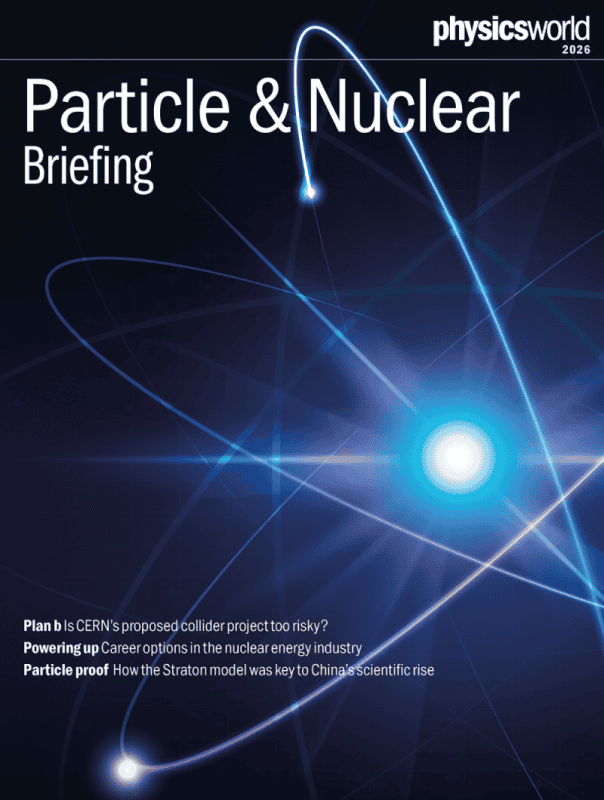
The Physics World 2026 Particle and Nuclear Briefing is out now

29 April 2026 at 11:00

Since taking up the role of CERN director-general earlier this year, Mark Thomson has already had to contemplate the consequences of funding changes within the UK’s research councils.

Late last year, UK Research and Innovation, the umbrella organization for the UK’s research councils, did not commit any further contributions towards a major £150m upgrade to the LHCb detector – one of the four large experiments at the Large Hadron Collider that continues to do pioneering science.

As we report in the Physics World 2026 Particle & Nuclear Briefing, unless the decision is overturned or other avenues of funding are found, the experiment will now finish operations in 2033 and not take advantage of the High-Luminosity LHC (HL-LHC) that is currently being installed at CERN.

Another item in Thomson’s in-tray will be setting the course for the next flagship collider at CERN after the HL-LHC finishes operations in the 2040s.

In the ongoing process to update the European Strategy for Particle Physics, the Future Circular Collider (FCC) is the preferred option. Constructed near the LHC, this huge 91 km circumference electron–positron collider will come with a significant cost of $18bn. Thomson could find it a hard sell with some of the funding needing to come from outside CERN’s 24 member states.

Front cover of the 2026 particle and nuclear breifing
(courtesy: IOP Publishing)

As physicist and historian Michael Riordan points out in the briefing, the eye-watering cost of the FCC together with the worsening geopolitics of a fragmenting world order could make funding and building such colliders risky.

There are still many open questions over building the FCC, and indeed the future of particle physics, and some of those issues are set to be discussed at the 17th International Particle Accelerator Conference, which will be held in Deauville, France, from 17-22 May.

Elsewhere in the briefing, we talk to six physicists working across the nuclear energy industry, highlighting how a background in physics can open many doors in this expanding sector, and take a look at an obscure theory of elementary particles that proved to be key to China’s re-emergence as a scientific nation after the Cultural Revolution had stalled its development.

  • The free-to-read Physics World 2026 Particle & Nuclear Briefing is available here.

The post The Physics World 2026 Particle and Nuclear Briefing is out now appeared first on Physics World.

Study reveals the physics behind nature’s pointed tips

24 April 2026 at 14:00

You might think that a bee’s stinger, a rose’s thorn or a razor-like animal tooth has a sharp pointed tip, rather like “cone-shaped” needles used for injections. Yet a closer look finds otherwise, and these objects are usually rounded at the tip, curving gently like a parabola.

Why this is the case is a mystery and it was thought that it was the result of convergent evolution, in other words different species independently arriving at similar solutions.

This is partly because a rounded curve penetrates skin better as it distributes forces more evenly throughout the tissue. The rounded shape is also less prone to breaking than a perfect cone.

Physicist Kaare Hartvig Jensen from the Technical University of Denmark (DTU), however, was not convinced by the evolution argument. “There is a general notion that almost everything in nature exists for a reason,” he says. “But if you look at an unused tooth, it does not necessarily have [a rounded] shape, and if you observe the shape later in the organism’s life, the parabola will emerge.”

Jensen thought that simple mechanical wear might be behind the effect, and so with his DTU colleague John Sebastian, they went about testing this hypothesis.

To do so they were inspired by industrial durability testing where a robot sits on a chair every few seconds to test its robustness, for example.

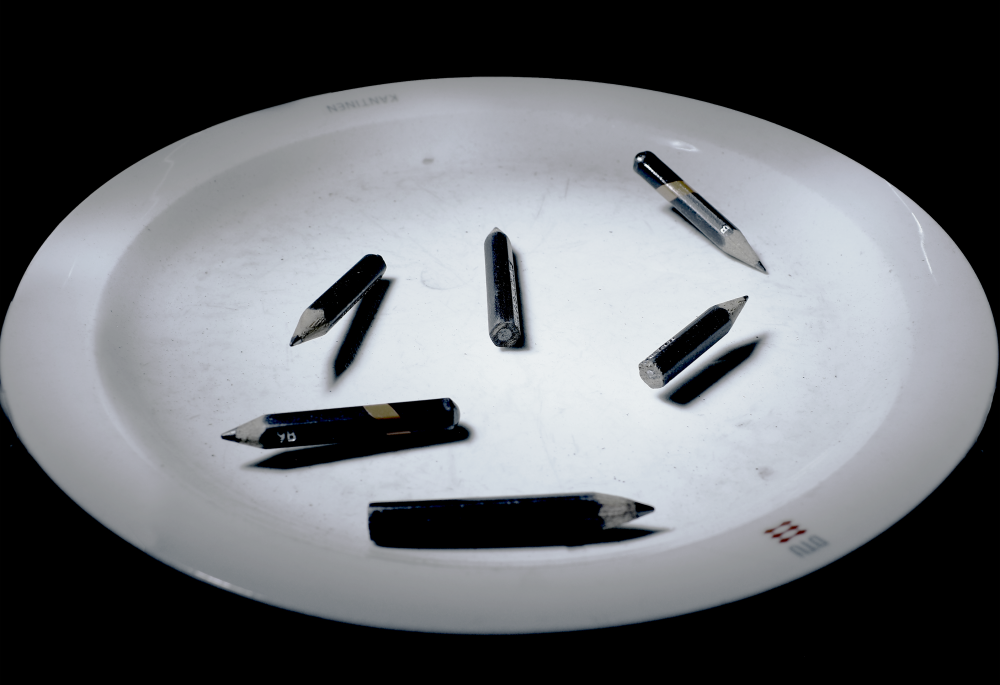
Their set-up involved a plate atop a vibrating machine containing a number of objects. “Initially, I attempted to build a device using sharpened chalk, but it produced a lot of dust,” he told Physics World. “Ultimately, I settled on pencils.”

pencils on a plate
Collision course The pencils were vibrated on plate for over four hours. (Courtesy: John Sebastian, Technical University of Denmark)

They sharpened the pencils as stand-ins for their biological counterparts and put them on the plate for over four hours as they constantly collided with each other. The team also carried around pencils in a small box in their pockets for several days, again to expose them to random collisions and movements.

They found that no matter how sharp the pencils were to begin with, their tips always developed the same rounded parabolic shape.

“This points to something more fundamental: that random processes in and of themselves can lead to a universal form,” adds Jensen. “The parabola is a stable shape across scales, from a thorn to an elephant’s tusk. The tips are thus not necessarily designed perfectly from the start – they become so through random wear.”

Jensen admits that – rather than in the isotropic case with pencils – most real biological materials have some structure to them, being stronger in one direction than another.

“I would like to explore what shapes result from random wear on these structured materials,” adds Jensen. “Perhaps we can start with something like nails – sharp right after cutting, then gradually blunting. Exactly how this occurs would be of interest.”

The post Study reveals the physics behind nature’s pointed tips appeared first on Physics World.

Researchers express ‘grave concern’ over attacks on Iranian institutions and science

22 April 2026 at 14:58

Almost 1400 people, including two Nobel laureates, have signed an open letter condemning the US/Israeli attacks on Iranian academic institutions. The signatories call on the international community to “protect scientific infrastructure, defend academic life, and uphold the principle that knowledge-serving institutions must never be treated as expendable in war”.

The letter, which is addressed to the United Nations secretary-general, the director-general of UNESCO, the UN High Commissioner for Human Rights and “the governments of all parties to the conflict”, was instigated by the theoretical condensed-matter physicist Alireza Qaiumzadeh and colleagues from the Norwegian University of Science and Technology.

The signatories, which include May-Britt Moser and Edvard Moser who shared the 2014 Nobel Prize in Physiology or Medicine, express their “grave concern” over the attacks that they say have “damaged laboratories, universities, hospitals, and other scientific institutions”.

Organizations that have been attacked include Isfahan University of Technology, Iran University of Science and Technology and the Pasteur Institute of Iran and Sharif University of Technology. During the 12-day war between Israel and Iran in June 2025, Israel’s Weizmann Institute of Science and Ben Gurion University were also hit.

“Scientific and educational institutions are civilian spaces essential to public health, knowledge, and human survival,” the letter states. “Their destruction endangers researchers, students, medical personnel, and the broader public, while causing lasting harm to science and society.”

Qaiumzadeh says that many of the Iranian research institutions that have been destroyed were built over decades under sanctions. “My colleagues in Iran are deeply disheartened to see that what they achieved under such difficult conditions has been reduced to rubble,” he says.

Due to the ongoing war, which began on 28 February, many schools, universities and research centres – in which more than 60% of Iranian students in STEM subjects are women – are now closed, with courses forced online under limited internet access.

Particle physicist John Ellis from King’s College London, who is among those who signed the letter, says that he counts many Iranian, Gulf State and Israeli physicists among his colleagues and friends and says he has visited some of the institutions that have been attacked.

“I deplore any and all military attacks on universities, and indeed other educational institutions,” adds Ellis. “I can only hope that this open letter and the publicity it receives may help convince the belligerents to refrain from such attacks.”

The letter now calls on all parties in the war to “immediately” end attacks on civilian scientific and educational sites. “Science is not a military target,” the letter states. “Universities and laboratories must not become battlefields.”

It also calls on international bodies to “document [the] damage”, “protect affected scholars and students” and “support independent investigations into violations of international humanitarian law”.

Qaiumzadeh told Physics World that he finds it “particularly troubling” the scientific bodies, such as academies and international scientific organizations, have remained largely silent during the conflict.

“They must understand that undermining academic institutions will only worsen the situation for those who believe in gradual, constructive change within Iran’s complex society,” he says.

The post Researchers express ‘grave concern’ over attacks on Iranian institutions and science appeared first on Physics World.

Dark energy survey unveils the largest 3D map of the universe

17 April 2026 at 11:00

The Dark Energy Spectroscopic Instrument (DESI) has created the largest high-resolution 3D map of the universe. The work involved observing more than 47 million galaxies and quasars as well as 20 million stars over a five-year period. Researchers will now use the vast dataset to probe the nature of dark energy.

DESI, which began collecting data in 2021, is mounted on the Nicholas U Mayall 4-m Telescope at the Kitt Peak National Observatory in Arizona. It comprises 5000 robot-controlled optical fibres that send light to an array of spectrographs.

This allows DESI to make an extensive map of galaxies and quasars with the spectroscopic data providing a measure of how fast a galaxy is moving away from us, which is determined by a galaxy’s redshift.

By comparing how galaxies clustered in the past with their distribution today, researchers can trace dark energy’s influence. Work published in 2024 found hints that the acceleration of the expansion of the universe has not been constant.

DESI will now use the expanded dataset to further test whether the “cosmological constant” could be evolving over time with the results expected to be published next year.

DESI director Michael Levi, who is based at the Lawrence Berkeley National Laboratory, says the survey has been “spectacularly successful and is “incredibly exciting”.

“The instrument performed better than anticipated,” he says, “We’re going to celebrate completion of the original survey and then get started on the work of churning through the data, because we’re all curious about what new surprises are waiting for us.”

DESI will now continue observations into 2028 and further expand the map by about 20% to include parts of the sky that are more challenging to observe.

The post Dark energy survey unveils the largest 3D map of the universe appeared first on Physics World.

NASA launches crewed Artemis II mission to the Moon

2 April 2026 at 14:04

NASA has successfully launched four astronauts on a 10-day mission to the Moon. The crew – Reid Wiseman, Victor Glover, Christina Koch and Jeremy Hansen – were aboard the Orion spacecraft that was launched yesterday by a Space Launch System rocket from NASA’s Kennedy Space Center in Florida.

The mission is the first crewed lunar flyby in more than 50 years but it also represents a number of significant firsts with Koch, Glover and Hansen set to be the first woman, Black person and Canadian, respectively, to travel to the Moon.

Following launch, the Orion capsule was put into Earth orbit and after five hours into the flight, the craft deployed four CubeSats – from Argentina’s Comisión Nacional de Actividades Espaciales; the German Aerospace Center; the Korea AeroSpace Administration; and the Saudi Space Agency – that will conduct scientific investigations and technology demonstrations.

The craft is now set to carry out a six-minute rocket firing that will send the spacecraft towards the Moon.

During a lunar flyby on 6 April, the astronauts will take photographs and provide observations of the Moon’s surface being the first people to see some areas of the far side.

Some four days later, the craft will then return to Earth and splash down in the Pacific Ocean.

This mission follows the Artemis I mission, which carried a simulated crew of three mannequins wired with sensors, that completed a flyby of the Moon in 2022.

Artemis III, meanwhile, is currently ear-marked for launch in 2027, planning to be the first crewed lunar landing since the Apollo missions in the 1960s and 70s.

Will the Artemis programme instil the same sense of awe as the Apollo missions?

In the summer of 1969 I was four years old and I have a very distinct memory of my mother calling me and my brother in from the garden to watch something on television. That something had to do with NASA’s Apollo 11 mission to the Moon.

For years, I thought that I had watched Neil Armstrong take his first steps on the Moon on live TV. I now realize that the timing was all wrong. I was in Montreal and it was daytime – whereas the walk occurred at about 11 p.m. EDT, well after my bedtime. So I was (probably) not one of the estimated 500 million people worldwide (including Pope Paul VI) who witnessed this momentous event as it happened.

Regardless of whether I watched it live or not, the first human steps on the Moon made a great impression on me – and who knows, maybe that early exposure to the cutting edge of science and technology encouraged me to pursue a career in physics.

I could be wrong, but I don’t think that the Artemis missions will instil the same awe in people as did the Apollo missions. I didn’t watch the Artemis II launch and I had a distinctly “been there, done that” feeling when I heard about its success.

Indeed, I have been left wondering exactly why the US has decided to return to the Moon now. Is it for reasons of science and exploration (possibly setting the scene for a human mission to Mars), or is this more about nationalism and colonialization? I hope it is the former, because for me sending humans to the Moon and beyond is akin to blue-sky research in physics – probing the universe to expand knowledge, with the confidence that this will result in a better world.

Hamish Johnston is an online editor of Physics World

The post NASA launches crewed Artemis II mission to the Moon appeared first on Physics World.

Researchers from China dominate IOPP outstanding reviewer awards

27 March 2026 at 17:36

More than 1600 researchers from 74 different countries have won “outstanding reviewer awards” from IOP Publishing, with researchers from China making up almost a third of awardees. The annual award recognises scientists who have delivered exceptional peer-review reports for IOP Publishing journals over the past year.

Reviewer feedback to authors plays a crucial role in the peer-review process, boosting the quality of published papers for the benefit of authors and the wider scientific community. Awards such as those from IOP Publishing are an attempt by publishers to raise the importance of courteous and constructive peer review.

This year’s recipients were selected from about 35,000 reviewers who submitted peer-review reports to IOP Publishing journals in 2025. Journal editors evaluated nominees based on the volume, timeliness and quality of their reviews.

A total of 1621 individuals have been honoured with a 2025 award. China makes up 30% of awardees followed by 16% from the US and just over 6% from India. Some 10% of this year’s award winners are also based in lower middle-income countries or territories.

“High quality peer review is essential to maintaining trust in science as it safeguards the quality and integrity of academic work,” notes Laura Feetham-Walker, IOP Publishing’s reviewer engagement manager. “I’d like to thank this year’s winners, whose thoughtful and rigorous reviews help advance scientific discovery and strengthen the communities we serve.”

The IOPP’s outstanding reviewer programme has been awarded annually since 2016. The IOPP also recently introduced a peer review excellence certification programme that provides free peer review training and certification. In 2025, more than 1500 reviewers took the initiative.

The post Researchers from China dominate IOPP outstanding reviewer awards appeared first on Physics World.

❌