Almost a fifth of the earth's population lives in Africa. And Africa's next generation of power projects "is increasingly being built around solar and wind power and battery storage," reports the Associated Press, "as governments and investors shift away from coal and large hydropower dams in search of cheaper, faster and more reliable electricity."
The shift is visible in a $1.5 billion energy agreement between China and Zambia announced in early May that includes three separate 300-megawatt projects spanning solar, wind and coal-fired power. While the inclusion of coal underscores the continent's continuing need for stable baseload electricity, African countries facing rising fuel import bills as a result of the Iran war, unreliable grids and growing industrial demand are increasingly turning to renewable energy projects that can be deployed faster and more cheaply than traditional plants.
Of the 322 energy projects announced across Africa in 2025, 173 were solar projects, followed by hydropower at 46, wind at 34, gas at 22 and hybrid energy projects at 14, according to the energy research firm Electron Intelligence... Utility-scale solar power costs have dropped by nearly 90% globally since 2010, while onshore wind costs have fallen around 70%, making renewables the cheapest source of new electricity generation in many African markets...
Much of the growth is through distributed solar and battery systems installed directly in mines, factories, telecom towers and homes. "Most official statistics still measure the energy transition the old way, by counting megawatts connected to national grids," [said Matt Tilleard, CEO of CrossBoundary Energy, which invests in renewable energy in Africa]. "But solar and batteries don't need central utilities." Data from the Africa Solar Industry Association shows 23.4 gigawatts of operational solar projects had been tracked across Africa by the end of 2025. But Chinese export figures indicate 58.1 gigawatts of solar panels have been shipped to African countries since 2017, suggesting solar adoption may be growing far faster than official figures capture.
Investor Tilleard says "Renewable energy is now unequivocally the fastest, cheapest, and most bankable way to connect people, companies and economies to the megawatts they need to grow."
And the article also includes this quote from Mugwe Manga, climate finance lead at FSD Kenya. "Africa is not on the periphery of the global energy transition, it is sitting at its center. The continent holds the world's best renewable resources, and the economics have now decisively turned in favor of clean energy."
Learn about the methodology and tools for AI-driven arc fault detection to create real-time classification on MCUs, improving accuracy and reducing false trips, for edge deployment.
Electronic Design’s Lee Goldberg shares a close and personal look at Bristell’s Energic electric sport plane, which promises to make flying more cost- and environment-friendly.
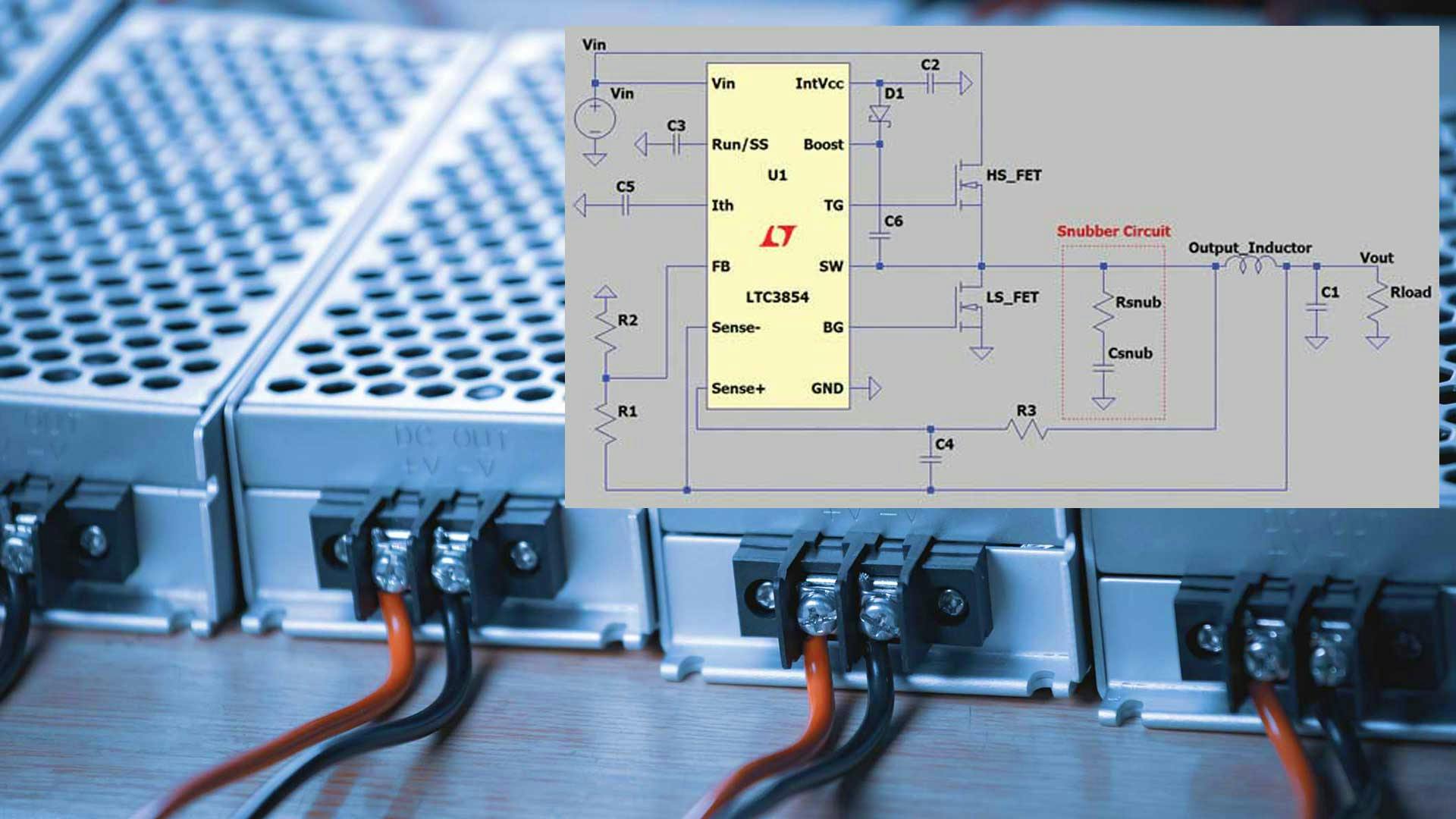
Switching noise in power converters can be difficult to eliminate. However, a well-designed and optimized snubber circuit helps dampen this ringing and improve overall efficiency.
Australia is pioneering a revolution in home renewables and battery use, proving what is possible with the right policies
The timing was rich with symbolism. As intense heatwaves pummelled Europe and Asia, and oil markets around the world leapt and sputtered, the two big chimneys of one of Australia’s largest power stations were being demolished. Meanwhile, the Australian energy minister was holding a media conference to hail a fall of up to 10% in the benchmark electricity price in parts of the country.
Quietly, and with surprisingly little fanfare from the rest of the world, Australia is pioneering a revolution in home renewables and battery use, proving what is possible with the right policies. The country was already one of the global leaders in domestic solar power, with panels on one in three homes. It also remains, however, a major contributor to the climate crisis through its vast fossil fuel exports.But it is batteries that are giving Australia a new burst of speed.
More than 400,000 batteries have been installed under the cheaper home batteries scheme. Here’s how to get the best bang for your buck
Change by degrees offers life hacks and sustainable living tips each Saturday to help reduce your household’s carbon footprint
Got a question or tip for reducing household emissions? Email us at changebydegrees@theguardian.com
If Australians love solar, they are head over heels for home batteries. More than 400,000 batteries have been installed under the government’s subsidy scheme.
Here’s what you need to consider if you’re looking at getting one installed.
A Dominion Energy power plant near Davis, W.Va. NextEra Energy’s political activities are expected to be scrutinized as it seeks approval of its purchase of Dominion.
A PAC representing wind and solar energy interests spent $1.1 million to boost the Republican primary opponent of Chip Roy, an opponent of renewables. Now they are trying to save a Republican ally in Iowa.
A PAC representing wind and solar energy interests spent $1.1 million to boost the Republican primary opponent of Chip Roy, an opponent of renewables. Now they are trying to save a Republican ally in Iowa.
A group of renewable energy investors paid for this projection on the side of the Energy Department building in Washington gloating over Representative Chip Roy’s defeat in a Republican primary for Texas attorney general.
Abandoning net zero and drilling for more oil and gas in the North Sea would be a massive setback for the UK and would not help the economy, leading experts have said in response to claims by the former prime minister Tony Blair.
“This is a bizarre intervention to make during the worst May heatwave on record and when the Iran crisis is providing yet more evidence of the enormous costs of oil and gas,” said Ed Matthew, the UK programme director at the E3G thinktank. “Clean energy is cheaper energy – it protects our bills from prices skyrocketing, its running costs are virtually zero, and it doesn’t cause climate change which threatens economic collapse ... The government should ignore Blair’s ideological nonsense and focus on what works.”
More Americans are using small solar panels in their back yards or balconies as a clean way to cut their electric bills
If you feel like your electricity bill just keeps climbing, you aren’t imagining it. Since 2020, US residential energy prices have surged by about 30%, making power the largest household energy expense behind gasoline, according to the US Energy Information Administration.
But for residents like Alex Curtis, the days of feeling powerless against rising costs are coming to an end. Curtis is waging a war on his electric bill, and his new weapon of choice is a lightweight, thin-film solar panel.
Renters make up nearly a third of Australian households yet many are missing out on energy upgrades – such as insulation, appliances and rooftop solar – that could slash their power bills and improve home comfort.
The problem, according to the Institute for Energy Economics and Financial Analysis (IEEFA), is landlords’ lack of motivation.
Exclusive: Cache of internal documents leaked to the Guardian and the ABC’s Four Corners show multinational has war-gamed ways to massively delay decarbonisation
The world’s biggest miner has halted or delayed projects to cut vast amounts of emissions and has quietly war-gamed options to push major climate investments in its Western Australian iron ore operations into the next two decades, internal documents show.
An exclusive investigation based on documents leaked to the Guardian and the ABC’s Four Corners can reveal that BHP, one of Australia’s biggest historic emitters, has dumped plans for a facility that could have significantly reduced emissions and has put on ice renewable projects designed to power its iron ore operations in the vast, resource-rich Pilbara region.
Exclusive: BHP once dubbed climate change an ‘existential’ threat. But leaked documents show it has backtracked on decarbonisation at a vast network of mines
California truckers have expressed strong interest in the Tesla Semi because it costs much less and can travel further on a charge than electric trucks sold by established manufacturers.
Screens on either side of a Tesla Semi’s steering wheel provide a view of the traffic around the vehicle.
NextEra’s proposed acquisition of Dominion Energy comes as Americans are paying a lot more for electricity, and data centers are demanding a lot more power from utilities.
NextEra Energy’s acquisition of Dominion Energy would consolidate utility operations along much of the East Coast, which could shape electricity service for tens of millions of customers.
In scientific terms, fission and fusion are two sides of the same coin. The first produces energy by splitting big atomic nuclei into two or more pieces. The second produces it by combining two or more small nuclei into a larger one. In both cases, the difference between the mass you start out with and the mass you end up with determines how much energy you get, following Einstein’s famous equation E=mc2.
Practically speaking, though, fission and fusion are worlds apart. Fission power plants have been putting electrons on the grid since the 1950s. In 2024, they produced around 10% of the world’s total electricity – less than coal, gas or hydropower, but more than wind and solar.
Fusion power plants, in contrast, do not exist yet. Although the US National Ignition Facility (NIF) can generate more energy from a pellet of fusion fuel than it delivers to the pellet, not even its biggest fans would mistake it for a power plant. A Europe-based fusion experiment, ITER, remains under construction after years of delays. And so far, the private fusion companies that have sprung up in recent years have only designs, not working devices, to show for their efforts.
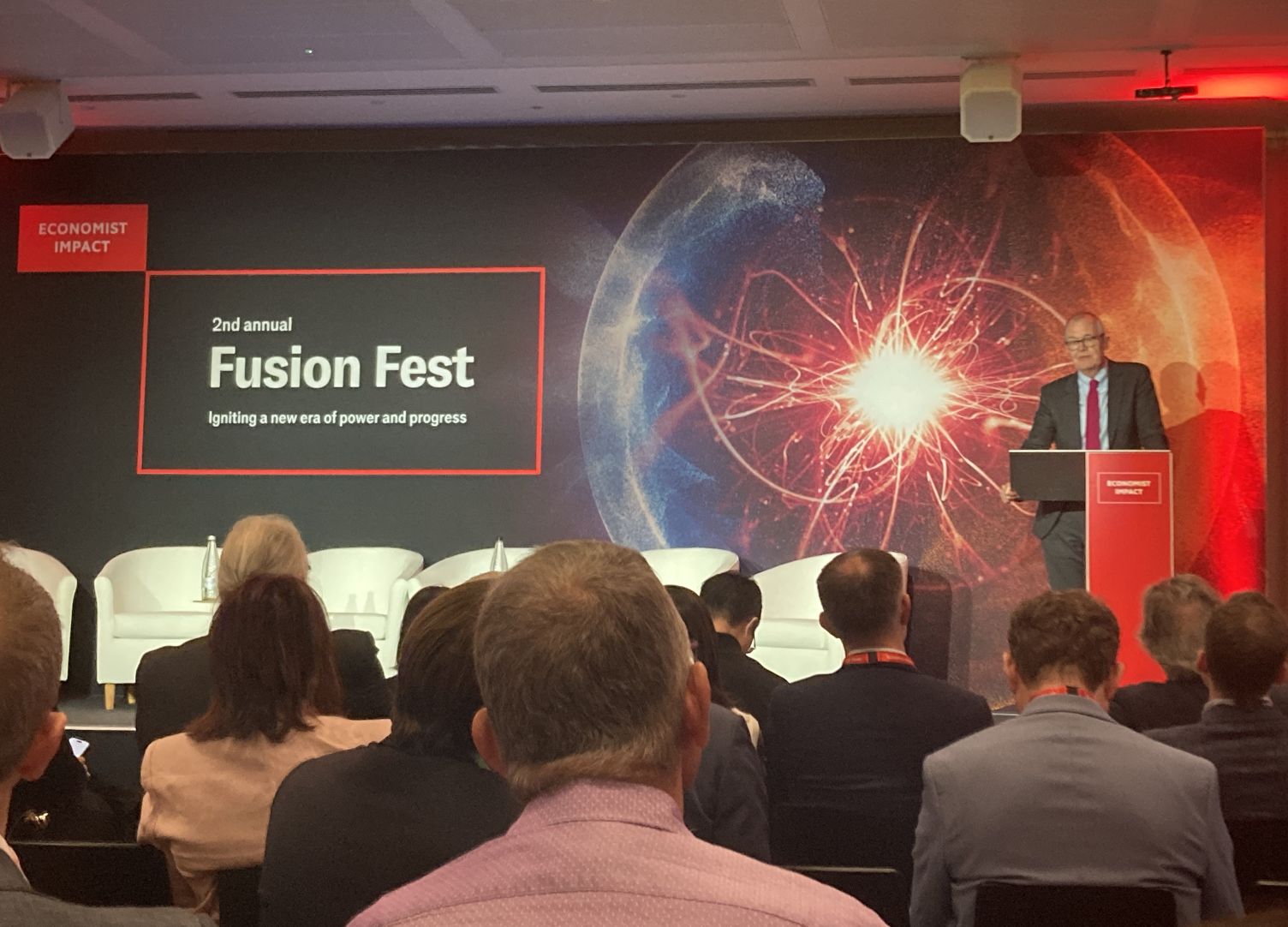
It’s an interesting question, then, why the vibes at last week’s Fusion Fest – which took place on 14 April in London, UK – were so much better than those at the Nuclear Summit held the next day in the same location. Both events took place under the auspices of The Economist newspaper. Both featured experts from finance, government, academic and policy circles. So why was the fusion gathering so bullish, and why was the fission one so downcast?
Fusion is having a moment
If you believe the speakers at Fusion Fest, they are optimistic because, after decades of being – as the old gibe has it – permanently 20 years in the future, fusion energy is finally ready for its close-up. “We are, I believe, at a pivotal moment in the field, and it’s a very exciting time to be in it,” Tim Bestwick, the interim chief executive of the UK Atomic Energy Authority (UKAEA), told the crowd at the opening session.
Later that day, a subsidiary of UKAEA, UK Fusion Energy Ltd, unveiled its strategy for building a pilot fusion power plant. Known as the Spherical Tokamak for Energy Production (STEP), it is receiving £1.3bn in UK government support and is scheduled to begin operations in 2040.
Other fusion organizations are promising results on even shorter timelines. A start-up called Pacific Fusion has pledged to build a power plant based on inertial fusion by the mid-2030s. Another company, Proxima Fusion, has a 2035 target for its stellarator-based technology. A third, Commonwealth Fusion Systems, is building a tokamak-style reactor that will, it claims, generate its first plasma (though admittedly not its first net energy) next year.
Declaration of energy independence: Koichi Masuda is the chief executive of Liberty Fusion, a spin-out from Los Alamos National Laboratory in the US. His company aims to produce a commercially viable version of the lab’s plasma-jet driven magneto-inertial fusion technology. (Courtesy: Margaret Harris)
The spokespeople for these firms (and many others) have a strong incentive to be optimistic. They’re trying to attract funding, and in most cases, they’re relying on notoriously impatient venture capitalists rather than nations like the UK (and, on a far bigger scale, China) that can afford to take a longer view. A certain amount of pie-in-the-sky thinking is to be expected from them. Yet when The Economist’s global energy and climate innovation editor, Vijay Vaitheeswaran, asked a more diverse pool of attendees to predict when fusion would become cost-competitive with solar, the most popular choice was “within 20 years”. It certainly wasn’t “never”.
Bumps on the road to limitless energy
A few Fusion Fest speakers did mention some potential pitfalls. One area of concern is that suppliers of key components – high-grade optics for laser fusion, high-temperature superconducting wire for magnetic fusion, and so on – do not yet have the capacity to support a growing fusion sector. This is a financial problem as well as a technical one. Jeff Lawson, the chief executive of Inertia Fusion, warned the audience that fusion will only succeed commercially if it follows the example of solar power by using components manufactured cheaply and at scale. Otherwise, he said, it risks becoming more like nuclear fission, characterized by expensive, bespoke facilities.
In a similar vein, several speakers suggested that it would be a serious setback for the field if fusion – which produces far less radioactive waste than fission, carries no risk of meltdown and does not use materials that can be repurposed for nuclear weapons – ends up bearing the same regulatory burden as fission reactors. Indeed, one audience member drew murmurs of agreement by asking whether fusion experts should avoid using the word “reactor”, to remove any associations with fission nuclear power.
Nuclear’s (new) new dawn
With fusion’s enthusiasts promoting it as the clean, safe nuclear energy of the future, it’s easy for fission to get cast as the waste-producing, meltdown- and proliferation-prone nuclear energy of the past. Yet there are reasons to be optimistic about fission’s prospects, too. Recent increases in energy demand have triggered an uptick of interest in low-carbon baseload power. So, too, has the Iran War and the closure of the Strait of Hormuz, which threatens the world’s supply of fossil fuels in a way that hasn’t happened since the 1970s. Back then, France responded by building 57 new fission reactors. Could it happen again?
Charles Oppenheimer certainly thinks it could. The grandson of atom bomb pioneer J Robert Oppenheimer, he is the founder and chief executive of Oppenheimer Energy, which aims to accelerate reactor deployment. At the Nuclear Summit, Oppenheimer argued that “economic tailwinds” are producing a burst of optimism about nuclear power, as new concerns about energy security join older ones about climate change. But even he couldn’t avoid sounding a note of caution. “Institutional capital does not look at nuclear as an investible product,” Oppenheimer warned. “It looks at it as a field with a bad track record.” To counter this view, he argued, “we need to get something going to justify the optimism.”
Small reactors could be huge…
For many attendees, that “something” is small modular reactors (SMRs). Because they are designed to be somewhere between the size of a shipping container and a house, the idea is that SMRs could be assembled by the hundreds in factories, rather than constructed on-site in ones and twos. This would save time and money, which is essential in an industry with a reputation for high costs and long delays. As Tim Stone, a former chair of the UK Nuclear Industry Association, put it, the nuclear industry needs to treat “construct” as a dirty word: “Anyone who says ‘construct’ has to put £5 in the swear box,” he said.
SMRs promise other benefits, too. Their small size makes them less prone to catastrophic meltdowns, and they are poorly suited to producing material for nuclear bombs. For these reasons, some speakers expressed hope that they could be regulated like research reactors, not power plants. That would ease the burden on developers and further reduce the time required to constr – sorry, manufacture – them.
Another advantage of SMRs is that in principle, they can be installed in places where large-scale power plants would not make technical or economic sense. For example, the UK firm Cambridge Atomworks is developing a 5 MW SMR that is designed to supply power to mines in remote locations. According to its chief executive, Ian Farnan, such a reactor could compete with diesel generators on logistics and environmental considerations as well as price.
Government backing: Patrick Vallance, the UK Minister for Science, Innovation, Research and Nuclear, speaking at Fusion Fest in London. (Courtesy: Margaret Harris)
More promising still – at least from an investor perspective – is the prospect of using SMRs to power AI data centres. The largest such centres can consume as much as a gigawatt of electricity, and their developers are increasingly looking off-grid for ways of powering them. They also have stringent uptime requirements (the industry standard is “five nines”, or 99.999% availability) that make them awkward for variable energy sources such as wind and solar. With local communities unsurprisingly objecting to data centres that run on noisy, polluting gas generators, SMRs are an attractive alternative. “If you want clean, firm, reliable and shit-tonnes of power, it’s got to be nuclear,” summarized Amy Roma, a lawyer and nuclear energy policy expert at the law firm Orrick.
…but maybe not right away
Despite these developments, though, an SMR-led fission revival is far from guaranteed. James Walker, the chief executive of the SMR firm Nano Nuclear Energy, drew pained laughter from the audience when he declared that the problem with small modular reactors is “they’re not small and they’re not modular”. Robert Rudich, the chief business development officer at another SMR firm, CGE, agreed that this is something the industry needs to work on. “If we don’t bring [reactors] to a place where the private sector can help, we’re not going to get there,” he said. On the policy front, Najat Mokhtar, the deputy director general of the International Atomic Energy Agency, isn’t sure that regulators will go easy on SMRs. “The technology is evolving fast and the regulation and licensing is not,” she warned.
With a technology that faces such knotty problems, it’s easy to be pessimistic. But it’s also easy to be optimistic about a technology that hasn’t matured enough to run into similar difficulties. This is the main reason for the different moods within fusion and fission. Though the fusion community may see the nuclear industry as a model of what not to do, many nuclear experts return the favour by regarding fusion as vapourware promised to gullible investors on impossible timelines. Will technical advances, climate concerns and the rising tide of world energy usage come together in a way that proves both sets of doubters wrong? Perhaps a future Fusion Fest and Nuclear Summit will hold the answers.
This article was amended on 23/04/2026 to update Amy Roma’s affiliation and on 27/04/2026 to correct the nature of Pacific Fusion’s power-plant concept.
India’s first prototype fast-breeder reactor (PFBR) has achieved criticality, marking a significant boost for the country’s nuclear programme. The 500 MW reactor, which is based at Kalpakkam, about 70 km south of Chennai, is intended to be a forerunner for a fleet of six similar fast-breeder reactors.
India’s currently has almost 9 GW of nuclear capacity from 24 plants, which are mainly pressurised heavy water reactors (PHWRs) that use domestic and imported natural uranium. Long-term, the Indian government wants to expand nuclear capacity to 100 GW by mid-century, quadrupling its share in electricity generation from 3% to 12%.
An Indian parliamentary panel examining the country’s nuclear programme warned earlier this year, however, that current capacity expansion is falling “significantly short” of the 100 GW target. The panel called for a “ring-fenced” funding mechanism and a clear roadmap and timelines to scale up fast-breeder reactors.
The PFBR uses uranium–plutonium mixed oxide (MOX) fuel and is designed to generate more fuel than it consumes. It does this by using a blanket of uranium-238 that surrounds the reactor’s core, absorbs neutrons and is transmuted into fissile plutonium-239. Work started on the PFBR in 2004 and it was originally supposed to open in 2010.
Despite delays and technical issues, the PFBR successfully achieved its first criticality on 6 April. “This is a historic moment,” says Anil Kakodkar, former secretary of India’s Department of Atomic Energy (DAE) who is now chancellor of the Homi Bhabha National Institute, told Physics World.
Three-stage solution
India has a three-stage nuclear strategy, in which PHWRs are the first stage, with the second involving spent fuel from PHWRs bring reprocessed into MOX fuel for fast breeders.
The third stage seeks to exploit India’s abundant thorium reserves – estimated at over a million tonnes of thorium compared to 433 000 tonnes of uranium – to produce uranium-233, potentially supporting energy demand for centuries.
Other countries, such as France, Japan and the US, have scaled back or deprioritised fast-breeder programmes due to technical and economic challenges.
Kakodkar cautions that the pace of future expansion will hinge on a shift from MOX to metallic fuel fast reactors, which use metal alloys and fast neutrons to breed new fuel. This could reduce the fuel doubling time in fast breeders from roughly 30 years to about a decade.
In parallel to the PFBR programme, the Bhabha Atomic Research Centre in Mumbai, has designed an Advanced Heavy Water Reactor (AHWR) to use thorium-based fuels. Kakodkar says that advancing the AHWR would “expedite transition” to the thorium fuel cycle by building institutional and industrial capability.

 Login
Login