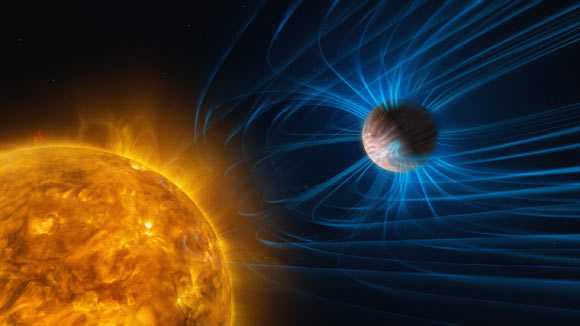
By tracking fierce winds racing through the atmospheres of seven ultra-hot Jupiters, astronomers have uncovered the strongest evidence yet that magnetic fields shape weather on worlds beyond our Solar System.
The best evidence for exoplanetmagnetic fields ever discovered has emerged from new European research, which measured wind speeds on seven ultra-hot Jupiters using the European Southern Observatory’s Very Large Telescope (ESO’s VLT) and the Gemini North telescope.
In a recent paper published in Nature Astronomy, the team suggests that magnetic fields are most likely driving the winds, enabling the first measurements of exoplanet magnetism.
Ultra-hot Jupiters are a class of exoplanets similar in size and composition to Jupiter in our solar system, yet orbiting much closer to their host stars, resulting in surface temperatures above 2000°K.
“This breakthrough opens a completely new window on exoplanet research,” said lead author Julia Seidel, an astronomer at the Laboratoire Lagrange, Observatoire de la Côte d’Azur, France.
“It’s the first time we can compare the magnetic environments of other worlds,” Seidel added, calling it “a key step toward ultimately understanding which planets can stay alive, keep their water, and perhaps even, one day, host life as we know it.”
Exoplanet Magnetic Fields
On Earth, magnetism is one of the primary influences on our atmosphere and is essential to maintaining habitability. Other planets in our solar system, like Jupiter and Saturn, have strong magnetic fields, while Mars has only small, weak pockets of magnetism rather than a powerful global field.
“Radio astronomy has been trying to find the direct signals of exoplanet magnetic fields for the past 15 years, but due to technical and geometrical limitations, they have not yet been successful,” Seidel told The Debrief, noting past works by Phillip Zarka and collaborators, who she said have “led a gargantuan effort in that direction.”
“But thus far, the tentative claims could not be confirmed,” Seidel added.
“In our work, we use an indirect method, via the wind speed measurement, to infer the characteristics of the magnetic field,” Seidel continued. “So it’s not a direct method, so not as robust, but it’s the first clear indication that planets outside of the solar system have a magnetic field at all!”
Strange Exoplanet Winds
Like some of science’s most spectacular advancements, the team set out looking for something else entirely: exoplanet wind speeds. The exoplanets observed in the team’s work are all tidally locked, meaning that one side always faces toward their star, while the other faces away.
Each ultra-hot Jupiter that the team observed orbits on a different side, yet all have tremendous dayside temperatures and frigid nightsides.
Exoplanets with such extreme temperature differences between hemispheres generate weather patterns that differ greatly from those seen on Earth. When air pockets with very different temperatures meet, they produce winds. These radical differences between the two sides produce a range of wind speeds from 7200 to 25000 kilometers per hour, compared to the relatively slow 1500 kilometers per hour of our local Jupiter.
“In the beginning, we set out to check if the atmospheric winds behaved the same way for all hot planets,” Seidel said.
A strange pattern emerged from the data, as the team identified that the hottest parts of the planet had slower winds, defying expectations.
“This is totally counterintuitive because, all things being equal, hot planets have more energy to accelerate the winds! Something must happen that slows down the wind speeds for hotter objects,” said co-author Vivien Parmentier, a professor at the Laboratoire Lagrange.
Using spectrographs, astronomers can measure the temperature and wind speed on exoplanets. A trend of decreasing wind speed with increasing temperature can betray the presence of magnetic fields on these planets. Credit: ESO/M. Kornmesser, L. Calçada
A Magnetic Explanation
To explain these anomalies, the researchers proposed that powerful global magnetic fields were serving as a brake on the charged particles that make up the winds. They were able to extrapolate each exoplanet’s magnetic field strength from the wind speed data.
Results of the work indicate these magnetic fields are relatively close to what has been found in our solar system, roughly half the strength of Jupiter’s and four times that of Saturn. An unusual added effect of these magnetic fields is that they likely produce much more dramatic auroras than those seen on Earth, moving the gases that produce such vivid lights.
“I like to imagine that some of these worlds have a sky filled not only with stars, but with vast curtains of colourful light dancing across a planet that’s half in perpetual day and half in endless night,” explained co-author Bibiana Prinoth, a former PhD student at Lund University, Sweden, now an astronomer at ESO in Garching, Germany.
The team has already identified the direction of their follow-up research.
“The next step is clear: Until what planetary temperature do magnetic fields dominate how atmospheres flow and at which temperature do these winds behave more similar than in the solar system?,” Seidel said.
“For that, we are planning an observational survey to look at less hot planets and see when the trend depending on the ionisation of the atmosphere (and therefore the magnetic field) breaks.”
Ryan Whalen covers science and technology for The Debrief. He holds an MA in History and a Master of Library and Information Science with a certificate in Data Science. He can be contacted at ryan@thedebrief.org, and follow him on Twitter @mdntwvlf.
James Webb Space Telescope (JWST) data are allowing researchers to resolve a gas giant’s cloud cover, providing a new level of detail that significantly alters our understanding of exoplanet conditions.
A tidally locked hot Jupiter, WASP-94A b, was the focus of the JWST for these observations, which captured a much more dynamic atmosphere than earlier simplified assumptions. In a new paper published in Science, an American team of astronomers reveals how the boundary between the planet’s permanent day and night sides creates an extreme temperature difference that dramatically affects the atmospheric chemistry.
A Hot Jupiter
The exoplanet WASP-94b is located about 700 light-years from Earth, in the constellation Microscopium. Hot Jupiters such as this intrigue scientists because their tight orbits produce incredibly intense surface temperatures, making them excellent natural laboratories for studying planetary surface dynamics.
As atmospheric aerosols travel across WASP-94A b, when they encounter the planet’s dramatic temperature shifts, they form into clouds to circulate over the exoplanet before eventually evaporating. Researchers were aware that these processes shape the appearance, chemistry, and temperature of exoplanet atmospheres, but had a limited understanding of how the exoplanet aerosol particles at their core behave.
The nature of hot Jupiter clouds was unclear, with researchers suggesting either photochemical hazes produced by stellar radiation or mineral clouds generated by condensation.
Adding to the difficulty is the tendency of these clouds to distort or obscure the spectral signals used to observe exoplanets. However, in the new work, JWST data provided strong confirmation of one of these hypotheses.
JWST Atmospheric Imaging
The JWST’s Near Infrared Imager and Slitless Spectrograph (NIRISS) instrument allowed the researchers to separately analyze WASP-94A b’s permanent morning and night atmospheric horizons. To do this, the team waited until the exoplanet passed in front of its home star, providing an opportunity to measure the light passing through the atmosphere at its edges. Their findings revealed that the two sides of the planet held extremely different atmospheres.
The cooler morning side contains high-mineral clouds that offer dense cover, while the morning side is clearer and shows high levels of water vapor absorption. These findings are consistent with condensation rather than the photochemical hypothesis.
The team also employed a 3D circulation model to study the dynamic cloud cycle, discovering that the massive 450 Kelvin temperature disparity between the hemispheres was a driving factor, with clouds forming not on the night side but evaporating before reaching the intense temperatures of the day side.
The work reveals that the common assumption that exoplanet atmospheres are relatively uniform can lead to a gross misunderstanding of what is occurring on these distant bodies.
James Webb Space Telescope Breaks Through
“I’ve been looking at exoplanets for 20 years, and general cloudiness has been a thorn in our side,” said co-author and program PI, David Sing, a Bloomberg Distinguished Professor of Earth and Planetary Sciences at Johns Hopkins. “We’ve known for quite a while that clouds are pervasive on Hot Jupiter planets, which is annoying because it’s like trying to look at the planet through a foggy window.”
“Not only have we been able to clear the view, but we can finally pin down what the clouds are made out of and how they’re condensing and evaporating as they move around the planet,” Sing added.
The researchers offered two possible explanations for the cloud movement: either strong winds are pushing clouds up on the night side, causing them to descend when they reach the day side, or the phenomenon could be similar to morning fog, but on a planetary scale, evaporating the day-side heat.
“It was a huge surprise. People have expected some differences, like it’s cooler in the morning than the evening—that’s something natural that we experience here on Earth,” Sing said. “But what we saw was a real dichotomy between the weather on both sides of the planet, and huge differences in cloud coverage, and that changes our whole picture of the planet.”
JWST Advances Continue
“With the Hubble telescope, when we used to do this type of observation, we got an average view of the whole planet with data from the clouds and the atmosphere squished together and indistinguishable,” said first author Sagnick Mukherjee, a postdoctoral fellow at Arizona State University who was a student at Johns Hopkins and UC Santa Cruz at the time of the research. “This approach with the JWST lets us localize our observations, which helped us see the cloud cycle.”
The team was surprised to find that the night side atmosphere resembled our local Jupiter’s sky much more than was initially expected, based on earlier data. When previously working with a simplified average planetary cloud cover, researchers arrived at figures indicating that the planet contained hundreds of times as much oxygen and carbon as Jupiter. Now, with a clearer understanding of the day/night differential, it was revealed that the planet actually contained only five times as much oxygen and carbon.
Comparing their findings with those for eight other gas giants, the team found two cognates of the same cloud-cycling mechanism: WASP-39 b and WASP-17 b. Following this work, the team is currently studying cloud cycling on multiple other types of exoplanets.
Ryan Whalen covers science and technology for The Debrief. He holds an MA in History and a Master of Library and Information Science with a certificate in Data Science. He can be contacted at ryan@thedebrief.org, and follow him on Twitter @mdntwvlf.
The largest moon in the solar system — Jupiter’s Ganymede — has a unique and inexplicable magnetic field. New research could finally explain it: the moon is heating up.
The largest moon in the solar system — Jupiter’s Ganymede — has a unique and inexplicable magnetic field. New research could finally explain it: the moon is heating up.

 Login
Login