
Normal view

Striking mathematical pattern uncovered in Chinese money plant leaves

15 May 2026 at 13:00

Researchers in the US and Canda have discovered a naturally occurring “Voronoi pattern” in the Chinese money plant.

Voronoi diagrams were introduced in the 1600s by French philosopher René Descartes and are named after the Russian mathematician Georgy Voronoi, who defined and studied them in the early 1900s.

Voronoi diagrams are geometric patterns used to divide space into regions. The plane is divided up into tessellating polygons, known as cells, that each contain a “seed” point. Every location inside a cell is closer to its seed than any other seed in a neighbouring cell.

Voronoi patterns have numerous applications across mathematics, as well as in various other disciplines such as modelling animal territories, city planning or crystal growth.

Voronoi-like patterns are common in nature, such as giraffe stripes. However, the difference between textbook Voronoi patterns and what we see in nature is that the latter usually lacks visible seed points.

Now, Saket Navlakha from Cold Spring Harbor Laboratory in New York and colleagues have found an exception in Pilea peperomioides, the Chinese money plant.

Chinese money plants are perennials native to China’s Yunnan and Sichuan provinces. The plant has round, flat leaves that feature prominent pores called hydathodes. These points are then surrounded by looping reticulate veins that transport water and nutrients to and from the leaf.

By mapping the pores and veins, the team discovered a naturally occurring, visible, Voronoi pattern with the veins acting as the cell boundaries and the pores being the seed points. They then built a mathematical model to match the observed patterns.

“To our knowledge, this is the first demonstration of the occurrence of Voronoi diagrams in plant venation patterns, where both edges and centres are visible and functional,” they write.

The researchers now plan to use the model to understand why other plants that have similar vein structures do not stick to the Voronoi structure in the same way as the Chinese money plant.

The post Striking mathematical pattern uncovered in Chinese money plant leaves appeared first on Physics World.
Study reveals the physics behind nature’s pointed tips

24 April 2026 at 14:00

You might think that a bee’s stinger, a rose’s thorn or a razor-like animal tooth has a sharp pointed tip, rather like “cone-shaped” needles used for injections. Yet a closer look finds otherwise, and these objects are usually rounded at the tip, curving gently like a parabola.

Why this is the case is a mystery and it was thought that it was the result of convergent evolution, in other words different species independently arriving at similar solutions.

This is partly because a rounded curve penetrates skin better as it distributes forces more evenly throughout the tissue. The rounded shape is also less prone to breaking than a perfect cone.

Physicist Kaare Hartvig Jensen from the Technical University of Denmark (DTU), however, was not convinced by the evolution argument. “There is a general notion that almost everything in nature exists for a reason,” he says. “But if you look at an unused tooth, it does not necessarily have [a rounded] shape, and if you observe the shape later in the organism’s life, the parabola will emerge.”

Jensen thought that simple mechanical wear might be behind the effect, and so with his DTU colleague John Sebastian, they went about testing this hypothesis.

To do so they were inspired by industrial durability testing where a robot sits on a chair every few seconds to test its robustness, for example.

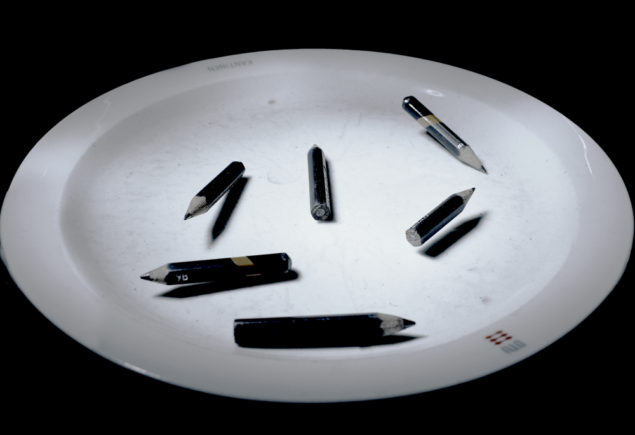
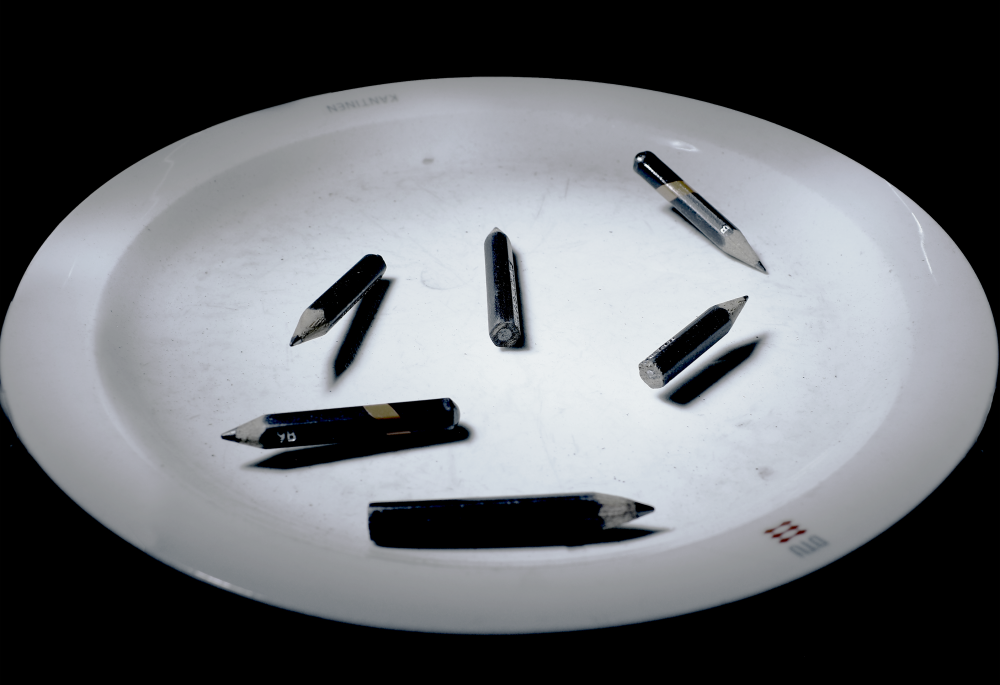
Their set-up involved a plate atop a vibrating machine containing a number of objects. “Initially, I attempted to build a device using sharpened chalk, but it produced a lot of dust,” he told Physics World. “Ultimately, I settled on pencils.”

pencils on a plate
Collision course The pencils were vibrated on plate for over four hours. (Courtesy: John Sebastian, Technical University of Denmark)

They sharpened the pencils as stand-ins for their biological counterparts and put them on the plate for over four hours as they constantly collided with each other. The team also carried around pencils in a small box in their pockets for several days, again to expose them to random collisions and movements.

They found that no matter how sharp the pencils were to begin with, their tips always developed the same rounded parabolic shape.

“This points to something more fundamental: that random processes in and of themselves can lead to a universal form,” adds Jensen. “The parabola is a stable shape across scales, from a thorn to an elephant’s tusk. The tips are thus not necessarily designed perfectly from the start – they become so through random wear.”

Jensen admits that – rather than in the isotropic case with pencils – most real biological materials have some structure to them, being stronger in one direction than another.

“I would like to explore what shapes result from random wear on these structured materials,” adds Jensen. “Perhaps we can start with something like nails – sharp right after cutting, then gradually blunting. Exactly how this occurs would be of interest.”

The post Study reveals the physics behind nature’s pointed tips appeared first on Physics World.

❌