
Normal view

Birds masturbate, and that’s perfectly normal

mycteria/Shutterstock

For captive animals, engaging in natural behaviour is a pillar of the animal welfare framework. But when it comes to sex, one important behaviour has been largely ignored, and sometimes even punished: masturbation.

Solo sex is surprisingly common across the animal kingdom. It is well documented in primates. Tortoises are surprisingly vocal during their solo lovemaking endeavours, if not very graceful. Camels masturbate by rubbing their penises in the sand and porcupines make inventive use of all sorts of objects.

Our new study could change how other scientists view masturbation in birds and improve their welfare.

Masturbation also seems to be common in birds. A quick internet search brings up an abundance of video clips on social media and dedicated posts on bird-keeping forums, largely from worried or bemused hobbyist bird keepers.

It has often been treated as an abnormal problem behaviour in captive birds (particularly parrots). Folklore husbandry has assumed it is the undesirable outcome of stress, bad health or poor environment. Bird keepers often therefore discourage masturbation via punishment or veterinary interventions such as diet or care changes and, sometimes, even drugs and surgery. Despite the welfare implications, masturbation in birds had been largely unexplored by the scientific community.

We set out to change that, by investigating the distribution and evolutionary history of masturbation in birds for the first time. We studied 120 species of bird across 22 major groups, gathering data from the scattered scientific literature, online reports and community forums, and surveys of bird experts.

Colourful parrot ducks behind wing.
There’s no need to shame parrots for solo sex. Wirestock Creators/Shutterstock

Our study found that masturbation is widespread across birds with a strong evolutionary history, meaning that it’s an ancient trait probably similar in closely related species. Although we found more records of masturbation in male birds, it occurs in both sexes and across all age groups.

Solo sex also seems to be linked to species that mate with multiple partners, supporting the idea that it might help to increase reproductive success when there is a high degree of competition over fertilisation. For instance, in males it may flush out old sperm to leave newer (better condition) sperm for mating. In females it may increase sexual arousal to help with sneak mating with males other than their partner.

Wild behaviour

Crucially, we discovered that masturbation is actually less common in captivity than the wild, and more common in birds reared by their own parents than by humans. What this tells us is that masturbation in birds is neither an unnatural behaviour, nor a consequence of captivity. Given this finding, it is important that birds are not prevented from masturbation. Of course, as with any behaviour, there may be extreme cases where chronic masturbation could indicate underlying health or husbandry issues.

Avian self-pleasure is usually a rather inelegant affair, in which a bird rubs their cloaca (a shared orifice for both excretion and reproduction) against an object, like a branch, twig or toy. This is often accompanied by a lot of flapping and self-satisfied vocalisation.

One potential reason for the lack of scientific studies exploring avian masturbation may be because the cloaca is thought to have fewer nerve clusters, and therefore lower sensitivity, than our own genitals.

Clearly however, birds are getting some satisfaction from masturbation, so perhaps there is more to a bird’s sensations during sex than has previously been recognised. Further exploration of this could have important implications for both welfare and captive breeding programmes. While sexual pleasure may not be exactly the same experience as for mammals, it is wildly premature to dismiss the idea that birds also feel pleasure.

The Conversation

The authors do not work for, consult, own shares in or receive funding from any company or organisation that would benefit from this article, and have disclosed no relevant affiliations beyond their academic appointment.
Life in the ancient Arctic: tiny teeth of newly discovered species suggest it was a cradle of mammalian evolution

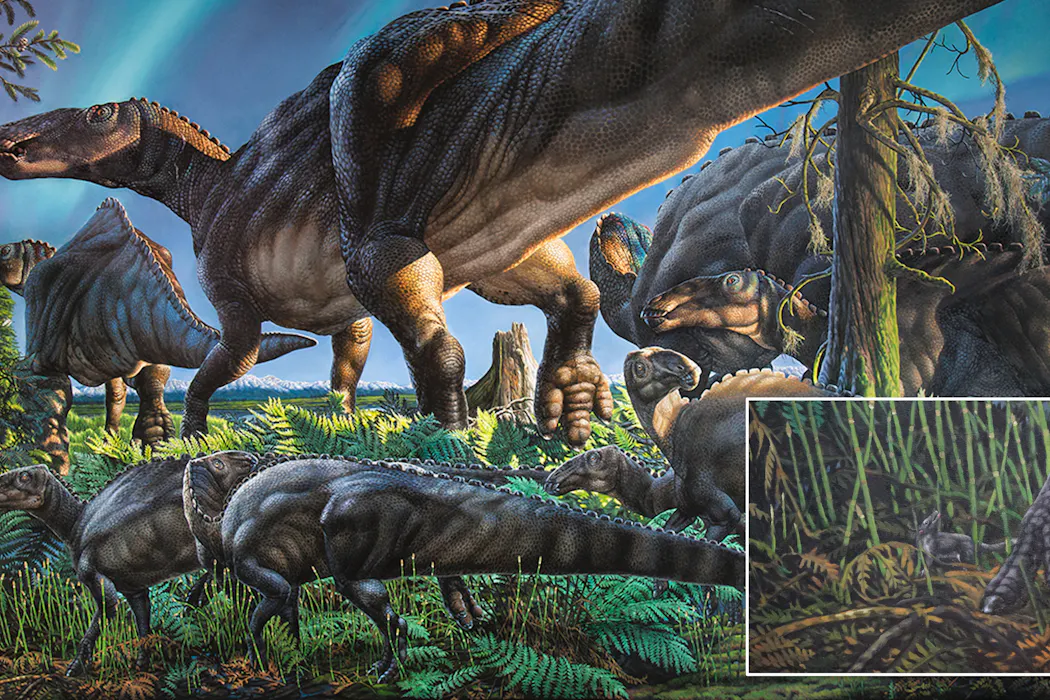
Artist's impression of the Prince Creek Formation in northern Alaska during the Late Cretaceous period, with small mammal highlighted. James Havens, CC BY-NC-SA

A fossil mammal tooth smaller than a grain of rice does not announce itself loudly. It must be hard won from sediment and stone. Then, under a microscope, it reveals itself – no longer just a speck of blackness but a surface of cusps, ridges and worn edges.

It is a small object, easily missed. Yet five such teeth from northern Alaska, belonging to three newly discovered species of long-extinct rodent-like mammals, hold an unexpectedly large history: of polar environments, shifting continents, winter darkness – and of mammals moving through this world that was colder, stranger and more connected than we once imagined.

The fossil mammal teeth at the centre of my new study with US colleagues come from the Late Cretaceous Prince Creek Formation, around 73 million years ago. At that time, northern Alaska’s palaeolatitude was roughly 80-85°N (10-15° closer to the north pole than it is today).

Our discovery shows the Arctic was not simply a cold, lifeless edge of the Cretaceous world, but a place where mammals adapted, diversified, migrated and originated. It raises deeper questions about what it means for a species to be native to a place whose landscapes, climates and inhabitants are forever changing.

The Arctic is not an empty landscape now, and nor was it in the deep past. It was a distinctive and demanding biome, with months of winter darkness, freezing temperatures and strong seasonality.

Rivers crossed this landscape. Plants grew through the long light of summer. Dinosaurs lived and thrived there, and evidence suggests they reared their young in the Arctic. There was also a diversity of birds, fish and mammals: tenacious denizens of the polar dark.

View of Colville River in northern Alaska
Colville River in northern Alaska, where tiny multituberculate fossilised teeth were discovered. Pat Druckenmiller, CC BY-NC-SA

The teeth we found

Finding miniscule fossil mammals is not the kind of palaeontology that begins with a spectacular skeleton weathering from a cliff. It begins with bulk sediment. Bags and buckets of it.

The material is dug out, washed, sieved through fine screens, dried, then meticulously sorted grain by grain beneath a microscope.

Mammalian palaeontology often depends on fragments: a tooth cusp, a root, a worn edge of enamel. It asks for patience more than drama. The field site may be remote, the landscape vast, but the discovery happens at the scale of a fingertip. It is an act of attention.

The five teeth described in our new study are multituberculates: a group of rodent-like mammals that lived alongside dinosaurs. They are the longest-lived mammal group to date, with a history spanning well over 100 million years. Our own species Homo sapiens, by comparison, is only a few hundred thousand years old.

But their success was not permanent. After surviving for longer than any other mammalian lineage, multituberculates eventually vanished, with their last representatives disappearing around the Eocene-Oligocene boundary, roughly 34 million years ago.

Multiple images of five fossilised teeth.
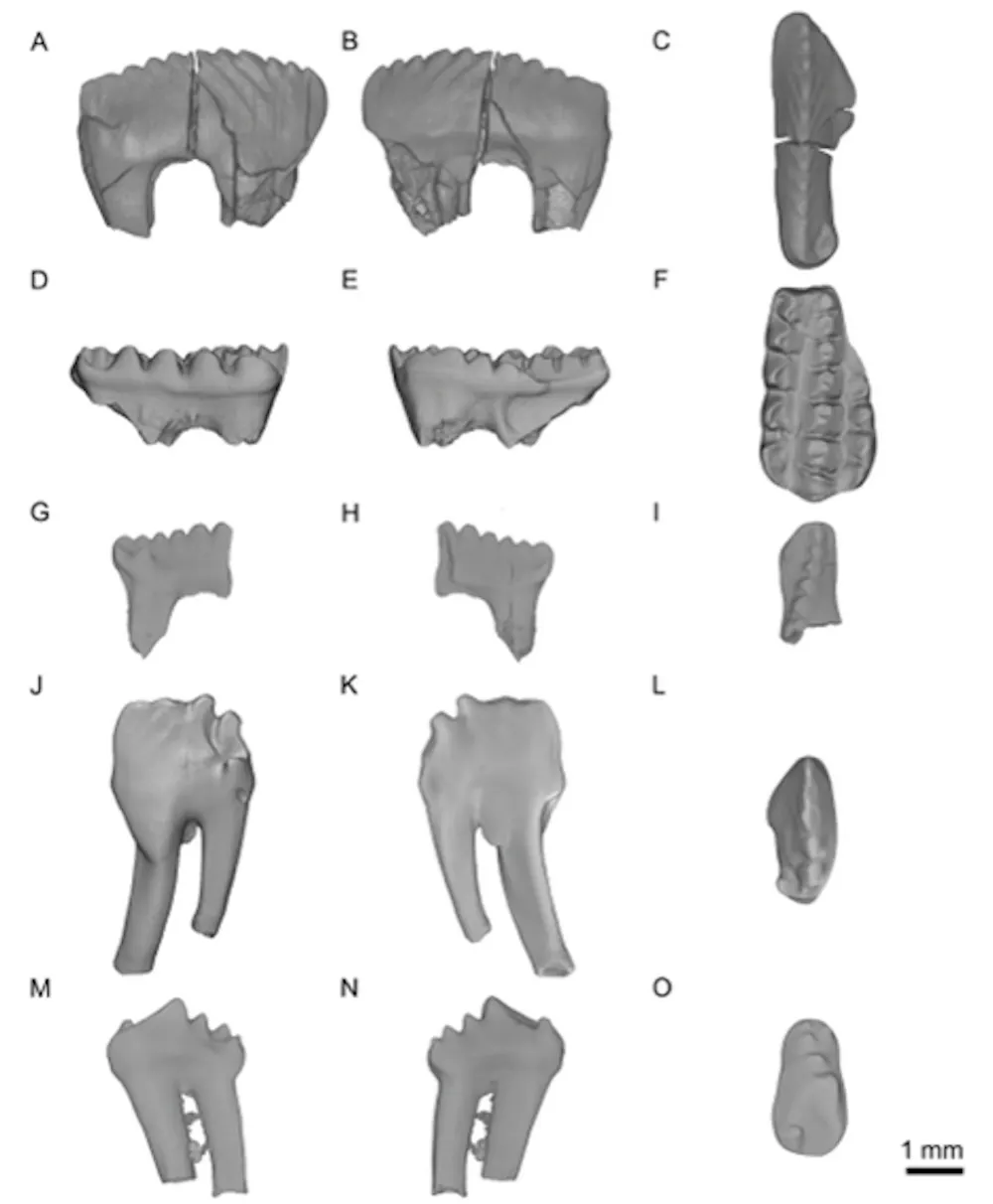
Views of five fossilised teeth discovered in Alaska’s Prince Creek Formation. Shelley et al (2026), CC BY-NC-SA

The teeth we found at Prince Creek represent three new species: Camurodon borealis, Kaniqsiqcosmodon polaris and Qayaqgruk peregrinus. The last of these sits especially close to the heart of the story.

Qayaqgruk peregrinus has close evolutionary affinities with a group of multituberculates discovered in Mongolia,, indicating that, many millions of years ago, these minute mammals moved between Asia and North America through a polar land corridor.

This was not the world of Pangaea, the single giant continent of earlier Earth history. By 73 million years ago, the continents were taking on more familiar shapes, but they had not yet settled into the map we know today.

North America was split by a shallow inland sea, and its far northwestern edge lay near northeastern Asia, creating a high-latitude corridor through which animals could move between continents.

The Arctic corridor itself was not unknown. Fossils of dinosaurs, birds and some mammals have shown that animals were migrating between Asia and North America during the Cretaceous.

But for multituberculates, the picture was much less clear. Their fossil record left open whether they crossed between the continents early and repeatedly, or only later in the Cretaceous. Qayaqgruk peregrinus helps close that gap.

Its name draws on the language of the Iñupiat, Alaska Native people, from the region where the fossils were found. Qayaq is a legendary Iñupiaq hero and wanderer whose journeys are told in The Epic of Qayaq.

Many of its Mongolian relatives carry the suffix -baatar, meaning hero in Mongolian, so the name also links its Alaskan discovery to its Asian evolutionary affinities.

Kaniqsiqcosmodon polaris is the oldest known member of the Microcosmodontidae family of multituberculates, suggesting this lineage, later known from North America, may have had a polar origin. Camurodon borealis represents the northernmost known occurrence of the North American family Cimolomyidae.

Five teeth are not a complete ecosystem, but they are enough to show these mammals were not occasional strays at the edge of their range. They belonged to the Arctic.

Surviving mass extinction

Survival in this environment was not a passive condition. Multituberculates survived through the end-Cretaceous mass extinction, 66 million years ago, when as much as 75% of all life on Earth went extinct, including the non-avian dinosaurs.

The adaptations that helped these ancient Arctic species live though deep winter cold, short dark days and seasonal scarcity may have given them advantages when the world’s ecosystems were devastated.

This is not to say the Arctic was a refuge in any simple sense. Evolution is rarely simple – it is full of bottlenecks and unexpected openings. But tiny mammals already adapted to seasonal scarcity may have carried some advantages into a disrupted world.

The Alaskan multituberculates did not belong to the Arctic because they had always been there, or because their lineages had never moved. They belonged because they were part of that ecosystem for a time: shaped by its dark, its cold, its flora, its fauna, its seasons and its routes of passage.

Fossils make this kind of belonging harder to define, but more interesting. They give the word indigenous, at least when we use it for species, a chronology: deep time shows that belonging is not always a matter of original presence, but of ecological participation across changing landscapes.

These five multituberculate teeth from the Prince Creek Formation are small enough to vanish in a pinch of sediment. Yet in their enamel are continents, seasons, darkness, ancestry and journeys.

They show that the ancient Arctic was not an evolutionary margin. It was a living biome, a passage between worlds, and part of the deep history of mammalian evolution.

The Conversation

Sarah Shelley does not work for, consult, own shares in or receive funding from any company or organisation that would benefit from this article, and has disclosed no relevant affiliations beyond their academic appointment.
❌