
Normal view

Received — 31 May 2026 The Conversation

Beyond Anglo-Saxons, Celts and Vikings: DNA uncovers a dynamic history of migration to Britain

Each of us tells a story about who we are, often tracing our identity back through an imagined line of ancestors. Though identity is fundamentally cultural, we tend to anchor it in biology – in the idea of a stable genetic inheritance passed down through generations.

Population genomics has exposed a history far more complex, dynamic and intertwined than we might wish to imagine. Even in a place such as Britain, long imagined as an island of deep and uninterrupted heritage, genetic data suggest a history marked by intense migration, mixture and cultural reinvention.

Two new studies have reinforced this picture, by analysing DNA from the skeletal remains of British individuals who lived during Roman and medieval times.

Prehistoric Britain witnessed periodic major migrations interspersed with smaller and more regular movements of peoples across what was then a contiguous landscape.

After about 6100BC, rising sea levels isolated Britain from mainland Europe, helping to promote later historical narratives of a population relatively isolated.

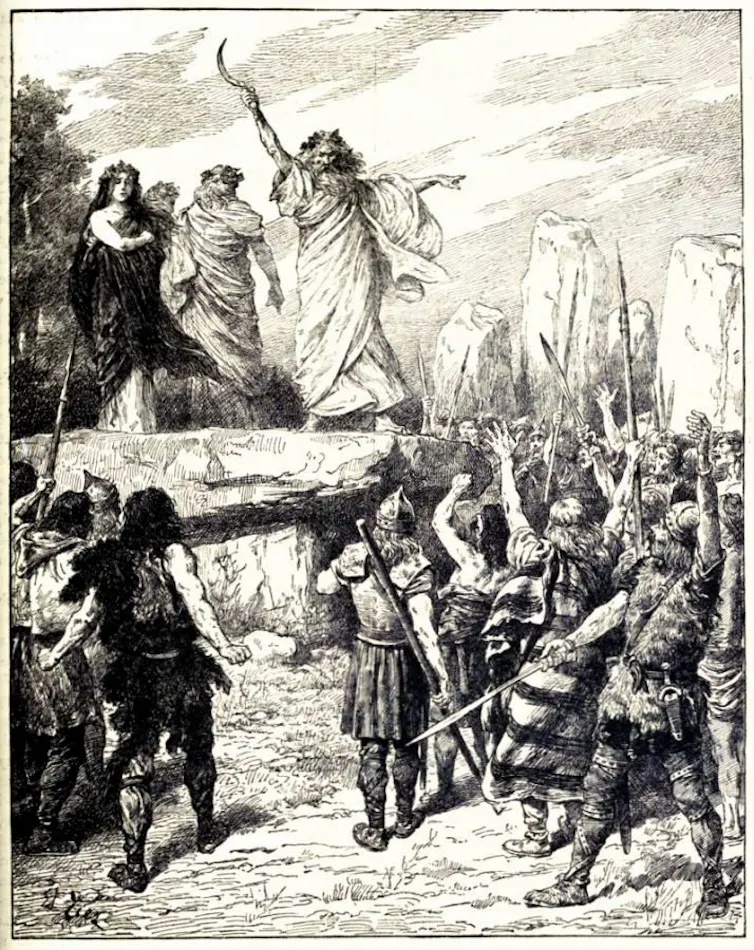
Yet even early observers recognised otherwise. Writing in the first century AD, the Roman historian Tacitus noted the diversity of Britain’s tribes, suggesting their origins lay in Germany, Gaul and Iberia.

Druids incite the Britons to oppose the landing of the Romans.
Druids incite the Britons to oppose the landing of the Romans. Edouard Zier

Such conclusions were drawn from physical, cultural and linguistic observations. Now it is testable, thanks to rapid advances in population genomics and ancient DNA sequencing, allowing direct ancestry reconstruction across demographic and political changes.

A major recent study by Marina Silva, from the Francis Crick Institute in London, and colleagues analysed more than 1,000 ancient genomes from across Britain during the first millennium AD.

The pre-print, which has not yet been published in a journal, asks one simple question: could the main historical events of Britain – the Roman occupation, Anglo-Saxon migration, the Viking Age and the Norman conquest – be detected in the genetic data of the populations that lived through these eras?

The answer was complicated. The Roman period, for all its political and cultural upheaval, left surprisingly little mark on the genetic structure of the wider population. About 80% of the individuals who lived during Roman times in Britain cluster almost exactly with those of the immediately preceding Iron Age, arguing for genetic continuity and no replacement. Even in urban centres where occupying Roman elites were most prevalent, the broader population retained overwhelmingly local ancestry.

In contrast, the early medieval period, from around 410AD (when Roman rule collapsed) to 1066AD, saw a substantial influx of new ancestry from across the North Sea. The researchers were able to detect this influx by comparing the British samples with genetic data from populations in other parts of north-west Europe. Continental ancestry associated with Anglo-Saxon migration appears in more than 70% of of the burials in southern “Anglo-Saxon” Britain.

The early medieval period saw a substantial influx of new ancestry from across the North Sea
The early medieval period saw a substantial influx of new ancestry from across the North Sea. Shutterstock AI

Thus, migration was not just cultural but demographic on a scale sufficient to leave its imprint on the shape of population structure.

Yet even this transformation cannot be generalised. From about 700AD to 1000AD, further waves of continental influence appear in Britain, with the arrival of settlers from central Europe (seemingly from France and the Rhineland) and, to a lesser extent, the south of Europe. However, the Viking Age leaves a more uneven and regionally variable genetic signal than its historical prominence might suggest.

While a Scandinavian component is clearly present in northern and eastern regions, it is rarely of a magnitude comparable to that found in early medieval migrations. Most surprisingly, the Norman conquest of 1066 appears to have been largely an elite process, leaving little detectable trace in the genomes of the common population.

Genome-wide ancestry profiles straddle the date of the conquest, with no hint of abrupt population replacement. Despite all its drama, the conquest seems, at the level of population genetics, to have involved elite replacement by relatively few individuals.

A second pre-print study provides a closer view of what this looked like on the ground. Focusing on a rural cemetery at Priory Orchard in Surrey, Flavio De Angelis, from Arizona State University in Tempe, and colleagues examined individuals buried across the centuries before and after the Norman conquest.

Again, the results are surprising: rather than any clear genetic break after 1066, both pre- and post-conquest burials fall within the same cluster, showing shared ancestry and no evidence for demographic turnover. The continuity is not just qualitative, but visible in the statistical similarity of ancestry components across generations.

Instead, the community reflects a much longer history of interaction across the North Sea world. Its ancestry includes Anglo-Saxon-associated components, significant Scandinavian input dating to the Viking period, and smaller continental contributions.

Crucially, these elements are already present before the Norman arrival and persist afterward. The Norman conquest, in genetic terms, is barely visible. What looks, on historical timelines, like a moment of dramatic rupture appears, at the level of the common individual, as a continuation. Genes tell the story of populations and detect localised impacts of migration, but they do not map neatly onto geopolitics.

Taken together, these studies point to a crucial distinction. Cultural and political change does not necessarily equate to demographic change. Britain’s history is neither one of uninterrupted continuity nor of repeated population replacement, but something more complex: long-term mixture punctuated by events that reshape institutions more than populations.

Some migrations – such as those of the early medieval period – left deep and measurable genetic legacies. Others, despite their prominence in historical narratives, left only faint traces. The discrepancy is striking: the scale of genetic change does not map neatly onto the scale of historical attention.

Cardiff castle was built by the Normans on top of a Roman fort. meunierd / Shutterstock

Modern genetic data reinforce this picture. Contemporary populations across the British Isles do not form a single, uniform group. Instead, they cluster into overlapping but distinct lineages reflecting different regional histories and varying degrees of past migration.

These patterns echo the ancient record, but they did not affect all regions equally. Wales and Ireland retain stronger continuity with earlier populations, while England shows clearer evidence of ancestry linked to early medieval migration from northern Europe. Scotland occupies an intermediate position, reflecting both long-term continuity and later Scandinavian influence.

Importantly, these differences are matters of degree, not kind. All populations of the British Isles share deep common ancestry overlaid by layers of migration whose effects vary regionally. The structure we see today is the product of these layered histories, not the survival of isolated or “pure” populations.

What emerges is not a story of rooted, bounded identities, but of continual connection. British identity – like all identities – has been assembled over millennia through movement, interaction and adaptation.

Modern genomes do not simply tell us who we are; they preserve how we got here. History does not make migration exceptional – it reveals it as the norm.

The Conversation

Jay Silverstein does not work for, consult, own shares in or receive funding from any company or organisation that would benefit from this article, and has disclosed no relevant affiliations beyond their academic appointment.
Asexual lizards, virgin births and clones – the all-female species of the animal kingdom

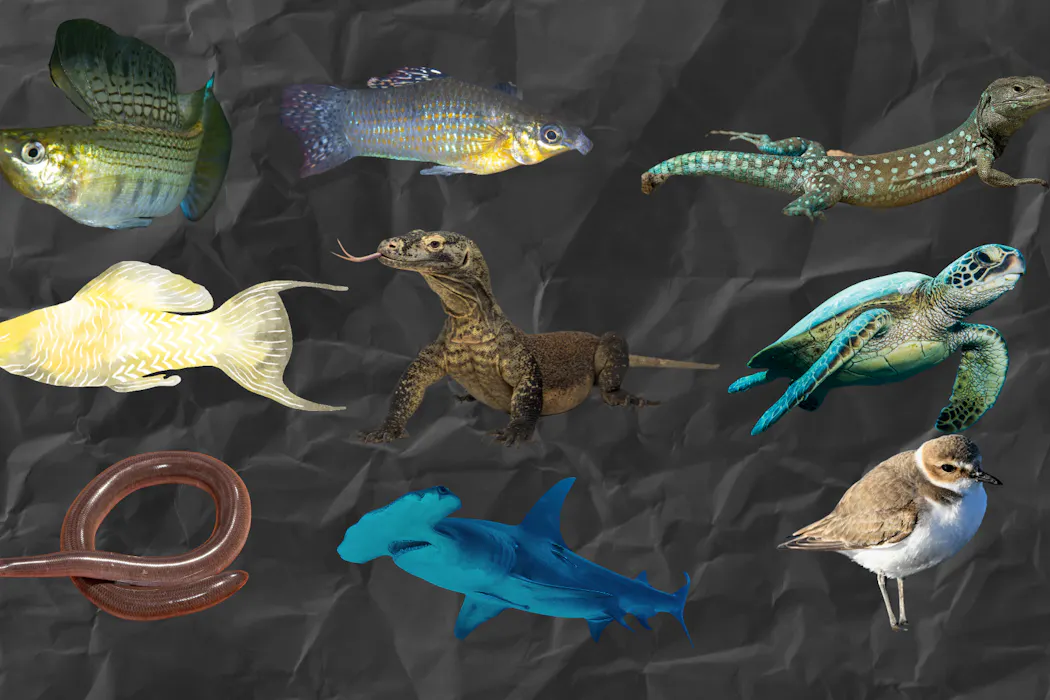
All-female animal groups including the Amazon molly fish, Komodo dragon and hammerhead shark. LifeonWhite/sketchify/EllesRijsdijk/MikhailRudenko/rockptarmigan/Nigel Marsh/KenGriffiths(Canva); GriffinGillespie x2 (Shutterstock)

It may sound too bizarre to be true but the Amazon molly (Poecilia formosa), a fish that inhabits rivers, lakes and swamps in Mexico and Texas, exists over much of its range in populations that are 100% female. In 1932, the Amazon molly became the first known vertebrate to reproduce by cloning itself, producing all-female populations. A new genetic study has given scientists insights into the longstanding mystery about how and why this happens.

The proportion of females in the human population is roughly 50%. A few countries such as Maldives (38% female) and Moldova (54% female) diverge from this, but these differences can largely be explained due to male immigration and emigration. However, much more dramatic sex ratios are found in the animal kingdom. Kentish plover bird populations, where males care for offspring, comprise only 14% female, and sea turtle populations, where sex is determined by temperature often exceed 75% female.

Most animal species reproduce sexually. This involves the fusion of two gametes, the sperm and egg, that develops into an embryo. A process, known as recombination, randomly shuffles the genetic material from the mother and father. This produces increased variability in the offspring, and new combinations of traits. The genetic diversity improves the chances of survival for the species if its environment changes.

Small fish in palm of a human hand.
The Amazon molly’s name is a reference to the matriarchal society in Greek mythology. Jon McIntyre/iNaturalist, CC BY-NC

But the Amazon molly reproduces asexually, where there is no mixing of genetic material. This reduces genetic diversity, making populations vulnerable to extinction – if one Amazon molly is susceptible to a disease, they all are.

And there is another problem to being identical. Asexual species are more likely to accumulate harmful mutations. This phenomenon, known as Muller’s ratchet, predicts that clones should go extinct within 10,000 years. Yet, the Amazon molly, – a hybrid that arose through sexual reproduction between a female Atlantic molly (P. mexicana) and a male sailfin molly (P. latipinna) – has survived for over 100,000 years.

So, what is the secret to their sustained existence?

Gene conversion is a process where one version of a gene is replaced by another. In most species, such as humans, it is used to repair damaged DNA. However, in the Amazon molly, gene conversion has slowed Muller’s ratchet. The new study found that gene conversion appears to play the same role as recombination. This essentially enables the fish to purge harmful mutations and preserve beneficial ones. Indeed, despite reproducing asexually, the Amazon molly shows differences in body shape between populations, demonstrating evolution in response to its local environment.

The Amazon molly reproduces via a process called parthenogenesis, also known as “virgin birth”, where young are produced from an unfertilised gamete. This allows rapid growth of successful genotypes, the genetic blueprints of organisms, as all of the Amazon mollies can reproduce without finding a mate. As such, animals created via virgin births can colonise habitats quickly.

Parthenogenesis can be obligative, like in the Amazon molly, where it is the only means of reproduction. But, it can also be facultative, where species can switch between sexual and asexual reproduction. For example, the marbled crayfish, reproduce sexually in their native range but rapidly establish themselves in new habitats asexually, often from a single female.

The Amazon molly has a type of parthenogenesis known as gynogenesis where sperm is required to stimulate development of the unfertilised egg. So, the Amazon molly still needs to “mate” each time she reproduces, but the sperm is not incorporated into the offspring.

The Amazon molly mates with males from species closely related to them, which reproduce sexually. Although the genes of these males are not passed on to the next generation, it is still advantageous for them. That’s because female animals often follow trends when it comes to selecting a mate. So when the female fish of their own species see the males with an Amazon molly, they are more likely to mate with them.

Parthenogenesis is common in invertebrate animals, including ants, bees and wasps. It is less common in vertebrates but has been found in other fish, amphibians, reptiles including the Komodo dragon, birds such as Californian condors and sharks for example hammerheads.

Other all-female parthenogenic vertebrates include the whiptail lizards, where almost a third of species are comprised solely of females. The New Mexico whiptail lizard has even become a queer icon. Unlike the Amazon molly, these “lesbian lizards” do not need sperm from a male to stimulate egg development. They just need to engage in mating behaviour to stimulate ovulation, bypassing males completely.

Small striped lizard on sandy ground
The New Mexico whiptail lizard doesn’t need a male to reproduce. Danita Delimont/Shutterstock

Some blue-spotted salamanders have reproduced asexually for several million years. Although the all-female populations of the salamanders reproduce in a similar way to the molly fish, requiring sperm to stimulate development, they are kleptogenic. This means that they replace a portion of the mother’s DNA with a portion of DNA from the male’s sperm, incorporating a small amount of his genetic material into the offspring. This facilitates the genetic diversity that has enabled the salamanders to survive for so long.

Like the Amazon molly, the Brahminy blind snake, also known as the flowerpot snake due to its habit of burrowing in potted plants, is the only other known vertebrate that breeds exclusively via parthenogenesis.

The snakes have three copies of each chromosome, rather than the usual two, probably due to an error in cell division at some point in the evolutionary history of the species. Increased numbers of chromosomes have been found in many species, including salmon with four copies, and sturgeon fish with eight copies.

Increased numbers of chromosomes generates increased genetic diversity, which probably explains how the blind snake clones have survived for so long.

There could be more all-female animals out there yet to be discovered. After all, up until a few years ago we didn’t know that female snakes have two clitorises.

The Conversation

Louise Gentle works for Nottingham Trent University.

Eaten, used as taxis and vomited up: how bees support other animals

The importance of bees for pollinating wild plants and crops is well known. If we lose the bees, we lose our food. But this is only part of the picture. Bees also support a hidden network of other species, sometimes as mutual partners, sometimes as prey, sometimes as other unwilling victims.

Many organisms depend on bees for survival, and many of these interactions are not mutually supportive. Some predators focus on bees, for example bee wolves (Philanthus triangulum), capture bees to feed their young in their underground nests.

Crab spiders, also known as the white death spider, are often found camouflaged on the top of flowers. They wait for bees to sip on some nectar and then the spider consumes the bee, and afterwards vomits the corpse back up.

It’s not just insects, vertebrates depend on bees too. Birds such as bee‑eaters and great tits, as well as some species of bat consume bees as part of their diet, while badgers and foxes often raid nests for larvae and honey. And, of course, humans have been eating honey from before there were written records.

Playing host to unwelcome guests

Around 40% of animals are actually parasites and bees support a wide range of these species. The wingless fly Braula coeca, sometimes referred to as the bee louse, lives on honey bees, feeding on their secretions. Though small, these parasites are a constant presence in some colonies.

A spider about to consume a bee, close up
A spider preparing to eat a bee. EUIP/Shutterstock

Another parasite, Sphaerularia bombi, the nematode (a type of worm-like creature), enters bumblebee queens during hibernation. Once inside they inflate, filling much of the queen’s body. When she emerges in the spring, this queen has been neutered by the parasite and is no longer able to find a new family. She instead just acts as a vehicle to spread the parasite to new sites.

Some bees need other bees to help them survive. Cuckoo bees infiltrate the nests of bumblebees. After they gain access they suppress the bumble bee queen and force her workers to raise their young.

Invading the lives of bees

Sometimes parasitic interactions go one step further and ultimately kill the bee by spending part of their lifecycle within their host. Strepsiptera are an unusual insect, which most people may not have heard of. Stylops are one genus of Strepsiptera which live in the abdomens of bees, visible only by a small protrusion in the abdomen. But when it is time for Stylops to mate they explode from the abdomen of their bee host, killing it.

Bee flies definitely deserves a mention, as they bear a striking resemblance to bees. In the UK, species such as Bombylius major dance around flowers with their fuzzy, bee‑like bodies. While the adults are harmless and actually serve a role as pollinators themselves, their larvae are parasitoids of solitary mining bees. Parasitoids are defined as those that live on (or in) their host eventually killing it, a subset of parasites. The females flick their eggs into the entrances of bee nests and when they hatch, the larva consumes bee eggs or young larvae before feeding on the pollen stores.

Using bees to hitch a ride

Some species just use bees for transport. Mites such as Chaetodactylus attach themselves to solitary bees in order to travel between nests. Their larvae however, are less benign. They greedily consume the pollen stores of nests, occasionally eating eggs.

Perhaps even weirder however are the trigulins (or larvae) of blister beetles. These often cluster around flowerheads. They wait for bees, only to then climb on board for a free ride – using them as a free taxi to a nest where they feed on its contents with a particular fondness for bee eggs.

Pseudoscorpions are a distant relative of scorpions. They bear a striking resemblance to true scorpions, but these instead of carrying a sting in their tail, use the bee for a free ride. Hanging on to the bees with their pincers they use the bees as a taxi, but in their case just as a way to save energy on long-distance travel.

In the end, bees – whether they are solitary bees, mining bees, honey bees or bumble bees – are far more than pollinators. They support a much wider ecosystem. Countless other organisms rely on bees as hosts, prey, transport, or providers of food and shelter every day. Without bees we would not only lose those plants they pollinate but also those animals that need the bees to feed them and help them reproduce.

The Conversation

Alex Dittrich does not work for, consult, own shares in or receive funding from any company or organisation that would benefit from this article, and has disclosed no relevant affiliations beyond their academic appointment.

❌