Normal view

Birds masturbate, and that’s perfectly normal

mycteria/Shutterstock

For captive animals, engaging in natural behaviour is a pillar of the animal welfare framework. But when it comes to sex, one important behaviour has been largely ignored, and sometimes even punished: masturbation.

Solo sex is surprisingly common across the animal kingdom. It is well documented in primates. Tortoises are surprisingly vocal during their solo lovemaking endeavours, if not very graceful. Camels masturbate by rubbing their penises in the sand and porcupines make inventive use of all sorts of objects.

Our new study could change how other scientists view masturbation in birds and improve their welfare.

Masturbation also seems to be common in birds. A quick internet search brings up an abundance of video clips on social media and dedicated posts on bird-keeping forums, largely from worried or bemused hobbyist bird keepers.

It has often been treated as an abnormal problem behaviour in captive birds (particularly parrots). Folklore husbandry has assumed it is the undesirable outcome of stress, bad health or poor environment. Bird keepers often therefore discourage masturbation via punishment or veterinary interventions such as diet or care changes and, sometimes, even drugs and surgery. Despite the welfare implications, masturbation in birds had been largely unexplored by the scientific community.

We set out to change that, by investigating the distribution and evolutionary history of masturbation in birds for the first time. We studied 120 species of bird across 22 major groups, gathering data from the scattered scientific literature, online reports and community forums, and surveys of bird experts.

Colourful parrot ducks behind wing.
There’s no need to shame parrots for solo sex. Wirestock Creators/Shutterstock

Our study found that masturbation is widespread across birds with a strong evolutionary history, meaning that it’s an ancient trait probably similar in closely related species. Although we found more records of masturbation in male birds, it occurs in both sexes and across all age groups.

Solo sex also seems to be linked to species that mate with multiple partners, supporting the idea that it might help to increase reproductive success when there is a high degree of competition over fertilisation. For instance, in males it may flush out old sperm to leave newer (better condition) sperm for mating. In females it may increase sexual arousal to help with sneak mating with males other than their partner.

Wild behaviour

Crucially, we discovered that masturbation is actually less common in captivity than the wild, and more common in birds reared by their own parents than by humans. What this tells us is that masturbation in birds is neither an unnatural behaviour, nor a consequence of captivity. Given this finding, it is important that birds are not prevented from masturbation. Of course, as with any behaviour, there may be extreme cases where chronic masturbation could indicate underlying health or husbandry issues.

Avian self-pleasure is usually a rather inelegant affair, in which a bird rubs their cloaca (a shared orifice for both excretion and reproduction) against an object, like a branch, twig or toy. This is often accompanied by a lot of flapping and self-satisfied vocalisation.

One potential reason for the lack of scientific studies exploring avian masturbation may be because the cloaca is thought to have fewer nerve clusters, and therefore lower sensitivity, than our own genitals.

Clearly however, birds are getting some satisfaction from masturbation, so perhaps there is more to a bird’s sensations during sex than has previously been recognised. Further exploration of this could have important implications for both welfare and captive breeding programmes. While sexual pleasure may not be exactly the same experience as for mammals, it is wildly premature to dismiss the idea that birds also feel pleasure.

The Conversation

The authors do not work for, consult, own shares in or receive funding from any company or organisation that would benefit from this article, and have disclosed no relevant affiliations beyond their academic appointment.
Received — 31 May 2026 The Conversation

My unsung hero of science: William Adams, the Bombay bureaucrat whose vision of a solar future was dashed by colonial conservatism

William Adams was entranced by energy. As a young man, his interest was nursed by working as a clerk in a London patent office in the 1860s. This gave him an early look at some of the first British designs for exploiting solar energy using mirrors, water or both.

Adams would later recount his excitement at reading about the French mathematician Augustin Mouchot’s invention of the first machine ever to run on energy from the Sun. The device, which connected a solar boiler to a specifically designed steam engine, was warmly received by Napoleon III when it was presented to the emperor in 1866.

Inspired, Adams soon designed and patented his own rudimentary solar boiler. The only problem was, he needed more sun.


Frank Malina beside a rocket

This series is dedicated to lesser-known, highly influential scientists who have had a powerful influence on the careers and research paths of many others, including the authors of these articles.


When offered the chance to become deputy registrar of Bombay by the Indian city’s governor, Sir Philip Edmond Wodehouse, Adams jumped at the opportunity. There, he became the first Briton to design, build and test a fully-functioning solar steam engine fit for industrial purpose.

But he also came up against the conservatism of India’s colonial rulers, who did not see this Bombay bureaucrat for the energy visionary that he undoubtedly was.

‘The rays beat like missiles’

Adams arrived in Bombay in 1873 to find it in the middle of a cotton boom, with mills popping up like mushrooms across the city. The population was growing so quickly that firewood was depleted for miles around. The landscape grew “bald as a billiard ball”, as Adams put it.

Every morning before setting off for work near Bombay’s central fort, Adams would set up his outdoor laboratory at his home in the southernmost Colaba district, near the open sea. He instructed an Indian fundhi (skilled carpenter) to build a set of three-tiered wooden shelves to hold 18 looking glasses.

“Each glass was moveable on a swivel in the same manner as an ordinary toilet glass”, Adams explained, meaning he could pivot each glass by “the touch of the finger”.

Later, for open-air experiments, Adams used two banks of mirrors (36 in total) which made “the mercury in the thermometer boil, leaping up to over 670 degrees fahrenheit”. He then placed a copper cylinder containing three gallons of water in the focus of all 36 mirrors, making it boil in exactly 20 minutes.

But Adams’s ambition did not end there. To reach sufficient pressure in the boiler to drive a steam engine, this bureaucrat-cum-engineer built a giant concave mirror, 24 feet in diameter. He then sent for his London solar boiler, which was delivered by ship to Bombay in 1876.

One fine morning, Adams – wearing dark glasses for safety – turned his giant concave mirror on the copper cylinder filled with water. “The rays beat like missiles in a continuous and incessant storm of solar fire,” he wrote.

An hour later, the cylinder registered 55 pounds of pressure per square inch. He hired a steam engine of 3 horsepower and connected it to the boiler: the pressure moved the pistons. Adams had built the first working, British-designed solar steam engine.

For a fortnight, he kept the pump going near his bungalow in Colaba – proudly and sweatily displaying his innovation to government officials, newspaper reporters, mill owners and the local Indian communities. Members of the public were invited to witness his experiments too, via a notification in a Bombay newspaper.

Engraving showing William Adams's design for a portable solar cooking stove.
Adams’s design for a portable solar cooking stove. Illustration from Cooking by Solar Heat by William Adams in Scientific American (1878), CC BY-NC-ND

‘An inexhaustible source of wealth’

In 1877, Adams wrote a letter to the editor of the Times of India arguing that the application of his solar steam engine would “make India the seat of the principal manufacturing industries of the world”.

Later, in his wildly ahead-of-its-time treatise Solar Heat: A Substitute for Fuel in Tropical Countries (1878), Adams argued that countries near the equator “possess, in their clear skies, a gratuitous and inexhaustible source of wealth, equal to that which western nations have to dig, with infinite labour and toil, from the bowels of the Earth”.

Adams sketched out plans to use solar heat for everything from cotton gins (engines to separate cotton fibres from seeds) to Hindu crematoria. He called upon the colonial British government to invest in this promising substitute for coal, which was then being imported to India at great expense.

Adams envisioned solar energy transforming the Raj. Just like the coal-combusting steam engine had replaced the waterwheel in England, he argued that thermal heat could now replace fossil fuels in India. But his colonial bosses were not persuaded.

‘Too subversive’

Adams was part of a 19th-century wave of global research into solar steam engines, as I explore in my postdoctoral project and upcoming book. But in contrast to fellow pioneers including Frenchman Mouchot, Adams built his solar steam engine to stimulate local Indian industry, not to benefit the colonial government.

The locals shared Adams’s belief in this technology. One even wrote to Scientific American magazine to express their desire for the rapid adoption of solar power:

My residence is in a tropical part of India … where fuel is scarce and dear … In this part of the country (about 300 miles north of Bombay), there is a great opening for cheap power in small units.

Bombay’s new governor Sir Richard Temple concluded, however, that solar heat “could not be used for commercial purposes on a large scale”. He argued that local factory owners would not like giving “the workmen a holiday on days when the sky is not clear”.

In truth, Adams’s invention was too subversive for Britain’s colonial officials and capitalists. In less sunny climes, solar energy – tethered to the seasonal rhythms of nature – might negate their commercial ambition for timeless industrial production. But they also saw India as an important market for British coal exports.

A huge solar power plant in western India.
AMPIN Energy’s solar power plant in Bhadla, western India. India is now the world’s third biggest generator of solar power. Sarvajanik Puralekh/Wikimedia Commons, CC BY-SA

While a few mill owners adopted Adams’s auxiliary solar heater for their steam engines, most regarded it as a primitive contraption unfit to satisfy the demands of modern civilisation.

Increasingly frustrated that neither the industrial capitalists nor the colonial government supported his vision, Adams abandoned further experiments. His dream of India switching away from coal to solar power, from combustion to concentration, would not happen for at least another century.

Now, however, India is a world leader in the global energy transition. It heads the International Solar Alliance, and is the third largest solar power generator in the world.

Which begs the question: how much further advanced would this technology be had Adams’s 19th-century solar experiments been embraced by India’s colonial rulers at the time?

The Conversation

Sebastian Egholm Lund receives funding from the Carlsberg Foundation. His upcoming book, Changing the Climate at the Fin de Siècle, is published by Cambridge University Press (September 2026).

Heatwaves are now everyday disasters – here’s how the UK government can better protect people

Heatwaves are a growing global threat to human health, wellbeing and livelihoods.

Across 12 major European cities during the summer of 2025, a ten-day period of extreme heat led to 2,300 deaths – 1,500 of them were attributed to climate change amplifying temperatures by 1-4°C. Heatwaves were responsible for nearly half a million global deaths every year from from 2000 to 2019.

In addition to their health risks, European heatwaves in 2025 contributed to regional glaciers melting and wildfires hitting the largest area on record, according to a new report.

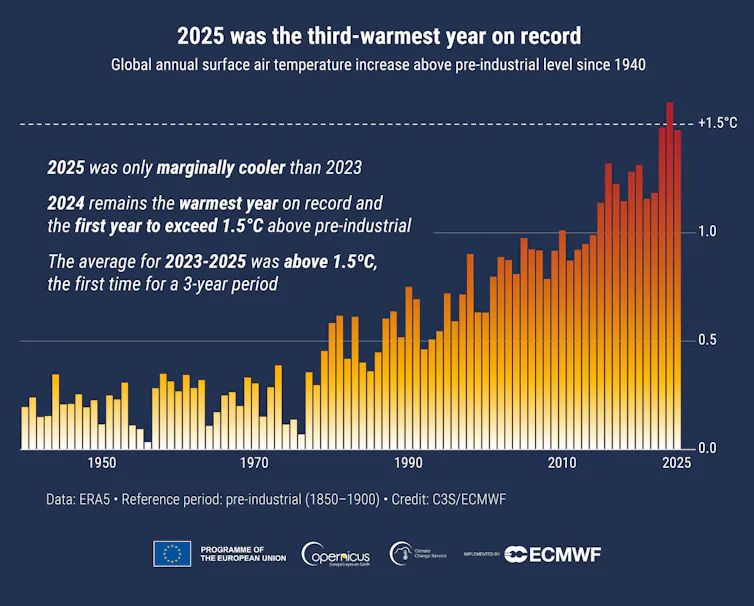
And it’s not just Europe, globally 2025 was ranked as one of three hottest years on record. Heatwaves are not going away: even after emissions targets are met, heatwaves will not return to pre-industrial levels for at least 1,000 years.

Governments across at least 47 countries have implemented heat action plans, such as the United Kingdom’s adverse weather and health plan and city-level plans across India.

These plans typically include early-warning systems, coordination between health and social authorities, and public messaging urging people to stay cool. People can try to implement a variety of measures, including staying in a cool environment, avoiding strenuous activity, drinking more water and wearing lighter clothes. These are theoretically simple steps, which is why heatwave deaths are so often called needless and preventable. But the realities of everyday life make adaptation far more complicated.

How people stay cool is closely tied to existing social inequalities, making heatwaves a nuisance for some and a catastrophe for others. Older people, for instance, have reduced abilities to regulate body temperatures, are more likely to have underlying health conditions that amplify risks and may lack networks of social support during disasters. Income divides create other risk factors such as who owns air conditioning and who can afford to run it. Other factors include who can work in a cool office or work from home, versus those doing outdoor or manual labour in the heat.

Unlike hurricanes or wildfires, which force widespread evacuations, life generally does not stop when heatwaves occur. People are forced to adapt while also meeting their ongoing daily obligations. Government advice might be to stay cool during the hottest part of the day which could be in conflict with a person’s rigid workplace schedule.

There are no maximum safe working temperatures in the UK, for instance. Staying at home can be the safest option if you have air conditioning. Yet during the catastrophic 2021 Pacific Northwest heatwave in the US and Canada, the vast majority of deaths in British Columbia happened in people’s own overheated homes, where there was inadequate air conditioning or fans.

A graph showing data from the Global Climate Highlights 2025 report.
Data from the Global Climate Highlights 2025 report. ECMWF/EU, CC BY-ND

How are people coping?

Recent research examines how people adapt their daily activities when dangerous summer heatwaves occur. Using mobile phone location data across seven countries – Brazil, China, France, India, Nigeria, Turkey and the United States – the study shows that people around the world are changing their daily lives to stay cool, ranging from leisure activities to work obligations.

These adaptations vary widely and reflect existing inequalities. People tend to withdraw into their homes during heatwaves, regardless of whether their country has widespread air conditioning or existing heat plans. In some places, people visit workplaces less (notably in France), though not everyone can afford to do so.

In others, people cut back on food shopping or going to the pharmacy as temperatures rise, essential for maintaining households and health (as the research shows has happened during heatwaves in the United States). Places for shopping and recreation – which may have air conditioning – as well as parks may serve as important refuges for those who cannot cool down at home.

Staying cool requires more than awareness and good decision-making – structural barriers, such as having to stay at work during high heat, severely limit people’s access to cooling.

Our research highlights that governments also need to pay closer attention to the space and time constraints people face, and policy efforts should grant people the flexibility to follow their advice. Research on Mexico, for example, found that those aged 18 to 35 were disproportionately likely to die from extreme heat, despite being physiologically less vulnerable than older people. This may be attributed to greater rates of outdoor work with little flexibility to use cooler spaces.

Setting maximum safe working temperatures, relative to local extremes, or allowances for flexible working hours could limit occupational health risks. Both could give workers the choice of where to spend the hottest hours of the day. There is already a precedent for climate-related leave. Spain introduced paid leave following the 2024 Valencia floods. But flexibility alone is not enough if people have nowhere to go nearby that is cool.

Governments need to focus on making accessible cool spaces available, especially in areas with low air conditioning ownership and in dense urban neighbourhoods. This means opening libraries, community centres and other public buildings as cooling centres, with extended hours and access to water. These provisions are currently absent from the UK’s heat plan, for example. Even as home air conditioning ownership rises, these investments in cool public spaces will remain essential. Air conditioning uptake will be limited by income, leaving many people in a continued state of cooling poverty.

Heatwaves are no longer a distant or occasional threat. They are a recurring feature of modern life in many places that are not used to experiencing them. Alongside early warning systems, public messaging and longer-term measures such as urban greening to reduce temperatures, governments need to do far more to help people stay cool when extreme temperatures hit.

The Conversation

Shiv Yucel receives funding from Social Sciences and Humanities Research Council of Canada, and the Canadian Centennial Scholarship Fund.

❌