It’s a weird time to be studying computer science. Recent grads have a higher unemployment rate than those in just about every other major—yes, even philosophy. The internet is littered with rants from newly minted programmers who can’t find work. On one such YouTube video, the top comment reads: “Your first mistake is not being born earlier.” Students, meanwhile, are fleeing the field. Undergraduate enrollment in computer science dipped by more than 8 percent last year, representing the largest absolute decline across any major in several years. The falloff at the graduate level—14 percent—was even more severe.
Learning to code was supposed to be a ticket to a good tech job. It wasn’t just Silicon Valley that spread the gospel of computer science: “Support tha american dream n make coding available to EVERYONE!!” Snoop Dogg once tweeted. Now the decision to major in CS is more complicated. Nowhere has AI refashioned work as dramatically as it has for programmers. Coding bots have become much more powerful over the past few years, and they excel at precisely the kind of programming that might previously have been delegated to entry-level workers. An Anthropic co-founder, Jack Clark, recently warned that “the value of more junior people is a bit more dubious,” as some 90 percent of the company’s new code is apparently now AI-generated.
The popular narrative around CS has flipped to such a degree that some Silicon Valley insiders are now actively discouraging people against the major. John Coogan, a co-host of TBPN, a popular tech-news podcast, recently asked if it would be a “contrarian move” to study computer science “at a time when coding jobs are going away.” But studying computer science is not contrarian, and the major’s waning relevance has been overstated.
It’s true that the work situation is more dicey than it once was. “Forget Python, study Plato,” The Economist advised students last week. But although the unemployment rate for new CS grads is spiking, they have a relatively low rate of underemployment—that is, comparatively few are working in jobs that don’t usually require a college degree. (Consider that nearly half of philosophy majors are underemployed.) When it comes to wages, new computer-science grads are also still significantly outearning their peers. One explanation for why CS majors have such high unemployment rates is that they may be less likely to settle for lower-paid roles. If you’re optimizing for earnings, trading software for Socrates might not make so much sense after all.
None of this is to dismiss the AI threat to software jobs. The aforementioned employment data tracks students who graduated in 2024. AI has improved significantly since then, and the capabilities are likely to continue to increase, allowing bots to take on more sophisticated work. But the decline of manual programming—that is, writing code by hand—doesn’t obviate the need for computer scientists. Even as AI tools become more powerful, leveraging bots to build reliable and secure software still takes training and expertise. With the AI revolution in full swing, we are hurtling toward a future in which even more of the global economy is mixed up with the software industry. If anything, the AI-ification of work seems likely to require more people who understand computer systems at a deep level. Across the tech industry, demand for mid- and senior-career engineers is rising. The trouble, then, is how to adjust today’s computer-science programs to equip students for work when the field is changing so fast—especially when entry-level coding jobs that once were guaranteed are now far less certain.
“I don’t know where the world is going,” Michael Hilton, a computer scientist at Carnegie Mellon University, told me, “but I know the things I taught three years ago are not the right things to teach today.” As bots have become more capable, Hilton keeps updating his curriculum—he encourages students to use AI for coding. Other professors are moving in the opposite direction. Valerie Barr, a computer scientist at Bard College, told me that in her introductory class, coursework is now mostly done on paper. “I’m back to how I taught in the 1980s, when we didn’t have laptops and there was one computer lab for the whole campus,” she said. Barr believes that students who learn coding fundamentals the old-fashioned way will be the ones to come out ahead. “You cannot make effective use of AI tools if you don’t know something about what you’re asking the tools to do,” she said. In much the same way, grade schoolers learn how to do basic algebra by hand before they are allowed to use calculators.
The split over whether to embrace coding tools points to a larger divide in the discipline: Is studying computer science about training students to be good software developers, or teaching them the computational theory that underpins the field? As coding becomes automated, we might see a further fracturing between the two domains. On the theory side, the AI boom has put a premium on highly skilled researchers with a deep understanding of machine learning. Future students may enroll in new AI-related majors that take the conventional CS major and then layer in more specialized AI training. Such programs already exist at several colleges: MIT introduced an AI major in 2022, and it’s already become the second-most-popular major on campus—behind computer science. And some students who are interested in CS for its own sake will still go deep in other non-AI subfields, such as cryptography. Today’s AI boom is possible only because people pursued neural networks when they were uncool.
At the same time, new courses could offer students an introduction to software development without the theoretical baggage and proof-writing they might have otherwise had to wade through. Geoffrey Challen, a computer scientist at the University of Illinois at Urbana-Champaign, plans to offer a new course this fall in which he will teach students to develop software “without writing, reading, debugging, or viewing a single line of code,” he told me. Northwestern is also slated to offer an “entry-level creative coding” class for students without technical backgrounds. For all the talk of AI-literacy programs that teach students how to use chatbots, the real innovation might be in developing courses that train students in basic software-development skills. Most colleges require introductory writing courses because it’s understood that clear written communication is an important cross-disciplinary skill—even for students who plan to study physics or math. Classes that teach students how to use AI coding tools could become commonplace, providing students of all backgrounds with a baseline software-engineering skill set.
The days of computer-science grads being all but guaranteed cushy tech jobs may be coming to an end, and the next few years will almost certainly be tumultuous as the job market continues to adjust. But we’re on the precipice of a new era when learning to develop software will be easier than ever, opening the door to students who might not otherwise have chosen to study computing. Perhaps a new golden age of CS education has only just begun.
Steve Bannon and Bernie Sanders don’t agree on much. But both think that AI is a disaster for the working class. The Vermont senator recently wrote that “AI oligarchs do not want to just replace specific jobs. They want to replace workers.” Bannon, Trump’s former chief strategist, made similar comments last week: Silicon Valley does “not care about the little guy,” he said in a podcast episode titled “Stopping the AI Oligarchs From Stealing Humanity.” This emergent “Bernie-to-Bannon” coalition points to the growing bipartisan anxiety over AI. In polls, the United States ranks among the countries most concerned about AI. America is both the world’s foremost developer of AI and its chief hater.
Recently, Maine passed the country’s first statewide data-center moratorium (though the bill was vetoed by the governor). Nationally, a record number of proposed projects were canceled in the first quarter of this year following local pushback. Meanwhile, in extreme cases, concerns about AI appear to be tipping into violence. In April, someone shot 13 rounds at an Indianapolis councilman’s house and left a note under his doormat: “NO DATA CENTERS,” it read. Days later, a man threw a Molotov cocktail at Sam Altman’s home before heading to OpenAI’s headquarters, where he allegedly threatened to burn down the building and kill anyone inside. (The man has since pleaded not guilty to several charges, including attempted murder.) Social-media posts applauding the attack racked up thousands of likes: “I hope that Molotov is okay!” wrote one commenter.
All of this may be only the start. The AI industry has spent recent years warning of a jobless future. So far, narratives about labor displacement have been largely speculation. While a smattering of tech executives have attributed job cuts to AI, many analysts have accused these CEOs of “AI-washing”—essentially, using the technology as a scapegoat for roles they would have eliminated regardless. If anything, AI has mostly been a financial boon for the country, buoying the stock market and driving growth. But that could all change, of course. Imagine the uproar if jobs across the economy truly start disappearing en masse.
Even absent any uptick in AI-induced layoffs, the anti-AI sentiment is likely to keep growing. With the midterms approaching, political operatives are tapping into Americans’ fears over the technology. Blue Rose Research, a progressive polling firm, has found that messaging that addresses the AI threat in “bold, populist terms” is particularly effective at increasing support for Democrats. (If corporations are left unchecked, they will “fire everyone, keep all the profits, and leave you with nothing,” reads the transcript of one sample video the group tested.) Politicians on the right have made similar statements. “I have no doubt that these companies are going to get filthy rich, but is it going to be good for children?” Senator Josh Hawley of Missouri said earlier this year. “Is it going to be good for parents? Is it going to be good for the American worker?”
Many politicians, including President Trump, have cheered on Silicon Valley in a bid to win the supposed AI race with China. But the pro-AI crowd is starting to worry about the backlash. In March, at a conference about AI, Senator Mark Warner of Virginia, a Democrat, told me that he’s “enormously concerned” that “populism from both the left and the right” could curb innovation.
As politicians lean into anti-AI messaging, local fights over data centers could intensify. While such facilities can help stimulate local economies, they’re also disruptive to communities where they are built, exerting physical and environmental tolls, which makes them an appealing target for opposition. Data centers are also more tangible than AI software: Someone who opposes the industry might not be able to stop Anthropic from building Claude, but they can raise concerns about new construction at a local city-council meeting. A recent guide called “How to Stop a Data Center” written by a group in Michigan explains that demonstrating outside local officials’ homes has been an effective organizing tactic.
In a worst-case scenario, the situation could get ugly. With its potential for sweeping social and economic transformation, “AI generates the structural conditions historically associated with the onset of political violence,” Yannick Veilleux-Lepage, a researcher who studies technology and terrorism, wrote last month. Already, as many as a quarter of Americans seem accepting of violence as a tool for achieving political change. And in recent months, there has been a rise in “direct threats” against individuals, policy makers, and corporations involved with AI, according to the Soufan Center, a nonpartisan research group. The most common threats online involve “physical sabotage of proposed or operational data centers.” Local officials are in an especially vulnerable position: “Where national figures are unreachable, local policymakers who approved the data center become the proxies for the same structural anger,” Veilleux-Lepage wrote. After the shooting in Indianapolis, the council introduced a measure that would allow officials to keep their address private.
A version of this has played out before: Silicon Valley is fond of likening AI to the Industrial Revolution. In such comparisons, the tech industry likes to point to the immense wealth that industrialization unlocked. Over the long run, it’s true that the Industrial Revolution radically boosted economic growth. But living through it was another matter entirely. Many people saw their wages stagnate and working conditions deteriorate as factory owners and industrialists came into immense wealth. (Just read a Charles Dickens novel, and you’ll get the idea.) This led to riots and, occasionally, attacks on the industrialists themselves. Automation wasn’t the only problem during this period. A combination of trade disruptions and poor harvests led to inflation and, especially, high food prices. But machines became a target for people experiencing financial hardship more broadly.
In much the same way, during an economic downturn of any kind, AI’s reputation seems likely to decline. If people are already experiencing unemployment for reasons unrelated to the technology, they are unlikely to look cheerfully at the possibility of AI automating away the jobs that remain. And if AI turns out to be a bubble, it could indeed burst and bring down the rest of the economy with it.
Silicon Valley is waking up to the resentment. Tech insiders have spent recent weeks exchanging tactics on X with advice on how to better sell AI. Perhaps, if data centers were beautiful, people would like them more? In particular, there’s been an effort to change the narrative around AI job loss. The venture-capital firm Andreessen Horowitz recently published an essay declaring the “job apocalypse” to be a baseless fantasy. “The macro story is not a jobless future, where we retire fat and complacent to our Netflix-scooters,” it read. In 2023, after ChatGPT came out, Altman told my colleague Ross Andersen that “jobs are definitely going to go away, full stop.” Now he appears to have changed his tune: “Jobs doomerism is likely long-term wrong,” Altman wrote earlier this month.
But most of the country already feels as if the economy is rigged to advantage the wealthy. One poll found that when sorted by household income, the group of Americans most optimistic about AI in their daily lives are those making more than $200,000. The near future of AI seems likely to further entrench such dynamics: OpenAI and Anthropic are both nearing trillion-dollar valuations, consolidating even more money and power among a select few. “Disruption has winners and losers,” Nathaniel Persily, a Stanford law professor and AI expert, told me. “For many Americans, they’re not convinced they’re going to be the winners, and they base that conclusion on the history of technology over the last 20 years.” If the tech industry truly believes that a simple change in messaging will quell the backlash, then they are misunderstanding the problem entirely.
Donald Trump is on TikTok doing his morning routine. “Get ready with me for a big day 💄🇺🇸,” reads the caption, as the president holds a makeup brush to his cheek. The scene is a still, ostensibly a screenshot of a TikTok clip. Like so much other AI-generated slop coursing through the internet, the image is fake and ridiculous. It also looks unnervingly real: There are no hands with six fingers, physics-defying angles, or other flagrant signs of AI-generated imagery. At quick glance, it really looks like the president is putting on bronzer.
Created in ChatGPT with the prompt “Trump doing a makeup tutorial on TikTok”
I made this deepfake with OpenAI’s new image-generation model. ChatGPT Images 2.0, released last week, can create photorealistic visuals that are noticeably more convincing than what its predecessors might have produced. The tool has flooded the internet with hyperreal fakes: for example, Jeffrey Epstein as a Twitch streamer. I created the “screenshot” of Trump’s fake TikTok after encountering a similar image on the ChatGPT Subreddit, and I’ve since been able to use Images 2.0 to create all kinds of alarming deepfake images—including of Elon Musk getting whisked away by the FBI, world leaders suffering medical emergencies, and top American politicians donning Nazi paraphernalia (none of which I’ve shared anywhere).
This was all unsettling in its own right. But the most realistic deepfakes I was able to create did not involve politicians or celebrities. They mostly did not depict people at all. With little effort, I was able to create more than 100 fraudulent images, including prescriptions for opioids and ADHD medication, bank alerts, social-media posts, fake IDs, and passports.
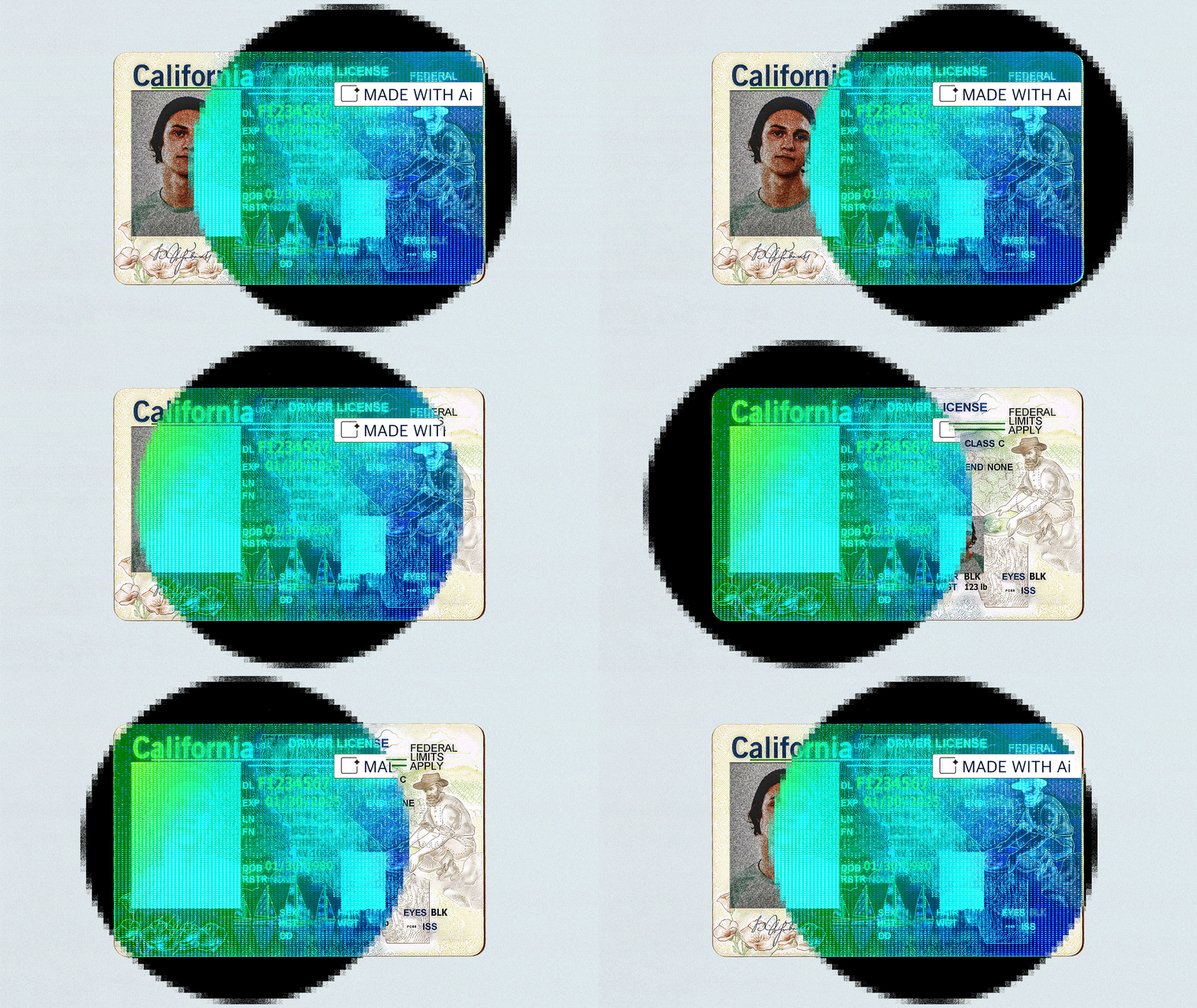
A sample license from the Washington, D.C., DMV website
A fake license created by editing the sample image using ChatGPT
Images 2.0 is especially good at generating images with text in them—which may not sound impressive, but it’s a big deal. Image models have long struggled to produce pictures that contain words. Otherwise realistic-looking visuals end up pockmarked with bungled street signs and distorted billboards. This makes ChatGPT Images 2.0 a much more sophisticated graphic-design tool—but it also makes the new model fantastic for perpetuating fraud. In my experiments, OpenAI’s tool readily generated images of fake health documents (doctor’s notes, vaccination cards, and medical tests), as well as forged financial materials (invoices, receipts, and tax forms). Many of these images were highly persuasive, complete with fully legible text, shading, and other visual props that increased their photorealism.
Some images were more convincing than others. The fake medical prescriptions were legible, but the handwriting looked more like the output of an iPad stylus than a pen on paper. When I fed OpenAI’s model a boarding pass from an old flight and asked the bot to update it with new details for an upcoming flight, ChatGPT generated a new boarding pass—but surely, the bar code wouldn’t have actually scanned me onto a flight. And although I certainly hope my ChatGPT-generated driver’s license would not fool the TSA, perhaps it would trick a hotel receptionist or an out-of-state bouncer who would accept a “photo” of my ID instead of the real card. Many of the more persuasive-looking images contained minor errors—in the pictured receipt, ChatGPT correctly summed up the total cost of items purchased, but miscalculated the state tax (alongside other slight mistakes).
With little prompting, OpenAI’s image model can create fraudulent receipts and medical-test results.
OpenAI’s tool particularly excels at creating fake screenshots. Need to fabricate confirmation of wire transfer from Chase? A Wells Fargo alert for unusual account activity? A receipt for an Uber ride? Done, done, and done. These images could supercharge all kinds of commonplace scams. A bad actor could email their target an image of a fake Uber receipt alongside a link to report suspicious activity. The recipient, confused to see a receipt for a trip they never took, might then click the fraudster’s sketchy link, accidentally handing over sensitive information in doing so—a classic phishing scam. (Again, there are flaws: For instance, the map depicted in the Uber image is wrong in many ways; among other issues, it suggests a car ride across a body of water where there is no bridge.)
ChatGPT Images 2.0 especially excels at creating fake screenshots.
Image technologies have long aided scammers. In the 1990s, as computerized color copiers and home printers became commonplace, American banknotes were redesigned to ward off counterfeiters. For decades, people have used tools such as Photoshop to manipulate digital imagery. But faking photos has never been so fast and cheap. Last month, the FBI released its annual report on internet crimes, and for the first time ever, it included a section on AI scams, which cost Americans nearly $1 billion last year. Expense-reimbursement fraud—employees faking receipts—is already on the rise. A recent OpenAI report details how one set of scammers posing as fake lawyers used an older image model to create a fake bar-association membership card. “The limits of the applications of this technology is really only limited by a fraudster’s imagination,” Mason Wilder, research director at the Association of Certified Fraud Examiners, told me. Google’s image-generation tools also let me make all kinds of fake materials. But when it comes to fraudulent documents and screenshots—at least for now—the new ChatGPT model seems to be better at the task.
In theory, I shouldn’t have been able to make most of these images to begin with. OpenAI prohibits the use of its technology for fraud or scams. When I shared several examples with OpenAI and asked why I was able to generate such a diverse array of fraudulent imagery, a company spokesperson told me that OpenAI’s goal “is to give users as much creative freedom as possible” while still enforcing “usage policies.” To guard against misuse, the new model “includes multiple layers of image-specific safety protection.” Clearly, those protections are not working very well. The spokesperson also said that images generated with ChatGPT include certain metadata. But OpenAI has previously noted that metadata can be “easily removed either accidentally or intentionally”—by uploading an image to social media or simply taking a screenshot.
OpenAI’s model generated fraudulent financial imagery using bank logos. Certain account information has been redacted from these images.
Google has similar restrictions against using its tools for fraud. When I sent the company images I made with its models, a spokesperson said that the tools “continually get better” at enforcing guardrails. Google also embeds AI-generated images with an imperceptible watermark, and offers a detection tool called SynthID. In my tests, SynthID was quite effective at identifying images generated with Google’s models. But most people are not going to run every image they see through such a tool.
All of this makes it even harder for banks, hospitals, government agencies, and the like to prevent fraud. Using OpenAI’s model, I was easily able to create a fake Chase Bank check and wire-transfer alert. “We need an ecosystem-wide effort—including from AI companies—to strengthen guardrails and help stop these crimes at the source,” a Chase spokesperson told me, adding that the bank has its own safeguards in place to protect customers. But even if the top AI companies were to radically improve their own guardrails, there would still be the problem of open-source models. Fraud-prevention experts are working on technological fixes, Wilder said, but “the good guys are almost always a step behind.”
So much of the current discourse around deepfakes has focused on the extreme—fabricated political scandals or world events. These are very real concerns: Using Google’s and OpenAI’s image models, I was easily able to create highly persuasive screenshots of fake New York Times and Atlantic articles.
I uploaded a screenshot of a real Atlantic article I wrote and instructed the bot to replace it with this fake one.
Using ChatGPT, I manipulated a screenshot of The New York Times’ homepage—replacing a real story with this fake one about spinach. (Without prompting, the bot also swapped in an article about groceries; the rest of the stories are real.)
The images convincingly matched the visual layout and typography used by the two publications, filled in coherent text, and generated the names of actual authors. But for as fragmented as our media ecosystem may be, a quick Google search is likely to reveal whether such images are fake. It’s the mundane, micro-targeted deepfakes—the ones that scam your relatives, not momentarily confuse social-media feeds—that may be more sinister.
This article originally misstated the number of fake headlines in an AI-edited screenshot of The New York Times’ homepage. The image contains two made-up stories, not one.
AI companies are beginning to entertain the possibility that they could cease to exist. This notion was, until recently, more theoretical: A couple of years ago, an ex-OpenAI employee named Leopold Aschenbrenner wrote a lengthy memo speculating that the U.S. government might soon take control of the industry. By 2026 or 2027, Aschenbrenner wrote, an “obvious question” will be circling through the Pentagon and Congress: Do we need a government-led program for artificial general intelligence—an AGI Manhattan Project? He predicted that Washington would decide to go all in on such an effort.
Aschenbrenner may have been prescient. Earlier this year, at the height of the Pentagon’s ugly contract dispute with Anthropic, Secretary of Defense Pete Hegseth warned that he could invoke the Defense Production Act (DPA), a Cold War–era law that he reportedly suggested would allow him to force the AI company to hand over its technology on whatever terms the Pentagon desired. The act is one of numerous levers the Trump administration can pull to direct, or even commandeer, AI companies. And the companies have been giving the administration plenty of reason to consider doing so.
Future bots could help design and carry out biological, nuclear, and chemical warfare. They could be weaponized to take down power grids, monitor congressional emails, and black out major media outlets. These aren’t purely hypothetical concerns: Earlier this month, Anthropic announced it had developed a new AI model, Claude Mythos Preview, capable of orchestrating cyberattacks on the level of elite, state-sponsored hacking cells, potentially putting a private company’s cyber offense on par with that of the CIA and NSA. In an example of Mythos’s power, Anthropic researchers described how the model used a “moderately sophisticated multi-step exploit” to work around restrictions and gain broad internet access, then emailed a researcher—much to his surprise—while he was eating a sandwich in the park.
Washington is getting antsy about the power imbalance. Over the past year, multiple senators have proposed legislation that would order federal agencies to explore “potential nationalization” of AI. Murmurs of possible tactics abound—including more talk within the administration of the DPA after Anthropic’s Mythos announcement, one person with knowledge of such discussions told us. Meanwhile, Silicon Valley is watching carefully. In recent weeks, Elon Musk, OpenAI’s CEO Sam Altman, and Palantir’s CEO Alex Karp have publicly spoken about the possibility of nationalization. Lawyers who represent Silicon Valley’s biggest AI firms are paying attention.
So what if nationalization actually happens?
In the most extreme scenario, top researchers from across the AI companies would be forced to work out of SCIFs in the basement of the Pentagon and report to Hegseth. Computational capacity, too, would be centralized under one nationalized mega-operation. The work would be locked down, and the focus would be primarily on defense applications, as opposed to the products made for businesses and individuals—ChatGPT and the like—that dominate the market today.
All of this would constitute full nationalization, an absolute takeover of the industry that would hollow out the commercial businesses of its three leading players: OpenAI, Anthropic, and Google DeepMind. Based on a dozen conversations we’ve had with former Pentagon and Trump-administration officials, AI-policy experts, and legal scholars, such a situation is, in all likelihood, not going to happen.
For starters, it’s probably illegal, according to Charlie Bullock, a senior research fellow at the Institute for Law & AI: The Constitution generally prevents the government from seizing private property without paying, and the government is unlikely to easily produce the trillions of dollars that the industry is collectively worth. The top American AI labs might immediately lose a fair portion of their research staff as well, because of restrictions on foreigners who can work on the most crucial defense-related technologies.
If AI firms were forced to focus primarily on defense applications, there would be the inevitable question of what to do with the massive consumer businesses these companies run. Would people use ChatGPT.gov, like buying a sundae from Cuba’s state-run ice-cream parlor? And if the goal of nationalization is to keep a competitive edge over China, it’s hard to imagine that Hegseth’s Pentagon could run an AI company more efficiently than Altman or Dario Amodei, the CEO of Anthropic.
But consider another possibility—slightly less extreme, though still capable of remaking the industry as we know it. The government could regulate AI companies like it does utilities. In the 1900s, as electricity went from a luxury good to a necessity, state and federal governments saw a need to regulate how much energy companies charge and to impose requirements around service reliability. In much the same way, the government could pass new laws regulating AI firms’ commercial activities. The companies could be prevented from charging more than it costs to generate images and text, for instance, or required to provide a basic level of model speed and capabilities to all customers, a sort of AI net neutrality.
A hard pivot to government control would likely entail both new state and federal laws, as well as heavy cooperation from tech companies—which, given the nation’s sclerotic politics and Silicon Valley’s libertarian leanings, could pose insurmountable barriers. But the notion is not so far-fetched. Some corners of Silicon Valley itself seem to be at least partially open to it. Altman has described a future in which “intelligence is a utility like electricity or water and people buy it from us on a meter.” Jensen Huang, the CEO of Nvidia, recently said that just as “every country has its electricity, you have your roads, you should have AI as part of your infrastructure.”
Such talk serves AI companies’ own interests—in part because being classified as a service provider can be, as the era of social media has demonstrated, an excellent way for companies to avoid liability for harmful or inaccurate information on their platforms—but it’s certainly possible that AI could become so entrenched that elected officials come to see it as an essential resource. Already, just as the federal government uses regulatory incentives and investment to spur the construction of new power plants and transmission lines, both the Biden and Trump administrations have undertaken initiatives that are essentially industrial policy for AI, using federal dollars and regulatory authority to accelerate the construction of AI infrastructure on American soil.
OpenAI has already flirted with the notion of a “Right to AI,” suggesting in a recent policy document that the government should consider making a “baseline level of capability broadly available, including through free or low-cost access points.” Similar regulations already govern many aspects of digital communication. “Your internet-service provider, cable, telephone services, these things are considered so essential that the government basically says how the providers” can do business, Dean Ball, a former AI adviser to the Trump administration, told us. AI could be next.
For years, AI companies have insisted they need to be regulated—but only as theysee fit. Should the federal government ever take AI regulation seriously, the utility route would be among the most aggressive approaches available. But, really, the AI industry would be getting what it asked for.
Illustration by The Atlantic. Sources: Daniel Heuer / Bloomberg / Getty; Krisztian Bocsi / Bloomberg / Getty; Mark Schiefelbein / AP.
Before we get into other conceivable futures, an important caveat. A full-blown nationalization effort may be unlikely, but that changes if a major global war breaks out or the economy collapses. During an emergency of historical scale, Ball reminded us—especially an emergency under the Trump administration—anything is possible. Drastic measures become easier to justify, both legally and politically.
Imagine that over the next year President Trump continues his game of imperialist roulette: America is further eroding the trust of its international partners, NATO keeps crumbling, and a new geopolitical reality continues to take shape. Say that in the midst of this, China decides to invade Taiwan. The conflict escalates fast, drawing in the U.S. and reluctant allies. The ensuing war is a major one. The Pentagon, already drastically short on munitions after its forays in Iran, wants to apply the latest AI capabilities to its wartime efforts, and Hegseth demands that Anthropic allow the Pentagon unrestricted access to Claude, reigniting the dispute first set in motion earlier this year.
Because there is active conflict, Anthropic is more willing to engage with the government’s demands than they were previously, but the firm asserts that it requires continuous oversight into how the Pentagon is using Claude. The company fears that in an effort to crack down on espionage, the Defense Department might create monitoring capabilities that supersede even the Chinese Communist Party’s, sliding America into an autocratic AI regime. Lest this sound speculative, it’s merely a restatement of Anthropic’s own position: Amodei has warned of a near future where “a powerful AI” scans “billions of conversations from millions of people” to “gauge public sentiment, detect pockets of disloyalty forming, and stamp them out before they grow.”
The spat from earlier this year looks mild by comparison. Amodei remains stubbornly principled despite repeated requests from the Defense Department made under emergency laws. Hegseth responds by sending his troops to descend upon the company’s headquarters in San Francisco. Amodei is forcibly removed and replaced with a deferential Army general. The situation is exceedingly unlikely, but not without precedent: Soldiers once carried the chair of one of America’s largest retailers out from his Chicago office after he failed to comply with federal demands during World War II.
Throughout American history, efforts to take control of industry have been rare, and limited mostly to times of crisis: President Woodrow Wilson nationalized the railroads during World War I, and Fannie Mae and Freddie Mac were placed under conservatorship during the financial crisis. Today, there are all kinds of possible emergencies. If a global financial crash leads AI companies to insolvency, the administration might swoop in to provide life support, as it did for many banks and car companies during the Great Recession. On the flip side, should AI models displace large swaths of the labor market, such that a handful of companies run most of the economy, “then some kind of nationalization becomes potentially imperative,” Samuel Hammond, the acting director of AI policy and chief economist at the Foundation for American Innovation, told us—to distribute wealth and simply ensure the proper functioning of society. Both Anthropic and OpenAI have already suggested possible versions of such redistributive measures.
Advances in AI could be their own kind of disrupter: Imagine a Sputnik 2.0 moment where the White House decides that American companies need to consolidate resources if the U.S. wants to win the AI race against China. By exerting more control, America becomes more like China in the very race to beat it.
The thing about nationalization, though, is that it need not be all or nothing. Nationalization “has layers,” Hammond said. “Like an onion.” Perhaps the most likely fate for American AI companies is a future of soft nationalization—a world in which the government doesn’t fully control AI labs and their models, but instead enacts an escalating series of policies and established close partnerships with private companies to shape the technology.
By some measures, soft nationalization has already begun. The Trump administration has already taken a 10 percent stake in Intel, a major semiconductor manufacturer, providing the White House with (some) direct financial leverage over the company. OpenAI has appointed the retired general and former NSA director Paul Nakasone to its board. Meanwhile, the Army recently established a new detachment for senior tech leaders, and its first four recruits included executives from Meta, Palantir, and OpenAI.
The top AI companies are coordinating with government officials as their products’ military and intelligence implications advance. OpenAI, which scooped up a contract with the Pentagon after Anthropic’s fell apart, has said it will deploy its own engineers to work alongside the military. The firm has also been briefing governments—at the state, federal, and international levels—on the capabilities of a new OpenAI cybersecurity model. Google is reportedly negotiating its own Pentagon contract to allow Gemini to be used in classified settings. And even Anthropic is coming back around. The company is fighting the Pentagon in court over a “supply-chain risk” designation that Hegseth slapped on them amid their dispute. But after Anthropic announced its Mythos model, a group of tech executives including Amodei spoke with Vice President Vance and others to discuss the risks, and Amodei took a trip to the White House. Last week, President Trump said a possible Pentagon deal with Anthropic might still be on the table.
The White House, OpenAI, and Anthropic all paid lip service to the value of cooperation when we reached out to them. The Trump administration is “working with frontier AI labs to discuss opportunities for collaboration,” a White House official told us. A spokesperson for OpenAI said: “As AI systems become more capable, it is only going to become more important for industry to work with governments.” And an Anthropic spokesperson told us that Amodei’s recent visit to the White House was “productive” and that the firm believes that governments must play a central role in addressing the technology’s national-security implications. (Google DeepMind and the Pentagon did not return repeated requests for comment.)
This campfire ethos could easily fall apart. And clearly, tensions exist. But so long as it’s in both the AI firms’ and Trump’s interests to please each other, we may see the leading AI companies partnering even more closely with the U.S. military to accelerate the development of defense applications, analogous to what contractors including Palantir, Boeing, and Lockheed Martin have done for years. As a protective measure, the White House might ask AI companies to increase their security practices to prevent espionage and exfiltration of the most capable versions of the technology (consider that a handful of unauthorized users have reportedly gained access to Mythos). The government could even designate certain research as classified and subject technologies to export controls, and federal employees could embed inside the companies to oversee various safety measures and run their own, independent evaluations. Every nuclear power plant in America has at least two on-site government inspectors who check daily to confirm compliance with federal safety requirements. So why not AI companies too?
If such partnerships persist, one could imagine private companies resisting certain government demands. But even without new legislation, the White House can easily exert greater authority over industry. “There’s quite a lot of power that the federal government can wield,” Paul Scharre, an executive at the Center for a New American Security who previously did policy work at the Department of Defense, told us. “And even more so if you have an administration that’s willing to stretch the bounds of executive power.” Anthropic’s supply-chain-risk designation—a label that effectively bars the military from doing business with the company, and that is typically reserved for companies with ties to foreign adversaries—was a clear example of the government flexing its muscles. So was the Biden administration’s decision to block Nvidia from selling its most advanced AI chips to China in 2022. (The Trump administration has since relaxed restrictions, claiming that selling to China was the better strategy for winning the AI race.)
One of the most salient tools available remains the Defense Production Act, the law that Hegseth threatened Anthropic with before pursuing the supply-chain-risk designation. The act has been used over the decades to support the manufacture of military equipment such as bombers and tanks, though in recent years, it has been used more expansively. Both the first Trump and the Biden administrations used it to accelerate pandemic safety measures, and Biden relied on the law in a since-repealed executive order to compel AI companies to share certain information about model training and evaluations with the government. Last week, Trump invoked the act to fund new energy projects. Actually pursuing the DPA as a general tool for controlling AI companies would raise a host of thorny legal issues, but that hasn’t exactly stopped the Trump administration in the past.
Such reins on an industry that has billed itself as capable of extinguishing humankind are, theoretically, in everyone’s interest. It would seem to clearly benefit the American people to have democratically elected institutions—rather than corporate executives—overseeing a set of technologies with huge implications for the nation’s security and well-being. It’s also historically anomalous for a private industry to dictate the deployment of such a powerful, general-purpose technology. With the announcement of Mythos, Anthropic has been effectively functioning as a geopolitical actor, briefing ally governments on the model’s capabilities. The European Commission, for instance, has met with Anthropic thrice since Mythos was announced—although as of Wednesday, the company had not yet given European Union officials access.
The government should play a role in dictating the terms of how AI transforms the world. But the ongoing fracturing of American politics, and especially the capricious and authoritarian-leaning tendencies of the current administration, complicates everything. Entrusting the future of generative AI entirely to Altman and Amodei or Trump and Hegseth seem like two very different and similarly disastrous outcomes—a “Scylla and Charybdis” dynamic, as Bullock put it, between the tremendous concentration of power in government or in a small cadre of companies.
The impossible truth is that no private company should be trusted to unilaterally steer the future of AI development, but Americans should also have serious questions about whether government control is in their best interest—not least of all under an erratic and norm-shattering Trump administration. The Manhattan Project coordinated the efforts of scientists, private companies, and America’s leaders. What if instead, Boeing and DuPont had been racing against each other to develop the atomic bomb while Hegseth and Trump led the military? We are diving headfirst into the 21st-century equivalent of such a situation. Our political dysfunction is about to ram into Silicon Valley’s immeasurable power.

 Login
Login