

Normal view

Received — 2 June 2026 The Atlantic - Technology

How Much of Data-Center Activism Is Really AI Slop?

Americans are wary of AI in general, and they are especially suspicious of the AI data centers that are popping up across the country like enormous mushrooms. A majority do not want a new data center built in their town. Across the country, community groups have organized to protest individual projects, and activists have successfully lobbied local and state politicians to place moratoriums on the facilities’ construction. But online, the movement has been mutated by some of the same forces it’s protesting. Defenders of the AI industry have claimed that the social-media conversation about the dangers of AI is inauthentic—that, in fact, it’s AI-generated—and to some extent, they’re right. There is a lot of anti-AI AI slop. Much of it is very strange.

[Read: Inside the dirty, dystopian world of AI data centers]

Last week, I perused dozens of local anti-data-center groups on Facebook, and in almost every one, I found people sharing AI-generated materials. Even in these groups, users posted screenshots of AI-generated summaries as backup for their arguments. In the comments under a post about data centers in Texas, a woman shared her concern about the fact that data centers use human stem cells. When someone called her a 🤡, she replied with a screenshot of a Google AI summary for the search Do data centers use stem cells. One Australian start-up is experimenting with the idea, but the AI summary made the practice sound widespread: “Yes, pioneering facilities are starting to utilize living human neurons grown from stem cells as biological processors,” it said. The same week, a town supervisor on Long Island had to debunk a rumor about a new data-center project after an inaccurate AI-generated search summary attracted so much attention that residents planned a protest (which they promoted with a flyer that itself appeared to be AI-generated).

A weirder, more disturbing type of AI-generated anti-AI content started proliferating on Facebook in March. The memes, which show broadly nostalgic images of the American countryside, are shared on state-themed pages with names such as “Life in Michigan” and “North Carolina Life.” In one repeating format, someone has mowed a spiky message into their grass or crops: “NOT WORTH GIVING UP AN INCH OF THIS TO A DATA CENTER,” for instance. (Sometimes they also mow a middle finger.) Another meme shows a boxy new industrial building—presumably a data center—right next door to a beautiful old farmhouse.

An accompanying caption will generally call out the unique qualities that make the state in question so worth fighting for: “quiet roads stretching beside cornfields and barns 🌽,” “Friday night football and county fairs 🎡,” “dark skies over peaceful countryside ✨.” Which state is that? Almost any of them. They’re all the same, but they’re all very special. AI data centers must not infringe on Indiana’s “quiet country roads, golden cornfields, old barns, peaceful sunsets, and the feeling of home that comes with them.” Nor should they be allowed to tarnish Kentucky’s “quiet country roads, golden fields, old barns, peaceful sunsets, and the feeling of home that comes with them.”

By far the most common template pairs an aerial image of pristine farmland with a copy-pasted story about a proud farmer making headlines after turning down a data-center developer’s offer of millions of dollars for his or her land. Although many commenters recognize that the stories are fake, many others offer apparently credulous responses: “Thank you”s and “God bless you”s and “#Respect.” One commenter gently fact-checked a post about an Alabama farmer, based on similar content that he’d come across in other places: “It was actually a Pennsylvania farmer that rejected the $15 million offer,” he wrote, “but there is supposedly a farmer in my home state of Kentucky that rejected a $33 million offer for his 650 acres.” (Actually, one farmer in Kentucky did reportedly turn down a huge offer from an unnamed company in March, but it was for $26 million, and the farmer was a woman.)

That many of these posts are AI-generated is not in question. They are not typically photorealistic. Some images include a deformed (or upside-down) state outline. Others name a state in the image that doesn’t match the one named in the caption. I found one in which the poster seemed to have forgotten to cut out some extra AI-generated text before sharing: Here’s a Michigan version in the same style,” it says at the top. I also saw a depiction of Pennsylvania with a New York flag flying over the landscape. And in a picture of Texas residents coming together to protest a new data center on the Gulf Coast, one activist holds a sign that says, nonsensically, PRESERVE BEFORE CLOUDS.

Who is making this stuff, and to what end? Maybe foreign actors are to blame. (Kevin O’Leary, the entrepreneur and Shark Tank star, has suggested that opposition to a 40,000-acre data-center project he is developing in Utah has been seeded by the Communist Party of China. The groups he has accused deny this.) When I showed some anti-AI slop posts to William Marcellino, a senior behavioral scientist at the RAND Corporation who has studied China-sponsored disinformation, he told me that both AI slop and state-by-state geographic-targeting campaigns are common in modern disinformation campaigns. But he didn’t see any particular reason to believe that these posts were part of one.

The deepfake expert and Meta adviser Henry Ajder told me last week that he thinks that blaming such material on geopolitical rivals is a “convenient explanation” for the AI industry “rather than the most likely” one. This was the first time Ajder had seen this kind of slop, but he guessed that people were creating and posting it to get attention on Facebook pages in order to make money. An anti-AI AI post is set up to get tons of engagement because people will comment and share approvingly when they’re fooled, and they’ll comment and share angrily when they’re not. Even the ironic fact of AI being used to rail against AI might be only another reason for sharing.

I sent direct messages to many of the slop-producing accounts—so many, in fact, that Facebook locked my account, and I had to submit a video selfie proving that I am a human being. Exactly one content producer responded to my queries, a poster who had put up fake images of Pennsylvania cornfields, rivers, and shoreline (Lake Erie, I guess?) with anti-data-center messages. “I actually live in Bangladesh,” the account runner told me. “But Pennsylvania has always been one of the U.S. states I’ve found most interesting online.”

Meta’s monetization program, which rewards views, comments, and other interactions, has long encouraged low-quality, lowest-common-denominator swill. The pages currently posting AI slop about AI also post AI slop about other geographically targeted mundanities, such as the humidity in Alabama and how confused Texas drivers get by roundabouts. (An analysis that was posted recently by a pseudonymous Substacker found that a lot of this U.S.-state-themed engagement bait comes from Bangladesh.) “I imagine the people that are posting this content are in most cases dispassionate to the issues they’re posting about,” Ajder said. “They just want to see the numbers going up each month on their payments on the platform.” The anti-AI slop creator who claimed that he has always had a thing for Pennsylvania also told me that he doesn’t really care about U.S. data centers and is interested simply in sharing “relatable” content. (He also said that he is supporting his family with his monetized social-media accounts, but he declined to share any proof of that income and did not provide a way for me to verify his identity when I requested it.)

Meta has said that it tries to label content that was produced using AI so that users will know when media is manipulated or totally made-up, but none of the posts I saw had labels, and few of the pages that hosted them made any reference to AI in their descriptions. When the pages were tied to “people,” the people seemed to be fake: One Texas-themed page was itself an administrator of the group “Born & Raised in Texas.” The other two listed admins for that group were a page called “I Love America” and a woman named Alice whose profile photo shows a Pakistani actor who was found dead last year. (A spokesperson for Meta told me that Facebook can’t label all AI-generated content.)

Whatever the source of anti-AI AI slop, thousands of people care enough about the issue it addresses to share and comment on the slop. They have legitimate concerns about the mysterious facilities straining their local utilities, taking over large open spaces, and likely providing very few long-term jobs to their community in exchange. In some cases, they may even understand that the images are fake and repost them anyway.

Before this year, “a lot of people probably didn’t really give a toss about AI,” Ajder said. (He’s British.) When it was just a new feature on our phones and computers, people could take AI or leave it. Now the same technology has an unavoidable and creepy physical presence in the form of huge, windowless buildings humming with machines—“alien monoliths that land in your pristine, bucolic countryside,” as Ajder put it.

Some of the people who are most put off by those buildings’ presence are getting taken in by AI output. That may be ironic, but it also shows how right they are to say that the world they’ve known and understood is disappearing.

© Illustration by Akshita Chandra / The Atlantic. Source: Getty.

Received — 31 May 2026 The Atlantic - Technology

Here’s Another Way America Will Choke at the World Cup

The planet’s biggest sporting event, the World Cup final, will take place this summer in MetLife Stadium, which is presently known as New York New Jersey Stadium because FIFA has strict rules on corporate branding. The stadium—whatever you want to call it—is located in the marshlands of New Jersey, about nine miles from Midtown Manhattan. On the day of the final, as on the dates of seven other matches throughout the World Cup tournament, an estimated 80,000 fans will converge at its gates.

But how will they get there? Some will drive, even though they’ll have to pay $225 to use one of the 5,000 available parking spots at a nearby shopping mall that is connected to the stadium area by pedestrian bridges. Others will buy a seat on a shuttle bus—originally $80, cut to $20 after last-minute maneuvering by New York Governor Kathy Hochul. (Some of these will be yellow school buses.) Or they will cough up whatever amount ride-share apps are charging on those days. And the rest—up to 40,000 people for each event—will take their chances on an infrequently used branch of New Jersey Transit that has struggled with large crowds in the past.

[Read: A ‘Death Train’ is haunting South Florida]

In the coming months, America’s patchwork railway system will be similarly challenged—and its weaknesses exposed—across all 11 U.S. sites of World Cup matches. In Dallas, most people who are going to the stadium will either have to pay for expensive parking or take a commuter rail to a charter bus. Kansas City will rely entirely on charter buses. Where direct rail access is available, the trains aren’t likely to be convenient, and tickets may be outrageously expensive. New Jersey is a case in point: Last month, NJ Transit announced plans to charge $150 for each round-trip journey on a route that would otherwise cost less than $13.

That price was later reduced to $105, thanks to donations from various unnamed companies, then reduced again to $98 just before tickets went on sale—but the fact of any of these fares suggests a deeper problem. NJ Transit President and CEO Kris Kolluri explained the dismal math behind this pricing at a press conference in April, alluding to the agency’s enormous debt and degrading equipment. To transport all of those people to the stadium, he said, the agency would need to spend about $6 million a game, mostly for labor and security, as well as for maintenance work on 50 railcars; this would include the purchase of new wheels, axles, and air-conditioning units “to make sure that we don’t have the challenges we typically do.” Such costs could be passed on to New Jersey taxpayers, Kolluri pointed out, but “no one that I have spoken to thinks that that’s (1) fair and (2) reasonable.” So instead, the agency has done some simple arithmetic: $6 million in operating expenses divided by 40,000 riders equals $150.

From the start, the situation has had all the makings of a political brouhaha. When FIFA complained that the fare was too expensive, New Jersey Governor Mikie Sherrill argued that the association, which stands to bring in $11 billion in revenue from the tournament, should subsidize or cover the fares itself. A FIFA official shot back that the hiked-up fares would “diminish the economic benefit and lasting legacy the entire region stands to gain from hosting the World Cup.” Then the New York Post’s editorial board took issue with NJ Transit’s plan to close off its section of Manhattan’s Penn Station for long stretches on match days, arguing that the agency was “dissing” its regular riders. Separately, Pennsylvania Governor Josh Shapiro boasted that fans could get to and from the matches held in Philadelphia using the region’s SEPTA rail system for just $2.90.

Kolluri said that NJ Transit’s special challenges justify the (much, much) higher fare. The Philadelphia stadium is in the city, for example, and SEPTA trains already go there every day. MetLife Stadium, however, has no regular train service. It “is a suburban stadium,” he said, which is “very different fundamentally.” Isn’t that the problem, though? Europeans have lately been wondering on social media why this stadium was constructed where it is in the first place—stranded miles from the city center and encircled by highways, parking lots and swamps—and nobody has been able to supply them with a good answer. It’s just how we like it!

[Read: Airport chaos is leading people to ride the Amtrak]

One reporter asked Kolluri about the 2014 Super Bowl, held in the same location, also with approximately 80,000 people in attendance. NJ Transit did not raise fares anywhere near as much for that game, he pointed out. “First of all, do you know what happened in the Super Bowl?” Kolluri snapped. “I think you’re the only guy who may not know what actually happened.” What happened was widely reported travel chaos: Long lines and delays, and at one point, a request that people stay inside the stadium until some portion of the crowd dispersed from the train platform. The event went so poorly that the agency commissioned an independent investigation of its failures. Kolluri described all of this as having caused “PTSD,” and said that the situation was a reason to do things very differently this year. “People think about that moment and say we can never let that happen again,” he said. (People did, in fact, let that happen again in 2019, when thousands of fans got stuck waiting for hours in the darkness for a NJ Transit ride after a WrestleMania event.)

The $150-a-ticket pricing, Kolluri argued, was only what would be needed to prevent catastrophe. “I think that’s a defensible claim,” says Zoe Baldwin, the vice president of state programs at the Regional Plan Association, a nonprofit focused on economic development and quality of life in New York, New Jersey, and Connecticut. “We have a very old system that is in desperate need of overhaul, let alone maintenance.” Equipment failures are more common in the summer, she told me, so NJ Transit will have to spend on back-up crews and engines in case any trains are taken out of service. She seemed optimistic about the agency’s ability to handle the tournament crowds, and she emphasized that the trip out to the stadium would be a great opportunity for people all over the world to get a look at one of the country’s biggest and most fascinating urban wetlands. When I asked her whether those same people might be horrified by the look they get at New Jersey’s tangle of unwalkable roadways and parking lots, she protested: “What are they going to think when they go to L.A., then?”

To her point, the most public drama over World Cup transportation until now has occurred in a region that has better public-transit options than any other part of the United States does. The railway infrastructure throughout the Northeast may be old and shoddy—for example, Amtrak service between New York and Boston was recently suspended because pieces of a highway on-ramp had fallen onto the tracks—but at least it exists. Just two World Cup host cities in the U.S.—Seattle and San Francisco—have an Amtrak station anywhere near their stadium. In Houston, where fans can take the city’s light-rail system, two of the relevant lines run only once every 12 minutes. In Los Angeles, the matches will be accessible via shuttle-bus service from designated Metro drop-off points. Even back East in Philadelphia, where SEPTA service goes directly to the stadium, the system will be strained: A spokesperson estimated that that line can transport 15,000 people an hour, but twice that many are expected to take a train to each match.

When I asked Jim Mathews, the president and CEO of the nonprofit Rail Passengers Association, about his impressions of the various host cities’ transportation plans, he complimented the Los Angeles strategy on the grounds that it would be affordable and temporarily link several independent transit systems. But he did not agree with the triple-digit price tag for NJ Transit rides, or the $80 fares for those who take a train from Boston to a match at Gillette Stadium. “You’re taking this moment when the spotlight of the world is on you, and you’re making it stupidly expensive,” he told me. “It just shows you what happens when you go for decades underinvesting in capacity.”

Mathews said he’s worried that visitors from overseas will be shocked when they arrive in the U.S. and get a look at its trains. Although some cities here now have more transit options than they did a few years ago, tourists may still be disappointed by the scarcity of options. And despite Americans’ dramatic increase in interest in soccer over the past three decades, he expected we’d be embarrassed on the field too: “We are still going to exit in the first round.”

© Illustration by Lucy Naland. Source: Facundo Morales / NurPhoto / Getty.

The Ballroom Truthers Have a Theory

28 April 2026 at 20:19

Updated at 11:25 a.m. ET on April 29, 2026

Sign up for Inside the Trump Presidency, a newsletter featuring coverage of the second Trump term.

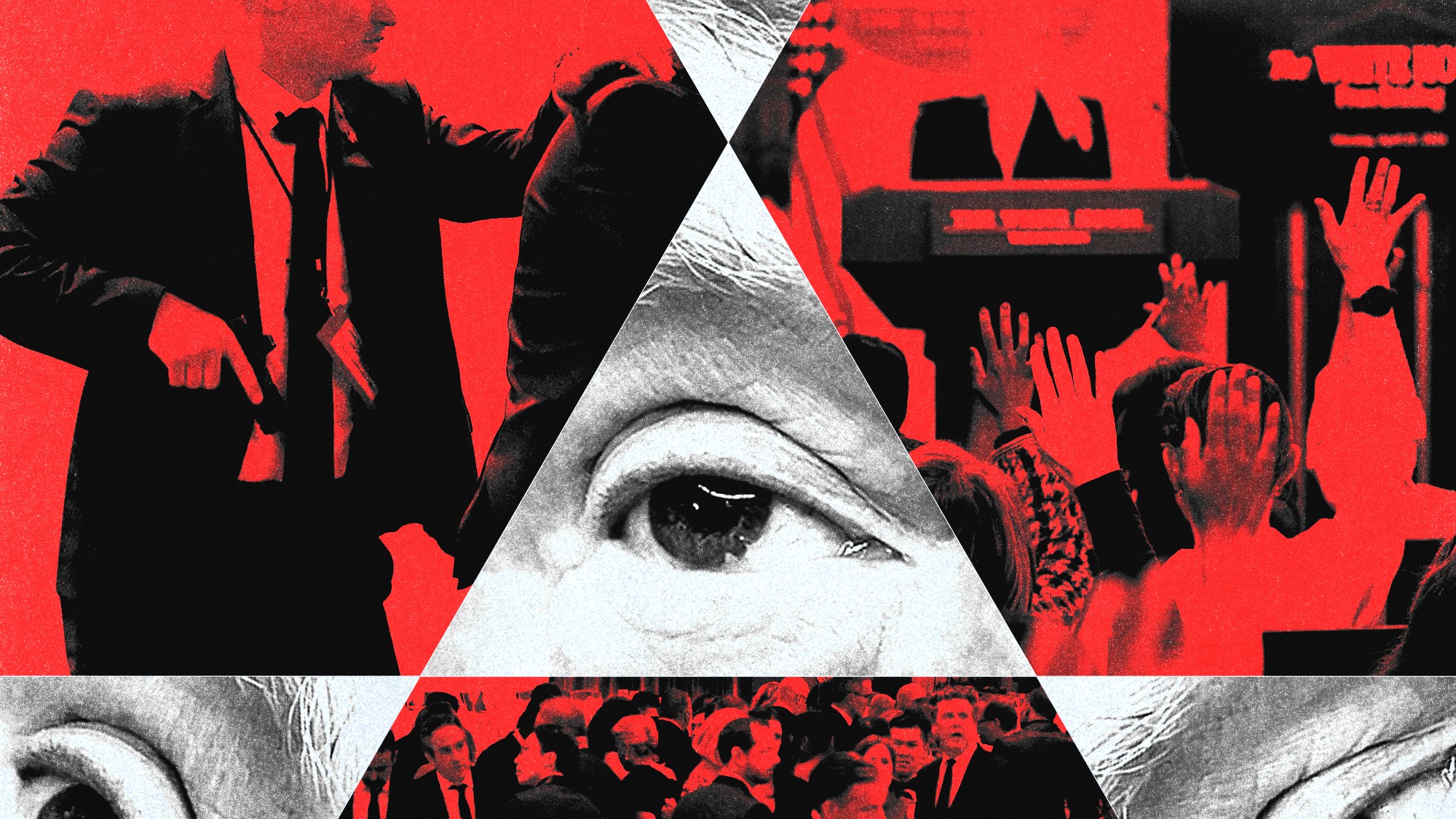
Within hours of the gunfire at the White House Correspondents’ Dinner on Saturday night—and initial, erroneous reports that the shooter had been killed—the usual swirl of misinformation and rumor was swirling in a particular direction. The event was staged, people said.

More than 300,000 posts containing the word staged were shared on X before midday on Sunday, according to an analysis cited by The New York Times. Some of those were probably saying that, actually, the event was not staged, but still: People with substantial social-media followings (including some celebrities) were raising questions. They drew attention to a clip of White House Press Secretary Karoline Leavitt from just before the dinner, laughing as she previewed her boss’s speech: “There will be some shots fired tonight in the room.” Others, in the style of pop-music stan accounts, grabbed photos of President Trump and other members of the administration, taken just before the shooting, in which one might find evidence of knowing smirks or other telling body language. Some of these posts were viewed millions of times.

The conspiracy theorists also latched on to a video pulled from Fox News’s live broadcast, in which the reporter Aishah Hasnie, calling from inside the Hilton hotel that hosted the event, told the anchor that she had been speaking with Leavitt’s husband right before the shooting started. “You need to be very safe,” she said he’d told her. “And he was very serious when he said that to me, and he kind of looked around the room and he said there are some—” Then the call dropped. Hasnie clarified in a post on X that cell service had been spotty in the ballroom, but her explanation, delivered at 1:30 in the morning, was not as widely viewed as posts suggesting that Fox had cut her feed before she could reveal what her source had gone on to say. (“There are some … people in here who are going to fake an attempt on the president’s life but with live ammunition”?)

A potential motive for a staged assassination attempt was quickly floated too. Less than two weeks earlier, a federal judge had ruled that Trump could not justify his plan to build a ballroom by saying it was necessary for security reasons. Now he had a perfect counterpoint: “This event would never have happened with the Militarily Top Secret Ballroom currently under construction at the White House,” he posted on Truth Social, his social-media platform, on Sunday. Some of the last large #Resistance Twitter accounts started circulating collages of all the posts from Trump allies who were arguing the same point, in suspiciously similar ways. Yesterday, three GOP senators pressed again for funding for the ballroom, and the Justice Department filed a bizarre motion backing the project with Trumpian rhetoric (asserting that any opponents must have “TRUMP DERANGEMENT SYNDROME”).

Among the highly online left, some stated as fact that the whole event had been a ploy to get the ballroom. To some MAGA influencers, it was equally clear that Trump’s enemies had been pushing back on the ballroom plans all along, with the intention of causing his death. “The Democrat judges who stopped the construction of a White House ballroom did so to enable an assassination of Trump,” the far-right internet personality Mike Cernovich wrote, apparently in earnest. I also saw one person with almost 300,000 followers try to tie the shooting to a recent, roundly debunked story about a bunch of scientists who were supposedly mysteriously “missing.”

All of this has echoes of the many conspiracy theories that surrounded an earlier attempt on Trump’s life in Butler, Pennsylvania, in July 2024. That incident left behind a long trail of speculation and rumor, including a debate over whether the president was lying about the fact that a bullet struck his right ear. (Some still post photos of the president and insist that his cartilage appears to be intact.) Then, as now, a contingent of observers claimed that the whole thing had been invented to help Trump—in that case, to make his polling numbers go up, which they didn’t. Now, apparently, the Trump administration was going back to the same playbook. Or maybe Saturday’s attempt was staged and the one in Butler wasn’t? Or vice versa? It was “highly possible” that the Butler shooting had been staged, the author Joyce Carol Oates said in a post on Sunday afternoon, but the previous night’s shooting seemed legit. Later that day, her perception had shifted: “He knew the script,” she wrote, in reference to one Cabinet official who was in attendance at the dinner.

Reached for comment, the White House spokesperson Davis Ingle said in an email, “Anyone who thinks President Trump staged his own assassination attempts is a complete moron.” But how many people fit into this category? Do a meaningful number of Americans actually believe that the president was part of a (successful) plot to fake one or more attempted murders in order to consolidate his power (and build a ballroom)?

Mark Fenster, a professor at the University of Florida’s law school who writes about government transparency and conspiracy theories, told me this would be hard to know. Social media makes conspiracy theories more visible, he said, but may not reflect their actual popularity. Public-opinion polls would provide a better view, but these can fail to capture how committed people are to the positions they claim to hold. “If you ask someone who isn’t particularly well informed or doesn’t care that much but doesn’t like or trust Trump, they might say, Yeah, it’s staged,” Fenster told me. “That doesn’t mean they’re a conspiracy theorist who really believes it.”

The historian Kathryn Olmsted, who surveyed the history of American paranoia in her 2009 book, Real Enemies: Conspiracy Theories and American Democracy, World War I to 9/11, told me that prior assassination plots have not all produced the same quantity of disbelief. (As Fenster noted to me, successful ones generally produce more.) In 1975, a time of notable distrust of government and widespread concern about the secret machinations of the state, two attempts were made on Gerald Ford’s life in the space of three weeks. “There was abundant media coverage of both attempts, but I don’t think I’ve seen evidence of anyone thinking he was responsible for the plots himself,” Olmsted said. In 1981, John Hinckley Jr. shot Ronald Reagan outside the same Hilton hotel that hosted Saturday’s dinner, but that incident didn’t produce many conspiracy theories either. People seemed to take Hinckley at face value when he said he’d acted to impress the young actor Jodie Foster.

Olmsted also pointed out that political assassinations used to be far more common in America than they are today, and that the Secret Service greatly improved its security measures in the 1980s. Given the frequency of these events in earlier eras, she said, people may have been less inclined to invest any one of them with secret meaning. “I think most Americans just assumed there were plenty of mentally ill people who wanted to kill someone famous.”

But that’s not all that’s different. Trump is different, too. He’s a prolific liar with a well-established love for spectacle, and from the day he entered the political sphere, he has repeated and encouraged conspiracy theories of many stripes. It comes as no surprise that he’s at the center of one.


This article originally stated that Aishah Hasnie had been speaking with President Trump right before the shooting started. In fact, the quote provided was from Karoline Leavitt's husband.

© Illustration by Lucy Naland. Sources: Tasos Katopodis / Getty; Mandel Ngan / AFP / Getty; Brendan Smialowski / AFP / Getty.

❌