Normal view

Received — 31 May 2026 SpaceDaily News

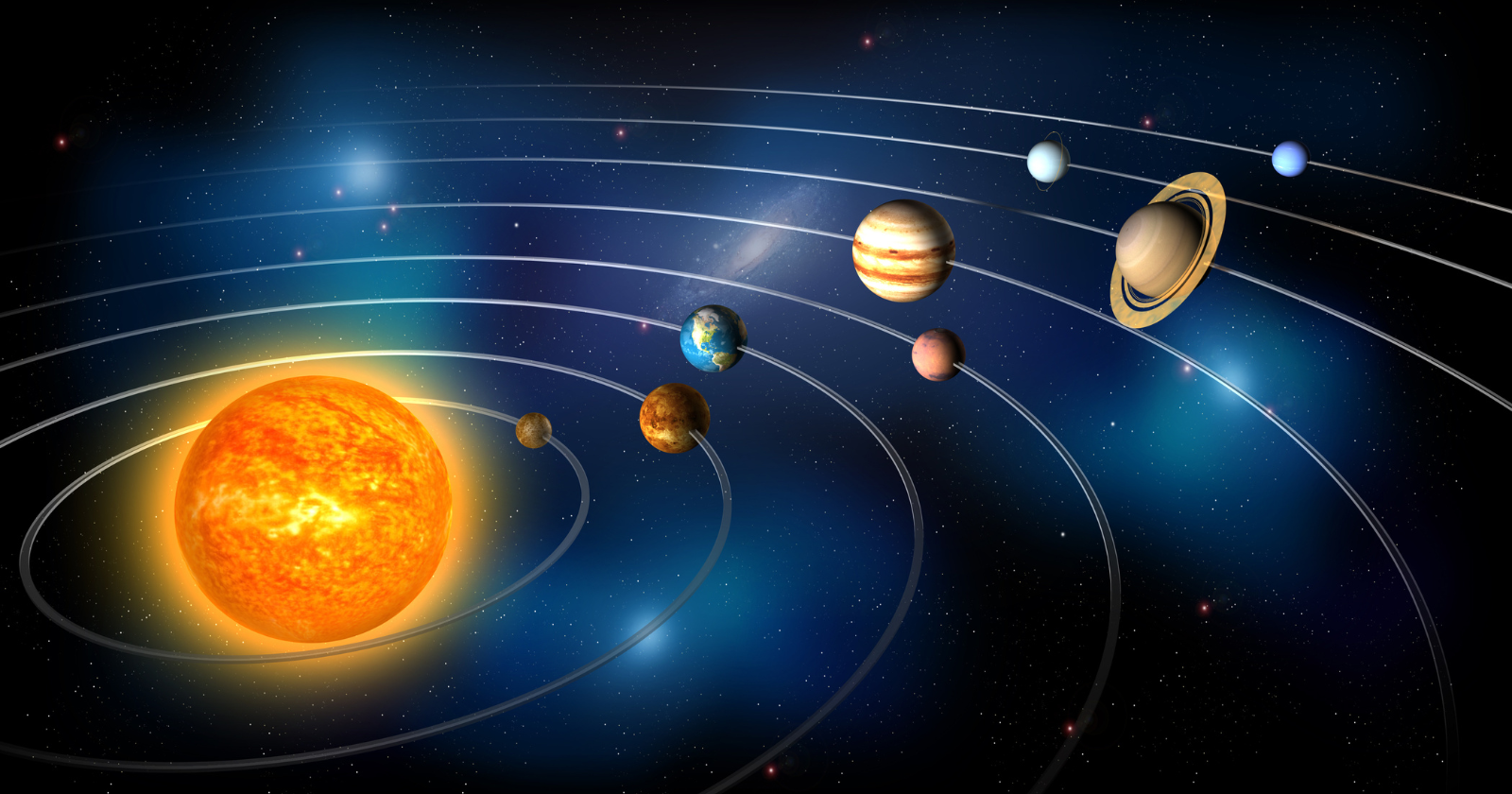
The Sun is not standing still. It is carrying the entire Solar System around the centre of the Milky Way, and one lap takes roughly 230 million years. The last time we were this far around the galaxy, Earth was in the Triassic Period and the very first dinosaurs were only just beginning to walk.

The Sun is not fixed in space. It carries the entire Solar System around the centre of the Milky Way, completing one lap in roughly 230 million years. One galactic year ago, Earth was in the Late Triassic, and the first dinosaurs were only just beginning to appear in the fossil record.

The image is tidy and the underlying facts hold up reasonably well. But both numbers carry more uncertainty than the neat pairing suggests, and the idea that we have come back to the same place is, on closer reading, not quite right.

How well we actually know the number

The Sun’s orbital period around the galactic centre is not pinned to a single value. Estimates run from about 225 to 250 million years, with 230 million the figure most often quoted. Keith Hawkins, an astronomer at the University of Texas at Austin, put it at around 220 to 230 million years and made the point that this so-called galactic year is specific to our position in the galaxy: stars closer to the centre orbit faster, those further out more slowly.

The numbers underneath are better constrained than the period itself. The Sun sits roughly 26,000 light-years from the galactic centre and moves through its orbit at about 230 kilometres a second, a figure the National Radio Astronomy Observatory gives alongside a period of about 226 million years. Data from the European Space Agency’s Gaia mission has since tightened the rotation curve and nudged the favoured period towards the lower end of the range. So when anyone says 230 million years, the honest reading is a figure good to within a few tens of millions of years, not a precise count.

The Triassic check

The dinosaur half of the claim survives scrutiny. One galactic year ago lands in the Late Triassic, in the stage palaeontologists call the Carnian. The oldest dinosaurs that are confidently identified as dinosaurs come from the Ischigualasto Formation in northwestern Argentina, dated to around 230 to 233 million years ago: small bipedal animals such as Eoraptor and Eodromaeus, and the larger predator Herrerasaurus.

What the popular version tends to leave out is that these animals were not yet the rulers of anything. The Natural History Museum in London, drawing on the work of dinosaur researcher Paul Barrett, notes that the first definite dinosaurs around 230 million years ago were rare members of the fauna, overshadowed by crocodile-line reptiles. Their dominance did not begin until the end-Triassic extinction about 201 million years ago cleared the field. The coincidence with the galactic year works as well as it does partly because two independently uncertain dates, the orbital period and the first-dinosaur date, happen to fall in the same window.

Why “this far around” is the wrong picture

The phrase that does the heavy lifting in the original observation is “this far around the galaxy,” and it implies a return to the same spot. We have not returned to the same spot.

Several things get in the way. The galaxy rotates differentially, so there is no single rigid sweep that carries everything around together. The spiral arms are not solid structures made of fixed stars; they behave more like wave patterns moving through the disc, which means the arm we sit near now is not the arm we sat near in the Triassic. The Sun also bobs up and down through the galactic plane, crossing it every few tens of millions of years, with a full vertical cycle of roughly 60 to 70 million years. Over hundreds of millions of years it drifts in galactic radius as well.

Put together, one lap brings the Sun back to a similar distance from the centre and a similar angular position, while the actual neighbourhood, the nearby stars, the gas clouds, the arms, is entirely different. The clock comes back around. The place does not.

What not to read into it

The tempting next step is to treat galactic position as a cause of what happens on Earth, and there is a real line of research that flirts with exactly this. In 1984, Schwartz and James proposed in Nature that an apparent periodicity in mass extinctions might track the Sun’s oscillation through the galactic plane, the suggested mechanism being that plane crossings disturb the outer comet cloud and send impactors towards the inner Solar System.

The idea has been revisited and challenged repeatedly in the decades since. The main objections are that the plane-crossing interval does not cleanly match the claimed extinction period, and that the extinction periodicity itself is disputed. It remains an unconfirmed hypothesis, not an established link. The galactic year is a useful way to feel the depth of geological time. On the available evidence it is not a lever on terrestrial biology.

The figure will keep moving as Gaia data accumulates and the Milky Way’s rotation curve is measured more precisely. The defensible version of the dinosaur line is the modest one: roughly one trip around the galaxy ago, by a clock we can only read to within tens of millions of years, the first dinosaurs were small, rare, and a long way from inheriting the planet.

The post The Sun is not standing still. It is carrying the entire Solar System around the centre of the Milky Way, and one lap takes roughly 230 million years. The last time we were this far around the galaxy, Earth was in the Triassic Period and the very first dinosaurs were only just beginning to walk. appeared first on Space Daily.
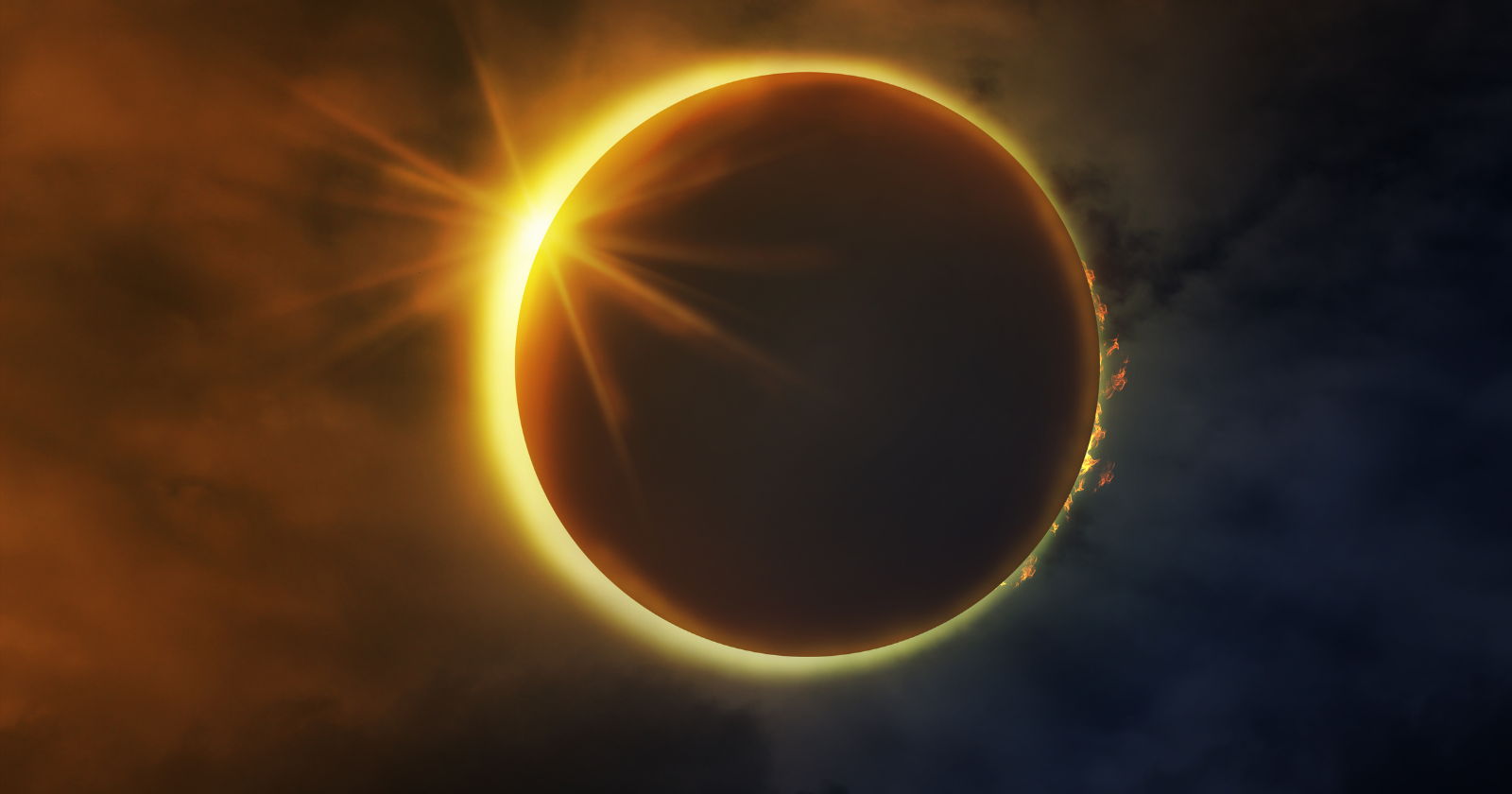
A total solar eclipse is only possible because of a cosmic coincidence: the Moon is about 400 times smaller than the Sun but also about 400 times closer, making the two look almost the same size from Earth. But the Moon is slowly drifting away, so this alignment will not last forever. One day, hundreds of millions of years from now, the last total solar eclipse will pass across the planet, and no one will ever see the Moon fully cover the Sun again.

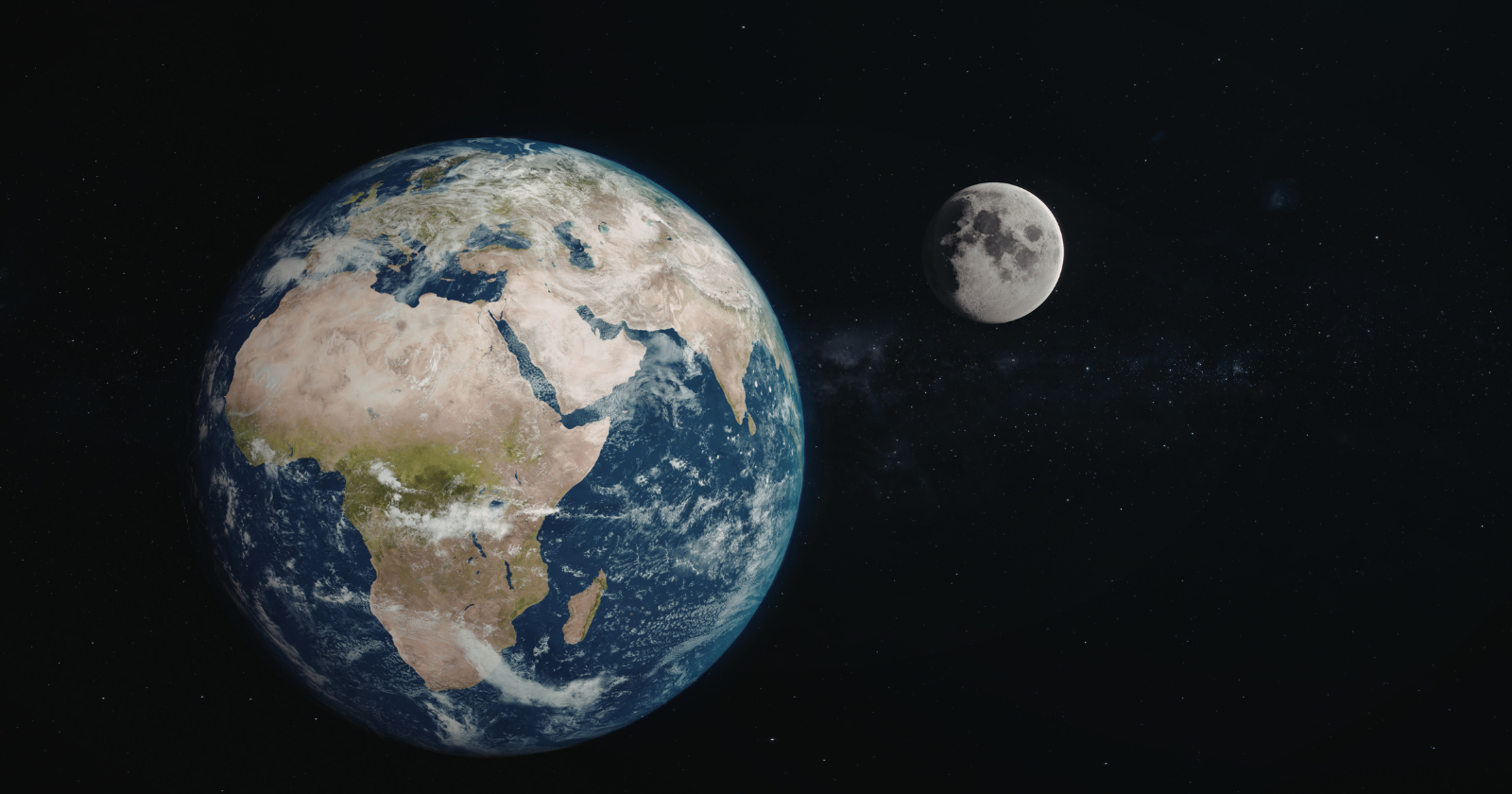
A total solar eclipse rests on a coincidence that is simple to state and still hard to quite accept. The Sun is roughly 400 times wider than the Moon. At present it also sits roughly 400 times further away. The two therefore appear almost the same size from the ground, which is why the Moon can cover the Sun’s disc closely enough that the faint corona becomes visible for a few minutes. Nothing in physics requires this match. It follows from where the Moon happens to sit in a slow outward drift, and that drift is carrying the coincidence towards its end.

The Moon is moving away from Earth at about 3.8 centimetres a year. The figure comes from lunar laser ranging. The Apollo crews left retroreflectors on the surface, and observatories have spent decades bouncing laser pulses off them and timing the return to within a few centimetres. NASA’s account of that work, on the Goddard eclipse pages, puts the recession at about 3.8 centimetres a year, the result of tidal friction between the two bodies.

That rate sounds trivial, and over a human lifetime it is. Across hundreds of millions of years it is not.

What the recession does to an eclipse

As the Moon retreats, its apparent size in the sky shrinks. The geometry that lets the lunar disc cover the Sun completely is already marginal, and it already fails on a regular basis. The Moon’s orbit is an ellipse, so its distance, and therefore its apparent size, changes over the course of a month. When the Moon is near the far end of its orbit, it appears slightly smaller than the Sun. An alignment at that point produces an annular eclipse: the Moon sits in front of the Sun but leaves a bright ring of sunlight around its edge. Totality does not happen.

This is the part the headline version tends to skip. Total eclipses are not a fixed feature of the present that will one day switch off. They already occur only when the Moon is close enough on a given pass. The recession does not introduce a new failure mode so much as it tilts the existing balance, year by year, towards the annular case. The share of alignments that yield a total eclipse falls. The share that yield an annular one rises.

The 600 million year figure, and why it is not a date

The number usually quoted is about 600 million years. It traces to a 2017 NASA statement, in which Goddard lunar scientist Richard Vondrak said that Earth would see its last total solar eclipse in roughly 600 million years. As an order of magnitude that holds up. As a date it does not, and the more careful sources are clear about why.

Sky & Telescope, working through the geometry, frames it as a question about the Moon’s closest approach. For totality to become impossible even under the most favourable conditions, the Moon’s perigee distance has to grow by about 23,000 kilometres, which at the current rate takes more than 600 million years. But the same answer cites the Belgian astronomer Jean Meeus, whose book More Mathematical Astronomy Morsels points out that orbital perturbations complicate the picture considerably. On Meeus’s account the system does not stop cleanly. Total eclipses become erratic from around 620 million years out, occurring less and less often, with the genuine last one perhaps not arriving until something closer to 1.2 billion years from now. A separate NASA analysis has been cited for an earlier endpoint of about 563 million years.

Two further things keep the figure soft. The recession rate has not been constant over geological time and is not guaranteed to stay fixed: it depends partly on the arrangement of Earth’s oceans and how they resonate with the tides. And the Sun itself is slowly growing as it fuses hydrogen into helium, which enlarges its apparent disc and works in the same direction as the Moon’s retreat. So the honest reading is a range that runs from somewhere over half a billion years to more than a billion, with a long tapering rather than a switch.

What the window means

It is worth being precise about what is and is not remarkable here. The coincidence of apparent sizes is real and, as far as anyone can tell, we happen to be alive during a stretch when it is close to exact. That stretch is long by any human measure. It is short only against the age of the Earth and Moon, which formed together about 4.5 billion years ago.

The claim sometimes made alongside this, that such a match must be rare or unique in the galaxy, is harder to stand behind. We do not have the survey data on other planet and moon systems to say so. It is a reasonable guess, not an established fact, and it sits outside what the eclipse measurements themselves can support.

The more grounded point is that the transition is already underway. Annular eclipses are not a future development; they happen now, several times a decade, for exactly the reason that will eventually make totality impossible. The drift that ends the total eclipse is the same drift that is, very slowly, lengthening our days. The endpoint is hundreds of millions of years off and its exact timing is genuinely unsettled. What is settled is the direction, and the fact that it is visible, in small print, every time the Moon passes in front of the Sun and leaves a ring of light behind.

The post A total solar eclipse is only possible because of a cosmic coincidence: the Moon is about 400 times smaller than the Sun but also about 400 times closer, making the two look almost the same size from Earth. But the Moon is slowly drifting away, so this alignment will not last forever. One day, hundreds of millions of years from now, the last total solar eclipse will pass across the planet, and no one will ever see the Moon fully cover the Sun again. appeared first on Space Daily.
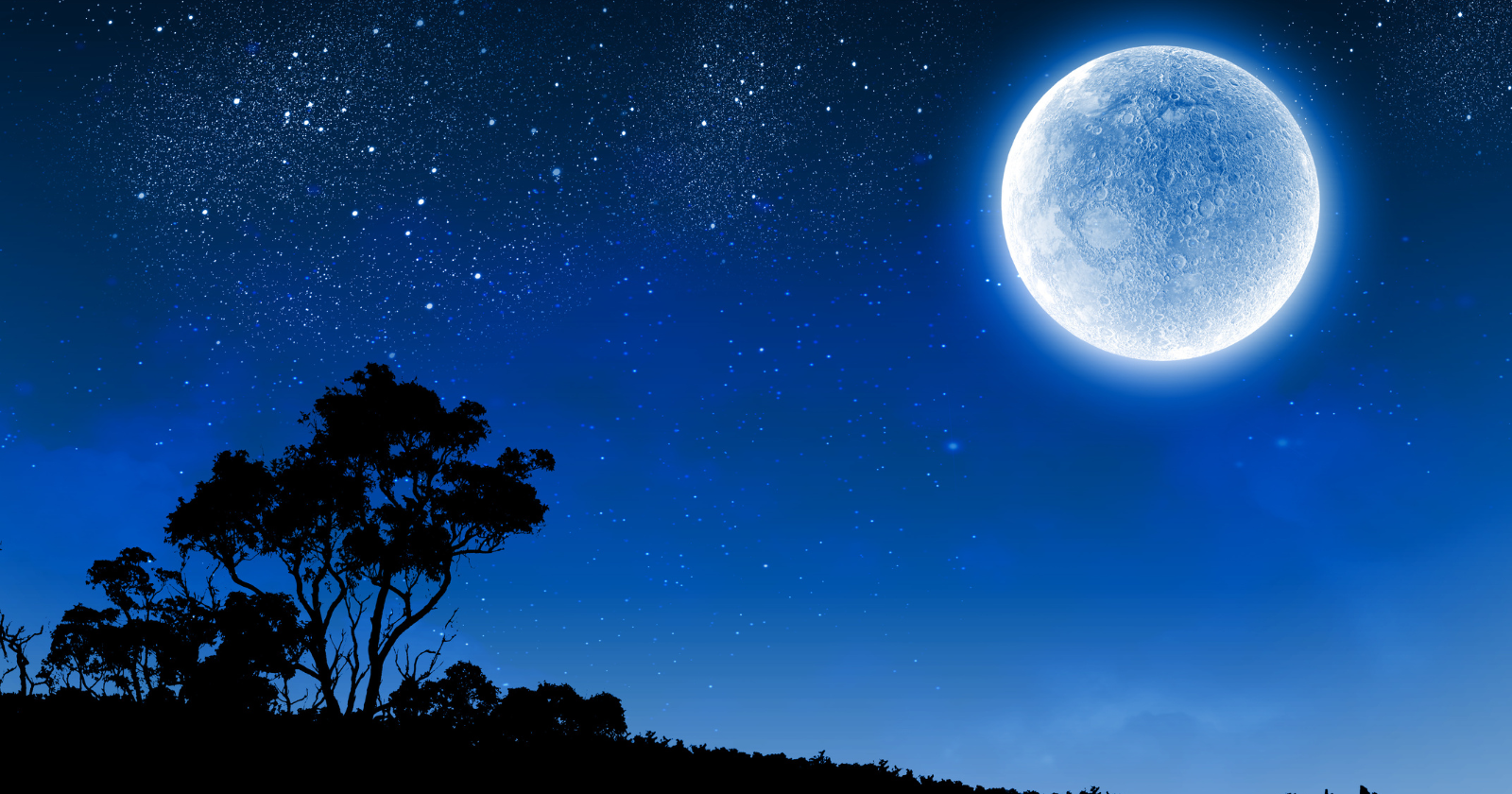
The Moon looks white in the night sky, but its surface is closer in color to a worn asphalt road — and it appears bright enough to read by on a clear night not because the surface is bright, but because the Moon is so close and fully sunlit that even a surface reflecting just 12 percent of incoming light becomes one of the brightest objects in the sky

The Moon looks white in the night sky, sometimes silver, sometimes yellow or orange when it sits low on the horizon. The casual impression is of a bright object, possibly even of a slightly luminous one. That impression is wrong about the surface. The Moon’s average surface reflectance, the proportion of sunlight it scatters back into space, is about 10 to 12 percent. Most of the sunlight that strikes the Moon is absorbed rather than reflected. The actual colour of the lunar surface, when you take a piece of it down to a laboratory and look at it in ordinary light, is a dark grey close to the colour of an old asphalt road or a worn parking lot. The reason it appears so bright in the night sky comes down to a combination of factors, of which the surrounding background, the black emptiness of space, is the largest.

According to NASA’s official “Moonlight” reference page, written by Caela Barry of NASA’s Goddard Space Flight Center, only about one-tenth of the sunlight that hits the Moon is reflected back into space, compared with about three-tenths for Earth and well over half for Venus. The reason the Moon is so dark, despite being made of the same general kinds of material as the inner planets, is that much of its surface is volcanic basalt left behind by ancient lava flows. NASA’s reference page draws an explicit parallel between the lunar surface and the dark volcanic rocks found near volcanoes on Earth, including the slopes of Kilauea in Hawaii. These dark-coloured materials absorb most of the visible light that reaches them, which is precisely what defines a low-albedo surface.

What albedo actually measures

Albedo is the fraction of incoming light that a surface reflects, expressed as a number between 0 and 1. A surface with an albedo of 0 absorbs everything; a surface with an albedo of 1 reflects everything. Fresh snow sits at about 0.8 to 0.9. Desert sand is around 0.4. Bare soil is around 0.17. Open ocean is around 0.06. Fresh asphalt, the dark black surface a new road has when it has just been laid, sits at about 0.04 to 0.10. Worn asphalt, the lighter grey colour of an older road surface after years of oxidation and tyre wear, sits at about 0.10 to 0.15. The Moon’s geometric albedo, the measure that most closely corresponds to perceived brightness, is 0.12. Worn asphalt is conventionally cited at the same figure. The two surfaces really do reflect roughly the same fraction of light.

If a section of lunar regolith were transplanted to a road in any city on Earth, it would look like a slightly unusual but unremarkable patch of grey pavement. Apollo astronauts who walked on the Moon described the surface colour as varying between charcoal grey, brownish grey, and almost black, depending on the angle of the Sun and which region they were in. The darker basaltic plains, known as the lunar maria (Latin for “seas,” because early astronomers mistook them for bodies of water), have albedos as low as 0.06. The brighter highlands, which appear lighter to the naked eye from Earth, have albedos closer to 0.18. The average across the visible disc lands at the parking-lot figure.

Why a dark surface looks bright

The human visual system does not measure absolute brightness. It measures contrast. A patch of grey paper held up against a black sheet of paper will appear far brighter than the same patch of grey held up against a sheet of white paper, even though the grey is reflecting exactly the same amount of light in both cases. The brain interprets brightness relative to the surrounding field. When the surrounding field is dark, even a moderately reflective surface registers as bright.

The night sky is the most extreme dark background available to a ground-based observer. With minimal atmospheric scattering, no other illuminated objects in the field of view, and a backdrop of effectively black space, the Moon’s 12 percent reflectance is competing against nearly zero. The contrast ratio is enormous. The full Moon’s apparent magnitude is roughly −12.7, which is about 400,000 times dimmer than direct sunlight but about 1,700 times brighter than Venus at its brightest. The Moon’s ranking among bright objects in the sky is the result of three things working together: its large angular size (about half a degree across), its proximity (an average of 384,000 kilometres from Earth), and the full unattenuated sunlight illuminating its surface. The surrounding dark sky then magnifies the perceptual impact of that combination.

NASA’s Moonlight page puts the proximity argument particularly cleanly. The Moon, despite being darker than Venus, dominates the Earth’s night sky because it is so much closer. Venus, at its closest approach, is roughly 100 times farther from Earth than the Moon is. The amount of reflected light reaching Earth depends not only on what fraction is reflected but on how far the light has to travel before reaching the observer’s eye. The Moon’s small albedo is more than compensated for by its near-Earth orbit.

What full moonlight is actually doing

A full Moon at zenith on a clear, moonless night provides enough illumination at the ground to read large-print text and to walk around outdoors without artificial light. Earth’s overall reflectance, by comparison, is roughly three times the Moon’s, which is why astronomers can study Earth’s albedo by measuring earthshine on the dark side of a crescent Moon. According to NASA’s Earth Observatory reference on earthshine, this technique has been used continuously since 1998 to track variations in how much sunlight the planet reflects. The Moon, sitting at a fixed average distance with a known albedo, has been used as a kind of natural mirror for measuring Earth’s own brightness.

The next-brightest astronomical object after the Moon, Venus at maximum brilliance, is roughly 8 magnitudes fainter than the full Moon, which corresponds to a brightness ratio of about 1,700 to 1. The reason the Moon outranks Venus so dramatically, despite Venus being a far more reflective object, is the same combination of factors that makes the Moon outrank everything else in the night sky after the Sun. Distance and angular size do the work that intrinsic brightness cannot.

The Moon’s role as a nighttime light source has been so consistent throughout human history that human dark-vision and biological rhythms are partly calibrated to it. Hunter-gatherer cultures hunted, travelled, and gathered by full moonlight. Pre-industrial cities sometimes scheduled markets and judicial proceedings around the lunar cycle. The Moon was never a particularly reflective object. It was simply the brightest thing available in a sky that, before electric light, was very dark indeed. The contrast did most of the work.

The post The Moon looks white in the night sky, but its surface is closer in color to a worn asphalt road — and it appears bright enough to read by on a clear night not because the surface is bright, but because the Moon is so close and fully sunlit that even a surface reflecting just 12 percent of incoming light becomes one of the brightest objects in the sky appeared first on Space Daily.
When Zhang Chenxing, who holds a PhD from MIT, co-founded Mega Engine Technology in Xi’an in early 2024, China’s high-pressure oxygen-rich staged-combustion know-how sat almost entirely inside state propulsion houses — and by May 2026 his startup had logged 1,000 seconds of accumulated test time on a closed-cycle kerolox engine

A private Chinese startup just ran a kerolox engine for 1,000 seconds straight — and the real story isn't the burn time, it's which closed club in Beijing they quietly broke into

Roughly two years after it opened its doors, a Xi’an commercial startup called Mega Engine Technology has announced that a single high-pressure oxygen-rich staged-combustion kerolox engine accumulated 1,000 seconds of run time at rated conditions across its test campaign — the kind of endurance number that until now belonged almost exclusively to engines designed inside China’s state propulsion houses.

The company disclosed the results in a Chinese social media post on May 25, 2026, according to SpaceNews, describing the engine — called Chi, which translates roughly as “blazing” — as having demonstrated rapid startup, stable operation, and intact hardware on post-test inspection. Total program test accumulation across all firings has reached 2,000 seconds.

The performance figures place Chi squarely in the class of engines that matter for reusable medium-lift launchers. Sea-level thrust is reportedly throttleable between 35 and 75 tons, rising to 87 tons in vacuum. Sea-level specific impulse is rated at 302 seconds, climbing to 350 seconds at altitude.

Why Oxygen-Rich Staged Combustion Matters

Staged combustion is hard. The cycle pre-burns a portion of the propellants in a small chamber to drive the turbopump, then injects that hot, oxygen-rich gas into the main combustion chamber where the rest of the fuel completes the burn. The result is higher chamber pressure and meaningfully better specific impulse than the open-cycle gas-generator engines most commercial startups have built.

The catch is metallurgy. Hot, oxygen-rich gas running through turbine blades and manifolds at high pressure tends to set metal on fire. Soviet engineers cracked the problem first — Valentin Glushko’s KB Energomash flew the oxygen-rich staged-combustion RD-253 on Proton in 1965, and the much larger RD-170 family followed in the 1980s. Outside Russia, only a handful of programs have replicated it. Europe’s ESA staged-combustion demonstrator ran at sub-scale at the DLR Lampoldshausen facility, and Germany’s Rocket Factory Augsburg fired the first full-scale commercial European staged-combustion engine in 2021 — both methalox, both still pre-flight.

In China, the technology has lived almost entirely inside the Academy of Aerospace Liquid Propulsion Technology (AALPT), the CASC institute in Xi’an that developed the oxygen-rich staged-combustion YF-100 engine now flying on the Long March 5, 6, 7, and 8 families. AALPT’s commercial offering for private launchers is the open-cycle YF-102 — lower chamber pressure, lower specific impulse, but easier to build, and currently flying on Space Pioneer’s Tianlong-2 and CAS Space’s Kinetica-2.

Chi, if its test data hold up under flight conditions, would give Chinese commercial launchers access to staged-combustion performance without going through the state propulsion house.

A Company That Appeared Almost Overnight

Mega Engine began operations in early 2024. According to a 2025 conference summary cited by SpaceNews, co-founder Zhang Chenxing — who holds a PhD from MIT — told attendees at an April 2025 industry event that the company had completed development and partial testing of its first staged-combustion engine. Roughly a year later, it is logging 1,000-second accumulated runs on a single test article.

That timeline is striking. Building a working oxygen-rich staged-combustion engine from a blank sheet typically takes a decade or more. Mega Engine appears to have done it in under two years.

The company itself offers only that the core team is a group of experts focused on the development of advanced liquid rocket engines. The founding team almost certainly carries direct experience from AALPT or related state institutes in Xi’an. The geography alone is suggestive. So is the technical maturity.

Civil-Military Fusion as Industrial Policy

The pattern is not an accident. Beijing has spent the better part of a decade pushing expertise, intellectual property, and personnel out of state defense-industrial institutions into nominally private commercial ventures. The official term is civil-military fusion, and propulsion is one of its clearest test cases.

The contrast with the American approach is sharp. As one defense investor argued in War on the Rocks, U.S. startups working on security-relevant technology are typically encouraged to build commercial applications first and adapt for defense later — a sequence that can add five to ten years before a capability reaches the Pentagon. China’s system does not impose that delay. Whether one views fusion as efficient or coercive, it compresses the path from state lab to flight hardware.

Mega Engine fits that template precisely. State-trained engineers, state-developed technology base, private capital structure, commercial customer list.

The 200-Ton Engine and What It Implies

Chi is not the endpoint. The company has stated it aims to unveil a second engine, called Yan, later in 2026 — a 200-ton-class closed-cycle kerolox engine intended for heavy-lift applications. Together, Chi and Yan are pitched as a complete reusable LOX/kerosene family covering small upper stages through large first stages.

A 200-ton kerolox staged-combustion engine would represent a significant capability advance for China’s commercial sector. If Yan flies on schedule, China’s commercial sector will have a domestically produced, reusable, high-performance kerolox engine outside the state monopoly for the first time.

Mega Engine describes high-pressure closed-cycle engines as the “deep water zone” of commercial liquid propulsion. Most Chinese private launch companies — Landspace, Jiuzhou Yunjian, iSpace — have built methalox engines instead, which are easier to develop and offer reusability benefits but lower density-specific impulse.

The Megaconstellation Pull

The market context explains the urgency. China has committed to megaconstellation programs — including Guowang and Qianfan — aiming for tens of thousands of satellites. Beijing is also studying orbital data centers. None of it is feasible at China’s current launch cadence.

The state-owned launch sector cannot scale fast enough on its own. That is why Beijing has tolerated and actively supported a commercial launch sector that competes, at the margins, with CASC’s own rockets. Engine supply is the bottleneck. A private vendor capable of delivering staged-combustion kerolox engines in volume would be valuable to nearly every commercial launch company chasing constellation contracts.

rocket engine hot fire test

What Remains Unverified

The Mega Engine claims rest entirely on company-issued statements and social media posts. Independent verification of the throttle range and specific impulse figures is not yet available, and the company has not yet announced a launch vehicle customer or a flight date for Chi.

Several questions matter for assessing how seriously to take the program. First, what was the longest single firing in the 1,000-second campaign, and did it run at full rated chamber pressure or at a derated condition? The statement indicates the campaign was conducted at rated conditions, but provides no telemetry data. Second, the company has not disclosed whether the test article was a flight-configuration engine or a development unit with simplified components. Third, the supply chain for high-grade alloys and turbopump bearings — the parts that fail first in oxygen-rich environments — has not been described.

Mega Engine’s claims rest on a single weekend’s social media post. The trajectory looks credible; the verification does not yet exist.

The Broader Signal

Whether or not Chi flies on schedule, the appearance of a credible private oxygen-rich staged-combustion program in China is a real data point. The technology gap between Chinese state and commercial propulsion is narrowing fast, and the mechanism doing the narrowing is deliberate state policy moving engineers and know-how across an institutional boundary that, in other countries, would be far harder to cross.

Mega Engine tests its engines in Xi’an, the same city that houses the AALPT institutes whose engineers built the YF-100 family flying today on every modern Long March. The test stands echo into the same Shaanxi evenings. The smoke from Chi has cleared. The smoke from Yan, if the company fires it on schedule this year, will say whether the closed propulsion club has truly opened — or whether a single startup just got close enough to look in.

The post When Zhang Chenxing, who holds a PhD from MIT, co-founded Mega Engine Technology in Xi’an in early 2024, China’s high-pressure oxygen-rich staged-combustion know-how sat almost entirely inside state propulsion houses — and by May 2026 his startup had logged 1,000 seconds of accumulated test time on a closed-cycle kerolox engine appeared first on Space Daily.
The leading explanation for how the Moon was born is that a world the size of Mars called Theia slammed into the young Earth and flung out the debris that became the Moon, and recent research suggests Theia itself never fully left, with two continent-sized blobs buried near our planet’s core possibly being the last remains of the world that struck us.

The leading account of where the Moon came from is a collision. Early in the Solar System’s history, a young planet roughly the size of Mars, given the name Theia, is thought to have struck the proto-Earth a glancing blow. The debris thrown into orbit gathered into the Moon. This is the giant-impact hypothesis, and it has been the mainstream view among planetary scientists for decades.

A 2023 study added a striking idea to it: that Theia did not simply vanish into the young Earth, and that two continent-sized masses sitting near our planet’s core may be what is left of it. The idea is well argued and genuinely interesting. It is also a single modelling study proposing a hypothesis, not a settled finding, and the two deserve to be kept apart.

Why the impact hypothesis leads

The giant-impact model earned its place because it explains several things at once. It accounts for the Moon’s large size relative to Earth, for the Earth-Moon system’s angular momentum, and for the Moon having only a small iron core, which fits an object assembled mostly from the rocky outer layers of two bodies after their metal had sunk to the centres.

It is the leading hypothesis rather than the only one. It also carries an unresolved problem worth stating plainly: the Earth and the Moon are almost identical in the isotopes of several elements, far more alike than the model easily predicts if the Moon were built largely from a separate impactor with its own distinct composition. The match is close enough that researchers have called it a significant puzzle for prevailing Moon-formation models. Various fixes have been proposed, from a more violent and thoroughly mixed impact to alternative formation models, and the question is not closed. The impact hypothesis is the best account available, not a proven event.

The blobs are real. Their origin is the open question.

The two masses near the core are not in doubt. Seismologists identified them in the 1980s by watching how earthquake waves slow as they pass through the lowermost mantle, and they have a formal name: large low-velocity provinces, or LLVPs. One sits beneath Africa, the other beneath the Pacific. Each is continent-sized, and they appear to differ in composition from the mantle around them.

What has never been settled is where they came from. They could be accumulations of dense oceanic crust dragged down over billions of years of plate tectonics. They could be material left over from an early magma ocean. They could be a primordial layer that never mixed in. The blobs are an observed feature of the deep Earth with several competing explanations, and that was the state of the question before 2023.

What the 2023 study actually argued

The new proposal came from a team led by Qian Yuan, then at Arizona State University and Caltech, published in Nature. Its claim is specific. If Theia’s mantle was richer in iron than the proto-Earth’s, then fragments of it would have been denser than the surrounding rock. Some of that dense Theian material, rather than being flung into orbit or fully blended in, could have sunk through the young Earth and settled atop the core, where it could clump and survive for billions of years as the LLVPs we detect today.

The team supported this with simulations: models of the impact itself, then models of how dense blobs would move through the mantle over time. In those runs, material around 2 to 3.5 per cent denser than the surrounding mantle sank and gathered into piles resembling the LLVPs. So the study offers a physical pathway by which the blobs could be Theia, and shows that pathway is consistent with the physics. The authors’ own framing is careful. In the paper they write that the LLVPs “may represent” buried relics of Theia, not that they are.

What the study does not show

This is where the popular version tends to outrun the research. A simulation that produces LLVP-like structures from Theian material demonstrates that the idea is possible and self-consistent. It does not, on its own, confirm that this is what happened.

No piece of Theia has been held in a hand or measured directly. The blobs sit roughly 2,900 kilometres down and cannot be sampled. The case rests on the impact hypothesis being correct, on assumptions about Theia’s composition that are themselves inferred, and on models rather than physical evidence. Other explanations for the LLVPs have not been ruled out. A coherent model that links two of the deepest puzzles in Earth science, the Moon’s birth and the blobs near the core, is an elegant result and a reason to take the idea seriously. It is not the same as having found the impactor.

What to watch

The interesting work now is whether the link can be tested rather than only modelled. If the LLVPs really are Theian, they might carry a chemical signature distinguishable from ordinary mantle, and traces of deep material brought toward the surface by mantle plumes are one place researchers look for it. Independent lines of evidence about the Moon’s composition, and refinements to the impact models, will also bear on whether the iron-rich-Theia assumption holds.

For now the honest summary is layered. The Moon most likely formed from a giant impact. Two real, continent-sized anomalies sit near Earth’s core. One well-argued study proposes that the second is the leftover of the first. The first claim is mainstream, the second is observed, and the third is a hypothesis worth following rather than a closed case.

The post The leading explanation for how the Moon was born is that a world the size of Mars called Theia slammed into the young Earth and flung out the debris that became the Moon, and recent research suggests Theia itself never fully left, with two continent-sized blobs buried near our planet’s core possibly being the last remains of the world that struck us. appeared first on Space Daily.
Earth’s magnetic field has flipped hundreds of times, swapping magnetic north and south in a switch locked into ancient rock, and it happens on no fixed schedule, yet nothing in the record suggests a single flip ever wiped out life.

Magnetic reversals are real and common over geological time, but they do not run on a neat schedule. The switch is recorded in rock, and the fossil record shows no reversal ever wiping out life. It is one of those facts that sounds alarming and turns out to be reassuring once the detail is filled in.

The detail is worth filling in, because reversals attract more doomsday theory than almost any other ordinary geological process.

How the rock keeps the record

When molten rock cools, magnetic minerals inside it line up with Earth’s field and then lock in place as the rock solidifies, preserving the direction the field pointed at that moment. The same happens as sediments settle. Read enough of these frozen compass needles across the geological column and the pattern of past reversals emerges, including the striped magnetic bands on the seafloor that helped confirm plate tectonics in the 1960s.

From that record the numbers are firm. According to NASA, Earth’s magnetic poles have reversed 183 times in the last 83 million years, and at least several hundred times across the past 160 million. So “hundreds of times” is right, with the caveat that the count depends on how far back you reach.

No schedule, and a long current pause

The intervals between reversals are genuinely irregular. Depending on the slice of geological time used, the average comes out to a few hundred thousand years, but the average hides a wide spread, from tens of thousands of years to tens of millions. There is no clock.

The last full reversal, the Matuyama-Brunhes, happened about 780,000 years ago. That is more than twice the average gap, which is the kind of fact that gets turned into a headline about a reversal being overdue. It is not overdue in any meaningful sense, because the process is not periodic. An average is not a due date. A coin that has landed heads for a while is not owed a tail.

A flip is slow, and the field never vanishes

The word “flip” does most of the misleading work in the popular telling. It suggests something sudden, a single moment when the poles swap and a compass spins. The record shows nothing of the kind.

A reversal unfolds over a long span by human standards. Estimates for the Matuyama-Brunhes transition vary widely. Some reconstructions put the full process in the tens of thousands of years, while other summaries describe reversals more generally as taking hundreds to thousands of years. During that window the field weakens and becomes messy, with more than one pole appearing at the surface for a time, before it settles into the opposite orientation.

Crucially, the field weakens but does not switch off. There is no point in the record where Earth is left with no magnetic field at all. A weaker field during the transition would let slightly more solar radiation reach the surface, and would push aurorae toward lower latitudes, but Earth’s atmosphere provides its own substantial shielding against charged particles regardless. The planet is not left bare.

Why no reversal ever ended life

This is the part the factoid gets exactly right, and it is backed by the agencies that study it. NASA states that the geologic and fossil records from past reversals show nothing remarkable, no doomsday events and no major extinctions. The US Geological Survey puts it just as plainly: there is no evidence of a correlation between mass extinctions and magnetic pole reversals.

There is one honest complication, and it is worth stating rather than smoothing over. A 2021 study argued that a much shorter event, the Laschamp excursion around 41,000 years ago, when the field weakened sharply and briefly flipped before flipping back within a few centuries, coincided with environmental changes the authors linked to climate stress. The work was widely debated, and other researchers were sceptical that the timing lines up with the climate record. It also concerns an excursion, a brief wobble, rather than a full sustained reversal. The distinction matters: a short, deep weakening is not the same event as the slow, complete reversals the original claim is about, and even the disputed Laschamp case is a long way from wiping out life.

What to keep from the factoid

The claim holds, and the reassurance in it is earned rather than glib. Reversals are real, frequent over geological time, irregular, recorded faithfully in rock, and have never been shown to cause a mass extinction.

The single thing to carry alongside it is that a reversal is a slow process, not a switch, and the field thins rather than disappears while it happens. The next one, whenever it comes, will most likely announce itself over thousands of years and trouble our satellites and compasses more than our survival.

The post Earth’s magnetic field has flipped hundreds of times, swapping magnetic north and south in a switch locked into ancient rock, and it happens on no fixed schedule, yet nothing in the record suggests a single flip ever wiped out life. appeared first on Space Daily.

Zealandia, the submerged continent geologists confirmed in 2017, is 94 percent underwater and stretches nearly two million square miles beneath the South Pacific, yet its modern name was quietly proposed by geophysicist Bruce Luyendyk in 1995

Close-up of a vintage map showing the Indian Ocean with detailed geographic features.

The Interislander ferry between Wellington and Picton carries tourists, freight trucks, and commuters across a stretch of the Cook Strait most of them assume is just water between two New Zealand islands. It is not. The cliffs on either side are the exposed peaks of a continent, and the three-hour crossing passes over a shallow gap in a landmass nearly the size of the Indian subcontinent. Almost no one on board knows they are crossing it. For most of human history, no one knew it existed at all.

Zealandia, as geologists now call it, covers about 4.9 million square kilometres (1.9 million square miles) of the South Pacific. Roughly 94 to 95 percent of it sits below sea level, in places under a kilometre or more of water. New Zealand’s North and South Islands, plus New Caledonia and a scattering of seabird-covered rocks, are the only parts that breach the surface. Everything else, including the Lord Howe Rise, the Challenger Plateau, the Campbell Plateau, and the Chatham Rise, is the drowned body of a continent that broke off Gondwana around 80 million years ago and slowly sank.

The strange thing about Zealandia is not that it is underwater. It is how long it took the people who study Earth’s crust to call it what it is.

A name, and then two decades of silence

Bruce Luyendyk, a geophysicist at the University of California Santa Barbara with deep ties to New Zealand’s scientific community, proposed the name in 1995. He was not arguing that the region qualified as a full geological continent. He was pointing out that the rocks beneath the waves were clearly built from the same ancient slab and needed a single label. The continental crust under New Zealand did not stop at the country’s shoreline. It extended outward across the surrounding ridges in the shape of a long, drowned wing.

The name stuck within a small circle of marine geologists. Outside that circle it went nowhere. Continents, in the public imagination, are the seven you learn in primary school. Adding an eighth, mostly underwater and visible only as a pair of islands and a few rocks, was not the kind of revision that travelled fast.

It took twenty-two years for someone to make the bigger claim.

The moment it became a continent

In 2017, GNS Science geologist Nick Mortimer and ten coauthors published the case in GSA Today, the journal of the Geological Society of America. Their argument was procedural rather than dramatic, which was part of the point. Geologists already had four working criteria for what makes a continent: elevation above the surrounding ocean floor, a distinctive range of igneous, metamorphic, and sedimentary rocks, thicker crust than the abyssal basins around it, and well-defined limits over a large enough area to count as more than a microcontinent. Zealandia, the team showed, satisfied all four.

The crust beneath it runs 10 to 30 kilometres thick, against roughly 7 for the oceanic crust around it. The submerged plateau sits one to two kilometres higher than the surrounding seafloor. The rocks dredged from its ridges are granite, schist, and sandstone, the standard continental assemblage. The boundaries enclose a coherent block about the size of the Indian subcontinent.

Calling it a continent was not, in their phrasing, a sudden discovery. It was the recognition of something that had been mapped piece by piece for half a century. The Mortimer paper credited Luyendyk explicitly. The name introduced in 1995 became the natural label for the continent they were now formally describing.

Explore the deep blue underwater world with bubbles, rope, and ambient light.

How a continent goes underwater

Zealandia’s submersion is a story of stretching. Around 105 million years ago, the eastern edge of Gondwana, the southern supercontinent that once included Australia, Antarctica, South America, India, and the future Zealandia, began to pull apart. A 2025 reconstruction by Luca Dal Zilio and colleagues described the rifting as a flood of fire, with massive volcanic activity accompanying the tear.

As the crust stretched, it thinned. Thinner crust sits lower. By 80 million years ago, Zealandia had fully separated, and its surface, once mountainous and forested, began to sink. By around 23 million years ago, most of it lay underwater. Whether any part of it stayed continuously above the waves is still debated, and the answer matters: it determines whether the tuatara, the kiwi, and the kauri trees of northern New Zealand are the survivors of a continuous lineage that rode Zealandia down, or later arrivals that dispersed across the ocean to a re-emerged island.

Mapping the invisible

Most of what is now known about Zealandia’s shape comes from bathymetry, the underwater equivalent of topography, gathered over decades of ship surveys and satellite passes. GNS Science and collaborators have since released what they described as the first complete map of the continent, revealing the geology of the northern two-thirds in detail that had not existed before, including a long-suspected belt of subduction-zone rocks running through the submerged interior. Modern bathymetric surveys now combine lidar, sonar, and uncrewed surface vehicles to chart depths that, for most of human history, were measured with a lead weight on a rope.

Each survey added a few percent more detail. The continent did not appear in any single moment. It accumulated, the way scientific consensus usually does, by the slow piling up of data until a name proposed in 1995 by one geophysicist became unavoidable to eleven of his successors.

Stunning rocky coastal formations with waves crashing against them on a sunny day.

What recognition looks like

The 22-year gap between Luyendyk’s suggestion and Mortimer’s confirmation is itself a small lesson in how earth science works. Continents are not discovered the way islands are. There is no moment when a sail crests a horizon. There is only the accumulation of soundings, dredge samples, gravity readings, and sediment cores, until the shape of something becomes impossible to deny. The 2017 paper did not find Zealandia. It declared, on behalf of a discipline that had been quietly mapping the thing for fifty years, that the evidence was now sufficient.

Even so, school maps and atlases have not caught up. As one summary of the discovery put it, the landmass is Earth’s missing eighth continent, hiding in plain sight under a relatively shallow stretch of the Pacific.

From the deck of the Interislander, the cliffs on either side are not the edge of an island chain. They are the exposed peaks of a continent confirmed by eleven scientists in 2017, named by one in 1995, and mapped in full only a few years ago. The South Island’s Southern Alps, rising above 3,700 metres at Aoraki Mount Cook, are the highest point of a landmass whose average elevation is more than a kilometre below sea level. Below the hull, the rest of it stretches for nearly two thousand kilometres in every direction, dark and granite and, until very recently, nameless.

The post Zealandia, the submerged continent geologists confirmed in 2017, is 94 percent underwater and stretches nearly two million square miles beneath the South Pacific, yet its modern name was quietly proposed by geophysicist Bruce Luyendyk in 1995 appeared first on Space Daily.

New Zealand and New Caledonia are the only large fragments of Zealandia still poking above the ocean, meaning the country most travellers think of as a pair of islands is actually the exposed mountain peaks of a continent five times their size.

Stunning aerial view of Wellington's urban landscape and waterfront on a sunny day with clouds.

Stand on Piha Beach west of Auckland at low tide. The black sand stretches toward the Tasman, the surf rolls in, and the horizon looks like the edge of the world. It isn’t. The continent you are standing on extends roughly 2,000 kilometres in nearly every direction beneath the waves, five times larger than the country shown on any map you have ever seen. New Zealand is not a pair of islands. It is the exposed summit ridge of a drowned continent called Zealandia, and the reclassification of that submerged landmass is quietly rewriting how scientists, lawyers, and cartographers understand the South Pacific.

Geologist Nick Mortimer and his colleagues at GNS Science, Victoria University of Wellington, the Geological Survey of New Caledonia, and the University of Sydney published the formal case in GSA Today in February 2017, arguing that the landmass beneath New Zealand and New Caledonia meets every geological test for continental status. The name itself was not new. It had first been proposed by geophysicist Bruce Luyendyk in 1995, and Mortimer’s team used the 2017 paper to show why Zealandia should be treated not as a scattering of fragments, but as a coherent continent. It covers about 4.9 million square kilometres, roughly two-thirds the size of Australia, and about 94 percent of it sits underwater. New Zealand’s North and South Islands, together with New Caledonia far to the north, are the only large fragments still breaking the surface of the Pacific.

The continent hiding in plain sight

Mortimer’s team did not discover Zealandia in the sense of stumbling on something unknown. Bathymetric maps had shown the broad, shallow plateau around New Zealand for decades. What the 2017 paper did was apply the four criteria geologists commonly use to define a continent: high elevation relative to oceanic crust, a distinct range of rock types, thicker crust than the surrounding ocean floor, and clearly defined boundaries across a large enough area.

Zealandia passed all four. The crust beneath the Tasman Sea and the Pacific around New Zealand runs between 10 and 30 kilometres thick, against about 7 kilometres for normal oceanic crust and roughly 30 to 46 kilometres for the continental crust of Australia or North America. Zealandia sits at the thinner, stretched end of the continental range, which is why most of it sank, but it is still continental rock, including granite, schist, greywacke, and sandstone, not simply the basalt of an ocean floor.

Bathymetric map showing the submerged continent of Zealandia beneath New Zealand and New Caledonia.

The scale is hard to absorb. New Zealand’s land area is about 268,000 square kilometres. New Caledonia adds another 18,500. The continent itself spans close to five million square kilometres, which makes the visible portion only a small fraction of the whole. The Chatham Rise east of the South Island, the Campbell Plateau to the south, the Lord Howe Rise stretching toward Australia, and the Norfolk Ridge running up to New Caledonia are all parts of the same broad block of continental crust. The ocean is shallower over them because the rock beneath is lighter, granite-rich, and stands higher than the surrounding seafloor.

How a continent drowns

Zealandia broke away from Gondwana between roughly 85 and 60 million years ago, pulling apart from what is now Antarctica and Australia. The rifting stretched the continental crust like warm toffee, thinning it from a standard continental thickness toward the 10-to-30-kilometre range measured across much of Zealandia today. Thinner crust floats lower on the mantle beneath it. Over tens of millions of years, most of Zealandia subsided below sea level.

The North and South Islands of New Zealand exist because they sit on the boundary between the Pacific and Australian tectonic plates. The collision there has been crumpling and uplifting rock for the past 25 million years, building the Southern Alps and the volcanic spine of the North Island faster than erosion can wear them down. New Caledonia survived above water for related tectonic reasons, riding a separate piece of crust that was pushed up during the same broad period of deformation.

Everywhere else on the continent, the slow sinking won. The Challenger Plateau, the Hikurangi Plateau, and the Bounty Trough are all Zealandian terrain that lost the race against subsidence.

The ship that mapped the underside

In 2017, the International Ocean Discovery Program sent the drillship JOIDES Resolution across northern Zealandia to take core samples from six sites in the Tasman Sea. The expedition recovered more than 2,500 metres of sediment and volcanic rock, giving scientists a deeper record of how the drowned continent moved, rose, sank, and changed through the Paleogene.

Those cores helped show that parts of northern Zealandia had shifted vertically by kilometres. Some areas that are now deep underwater were once much shallower, and the recovered sediments gave researchers new evidence for reconstructing Zealandia’s changing geography through time.

Then, in 2023, GNS Science reported that Zealandia had become the first ever continent to have its geology, volcanoes, and sedimentary basins mapped out to its underwater edges. The map identifies volcanic regions, sedimentary basins, and a 4,000-kilometre granite backbone running through the continent, a topography as varied as any continent above water, just submerged.

A serene beach scene with trees, turquoise water, and distant mountains, perfect for relaxation.

What New Caledonia is, geologically

New Caledonia is often described as a Pacific island, lumped together with Fiji, Vanuatu, and the Solomons. Geologically, it has almost nothing in common with them. Vanuatu and the Solomons are young volcanic island arcs, built by subduction on oceanic crust. New Caledonia is an exposed fragment of ancient continental terrain at the northern end of Zealandia, with basement rocks that trace back to Gondwana.

The island’s famous nickel deposits, which have shaped its political and economic life for more than a century, sit in ultramafic rocks associated with an ophiolite: a slice of mantle and oceanic crust thrust on top of older continental basement during a tectonic squeeze. That is what makes New Caledonia so geologically strange. In one place, it preserves both a drowned continent and a piece of ocean floor pushed onto it.

Why “eighth continent” is more than branding

Whether Zealandia counts as a continent depends on who is counting. Geographers traditionally name seven, and that list is taught from primary school onward. Geologists, who care about crustal composition and structure rather than coastlines, increasingly accept eight. The distinction matters because it changes how the region is studied, funded, and understood.

It also overlaps with law and resource management, although not as simply as a slogan about an “eighth continent” might suggest. Under the United Nations Convention on the Law of the Sea, continental shelf claims depend on technical evidence about the seafloor and the outer edge of the continental margin. New Zealand made a submission to the UN Commission on the Limits of the Continental Shelf in 2006 for areas beyond 200 nautical miles, years before Zealandia became a popular headline. The later geological framing gives the public a clearer language for the same underlying reality: much of the seafloor around New Zealand is not abyssal wilderness, but part of a continent’s submerged edge.

The classification also reframes the entire South Pacific. The region looks empty on a standard map, a vast blue space dotted with small islands. The bathymetric map looks completely different. A continent the size of the Indian subcontinent stretches across it, with New Zealand and New Caledonia as the only substantial peaks.

Living on a summit

For a New Zealander or a New Caledonian, the implications are quiet but persistent. The country’s mountains, Aoraki / Mount Cook at 3,724 metres, the volcanic peaks of the North Island, and the chain of New Caledonia’s central range are not isolated highlands rising out of an ocean. They are the highest points of a continental landscape that continues, smoothly and continuously, downward and outward beneath the sea.

Earthquakes in the region are largely the consequence of Zealandia’s slow tectonic argument with the Pacific Plate. The same forces that keep the North and South Islands above water also produce the country’s frequent seismic activity. The land is geologically alive because it is being held up against gravity by ongoing collision.

The fish stocks, seabird colonies, and marine life around New Zealand and New Caledonia also depend on the unusual bathymetry of the continent beneath them. Shallow continental shelves help create nutrient-rich waters and productive ecosystems that ordinary deep-ocean island groups cannot support. The reason the surrounding seas teem with life is connected to the same reason the islands themselves exist: a continent sits just beneath the surface.

The map you grew up with

School atlases still show seven continents and a scatter of Pacific islands. Most globes give Zealandia no acknowledgement. The continent is invisible at the resolution of standard cartography because it is, on average, more than a kilometre underwater.

If sea levels were lower by 2,000 metres, the world map would look strikingly different. A landmass larger than India would appear in the South Pacific, with the present North and South Islands as a narrow mountain range running up its eastern side and New Caledonia as a northern extension. Australia would have a continental neighbour, separated by a shallow sea rather than the deep Tasman.

The water is the only reason that map is not the familiar one. Underneath, the continent is already there, already mapped, already named, with New Zealand and New Caledonia standing on top of it the way a climber stands on the last few metres of a much taller peak.

The post New Zealand and New Caledonia are the only large fragments of Zealandia still poking above the ocean, meaning the country most travellers think of as a pair of islands is actually the exposed mountain peaks of a continent five times their size. appeared first on Space Daily.

A rainbow is not actually located in any specific place in the sky — every person watching the same rainbow is seeing a slightly different one, formed by different raindrops, and if two people stood next to each other looking at the same rainbow, the rainbows they are seeing would be technically different, with no two viewers in the world ever sharing the exact same rainbow

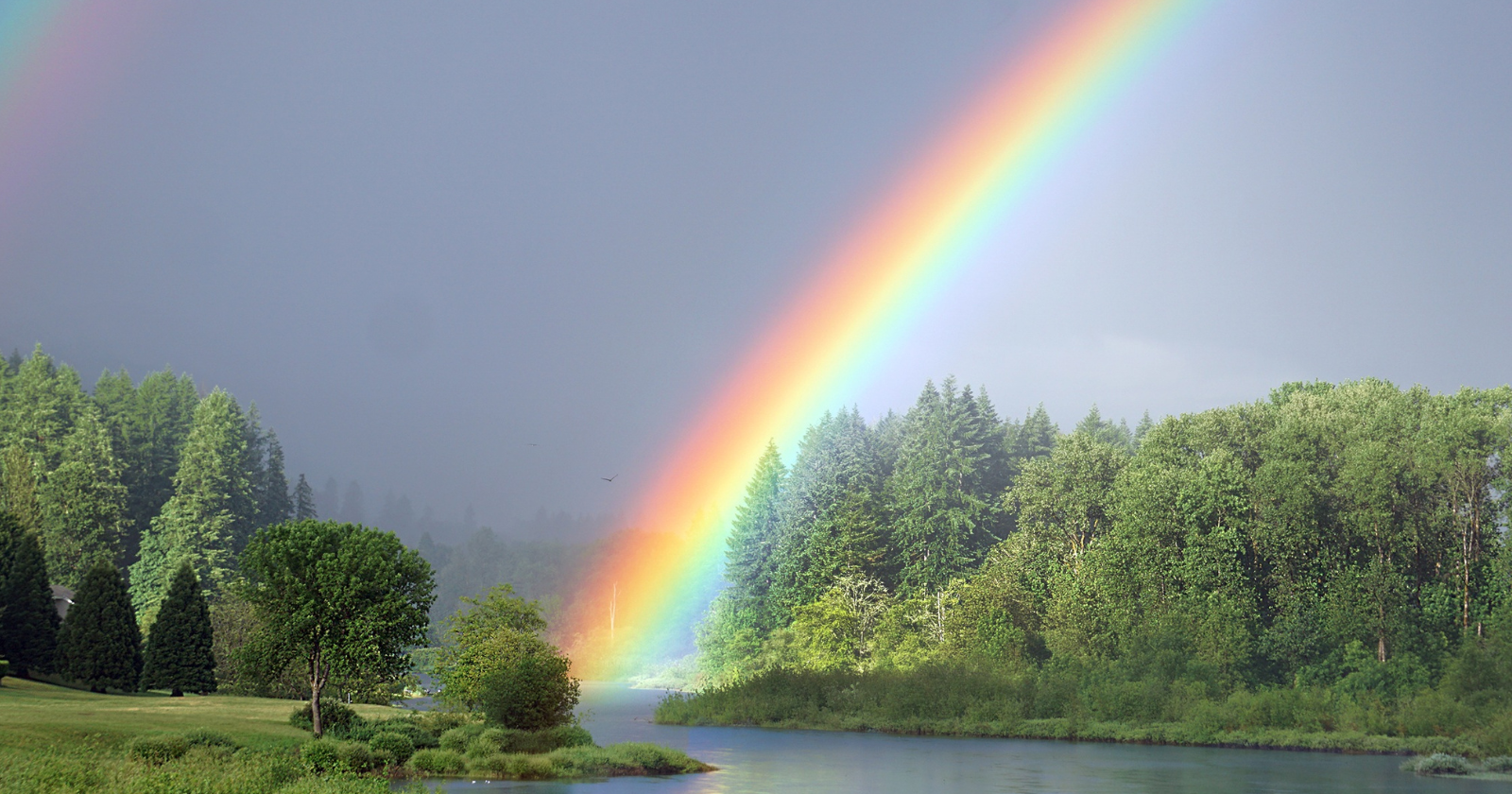
A rainbow looks like an object in the sky. It appears to have a definite location: starting somewhere over the trees, arcing across the field, ending somewhere near the horizon. Walk toward it and it retreats. Walk away from it and it recedes. The reason it behaves this way is that it has no fixed position at all. A rainbow is a viewing-angle phenomenon, formed by the geometric relationship between the sun, the raindrops in the air, and the observer’s eyes. Every person looking at what appears to be the same rainbow is, technically, looking at a different rainbow, formed by a different set of raindrops, centred on a different point. Even your two eyes are looking at slightly different rainbows.

The physics is well-understood and has been worked out in detail since the seventeenth century. The cleanest modern technical treatment is in a 2002 review article by John A. Adam, “The mathematical physics of rainbows and glories,” published in Physics Reports. Adam states the key fact directly. The cones of light that define the rainbow “will be different for each observer, so each person has his or her own personal rainbow.”

What is actually happening with the raindrops

When sunlight enters a spherical raindrop, three things happen in sequence. The light slows down as it passes from air into water, which bends it (refraction). The light then strikes the back curved surface of the raindrop and reflects internally. On its way back out, it passes from water to air again and bends a second time. Different wavelengths of light bend by different amounts, because the refractive index of water depends on wavelength. Red light, with a longer wavelength, bends slightly less than violet light. The result is that white sunlight entering a raindrop comes back out as a spread of colours, separated by angle.

The crucial number is the angle. For the dominant emerging beam, which is the one that produces the visible rainbow, the deviation from the original path of the incoming sunlight is approximately 138 degrees. The supplementary angle, the one between the observer’s line of sight to the raindrop and the line from the observer to the antisolar point, is therefore about 42 degrees. The antisolar point is the imaginary point exactly opposite the sun from the observer’s position, located on the line that runs from the sun, through the observer’s head, and out the other side. The shadow of the observer’s head sits on the antisolar point.

Every raindrop in the sky that lies on a 42-degree cone centred on the antisolar point, with its apex at the observer’s eye, will refract some sunlight back toward the observer. Those raindrops together form the rainbow. Drops at slightly smaller angles produce violet light; drops at slightly larger angles produce red. The full sequence of colours from red on the outside to violet on the inside is the result of seeing the same physical process at slightly different angles across the cone.

Why your rainbow is yours

The cone is defined relative to a specific antisolar point, and the antisolar point is defined by the position of a specific pair of eyes. If you and a friend are standing a metre apart looking at the same approximate region of sky, your antisolar points are also a metre apart. The 42-degree cones extending from your respective eyes pass through different raindrops. Your friend’s rainbow is being formed by one set of falling water droplets in the sky. Your rainbow is being formed by a different set. The two rainbows appear to overlap, because you and your friend are close together, but the actual photons reaching each pair of eyes have travelled through different drops.

According to National Geographic’s reference on rainbow formation, this means that “no one sees the same rainbow—each person has a different antisolar point, each person has a different horizon.” A person standing where you see the end of the rainbow is seeing a rainbow extending from their own horizon, not the one you are seeing. The famous question about whether there is a pot of gold at the end of the rainbow has a quiet physical answer: there cannot be an end of the rainbow that any other observer would agree was at the same place, because each observer’s rainbow ends somewhere different.

The effect even applies between your own two eyes. Your left eye and your right eye are separated by roughly six centimetres. The two cones of viewing angle that produce the rainbows visible to each eye pass through slightly different raindrops. When you look at a rainbow with both eyes open, your brain fuses two slightly different optical phenomena into a single perceived image, the same way it fuses two slightly different views of any object into stereoscopic depth perception. The fusion is so seamless that the underlying difference is undetectable. The rainbow you see with one eye closed is not quite the rainbow you see with the other eye closed.

Why the rainbow is always at 42 degrees

The 42-degree angle is not an accident of any particular rainbow. It is a fundamental property of how water refracts visible light, derived from the refractive index of water (about 1.33) and the geometry of light entering and exiting a sphere. Every raindrop, anywhere on Earth, in any era, refracts sunlight at the same set of angles. This is why every primary rainbow, no matter where or when it forms, sits at the same angle relative to the antisolar point. The rainbow you see today and the rainbow somebody saw in ancient Greece are geometrically identical at the level of angle, despite being separated by thousands of kilometres and thousands of years. What differs is the raindrops doing the work.

The secondary rainbow, sometimes visible as a fainter arc outside the primary, forms at about 51 degrees from the antisolar point. It is produced by light that reflects twice inside each raindrop rather than once, which is why it is fainter (each internal reflection costs some light) and why the colour order is reversed (the geometry of the double-reflection inverts the angular order of the wavelengths).

What the rainbow actually is

The mathematically clean way to describe a rainbow is to say it is the set of directions, relative to the observer’s eye, from which water droplets are sending the maximum intensity of refracted sunlight at each visible wavelength. That set of directions forms an arc, centred on the antisolar point, at angular radii that depend on wavelength. The arc is not at any particular distance. The raindrops doing the work can be near or far. As long as a raindrop sits on the 42-degree cone, it contributes. Move toward the rainbow and you bring new raindrops into the cone while losing the old ones. The rainbow appears to retreat because it is doing exactly that, in the sense of being formed by a constantly updating set of drops as you move.

What this means for the everyday observer is that the rainbow is a deeply personal optical event. It is centred on a point that exists only relative to you. It is built out of raindrops that no other observer is using. It looks like a thing in the sky because the brain is good at extracting object-shaped patterns from sensory input, but the underlying physics describes not an object but a geometry. The rainbow is your rainbow, no one else has the same one, and a moment from now even you will be looking at a different one, formed by raindrops that have fallen slightly further toward the ground.

The post A rainbow is not actually located in any specific place in the sky — every person watching the same rainbow is seeing a slightly different one, formed by different raindrops, and if two people stood next to each other looking at the same rainbow, the rainbows they are seeing would be technically different, with no two viewers in the world ever sharing the exact same rainbow appeared first on Space Daily.

A team led by Nick Mortimer at GNS Science in New Zealand spent two decades mapping the basalt and granite floor of the Tasman region before formally naming Zealandia in a 2017 paper, ending more than a century of arguments about whether a submerged landmass could still count as a continent.

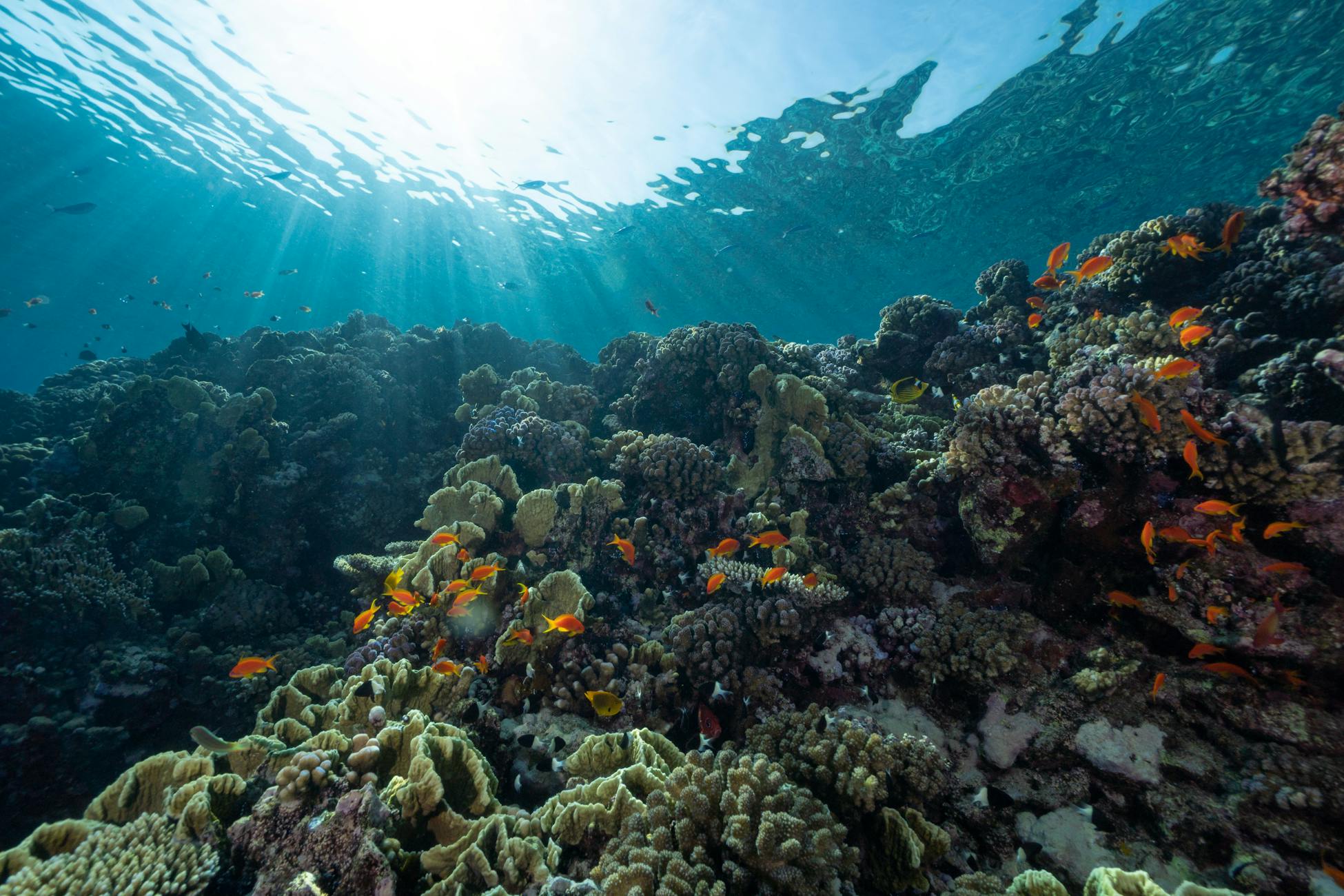
Explore the vibrant underwater world with coral reefs and fish under sunlight in clear ocean waters.

For more than a century, schoolchildren have learned that Earth has seven continents, and for more than a century that count has been wrong. Not because anyone miscounted the dry land, but because the working definition of “continent” quietly assumed a continent had to be mostly above water. When a team led by geologist Nick Mortimer at GNS Science in Lower Hutt, New Zealand, finally went public in 2017 with a paper formally naming Zealandia, a continent of roughly 4.9 million square kilometres lying 95 percent underwater, the real argument was not about a new piece of land. It was about whether scientific definitions can survive contact with evidence that doesn’t fit them.

The claim was not that Mortimer’s team had discovered new land. The claim was that the rock under the Tasman Sea was the wrong kind of rock to be ocean floor, and that the only thing keeping it off the list of continents was an unwritten rule about being dry.

What a continent actually is

To a geologist, a continent is not defined by being dry. It is defined by being made of thick, buoyant, silica-rich crust, the kind that rides high on the mantle because granite is lighter than basalt. Ocean floor is thin and dense and dark. Continental crust is thick, pale, and old.

Mortimer’s team set out four tests a chunk of Earth has to pass to qualify: elevation above the surrounding ocean floor, a distinct geology of continental rocks, thicker crust than the seabed around it, and well-defined limits over a large enough area to count as more than a fragment.

Zealandia, they argued, passes all four. The trouble is that a fifth test had always been hiding in the background: most people assumed a continent had to be mostly dry. There was no scientific reason for that assumption. It was just convention, and the question Mortimer’s paper forced was whether convention should outweigh the rock.

Two decades of dredging

The evidence that broke the convention was accumulated slowly, expensively, and unglamorously. Research vessels lowered steel buckets onto undersea ridges and plateaus and hauled up whatever broke off. Mortimer’s team and collaborators pulled granite samples from the Lord Howe Rise, sandstone with fossilised pollen from the Challenger Plateau, and Cretaceous basalts from the Campbell Plateau south of New Zealand.

None of that material belonged on an ocean floor. Granite forms inside continents, where heat and pressure cook silica-rich magma in deep chambers over millions of years. Finding it sitting more than a kilometre below sea level, hundreds of kilometres from any coast, is like finding a redwood stump on the floor of an empty swimming pool.

The team also used satellite gravity data and seismic profiles to measure crustal thickness. Oceanic crust runs about 7 kilometres thick. Zealandia’s crust came in between 10 and 30 kilometres, thinned by stretching but unambiguously continental. Each line of evidence on its own could be argued with. Together, they made the existing definition of continent harder to defend than the new boundary on the map.

From above of fit anonymous diver in flippers with oxygen cylinder on back exploring blue ocean water with bubbles during vacation

How a continent ends up underwater

About 105 million years ago, Zealandia was part of the eastern edge of Gondwana, attached to what is now Australia and Antarctica. Then it broke off. As the rift between it and Australia widened into the Tasman Sea, the crust stretched and thinned, the way pulled taffy goes pale and flat. Thinned crust sits lower. Lower crust ends up underwater.

By around 80 million years ago, Zealandia was a separate continental ribbon, gradually subsiding as it cooled and rode away on its own tectonic plate. Most of it sank below sea level by the late Eocene. Only the bits riding the boundary between the Pacific and Australian plates, including the islands now called New Zealand, got pushed back up by collision and stayed in the air.

Nature’s geodynamics summary describes Zealandia as a continental fragment rifted from East Gondwana during the Cretaceous, with its current shape controlled by successive phases of extension and magmatism. In plain terms: it was stretched, thinned, and then drowned by its own weight. None of that makes it less continental. It just makes it harder to see.

Why nobody named it sooner

The idea that something continental sat under the Tasman Sea was not new in 2017. The word “Zealandia” had been used as early as 1995, mostly as a convenient label for the region’s geology. Soviet and New Zealand surveys had been pulling continental rocks off the seabed since the 1970s. The evidence had been piling up for decades; what was missing was the willingness to test it against the definition.

By 2017 the team had enough dredge samples, gravity maps, and seismic lines to draw a continuous boundary around the whole thing. The 2017 paper was the moment the geological community had to either accept Zealandia or come up with a reason it didn’t count.

Nobody came up with a good reason. The criteria were the criteria, and a continent did not stop being a continent because it was wet. That is how scientific definitions are supposed to give: when the evidence stops fitting, the words have to move.

The map that took six more years

Naming Zealandia was one thing. Mapping it properly was another. In 2023 Mortimer and colleagues at GNS Science published the first complete geological map of the continent, including the northern reaches that had been the least sampled. They added dredge data from a 2016 voyage that recovered basalts, sandstones, and limestones from the seabed north of New Zealand, some of them around 95 million years old.

The new map showed the spine of Zealandia running from north of New Caledonia down through the Lord Howe Rise, the Challenger Plateau, the New Zealand landmass, and the Campbell Plateau, a continental strip nearly 5,000 kilometres long. By area, it is the smallest of Earth’s continents and the youngest to be formally recognised.

It is also, by a wide margin, the most submerged. Africa, Europe, Asia, the Americas, Australia, and Antarctica all sit mostly above sea level. Zealandia has only the tips of its mountains showing.

What the granite tells you

One of the most useful clues came from a process called partial melting. When the lower crust heats up, only the easiest-melting minerals turn liquid, and that melt rises to form granite higher up. The chemistry of the resulting granite carries a signature of the source rock.

Nature’s summary of partial melting notes that these melts drive crustal differentiation, the slow process by which continents become chemically distinct from the mantle below them. The granites dredged from Zealandia have the same fingerprints as granites from Australia and Antarctica, the continents Zealandia was once joined to. That match is not something an oceanic plateau could fake. The rock itself was telling a story the old definition could not hear.

Detailed close-up of a granite surface showcasing its natural texture in black and white contrast.

The argument that took a century

The notion that there might be sunken continents is older than plate tectonics. Nineteenth-century naturalists invoked land bridges and submerged landmasses to explain why similar fossils appeared on opposite sides of oceans. Most of those guesses turned out to be wrong, because continental drift, not sinking, moved the fossils apart.

But Zealandia was the case where the old idea turned out to be partly right for a different reason. It did not sink because of some catastrophe. It sank because the crust got stretched too thin to float high.

The debate over whether a submerged landmass could count as a continent went on for more than a century, partly because the definition of continent had been built around what people could see from a ship. Once the definition was rewritten around what the rock actually was, the argument collapsed.

What it changes

Adding a continent to the textbooks is not a trivial bookkeeping exercise. It changes how plate reconstructions of Gondwana have to be drawn, because there is now a large piece of continental crust that has to be accounted for in any model of how the supercontinent broke apart. It changes how biogeographers explain the distribution of certain plants and animals between New Zealand, New Caledonia, and Australia, because Zealandia provides a long, partly emergent corridor that may have stayed above water in places for longer than previously thought.

It also raises uncomfortable questions about what else is down there. The same gravity and seismic techniques that mapped Zealandia have flagged thinned continental fragments under other oceans, including pieces in the Indian Ocean and the North Atlantic. None of those is as large or as coherent as Zealandia. But the idea that the planet’s continents are exactly the seven you can see on a globe is now formally wrong, and the tools to find the others are already in the water.

The continent under the waves

If you fly from Auckland to Sydney, you spend three hours over open ocean. The plane is crossing a continent the whole time, two kilometres above ridges that were dry land when dinosaurs walked them. The reason nobody called it a continent for so long was not that the evidence was missing. It was that the word had been built around a habit of looking, not a property of rock.

Mortimer’s team did not discover Zealandia in the way an explorer discovers a coast. They argued, with two decades of rock samples in hand, that it had always been a continent and the maps had simply refused to call it one. In 2017 the maps caught up, and in doing so they conceded a larger point: what counts as a continent is decided by what the Earth is made of, not by what happens to be visible from the deck of a ship. That is a smaller revolution than plate tectonics, but it is the same kind of revolution, and it leaves the textbook count of seven looking less like a fact than a placeholder.

The post A team led by Nick Mortimer at GNS Science in New Zealand spent two decades mapping the basalt and granite floor of the Tasman region before formally naming Zealandia in a 2017 paper, ending more than a century of arguments about whether a submerged landmass could still count as a continent. appeared first on Space Daily.

The Moon is stealing time from the Earth, and it has been getting away with it for billions of years. Our planet spins so much slower than it once did that a single day has stretched from just 19 hours to the 24 we live by, and the Moon is still creeping away from us right now.

Earth’s spin is slowing, the day is getting longer, and the Moon is drifting outward at about 3.8 centimetres a year, a figure measured by bouncing lasers off the reflectors the Apollo missions left on the surface. Two things in the popular telling are worth correcting, though, because both make a careful process sound more dramatic, and stranger, than it is.

The Moon is not stealing anything. And the day did not stretch from 19 hours to 24 in the order that phrasing implies.

Nothing is being stolen

The “stealing time” image is vivid, but it describes a straightforward transfer rather than a theft.

The Moon raises tidal bulges in Earth’s oceans. Because Earth rotates faster than the Moon orbits, our planet’s spin drags those bulges slightly ahead of the line between the two bodies. The displaced water pulls gravitationally on the Moon, and the Moon pulls back. The result is a brake on Earth’s rotation and a push that nudges the Moon into a higher, wider orbit.

What ties the two together is a conservation law. The total angular momentum of the Earth-Moon system stays constant. As Earth’s rotation loses angular momentum, the Moon’s orbit gains exactly that amount, which is why it moves away. Nothing is lost from the system and nothing is taken from outside it. The “theft” is bookkeeping: one column falls, the other rises by the same figure. A less colourful description, but the accurate one is a transfer, not a heist.

Where the 19 hours actually fits

The bigger problem with the popular version is the timeline. It suggests the day began at 19 hours and has been climbing steadily to 24 ever since. The real sequence runs the other way at the start, and includes a long pause in the middle.

Soon after the Moon formed, roughly 4.5 billion years ago, Earth was spinning far faster than now. Estimates for that early day run well under 19 hours, somewhere in the region of 10 hours or less. The day then lengthened over time as tidal braking did its work. So 19 hours is not the beginning of the story. It is a point partway through.

And it is a striking point, because the day appears to have stalled there. A 2023 study in Nature Geoscience by Ross Mitchell and Uwe Kirscher found that Earth’s day held at roughly 19 hours for about a billion years during the mid-Proterozoic, between around two billion and one billion years ago. This is one study built on a compilation of geological constraints, not a settled count, but the mechanism it proposes is elegant. Lunar ocean tides were slowing Earth’s spin, as always. At the same time the Sun’s heating of the atmosphere drove atmospheric tides that pushed the other way, speeding the spin up. For roughly a billion years the two effects came close to cancelling, and the day stopped lengthening.

So the honest version is almost the reverse of the slogan. The day began far shorter, lengthened over time, then appears to have paused near 19 hours for roughly a billion years before the slow climb toward 24 hours resumed.

Measured with Apollo’s mirrors

The present-day half of the claim, that the Moon is still moving away, is the part we can measure most directly, and the method belongs on a page about space.

Three Apollo missions and two Soviet landers left arrays of corner-cube reflectors on the lunar surface. Observatories on Earth fire laser pulses at them and time the round trip. Multiplying by the speed of light gives the Earth-Moon distance to within a few centimetres, and tracking it across decades shows the Moon receding at about 3.8 centimetres a year, close to the rate a fingernail grows.

One caution about that number. It is the present rate, not a constant, and it cannot simply be run backwards. Project 3.8 centimetres a year into the past and the Moon would have been touching Earth around 1.5 billion years ago, which is impossible given that it formed some three billion years before that. The recession rate depends on how the continents and ocean basins are arranged, and today’s layout, with an Atlantic close to a tidal resonance, makes the braking unusually strong. In the deep past the rate was slower. The Moon is leaving, but not on a straight line drawn from today’s speed.

What to keep from the factoid

Earth’s spin is slowing, the day is lengthening by a couple of milliseconds a century, and the Moon is edging away, all driven by tides and all measured rather than guessed.

The two refinements worth carrying are quieter than the slogan. No time is being stolen, because the angular momentum Earth loses is precisely the amount the Moon’s orbit gains. And 19 hours was not a starting line but a thousand-million-year pause, a stretch when two tides held the day still before the slow lengthening resumed.

The post The Moon is stealing time from the Earth, and it has been getting away with it for billions of years. Our planet spins so much slower than it once did that a single day has stretched from just 19 hours to the 24 we live by, and the Moon is still creeping away from us right now. appeared first on Space Daily.

There are more trees on Earth than stars in the Milky Way. A major global estimate put the planet’s tree count at about three trillion, while NASA gives the Milky Way’s star count as roughly 100 to 400 billion.

The most cited global estimate puts the number of trees on Earth at about three trillion. NASA gives the Milky Way somewhere between 100 and 400 billion stars. Three trillion is more than seven times the high end of that range, so there are indeed more trees on Earth than stars in our galaxy.

Both numbers are more interesting than the comparison that pairs them, partly because neither is a count.

Where the tree number comes from

The three trillion figure is modern, and it changed the way people talked about global tree numbers. It comes from a study led by Thomas Crowther, published in Nature in 2015, which put the global total at about 3.04 trillion.

The striking part is what it replaced. The previous commonly repeated estimate was in the hundreds of billions, built from satellite imagery and forest-area calculations alone. The 2015 study added more than 400,000 ground-based tree-density measurements to the satellite picture and arrived at a number roughly an order of magnitude higher. The trees did not appear between the two studies. The method improved. A count built only from above had been undershooting what was actually on the ground.

So the headline number is best read as a careful estimate from a particular study, not a tally. It is the most thorough attempt so far, not a final figure, and it carries its own uncertainty.

Why the star number is a range, not a figure

The star count is uncertain for a different reason, and the gap between 100 and 400 billion is not sloppiness. It reflects something real about how the number is reached.

Nobody counts the stars in the Milky Way one by one. Dust blocks much of the galaxy from view, and most of it lies too far away to resolve into individual stars. Instead astronomers estimate the galaxy’s mass, work out how much of that mass is in stars, and divide by the mass of an average star. That last step is where the range opens up. The most common stars by far are faint, low-mass red dwarfs, which give off very little light and are easy to undercount. A small uncertainty in how many of those there are turns into a large uncertainty in the total. The European Space Agency’s Gaia mission has mapped the positions of well over a billion stars, but even Gaia cannot see the faintest of them, so the galaxy-wide figure stays a range.

One number rests on filling the gaps in satellite data with ground samples. The other rests on dividing a mass estimate by an average. Neither is a head count, and both have honest error bars.

The comparison only works at galaxy scale

The factoid is careful to say stars in the Milky Way, and that limit is doing the heavy lifting.

Earth has more trees than our galaxy has stars. It does not have more trees than the universe has stars, and the gap there is not close. A Hubble-based estimate discussed by NASA suggested the observable universe could contain about two trillion galaxies, and NASA estimates the universe could hold up to a septillion stars, a one followed by twenty-four zeros. Against that, three trillion trees is a rounding error.

So the comparison is true and also narrow. Pick our galaxy and the trees win. Widen the frame to the observable universe and the stars outnumber every tree that has ever grown on Earth by something like twelve orders of magnitude.

The part of the tree number worth keeping

There is a figure in the same study that tends to get dropped when the factoid is repeated, and it is the one that matters most.

The Crowther study also estimated that the number of trees on Earth has fallen by about 46 per cent since the start of human civilisation, and that more than 15 billion trees are lost each year. The three trillion that remain are roughly half of what once stood. The cheerful version of the factoid, that trees outnumber the stars in the galaxy, sits on top of a second finding that is harder to enjoy.

What to keep from the factoid

The comparison is sound. There are more trees on Earth, about three trillion by the best current estimate, than there are stars in the Milky Way, somewhere between 100 and 400 billion.

Both numbers are estimates rather than counts, reached by different methods with real uncertainty, and the comparison holds only because it stops at the edge of our own galaxy. The more durable fact underneath it is that the three trillion is a reduced number. The same study estimated that Earth has lost about 46 per cent of its trees since the start of human civilisation, and that more than 15 billion are cut down each year.

The post There are more trees on Earth than stars in the Milky Way. A major global estimate put the planet’s tree count at about three trillion, while NASA gives the Milky Way’s star count as roughly 100 to 400 billion. appeared first on Space Daily.

❌