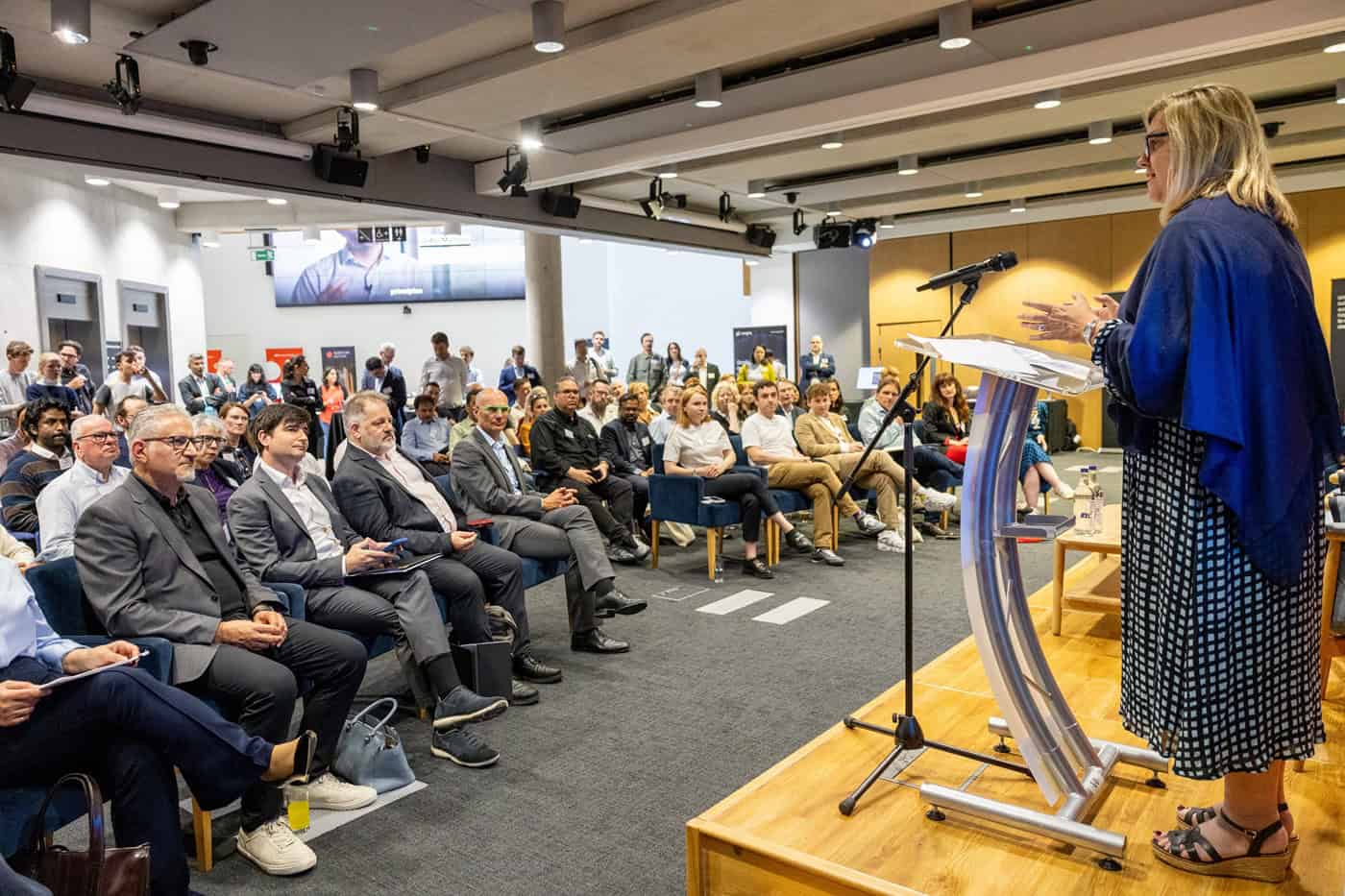
Capital connections Janet Coyle from London and Partners addressing delegates at a meeting at the Institute of Physics to mark the first anniversary of the London Quantum Cluster. (Courtesy: Carmen Vilano)
“There are two types of people when it comes to quantum,” joked Howard Dawber, deputy mayor of London for business and growth at a meeting at the Institute of Physics last night to celebrate the first anniversary of the London Quantum Cluster.
“There are those who understand quantum mechanics. There are those who don’t. And there are those who are in superposition of understanding and not understanding until they are observed.”
It was a light-hearted remark that matched the mood of what was essentially an evening of boosterism for quantum technology in London ahead of London Tech Week next week.
As chair of London and Partners – the growth agency for London – Dawber told the gathering of more than 100 “quantum influencers” that the organization was “100% behind the London Quantum Cluster”.
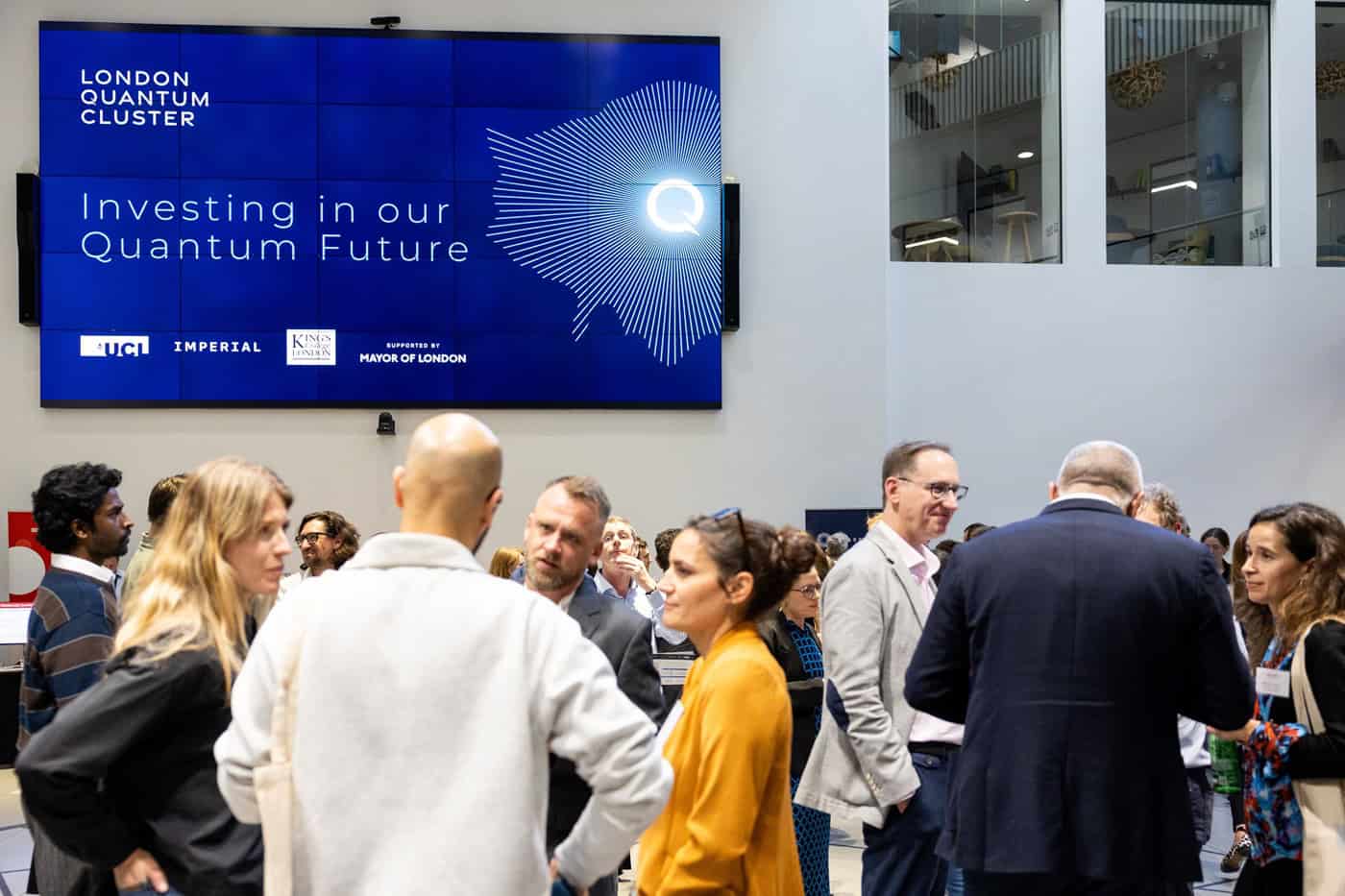
Founded in 2025 by University College London, King’s College London and Imperial College London, with support from the Mayor of London and the UK government, the cluster seeks to establish the capital as a powerhouse of quantum tech.
Georgia Siora from Warwick Economics and Development presented data to show that London is already doing well in the sector, being home to more than 160 quantum companies, with seven of the top 10 UK quantum firms based in the city. Small- and medium-sized quantum firms in the capital, she added, contribute an estimated £153m annually to the economy.
Happy anniversary The London Quantum Cluster is now one year old. (Courtesy: Carmen Vilano)
“Quantum and deep tech are at the heart of the capital’s 10-year growth plan,” added Janet Coyle, managing director of London and Partners.
Geraint Rees, vice-provost for research, innovation and global engagement at UCL, said his aim was “to make London the best place on the planet for serious quantum companies”. He pointed to UCL spin-out Quantum Motion, which has just won $160m of venture-capital funding, as an example of the kind of firm making a name in the city.
The evening ended with a panel debate chaired by Jess Wade from Imperial College London, featuring Maria Maragkou from Nu Quantum as well as Richard Murray, founder of ORCA Computing, who drew a distinction between universities being all about expanding the frontiers of knowledge, whereas for start-ups “the aim is to win”.
Also on the panel was physicist Alejandro Montblanch – head of quantum communication and networking at banking group HSBC – who made it clear that what he wanted to know was: “How can your quantum company help HSBC make more money?”
A welcome note of caution came from London-based venture-capital investor Eloisa Angeles, who pointed out that while the UK has a good track record of government-funded research, the UK is weak at “follow through”, with the government not focused on procurement and not having the end customer of the research in sight.
From heatwaves to extreme rainfall, the impact of climate change is rapidly becoming a reality in our daily lives and a danger to our planet. But physicists are in a great position to help, with physics-based research bringing about practical, real-world solutions, whether it’s more efficient solar cells, better climate models, or novel materials for capturing carbon dioxide from the atmosphere.
There are huge economic and commercial benefits from such work too. A 2023 report from the Institute of Physics (IOP), entitled Physics Powering the Green Economy, estimates there are almost 1800 companies in the UK and Ireland taking green technologies to market with a combined turnover of £750bn.
Last year a follow-up IOP Impact report entitled Unleashing Physics to Power the UK Energy Sector identified the most promising physics technologies for transforming the UK’s energy system. These fall into three main areas: energy generation (nuclear power, photovoltaics), storage (batteries) and transmission (high-temperature superconductors).
The clean-energy revolution will not be easy, however. As the IOP report points out, the UK has a strong research base, good international collaborations, and a growing pipeline of spin-out and early-stage companies. But the country doesn’t invest enough in technology scale-up facilities, faces critical skill shortages, and isn’t great at recycling either.
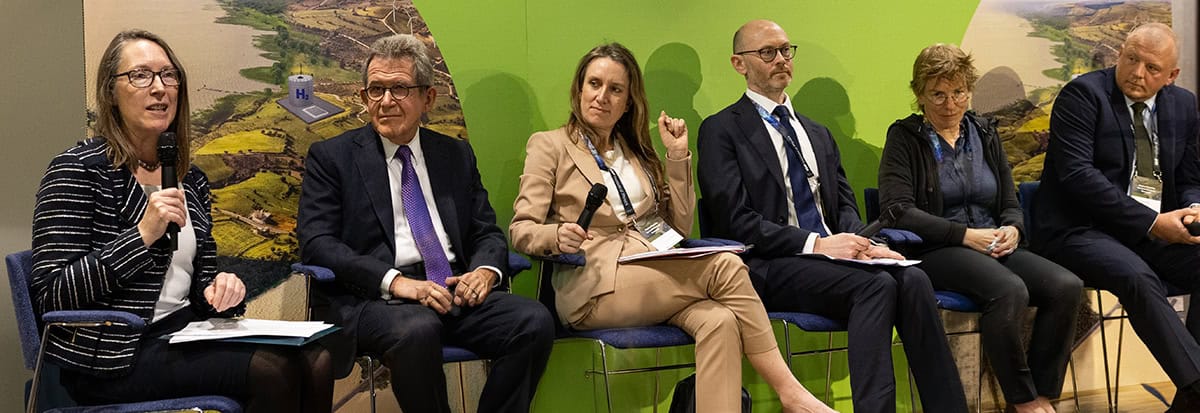
To discuss how physicists are supporting the green economy – and what more they can do – a panel debate was recently held at the IOP in central London. Attended by Prince Edward, the Duke of Edinburgh, as well as about 100 business leaders, policy chiefs, senior physicists, and IOP and IOP Publishing staff, it was chaired by Tara Shears, the IOP’s vice-president for science and innovation.
The panel featured ex-BP boss John Browne, who now works in green energy, Emily Nurse from the UK’s Climate Change Committee, former Sizewell C energy-strategy director David Cole, solar-cell physicist Jenny Nelson from Imperial College, and Nellie Technologies founder Stephen Milburn. The following is an edited extract of the discussion.
Physicists for a greener future
Green game-changers Tara Shears (far left) chairing the panel debate at the Institute of Physics in London on how physics can support the green economy. It featured (from left to right) John Browne, Emily Nurse, David Cole, Jenny Nelson and Stephen Milburn. (Courtesy: Carmen Valino)
John Browne is chair of BeyondNetZero, a climate-growth equity venture firm. He was group chief executive of energy giant BP from 1995–2007, having joined the firm in 1966 after studying natural sciences.
Emily Nurse, who was originally an experimental particle physicist, is the director of net zero at the UK’s Climate Change Committee, which advises the UK government on reducing emissions and adapting to the impacts of climate change.
David Cole, an engineer by training, was at the time of the discussion director of energy strategy at the Sizewell C nuclear-power plant, which is being built in Suffolk in the UK. When complete, it is expected to meet up to 7% of the UK’s total electricity demand. He is now executive president, consulting, at energy firm Wood.
Stephen Milburn is a physicist who is founder and chief executive of the firm Nellie Technologies in South Wales. It removes carbon dioxide form the atmosphere using biomass, which can then be used as animal feed or construction material.
What role are physicists currently playing in our quest for a greener economy?
John Browne: I made a wonderful decision 60 years ago, when I was 18, which was to read physics. After graduating, I became an engineer, but over the last 30 years physics has come back in to my life as I’ve found myself doing something very important – trying to get to net zero. Physics, you see, touches absolutely everything.
All that I’ve ever done – whether it’s renewable energy or “old energy” [fossil fuels] in my old life – starts with physics. Whether you’re involved in chemistry, biology, electronics or engineering, it could not exist without a much deeper understanding of physics. We have to make sure everybody knows that – but I don’t think people currently do. They tend to think engineering is the only enabler for commercialization, but physics is there.
Emily Nurse: I started out as a particle physicist working at CERN on the Large Hadron Collider but for the last four years, I’ve been involved in climate policy and now work with the UK’s Climate Change Committee. We are the UK government’s official advisers on its climate targets – and assessing progress towards meeting those targets. As we celebrate global decarbonization to date, we need to remember it’s all underpinned by physics.
Take the rise of solar power for example, which has been the fastest growing source of global electricity generation for the last 20 years in a row. Solar installations in 2024 were double those in 2022. Along with wind, solar has led to a reduction in electricity from fossil fuels. We’re seeing the costs of solar plummeting and they just keep falling further.
In the UK, solar power has been growing more slowly, but it’s starting to pick up and is going to be a really important part of the electricity mix. We’ve also got a lot of wind here in the UK – it’s a very windy island after all. I would also like to give a shout out to heat pumps: as a physicist, how can you not love their efficiency?
David Cole: I am an engineer, not a physicist, but I’ve spent my career in lots of different sectors and been fascinated with the role that energy plays in creating a better society. What’s really interesting at Sizewell C is the ownership structure, which involves both state and private investment. It’s the first time private investment has been used for a new nuclear build in the UK.
I hope it leads to a virtuous circle, in which the more plants we build, the more we can reap from that investment
David Cole
Getting this hybrid financial structure over the line was not trivial – it took a lot of effort – but I think it will drive great performance. We’re also trying to use as much UK content in the plants as possible, whether that’s materials, skills or technology. I hope it leads to a virtuous circle, in which the more plants we build, the more we can reap from that investment. Sizewell C will, in other words, bring down energy costs, which is fundamental to economic growth.
Jenny Nelson: I have been active in research into solar photovoltaic (PV) materials and devices for over 30 years and we should celebrate how much has happened in the field during that time. In the last 10 years, we have seen capacity increase globally by more than a factor of 10, we’ve seen the efficiency of solar cells increase, and we’ve seen the cost come down almost by a factor of eight, all of which is remarkable.
Those innovations are firmly rooted in physics – whether it’s changes in device structure… or of the optical properties of materials
Jenny Nelson
The cheapest form of electricity globally, in other words, is now from solar PV, which was not the case 30 years ago. These developments have come partly from economies of scale and partly from technological innovations that have now fed through into production. Those innovations are firmly rooted in physics – whether it’s changes in device structure due to our understanding of semiconductor physics or new developments in the optical properties of materials.
The next generation of PV cells, which are likely to be silicon-based tandem devices, will also depend on scientific breakthroughs and innovations.
Stephen Milburn: I’m chief executive of Nellie Technologies, which is based in South Wales on the site of a former chemical-weapons storage facility. We’re using biomass waste for removing atmospheric carbon dioxide, and if you visit us, you’ll see all kinds of activity: in one corner there’s chemistry, in another engineering and in the next there’s biology and biochemistry. But physics is at the heart of the technology. Physicists are a bit arrogant when we say we think we can do everything, but the fact is we probably can.
But we should also celebrate the work that has gone on to create a market in which carbon-emission credits can be bought and sold. Trading carbon credits has been a bit of a dark activity over the last 10 years, with double counting and bad things happening purely by firms wishing to make a profit. However, the market does have the power to regulate itself – in fact the alignment we’re starting to see between the UK and the EU will help greatly.
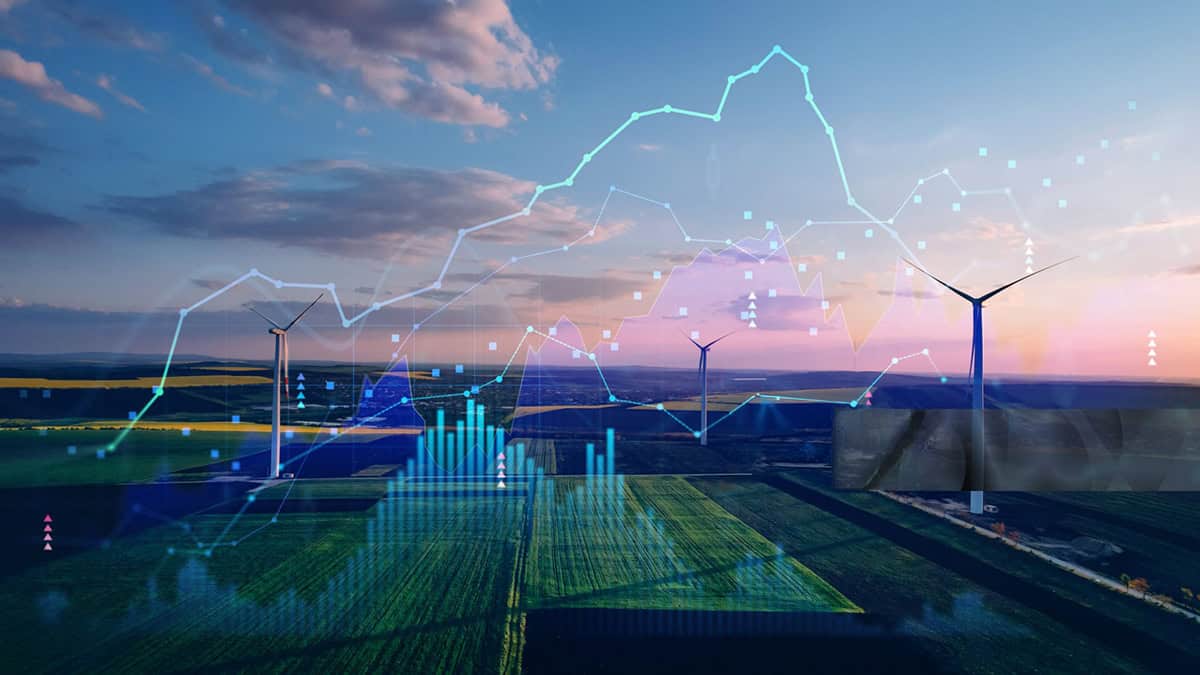
Challenging times Technologies to store, generate or transmit energy are rooted in physics. (Courtesy: iStock/Galeanu Mihai)
What are the biggest growth opportunities for the green-economy sector?
John Browne: First, we can do much more with what we’ve already got – for example we could increase our offshore wind or rethink whether we should go back into onshore wind. Second, we can improve what we’re doing – for instance, by increasing the efficiency of solar panels to their theoretical maximum, which would make rooftop solar economically attractive. Third, there are new opportunities, such as metallic organic frameworks and nuclear fusion.
What we do here in the UK needs to move the needle globally, which means thinking about how to scale and finance it properly
John Browne
However, the UK needs to avoid doing things that others are doing much better. The race for the best battery in the world is, for example, probably going to be won elsewhere. What we do here in the UK needs to move the needle globally, which means thinking about how to scale and finance it properly. The UK shouldn’t end up as a secondary player.
Emily Nurse: The UK has made a lot of progress in our quest to reach net zero by 2050. Since 1990, for example, we’ve halved our carbon emissions, mainly by decarbonizing electricity – phasing out coal, reducing gas generation, while significantly increasing wind, solar and other renewables. Electricity generation now accounts for only around 7% of UK emissions, which are dominated by transport (cars and vans) and heating (oil and gas boilers).
Reducing emissions still further will predominantly come from moving to electric technologies, including electric vehicles and heat pumps, and by further decarbonizing the electricity supply. There will be a backbone of wind and solar, but to ensure a secure supply, we’ll need nuclear, carbon capture and storage, hydrogen and batteries. We’ll have to reduce emissions from agriculture and land use too.
A report from the Confederation of British Industry (CBI) last year estimated that the net-zero economy grew by 10% in 2024, which is three times faster than the rest of the UK. But we’ll need more innovations to continue to bring costs down – and we’ll also need to provide incentives to boost the take-up of electric technologies. If we do that, there’ll be an overall saving to the UK economy in about 15 years’ time, our analysis suggests. There are huge opportunities for green growth to come from this investment.
David Cole: I agree that for the UK to be competitive, the cost of energy has to come down – not just for domestic customers but businesses too. In fact, there are two main opportunities First, we have to adopt a “whole-systems” approach. If we’re building a power station, for example, can we use every bit to its maximum potential?
Let’s say I’m running a direct air-capture plant operating at 25–30 ºC – can I use the waste flow from my coolant system to encourage new industries? Can it support nearby hydrogen generation plants or companies making, say, synthetic aviation fuel? Those questions involve thinking about physics and engineering as well as materials science, which is also super important.
Whichever way you look at it, we’re talking about building a lot of hardware, which involves materials. How much energy per unit mass are they using? Can we recycle those materials? What can we do with the waste products? Ultimately, what is really important is energy security: where does your energy come from, who made it and what impact does it have on the environment?
Jenny Nelson: The net-zero economy is growing significantly faster than the rest of the economy and I think that will continue. But decarbonizing the power sector only addresses part of the problem and we’re going to see a big transition across the rest of industry, agriculture and elsewhere that will generate a wide range of opportunities and stimulate the economy too. I’m not just talking about rolling out more renewables, but about integration – bringing together the generation and storage of energy, ensuring that we are managing demands and have the right infrastructure.
As for my area of photovoltaics, we’ve seen great ideas and technologies come out of the UK that are very likely going to be developed outside the UK because the manufacturing capacity isn’t here. Nevertheless, those ideas and innovations can still benefit the country through licensing, partial manufacturing and new technology.
One thing to remember about solar power is it’s distributed. You can have solar generation without being connected to the grid. That not only opens some markets for certain applications where you want to generate electricity locally, but it also provides a route to energy security through back-up generation, towards which solar power will be an important part.
Stephen Milburn: Having a strong green-technology manufacturing base is a huge opportunity for the UK. My company is based in South Wales, where we have lots of highly skilled people who used to work in traditional industries but now don’t have many places to go. Yes, there’s a fantastic semiconductor industry here, but when it comes to deploying green technology we cannot outsource that responsibility to other parts of the world.
Green tech needs to be deployed in the UK’s industrial heartlands… if we don’t nurture jobs and skills here there’s a real risk they will be gone forever
Stephen Milburn
Green tech needs to be deployed in the UK’s industrial heartlands to take advantage of the skills we already have, but which we are at risk of losing. In fact, if we don’t nurture those jobs and skills here there’s a real risk they will be gone forever. Having a strong green-technology manufacturing base is a huge opportunity for the UK.
Deep thinkers Combining analytical minds with great problem-solving skills, physicists are well placed to tackle the challenges of climate change. (Courtesy: iStock/MTStock Studio)
What needs to happen so that these opportunities can be put into practice?
Stephen Milburn: Many science graduates leave university equipped with solid academic rigour and a great scientific understanding, but they often lack practical green-technology skills. This summer my company is therefore hoping to launch a climate apprenticeship programme, which will allow graduates to pick up those skills. We need to build green-tech skills in the real economy, in particular those that will deal with climate change.
Jenny Nelson: The UK must do more to support its own innovations. We need better regulations to avoid unnecessary bottlenecks. We need to invest in infrastructure like the grid. We should completely avoid subsidizing fossil fuels and instead divert any subsidies into alternative economies. Finally, we need to train and educate people, showing the public the potential of green technology so that they become part of the transition, for example by generating their own electricity.
David Cole: We need to integrate our policies on industry, energy, land use and AI so that we can invest in them all as growth areas. In particular, I’d like to see a long-term nuclear programme in which we build a fleet of new reactors all of the same design, which will drive down costs by letting us replicate a particular technology. It’s also vital that we get a high proportion of UK content and technology into these reactors, which will lead to a virtuous circle, with money coming back into the economy that we can re-invest in industrial and academic partnerships.
Emily Nurse: What’s vital is consistency in policies; we need certainty. In the UK, we are fortunate to have world-leading climate legislation in the form of the 2008 Climate Change Act, which does not just make it a legal requirement to reach net zero by 2050 but also gives us targets along the way. It means we know what we need to do in both the medium- and long-term, which gives certainty to investors, businesses, innovators and consumers.
What’s really important is communication – supporting communities through the transition and making sure they realize the benefits
Emily Nurse
So the first thing we need to do is keep the Climate Change Act. Then, of course, we’ve got to address barriers to delivery, including having the right incentives to electrify the economy. And what’s really important is communication – supporting communities through the transition and making sure they realize the benefits, not just in terms of reducing carbon production but of having cleaner, better and more efficient technologies too.
John Browne: First, we must never stop investing in people who can discover things and translate them into real commercial products. Second, we need to understand how to scale things, which means focusing on the winners and getting rid of things that are “nice to have” but aren’t going anywhere. That’s not easy because you have to push people to say, “You’ve done great work, but you’ll have to stop”.
What’s more, to scale new technology, people have to learn what it takes. When I’m in the US, I often speak to chief executives who can explain their technology to the financier who’s supporting it, whereas here in the UK that often doesn’t happen.
Third, we need to maintain confidence in what we’re doing. I often talk to people who think that it’ll be really expensive to get to net zero, but in fact estimates suggest that each household would only have to spend an average of about £150 a year to get there. So it’ll be less than the cost of a TV licence to get to net zero.
Of course the investment needed will be “lumpy” – it’s not as simple as just levying a fee – but the point about governments is that they can smooth things out. That is what they have done in the past and it’s what they should continue to do.
For more information about the IOP’s work on the green economy, click here. You can also keep up to date with the all latest research in the field through IOP Publishing’s series of open-access Environmental Research Journals at this link.
Nuclear fusion powers the Sun, and scientists and engineers have long been trying to harness the process to generate clean energy. While much progress has been made, the commercially-viable generation of fusion energy remains elusive.
One important challenge is developing a range of specialized materials that can contain an extremely hot, radiation-emitting plasma in close proximity to ultracold superconducting magnets.
Our guest this week is Jacob John of the UK Atomic Energy Authority, who studies how radiation damages materials. In conversation with Physics World’s Matin Durrani, he talks about the near-oxymoronic materials requirements for fusion reactors and how they can be met.
Gwenaëlle Lefeuvre studied physics at Sorbonne Université in Paris, France, before moving to Université Paris Cité to do a PhD in experimental particle physics. After postdocs at Syracuse University in the US and the University of Sussex in the UK, she left academia and worked for 10 years at the UK company Micron Semiconductor Ltd. Here, Lefeuvre set up a business unit dedicated to designing and manufacturing CVD diamond sensors.
Lefeuvre now works as the network coordinator for Photonics Bretagne – a non-profit association in Brittany, France. As an innovation hub, the organization supports the development of the photonics ecosystem across industry, research and education in Brittany, and helps integrate photonics technologies into other sectors.
What skills do you use every day in your job?
When it comes to skills I need for my role, my scientific background is just the starting point. I am the contact point between the Photonics Bretagne team, our members, our European partners, and any other parties interested in what photonics have to offer. While my background gives me credibility, what I really use is the inquisitive spirit that a physics education imprints in us. I ask a lot of questions, all the time and to everyone, so I can better understand what people work on, what they need, and how their products can be used in different situations.
Of course, this means that communication and networking are also crucial. Representing my member companies, for example, means that I must be able to translate what they are offering so it’s understandable for people who might work in a very different sector, such as mobility, agriculture or cosmetics.
Finally, being flexible is a must. I wear different hats depending on the task at hand, and need to be able to switch them around quickly.
What do you like best and least about your job?
I love many aspects of my role, but top of the list is having the opportunity to keep learning about new technologies and applications. The breadth and depth of knowledge my co-workers and our members possess is as humbling as it is inspiring. While I am more of a “generalist physicist” myself, I have worked on many different types of experimental systems so can appreciate the expertise at play.
I also enjoy the diversity of my work, which makes my days fun and varied. I might be meeting with members and looking for ways to support them; organizing a delegation visit with my European partners; or advocating for photonics in cross-sector events – and that’s just naming a few of my responsibilities. There is never a dull day.
With the diversity of my role and my enthusiasm to find out more comes the challenge of prioritizing. There are so many things I would love to be doing, but we are a small team and we must focus our efforts on those actions that can best serve our community. And of course, the administrative and reporting tasks are never loved by anyone and take up more valuable time than I would like. They are a constant in every job though, and can be managed through good planning.
What do you know today, that you wish you knew when you were starting out in your career?
Three things come to mind. The first is that it’s helpful to know whether you will enjoy becoming a highly specialized researcher, or if you would thrive in a more general role. Higher education in physics is designed around gaining a finer and finer degree of specialization. I realized during my postdocs that I was not enjoying staying in one given field (neutrino physics, in my case) as much as I expected to. What I loved was working hands-on with different types of sensors, which is a more transversal specialization, so to speak. Not everyone is built to be a specialist and there is nothing wrong with that. Many career options are open to those who embrace remaining curious about everything, provided they have a strong background to back it up.
There are so many ways to work in, with or for the physics community – the main limiting factor for my younger self was probably my own imagination
Secondly, it’s worth remembering that people change, and ambitions do too. It has been said many times in this column, but life isn’t linear and neither is a career. It is important to account for the person you will become, so that you don’t make choices today that will make your future self unhappy or stuck. There are so many ways to work in, with or for the physics community – the main limiting factor for my younger self was probably my own imagination. Luckily, many degrees now include broadening experiences like semesters abroad or entrepreneurship classes.
Finally, I wish I had realized earlier that people love it when we ask them questions about their work. Doing so does not showcase our ignorance but our interest – it’s a true win-win.
Physicists who go into politics are a rare breed. Most famously there was Angela Merkel, who was chancellor of Germany for 16 years. Climate physicist Claudia Sheinbaum Pardo was elected Mexican president in a landslide win in 2024. Alok Sharma, meanwhile, was business secretary in the UK government and president of the COP-26 climate summit.
But Dave Robertson is even more unusual. Having originally studied physics at the University of Liverpool in the UK, he worked as a physics teacher in Birmingham for almost a decade. After spells in the trade-union movement and local politics, Robertson has been the Labour Member of Parliament (MP) for Lichfield, Burntwood and the Villages since 2024.
He’s not the only physicist currently serving as an MP. Others include Layla Moran – another former physics teacher – who’s been Liberal Democrat MP for Oxford West and Abingdon since 2017. There’s also shadow home secretary Chris Philp, who’s been Conservative MP for Croydon South since 2015.
But Robertson is the only physics-teacher-turned-MP in the current Labour government, which came to power at the 2024 general election. It won a 174-seat landslide majority, though Robertson’s own victory was wafer-thin. He squeaked home by just 810 votes over his Conservative rival Michael Fabricant, who had been Lichfield’s MP for more than 25 years.
In an interview with Physics World, Robertson admits he had little idea of what the job of MP would involve (see box). Describing the British parliament as “a truly bonkers and bizarre workplace”, he divides his time between Lichfield and London. “I try to do four days in my constituency a week and four days in parliament. That doesn’t add up, but if can split my Mondays, I can just about make it work.”
Dave Robertson MP: what happened after I got elected
Dave Robertson recalls the immediate aftermath of his victory in the UK general election on Thursday 4 July 2024.
When you win an election, they give you this envelope. I was expecting a proper, thick A4 envelope, but all they gave me was a single sheet of A4 paper folded in half. It was 4.30 in the morning, I’d had no sleep and I’d been on my feet since 7 a.m. or something stupid. And I thought “I’m not opening this now. I’m going to take it home.”
When I opened it in the morning, it basically said “Congratulations, phone this number.” So I rang and someone said “Oh, when are you coming down to parliament?” And my reaction was “I thought you’d tell me that!” In the end, I went down on the Sunday after the election and I remember walking into Westminster Hall for the first time with the person who was showing me round and she said, “So when was the last time you were in parliament?”
As I put my hand on the door, I had to admit I’d never been in the building before: it was literally the first time I’d ever been there. And it’s nothing like I expected. It is a truly bonkers and truly bizarre workplace. It’s unique and so different to everything else. That comes with its frustrations, but it is also an absolute privilege to be involved – and long may it continue.
Into the classroom
Brought up in Lichfield, Robertson began his physics degree at Liverpool in 2004. Saying he “loved every second” of his time there, Robertson particularly enjoyed nuclear physics. But it was a science-communication course, which Robertson admits he only took because he thought it would be easy marks, that made him realize how much he liked taking complicated concepts and explaining them to non-experts.
After graduating in 2007 and taking a year off, Robertson returned to the Midlands to do a teacher-training degree at the University of Birmingham. The course was largely practical, with Robertson spending most of his time getting hands-on teaching experience at various schools in Birmingham, including one – Great Barr School – that he ended up working at.
Roberston spent seven years as a physics teacher at Great Barr, which was then one of the largest secondary schools in the UK. With about 2500 pupils, it had as many as 16 classes in each year group, from age 11 to 16. Great Barr was also able to offer physics to 17 and 18 year olds who stayed on to do A-levels. “We’d always have one physics group or occasionally two in year 12.”
Rather than just focusing on the syllabus, Robertson would try to make his lessons “loud and engaging” to emphasize the excitement and sheer bizarreness of physics. Claiming he has good control of his voice, Robertson says he would also “put on accents and do silly voices” to keep pupils entertained.
He particularly enjoyed teaching a course called “Science in the news”, where pupils would look into the impact of a particular topic in the syllabus on the wider world. “That was wonderful,” Robertson recalls. “It was effectively a literature review, which let us teach a lot of the skills that we want to see kids developing when they’re learning sciences. It was fascinating.”
Not all pupils enjoyed physics. “For some kids, physics wasn’t their thing – it’s not what drove them,” he says. But he regarded it as “an absolute privilege” to teach students who were engaged with the subject, especially those who went on to study physics at university. One ex-pupil even contacted Robertson after he became an MP to say she’d just passed her PhD. “She’d dropped a note into her thesis thanking Mr Robertson for being an inspiring physics teacher.”
Political moves
Robertson’s time at Great Barr came to an end in 2016 when the school was making job cuts and he accepted voluntary redundancy. After doing supply teaching for about a year, he got wind of a post at the NASUWT teachers’ trade union, which he’d been school rep for at Great Barr. “It was one of those jobs I’d have regretted if I didn’t apply for it,” he says.
It was while working for the NASUWT that Robertson got involved in local politics. He joined the Labour Party and in 2019 was elected to Lichfield District Council, which was then run by the Conservative Party. He also stood in that year’s UK general election, but was beaten by Michael Fabricant, losing by more than 23,000 votes. “I don’t talk about that result,” Robertson jokes.
Heart of the country Dave Robertson was elected as Labour Member of Parliament for the Staffordshire seat of Lichfield, Burntwood and the Villages at the 2024 UK general election, beating the sitting Conservative MP Michael Fabricant by just 810 votes. The former physics teacher serves a semi-rural constituency centred on the cathedral city of Lichfield (pictured). Lying about 30 km north of Birmingham, the constituency also includes farmland, villages and the town of Burntwood. (Courtesy: iStock/Nicholas E Jones)
Robertson is now one of more than 400 Labour MPs and spends most of his time on local Lichfield matters. “My number one focus is very much what’s going on in my constituency, and that will always be the case,” he says. “But I’m very fortunate to be one of a very small number of parliamentarians who’ve got a science background, let alone a physics background.”
That interest saw Robertson host an exhibition in the Houses of Parliament, organized by the Institute of Physics (IOP), in June 2025 to support the International Year of Quantum Science and Technology (IYQ). “Every MP and member of the Lords would have been able to walk past and see that it was the IYQ,” he says. The exhibition was, for him, a great opportunity “to show decision-makers that the UK is one of the world leaders in quantum”.
That month Robertson also hosted a hands-on display of quantum technology for MPs and members of the House of Lords, again organized by the IOP. At the end of 2025 he sponsored another parliamentary reception, this time for physics-based companies that had won IOP Business Awards. “The event was absolutely wonderful,” says Robertson. “Seeing some of the cutting-edge science from companies on show was astonishing.”
Robertson’s focus on science extends to his membership of various cross-party parliamentary groups, including ones about nuclear energy and space. He is also chair of a new group he has set up devoted to quantum science and technology. As a backbench MP, Robertson cannot dictate or implement policy, but he says such groups “can help build up a critical mass of interest in parliament to drive an agenda forwards”.
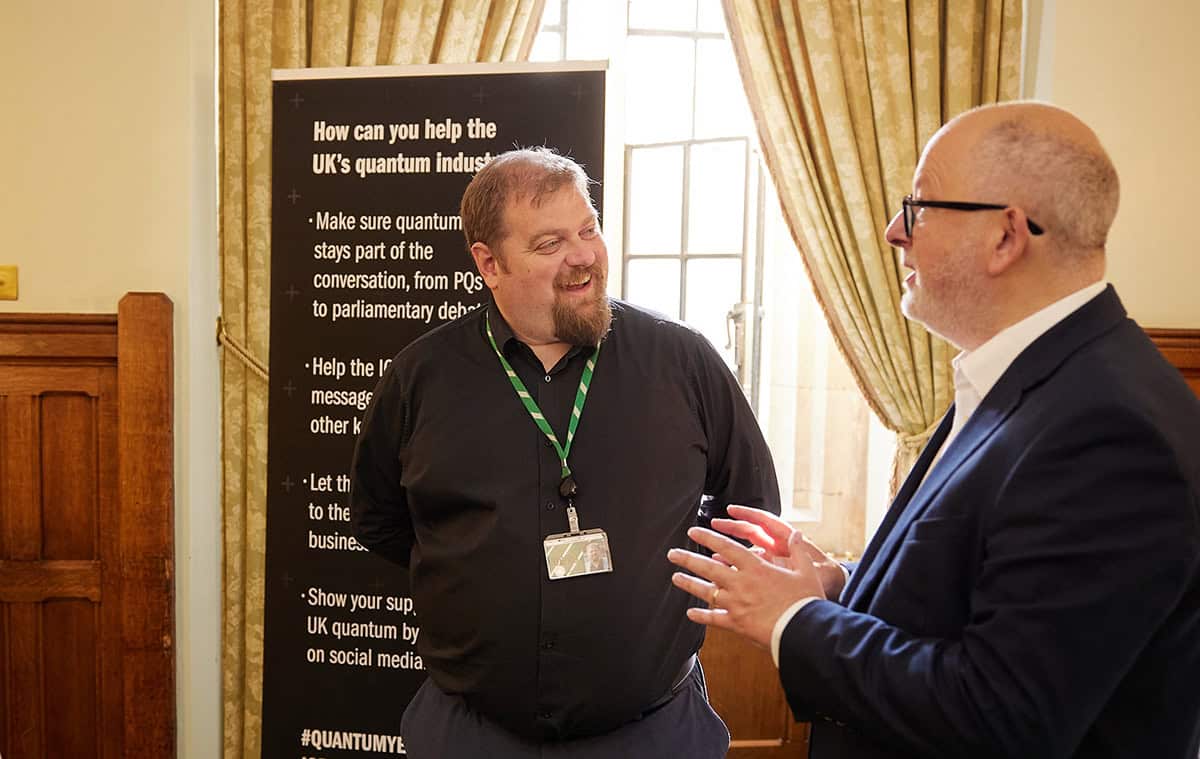
Spreading the word Dave Robertson (left) at an Institute of Physics event that he sponsored at the Palace of Westminster in June 2025 to inform parliamentarians, including fellow MP Steve Yemm (right), of the commercial applications of quantum science. The event formed part of the International Year of Quantum Science and Technology. (Courtesy: Barry Willis Photography)
With his background in teaching, Robertson is also keen to highlight the UK-wide shortage of physics teachers. While at Great Barr School – now rebranded as Fortis Academy – he was lucky. “I remember having a physics group meeting,” he says, “where there were six of us around the table and thinking ‘This is more [physics teachers] than most cities have’.”
As a 2025 IOP report pointed out, a quarter of state schools in England have no specialist physics teachers. In fact, more than half of physics lessons for 14–16 year olds are taught by teachers who never studied a physics-related subject beyond the age of 18. Despite some improvement, only 31% of the government’s target number of physics teachers have been recruited, while 44% of new physics teachers quit within five years.
It’s the responsibility of me and other MPs with a scientific background to spark an interest in physics
Dave Robertson MP
Robertson admits that getting the lack of physics teachers on the radar is an uphill battle. “There are 650 MPs but have they all thought about the importance of getting more physics teachers in the classroom? Probably not, if I’m honest. That’s why it’s the responsibility of me and other MPs with a scientific background to spark an interest in physics and unearth the next Paul Dirac or Isaac Newton.”
Robertson would also like to get on the influential science innovation and technology select committee to spread the message about the importance of physics. But he is wary of spending too much time in parliament with other MPs with a scientific background. “It’s more helpful if all of us have tentacles that spread out into other groups and parties and sections of parliament.”
Spreading the message
For the wider physics community, Robertson believes that physicists need to speak out more strongly about how they can tackle many of the world’s problems, notably climate change. “It’s the biggest issue at the moment and a lot of the solutions are going to come from physics,” he says. “Getting more physicists engaged with decision-makers will not only be good for the future of the economy but ultimately for the future of the planet.”
As for Robertson’s own future, he knows that a career in politics is precarious. Voters rarely hold politicians in high regard and will often boot them out on a whim. It’s therefore hard for any MP to have a predictable career path or plan too far ahead. Robertson himself admits to having “no big aspirations” to be a cabinet minister, which is perhaps just as well given that his majority at the last election was so thin.
With the next general election not due to take place until 2029, Robertson is for now focusing squarely on his role as a backbench constituency MP. “The job I have is just about the most wonderful in the world,” he says. “I want to keep doing it because there’s some wonderful things I can do for my community, whether it’s physics, quantum or football.” But if Robertson did get kicked out, at least he can go back into the classroom.
“Rumour has it, we could do with a few more physics teachers.”

 Login
Login