
Normal view

Received yesterday — 2 June 2026 Google News Content : ScienceAlert : The Best in Science News and Amazing Breakthroughs

Astronomers Have Uncovered a Strange Pattern in The Winds of Alien Worlds

The hottest giant planets in the galaxy should, in theory, have the fastest winds.

The hotter a planet is, the stronger its atmospheric currents should be – and a category of exoplanets known as hot Jupiters contains the hottest worlds we've ever found.

They orbit so insanely close to their host stars that some of them are literally evaporating from the heat…

Yet a new analysis of seven hot Jupiters reveals wind speeds that are practically sluggish, compared to what astronomers expected.

The best explanation for this surprise, according to a team led by astronomer Julia Seidel of Côte d'Azur Observatory in France, is that something is holding the winds back.

And the mechanism that could best explain that powerful braking effect is a magnetic field.

If the team's findings are validated, these laggardly winds could be the best evidence we've seen yet of magnetic activity on a world outside the Solar System.

YouTube Thumbnail

"This breakthrough opens a completely new window on exoplanet research," Seidel says.

"It's the first time we can compare the magnetic environments of other worlds – a key step toward ultimately understanding which planets can stay alive, keep their water, and perhaps even, one day, host life as we know it."

Hot Jupiters are already some of the most fascinating exoplanets in the Milky Way. These worlds are in such proximity to their stars that, in the most extreme cases, their orbits are less than a day.

This means that two things are usually true for hot Jupiters. The first is that they are tidally locked, with one side permanently in daylight facing the star, and the other in permanent darkness facing away.

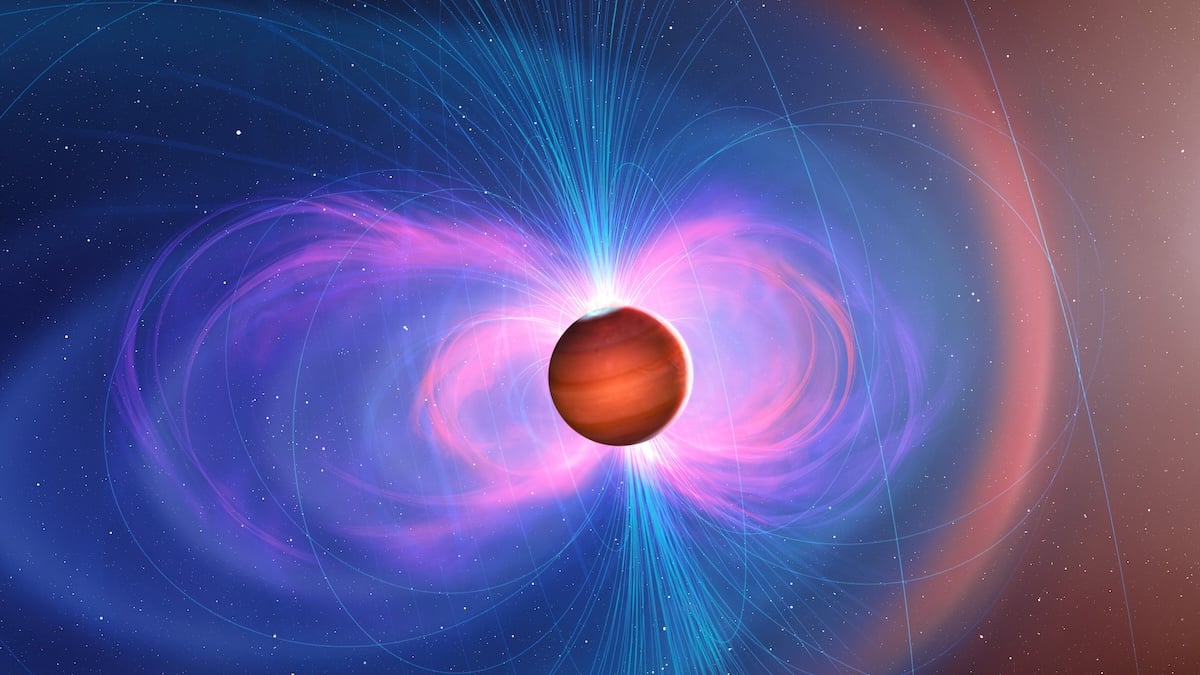
An artist's impression of a hot Jupiter. (NASA, ESA and G. Bacon)

This produces a temperature contrast that should create some absolutely demented weather.

The second is that these worlds are usually heated to equilibrium temperatures of several thousand degrees, helping drive even stronger atmospheric circulation.

Now, we can't directly measure magnetic fields on exoplanets, but previous studies of individual hot Jupiters have shown that, by tracing vaporized iron in the atmosphere, wind speeds can be established.

Because we know that magnetic fields can act as a brake on electrically charged gases, the researchers thought they might be able to use hot Jupiter wind speeds as a proxy for magnetic field activity.

An artist's impression of a hot Jupiter orbiting its star. (ESA/ATG medialab, CC BY-SA 3.0 IGO)

They used the MAROON-X instrument on the Gemini North telescope and the ESPRESSO instrument on ESO's Very Large Telescope to measure wind speeds across seven hot Jupiters.

Now, wind speeds on these worlds are still far beyond anything we might see in the Solar System. The researchers recorded howling gales at speeds between 2 and 7 kilometers (1.2 to 4.3 miles) per second. Jupiter's wind speeds – the fastest in the Solar System – only get as high as about 0.4 kilometers per second.

However, what makes the hot Jupiters interesting is the clear relationship between wind speed and temperature.

The researchers found that the hotter the exoplanet, the slower its winds.

YouTube Thumbnail

There are some other explanations for slower-than-expected winds on hot Jupiters; but, the researchers argue, the other possibilities would still show the opposite trend, with wind speed increasing with temperature.

"This is totally counterintuitive because, all things being equal, hot planets have more energy to accelerate the winds!" says astronomer Vivien Parmentier of Côte d'Azur Observatory. "Something must happen that slows down the wind speeds for hotter objects."

This something, the researchers argue, is most likely to be magnetic fields… and, based on the trend in their observations, they were even able to infer the strength of the field producing the effect.

The hot Jupiters, they found, should have magnetic fields of only a few gauss, roughly comparable to Jupiter's.

Subscribe to ScienceAlert's free fact-checked newsletter

Because it's a proxy measurement, further observations may be required to confirm the team's findings.

Related: Ludicrous Lemon-Shaped World Is Like Nothing We've Ever Seen

However, it's still a lovely result – one that shows just how far we've come in understanding alien worlds, moving away from the characteristics of individual planets to statistical-level analyses that start to reveal patterns.

"Here on Earth, we know the beauty of the northern and southern lights, where particles from the Sun hit our magnetic field and are guided toward the poles, colliding with gases in the atmosphere to produce colorful displays of green, pink, and purple," says astronomer Bibiana Prinoth, formerly of Lund University, Sweden, now at the ESO.

"I like to imagine that some of these worlds have a sky filled not only with stars, but with vast curtains of colorful light dancing across a planet that's half in perpetual day and half in endless night."

The research has been published in Nature Astronomy.
ScienceAlert stories are written, fact-checked, and edited by humans, never generated by AI. Don't miss a story, subscribe here.

Physicists Just Achieved 'Perfect Randomness' For The First Time Ever

One of the hardest things to do in physics is to generate true, provably unpredictable randomness.

That's because it's impossible to determine randomness based on the output alone.

Dice may have nicks and flaws that influence how they roll.

Computer random-number generators are usually driven by algorithms.

Even coin flips are governed by physical forces that, in theory, could be predicted.

The difficulty lies not in generating numbers that appear random, but in showing that no one could have possibly predicted the outcome – that the system isn't secretly affected by subtle hidden rules or biases.

Now, a team of physicists at ETH Zurich in Switzerland has overcome that challenge by leveraging one of the strangest phenomena in quantum mechanics: entanglement.

YouTube Thumbnail

"The resulting sequence of zeros and ones is now really perfectly random, and we can even certify that," says physicist Renato Renner of ETH Zurich.

Randomness is crucial to modern security.

It's the core feature that makes passwords, authentication codes, and encryption keys harder to guess.

It's the reason password generators will produce a string of meaninglessly jumbled characters rather than something like YourFirstPet123.

But the stakes extend far beyond a Flickr password to international security.

Recent examples of security weaknesses include the 2024 PuTTY vulnerability, in which one of the world's most widely used SSH clients had a flaw in its random-number generation for cryptographic signatures.

And don't forget the 2025 AMD Zen 5 RDSEED bug, in which a hardware random-number instruction would generate predictable values while falsely reporting success.

The 30-meter tube that connects the qubits. Photons can move between the two chips, allowing quantum entanglement. (Kilian Kessler/ETH Zurich)

If a code is not perfectly random, it's easier for attackers to guess.

"Any conventional electronic device, like a phone or a computer, is completely deterministic," Renner told Adam Kovac at Scientific American, "so it's actually very difficult for a computer or any other electronic device to generate a random value."

To try to find a solution to this problem, the researchers turned to a quantum experiment known as the Bell test.

They created a pair of entangled quantum bits, or qubits, separated by 30 meters (98 feet) and cooled to temperatures close to absolute zero.

Physicists Just Created 'Perfect Randomness' For The First Time
An image of a sheep (left) encrypted using imperfect randomness (middle) and perfect randomness (right). (ETH Zurich)

Entangled particles are those that, when measured, show similarities that cannot be explained by classical physics alone.

Measurements performed on the qubits produced correlations so strong that they could not be explained by ordinary hidden rules or pre-programmed behavior.

This achievement required major technical improvements to both the stability and speed of the experiment, allowing the team to perform more than a billion Bell-test trials over roughly nine hours.

A graph showing how ow earlier Bell-test experiments fell short of the threshold needed for randomness amplification, while the ETH Zurich experiment finally crossed into the regime where certifiably perfect randomness became possible. (Kulikov et al., Nature, 2026)

Previous quantum random-number generators could produce highly random outputs, but they still relied on trusted hardware and perfectly random starting conditions.

The ETH Zurich team instead demonstrated something called randomness amplification, deliberately starting with imperfect randomness – taking randomness that may contain subtle flaws or biases and transforming it into randomness that can be certified as perfectly unpredictable.

"Crucially," they write in their paper, "randomness amplification has been proven to be impossible by purely classical means."

Subscribe to ScienceAlert's free fact-checked newsletter

The result is a system capable of generating certifiably perfect randomness, even when starting with flawed or imperfect randomness.

Related: Crystals Have Been Used to Generate Truly Random Numbers For The Very First Time

And it's also device independent, which means the randomness does not depend on trusting the hardware itself, but on the quantum behavior observed in the experiment.

In the long term, the researchers say that their system could perform the same function atomic clocks perform for timekeeping – a physically certified source of randomness against which others can be measured and set.

"The technical improvements allowed us, for the first time, to create random numbers that will remain perfectly random for all eternity – no matter what analytical methods are used to assess their randomness," Renner says.

The research has been published in Nature.

ScienceAlert stories are written, fact-checked, and edited by humans, never generated by AI. Don't miss a story, subscribe here.

❌