
Normal view

Received — 1 June 2026 Google News Content : ScienceAlert : The Best in Science News and Amazing Breakthroughs

Scientists Find Cosmic 'Rosetta Stone' To Decode Baffling Signals From Deep Space

Just a few years ago, a strange signal was received from the plane of the Milky Way.

It was something astronomers had never seen before, pulsing with a radio beat too slow to fit any known astronomical object.

It may have just come and gone as a one-off anomaly.

But then they found another one.

And another.

To date, around a dozen of these long-period radio transients (LPTs) have been detected from diverse corners of the galaxy, leaving scientists baffled.

Now, a team led by astronomer Kovi Rose of the University of Sydney in Australia thinks they may finally have found their Rosetta Stone, the object that could help them interpret at least some of these weird, pulsating objects.

In the direction of the galaxy's inner regions, the researchers traced an LPT signal directly to a magnetic cataclysmic variable star – a strongly magnetized white dwarf cannibalizing its companion and belching periodic radiation.

An artist's impression of a magnetic cataclysmic variable binary. (Carl Knox/OzGrav/Swinburne and Dr Joshua Preson Pritchard/CSIRO)

"Long-period radio transients have puzzled astronomers for years," Rose says.

"We've only found about a dozen, and their origins have been unclear. Now, we've been able to show that the source for one of these transients comes from a white dwarf actively pulling material from a companion star."

The mystery of the LPTs, first detailed in a 2022 paper, reared its head again after astronomers found something in the plane of the Milky Way pulsing in a weird way.

Every 18.18 minutes, the brightness of an object named GLEAM-X J162759.5−523504.3 increased for 30 to 60 seconds, temporarily making it one of the brightest objects in the low-frequency radio sky.

Then it stopped.

But it wasn't long before astronomers found more – showing that, whatever this strange object was, it wasn't just a one-off weirdness.

As the population grew, astronomers began to piece together possible explanations.

Some observations pointed to highly magnetized white dwarfs, while others hinted that at least some LPTs might arise in binary systems, where a white dwarf interacts with a companion star.

YouTube Thumbnail

A major breakthrough came in 2025, when one LPT signal, named ILT J1101+5521, was traced to a binary star consisting of a red dwarf and a white dwarf, orbiting so closely together that their magnetic fields repeatedly clashed, sending out periodic bursts of radio waves.

The picture grew even more complicated when astronomers discovered that one LPT, ASKAP J1832-0911, also emitted X-rays, suggesting energetic processes beyond radio emission alone.

But no single object seemed capable of tying all the clues together.

And that's what makes this new discovery so intriguing. Its name is ASKAP J1745-5051, and it's the first object to unite many of the puzzle pieces previously observed in other LPTs.

That includes both radio and X-ray emission, a white dwarf and a binary companion, strong magnetic activity, orbital motion, and accretion – the gravitational transfer of material onto the white dwarf.

"Some similar objects had been linked to binary systems before, but this is the first one where we can clearly see both stars and the accretion process in action," says astrophysicist Tara Murphy of the University of Sydney and the ARC Center of Excellence for Gravitational Wave Discovery (OzGrav).

The discovery was made using CSIRO's ASKAP radio telescope in Wajarri Yamaji Country in Western Australia – one of the world's most sensitive facilities.

A graph that maps the X-ray emission (top), radio emission (middle) and orbit (bottom). (Rose et al., Nat. Astron., 2026)

Because the system is such a chaos gremlin, it's impossible to tell exactly how far away it is. The best estimates place it between around 1,300 and 30,000 light-years away.

But the data were detailed enough that the researchers could figure out what kind of object it is.

ASKAP observations show a system that flares in radio waves every 81 minutes (1.35 hours), accompanied by matching periodic X-ray emission detected by NASA's Swift observatory and the Einstein Probe X-ray Telescope.

Optical observations obtained using the Southern Astrophysical Research (SOAR) Telescope showed a white dwarf binary at the emission's location in the sky, with spectra revealing a clear orbital period of about 81 minutes – closely matching the period of the radio and X-ray bursts.

These observations reveal that the object is a magnetic cataclysmic variable. Every orbit, the white dwarf pulls material from its red dwarf companion star, which is funneled by the white dwarf's magnetic field onto its surface.

Subscribe to ScienceAlert's free fact-checked newsletter

As the material crashes onto the white dwarf, it heats to millions of degrees and emits high-energy radiation – that's the source of the X-ray signal.

Related: Mystery Signals May Be Coming From One of The Rarest Stars in The Galaxy

Meanwhile, gas accelerated by the two stars' clashing magnetic fields appears to produce the radio signal, similar to the mechanism proposed for ILT J1101+5521.

It's such a beautiful convergence of characteristics that it could help explain other LPTs that only show some of these traits.

And it's genuinely exciting to be able to observe our understanding of LPTs evolve in real time.

"Each new discovery is helping us piece together the bigger picture," Rose says.

"We're only just beginning to understand this new class of cosmic events."

The research has been published in Nature Astronomy.
ScienceAlert stories are written, fact-checked, and edited by humans, never generated by AI. Don't miss a story, subscribe here.

A Sea Cucumber's Amputated Tissue Refuses To Die. Could It Live Forever?

The oceans are home to many of Earth's longest living creatures.

Glass sponges can survive for more than 10,000 years, and an individual quahog clam can thrive for more than 500.

A few jellyfish, jellies, and hydra are so good at regenerating themselves that they can theoretically live forever.

But the humble sea cucumber has a truly unique longevity trick.

Scientists in Canada have now discovered a sea cucumber species with tissue that may live 'indefinitely'.

When scientists amputated bits of a scarlet sea cucumber (Psolus fabricii), the tissues refused to die.

A scarlet sea cucumber (Psolus fabricii). (Nozères, Claude/CC-BY-NC-SA 4.0)

For three years and counting, the isolated tube feet and tentacles have sat all on their own in a tank of natural running seawater, without decaying away.

Not only are they not dead, but these tissues are biologically active and changing.

Many of their immune, metabolic, and cellular processes are still intact.

That's never been seen before – not from the tissue of any known animal on Earth.

"We haven't grown a new, complete sea cucumber yet, but we are seeing pretty stunning growth and diversification of cells literally years after this tissue was removed," explains marine biogeochemist Rachel Sipler from the Bigelow Laboratory for Ocean Science, a nonprofit research institute in the US.

"It's like a lizard that loses its tail. We know some lizards can grow new tails; we're talking about whether the tail can grow a new lizard."

Amputated Tissue Sea Cucumber
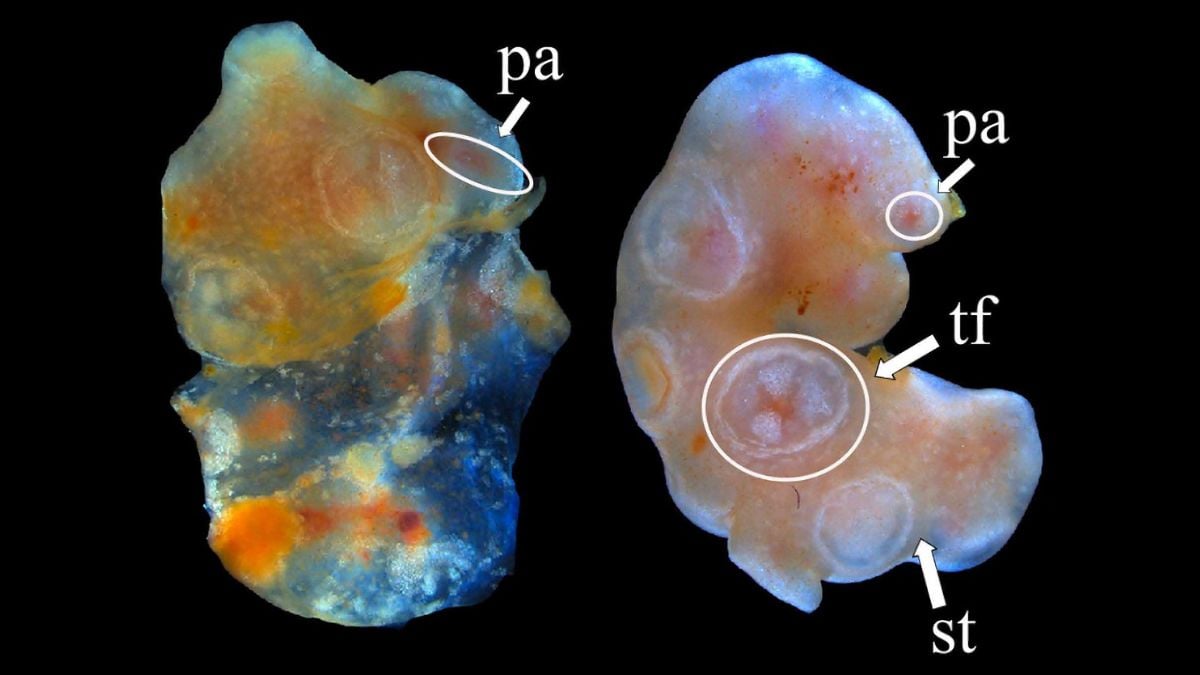
The amputated tissue of a sea cucumber's 'tube foot' one year after amputation (left) versus several years after (right). The change in overall color from red-orange to lighter white and pink reflect pigmented cells forming and consolidating transparent connective tissue. (Sara Jobson)

Like many lizards on land, the sea cucumber species, P. fabricii, is a bit of a klutz in the ocean. It regularly loses or injures its tube feet and tentacles, which means it has a potentially great capacity for regeneration.

To test that idea in the lab, Sipler and her colleagues at Memorial University of Newfoundland watched and waited to see what happened to excised bits of this wild-looking sea cucumber.

Soon enough, the tissue samples began showing signs of wound repair. Their immune cells appeared to spring into action, and any dead cells were removed.

Repair was then followed by regeneration. Over time, the tissues began to absorb dissolved nutrients from the seawater, growing and restructuring themselves.

Years on, the isolated tentacles can still respond to tactile stimuli, indicating the preservation of a neural network.

This is the first known case of a tissue 'explant' surviving and growing long-term in a natural setting, write Sipler and her colleagues.

"Our findings," they add, "challenge conventional perceptions of tissue immortality."

They also raise the question: What does it mean for tissue to be alive?

Six days after excision (c), the P. fabricii samples contained almost no dead tissue (stained blue), and further imaging more than a year later showed regeneration of tube feet (tf). DPE: days post-excision. (Jobson et al., Sci. Adv., 2026)

For centuries now, scientists have tried to keep the cells and tissues of living animals functional, even when they are removed from the rest of the body.

While researchers have managed to engineer immortal cell lines from animal and human stem cells, these self-proliferating units must be kept in highly controlled environments, where they are carefully guarded against pathogens.

Keeping a whole bunch of cells alive within a section of tissue is much harder to manage.

Animal tissue is a flexible yet delicate structure; it requires a complex scaffold of communicating cells and a robust nutrient delivery system to keep everything plump.

Subscribe to ScienceAlert's free fact-checked newsletter

Even when animal tissue is kept in a special solution to extend its longevity, it typically survives about 9 weeks in the laboratory.

But a bit of P. fabricii could live "indefinitely" in natural seawater, researchers speculate. In fact, it seems to thrive in the natural 'dirtiness'.

"Natural seawater is just about the most microbially diverse, least clean approach we could take experimentally," says Sipler.

"Yet, that rich environment full of bacteria and all this organic matter was actually feeding them and allowing this tissue to heal and grow."

Tube Foot Sea Cucumber
Microscopic image of the excised tube foot with fluorescent staining to show cell differentiation. The denser green colors reflect areas of more active cellular processes. (Sara Jobson)

The only other tissue culture that scientists have described as 'indefinite' was taken from a chicken embryo, and it did not show the same capacity for healing or survival as the scarlet sea cucumber.

In fact, P. fabricii may be unique even among sea cucumbers.

Sipler and her colleagues tested several other sea cucumbers, but none of their tissue explants survived more than 3.5 months.

"Here is this species that has this groundbreaking ability, and we had no idea," says Sipler.

"It's a reminder how much is yet to be discovered in the marine environment."

Related: Mammals May Have a Hidden Limb Regeneration Ability We Never Knew About

Andrea Bodnar, science director at the Gloucester Marine Genomics Institute, was not involved in the study, but she agrees with the paper's conclusions.

"The fact that tissue explants from a sea cucumber can heal, reorganize, and survive independently for years in natural seawater suggests an entirely new model for biological resilience and tissue regeneration," she says.

The study is published in Science Advances.

ScienceAlert stories are written, fact-checked, and edited by humans, never generated by AI. Don't miss a story, subscribe here.

Humans Are Still Evolving Right Before Our Eyes on The Tibetan Plateau

Humans are not yet done cooking. We're continuing to evolve and adjust to the world around us, the records of our adaptations written in our bodies.

We know that some environments can make us unwell. Mountain climbers often experience altitude sickness – the body's reaction to a significant drop in atmospheric pressure, which means less oxygen is taken in with each breath.

And yet, at high altitudes on the Tibetan Plateau, where oxygen levels in the air people breathe are notably low, human communities thrive.

Over more than 10,000 years of settlement in the region, the bodies of those living there have changed.

They've changed in ways that allow the inhabitants to make the most of an atmosphere that, for most humans, would result in insufficient oxygen being delivered to the body's tissues via blood cells, a condition known as hypoxia.

Watch the video below for a summary of the research:

YouTube Thumbnail

"Adaptation to high-altitude hypoxia is fascinating because the stress is severe, experienced equally by everyone at a given altitude, and quantifiable," anthropologist Cynthia Beall of Case Western Reserve University in the US told ScienceAlert.

"It is a beautiful example of how and why our species has so much biological variation."

Beall has been studying the human response to hypoxic living conditions for years. In research published in October 2024, she and her team revealed some of the specific adaptations in Tibetan communities: traits that improve the blood's ability to deliver oxygen.

To unlock this discovery, the researchers looked into one of the markers of what we call evolutionary fitness: reproductive success.

Women who deliver live babies are those who pass on their traits to the next generation.

We're Watching Humans Evolve Right Before Our Very Eyes on The Tibetan Plateau
Lo Manthang in Nepal, where some of the data was collected. (James J. Yu)

The traits that maximize an individual's success in a given environment are most likely to be found in women who are able to survive the stresses of pregnancy and childbirth.

These women are more likely to give birth to more babies.

Those offspring, having inherited survivability traits from their mothers, are also more likely to survive, reproduce, and carry those same traits forward.

That's natural selection at work.

Natural selection can be a bit strange and counterintuitive; in places where malaria is common, for example, the incidence of sickle cell anemia is high, because it involves a gene that protects against malaria.

Subscribe to ScienceAlert's free fact-checked newsletter

Beall and her team studied 417 women aged 46 to 86 who had lived their entire lives in Nepal at altitudes above 3,500 meters (11,480 feet).

The researchers recorded the number of live births – ranging from 0 to 14 per woman, with an average of 5.2 – along with physical and health measurements.

Among the things they measured were levels of hemoglobin, the protein in red blood cells responsible for delivering oxygen to tissues.

They also measured how much oxygen was being carried by the hemoglobin.

Interestingly, the women who demonstrated the highest rate of live births had hemoglobin levels that were neither high nor low, but average for the testing group.

But the oxygen saturation of their hemoglobin was high.

A 3D molecular model of hemoglobin, shown as a dense cluster of red, blue, white, and gray atoms against a black background.
Hemoglobin in red blood cells is responsible for delivering oxygen to tissues. (Science Photo Library/Canva)

The results suggest that the adaptations are able to maximize oxygen delivery to cells and tissues without thickening the blood – an outcome that would increase stress on the heart as it struggles to pump a higher-viscosity fluid more resistant to flow.

"Previously we knew that lower hemoglobin was beneficial; now we understand that an intermediate value has the highest benefit," Beall said.

"We knew that higher oxygen saturation of hemoglobin was beneficial; now we understand that the higher the saturation, the more beneficial. The number of live births quantifies the benefits.

"It was unexpected to find that women can have many live births with low values of some oxygen transport traits if they have favorable values of other oxygen transport traits."

We're Watching Humans Evolve Right Before Our Very Eyes on The Tibetan Plateau
The noninvasive measurement of hemoglobin concentration and oxygen saturation. (Sienna R. Craig)

The women with the highest reproductive success rate also had a high rate of blood flow into the lungs, and their hearts had wider-than-average left ventricles, the chamber of the heart responsible for pumping oxygenated blood into the body.

Taken all together, these traits increase the rate of oxygen transport and delivery, enabling the human body to make the most of the low oxygen in the air respired.

It's important to note that cultural factors can play a role, too. Women who start reproducing young and have long marriages seem to have a longer exposure to the possibility of pregnancy, which also increases the number of live births, the researchers found.

Even taking that into account, however, the physical traits played a role. Nepalese women with physiologies most similar to women in unstressed, low-altitude environments tended to have the highest rate of reproductive success.

Related: Humans in The Andes Appear to Have Evolved a Strange Genetic Ability

"This is a case of ongoing natural selection," Beall said.

"Understanding how populations like these adapt gives us a better grasp of the processes of human evolution."

The research was published in the Proceedings of the National Academy of Sciences.

An earlier version of this article was published in October 2024.

ScienceAlert stories are written, fact-checked, and edited by humans, never generated by AI. Don't miss a story, subscribe here.

❌