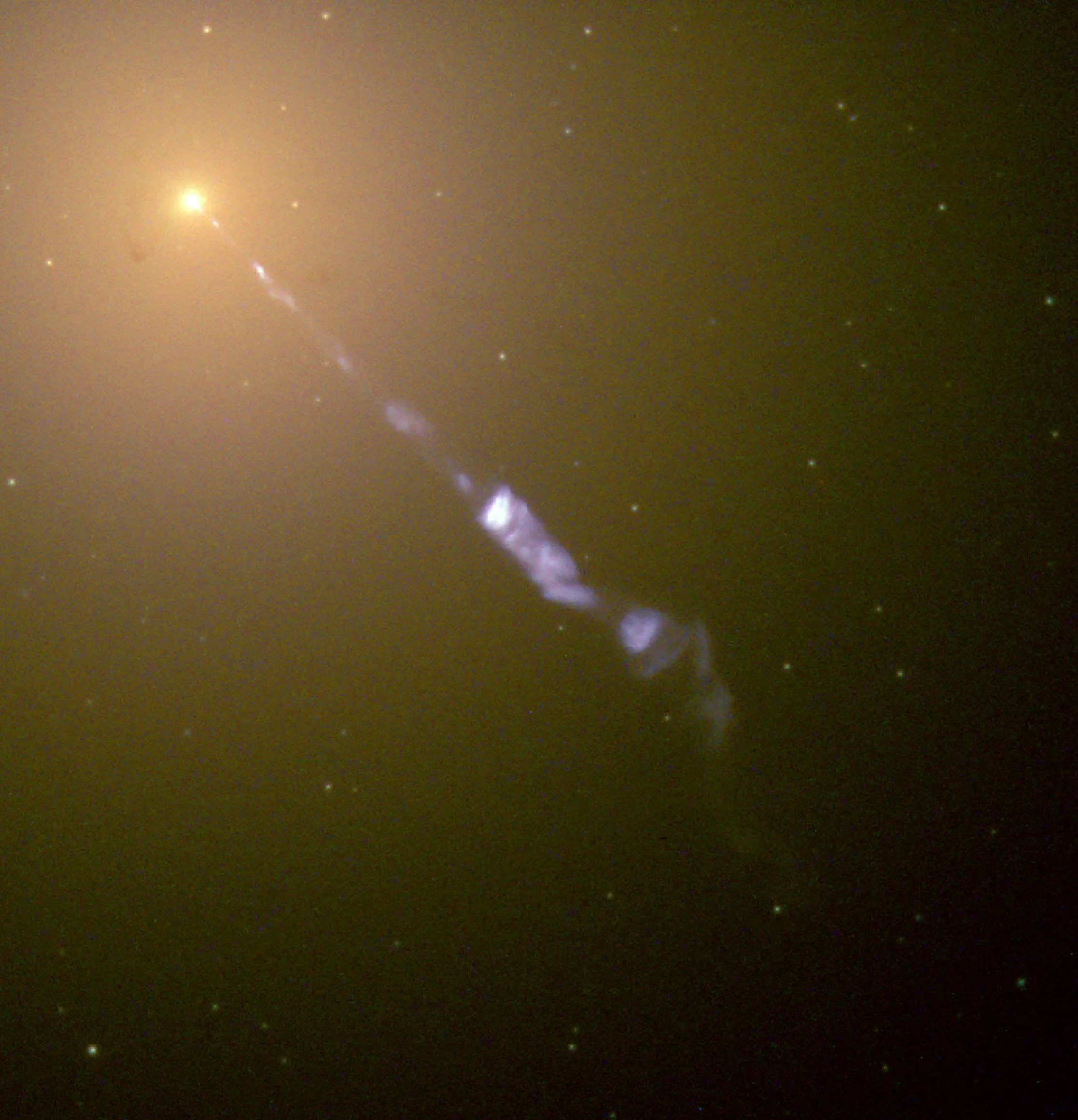
Upgraded interferometers will give researchers a never-before-seen view of the jets of active supermassive black holes. By modeling what might be seen when these instruments come online, researchers have discovered a new way to measure black hole spin.
Black Holes and Relativistic Jets
Galaxies across the universe harbor supermassive black holes. Determining the properties of these black holes — their masses and spins — is key to understanding the formation and evolution of supermassive black holes and how they shape the evolution of their host galaxies.
Some supermassive black holes produce relativistic particle jets that are thought to be powered by the black hole’s spin. This means that precise observations of black hole jets could provide a potential way to measure the spin of a black hole.
Planned and proposed interferometers will stretch observing baselines to great distances — even into space — to attain the high resolution necessary for this sensitive measurement. Building on the successes of the Event Horizon Telescope, a planet-spanning interferometer that has revealed images of the supermassive black holes at the center of the giant elliptical galaxy Messier 87 and the Milky Way, observatories like the Next-Generation Event Horizon Telescope and the Black Hole Explorer will advance our understanding of supermassive black holes and relativistic jets.
Tracing Rays from Modeled Jets
To learn what might be gleaned from future images of black holes and black hole jets, Zachary Gelles (Princeton University) and collaborators developed a model of a nearly face-on relativistic black hole jet, much like the jet from Messier 87’s black hole. The team’s model incorporates both general relativistic magnetohydrodynamics, which describes a magnetized fluid subjected to the rules of Einstein’s General Theory of Relativity, and force-free electrodynamics, which focuses on the dynamics of the system’s electromagnetic fields.
Ray-traced polarized image of a collimated black hole jet. The white bars show the direction of polarization, while the color scale shows the normalized intensity. Several abrupt changes in the polarization direction as a function of radius are visible. Click to enlarge. [Adapted from Gelles et al. 2025]
With this model in hand, the team used ray tracing — following the paths that photons would take through the modeled jet — to predict how the jet would appear in polarized light. Examining the results for jets with varying degrees of narrowness, or collimation, the team noted that the polarization of the most collimated jet behaved strangely, with the polarization angle changing dramatically with position.
Gelles and coauthors demonstrated that one of these sudden polarization changes happens at the black hole’s light cylinder, or the radius at which the jet becomes relativistic and the magnetic field switches from being mostly poloidal to mostly azimuthal. Because the position of the light cylinder is dependent upon the spin of the black hole, measuring the location of this polarization swing allows for a measurement of the black hole’s spin.
The Promise of Polarization
This method has several potential advantages over other methods. Unlike the current leading method for measuring black hole spin, X-ray spectroscopy, this method applies to low-luminosity active black holes, which are thought to be common throughout the universe. And while the model includes a number of simplifications, the team asserts that incorporating features of more realistic jets, such as asymmetry, is unlikely to change the outcome.
Polarization direction as a function of impact parameter, showing the locations and causes of the abrupt changes in polarization angle. Click to enlarge. [Gelles et al. 2025]
Gelles’s team also showed that the location of the polarization flip for slowly spinning black holes is 10 times farther out than it is for rapidly spinning black holes. What this means in practice is that determining whether a black hole is slowly or rapidly spinning doesn’t require extraordinarily high resolution, just a general sense of where the flip happens.
Looking forward, Gelles’s team plans to continue their simulations, shoring up their predictions until they can be tested when future interferometers come online.
Citation
“Signatures of Black Hole Spin and Plasma Acceleration in Jet Polarimetry,” Z. Gelles et al 2025 ApJ 981 204. doi:10.3847/1538-4357/adb1aa
The post A New Way to Measure Black Hole Spin appeared first on AAS Nova.

 Login