❌

Normal view

AAS 246: Day 4

13 June 2025 at 17:00

solar activity over the solar cycle

Editor’s Note: This week we’re at the 246th AAS meeting in Anchorage, AK, and online. Along with a team of authors from Astrobites, we will be writing updates on selected events at the meeting and posting each day. Follow along here or at astrobites.com for daily summaries, or follow @astrobites.bsky.social on Bluesky for more coverage. The usual posting schedule for AAS Nova will resume on June 16th.

Table of Contents:


Solar Physics Division Plenary: Karen Harvey Prize Lecture: Building Connections in Heliophysics with Surface Flux Transport Modeling, Lisa Upton (by Kerry Hensley)

The 2025 Karen Harvey Prize, “awarded in recognition of a significant contribution to the study of the Sun early in a person’s professional career,” went to Lisa Upton (Southwest Research Institute) for her work on large-scale solar flows and magnetic flux transport. Upton began by honoring Karen Harvey, with whom she shares many scientific interests. Harvey’s interest in solar physics began as a teenager observing sunspots with a small telescope, which led to her first scientific paper. She is remembered for her service to the solar physics community, her spirit of collaboration, and her education and public outreach efforts.

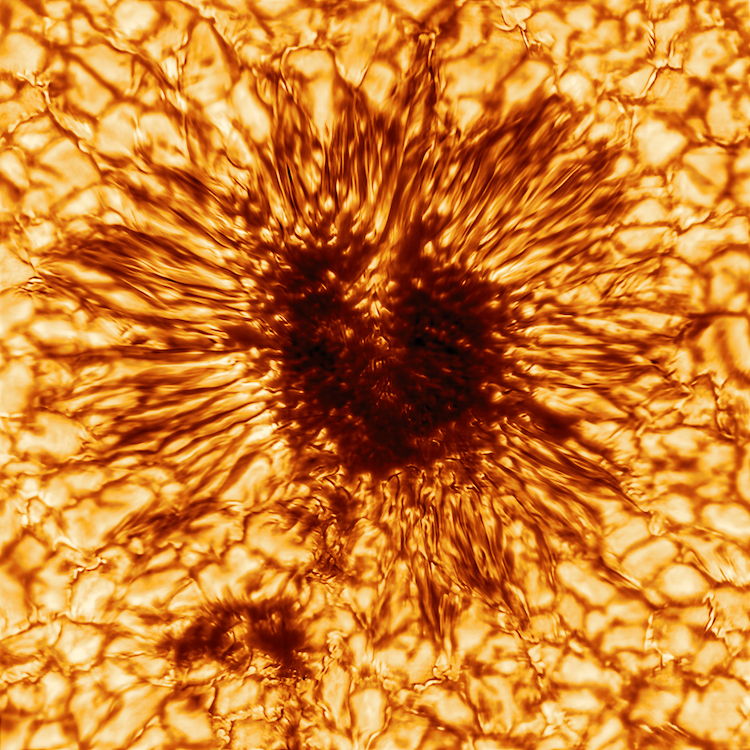
a large, dark sunspot surrounded by a pattern of solar granules

An extreme close-up of a sunspot taken by the Daniel K. Inouye Solar Telescope in Hawai’i. [NSO/AURA/NSF; CC BY 4.0]

Upton began by studying coronal loops — arches of plasma confined by magnetic fields and suspended within the Sun’s outer atmosphere, or corona — before transitioning to her current work on the solar activity cycle. The Sun’s 11-year activity cycle, which manifests as periodic changes in the frequency of sunspots, solar flares, and coronal mass ejections, is intimately related to the Sun’s complex magnetic field. The Sun’s interior acts like a fluid, allowing the magnetic field to be frozen into the plasma, meaning that the motion and evolution of the magnetic field is largely dictated by the behavior of the plasma. As Upton noted, this is unlike anything we see on Earth.

How the Sun’s magnetic field explains the existence of the solar cycle is described by the Babcock dynamo model. In this model, the differential rotation of the Sun — the faster rotation of the Sun at its equator than at its poles — stretches the submerged magnetic field and makes it stronger. The field then becomes buoyant and causes sunspots to emerge at the Sun’s surface. The turbulent convective motion of the Sun that cycles material from the interior to the surface causes the surface magnetic flux to spread out, eventually being transported to the poles, where it cancels out the old magnetic field and creates a new field pointing in the opposite direction. This starts the solar cycle anew.

Upton described her research, which has covered a remarkably broad range of topics within solar physics. For example, she has studied large-scale flows, leading to the discovery of the long-sought-after giant cells. She also described her work on surface flux transport modeling, simulating the emergence and decay of magnetic flux through the solar surface. By incorporating observations of extreme-ultraviolet light from the far side of the Sun, Upton and collaborators greatly improved models of solar active regions emerging on the far side. More recently, Upton has been working to connect phenomena on the solar surface to the solar corona and beyond, working to predict the appearance of the solar corona during a solar eclipse, among other projects. She has also worked to generate realistic synthetic solar active regions, enabling both predictions of active region behavior as well as historical reproductions of the Sun’s appearance going back 200 years. Looking forward, she hopes to extend her research to the study of activity on other stars, where we see starspots far larger than anything on the Sun.

To close, Upton emphasized the need to remain united, support each other, and advocate for science as we navigate the challenging conditions in the world today.

Return to Table of Contents.


Public Policy Plenary: The Current Landscape for Science Policy and How YOU Can Make a Difference (by Lucas Brown)

To finish out a wonderful week at AAS 246, we heard from a panel of AAS leadership and participants in the recent AAS Congressional Visits Day on ways to make a difference in today’s current science policy landscape. First, we heard from AAS Deputy Chief Executive Officer and Director of External Affairs and Public Policy Joel Parriott, who provided an overview of what AAS’s stated science policy priorities are — focusing on the Society’s top priority of addressing the significant global issues that affect astronomy. A common theme that echoed throughout the plenary was that the advancement of these goals requires the advocacy and voices of as many people as possible.

Next, AAS Deputy Director of Public Policy Roohi Dalal spoke about the current state of science policy — from the large amount of proposed budget cuts we have seen come from the federal government over the past six months to the actions of the AAS in advocating for funding astronomy research. Specifically, AAS launched a “share your story” campaign to highlight the human impact of these cuts and has interfaced directly with representatives and their staff through initiatives like Congressional Visits Day. Dalal’s talk once again returned to the idea that the AAS needs everyone’s voice to make change.

AAS President Dara Norman then took the stage to explain in greater detail what actions people can take in supporting the policy goals of the Society and astronomy more broadly. Her top recommendation was to pay attention to AAS action alerts, which provide detailed instructions as to what actions will have the most impact at any given moment. Right now one of those top actions is to get in contact with local elected officials either via email, phone, or through an in-person meeting.

After Norman’s speech, the plenary transformed into a panel discussion featuring Lori Porter from Columbia University, Becka Phillipson from Villanova University, and Marcel Agüeros also from Columbia University, all of whom participated in this year’s Congressional Visits Day program. They spoke about the real impact that these sort of one-on-one visits with congressional staff or representatives can have, and shared tips on how to approach communicating effectively during such a visit. Their words of advice once again underscored the power of people’s voices in ensuring the future of astronomy remains bright.

Photo of the participants in AAS's 2025 Congressional Visits Day posing in front of the US Capitol Building

Photo of the participants in AAS’s 2025 Congressional Visits Day posing in front of the US Capitol Building. [AAS]

Return to Table of Contents.

The post AAS 246: Day 4 appeared first on AAS Nova.

AAS 246: Day 3

12 June 2025 at 17:38

Composite Webb NIRCam image of galaxy cluster Abell 2744, showing the locations of young starburst galaxies.

Editor’s Note: This week we’re at the 246th AAS meeting in Anchorage, AK, and online. Along with a team of authors from Astrobites, we will be writing updates on selected events at the meeting and posting each day. Follow along here or at astrobites.com for daily summaries, or follow @astrobites.bsky.social on Bluesky for more coverage. The usual posting schedule for AAS Nova will resume on June 16th.

Table of Contents:


Plenary Lecture: The Hubble Space Telescope at 35: Eyeing the Future, Jennifer Wiseman (Goddard Space Flight Center) (by Margaret Verrico)

Hubble image of the spots where the fragments of comet Shoemaker–Levy 9 impacted Jupiter

Hubble image of the spots where the fragments of comet Shoemaker–Levy 9 impacted Jupiter. [Hubble Space Telescope Comet Team and NASA]

Wednesday started bright and early with a plenary talk by Hubble Space Telescope Senior Project Scientist Jennifer Wiseman. AAS Vice President Grant Tremblay opened the talk with a story about seeing comet Shoemaker–Levy 9 impact the planet Jupiter on the news, an event that was imaged with Hubble and that he said influenced his decision to pursue astronomy. It was an appropriate anecdote to start the celebration of Hubble’s 35th year in orbit, which Dr. Wiseman credited with opening many new worlds in astronomy.

Dr. Wiseman began by describing how our science community has been transformed by Hubble’s impact. She highlighted Hubble’s multiple science instruments and ultraviolet–optical capabilities, which cover a crucial part of the electromagnetic spectrum that is not covered by other flagship observatories like JWST. She described the evolution of Hubble, from the first description of a space telescope by Dr. Lyman Spitzer in 1946 to its announcement by Nancy Grace Roman in 1977 and eventually its launch on the space shuttle in 1990. Its key science drivers originally included measurements of the expansion rate of the universe, understanding how galaxies have evolved throughout the history of the universe, determining whether supermassive black holes really exist at the centers of massive galaxies (only a theory at the time of launch), and studying planets in our solar system. Over the past 35 years, Hubble’s ~1.7 million observations of over 100 million objects have revolutionized our understanding of the solar system, star formation, and the evolution of the universe, leading to the discovery of the accelerating expansion of the universe, confirmation of the existence of supermassive black holes, and an understanding of a dynamic and evolving solar system.

Dr. Wiseman described how Hubble is a crucial part of the suite of Great Observatories in operation today. She emphasized its importance as a follow-up telescope for transient events like supernovae, its decades-long archive for long-term monitoring of solar system planet atmospheres, and its ultraviolet coverage that complements the infrared range of JWST. She promoted new support services for Hubble data, including the Hubble Spectroscopic Legacy Archive (HSLA) — a publicly available database of archival Hubble spectra — and the upcoming Hubble Advanced Spectral Products (HASP) database, which will be public later this summer. Dr. Wiseman cited Hubble’s continually improving user support and data archives as a crucial piece of the observatory’s future while warning that continued budget cuts have impacted their ability to fund new research and threaten the facility’s ability to support new science through the end of the 2020s.

Dr. Wiseman closed with a hope that the audience would leave her talk and the AAS meeting inspired to join the celebration of Hubble’s 35 years of discoveries. She expressed excitement for the new discoveries that will be enabled by Hubble through the early 2030s and its essential part in the suite of Great Observatories over the next half decade.

Read an interview with Jennifer Wiseman here.

Return to Table of Contents.


Press Conference: Recent and Upcoming Discoveries in the Broader Universe (by Lucas Brown) (Briefing video)

jellyfish galaxy NGC 4858

HST imagery of NGC 4858, a “jellyfish” galaxy that exhibits long tails of gas and stars extending outwards from the disk. These tails are expected to form as the result of drag forces as the galaxy moves through a gas-dense region of intergalactic space. [HST/ALMA/H. Souchereau]

In our final press conference of AAS 246, we heard five talks unveiling new insights into galaxies, reionization, and the universe at large. The first of these talks was given by Harrison Souchereau of Yale University, titled “Inner Tail Gas Asymmetries and Fallback in a Jellyfish Galaxy.” Jellyfish galaxies are a type of galaxy with star-forming tails of gas that trail behind the main disk. These tails are formed as a result of external pressures caused by the galaxy moving through a gas-dense medium like the space within a galaxy cluster. Souchereau’s team observed one such galaxy—NGC 4858—with the Atacama Large Millimeter Array (ALMA) radio telescope to map out not just the positions, but the velocity of gas in these tails. In doing so, they found that not only was the gas distribution asymmetric, but the gas appeared to be falling back in towards the galaxy. The team believes this shows that the gas was preferentially stripped from one side of the galaxy due to the direction of its rotation, and that the gas has since collected on the other side of the galaxy while beginning to fall back inwards. The full press release can be found here.

Next, in “In the Belly of the Beast: Massive Clump Formation in the Hearts of Major Mergers,” we heard from Sean Linden of University of Arizona about new insights from JWST into the dense star-forming clumps found in many major galaxy mergers. These clumps are unlike anything seen in typical, non-merging galaxies in the universe today, and they’re thought to be the “building blocks” of galaxies in the early universe. Thanks to the space telescope’s increased resolution and sensitivity to infrared light, it has been able to peer through the obscuring dust found within some of the universe’s biggest mergers to identify the presence and characteristics of such clumps. These new observations confirm many predictions about clump formation made in prior simulations. The full press release can be found here.

Third, we were briefed on “UNCOVERing the Drivers of Reionization with JWST” from Isak Wold of NASA and The Catholic University of America. Reionization was a period of a few hundred million years in the very early universe wherein the neutral hydrogen that permeated the cosmos at the time was nearly completely ionized. The exact origin of the necessary radiation to set off this reionization has long been a source of speculation. In Wold’s talk, new evidence was presented advancing the idea that a class of young, star-forming, and oxygen-III-emitting galaxies could completely source this ionizing ultraviolet light. Wold’s team draws on new JWST observations of such galaxies, which indicate that the galaxies are numerous, largely dust-free and metal-poor, and indeed emit abundant ultraviolet light—all the ingredients needed for a strong candidate to explain the epoch of reionization. The full press release can be found here.

Fourth, in “The ‘Dark-Matter Dominated’ Galaxy Segue 1 Modeled with a Black Hole and No Dark Halo” presented by Nathaniel Lujan of The University of Texas San Antonio, we heard about a new model for the structure of the dwarf galaxy known as Segue 1. Previous observations of the galaxy, which has few stars but a large amount of mass, suggested that the galaxy contains a large amount of dark matter. In order to derive the new model, Lujan and his collaborators compared observations of stellar motion against a set of 100,000 simulations of stellar motion given different underlying parameters describing the distribution of mass in the galaxy. The team found that a model including a central black hole with the mass of 500,000 suns and only minimal dark matter fits better than a dark matter–dominated model, challenging previous assumptions about the system, the prevalence of dark matter in dwarf galaxies, and the abundance of supermassive black holes in our universe. The full press release can be found here.

one of the first images from SPHEREx

One of the very first images taken by the SPHEREx mission. The color gradient present across the frame is the result of linear variable filters that cause different parts of each image to be sensitive to different wavelengths of light. By taking many images while panning over a patch of sky, this filtering allows each pixel in the image to be spectroscopically characterized. [SPHEREx]

And finally, in our very last press briefing of AAS 246, we heard from Caltech’s Phillip Korngut on “First Light with the SPHEREx Observatory.” This briefing provided an update on the status of NASA’s newest space observatory, the Spectro-Photometer for the History of the Universe, Epoch of Reionization and Ices Explorer (SPHEREx), which aims to take detailed infrared spectra of millions of galaxies and other astrophysical systems over the course of the next few years. The mission will accomplish this by scanning the entire sky with linear variable filters placed above the camera’s sensor, which essentially causes each row of each image to be sensitive to different wavelengths of light. By slowing panning over areas of the sky, this allows each pixel of an image to eventually be characterized spectroscopically. We were able to view the very first images taken by SPHEREx, as well as compilations of imagery that demonstrate the mission’s unique ability to observe objects like the nebula NGC 1760 across a wide variety of wavelengths. Data products from the mission are expected to go public in early July.

Return to Table of Contents.


Plenary Lecture: Advancing Exoplanet Characterization: Five Years of High-Resolution Spectroscopy with KPIC, Dimitri Mawet (California Institute of Technology) (by Margaret Verrico)

The next plenary lecture was given by Professor Dimitri Mawet, the David Morrisroe Professor of Astronomy at Caltech and a Senior Research Scientist at NASA’s Jet Propulsion Laboratory. Professor Mawet talked about the importance of ground-based observatories and high-resolution spectroscopy for exoplanet science.

artist's impression of K2-18b

An artist’s impression of the planet K2-18b orbiting its host star. [ESA/Hubble, M. Kornmesser; CC BY 4.0]

Professor Mawet began with an overview of exoplanet science in the 21st century. The primary science goals in exoplanet research are understanding exoplanet demographics and diversity, learning how exoplanets form and evolve, and finding evidence of habitability and even life. More than 6,000 exoplanets have now been detected, but the vast majority have never been observed spectroscopically, which is crucial for characterizing their atmospheres, spins, orbital parameters, and weather. High-resolution spectroscopy in particular is crucial for measuring these properties, as it allows for the separation of exoplanet spectral features from the properties of the host star or Earth’s atmosphere. To that end, Professor Mawet helped develop the Keck Planet Imager and Characterizer (KPIC), a high-resolution spectrometer optimized for exoplanet science. KPIC has led to the detection of more than 30 exoplanets and brown dwarfs and several exciting discoveries.

Professor Mawet highlighted several works by his students on KPIC exoplanets. Mawet’s student Jason Wang directly imaged HR 8977, a four-planet system, and obtained spin measurements for all four planets, which can be used to study the relationship between the planets and their magnetic fields. Another one of his students, Chih-Chun (Dino) Hsu, will be giving a talk later today on the differences in the spin properties between giant planets and brown dwarfs. Using KPIC’s high-resolution spectrometer, Professor Mawet’s group has made groundbreaking discoveries in exoplanet formation science, paving the way for future work with ground-based and space-based observatories.

To wrap up the talk, Professor Mawet talked about the future of ground-based exoplanet science with the High resolution Infrared Spectrograph for Exoplanet Characterization (HISPEC) and Multi-Objective Diffraction-limited High-resolution Infrared Spectrograph (MODHIS). In particular, HISPEC is expected to nearly double the number of directly imaged planets and brown dwarfs when it comes online in 2027.

Read an interview with Dimitri Mawet here.

Return to Table of Contents.


Donald E. Osterbrock Book Prize Lecture: Where Are We? How Past Astronomers Found Their Place in the Universe — and on Earth, Seb Falk (University of Cambridge) (by Olivia Cooper)

Seb Falk during the plenary talk

Figure 1: Seb Falk giving his plenary talk, pictured with the astronomical chart that is the cover image for his book. [Seb Falk / Olivia Cooper]

In the afternoon, we heard from University of Cambridge historian Seb Falk, author of the book “The Light Ages: The Surprising Story of Medieval Science”. In his plenary (see Figure 1), Falk shared how our understanding of the Universe has evolved over the past several centuries, with a particular focus on the science of the middle ages. Before the existence of telescopes, astronomers were watching the skies and charting the motions of the stars and planets to incredible accuracy, even demonstrating that Earth is a sphere and calculating its size to within a few percent. In his book, Falk focuses on the journey of a 14th-century monk who navigated by the night sky, developed mathematical techniques to track the motions of the solar system, and kept time by the stars. Across the globe, in all regions and cultures, astronomy has been used in both tangible and esoteric ways, from ship navigation to interpretation of faith. Yet all of these pursuits are ultimately centered on understanding our position and direction as we move through the universe.

Throughout the talk, Falk shared a handful of lessons he has taken from the history of astronomy, about how to do astronomy in a changing world. First, everyone has a contribution to make: there are countless unknown, unnamed, historically-unrecognized people taking measurements, developing knowledge, and constructing instruments. Next, motivations matter, for better or worse. Our motivations for doing science (and for the way we conduct science) can provide momentum, and can also create biases and limit our scientific understanding. Further, astronomy is never pointless: though our work often seems abstract, the implications are quite grounded, and have led to the development of mathematical techniques, new technologies, art, storytelling, and more. Regarding the practice of astronomy, Falk reminds us that it is most impactful through physical experience, when we contextualize the act of doing astronomy by the experience of looking at the night sky. Upon these experiences, he notes that modeling matters; how we encode, distill, and distribute knowledge in turn impacts our collective interpretation of the cosmos.

Towards the end of the talk, Falk remarked that the pre-modern world was a time of amazing creativity, teamwork, patience, and interdisciplinarity. Although there were certainly misconceptions about the Universe and our place in it, he notes the importance of giving dead ends and disappointments a chance to pan out, and reminds us to persevere through times of political unrest and threat to scientific pursuit, as did astronomers of the past worldwide.

Read an interview with Seb Falk here.

Return to Table of Contents.


Plenary Lecture: Things in Disks: Towards a New Understanding of Galactic Nuclei, K.E. Saavik Ford (CUNY Borough of Manhattan Community College/American Museum of Natural History) (by Margaret Verrico)

The final plenary of the day was given by K.E. Saavik Ford, a Professor in the Science Department at CUNY Borough of Manhattan Community College, Professor of Physics at the CUNY Graduate Center, research associate at the American Museum of Natural History, and a visiting scientist at the Flatiron Institute’s Center for Computational Astrophysics. She discussed her work understanding “things in disks,” particularly stellar- and intermediate-mass black holes in active galactic nucleus disks.

Professor Ford opened with an image of the orbits of stars around the Milky Way’s central supermassive black hole, Sagittarius A*. Most of these stars are Type B, meaning there was once a population of O-type stars that have since gone supernova and left behind black holes and neutron stars. She argued that this should also be true around actively accreting supermassive black holes (active galactic nuclei, or AGN), meaning these stars and stellar remnants should be interacting with the AGN disk. These interactions will eventually have enough drag to bring those stars and their remnants into a coplanar orbit inside the AGN disk and can contribute to the formation of black hole binaries. In fact, Professor Ford argues that AGN may be a dominant formation pathway for black holes over 50 solar masses, which should not be able to form from supernovae of isolated stars. These objects have been observed as the progenitors of black hole mergers with LIGO, so their formation channels are an important piece of the gravitational wave puzzle.

Professor Ford spent most of her talk advertising McFACTS, a Monte Carlo simulation code for stellar-mass black holes embedded in AGN disks. She highlighted a few results from collaborators and students who have used the code, including her student Vera Delfavero’s modeling of the supermassive black hole mass peak at 108 solar masses (ADS link here) and predictions by Harrison Cook for the gravitational wave signatures of the AGN channel (ADS link here). She also discussed ongoing and future work to improve the software’s ability to model stars, electromagnetic signatures of black hole mergers in AGN disks, and transient events like tidal disruption events, changing-look AGN, and quasi-periodic eruptions that might result from those mergers.

Professor Ford closed out the talk with several pieces of advice. She advised working with kind people and being kind in return. She reminded the audience to control what they could control and to work sustainably. She emphasized the importance of doing research, building community, having hobbies, having a plan B, and wearing sunscreen. To close out today’s series of talks, she remarked that no one knows what the future holds, whether for good or for bad.

Read an interview with Saavik Ford here.

Return to Table of Contents.

The post AAS 246: Day 3 appeared first on AAS Nova.

AAS 246: Day 2

11 June 2025 at 17:57

coronal mass ejection seen by PUNCH

Editor’s Note: This week we’re at the 246th AAS meeting in Anchorage, AK, and online. Along with a team of authors from Astrobites, we will be writing updates on selected events at the meeting and posting each day. Follow along here or at astrobites.com for daily summaries, or follow @astrobites.bsky.social on Bluesky for more coverage. The usual posting schedule for AAS Nova will resume on June 16th.

Table of Contents:


Laboratory Astrophysics Division Plenary Lecture: Icy Ocean Worlds, Europa Clipper, and the Search for a Second Genesis, William McKinnon (Washington University in St. Louis) (by Karthik Yadavalli)

In this talk, Dr. William McKinnon gave a detailed overview of the Europa Clipper mission and the science that is expected from this mission. The mission will fly by Europa, a moon of Jupiter. Dr. McKinnon started by comparing the Europa Clipper mission to the Cassini mission. The Cassini mission flew by Saturn during 2004–2017, learning about both Saturn and its many moons.

Europa is somewhat like a “smaller Earth,” with a large ocean and a cooler (~100 Kelvin) surface. JWST has found solid carbon dioxide on its surface. The clipper is meant to be a comprehensive mission that studies the ice, composition of the moon, and geology of the moon. Europa is expected to have many of the ingredients for life:

  1. Water: Europa has much more water than all of Earth’s oceans
  2. Essential elements: Elements like hydrogen, carbon, nitrogen, and oxygen would have been present from formation and were likely also added to Europa from impacts and collisions
  3. Chemical energy: Though the surface is likely too cold for life, there would be sources of energy both from Jupiter’s emission and from deep-sea vents.
A schematic of the Europa Clipper showing all of the instruments on the clipper.

Figure 1: A schematic of Europa Clipper and all of its instruments. [Slide by William McKinnon]

Because Europa Clipper is meant to study many aspects of the physics of Europa, it has many instruments, as seen in Figure 1.

Dr. McKinnon then went on to describe the Clipper mission in detail. It launched in October 2024 and will enter Jupiter orbit in early 2031. During that period, it will orbit around Jupiter for several years. The Clipper already has flown past Mars and taken a thermal image of the surface of Mars (see Figure 2).

This shows thermal images of the surface of mars. The one on the left is a black and white image showing the data taken from the instrument on Europa Clipper. On the right is a detailed and color image taken by a different, more sensitive image.

Figure 2: Thermal image of Mars taken by Europa Clipper (left) compared to a detailed thermal image of Mars by TES (right), a dedicated instrument for that task. The two images agree with each other very well, showing that the Europa Thermal Emission Imaging System works extremely well. [Slide by William McKinnon]

Dr. McKinnon also emphasized that at least two other missions will overlap with the Clipper while in Jupiter’s orbit. Both Juice, a European Space Agency mission, and Tianwen-4, a Chinese mission, will overlap in Jupiter orbit, potentially allowing for synergies in science.

Dr. McKinnon finished by emphasizing that planned future exploration of the Jupiter systems is going to be very exciting. Three of Jupiter’s moons, Europa, Ganymede, and Callisto, will in particular be well-studied by the three planned missions.

Return to Table of Contents.


Press Conference: Planets, Exoplanets, and Brown Dwarfs (by Lexi Gault) (Briefing video)

Revealing the Classical Uranian Satellites in Ultraviolet — Christian Soto (Space Telescope Science Institute)

With the Hubble Space Telescope, Christian Soto and collaborators obtained ultraviolet spectroscopy of four moons of Uranus — Ariel, Titania, Umbriel, and Oberon — to investigate how Uranus’s magnetosphere affects the surfaces of the moons. This system is particularly interesting to study because Uranus’s axis of rotation is tilted 98 degrees from the plane in which its moons orbit. This extreme tilt causes the magnetic field lines to sweep past the moons frequently, causing charged particles moving along the field lines to interact with the moons. Soto and team hypothesized that since these four moons are tidally locked, meaning that one side of the moon always faces Uranus (“leading” side) and the other always faces away (“trailing” side), interactions with the charged particles trapped in the magnetosphere would primarily hit the trailing sides, causing them to darken. However, their observations revealed that the leading sides of the two outer moons, Titania and Oberon, show evidence of darkening — the opposite of their hypothesis. Instead, the group suggests that dust from irregular satellites orbiting Uranus is hitting the leading sides of these moons, causing them to darken, and interactions with the magnetosphere are actually less influential than previously thought. Upcoming JWST observations of the system will help us to further understand this interesting result. The full press release can be found here.

Off-Polar Hint: Hottest-Star Sub-Saturn Obliquity — Emma Dugan (Indiana University)

The planets in our solar system orbit the Sun in the same direction that it spins, however, in many exoplanet systems, this is not always the case. In particular, Jupiter-mass planets orbiting hot stars tend to be misaligned, while Jupiters around cooler stars tend to be more well aligned. However, recent observations show that smaller sub-Saturn-type planets can be misaligned around cool stars, often with polar orbits — but few observations exist for sub-Saturns around hot stars, limiting our understanding of sub-Saturn formation. Aiming to add to the picture, Emma Dugan and collaborators investigated the spin–orbit alignment of the sub-Saturn TOI-1135 b, which orbits the hottest star with such measurements to date. Using observations obtained with NEID on the WIYN 3.5-meter telescope, the team found that TOI-1135 b has a near-polar orbit, unlike the polar orbits of sub-Saturns around cooler stars. This observation suggests that sub-Saturns orbiting cooler stars may be more misaligned than sub-Saturns orbiting hot stars, the opposite of what is observed for Jupiter-mass planets. Further observations of sub-Saturns will aid in filling out this dataset and understanding the formation mechanism governing sub-Saturns.

14 Herculis c

The new image of the exoplanet 14 Herculis c from JWST. The white star marks the location of the host star, which is blocked from view by a coronagraph. [NASA, ESA, CSA, STScI, W. Balmer (JHU), D. Bardalez Gagliuffi (Amherst College)]

JWST Coronagraphic Images of 14 Her c: a Cold Giant Planet in a Dynamically Hot, Multi-Planet System — William Balmer (Johns Hopkins University) & Mark Giovinazzi (Amherst College)

When studying exoplanets, astronomers want to understand how planetary systems form and evolve over time. One of the best ways to understand and characterize exoplanets is through directly imaging them, but this is a difficult task when these planets, especially cold ones, are so faint next to their host stars, hidden within the overpowering bright stellar light. However, with JWST’s great sensitivity to longer wavelengths where cold planets appear brighter, direct imaging becomes a possibility. William Balmer and Mark Giovinazzi presented the first JWST direct image of the cold giant planet 14 Her c, which was one of two planets previously detected through radial velocity measurements of the system. Their observations reveal that 14 Her c was fainter than anticipated based on modeling, which is likely due to updrafts and water-ice clouds in its atmosphere. Additionally, the team refit the orbits of the two planets and determined that 14 Her c was likely scattered out to its current, far-out orbit due to dynamics and interactions with the other planet in the system. See the full press release here.

Detailed JWST Observations of a Multi-Planet System Around a Sun-Like Star — Kielan Hoch (Space Telescope Science Institute)

YSES-1 is an exoplanetary system with multiple planets orbiting a young Sun-like star, only ~16 million years old, that was originally directly imaged in the Young Suns Exoplanet Survey. This system is interesting because it has two planets that are both orbiting very far from the central star — YSES-1 b at 160 times the distance of Earth to the Sun and YSES-1 c at 320 times the distance of Earth to the Sun. With the launch of JWST, Kielan Hoch and her collaborators wanted to directly image these planets again with the high-resolution spectroscopy and imaging of JWST. From their observations, the team was able to detect different molecules in the atmospheres of the two planets. For YSES-1 c, the spectra show evidence of silicate clouds in its atmosphere, demonstrating the strongest absorption feature observed in an exoplanet to date. For YSES-1 b, the team observed a disk around the planet that is likely material that will feed onto the planet. However, such disk-like features are typically only present for planets younger than YSES-1 b, so the team suggests that this may be a second-generation disk of material that is involved in forming a moon. Further observations and modeling will reveal more information and clues into the formation history of these planets. See the full press release here.

Return to Table of Contents.


Plenary Lecture: The Missing Link: Planet Formation from Millions to Billions of Years, Meredith Hughes (Wesleyan University) (by Karthik Yadavalli)

In her talk, Dr. Meredith Hughes (Wesleyan University) presented results from the ALMA survey to resolve exoKuiper belt structure (ARKS). She started by emphasizing how rapidly the field of exoplanet observations has evolved in the past two decades, and that we now know that on average every star in the galaxy likely has at least one planet. As such, it is now possible to ask detailed questions about how planets are formed around stars. When a star forms from a large dust cloud, a protoplanetary disk also forms alongside it. Planets will eventually form in this disk. Protoplanetary disks only last about ~10 million years after the star forms, whereas the planets we detect are expected to have ages of ~billions of years. As such, the evolution stages in between the protoplanetary disk and the full-fledged planet have not been observationally mapped out.

Dr. Hughes focuses on trying to find systems that are in between these two stages. With ALMA, Dr. Hughes has been able to take very detailed images of the “debris disk,” the intermediate stage between the protoplanetary disk and fully formed planets. The solar system’s Kuiper Belt is the analog of a debris disk. ALMA is now sensitive enough to take detailed images of debris disks. In particular, the ARKS survey has obtained 18 new high-resolution observations of previously not observed debris disks.

presentation slide showing possible vertical profiles of a debris disk

Figure 1: Vertical structure in a debris disk can reveal the mass of the planet living in the disk. More massive planets will cause the disk to flare up, whereas lower-mass planets will keep the disk quite flat. [Slide by Meredith Hughes]

Dr. Hughes went into detail about three findings about the debris disks from the ARKS survey: 1) finding substructure, 2) studying the vertical extent of debris disks (see Figure 1), and 3) finding gas content in the debris disks. With the increased sensitivity of the ARKS survey, much more substructure of debris disks is visible. Sensitivity to substructure allows for detailed study specifically of planet-disk interactions. Studying the vertical extent of debris disks allows for better constraints on the mass of the observed planet.

Dr. Hughes concluded by briefly describing the institution at which she works, Wesleyan University. Wesleyan is primarily an undergraduate institution and therefore the research at the university is primarily done by younger students rather than by postdocs and PhD students. It also offers a path to an astronomy PhD for nontraditional students, including those who have not started their academic careers in astronomy (see Figure 2).

presentation slide presenting information about Wesleyan University

Figure 2: Wesleyan University offers a path into astronomy academia for nontraditional students and primarily focuses on undergraduate studies. [Slide by Meredith Hughes]

Return to Table of Contents.

Press Conference: New Views and Insights into the Sun and Its Surroundings (by Lucas Brown) (Briefing video)

coronal mass ejection seen by PUNCH

[An image from the Narrow Field Imager (NFI) camera on board a spacecraft that is part of the PUNCH mission. PUNCH enables extremely wide field-of-view observation of the Sun’s corona. [SwRI]

Our second press conference of Day 2 was all about the Sun — from the dynamics right at its surface to the solar corona and all the way out into deep interplanetary space. First up, we heard “Polarimeter to Unify the Corona and Heliosphere (PUNCH): Mission Overview and First Light” from Craig DeForest of the Southwest Research Institute. This briefing provided updates on the PUNCH mission which launched in March of this year. DeForest described the mission as providing a look at “space weather like you’ve never seen before,” referring to the mission’s unique capability of observing the corona and solar wind across a whopping 90-degree field of view. The mission accomplishes this by pulling from data across four satellites evenly spaced throughout a polar orbit oriented to enable constant views of the Sun. While the mission is still in the commissioning phase and the satellites have not reached their final configuration, DeForest was able to show some amazing preliminary video footage compiled from the satellites for the very first time. The video demonstrated the mission’s ability to track solar coronal behavior from very close to the Sun all the way out to Earth — and to produce some incredible footage of space weather like no one has ever seen before! The full press release can be found here.

Second, in “The Coronal Diagnostic Experiment (CODEX): First Light,” Nicholeen Viall of NASA Goddard Space Flight Center presented on another new solar physics experiment that has recently been initiated. Whereas PUNCH focused on achieving a wide field of view of the Sun, Viall explained that CODEX is all about getting up close and personal with the dynamics of the corona closer to the solar surface. The experiment is mounted on the International Space Station and uses occulting disks to create an artificial eclipse, blocking out light from the disk of the Sun in order to view the corona. CODEX features numerous innovative technologies that allow it to measure temperatures and velocities of coronal material better than previous experiments, which will hopefully improve our understanding of the intricate dynamics and flow of energy that occurs within the solar corona. The full press release can be found here.

Third, we heard a briefing on “Cracking the Solar Code: Hybrid Machine Learning for Predicting Hemispheric Bursts and Cycle Trends,” given by Juie Shetye of New Mexico State University & Armagh Observatory and Planetarium and Mausumi Dikpati of High Altitude Observatory/NSF-NCAR. Their work focuses on trying to employ mathematical modeling, statistics, and machine-learning methods to better predict individual “bursts” of solar activity. Whereas solar cycles are periodic and fairly predictable, understanding when solar activity is going to suddenly rise on short timescales to produce things like coronal mass ejections is very difficult. Their team hopes that through synthesizing physics-informed models and advanced machine learning techniques, they can improve our ability to predict these events and therefore minimize the damage they cause here on Earth.

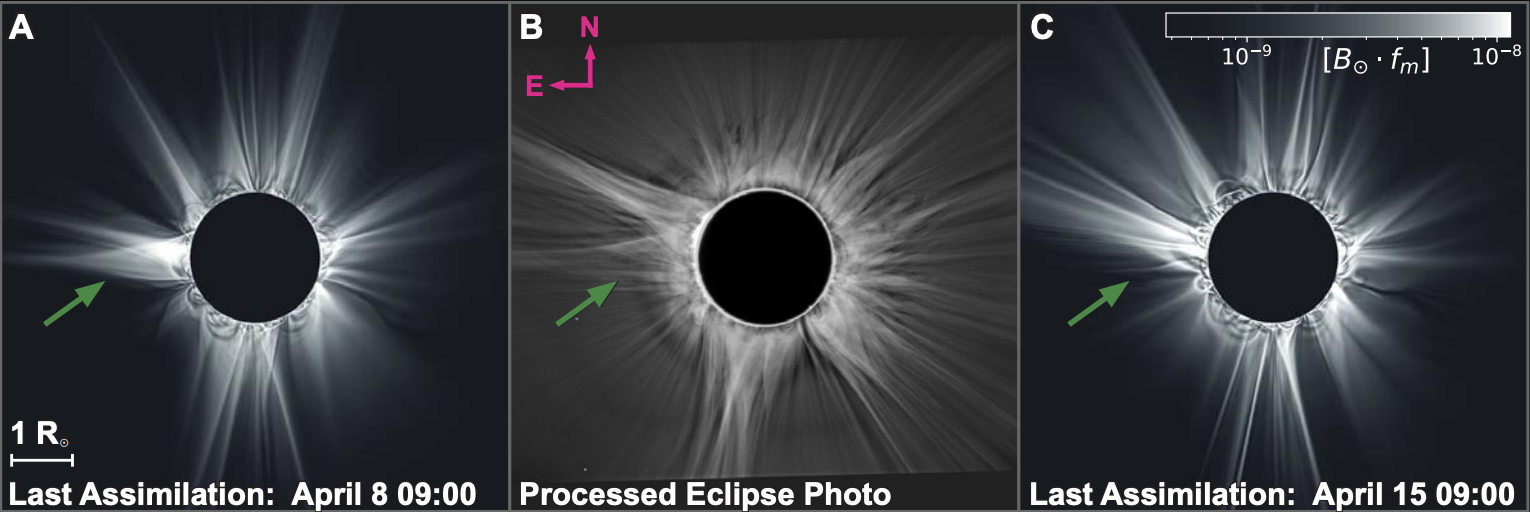
Three views of the solar corona observed during a total solar eclipse in April 2024 are shown, with the two on the outer edges being simulated from solar magnetic field data. The inner image is a real image of the solar corona from the moment of totality.

Simulated and real imagery of the solar corona during the April 2024 total solar eclipse. The image on the left is simulated using software from Predictive Science Inc., relying on solar magnetic field data taken in the days leading up the eclipse. The central image shows an actual image of the solar corona on the day of the eclipse. The final image shows a further-updated simulation. The simulations share many of the major structural features of the real image. [Jon Linker/Predictive Science Inc.]

Continuing the theme of predicting solar behavior, our final presentation of the day was “A Near-Real-Time Data-Assimilative Model of the Solar Corona,” given by Jon Linker of Predictive Science Inc. Linker spoke about the work his team has been doing to work towards solar corona models that are informed by near real-time solar observations. They used custom magnetohydrodynamics code which, informed by real measurements of the Sun’s magnetic field, can model the behavior of magnetic field lines in different regions of the Sun and subsequently predict the general structure of the corona and its evolution through time. The team demonstrated their model’s capabilities by running it with real-time input for 32 days leading up to the April 2024 total solar eclipse and showing that they were indeed able to predict many of the overall features of the corona during totality. Linker hopes that this sort of modeling will become more common, mirroring how weather prediction on Earth relies on real-time data inputs from satellites.

Return to Table of Contents.


Plenary Lecture: Exoplanets in Multi-Star Systems, David Ciardi (NASA Exoplanet Science Institute-Caltech-IPAC) (by Kerry Hensley)

The first of three back-to-back plenary sessions was given by David Ciardi, the deputy director of the NASA Exoplanet Science Institute. Ciardi described what we’ve learned about the properties of planets in multi-star systems and compared them to single-star systems.

Though our solar system contains only one star, many stars have companions: essentially all stars with spectral types O, B, and A have companions, as do 50% of F, G, and K stars and 25% of M stars. On average, every star also has a planet, which means that a rather large number of planets must occupy systems with more than one star.

As Ciardi explained, the presence of stellar companions affects how we detect and characterize planets. Many exoplanets are discovered via the transit method, in which a planet blocks some of the light from its host star as seen from our perspective. If the host star has an unknown companion, the planet radius derived from the transit method can be underestimated by a factor of two or more — and the planet might even orbit the unseen star instead of the star that’s being studied!

Using transit fitting, researchers have developed ways to determine which star in a binary or multiple system a planet is orbiting. These methods suggest that most planets orbit the primary star in the system. This is likely a result of observational bias, because primary stars are typically brighter, and it’s easier to detect a planet around a brighter star. However, a nonzero fraction of planets have been found to orbit the secondary stars of their systems, with more waiting to be found.

In terms of how binarity affects the likelihood of a star hosting planets, studies have shown that roughly 20% of single stars host giant planets, compared to just 10–12% of binary stars. However, wide binaries (orbital separations greater than 100 au) host giant planets at essentially the same rate as single stars, while close binaries host giant planets at a greatly reduced rate. In contrast, research suggests that wide and close binaries might host small planets at approximately the same rate.

Researchers have also discovered a small but growing number of planets in extremely close binary systems that are orbiting both stars at once. Estimates suggest that 10–40% of close binaries might have circumbinary planets, but this number is still uncertain. Recent findings suggest that essentially all of these systems are aligned, with the orbit of the planet in the same plane as the orbits of the stars.

Finally, Ciardi noted that while finding small planets is already difficult, the presence of a stellar companion makes it even more difficult. Research shows that we’re likely sensitive to only about 50% of Neptune-size planets in binary systems and scarcely any Earth-size planets. Combining this information with existing observations suggests that there are likely 10–30% more small planets in our galaxy than previous estimates that don’t account for binarity have suggested.

Return to Table of Contents.


Plenary Lecture: Unraveling AGN Feeding and Feedback: JWST, ALMA, and Integral Field Spectrometers to the Rescue, Erin Hicks (University of Alaska Anchorage) (by Maggie Verrico)

Professor Erin Hicks from the University of Alaska Anchorage gave the second plenary talk of the session. She highlighted several recent results by the Galaxy Activity, Torus, and Outflow Survey (GATOS) collaboration on active galactic nucleus fueling and feedback mechanisms which were made possible by high-resolution instruments like the Atacama Large Millimeter/submillimeter Array (ALMA) and JWST.

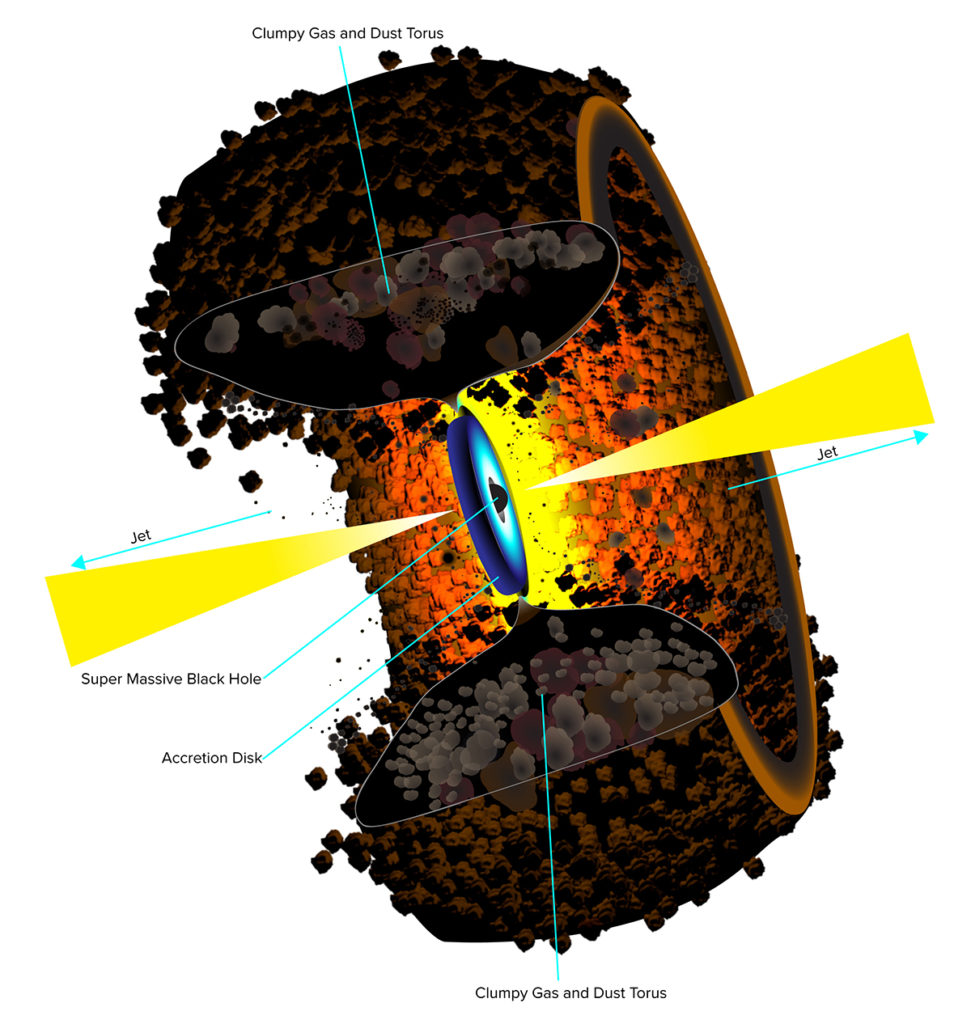
diagram of the unified model of active galactic nuclei

A diagram of the unified model of active galactic nuclei, showing an accretion disk, dusty torus, and jets. [B. Saxton NRAO/AUI/NSF; CC BY 4.0]

We think all massive galaxies host central supermassive black holes, some of which are actively accreting material — so-called “active galactic nuclei.” These active galactic nuclei are connected to their host galaxies by a complex fueling structure that funnels gas in the galaxy down to the supermassive black hole’s accretion disk. Under the “unified theory of active galactic nuclei,” that accretion disk is surrounded by a donut-shaped structure called the “dusty torus,” which can obstruct certain sightlines toward the active galactic nucleus. Professor Hicks’ work has been to complicate our model of the dusty torus; instead of a small, donut-shaped dusty structure, the work she highlighted has revealed that the torus is a large and dynamically complex interface between the accreting black hole and the nucleus of its host galaxy. She emphasized the importance of the torus as both a site of active galactic nucleus fueling by gas inflows and where feedback drives gas outflows which can have a huge impact on the host galaxy.

Professor Hicks first highlighted several studies of individual active galactic nucleus hosts in the nearby universe to demonstrate that active black holes can have very different relationships with their host galaxies, even when they are similar in luminosity. In particular, she discussed how the relative orientation between the torus and the host galaxy is crucial for understanding active galactic nucleus feedback. When the torus is aligned with the host galaxy, the active galactic nucleus drives outflows perpendicular to the plane of the galactic disk, sometimes inducing star formation outside the galactic disk (so-called “positive active galactic nucleus feedback”; seen in this work by GATOS collaborator Laura Hermosa Muñoz). On the other hand, when the torus is perpendicular to the plane of the disk, the active galactic nucleus drives outflows that deplete the molecular gas in the central region of the galaxy. In theory, this should drive “negative active galactic nucleus feedback,” a process by which the active black hole limits star formation in its host.

Professor Hicks hinted at future work regarding this active galactic nucleus–host galaxy coupling, particularly in finding ways to test how well-coupled the black hole system is with the host galaxy molecular gas reservoir. She highlighted a recently submitted work by her graduate student Lulu Zhang studying different ionized emission lines as a tracer of the chemical and physical qualities of gas in the nucleus around active black holes. She also discussed the need for population studies which can reveal larger patterns in behavior, like this article by Santiago Garcia-Burillo that uses decades of ALMA observations to find evidence of feedback in the central 50 parsecs of high-luminosity active galactic nucleus hosts. These high-resolution datasets will be crucial for understanding the complex relationship between active galactic nuclei, their dusty tori, and the galaxies in which they live.

Return to Table of Contents.


SPD Plenary: González Hernández Prize Lecture: Solar Connections: Reflecting and Leaning Forward, Holly R. Gilbert (High Altitude Observatory/NCAR) (by Lexi Gault)

Dr. Holly R. Gilbert was awarded the inaugural Irene González Hernández Prize, which recognizes mid-career scientists for their outstanding contributions to the field of solar physics. This award, as Dr. Gilbert began her talk acknowledging, honors the memory of Irene González Hernández, a solar physicist remembered for her significant contributions and dedication to the solar physics community.

Following this recognition, Dr. Gilbert provided an overview of her career path that she fondly referred to as a “random walk.” Having originally planned to become a concert cellist, Gilbert was drawn to astronomy and decided to pursue a career as a solar physicist. Interested and inspired by images of the Sun, she wanted to understand how it worked and what mechanisms were behind this extremely close star.

extreme-ultraviolet image of the Sun

An example of a solar prominence. If this prominence were viewed against the Sun’s disk, the relatively cool plasma would appear dark against the solar surface. [NASA/STEREO]

In particular, Dr. Gilbert was interested in understanding how prominences worked. Solar prominences are bright filaments of material extending from the surface of the Sun into the corona that follow along the Sun’s magnetic field. During the earlier stages of her career, she used observations of solar prominences to guide new physical insights about these features. Along with collaborators, Gilbert modeled and measured the mass of material involved in observed prominences, finding that down flow of neutral hydrogen and helium leads to mass loss within the structures. These processes can impact the evolution of prominences and show that the Sun’s magnetic field governs interactions of the solar surface and in the corona.

From here, Dr. Gilbert discussed the importance of continuing to study the Sun’s magnetic field and how understanding the corona and solar surface will allow for better predictions and monitoring of solar weather. She highlighted a number of proposed missions including the Chromospheric Magnetism Explorer (CMEx), the Coronal Solar Magnetism Observatory (COSMO), and the Next Generation Global Oscillations Network Group (ngGONG), which would all aid in understanding space weather, unlocking huge discoveries and advancing the field of solar physics. However, Gilbert acknowledged that looking toward the future in the current climate is hard. All of these planned missions and hopes for advanced science are at risk, but she charged the community to stay resilient and work together in order to continue doing the impactful and critical science we are passionate about.

Return to Table of Contents.

The post AAS 246: Day 2 appeared first on AAS Nova.

AAS 246: Day 1

10 June 2025 at 17:32

galaxy cluster

Editor’s Note: This week we’re at the 246th AAS meeting in Anchorage, AK, and online. Along with a team of authors from Astrobites, we will be writing updates on selected events at the meeting and posting each day. Follow along here or at astrobites.com for daily summaries, or follow @astrobites.bsky.social on Bluesky for more coverage. The usual posting schedule for AAS Nova will resume on June 16th.

Table of Contents:


Fred Kavli Plenary Lecture: Unveiling the First 500 Myr of the Universe with CEERS, Steven Finkelstein (University of Texas, Austin) (by Olivia Cooper)

Kicking off Day 1 of AAS 246, Professor Steve Finkelstein (UT Austin) gave his prize plenary titled “Unveiling the First 500 Myr of the Universe with CEERS.” In it, he shared the stories and surprises of CEERS (Cosmic Evolution Early Release Science Survey), one of the earliest programs with JWST, comprised of an international team of extragalactic astronomers led by Prof. Finkelstein. Though he admittedly “suffered from a lack of imagination” at first and supposed the survey would merely confirm past assumptions about galaxy evolution, instead CEERS has uncovered new mysteries about galaxies in the very early universe.

Prof. Finkelstein’s main scientific goal is to find out when the lights first turned on, or when galaxies formed out of the cosmic dark ages. To understand this beginning of everything, Finkelstein and his team work to observe galaxies at earlier and earlier times, count them up, and investigate what they look like. With the longer wavelength coverage and sensitivity of JWST, we can push this galaxy counting technique to even earlier times, within the first few 100 million years (of about 14 billion years from the Big Bang to now). Even in the first few days after receiving the first data from CEERS (see Figure 1), the team found a few surprises, all of which have since held up: the early universe is full of (1) too many unexpectedly bright galaxies, (2) galaxies that are too massive, and (3) lots of accreting supermassive black holes. With more detailed data coming in from spectroscopic follow-up programs, the team is now working towards confirming these galaxy puzzles, and eventually determining the physical origins of the seemingly rapidly evolving early universe.

images of CEERS data

A few team members looking at some of the first data from CEERS at the TACC visualization lab at UT Austin. The image is full of galaxies, and is displayed over multiple screens spanning the room, with the scientists’ silhouettes appearing over the image. [R. Larson]

Throughout his talk, Finkelstein shared his appreciation for the CEERS team and continually promoted the work of junior scientists (including Katherine Chworowsky, Rebecca Larson, Mic Bagley, Alexa Morales, Pablo Arrabal Haro, and more). He emphasized that it is an explicit goal of CEERS to enable tons of science within the broader astronomy community, and pointed us to the CEERS survey paper and website, where you can download data products and find detailed jupyter notebooks to reduce JWST data. Lastly, Finkelstein reminded us that to support our community in light of the ongoing threat to science in the US, it is essential to be vigilant in our resistance.

Return to Table of Contents.


Press Conference: Cosmic Accelerators and Active Black Holes (by Lucas Brown) (Briefing video)

This press conference session marked the very first of the meeting, and featured five presentations covering various exciting developments in the study of our universe’s biggest and brightest natural particle accelerators.

The first of these presentations, “Multimessenger Probes of Galactic PeVatrons,” was given by Shuo Zhang from Michigan State University. PeVatrons are, broadly speaking, any astrophysical source that is able to accelerate particles to PeV-scale energies. These are thought to include pulsar wind nebulae, supernova remnants, molecular cloud interactions, star-forming regions, and various black hole systems. Zhang shared that her team recently identified a pulsar wind nebula candidate that was spatially associated with an energetic cosmic-ray event detected by the Large High Altitude Air Shower Observatory (LHASSO) known as J0343+5254u. They believe this system could be the source of this particular high-energy event. Additionally, Zhang shared that her team has launched new searches for PeVatron star-forming regions using the IceCube neutrino detector. The full press release can be found here.

galaxy cluster PLCK G287.0+32.9

A composite image of the galaxy cluster PLCK G287.0+32.9 shown in radio and X-ray emission is displayed. The X-ray signal shines strongest in a central spherical region, while the radio is offset and in the form of two large arcs. [X-ray: NASA/CXC/CfA/K. Rajpurohit et al.; Optical: PanSTARRS; Radio: SARAO/MeerKAT; Image processing: NASA/CXC/SAO/N. Wolk]

Next up was “Where Giants Collide: Particle Acceleration in the Universe’s Largest Structures,” presented by Kamlesh Rajpurohit from the Center for Astrophysics | Harvard & Smithsonian. Whereas the previous presentation focused on grand cosmic accelerators that exist within our own galaxy, the focus here was on something a bit larger in size: galaxy clusters. When these clusters — which constitute some of the largest structures in the universe — collide, they release an incredible amount of energy. Rajpurohit’s group recently discovered a vast radio emission cloud filling the entire volume of the galaxy cluster PLCK G287, the largest ever observed. Such persistent and voluminous radio emission requires the continual acceleration of electrons throughout the cluster, which Rajpurohit’s team believes may be sourced from shocks and turbulence in the diffuse gas between galaxies. The full press release can be found here.

Third, in “Chandra Reveals Two Distant Quasars Transforming Universe’s First Light into High-Energy X-Ray Jets,” Jaya Maithil from the Center for Astrophysics | Harvard & Smithsonian talked about quasars, which are the brightest objects in the entire universe. She shared that her team identified two quasars in the early universe (with the light from them originating only 3 billion years after the Big Bang). Quasars from this era are important to understand because this cosmic epoch is when star formation and quasar activity is thought to have peaked. These quasars were detectable thanks to the exceptional power of the Chandra X-ray Observatory and the quasars’ ability to boost cosmic microwave background photons to X-ray energies due to their strong jets. In one of the quasars, the team found that the jet contributed a whopping half of the quasar’s entire energy output, the equivalent of 10 trillion suns! This discovery will hopefully shed light (literally) on the role of quasars in shaping galactic environments in the early universe. The full press release can be found here.

Finally, in “Multi-Phase Shocks and Feedback in a Nearby Spiral Galaxy Revealed by JWST Imaging,” Travis Fischer from the Space Telescope Science Institute informed us on JWST’s new insights into the role of shocks and active galactic nucleus feedback within galaxies. This work focused specifically on a nearby galaxy NGC 4258. While radio emission features in this galaxy have long been assumed to result from active galactic nucleus jets, JWST’s high-resolution observations of substructure in the galaxy for various different materials like iron or dust grains makes the jet-origin scenario less likely. Instead, Fischer’s team believes that a slower-moving active galactic nucleus wind provides a better explanation for the distribution of materials along the regions where radio emission is observed, supporting the idea that extended radio features in galaxies may not always be the result of jets as previously assumed.

Hubble and JWST images of NGC 4258

This collage features three views of Messier 106, also known as NGC 4258. The first two images show the target in visible light as seen by Kitt Peak National Observatory and the Hubble Space Telescope. The image on the right is from JWST in the infrared. [ESA/Webb, NASA & CSA, J. Glenn, KPNO/NOIRLab/NSF/AURA, the Hubble Heritage Team (STScI/AURA), R. Gendler, M.T. Patterso, T.A. Rector, D. de Martin & M. Zamani; CC BY 4.0]

Return to Table of Contents.

Helen B. Warner Prize Lecture: Magnetism and Morphology: Decoding the Interstellar Medium, Susan Clark (Stanford University) (by Karthik Yadavalli)

This session, chaired by Grant Tremblay, was the lecture given by Dr. Susan Clark after receiving the Helen B. Warner Prize Lecture. Dr. Clark gave a detailed overview of the interstellar medium (ISM) and how the galactic magnetic field permeates through it. She detailed how the magnetic field can be probed through Faraday rotation, synchrotron radiation polarization of starlight, and polarization of dust emission. One of the key findings presented by Dr. Clark is that the distribution of the magnetic field in the ISM is correlated with the distribution of neutral hydrogen in the ISM. It turns out that even though the neutral hydrogen component isn’t charged, a very small fraction (~10-4) of that hydrogen is actually ionized, allowing the magnetic field to couple to the gas. Therefore, Dr. Clark and her group are able to learn about dust polarization from observations of the neutral hydrogen density and velocity fields.

map of neutral hydrogen velocity field

The velocity field of neutral hydrogen overlaid with the direction of the magnetic field. Color gives the observed line-of-sight velocity and the contours give the direction of the magnetic field. The two are correlated over this patch of the sky. [Adapted from Ade et al. 2023]

Using this, her group is able to train a neural network in this paper that is able to decompose the ISM into the warm and cool components, literally from just an image of the neutral hydrogen map.
interstellar material decomposed into cold, warm, and noise components

A decomposition of the interstellar material into a cold component (top), warm component (middle), and residual noise (bottom) using an autoencoder. [Adapted from Lei et al. 2025]

Return to Table of Contents.

Press Conference: From Molecules to Molecular Clouds: Discoveries in the Milky Way (by Olivia Cooper) (Briefing video)

This press conference covered recent findings within our home Milky Way galaxy, from the detection of complex dust molecules, to the emergence of elusive stellar activity, to advances in techniques for mapping the galaxy’s gaseous disk.

cyanocoronene molecule

Artist’s rendition of the cyanocoronene molecule, which has seven interconnected benzene rings and a cyano group. [NSF/AUI/NSF NRAO/P.Vosteen; CC BY 4.0]

First up was “If You Like It Put More Rings on It: Discovery of Interstellar Cyanocoronene” by Gabi Wenzel (MIT/Center for Astrophysics | Harvard & Smithsonian). Wenzel and her team utilized laboratory spectra and observations from the Green Bank Telescope in tandem to discover interstellar cyanocoronene (see Figure 1), the largest polycyclic aromatic hydrocarbon (PAH) molecule ever detected in an interstellar environment. PAHs are a type of dust that contributes to many processes related to star and planet formation, and this detection provides new context regarding the chemical origins and evolution of the cosmos. The full press release can be found here.

Next, in “Discovery of the Elusive Radio Burst Indicators of Massive Eruptions in a Young Active Star,” Atul Mohan (NASA-GSFC/The Catholic University of America) presented the first detection of coronal mass ejection–associated radio bursts in an active star. He noted that though these bursts of radio emission are expected alongside these energetic stellar eruptions, they have not yet been detected in a decades-long search until now, primarily due to line-of-sight effects given that the radio emission is localized.

In “The Spotty Surface of the Blue Giant Xi Persei,” Tahina Ramiaramanantsoa (Arizona State University) showed the second case of bright spots discovered on a massive star. These spots are unexpected for massive stars as they have fundamentally different structures than the Sun, where such spots are typically seen. Through time–frequency analysis of 13 years of space-based observations from small and large satellites, the team found that the spots come and go, but their origin remains unknown.

Peter Craig (Michigan State University) took us from individual molecules and stars to the larger structure of the Milky Way in “A Map of the Outer Gas Disk of the Galaxy with Direct Distances from Young Stars.” Given our viewpoint from within the galaxy, it is challenging to construct a complete map of the gaseous disk of the Milky Way, which we know must have a complex structure. In the past, astronomers have used the motions of the gas relative to our position to infer the structure from a top-down view. However, it is prohibitively challenging to measure the distance to each parcel of gas, meaning these conversions can suffer from inaccuracies. In their recent work, Craig and team demonstrated a new technique to map the disk more accurately and completely: first, they measure the motion of the gas, then, assuming young stars remain near their natal gaseous clouds, measure distances to the stars to estimate the distance to the gas. This has resulted in more accurate maps, which reveal fluffy spiral structures in the galaxy’s gas disk. See the full press release here.

infrared images of the center of the Milky Way

Infrared images of the galactic center, showing gas and dust clouds illuminated in red and blue with a few bright red or blue stars embedded in the clouds. Two star forming regions that were studied are shown as zoomed-in insets, where hot, blue massive stars are seen causing the gas clouds to glow. [J. De Buizer (SETI) / SOFIA / Spitzer / Herschel]

Closing out the session, Wanggi Lim (Caltech/IPAC) presented “The SOFIA Mid-Infrared Giant H II Region Survey: Galactic Center.” This work provides the best and most recent view of ongoing massive star formation in the galactic center using the Stratospheric Observatory for Infrared Astronomy (SOFIA) telescope, an airplane-borne infrared instrument. The central region of our galaxy is thought to have relatively dampened star formation activity, where only a single generation of stars may have formed. While the team found generally consistent results with this notion (Figure 2), they also found a potentially new type of stellar nursery, where star formation rates are low, but the fuel for future star formation remains. The full press release can be found here.

Return to Table of Contents.


George Ellery Hale Prize Lecture: Why are the Coronae of the Sun and Other Stars so Darned Hot?, James Klimchuk (NASA GSFC) (by Karthik Yadavalli)

This session, chaired by Dawn Gelino, was the lecture given by Dr. James Klimchuk after receiving the George Ellery Hale Prize Lecture. In this talk, Dr. Klimchuk specifically wanted to present about three different studies he did recently, each on three different approaches: observational, theoretical, computational. The guiding question about his research is why the Sun’s corona is so hot. Dr. Klimchuk presented what must be the story of how the corona is structured and heated in this way. Magnetic field lines travel through the solar photosphere, loop through the corona, and loop back into the photosphere. Dynamics of the plasma in the photosphere move around the “foot points” of the magnetic field lines, causing the field lines to get twisted with each other. This twisting causes the field lines to suddenly “snap,” releasing a burst of energy. This energy is thought to heat the corona.

ultraviolet image of the Sun

Left: A representative ultraviolet image of the Sun, showing the magnetic field loops in the corona. Right: A zoom in on one active region where a lot of energy can be emitted into the corona. [Slide by James Klimchuk]

The first study he presented was the observational one, which found that the magnetic field loops must have circular cross sections. The second study was a numerical (simulation) study that actually simulated the “snap” of magnetic field lines and showed how much energy comes out from the simulation. The third study is an order-of-magnitude theoretical study that explains why the magnetic fields suddenly reconnect after slowly building up magnetic pressure.
simulation schematic and flux from a flux tube cross section

Left: A schematic of the simulation, showing the field tube. Right: The flux emitted along one cross section of the field tube as it “snaps.” This flux heats the solar corona. [Slide by James Klimchuk]

Return to Table of Contents.

Plenary Lecture: Supernovae: The Ultimate Laboratories of Extreme Astrophysics, Danny “Dan” Milisavljevic (Purdue University) (by Lucas Brown)

For our final plenary lecture of the day, we heard from Dr. Danny Milisavljevic. His talk was focused on our modern understanding of supernovae, particularly from the perspective of analyzing supernova remnants within our own galaxy. As Milisavljevic pointed out early in his talk, while supernovae go off with regular frequency in galaxies all throughout our universe, these events are so distant that we can only get so much out of our observations of them. On the other hand, supernovae within our own galaxy are too infrequent to make regular observations of, meaning we have to rely on observing their remnants many hundreds or thousands of years after the initial explosion. This leaves open a lot of difficult questions regarding what features in remnants can be attributed to the explosion itself as opposed to interactions between the environment and ejected material, as well as questions about how to evolve supernova models through hundreds of years.
Dan Milisavljevic speaks at AAS 246

Dan Milisavljevic speaks at AAS 246. [Lucas Brown]

In order to reduce these uncertainties as much as possible, it’s helpful to study supernova remnants that are as young as possible. The prime example Milisavljevic focused on was Cassiopeia A — a supernova that likely went off in the mid 1600s and is particularly close to us (it’s a measly 11,000 light-years away!). Several prominent features of Cassiopeia A were highlighted, including the clear spatial separation of elements of different masses, outward and inward shock fronts, bubbles, rings, and more — all of which could be explained by computer simulations or fairly well-established physics. In the era of JWST, our understanding of this system has deepened, while other questions have opened up. For example, JWST observations unveiled a previously invisible substructure of gas dubbed the “green monster” for its strong appearance in green imaging filters. Additionally, researchers uncovered a web-like structure within the central region of the remnant, which Milisavljevic believes could be un-shocked ejecta material. On a final note, Milisavljevic provided a tantalizing preview of what could be the future of supernova science: a network of neutrino and gravitational wave detectors forewarning us about a supernova in our own galaxy before it even goes off, allowing telescopes around the world to observe the explosion in real time! But until then, we can still enjoy some beautiful images of their ancient afterglow.

Return to Table of Contents.

The post AAS 246: Day 1 appeared first on AAS Nova.

AAS 246: Welcome!

9 June 2025 at 17:00

AAS 246 banner

This week, AAS Nova and Astrobites are attending the American Astronomical Society (AAS) summer meeting in Anchorage, AK.

AAS Nova Editor Kerry Hensley and AAS Media Fellow Lexi Gault will join Astrobites Media Interns Lucas Brown and Maggie Verrico along with Astrobiters Olivia Cooper and Karthik Yadavalli to live-blog the meeting for all those who aren’t attending or can’t make it to all the sessions they’d like. We plan to cover all of the plenaries and press conferences, so follow along here on aasnova.org or on astrobites.org! You can also follow Astrobites on Bluesky at astrobites.bsky.social for more meeting content.

Where can you find us during the meeting? We’ll be at the Astrobites booth in the Exhibit Hall all week — stop by and say hello! You can also find Kerry and Lexi at the press conferences Monday through Wednesday, with AAS Nova Editor Susanna Kohler assisting online. AAS press conferences are open to all in-person and virtual meeting attendees, and they can also be viewed on the AAS Press Office YouTube channel for anyone not attending the meeting.

Finally, you can read the currently published AAS 246 keynote speaker interviews, which were conducted by Astrobiters Neev Shah, Lucas Brown, Maria Vincent, Sowkhya Shanbhog, Maggie Verrico, and Karthik Yadavalli. Be sure to check back all week as the remainder are released!


Education, Outreach, and More at AAS 246

AAS 246 features a broad range of sessions related to education and outreach. For a comprehensive and curated list of sessions, check out this post from AAS Education Program Manager Tom Rice. Here are a few highlights (all times AKDT; must be logged in to aas.org for links to work correctly):

Monday will kick things off with multiple education-related poster sessions in the Exhibit Hall from 9:00 to 10:00 am. This poster session will immediately be followed by the Education and Public Engagement oral session from 10:00 to 11:30 am, and there will be an eclipse-related special session from 2:00 to 3:30 pm. Close out your day at 49th State Brewing with an informal gathering of astronomy educators starting at 7:30 pm; RSVP here (optional but encouraged).

Tuesday begins with an education-related special session, Sharing Astronomy with Blind and Low Vision Audiences, from 10:00 to 11:30 am, immediately followed by an outreach event at the Anchorage Museum from 11:30 am to 1:30 pm. This event will feature a Sun observation table, solar telescopes, live music, and more; learn more about the event here. In the afternoon, check out the education-related parallel oral sessions Undergraduate Research with the Rubin Observatory and Moving Toward Mutuality in Astronomy Today from 2:00 to 3:30 pm.

On Wednesday, you can take your pick of six education-related parallel sessions, three in the morning from 10:00 to 11:30 am and three in the afternoon from 2:00 to 3:30 pm.

Thursday begins with three education-related poster sessions, Education and Public Outreach, Education Research, and Community and Profession, from 9:00 to 10:00 am in the Exhibit Hall. Finally, be sure to stick around for the closing plenary from 11:40 am to 12:30 pm, “The Current Landscape for Science Policy and How YOU Can Make a Difference.”

The post AAS 246: Welcome! appeared first on AAS Nova.

AAS Publishing at AAS 246 in Anchorage

6 June 2025 at 17:00

AAS 246 banner

Hundreds of astronomers are soon to assemble in Anchorage, AK, for the 246th meeting of the American Astronomical Society. The AAS Publishing team looks forward to connecting with meeting attendees, and you can find various members of the publishing and journals’ editorial staff at the AAS booth in the Exhibit Hall in the Dena’ina Civic & Convention Center. Ethan Vishniac (AAS Journals Editor in Chief) and Frank Timmes (Associate Editor in Chief and Lead Editor of the High Energy Phenomena and Fundamental Physics research corridor) will be available at the booth throughout the week, and Kerry Kroffe (AAS Director of Scholarly Publishing) will be staffing the booth on Wednesday and Thursday. Be sure to stop by the AAS booth in the Exhibit Hall to say hello, chat about the journals, and pick up some swag! While the trio of AAS data editors won’t be present at this meeting, they’re just an email away; reach out to data-editors@aas.org to have your data questions answered.

AAS Nova Editor Kerry Hensley, AAS Media Fellow Lexi Gault, Astrobites Media Interns Lucas Brown and Maggie Verrico, and the rest of the Astrobites team will also be available periodically at the Astrobites booth in the Exhibit Hall, while AAS Nova Editor Susanna Kohler will be available via the AAS 246 Slack workspace. We look forward to seeing you there!


Open Science at AAS 246

Note: The links in this section take you to the corresponding entries in the AAS 246 block schedule. You must be logged in for the links to work correctly; otherwise, they will take you to the main block schedule page.

Looking to learn more about open science? Here are a few sessions to get you acquainted. On Tuesday, the oral session “Open Science & Computation, Data Handling, and Image Analysis” will be held from 10:00 to 11:30 am AKDT in the Dena’ina Civic & Convention Center, Tubughnenq’ 4. This session will cover everything from the sonification of galaxy images to enable aural classification of galaxies to a spectroscopic data reduction pipeline that is being tuned to process JWST data.

Wednesday’s oral session “Community and Profession,” held from 10:00 to 11:30 AKDT in Dena’ina Civic & Convention Center, Tubughnenq’ 4, will also cover a broad range of topics. Of particular interest are a discussion of the past successes and future plans of the multi-institution Solar wind with Hydrogen Ion charge Exchange and Large-Scale Dynamics (SHIELD) DRIVE Science Center, which aims to advance our understanding of the heliosphere while broadening the heliospheric community; a presentation about the LightSound project, which continues to make solar eclipses more accessible to the blind and low-vision community; and an exploration of how the principles of architectural Universal Design can be used to make astronomy more accessible. This talk will include a description of how these principles can be applied to academic departments, conferences, and outreach and will offer guiding questions for departments wanting to become more accessible to those with disabilities.

Finally, on Thursday from 1:00 to 2:00 pm AKDT in the Dena’ina Civic & Convention Center Exhibit Hall, there will be a poster session on “Computation, Data Handling, Image Analysis.” These posters will focus on improving astronomical search algorithms, tools for background subtraction, high-precision image alignment, and more.

The post AAS Publishing at AAS 246 in Anchorage appeared first on AAS Nova.

❌