❌

Reading view

Your beer can only cool so fast. Blame quantum mechanics

How fast can a kettle boil water for your cup of tea, or a refrigerator cool down a bottle of beer? The answer depends on the details of the machines, but according to new work published in Nature Physics, the minimum wait time does not. Instead, it’s quantum mechanics that imposes a limit on how fast something can thermalize to a particular temperature.

Objects thermalize, or reach a state of thermal equilibrium, when they no longer exchange any net heat with their environment. Physicists already suspected that this process couldn’t happen arbitrarily quickly. “There was suggestive evidence from experiments, numerical simulations and analytical calculations that a physical system can’t be made to thermalize faster than some fundamental limit,” says Martí Perarnau-Llobet, a quantum scientist in the Quantum Information Group  at the Autonomous University of Barcelona, Spain, and one of the paper’s authors.

Although the exact conditions under which thermalization is always guaranteed remain an unanswered puzzle, the researchers chose to focus on systems that do have this feature. To guarantee thermalization, Perarnau-Llobet and colleagues in Barcelona; Vienna, Austria; and Geneva, Switzerland came up with the mathematical notion of a thermalization machine. Given a quantum system in some initial state, this thermalization machine evolves it to a thermal state (that is, one that doesn’t spontaneously exchange net heat with its environment) at a particular well-defined temperature. In the previous example, the refrigerator and kettle would be considered thermalization machines, and your beer and water would be the systems.

No cheating

In some cases, one can engineer a machine that takes a particular system to its equilibrium state arbitrarily fast. For instance, a machine might quickly swap a hot cup of coffee for an iced one. But that would be cheating, says team member Pavel Sekatski, a researcher at the University of Geneva. “Such examples where you can finely tune your algorithm to thermalize a specific system can be avoided by carefully defining thermalization,” he tells Physics World.
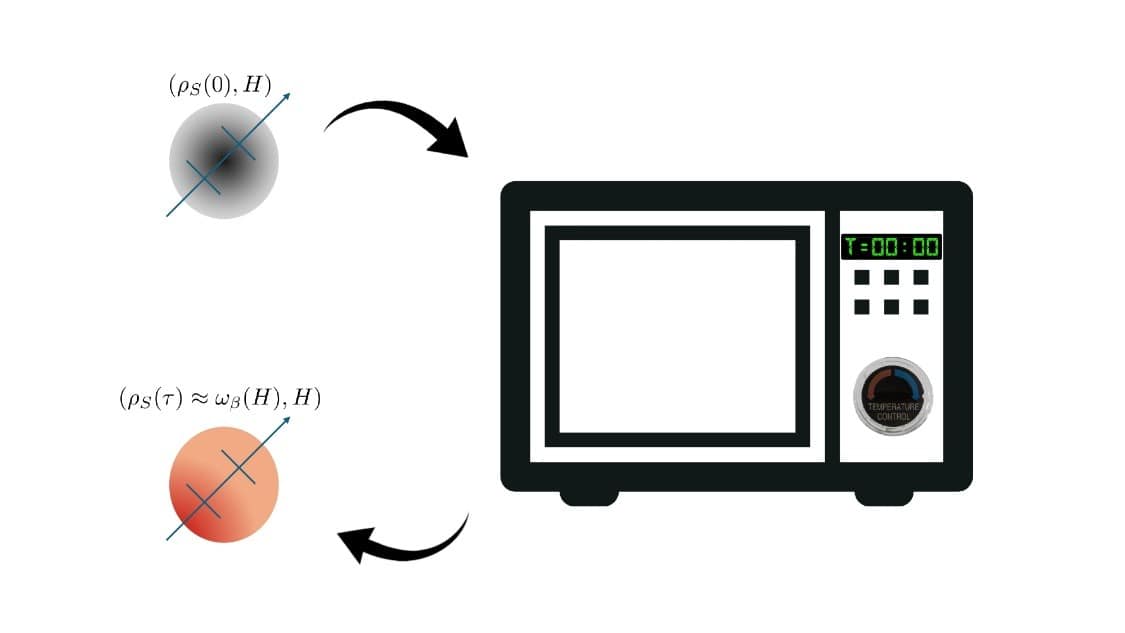
A diagram showing a microwave-like object taking in a quantum system in an initial state rho_s(0), H and outputting it in a state rho_s(t) that is approximately equal to omega_beta(H), H
Your quantum system is ready: A visualization of a thermalization machine that takes some quantum system in some initial state as input and outputs the system in its thermal state. (Courtesy: Paolo Abiuso, Alberto Rolandi, John Calsamiglia, Pavel Sekatski and Martí Perarnau-Llobet).

The researchers did this using a mathematical object called a Hamiltonian, which describes the possible energies a system can have. If a quantum system has a Hamiltonian that is close to the original one, then they require that the thermalization machine must be able to thermalize that system, too. In other words, the same thermalization machine that cools your cup of coffee must also be able to cool down other cups of coffee that may have slightly different amounts of sugar or milk. This rules out the instant swap tricks as the machine can no longer be tailored to a specific cup of coffee.

Based on the assumptions that such a thermalization machine is consistent with laws of quantum mechanics and that it works for some quantum systems that are close to each other, the researchers show that, away from absolute zero, the fastest thermalization time is approximately ℏ/(2kBT), where ℏ is Planck’s constant and kB is Boltzmann’s constant. “These restrictions on these thermal machines are actually very weak, and the notion is very general,” notes Perarnau-Llobet.

Related problems in computer science

The researchers note that their work is closely related to interesting tasks in computer science. One such task, known as Gibbs state sampling (GSS), involves taking a known Hamiltonian and using it to work out the corresponding thermal state at a particular temperature. This task can be performed arbitrarily fast. In contrast, if you have access to the quantum system, but you don’t know its mathematical description (that is, its Hamiltonian) you must perform a task called Hamiltonian learning (HL). This task admits a bound on the time taken for it to be solved.

“The task that we considered was somewhere in between the two,“ explains team member Paolo Abiuso, a physicist at the Institute for Quantum Optics and Quantum Information in Vienna. “We don’t know what the Hamiltonian of the quantum system is, but we do have access to the quantum system, and we want to produce the thermal state.” His Barcelona co-author John Calsamiglia adds that while the task they considered is “harder than GSS, it is still easier than HL”.

Beyond these connections to computer science, the researchers say their strategy could lead to insights on broader questions in physics. “We are now investigating what this approach can tell us about the fundamental limits imposed by the second and third laws of thermodynamics,” says Alberto Rolandi of TU Wien.

The post Your beer can only cool so fast. Blame quantum mechanics appeared first on Physics World.
  •  

Ignacio Cirac: Newton Medal winner looks to the future of quantum technology

This episode of the Physics World Weekly podcast features Ignacio Cirac, who has won the 2026 Isaac Newton Medal and Lecture for his “pioneering contributions that founded modern quantum information science, uniting profound theoretical insight, experimental vision, and exceptional scientific leadership shaping quantum physics and technology worldwide”.

Cirac is director of the theory division at the Max-Planck-Institute for Quantum Optics in Germany.

In conversation with Physics World’s Michael Banks, Cirac explains how an early interest in mathematics and science fiction drew him to quantum information – along with the field’s  potential to create new technologies.

He talks about his collaboration in the 1990s with Peter Zoller to design quantum simulators and computers based on trapped-ion qubits. Cirac weighs up the pros and cons of the qubit technologies available today and highlights the benefits of systems based on Rydberg atoms.

Looking to the future, Cirac cautions against quantum hype and points out that it is still not clear how quantum technologies will be used in the future. He also calls on European academics to maintain their scientific excellence and for more money to be invested in the continent’s quantum industries.

This podcast is supported by American Elements, the world’s leading manufacturer of engineered and advanced materials. The company’s ability to scale laboratory breakthroughs to industrial production has contributed to many of the most significant technological advancements since 1990 – including LED lighting, smartphones, and electric vehicles.

The post Ignacio Cirac: Newton Medal winner looks to the future of quantum technology appeared first on Physics World.

  •  

Gluon string breaking is simulated using trapped ions

The particle-physics process of string breaking has been modelled on a trapped ion quantum computer by researchers in the US. The results are similar to previous findings obtained independently using neutral atom quantum simulators and superconducting quantum computers. The result suggests that traditional models of string breaking need to be modified slightly.

The strong interaction is the force that binds quarks together inside hadrons such as protons and neutrons. Unlike gravity, electromagnetism and the weak interaction, which all diminish with distance – its effect becomes stronger as particles are pulled apart. In quark–gluon plasma, where quarks and antiquarks swim in a sea of gluons, they are effectively free. However, when an isolated quark is pulled away from an isolated antiquark (or a proton, for example), the energy in the gluon field increases indefinitely. At some point, this energy grows large enough to create a new quark and antiquark. These bind to the original particles, leaving two hadrons. Free quarks are therefore never observed.

This process, in which the potential energy in the gluon field grows and grows until it is released with the creation of new matter, is known as string breaking. The theory of this mechanism was first outlined in 1951 by the future Nobel laureate Julian Schwinger. The process often underpins the formation of new particles in colliders, but its fundamental details remain poorly understood.

Superconducting and atomic qubits

The notion of simulating experimentally inaccessible quantum processes using quantum processors has been discussed – and implemented for some systems – in the past few years. In 2025 scientists at Google Research in California and colleagues performed simplified calculations of the dynamics of string breaking using their Sycamore processor, which uses superconducting qubits, obtaining new insights into the process.

Also in 2025, researchers at the University of Innsbruck in Austria, together with colleagues at Harvard and the commercial company QuEra, took a slightly different tack. Instead of breaking the underlying quantum chromodynamic equations down into a series of discrete time steps and calculating their evolution, they used lasers to initialize the states of rubidium atoms such that their interaction would be analogous to quarks. This allowed them access to the dynamics of the string breaking process that would otherwise remain hidden.

Now, quantum-computing pioneer Christopher Monroe at Duke University in North Carolina and colleagues in the US and Belgium have achieved similar results to the QuEra group using trapped ions instead of neutral atoms. Monroe’s team modelled the behaviour of quarks using “domain walls” – regions where adjacent ions have opposite spins.

“You initialize the system with a certain number of domain walls, and then you apply the Hamiltonian – which means you do this QCD process – and you see how many domain walls you end up with. We show that the number actually increases.” Explains Arinjoy De, who was Monroe’s PhD student and now works at QuEra. To simulate the increasing energy in the gluon field as a quark is pulled away, the researchers used an external magnetic field: “We show that once you go beyond a certain threshold of the magnetic field, you go from two domain walls – or two particles – to create more particles,” says De.

Modifications needed

The results suggest some modifications to the canonical theories of string breaking. Notably, they found that, contrary to the predictions of Schwinger, string breaking is initiated at the edges, where coupling to the quantum vacuum reduces the energetic cost of new particle creation, before propagating inwards to the bulk.

The researchers are now hoping that, with more qubits and greater circuit depth, they will be able to look at domain walls farther apart. This would allow them to study the inverse problem of string formation when particles collide: “Our theory colleagues Alexey Gorshkov and Zohreh Davoudi at the University of Maryland are really thinking a lot about these meson scattering experiments,” says Monroe.

Quantum computing researcher Boris Blinov of the University of Washington in Seattle says that the work is “significant in its own right as a demonstration of the potential of a quantum simulator in the future to do things faster than any classical analogue of it.” He says the current system is too small to outperform what can be achieved with a supercomputer but “with more qubits and this technology, this way of controlling qubits would be of significance at the very least for quantum chromodynamics, gauge theories and fundamental physics.”

Monroe and colleagues describe their work in Nature Physics.

The post Gluon string breaking is simulated using trapped ions appeared first on Physics World.

  •  

Quantum physicist Ignacio Cirac awarded 2026 Isaac Newton Medal and Prize

The Spanish quantum physicist Ignacio Cirac from the Max Plank Institute of Quantum Optics in Garching, Germany, has won the 2026 Isaac Newton Medal and Prize for his “pioneering contributions that founded modern quantum information science, uniting profound theoretical insight, experimental vision, and exceptional scientific leadership shaping quantum physics and technology worldwide”. Presented by the Institute of Physics (IOP), which publishes Physics World, the international award is given annually for “world-leading contributions to physics by an individual of any nationality”.

Born in 1965 in Barcelona, Spain, Cirac earned a PhD in physics from the Complutense University of Madrid in 1991. After a stint at the University of Castilla-La Mancha, he then moved to Leopold-Franzens University of Innsbruck in 1996. In 2001 Cirac became director of the Max Planck Institute of Quantum Optics the US.

Cirac is best known for his work in the 1990s in which he co-developed a proposal for building a quantum computer using trapped ions with Peter Zoller from the University of Colorado at Boulder.

The “Cirac–Zoller” proposal provided an experimentally plausible route from the theoretical idea of a quantum computer to an actual machine with trapped ions remaining one of the leading quantum-computing platforms today.

He also showed how controlled quantum many-body systems can act as simulators to solve difficult problems in physics, chemistry, and materials science.

Cirac and collaborators also pioneered long-distance quantum communication, which included the idea of a quantum repeater that offers a way of distributing entanglement across distances despite losses and imperfections.

Cirac told Physics World that he is “deeply honoured” to receive the award. “I’m very thankful to the people who have made this prize possible – it’s a team working for many years,” says Cirac. “I am immensely grateful to all of them for the privilege of having worked together and for everything we have accomplished along the way.”

Professor Cirac’s pioneering work has helped shape modern quantum information science

IOP president Paul Howarth

Cirac has many other honours to his name including the Wolf Prize in Physics in 2013, the Max Planck Medal in 2018, as well as the inaugural ICTP-IBM Richard Feynman Prize in Quantum Computing.

IOP president Paul Howarth offered his congratulations to Cirac, noting that the Spanish physicist is “hugely deserving” of the award and that his influence can be seen not only in the development of quantum science, but “in the generation of researchers who have followed”.

“Professor Cirac’s pioneering work has helped shape modern quantum information science, providing crucial theoretical foundations for advances in quantum computing, simulation and communications,” adds Howarth. “His achievements demonstrate how fundamental physics can expand our understanding of the world while opening up new possibilities for technology.”

Celebrating success

Cirac’s honour forms part of the IOP’s wider 2026 awards, which recognize everyone from early-career scientists and teachers to technicians and subject specialists. Other winners include the school engagement programme Orbyts, which received the Lawrence Bragg Medal and Prize for “outstanding work empowering girls and students from socioeconomically disadvantaged backgrounds in physics education through cutting-edge research partnerships, and supporting physics teachers with novel teaching materials”.

Sarah Bohndiek from the University of Cambridge has been awarded the Rosalind Franklin Medal and Prize for “pioneering the use of light and sound in early disease detection, with a focus on clinical translation and equitable healthcare outcomes”.

Natalie Lines, a PhD student at the University of Portsmouth, meanwhile, has won the Jocelyn Bell Burnell Medal and Prize for “exceptional early-career contributions to observational cosmology and the application of machine learning to large-scale astronomical surveys, with particular distinction in the field of strong gravitational lensing”.

The full list of 2026 award winners is available here.

The post Quantum physicist Ignacio Cirac awarded 2026 Isaac Newton Medal and Prize appeared first on Physics World.

  •  

Scottish artist marks 100 years of Schrödinger equation with new installation

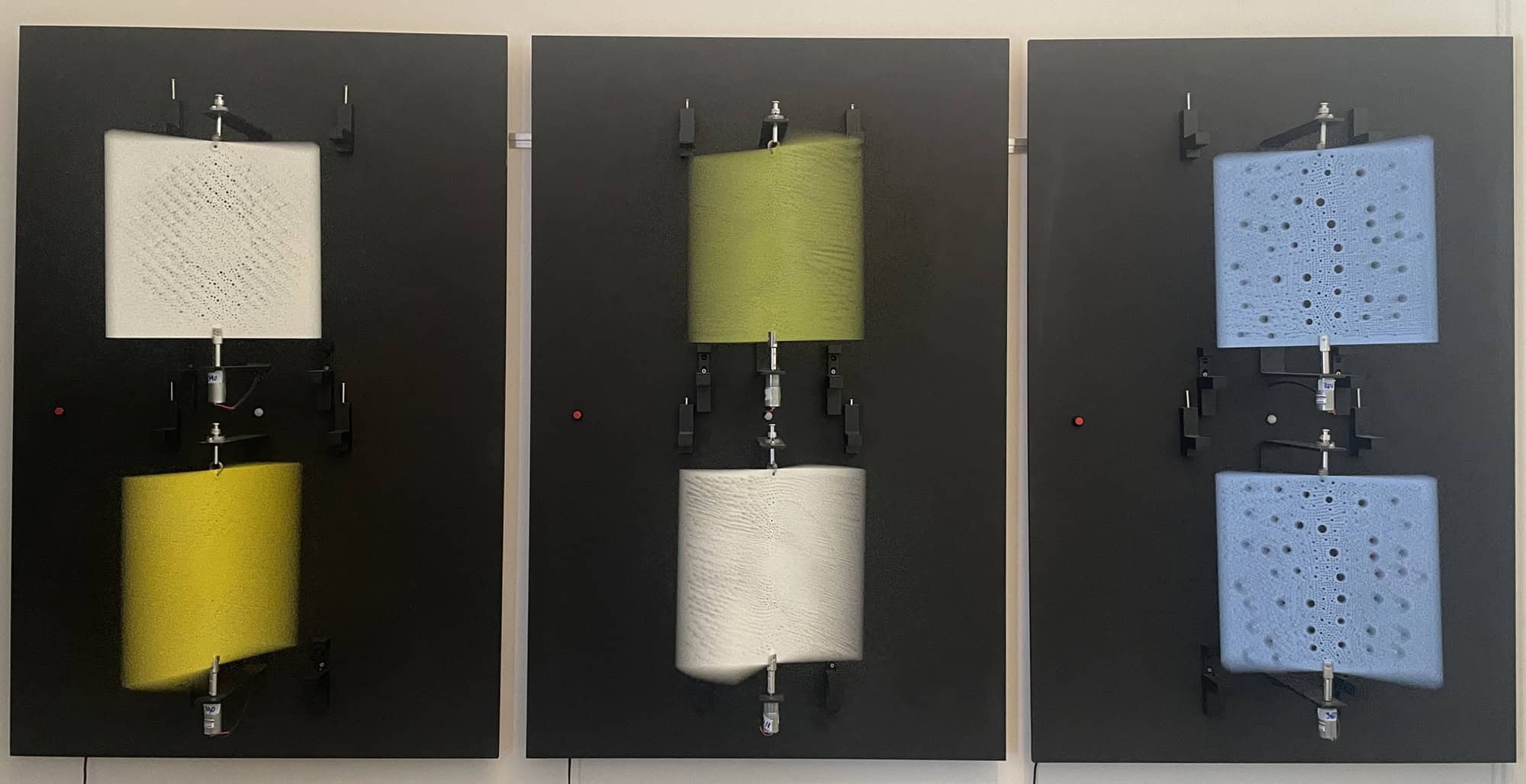
Scottish artist Gregor Harvie has created a new artwork to mark 100 years since Erwin Schrödinger published his famous equation that governs how the wave function of a physical system changes over time.

Dubbed Superposition, the piece has been created in collaboration with the quantum theory group at the University of Glasgow.

The installation explores two of features of quantum physics: superposition and entanglement.

It does so via 16 aluminium panels that each have hundreds of holes drilled through them, forming complex patterns.

One side is white while the other is coloured and when someone approaches, the panels begin to spin at 400rpm so that their forms “dissolve into shifting three-dimensional illusions”.

The panels are arranged in eight pairs and the stopping positions of the panels are random but over time seven pairs show the same side as their partner half the time. This is an analogy for superposition, where the spinning stops is akin to the collapse of the wavefunction.

Yet the eighth pair is different. Individually, its two panels still appear to stop randomly, but when seen together they show the same side three quarters of the time – an analogy for entanglement.

Harvie, who has a PhD in computational fluid dynamics and previous work Beyond Absolute Zero marked the bicentenary of the birth of Lord Kelvin in 2024, says the artwork puts people inside the quantum universe.

Superposition artwork
The panels are arranged in eight pairs (courtesy: Gregor Harvie)

“I wanted to make something you could stand in front of and genuinely not know what you are looking at,” notes Harvie. “The artworks are made of holes, so in a way there is nothing there, but spun fast enough they transform into something remarkable, something the eye can’t quite hold onto. Their form changes depending on where you are looking at them from, and one pair behaves in a way that defies logic.”

Theoretical physicist Stephen Barnett at the University of Glasgow says the artwork allows everyone to experience the “strangeness” of quantum mechanics and to question what they are seeing. “Quantum physics challenges our most basic ideas about what it means for something to have a definite state,” he says. “It tells us reality is stranger than anything we encounter in everyday life.”

If you want to experience the artwork for yourself, Superposition will be displayed at the Technology and Innovation Centre at the University of Strathclyde during weekdays from 20 to 29 October.

The post Scottish artist marks 100 years of Schrödinger equation with new installation appeared first on Physics World.

  •  

Festival season finds Quantum Software Lab in high spirits

photo of the third annual showcase of the lab
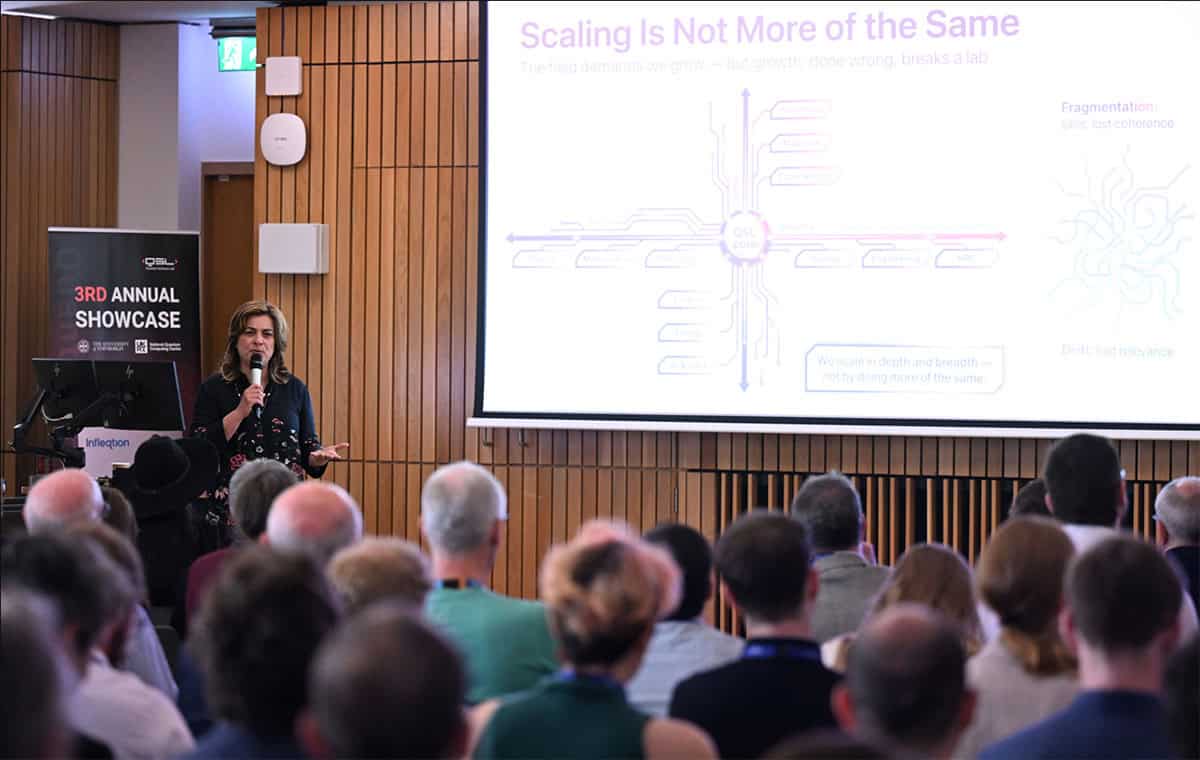
Towards quantum advantage Elham Kashefi, director of the QSL and chief scientist of theNQCC, speaks at the third annual showcase of the lab. (Courtesy: QSL)

The Quantum Software Lab (QSL) at the University of Edinburgh is going from strength to strength. Buoyed by its strategic partnership with the UK’s National Quantum Computing Centre (NQCC), in just three years the lab has become a globally recognized hub for creating software solutions that generate practical value from emerging quantum computers. With more than 70 researchers working across applications, algorithms and the underpinning theory and software, the QSL is also poised to lead a £20m project that will drive the delivery of tools, methods and systems for useful quantum computing.

The growing momentum at the QSL has also provided the impetus for the Quantum Fringe, a festival of events that debuted in 2025 to mark UNESCO’s International Year of Quantum Science and Technology. Modelled on Edinburgh’s world-famous Fringe festival, the programme provides a showcase for quantum-inspired events that have been convened by different organizations for a diverse range of audiences.

“The Quantum Fringe belongs to everyone who takes part, whether they are researchers, scientists in government and industry, or students at university or school,” says Elham Kashefi, director of the QSL and chief scientist of the NQCC. “That’s the whole point: no-one can do this alone, and each of the 16 events in this year’s festival provided an opportunity for the community to come together.”

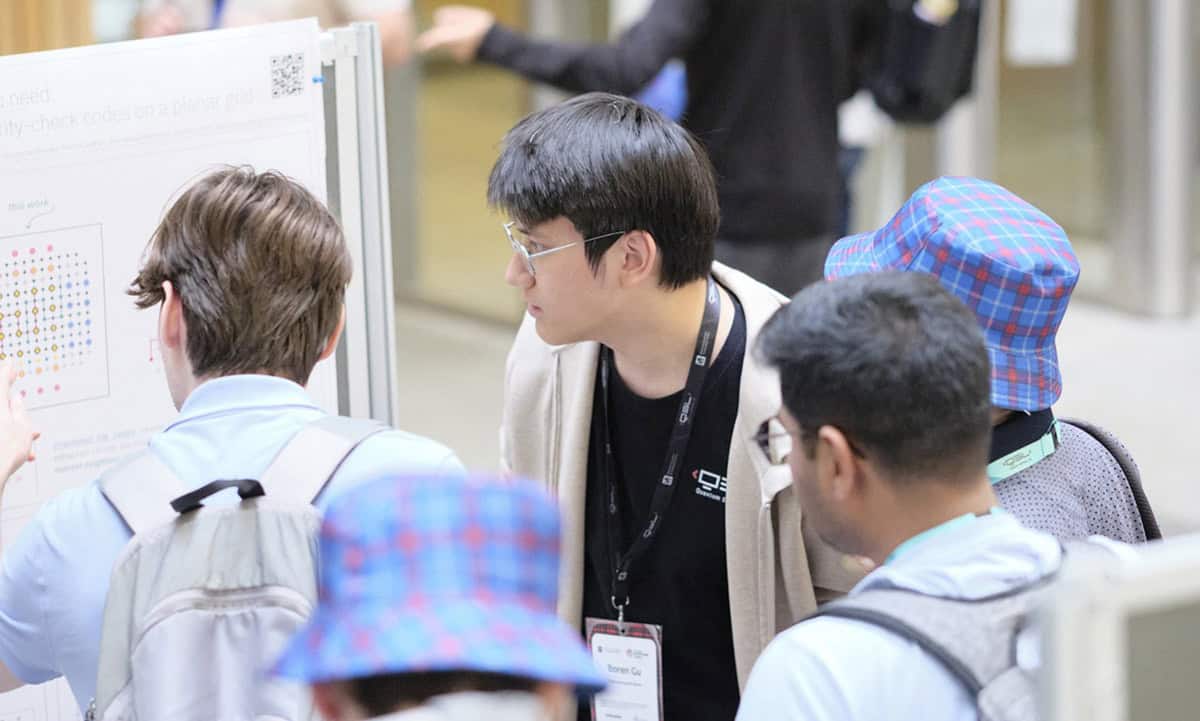
That cross-cutting ethos was evident in several collaborative workshops. As an example, a two-day event organized by the research hub for Integrated Quantum Networks (IQN) enabled scientists from different sectors and backgrounds to share expertise on the authentication requirements that will be needed to ensure the security of future quantum communications. Tutorial sessions enabled a broad spectrum of experts to engage meaningfully in technical discussions, while informal networking helped to establish new connections between the research and business communities.

Another workshop, this time organized by the QCi3 research hub, encouraged interactions between academics and industry experts by exploring the applications and integration challenges for quantum computing in the defence sector. Meanwhile, the aptly named TartanQEC workshop, organized by the Universities of Edinburgh and Strathclyde, welcomed more than 120 researchers from the UK and Europe to discuss practical methods for quantum error correction (QEC). Talks spanned hardware co-design, implementations, and software development, and the event was headlined with a keynote on QEC schemes for superconducting quantum computers by Andreas Wallraff of the ETH Zürich in Switzerland.

Building the ecosystem

Experts from start-up companies were involved too, with the QSL convening a workshop that brought together hardware vendors and the research community to discuss scalable frameworks for verifying and benchmarking the performance of rapidly evolving hardware architectures. Legal firm Simmons + Simmons offered start-up firms an insight into the legislation that can protect their core technology and guide their future growth plans, while the regular AIMday provided an opportunity for companies of all sizes to work with academics to explore a series of industry-relevant challenges. This year’s event was the largest yet, with more than 60 participants tackling such problems as using quantum optimization to design a multi-hub logistics network for the UK.

tartan-qec-workshop
Scottish software The TartanQEC workshop enabled researchers from across the UK and Europe to explore the rapid convergence between theory and experiment in quantum error correction. (Courtesy: QSL)

QSL also organized two educational events to inspire the next generation of quantum researchers. A three-day summer school enabled high-school students to find out what a research career might look like, learn the basics of quantum computing from practising scientists, and gain hands-on experience in coding techniques. Meanwhile, a week-long event offered postgraduate students and early-career researchers a deep-dive into quantum informatics within the stunning and peaceful surroundings provided by the Isle of Skye.

Reflecting the eclectic nature of the Edinburgh Fringe, the programme also featured an evening of music and poetry inspired by key concepts in quantum physics. Performed by Erika Andersson, a quantum researcher at Heriot-Watt University, along with computer scientist Ruth Aylett and a group of professional musicians, “Quantum Worlds” offered the audience a creative exploration of complex scientific ideas such as superposition, wave-particle duality, and quantum entanglement. The response was enthusiastic, with audience members commenting that the performance “helped to understand the science” and “made quantum physics feel more approachable”.

Making an impact

Among this multitude of events, the Quantum Fringe offered an opportunity for QSL to mark three years since its launch in 2023. In that time the team has grown from around 15 members to almost 100 researchers working across all facets of quantum software, ranging from foundational quantum theories through to the development of powerful quantum algorithms and real-world applications. “Quantum computing is almost always told as a hardware story, but a machine only matters if it can give you an answer that is useful and that can be trusted,” says Kashefi. “That is a software problem.”

The QSL’s anniversary event showcased some of its key achievements, and highlighted how the lab’s strategic partnership with the NQCC has shaped and enriched its research agenda. One particular benefit has been the opportunity for software specialists at the QSL to work directly with quantum hardware, with the NQCC now hosting seven testbed platforms based on all the leading qubit modalities.

“It is really important for us to build the engineering knowledge and skills needed to work with these machines,” says Caitlin Jones, a senior QSL researcher. “The hardware may not yet be perfect, but if we don’t try to use real devices we might come across unforeseen bottlenecks or miss opportunities that we might not have considered.”

As an example, PhD student Mario Herrero Gonzáles is investigating the use of quantum machine learning to generate new samples that are similar to an existing dataset. Herrero Gonzáles uses a classical computer to train the model and a quantum machine to generate the samples, with the aim of optimizing the quantum part of the solution to run on a neutral-atom platform from Infleqtion. “The Infleqtion team helped Mario to understand the timings of the gate operations and the sources of errors,” explains Jones. “That allowed him to reduce the noise by recompiling the programme to exploit the gate fidelity and connectivity offered by neutral-atom systems.”

qsl's-3rd-annual-showcase
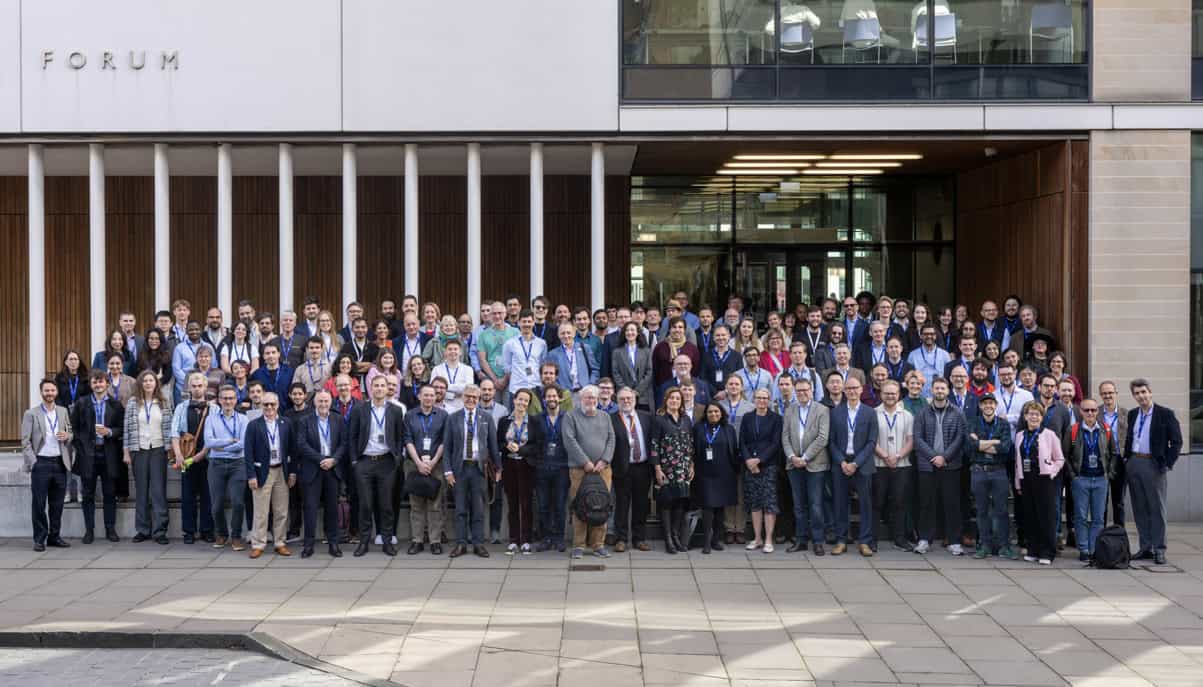
Community building Around 170 people from all parts of the quantum ecosystem attended the QSL’s third annual showcase. (Courtesy: QSL)

Another project is developing an adaptable computational approach to the problem of classically hard sampling, which is a good match for quantum photonic platforms. A team led by Leo Monbroussou has been working with two of the testbed providers, ORCA Computing and Aegiq, that have developed photonic platforms with different architectures and control mechanisms. “Having a direct dialogue with the hardware experts has really helped to push the research forwards,” says Jones. “Through the collaboration with the NQCC we have been able to embed that knowledge into the way that we approach software development.”

This established operating model provides a strong starting point for the new research programme, called QATCH (short for Quantum Advantage TurboCHarger), that is worth £20m from the UK government over the next four years. “We have an existing body of knowledge on how to run software on real quantum systems, which is really valuable and hard to create from scratch,” says Jones. “QATCH gives us more runway to design more ambitious experiments, such as developing code that will run on different hardware devices for cross-platform benchmarking and optimisation.”

QATCH also marks a change of emphasis for the QSL team. While the first three years focused on exploring potential routes to achieving quantum advantage, QATCH has a clear mission to deliver the tools, methods and systems that will drive real and evidenced impact from quantum computing in the UK. “The QATCH programme will launch the UK’s first full-stack feedback loop, serving as the software engine that translates fundamental theory into verified applications,” says Kashefi. “Through daily co-creation between our researchers, hardware vendors, and industry end-users on the national testbeds, we are ensuring that software actively drives forward the design and utility of these new quantum machines.”

  • This year’s Quantum Fringe was supported by the NQCC, Infleqtion, Quantinuum, Riverlane, Classiq, IBM, Institute of Physics, National Physical Laboratory, Nu Quantum, with input from Edinburgh Innovations, the Centre of Doctoral Training in Quantum Informatics, the QCi3 and IQN hubs, the Quantum Software Alliance, and Quantum Computing Application Cluster

The post Festival season finds Quantum Software Lab in high spirits appeared first on Physics World.

  •  
❌