
❌

Reading view

NASA’s Perseverance Mars rover sets distance record

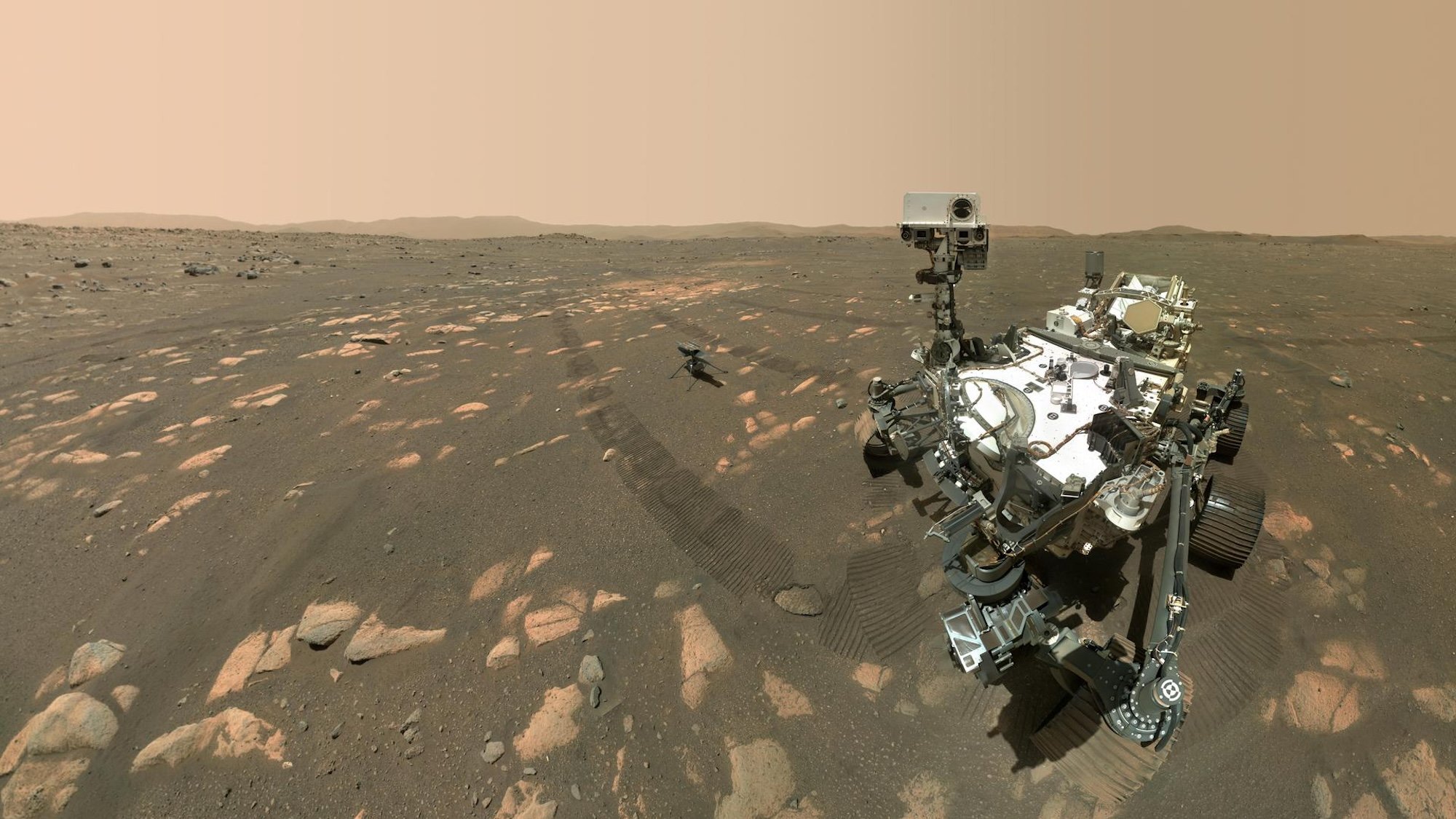
NASA’s Perseverance Mars rover has officially traveled 28.10 miles—farther across another planet’s surface than any other vehicle in history. Not only that, but the six-wheeled science lab accomplished this impressive feat almost entirely autonomously and in barely a third the time it took the previous recordholder.

“The original mission called for no more than 12.4 miles of driving. We’ve blown well past that,” Steven Lee, Perseverance and Curiosity project manager at NASA’s Jet Propulsion Laboratory, said in a statement.

Perseverance began operations on Mars on February 18, 2021, after landing in an ancient river delta selected for potential past microbial life called Jezero Crater. Since then, the rover has slowly but steadily made its way across the region, while conducting multiple sediment drilling surveys. These samples are then chemically analyzed using onboard laboratory equipment before the results are sent back to mission specialists at NASA.

Perseverance surpassed the previous travel record of 28.06 miles set by NASA’s Opportunity rover, before its communications with NASA ended on June 10, 2018. However, it took Opportunity nearly 15 years to accrue its distance while Perseverance exceeded the same mileage in less than six years, and on the 2,006th Martian day (sol) of its mission. Perseverance is currently traveling towards an area named Idubi through an expanse nicknamed “Lac de Charmes.” The region near Jezero Crater’s western rim hosts what may be the oldest landscape ever investigated in the solar system. Mars does not feature tectonic plates like Earth, which means its terrain is never eroded and subsumed into the planet’s substrates.

Mission engineers have not spent the last six years remotely steering Perseverance, either. The rover arrived on Mars equipped with a self-piloting system called AutoNav, which constructs 3D maps of the immediate surroundings to flag any potential hazards. AutoNav then charts a route between specific waypoints chosen by NASA specialists back home. Perseverance has completed 90 percent of its total excursion with AutoNav. Opportunity and its sibling rover, Spirit, only relied on a first version of the piloting system about five percent of the time.

Perseverance has a long road ahead of it, if all goes according to plan. In October, NASA approved the first mission extension that will continue the rover’s operations through about the end of 2028.

“With all mobility systems fully operational and favorable extended-ground-life test results, we expect Perseverance to keep adding to this record for many years to come,” added Lee.

The post NASA’s Perseverance Mars rover sets distance record appeared first on Popular Science.
  •  

Are Martian organics remnants of ancient life?

Since the 1976 Viking missions, when NASA first successfully placed uncrewed landers on Mars, scientists who study life in the universe, known as astrobiologists, have been gathering evidence to determine whether microorganisms ever lived on the red planet. It has been a challenging determination to make. Until a Mars sample return mission occurs, all necessary analyses must take place on Mars, using instruments designed as much to withstand the stresses of space travel as to collect data, which limits how thoroughly scientists can study Martian rocks. As a result, the search for evidence of microbial life on Mars is inherently incremental. 

Recently, scientists added another piece of exciting, yet inconclusive, evidence to their search. In the summer of 2024, the Mars 2020 Perseverance Rover science team was searching for signs of ancient microbial life in a 3,700-million-year-old lake bed on Mars, known as Jezero Crater. In the process, they detected complex, carbon-containing organic molecules in mudstones within a river channel that once brought water to the now-dry lake bed. 

This is not the first time complex organic molecules have been detected in Martian mudstones. However, there are 2 reasons that astrobiologists are particularly interested in this new discovery. First, these organic molecules are widely dispersed across all 4 river channel mudstones they analyzed. Second, some of the organic molecules they found are associated with minerals that are known to support microbial life on Earth. 

Widely dispersed organic molecules associated with minerals that can support microbial life are exactly what astrobiologists would expect to see if microorganisms once lived in Jezero Crater. However, organic molecules can also form through geological processes, like when gases and minerals react at high temperatures and pressures at deep-sea vents on Earth. Therefore, astrobiologists must carefully assess organic molecules to determine their origin. 

In July of 2026, more than 60 Perseverance science team members took a first step towards determining whether ancient microorganisms could have made the organic molecules found in Jezero Crater. They compared the organic molecule detections in Martian mudstones to similar detections of organic molecules in samples of known origin, including fossilized Earth life, meteorites, and minerals. 

NASA scientists detected the organic molecules in Jezero Crater with a rover instrument called Scanning Habitable Environments with Raman and Luminescence for Organics and Chemicals (SHERLOC). SHERLOC uses a 248.6 nanometer (nm) wavelength laser to excite molecules in unknown materials. When molecules are excited, they absorb and scatter the laser light, causing characteristic shifts in the wavelength of the scattered light. 

Instruments like this, known as Raman spectrometers, detect the shifted light and display the detections as lines called spectra, which scientists use to identify the unknown molecules. The Raman spectra from the 4 mudstones in Jezero crater showed shifts of about 1600 nm, which is characteristic of complex carbon molecules. These shifts appear as bands in the spectra that are often called G-bands.

Raman spectrometers are common laboratory instruments, but most use lasers with wavelengths of 485 nm or higher, so the spectra they produce can be slightly different from SHERLOC spectra even when the laser excites the same kind of molecule. To get around this issue, the scientists compared the Mars spectra with spectra of complex carbon molecules from fossilized Earth microorganisms, coal, graphite, meteorites, and synthetic samples collected by Raman instruments using the same wavelength laser that SHERLOC uses. They found that the spectra collected on Mars overlap with at least one example from every sample type except graphite. 

These results don’t rule out the possibility that organic molecules in Jezero Crater were produced by ancient microbial life, but they can’t tell us exactly how they formed either. That determination will have to wait until the samples are brought to Earth so they can be studied with laboratory instruments.

The Perseverance team has made a small but critical contribution towards determining whether microbial life ever inhabited our closest planetary neighbor, Mars. Their efforts exemplify how the science of astrobiology and the search for possible extraterrestrial life slowly and carefully move forward. If we keep at it, humans may one day have a definitive answer to one of our most consequential questions: Are we alone?

The post Are Martian organics remnants of ancient life? appeared first on Sciworthy.

  •  

Finding alien life with light signals

Astronomers and astrobiologists use a wide range of tools in their search for extraterrestrial life. Probes, satellites, and rovers take photographs and collect data on the geology and chemistry of planets and moons in the solar system. Radio telescopes sweep the sky, looking for signals from intelligent civilizations. And telescopes like the JWST can observe the atmospheres of distant exoplanets, potentially finding ones similar to Earth’s. 

A limitation of these methods is that they assume life on other worlds is fundamentally similar to life on Earth, requiring the same balance of molecules in the atmosphere, producing the same chemicals for their metabolic processes, or developing technologies analogous to those humans make. While researchers use these assumptions as baseline markers to look for, assuming such similarities might lead them astray. Scientists looking for life using too narrow a set of parameters might miss life unlike Earthlings. Or they might mistake coincidentally similar geological, chemical, or astronomical processes for having been made by living things.

So, to complement techniques that assume alien life resembles life on Earth, scientists also consider approaches that detect signs of life while making as few assumptions as possible about what it could look like, known as agnostic biosignatures. One of these life signs with few assumptions is complexity. Though it can be difficult to quantify precisely, living things tend to create more complex systems than nonliving things. A team of researchers recently tested whether living and nonliving worlds could be distinguished solely by examining the complexity of the light-reflection patterns from their surfaces.

For this, the team treated Earth and Mars, similar planets but one with life and one without, as stand-ins for exoplanets around other stars. They collected data on the light reflected off both planets’ surfaces from a space station monitoring Earth, known as the Deep Space Climate Observatory or DSCOVR, and an orbiter around Mars observing its atmosphere, known as the Hope Probe. 

The team identified 3 nearly identical wavelengths of light that these machines observe from their respective planets. From the machine databases, they collected measurements of how much light each planet reflected, called its reflectance, at these 3 wavelengths over 486 local days. By using only individual wavelengths of light rather than full photographs, the team claimed that, if their test worked, researchers could apply it to distant exoplanets that cannot be photographed in detail.

Without looking for any particular chemical or signal, the team compared these measured reflectances using a series of statistical tests to determine the variation and randomness in their reflected light, which they considered representative of the complexity of the planets’ surfaces. The researchers found that of the 27 complexity metrics they tested, Earth scored higher than Mars on 25, Mars scored higher than Earth on 1, and the planets scored the same on 1. So, even though both planets have rocky surfaces with atmospheres, weather, and cyclical changes, the one with life is measurably more intricate and dynamic, and the researchers found this difference detectable even with a small stream of light at great distances.

The researchers claimed their test demonstrated that complexity could be a valid agnostic biosignature, with caveats. One is that Earth is quite distinct from Mars, in that it has oceans and a relatively thick atmosphere. This means that processes like making and dispersing clouds and the sharp contrast between land and water could add complexity to Earth’s measurements without direct ties to living things. 

They suggested 2 possible explanations for how these complicating factors relate to life on Earth. Either life allows Earth to have these factors, or Earth is inherently complex regardless of life, and therefore it can’t be used to assess how life leads to measurable complexity. To say which is the case, one would have to replicate this test with a lifeless copy of Earth. However, the team argued that Earth’s biosphere is unlikely to be wholly unrelated to its water cycle.

To bolster the validity of their methods, the team plans to expand their sample of planets to include Venus, Saturn’s moon Titan, and simulated exoplanets with modeled biochemistry and atmospheres. If the model holds up, their methodology could represent a new category of mission to find alien life, with long searches for variations in reflected light uncovering properties of distant worlds that would otherwise go unnoticed.

The post Finding alien life with light signals appeared first on Sciworthy.

  •  
❌