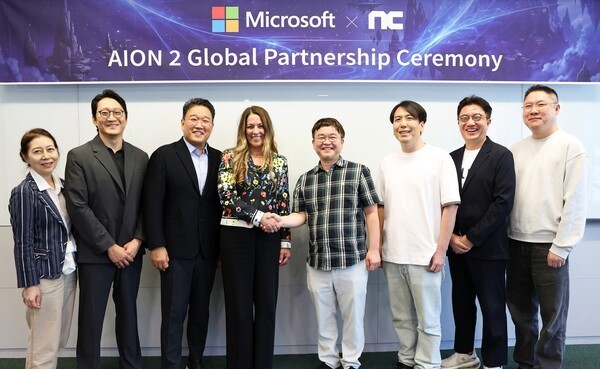
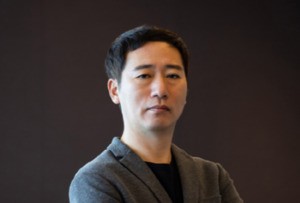
From left, Microsoft Korea Technical Sales Manager Lee Jong-hee, Gaming Customer Business Sales Representative Ma Seung-jae, CEO Cho Won-woo, Microsoft Executive Vice President and Chief Revenue Officer for Global Enterprise Deb Cupp, NC CBO Baek Seung-wook, AION 2 Global Publishing Head So In-seop, IP Alliance Director Choi Won-jong and AION 2 Technical Director Pung Hyun-seop. (Photo: NC)
From left, Microsoft Korea Technical Sales Manager Lee Jong-hee, Gaming Customer Business Sales Representative Ma Seung-jae, CEO Cho Won-woo, Microsoft Executive Vice President and Chief Revenue Officer for Global Enterprise Deb Cupp, NC CBO Baek Seung-wook, AION 2 Global Publishing Head So In-seop, IP Alliance Director Choi Won-jong and AION 2 Technical Director Pung Hyun-seop. (Photo: NC)
NC is working with Microsoft to prepare for the global launch of its new game “AION 2,” with Microsoft Korea setting up a dedicated team for the title. The companies will build global service infrastructure based on Microsoft Azure and pursue joint marketing with Microsoft’s global gaming organization.
NC said on Sept. 15 that it is strengthening its strategic partnership with Microsoft Korea to support the global service of AION 2.
Executives from the two companies met at NC’s R&D Center in Pangyo, Seongnam, on Sept. 14 to discuss cooperation for the global launch and operation of AION 2. Participants included NC Chief Business Officer (CBO) Baek Seung-wook and Microsoft Korea Chief Executive Officer Cho Won-woo.
Ahead of AION 2’s global launch on Oct. 5, NC will use Microsoft Azure’s global infrastructure. The aim is to handle large numbers of simultaneous users and regional traffic fluctuations during the global launch.
Microsoft plans to deploy its global technical organization and a dedicated Korea team to support AION 2, from performance verification before launch to incident response after the service goes live.
The companies will also expand their marketing partnership. They plan to conduct joint marketing with Microsoft’s global gaming organization to broaden AION 2’s reach among global users. Specific marketing methods and channels were not disclosed.
The partnership between NC and Microsoft also extends beyond game services. NC has deployed Microsoft 365 E5 companywide to establish its security and collaboration environment and is considering using Microsoft 365 Copilot to improve employee productivity.
“Microsoft, with its global operational capabilities and technical expertise, is a key partner joining NC in our most important global challenge,” Baek said.
“Microsoft will support NC’s service operations with its cloud capabilities and engineering expertise and work together to provide a stable gaming experience for users worldwide,” Cho said.
Kakao Games will acquire game company Me2on for 98 billion won.
The deal marks the first merger and acquisition (M&A) since co-CEOs Kim Tae-hwan and Lee Si-woo took office. It comes about a month after management said it would initially pursue M&A deals worth hundreds of billions of won.
Kakao Games said on Sept. 15 that its board approved the acquisition of 16,828,508 Me2on shares for a total of 98.01 billion won. Upon completion, Kakao Games will become Me2on's largest shareholder with a 39.56% stake. The transaction is scheduled to close on Nov. 16.
The entire 98 billion won, however, is not being paid to existing shareholders for management control. Kakao Games will acquire 7,011,390 existing shares held by Chief Executive Son Chang-wook, the current largest shareholder, and related parties for 70.11 billion won. Separately, it will participate in a third-party allotment capital increase by Me2on, acquiring 9,817,118 new shares for 27.9 billion won.
The existing shares will be acquired at 10,000 won each, about 3.2 times Me2on's Sept. 14 closing price of 3,110 won. Based on that closing price and 32,723,726 shares outstanding at the time, Me2on's market capitalization was about 101.8 billion won. Me2on shares closed Sept. 14 at 3,110 won, up 13.5% from the previous session.
By contrast, the new shares will be acquired at 2,842 won each, about 8.6% below the Sept. 14 closing price. The capital increase will raise Me2on's outstanding shares to 42,540,844 from 32,723,726. Kakao Games will hold a combined 16,828,508 existing and new shares, giving it a 39.56% stake after the capital increase. The roughly 27.9 billion won paid for the new shares will go directly to Me2on rather than existing shareholders.
The acquisition is the first implementation of the new Kakao Games management team's M&A strategy. Co-CEO Kim said during the company's second-quarter earnings announcement last month that Kakao Games was reviewing more than 10 investment and M&A opportunities in Korea and overseas. He said the company would start with deals worth hundreds of billions of won and gradually increase their scale rather than aggressively pursuing acquisitions worth trillions of won.
Me2on posted consolidated revenue of 120.9 billion won last year. According to regulatory filings, the company had assets of 264.9 billion won, liabilities of 22.7 billion won and equity of 242.2 billion won at the end of last year, with net income of 3.7 billion won. Second-quarter revenue rose 11.2% from a year earlier to 24.9 billion won, while operating profit jumped 61.6% to 4.8 billion won. First-half revenue totaled 47.9 billion won and operating profit 8.7 billion won.
Founded in 2010 and listed on Kosdaq in 2016, Me2on is a game company focused primarily on the social casino genre, with overseas markets accounting for more than 80% of its revenue.
Its major titles include "Full House Casino" and "Full Pot Hold'em." Full House Casino has built a user base primarily in Asian markets including Hong Kong and Japan. Me2on's businesses also include webtoon and web novel production and publishing, as well as drama production and entertainment management. More recently, it launched "ACE Casino," a global casino platform that supports the USDT stablecoin as a payment method.
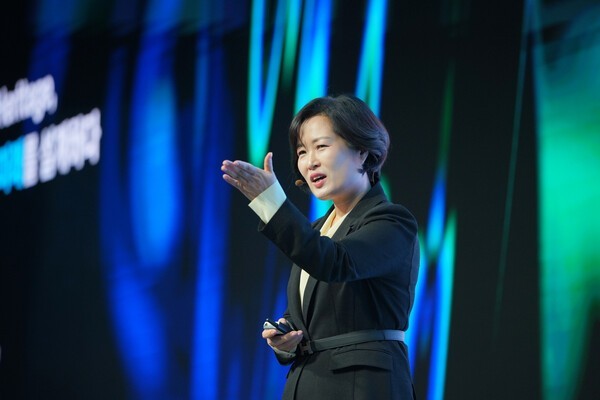
Choi Ok-jin, head of kt cloud’s DC division, presents the company’s AIDC supply roadmap. (Photo: KT)
Choi Ok-jin, head of kt cloud’s DC division, presents the company’s AIDC supply roadmap. (Photo: KT)
kt cloud plans to supply more than 1 gigawatt (GW) of artificial intelligence data center (AIDC) infrastructure across more than 20 sites in the Seoul metropolitan area and other regions by 2031. The company will vary the scale and development model of its data centers depending on location.
kt cloud unveiled its AIDC development roadmap and cloud business strategy at the “KT Cloud Summit 2026” held at the Grand InterContinental Seoul Parnas on Sept. 15.
KT announced its “AX Platform Company” strategy in July, saying it would invest 5 trillion won in AIDCs over the next five years to secure an additional 1GW of data center capacity.
The latest announcement sets out kt cloud’s execution plan, targeting completion by 2031. The company plans to provide more than 1GW of AIDC infrastructure across more than 20 locations. A simple calculation would put the average capacity at about 50 megawatts (MW) per site, although actual capacity is expected to vary depending on demand, power availability and site conditions.
The company will pursue different strategies in the Seoul metropolitan area and other regions. In the capital region, kt cloud will provide customized AIDCs based on sites where power and infrastructure have been secured. Outside the capital region, it will seek to attract global customers to areas where securing large-scale power supplies is relatively easier.
The strategy is aimed at attracting not only Korean companies but also global Big Tech companies and neocloud providers that supply large-scale AI computing resources.
kt cloud also plans to upgrade the technical specifications of its AI data centers. To address rising power consumption and heat generated by graphics processing units (GPUs) and other AI accelerators, the company will expand liquid cooling and ultra-high-density power supply technologies. It also plans to use digital twins, robots and open standards based on the Open Compute Project (OCP) to improve operational efficiency.
The company will also seek to integrate KT Group’s telecommunications infrastructure with its AIDCs. The plan is to connect geographically distributed AIDCs through KT’s ultra-low-latency backbone network, allowing multiple data centers to operate as a single infrastructure platform.
The key to kt cloud’s 1GW roadmap will be securing sufficient power, sites and demand. AI data centers consume significantly more electricity than conventional data centers, meaning the company will need to secure grid capacity, sites and regulatory approvals to bring the planned capacity into operation.
Kakao will shut down its standalone artificial intelligence (AI) service Kanana 17 months after its launch. The move marks a shift from its initial strategy of developing KakaoTalk and Kanana as services with separate roles, signaling a greater focus on AI services within KakaoTalk.
Kakao said on Sept. 15 that the Kanana AI mate app and PC service will end on Oct. 15, about 17 months after the beta service began in May last year.
Kanana is a standalone AI service that allows users to interact with AI mates named Kana and Nana. Kakao introduced various features through Kanana, including voice-based conversations, the “AI Studio” image-generation service and “Special Mate,” which supports services such as vehicle maintenance reservations.
Kakao initially planned to develop Kanana as an independent AI service separate from KakaoTalk.
Kakao Chief Executive Officer Chung Shin-a drew a distinction between KakaoTalk and Kanana during the company’s third-quarter earnings call in November 2024, dismissing concerns that the two services could cannibalize each other. Chung said the two had “different starting points,” with KakaoTalk focused on communication between users and Kanana on interactions between users and AI mates. The plan was to use Kanana to create new types of interactions between users and AI mates that would be difficult to implement within KakaoTalk. A subscription model was also discussed at the time as a potential way to monetize Kanana.
Kakao’s AI strategy, however, began shifting rapidly toward KakaoTalk last year. During the company’s second-quarter earnings call last year, Chung said Kakao would “no longer define Kanana as a name referring only to an independent app, but expand it into a brand encompassing Kakao’s entire AI business.” She also outlined a strategy to make AI part of everyday life through KakaoTalk.
Kakao has further strengthened its KakaoTalk-centered AI strategy this year. During its second-quarter earnings call last month, the company set a target of increasing monthly active users (MAUs) of AI services within KakaoTalk to more than 10 million by the end of this year. The plan is to integrate services including Kanana in KakaoTalk and “ChatGPT for Kakao” naturally into the KakaoTalk user experience.
Kakao has recently positioned “agentic AI,” which identifies user intent within KakaoTalk, recommends products and services, and handles orders, reservations and payments, as a new growth driver. The company plans to connect commerce, reservation, travel and payment service providers with AI agents, increasing AI usage within KakaoTalk and linking it to its existing businesses.
Kakao said all user data will be deleted upon termination of the service in accordance with applicable laws and its privacy policy.
Com2uS Holdings has launched “ARES: The Iron Vanguard,” a stylish action role-playing game (RPG) developed by Second Dive, in global markets.
The company is targeting major markets including North America, Europe and Southeast Asia. To improve accessibility, the game supports cross-play across PC and mobile platforms, including Apple’s App Store and Google Play.
The global version moves away from the traditional massively multiplayer online role-playing game (MMORPG) structure and has been revamped as a single-player-focused action RPG tailored to global players. The early stages center on single-player content, allowing players to experience the story and combat on their own. As they progress, the game expands into cooperative content including raids and seasonal endgame content. Competitive content is offered separately as an optional mode based on player preference.
The game also retains the original title’s science-fiction setting and action-oriented gameplay. Players can use “Suit Change” to configure two suits and switch between them in real time depending on the situation, along with dodging and combo attacks. Combat also includes battles aboard the giant Goliath mech and aerial combat using Valkyries.
Com2uS Holdings conducted a soft launch in six countries — Indonesia, Malaysia, Brazil, Canada, Australia and New Zealand — starting in August. Feedback collected from global players during the period was incorporated into content improvements and operational optimization for the global service.
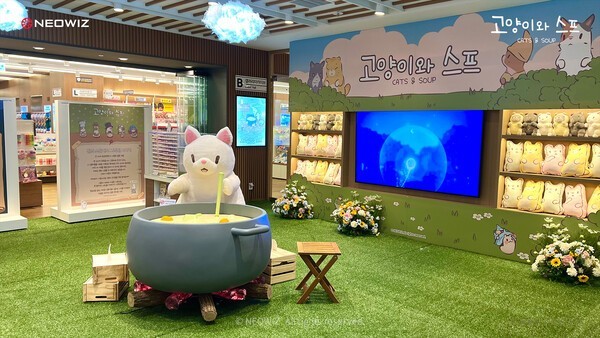
NEOWIZ has opened a “Cats & Soup” collaboration pop-up store with Youngpoong Bookstore. (Photo: NEOWIZ)
NEOWIZ has opened a “Cats & Soup” collaboration pop-up store with Youngpoong Bookstore. (Photo: NEOWIZ)
NEOWIZ said on Sept. 15 that its relaxing idle mobile game “Cats & Soup” has opened a collaboration pop-up store with Youngpoong Bookstore.
The pop-up, titled “Cats & Soup Met Between the Bookshelves,” will run through Oct. 11 in the Gallery Archive Zone at Youngpoong Bookstore’s Yeouido IFC Mall branch. The space combines the relaxing atmosphere of “Cats & Soup” with the bookstore’s focus on culture and leisure.
Visitors can experience a range of activities designed to bring the game’s relaxing atmosphere offline. The space includes a photo zone where visitors can take pictures with Kiki cooking soup, a relaxation zone where they can sit on beanbags, read books and listen to the game’s relaxing background music, and a photo booth featuring exclusive pop-up frames. A merchandise zone also displays and sells a variety of “Cats & Soup” goods making their debut at the pop-up.
The pop-up also offers benefits for visitors. Customers who spend at least 10,000 won on any products at Youngpoong Bookstore, including regular books, will receive a bookmark containing a coupon for an in-game “Cats & Soup” item, while those who spend at least 30,000 won will also receive a ticket for the dedicated photo booth. Special benefits are also available for existing “Cats & Soup” fans. Customers who verify on-site that they own at least 40 cats in the game will receive a “Collection Badge for Veteran Butlers.”
Joycity said Monday it has signed an official licensing partnership with the Major League Soccer Players Association (MLSPA) and OneTeam Partners for its upcoming game Freestyle Football 2.
Under the agreement, Joycity secured the rights to use player intellectual property, including the names, jersey numbers and likenesses of players represented by the MLSPA in Freestyle Football 2. MLS players will be created as playable characters in the game.
The collaboration is distinguished by Joycity's redesign of real players based on their actual data while adapting their appearance to the distinctive graphic style of Freestyle Football 2. Each player will feature a unique appearance tailored to the game's fast-paced play and dedicated skills reflecting the player's individual characteristics.
“We will turn selected MLS players into original characters tailored to the identity of the game, providing a new playing experience for both soccer fans and gamers,” said Park Jun-seung, head of Joycity's Strategic Business Division.
The partnership was facilitated by OneTeam Partners, the MLSPA's group player licensing partner. OneTeam Partners specializes in licensing the intellectual property, including the likenesses, of professional sports athletes and supports collaborations between players and game developers.
Kingnet, a Chinese game company that has been embroiled in a roughly decade-long legal dispute with Wemade over the intellectual property (IP) of "The Legend of Mir 2," will participate as a key investor in a consortium acquiring a controlling stake in Wemade. The company plans to invest about 400 billion won to establish a capital relationship with Wemade, effectively gaining a major shareholder position.
Wemade and Neopulse said in a joint statement on Sept. 14 that an investor consortium including game investment platform Neopulse and Kingnet signed a stock purchase agreement (SPA) with Wemade Chairman Park Kwan-ho on June 30. Wemade had not previously disclosed specific details about the acquiring company. The parties said they aim to complete the transaction, including payment of the remaining balance and regulatory approvals, on Oct. 30.
Once the transaction is completed, Neopulse will acquire Park’s 39.33% stake in Wemade for 920 billion won. Including its existing 0.92% stake, the consortium’s ownership will rise to 40.25%, making it Wemade’s largest shareholder.
The key investor newly identified on Sept. 14 is Kingnet. In a Chinese securities filing on Sept. 12, Kingnet disclosed that its wholly owned Hong Kong subsidiary, Cypress Technology HK Limited, will acquire a 49% stake in Neosphere, the parent company of Neopulse.
Kingnet estimates its total investment at about 2.03 billion yuan. In addition to Kingnet’s investment, Neosphere’s existing shareholders will contribute capital in a capital increase. The funds will be used for Neopulse’s acquisition of the stake in Wemade.
After the transaction, Kingnet will hold 49% of Neosphere, while existing shareholder Nexpulse will own 51%. Neosphere will control Neopulse, which will hold a 40.25% stake in Wemade. Kingnet also classified Wemade in its Chinese filing as an overseas listed company targeted for indirect equity investment, rather than a company targeted for management control.
The investment is driven by Wemade’s “Mir” IP.
According to Kingnet’s filing, the parties plan to pursue an exclusive licensing agreement for the Mir IP after the transaction involving Wemade’s shares is completed. Neosphere’s existing shareholder Nexpulse agreed to make efforts to have Wemade enter into an exclusive Mir IP licensing agreement with Neosphere once the delivery of Wemade’s 39.33% stake is completed. The proposed licensing fee would not exceed the consideration Wemade or its affiliates receive under existing Mir IP agreements with partners. The exclusive licensing agreement has not yet been signed.
Kingnet directly cited the Mir IP business as an investment objective. The company said it plans to strengthen cooperation on licensing and revenue sharing for the Mir IP and the development of derivative products, while expanding rights and business opportunities needed to develop, publish and operate Mir-related mobile, web and HTML5 games in China. It also plans to expand cooperation with Wemade on joint development of new titles and operations in the Chinese market.
Wemade and Kingnet had been engaged in legal disputes for about a decade. The dispute began after Kingnet subsidiary Zhejiang Huanyou failed to pay royalties for "Namwoljeonki," a game based on The Legend of Mir 2 IP that it had operated in China since 2016. International Chamber of Commerce (ICC) arbitration and litigation followed, and Wemade received a settlement payment of 43 billion won from Kingnet in April this year, bringing the dispute to an end.
The two companies, which had faced each other in court for roughly a decade, have effectively been tied together through capital just five months later. With Kingnet joining the consortium as a major investor in Wemade’s largest-shareholder group, the companies’ relationship over the Mir IP is shifting toward long-term business cooperation.
Wemade said, “Once the transaction is completed, the investor consortium plans, as Wemade’s largest shareholder, to focus on expanding various opportunities in global and Chinese markets, including publishing and core IP licensing businesses.” It added, “The core businesses currently being pursued and organizational operations will continue according to existing plans without disruption.”
Kingnet has operated Mir-related IP businesses in the Chinese game market for many years. By directly investing in the consortium that will become the largest shareholder of Wemade, the original rights holder of the Mir IP, Kingnet will be able to secure a more stable business base than before for game development, publishing and IP licensing in China.
The industry, however, takes a negative view of Wemade’s blockchain business, WEMIX. Under regulations jointly announced by 10 Chinese institutions, including the People’s Bank of China, in 2021, activities involving digital assets were classified as “illegal financial activities.” Exchanges between fiat currency and digital assets, transaction brokerage and the provision of price information were all prohibited. Overseas digital-asset exchanges providing services to users in mainland China via the internet were also interpreted as engaging in illegal financial activities.
An industry source familiar with the matter said, “China does not permit Chinese companies to operate overseas digital-asset businesses either. The prevailing view is that the WEMIX business will be separated from Wemade in some form.”

 Login