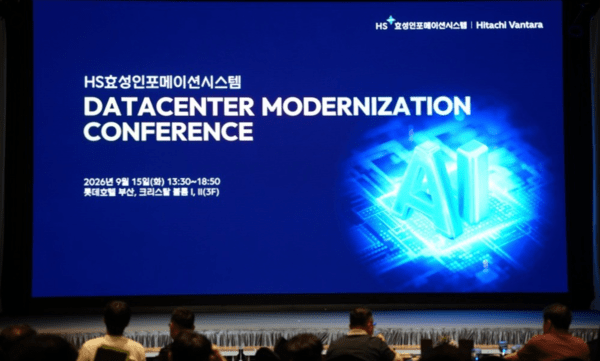
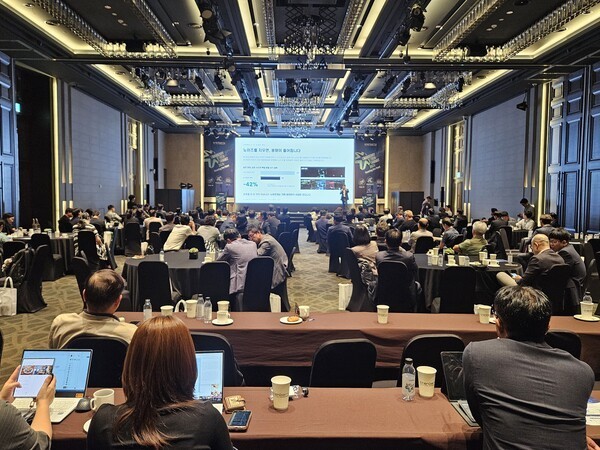
HS Hyosung Information Systems, an AI and data infrastructure solutions provider, held its Data Center Modernization Conference 2026 at Lotte Hotel Busan on Sept. 15. The conference is an annual event that HS Hyosung Information Systems has held for IT professionals in the Busan and South Gyeongsang region for more than a decade.
HS Hyosung Information Systems said it shared strategies and insights for data center modernization in the AI era, including data and infrastructure strategies for enterprise AI, more efficient private cloud operations and ways to strengthen cyber resilience.
According to HS Hyosung Information Systems, data center infrastructure is increasingly required to reliably process and operate large-scale AI workloads and vast amounts of data, driving a shift toward redesigning overall infrastructure to integrate AI infrastructure, cloud operations and data protection.
In response to these changes, the conference broadly covered key infrastructure strategies required for data centers, including data and infrastructure development for enterprise AI, modernization of AI training and inference environments, greater efficiency in private cloud and data center operations, and security and data protection.
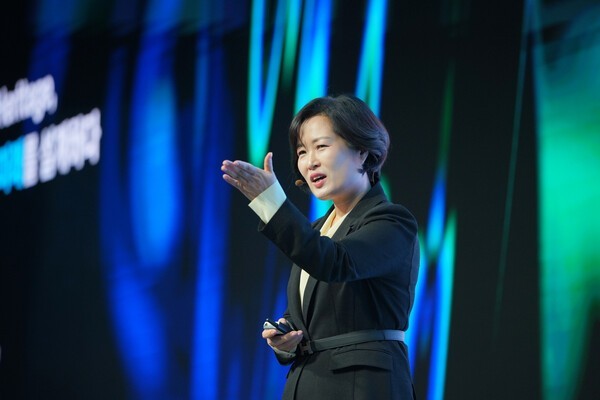
Dong-soo Kwon, a senior expert at HS Hyosung Information Systems, delivered a keynote presentation titled "Data and Infrastructure Strategies for Enterprise AI in the Agentic AI Era of 2026." Go-hoon Jung, a project manager at HS Hyosung Information Systems, then outlined the company's capabilities and strategies for building private clouds through a smart city development project case study. Dong-hyuk Kim, a team leader at HS Hyosung Information Systems, also presented data protection and recovery strategies designed to support uninterrupted business operations amid disasters and cyber threats.
Major technology partners also participated. FuriosaAI showcased its RNGD neural processing unit (NPU), which supports high power efficiency and high-performance inference, while Lablup presented modernization tools for efficient AI training and inference.
VMware by Broadcom shared ways to reduce data center costs using VMware Cloud Foundation (VCF), while Veeam Software presented next-generation service recovery strategies for zero-trust environments. Palo Alto Networks Korea presented a data center modernization strategy using its Precision AI-based security platform.
The venue also featured exhibition booths where attendees could explore technologies and solutions from major partners including C Platform, Ocean Technology, Gensys and Union Biometrics.
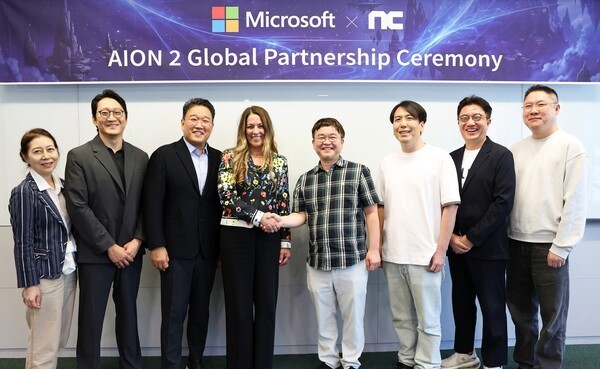
From left, Microsoft Korea Technical Sales Manager Lee Jong-hee, Gaming Customer Business Sales Representative Ma Seung-jae, CEO Cho Won-woo, Microsoft Executive Vice President and Chief Revenue Officer for Global Enterprise Deb Cupp, NC CBO Baek Seung-wook, AION 2 Global Publishing Head So In-seop, IP Alliance Director Choi Won-jong and AION 2 Technical Director Pung Hyun-seop. (Photo: NC)
From left, Microsoft Korea Technical Sales Manager Lee Jong-hee, Gaming Customer Business Sales Representative Ma Seung-jae, CEO Cho Won-woo, Microsoft Executive Vice President and Chief Revenue Officer for Global Enterprise Deb Cupp, NC CBO Baek Seung-wook, AION 2 Global Publishing Head So In-seop, IP Alliance Director Choi Won-jong and AION 2 Technical Director Pung Hyun-seop. (Photo: NC)
NC is working with Microsoft to prepare for the global launch of its new game “AION 2,” with Microsoft Korea setting up a dedicated team for the title. The companies will build global service infrastructure based on Microsoft Azure and pursue joint marketing with Microsoft’s global gaming organization.
NC said on Sept. 15 that it is strengthening its strategic partnership with Microsoft Korea to support the global service of AION 2.
Executives from the two companies met at NC’s R&D Center in Pangyo, Seongnam, on Sept. 14 to discuss cooperation for the global launch and operation of AION 2. Participants included NC Chief Business Officer (CBO) Baek Seung-wook and Microsoft Korea Chief Executive Officer Cho Won-woo.
Ahead of AION 2’s global launch on Oct. 5, NC will use Microsoft Azure’s global infrastructure. The aim is to handle large numbers of simultaneous users and regional traffic fluctuations during the global launch.
Microsoft plans to deploy its global technical organization and a dedicated Korea team to support AION 2, from performance verification before launch to incident response after the service goes live.
The companies will also expand their marketing partnership. They plan to conduct joint marketing with Microsoft’s global gaming organization to broaden AION 2’s reach among global users. Specific marketing methods and channels were not disclosed.
The partnership between NC and Microsoft also extends beyond game services. NC has deployed Microsoft 365 E5 companywide to establish its security and collaboration environment and is considering using Microsoft 365 Copilot to improve employee productivity.
“Microsoft, with its global operational capabilities and technical expertise, is a key partner joining NC in our most important global challenge,” Baek said.
“Microsoft will support NC’s service operations with its cloud capabilities and engineering expertise and work together to provide a stable gaming experience for users worldwide,” Cho said.
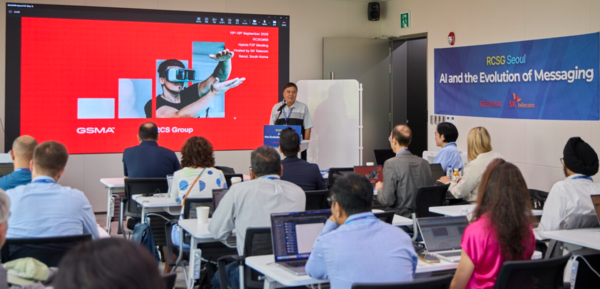
A GSMA RCS standardization meeting at SKT Tower. (Photo: SK Telecom)
A GSMA RCS standardization meeting at SKT Tower. (Photo: SK Telecom)
SK Telecom (SKT) said it is hosting an in-person standardization meeting of the GSMA Rich Communication Services (RCS) group at SKT Tower in Seoul from Sept. 15 to 18, where participants will discuss ways to combine artificial intelligence (AI) with messaging services.
As AI's capabilities expand into real-world actions such as reservations and payments, SKT is seeking to redefine the role of messaging. The company envisions using messages as a channel through which AI agents obtain users' final approval before carrying out actions.
The GSMA RCS group is a body under the GSMA where global telecommunications carriers, device and platform companies, and business messaging providers discuss RCS technical standards and service specifications. The SKT-hosted meeting is attended by 33 representatives, including staff from 16 companies — global carriers AT&T, T-Mobile, Vodafone and Orange, as well as Apple, Google and Samsung Electronics — along with GSMA officials. RCS is a next-generation messaging standard that supports features such as photo and video transmission through smartphones' native messaging apps.
An AI special session has been added to the meeting alongside regular standardization topics. SKT proposed the AI agenda to the GSMA and agreed to hold a special session titled "AI and the Evolution of Messaging" on Sept. 17. SKT also led the organization of the session and recruitment of participating companies.
The session will cover the integration of RCS and AI agents, trust in AI and user control, improvements to brand registration using AI, and AI-based spam prevention for business messaging. Participants will share their technologies and service experience and discuss the functions and roles messaging will require in the AI era.
User control is at the heart of discussions about connecting AI with RCS. As AI agents increasingly execute actual transactions, users need to directly review and approve key information such as order details and payment amounts before a transaction is finalized. If that confirmation takes place within the AI service itself, however, it could be affected by malfunctions or external manipulation. Different approval methods among AI agents could also make it difficult for users to determine whether a request is legitimate.
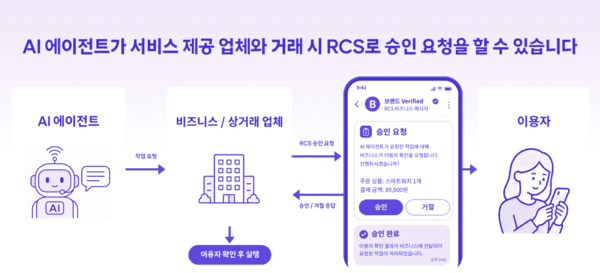
To address the issue, SKT has proposed "AI Agent Approval over RCS" as a standardization agenda, using RCS as a separate channel outside the AI service where users can make the final decision. RCS can verify that the company requesting approval is legitimate because only pre-registered and verified businesses can display their names and logos.
Messages can also include product images and an "Approve" button, allowing users to respond without opening another app. Approval requests and results remain in the conversation history of the smartphone's native messaging app for later review.
Example of an RCS-based AI agent approval process. (Source: SK Telecom)
For example, when an AI agent requests a product payment, the user can review the order details and payment amount in an RCS message and approve the transaction. This preserves the convenience of having AI perform tasks while leaving the final transaction decision to the user.
SKT said the role of telecommunications in the AI era will expand to connecting people with AI agents and that it plans to use its connectivity and authentication capabilities to build "AI trust infrastructure."
SKT said it has operated its own RCS network and services while working to incorporate features needed in Korea into global standards. Rich Text Formatting, which SKT proposed at a Seoul meeting in May last year, was incorporated into RCS Universal Profile 4.0 earlier this year. The company said the latest meeting will expand discussions to the convergence of RCS and AI while seeking opportunities for technical exchanges and cooperation with global carriers, device makers and messaging providers.
Kakao Games will acquire game company Me2on for 98 billion won.
The deal marks the first merger and acquisition (M&A) since co-CEOs Kim Tae-hwan and Lee Si-woo took office. It comes about a month after management said it would initially pursue M&A deals worth hundreds of billions of won.
Kakao Games said on Sept. 15 that its board approved the acquisition of 16,828,508 Me2on shares for a total of 98.01 billion won. Upon completion, Kakao Games will become Me2on's largest shareholder with a 39.56% stake. The transaction is scheduled to close on Nov. 16.
The entire 98 billion won, however, is not being paid to existing shareholders for management control. Kakao Games will acquire 7,011,390 existing shares held by Chief Executive Son Chang-wook, the current largest shareholder, and related parties for 70.11 billion won. Separately, it will participate in a third-party allotment capital increase by Me2on, acquiring 9,817,118 new shares for 27.9 billion won.
The existing shares will be acquired at 10,000 won each, about 3.2 times Me2on's Sept. 14 closing price of 3,110 won. Based on that closing price and 32,723,726 shares outstanding at the time, Me2on's market capitalization was about 101.8 billion won. Me2on shares closed Sept. 14 at 3,110 won, up 13.5% from the previous session.
By contrast, the new shares will be acquired at 2,842 won each, about 8.6% below the Sept. 14 closing price. The capital increase will raise Me2on's outstanding shares to 42,540,844 from 32,723,726. Kakao Games will hold a combined 16,828,508 existing and new shares, giving it a 39.56% stake after the capital increase. The roughly 27.9 billion won paid for the new shares will go directly to Me2on rather than existing shareholders.
The acquisition is the first implementation of the new Kakao Games management team's M&A strategy. Co-CEO Kim said during the company's second-quarter earnings announcement last month that Kakao Games was reviewing more than 10 investment and M&A opportunities in Korea and overseas. He said the company would start with deals worth hundreds of billions of won and gradually increase their scale rather than aggressively pursuing acquisitions worth trillions of won.
Me2on posted consolidated revenue of 120.9 billion won last year. According to regulatory filings, the company had assets of 264.9 billion won, liabilities of 22.7 billion won and equity of 242.2 billion won at the end of last year, with net income of 3.7 billion won. Second-quarter revenue rose 11.2% from a year earlier to 24.9 billion won, while operating profit jumped 61.6% to 4.8 billion won. First-half revenue totaled 47.9 billion won and operating profit 8.7 billion won.
Founded in 2010 and listed on Kosdaq in 2016, Me2on is a game company focused primarily on the social casino genre, with overseas markets accounting for more than 80% of its revenue.
Its major titles include "Full House Casino" and "Full Pot Hold'em." Full House Casino has built a user base primarily in Asian markets including Hong Kong and Japan. Me2on's businesses also include webtoon and web novel production and publishing, as well as drama production and entertainment management. More recently, it launched "ACE Casino," a global casino platform that supports the USDT stablecoin as a payment method.
Choi Ok-jin, head of kt cloud’s DC division, presents the company’s AIDC supply roadmap. (Photo: KT)
Choi Ok-jin, head of kt cloud’s DC division, presents the company’s AIDC supply roadmap. (Photo: KT)
kt cloud plans to supply more than 1 gigawatt (GW) of artificial intelligence data center (AIDC) infrastructure across more than 20 sites in the Seoul metropolitan area and other regions by 2031. The company will vary the scale and development model of its data centers depending on location.
kt cloud unveiled its AIDC development roadmap and cloud business strategy at the “KT Cloud Summit 2026” held at the Grand InterContinental Seoul Parnas on Sept. 15.
KT announced its “AX Platform Company” strategy in July, saying it would invest 5 trillion won in AIDCs over the next five years to secure an additional 1GW of data center capacity.
The latest announcement sets out kt cloud’s execution plan, targeting completion by 2031. The company plans to provide more than 1GW of AIDC infrastructure across more than 20 locations. A simple calculation would put the average capacity at about 50 megawatts (MW) per site, although actual capacity is expected to vary depending on demand, power availability and site conditions.
The company will pursue different strategies in the Seoul metropolitan area and other regions. In the capital region, kt cloud will provide customized AIDCs based on sites where power and infrastructure have been secured. Outside the capital region, it will seek to attract global customers to areas where securing large-scale power supplies is relatively easier.
The strategy is aimed at attracting not only Korean companies but also global Big Tech companies and neocloud providers that supply large-scale AI computing resources.
kt cloud also plans to upgrade the technical specifications of its AI data centers. To address rising power consumption and heat generated by graphics processing units (GPUs) and other AI accelerators, the company will expand liquid cooling and ultra-high-density power supply technologies. It also plans to use digital twins, robots and open standards based on the Open Compute Project (OCP) to improve operational efficiency.
The company will also seek to integrate KT Group’s telecommunications infrastructure with its AIDCs. The plan is to connect geographically distributed AIDCs through KT’s ultra-low-latency backbone network, allowing multiple data centers to operate as a single infrastructure platform.
The key to kt cloud’s 1GW roadmap will be securing sufficient power, sites and demand. AI data centers consume significantly more electricity than conventional data centers, meaning the company will need to secure grid capacity, sites and regulatory approvals to bring the planned capacity into operation.
Kakao will shut down its standalone artificial intelligence (AI) service Kanana 17 months after its launch. The move marks a shift from its initial strategy of developing KakaoTalk and Kanana as services with separate roles, signaling a greater focus on AI services within KakaoTalk.
Kakao said on Sept. 15 that the Kanana AI mate app and PC service will end on Oct. 15, about 17 months after the beta service began in May last year.
Kanana is a standalone AI service that allows users to interact with AI mates named Kana and Nana. Kakao introduced various features through Kanana, including voice-based conversations, the “AI Studio” image-generation service and “Special Mate,” which supports services such as vehicle maintenance reservations.
Kakao initially planned to develop Kanana as an independent AI service separate from KakaoTalk.
Kakao Chief Executive Officer Chung Shin-a drew a distinction between KakaoTalk and Kanana during the company’s third-quarter earnings call in November 2024, dismissing concerns that the two services could cannibalize each other. Chung said the two had “different starting points,” with KakaoTalk focused on communication between users and Kanana on interactions between users and AI mates. The plan was to use Kanana to create new types of interactions between users and AI mates that would be difficult to implement within KakaoTalk. A subscription model was also discussed at the time as a potential way to monetize Kanana.
Kakao’s AI strategy, however, began shifting rapidly toward KakaoTalk last year. During the company’s second-quarter earnings call last year, Chung said Kakao would “no longer define Kanana as a name referring only to an independent app, but expand it into a brand encompassing Kakao’s entire AI business.” She also outlined a strategy to make AI part of everyday life through KakaoTalk.
Kakao has further strengthened its KakaoTalk-centered AI strategy this year. During its second-quarter earnings call last month, the company set a target of increasing monthly active users (MAUs) of AI services within KakaoTalk to more than 10 million by the end of this year. The plan is to integrate services including Kanana in KakaoTalk and “ChatGPT for Kakao” naturally into the KakaoTalk user experience.
Kakao has recently positioned “agentic AI,” which identifies user intent within KakaoTalk, recommends products and services, and handles orders, reservations and payments, as a new growth driver. The company plans to connect commerce, reservation, travel and payment service providers with AI agents, increasing AI usage within KakaoTalk and linking it to its existing businesses.
Kakao said all user data will be deleted upon termination of the service in accordance with applicable laws and its privacy policy.
Com2uS Holdings has launched “ARES: The Iron Vanguard,” a stylish action role-playing game (RPG) developed by Second Dive, in global markets.
The company is targeting major markets including North America, Europe and Southeast Asia. To improve accessibility, the game supports cross-play across PC and mobile platforms, including Apple’s App Store and Google Play.
The global version moves away from the traditional massively multiplayer online role-playing game (MMORPG) structure and has been revamped as a single-player-focused action RPG tailored to global players. The early stages center on single-player content, allowing players to experience the story and combat on their own. As they progress, the game expands into cooperative content including raids and seasonal endgame content. Competitive content is offered separately as an optional mode based on player preference.
The game also retains the original title’s science-fiction setting and action-oriented gameplay. Players can use “Suit Change” to configure two suits and switch between them in real time depending on the situation, along with dodging and combo attacks. Combat also includes battles aboard the giant Goliath mech and aerial combat using Valkyries.
Com2uS Holdings conducted a soft launch in six countries — Indonesia, Malaysia, Brazil, Canada, Australia and New Zealand — starting in August. Feedback collected from global players during the period was incorporated into content improvements and operational optimization for the global service.
OpenAI has acquired smartphone camera artificial intelligence (AI) and imaging startup Glass Imaging Inc. for more than $300 million, The Wall Street Journal reported on Sept. 14. Neither OpenAI nor Glass Imaging has officially confirmed the deal, while foreign media have viewed the acquisition as a further expansion of OpenAI’s push into consumer hardware.
Glass Imaging develops AI-based image processing technology designed to overcome the physical limitations of smartphones’ small image sensors and lenses. The acquisition is drawing attention because OpenAI is developing consumer devices with renowned former Apple designer Jony Ive.
Ive led the design of Apple products including the iPhone, iPad and iPod. OpenAI has been developing new AI devices with Ive and his design firm LoveFrom since the fall of 2023.
Ive founded io Products Inc. in 2024 with Scott Cannon, Evans Hankey and Tang Tan, and OpenAI entered the consumer hardware market by acquiring io Products in May last year. OpenAI announced an all-stock transaction valuing io Products at $6.5 billion and completed the acquisition in July of the same year.
Following the acquisition, 55 hardware, software and product development employees, including former Apple staff at io Products, joined OpenAI. No new AI device has been officially announced, but Bloomberg reported last month that the first device under development by OpenAI and Ive is a donut-shaped, screenless smart speaker, with a price of $300 to $400 under discussion.
The industry is paying attention to OpenAI’s move to acquire AI camera technology.
If AI agents are embedded in smartphones, glasses, earbuds or other personal devices, cameras can serve as key sensors that allow AI to perceive the physical world. Current smart glasses allow users to show AI particular objects or places through a camera, enabling the AI to recognize, explain or analyze them.
Glass Imaging Uses AI Trained on Optical Characteristics to Overcome Smartphone Camera Limits
Founded in 2019, Glass Imaging is headquartered in Los Altos, California, and has raised $30 million in external funding. The company was valued at $100 million in a funding round last year. The latest acquisition represents a threefold increase in valuation.
Its co-founders, Ziv Attar and Tom Bishop, are also former Apple engineers. Attar founded Israeli camera startup LinX Imaging, which Apple acquired in 2015 for $20 million, bringing Attar to Apple.
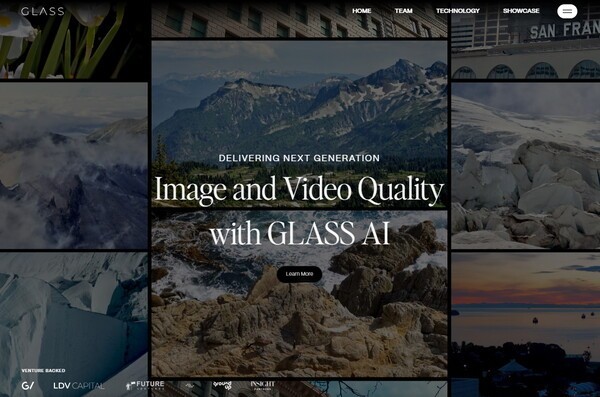
Glass Imaging's website. (Photo: Glass Imaging)
Foreign media have reported that the two co-founders led the team that developed Apple’s Portrait Mode. Apple’s Portrait Mode brought the so-called bokeh effect to smartphones by distinguishing a subject from the background and blurring the latter.
Bokeh is a photography term referring to blurred areas, points of light or out-of-focus regions in the background of a photo or video. The term derives from the Japanese word “boke,” meaning blur or haze. Computational photography is a digital imaging technology that uses software calculations, algorithms and AI to overcome the physical limitations of optical lenses and sensors and to synthesize and improve images. It enables thin devices with small lens apertures and sensors, such as smartphones, to produce images approaching the quality of large DSLR cameras.
Glass Imaging’s technology takes original RAW data captured by a camera sensor and processes the entire post-capture imaging pipeline through a neural network.
A key feature is that the neural network is trained in advance on the specific camera system used in each smartphone model. It learns the characteristics of the camera types, sensors, lenses and other components of a particular camera system.
GlassAI Trains Neural Networks on Individual Camera Modules
At the core of Glass Imaging’s technology is GlassAI, a neural network-based image signal processor (ISP) software. Unlike conventional ISPs, which process RAW data through multiple stages including demosaicing, noise reduction, sharpening and frame fusion, GlassAI uses an end-to-end neural network to process RAW data into red, green and blue (RGB) images.
GlassAI performs those processes at once while also modeling the optical characteristics of individual lenses. The neural network is trained to reflect the optical and sensor characteristics of each smartphone camera module, allowing it to produce images tailored to that particular camera system during capture.
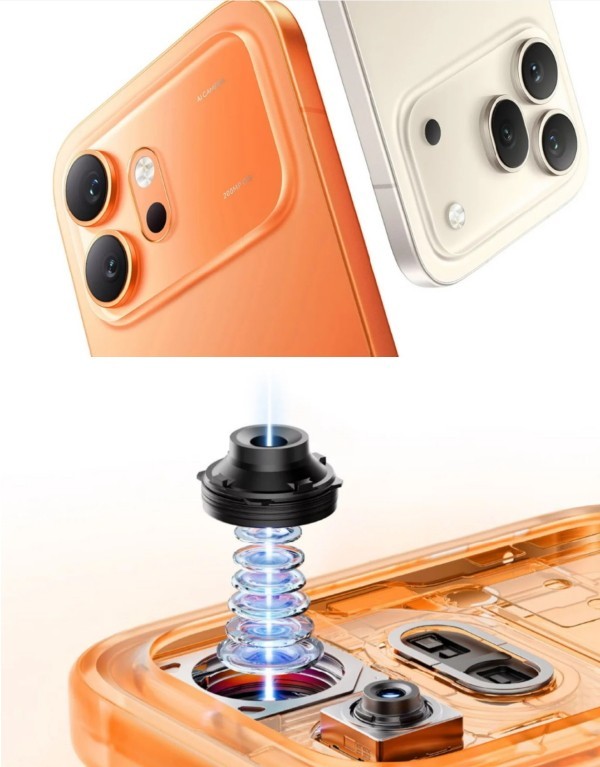
An Honor 600 smartphone equipped with Glass Imaging technology. The device uses a 200-megapixel camera and GlassAI for zoom photography without a telephoto lens. (Source: Honor)
While conventional AI photography technologies focus on improving the quality of images after they are captured, GlassAI learns the physical characteristics of camera lenses and sensors and uses a neural network for the entire process of converting RAW data into images.
According to SiliconANGLE, GlassAI measures the point spread function (PSF) for each lens-and-sensor combination, along with sensor response and noise profiles, and trains the neural network to address the shortcomings of that specific combination. A PSF mathematically describes how a perfect point of light spreads after passing through an optical system such as a camera, telescope or microscope. As a result, a change in smartphone model requires training and tuning for the specific camera module.
Glass Imaging says the resulting detail is not newly generated by AI but information captured by the sensor that would otherwise be lost during conventional ISP processing. The company also says the technology becomes more effective as pixel sizes decrease.
According to an interview Glass Imaging machine-learning engineer Shivansh Rao gave to photography publication PetaPixel, submicron pixels contain fine details that conventional approaches cannot properly decode. Tests showed that as pixel size decreased from 0.75 micrometers (μm) to 0.35μm, the neural-network approach improved MTF50, a resolution metric, by more than 50%.
A comparison of zoomed images of the same subject taken with the Honor 600 and iPhone 17. Left, the Honor 600 processed with the GlassAI neural network; right, Apple’s iPhone 17. (Source: PetaPixel)
The technology is being used for zoom functionality in the 600 series from Chinese smartphone maker Honor Device Co. The Honor 600 uses a 200-megapixel main camera to provide zoom without a dedicated telephoto camera. It uses a 16-in-1 Hexa Bayer configuration that combines 16 0.56μm pixels into the equivalent of a 2.24μm superpixel for regular photography.
The challenge arises when zoom is used. Cropping part of the sensor rather than using its entire area to magnify an image requires information from the small native 0.56μm pixels. As pixels become smaller, they capture less light and become relatively more susceptible to optical limitations, noise and blur. The structure is inherently disadvantaged compared with using a dedicated telephoto lens.
Glass Imaging uses neural networks to compensate for those limitations. GlassAI, trained in advance on the lens and sensor characteristics of a camera module, analyzes RAW data from the sensor and restores details lost in conventional image processing. Glass Imaging says this allows high-resolution main-camera pixels to deliver higher-quality zoom images without adding a separate telephoto camera.
Zoom remains an area where smartphone cameras face physical limitations. Smartphones, constrained by thickness and size, cannot accommodate long optical systems like those used in DSLRs. Even with multiple cameras, each has a limited focal length, while digital zoom results in image-quality degradation.
The Honor 600 uses GlassAI to correct the effects of optical aberrations and sensor noise during smartphone zoom photography and restore image detail. Glass Imaging’s technology uses AI to compensate for the physical limitations of small sensors and lenses, enabling higher-quality zoom images in compact devices.
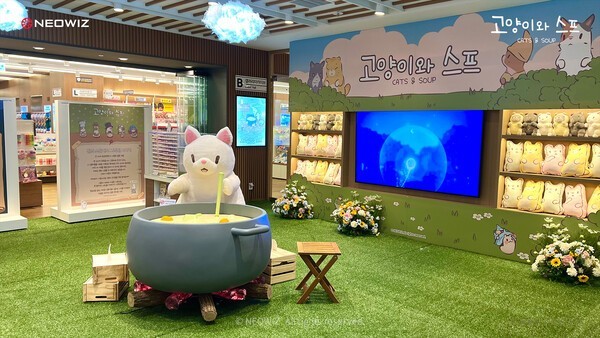
NEOWIZ has opened a “Cats & Soup” collaboration pop-up store with Youngpoong Bookstore. (Photo: NEOWIZ)
NEOWIZ has opened a “Cats & Soup” collaboration pop-up store with Youngpoong Bookstore. (Photo: NEOWIZ)
NEOWIZ said on Sept. 15 that its relaxing idle mobile game “Cats & Soup” has opened a collaboration pop-up store with Youngpoong Bookstore.
The pop-up, titled “Cats & Soup Met Between the Bookshelves,” will run through Oct. 11 in the Gallery Archive Zone at Youngpoong Bookstore’s Yeouido IFC Mall branch. The space combines the relaxing atmosphere of “Cats & Soup” with the bookstore’s focus on culture and leisure.
Visitors can experience a range of activities designed to bring the game’s relaxing atmosphere offline. The space includes a photo zone where visitors can take pictures with Kiki cooking soup, a relaxation zone where they can sit on beanbags, read books and listen to the game’s relaxing background music, and a photo booth featuring exclusive pop-up frames. A merchandise zone also displays and sells a variety of “Cats & Soup” goods making their debut at the pop-up.
The pop-up also offers benefits for visitors. Customers who spend at least 10,000 won on any products at Youngpoong Bookstore, including regular books, will receive a bookmark containing a coupon for an in-game “Cats & Soup” item, while those who spend at least 30,000 won will also receive a ticket for the dedicated photo booth. Special benefits are also available for existing “Cats & Soup” fans. Customers who verify on-site that they own at least 40 cats in the game will receive a “Collection Badge for Veteran Butlers.”
Joycity said Monday it has signed an official licensing partnership with the Major League Soccer Players Association (MLSPA) and OneTeam Partners for its upcoming game Freestyle Football 2.
Under the agreement, Joycity secured the rights to use player intellectual property, including the names, jersey numbers and likenesses of players represented by the MLSPA in Freestyle Football 2. MLS players will be created as playable characters in the game.
The collaboration is distinguished by Joycity's redesign of real players based on their actual data while adapting their appearance to the distinctive graphic style of Freestyle Football 2. Each player will feature a unique appearance tailored to the game's fast-paced play and dedicated skills reflecting the player's individual characteristics.
“We will turn selected MLS players into original characters tailored to the identity of the game, providing a new playing experience for both soccer fans and gamers,” said Park Jun-seung, head of Joycity's Strategic Business Division.
The partnership was facilitated by OneTeam Partners, the MLSPA's group player licensing partner. OneTeam Partners specializes in licensing the intellectual property, including the likenesses, of professional sports athletes and supports collaborations between players and game developers.
DeepSeek has unveiled its latest artificial intelligence model, DeepSeek-V4.1-Flash. Although it has fewer parameters than DeepSeek's top-tier V4-Pro model, the new model showed advantages in performance, cost and speed that could make it a practical substitute for the flagship. It also outperformed V4-Pro on some agentic and coding benchmarks.
DeepSeek-V4.1-Flash sharply reduces not only the number of active parameters but also its key-value (KV) cache, while posting agentic and coding performance ahead of V4-Pro and, on some benchmarks, several frontier models. DeepSeek said Monday that it would begin consolidating its existing V4-Pro application programming interface (API) service into V4.1-Flash.
DeepSeek-V4.1-Flash uses a Mixture of Experts (MoE) architecture, which activates only selected expert networks depending on the input to improve computational efficiency. The model has 552 billion parameters in its backbone, with 8 billion active parameters during input processing and 16 billion during output generation.
The previous V4-Flash had 284 billion parameters and 13 billion active parameters. The top-end V4-Pro had 1.6 trillion parameters and 49 billion active parameters. Despite that difference, DeepSeek says V4.1-Flash delivers better performance than V4-Pro in agentic and coding tasks. The distinction between active parameters for input and output in DeepSeek-V4.1-Flash is particularly notable.
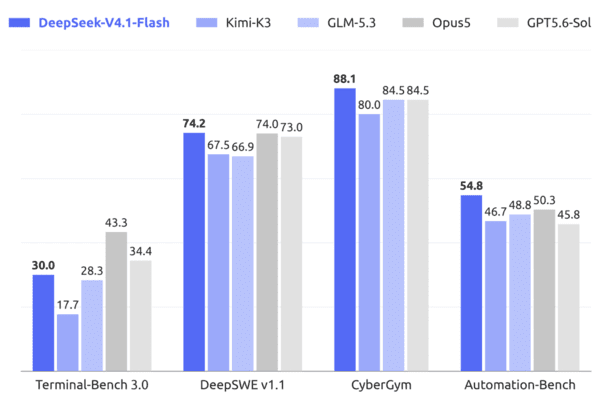
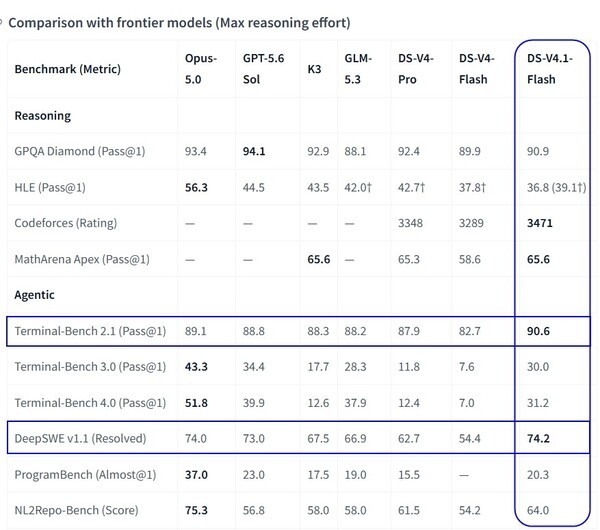
DeepSeek-V4.1-Flash is designed with a focus on agents and coding. According to DeepSeek, at the maximum reasoning intensity, or reasoning_effort=100, V4.1-Flash outperformed OpenAI's GPT-5.6 Sol and Anthropic's Claude Opus 5 on Terminal-Bench 2.1. DeepSeek also claims an advantage over the two models on DeepSWE v1.1 and AutomationBench.
DeepSeek-V4.1-Flash performance comparison with major frontier models on agentic benchmarks. (Source: Hugging Face model card)
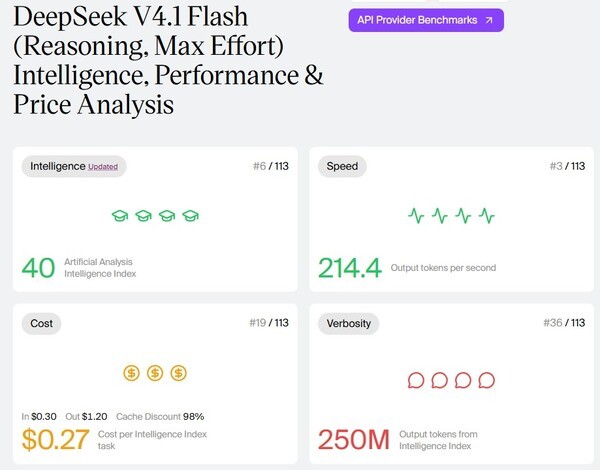
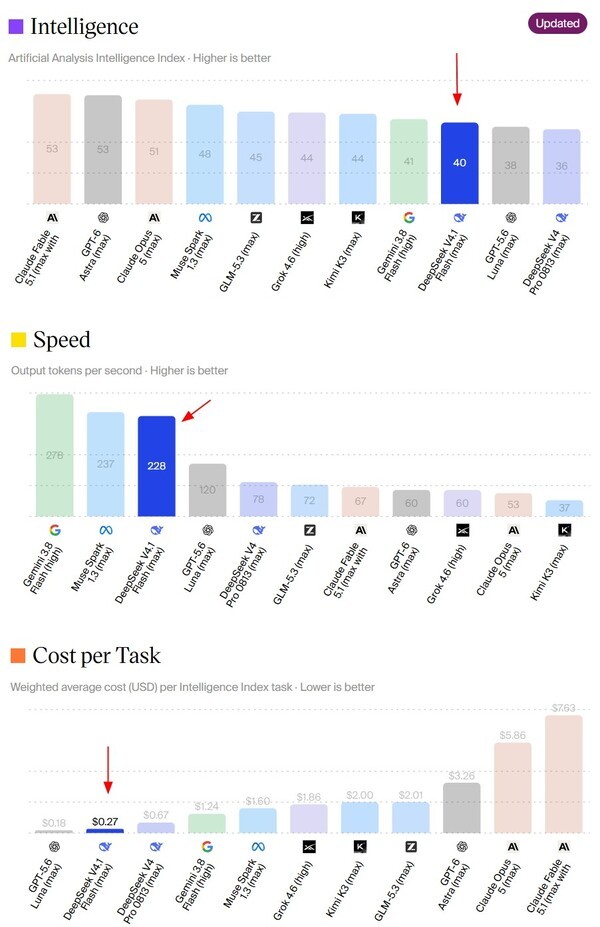
Outside agentic and coding tasks, however, the model posted relatively lower scores on difficult general reasoning. Artificial Analysis (AA), an independent AI model evaluation platform, gave the model an Intelligence Index score of 40. That was well above the average for open-weight models but below the leading frontier models.
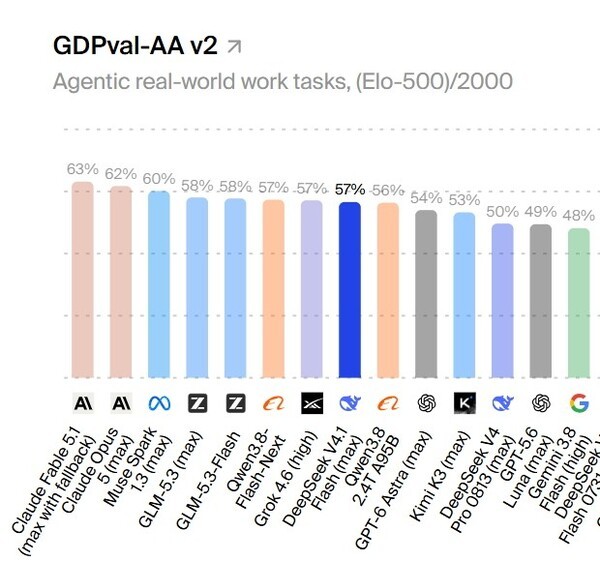
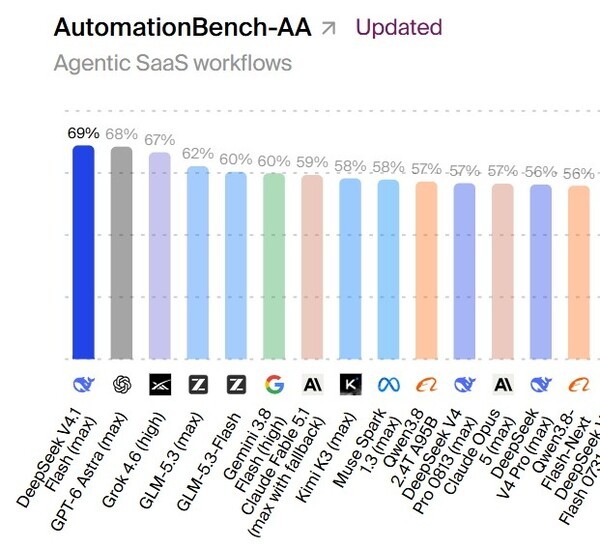
AA calculates its Intelligence Index by combining multiple evaluations, including GDPval-AA, AutomationBench-AA, SciCode, Humanity's Last Exam (HLE), CritPt and AA-LCR. DeepSeek-V4.1-Flash recorded scores including 1,632 on GDPval-AA v2, 69% on AutomationBench-AA, 52% on SciCode and 39% on HLE, leaving the model in the upper-middle range overall. The results indicate that the model can be highly efficient when deployed for coding-focused applications.
The score of 40 also reflects AA's recent changes to its evaluation methodology, which have lowered the overall scale of the index. AA upgraded its Intelligence Index from v4.2 to v4.3, making the evaluation set more difficult.
As a result, frontier models that previously scored well above 60 have been moved into the 50s under the revised methodology. Anthropic's Claude Fable 5.1, which had scored 66 under the previous v4.2 evaluation, now scores 53 under the revised system, alongside OpenAI's GPT-6 Astra.
DeepSeek's performance comparison between V4.1-Flash and other AI models, highlighting the model's claimed advantage in coding. (Source: Hugging Face model card)
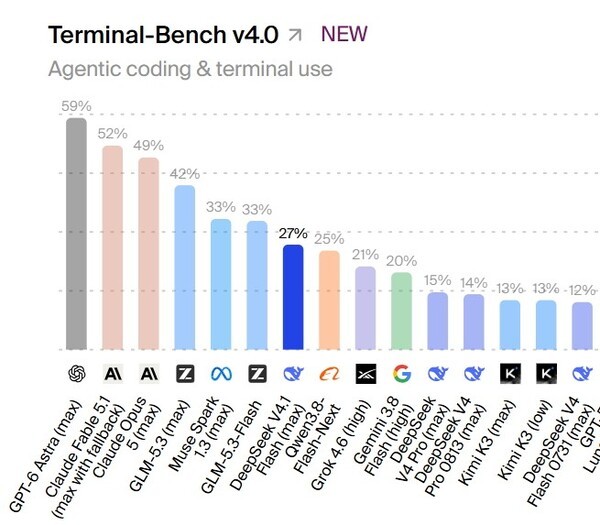
AA's upgrade was driven in part by the replacement of Terminal-Bench 2.1 with Terminal-Bench 4.0. DeepSeek-V4.1-Flash outperformed GPT-5.6 Sol and Claude Opus 5 on Terminal-Bench 2.1, but fell behind them on Terminal-Bench 4.0.
Terminal-Bench 4.0 consists of 66 complex terminal tasks spanning software, machine learning, science, operations, security, hardware and media. It revised computing and time allowances and improved task descriptions, environments and verification logic to more finely distinguish performance among frontier models.
In terms of parameter size, DeepSeek-V4.1-Flash's Intelligence Index score is slightly below the 42 points recorded by GLM-5.3-Flash but is well above the median score of 18 for other open-weight models of a similar size. Under AA's stricter Intelligence Index, GLM-5.3-Flash ranks first among open-weight models, while Alibaba's Qwen 3.8 Max and DeepSeek-V4.1-Flash share second place at 40. DeepSeek V4 Pro 0813 scored 36.
DeepSeek-V4.1-Flash is also fast, as DeepSeek claims. Its output speed is about 214.4 tokens per second, while time to first token (TTFT) is 1.13 seconds. The median for comparable models is 65.4 tokens per second and 2.34 seconds for TTFT, making V4.1-Flash more than three times as fast by the output-speed measure. AA also rated it as “notably fast.”
Artificial Analysis' overall evaluation of DeepSeek-V4.1-Flash, including intelligence, speed, cost and verbosity metrics. (Source: Artificial Analysis)
The model has reduced its KV cache to 890 bytes per token. AA also viewed this as a significant strength. The reduction becomes more consequential when combined with DeepSeek-V4.1-Flash's pricing structure.
According to AA, DeepSeek-V4.1-Flash is priced competitively for input and output tokens, with an overall cost below the median of comparable models. Cache-hit pricing receives further reductions, while off-peak periods receive an additional 50% discount.
AA, however, said the model is “very verbose.” Its Intelligence Index evaluation used 250 million output tokens, substantially more than the 130 million median for similar open-weight models. The total cost of the evaluation was also recorded. Although the model is fast, the length of its responses can affect actual cost and completion time.
Still, AA said the model reaches the Pareto frontier on a cost-per-task basis. In other words, it is among the least expensive models at a comparable level of intelligence.
Artificial Analysis' AI model evaluation as of Sept. 14, with DeepSeek-V4.1-Flash indicated by the red arrow; lower task cost is better. (Source: Artificial Analysis)
The reason DeepSeek-V4.1-Flash separates active parameters for input and output, unlike a conventional MoE model, lies in its Causal Encoder-Decoder (CED) architecture.
The term CED, or the concept behind it, was not created by DeepSeek. The term has been used since the late 2010s in fields including speech, time-series modeling and generative models. A paper on Alibaba's Qwen-Audio-VAE, published in July, also discusses CED. However, the CED used by DeepSeek in V4.1-Flash appears to be a different technology despite sharing the same name.
DeepSeek's CED makes the encoder causal rather than bidirectional and eliminates the need for cross-attention by projecting the encoder's final representation into the decoder's KV cache in a single operation. The structure appears to have been designed and named by DeepSeek for V4.1-Flash, and DeepSeek identifies it as a new architecture for its model in the official Hugging Face model card and technical documentation.
DeepSeek's CED in V4.1-Flash does three things: it changes the originally bidirectional encoder into a causal, sequential structure so it follows the same basic pretraining pattern used by today's autoregressive models; it eliminates the need for the decoder to query the encoder repeatedly through cross-attention by transferring the encoder's final output into the decoder cache in one operation; and it repurposes the architecture as a cost- and memory-saving mechanism inside a conversational chatbot.
Artificial Analysis' upgrade from Terminal-Bench 2.1 to Terminal-Bench 4.0; DeepSeek-V4.1-Flash led frontier models on Terminal-Bench 2.1 but ranked lower on Terminal-Bench 4.0. (Source: Artificial Analysis)
According to DeepSeek's technical report, the 40 Transformer layers in V4.1-Flash are divided into 20 causal encoder layers and 20 decoder layers. Instead of generating global KV separately at each decoder layer, the model projects the decoder's global KV from the final hidden state of the encoder.
DeepSeek's CED architecture does not correspond directly to either the original Transformer encoder-decoder architecture or the decoder-only architecture used by most modern large language models (LLMs). According to DeepSeek's technical documentation, it differs in three key ways.
First, the encoder itself is causal. In the original encoder-decoder architecture, the encoder reads a sentence bidirectionally, looking both forward and backward. In DeepSeek's CED, the encoder also reads sequentially, from left to right. This is why it is called a causal encoder. Making the encoder causal in the same way as the decoder allows all 40 layers to operate under a consistent causal scheme, simplifying training.
Second, DeepSeek eliminates cross-attention, through which the decoder would otherwise query information from the encoder in real time at every layer and for every generated token. Cross-attention is an attention mechanism in which one part of a model references information held by another part rather than relying only on its own representations.
How DeepSeek CED Differs From Encoder-Decoder and Decoder-Only Models
Early Transformer-based models used an encoder-decoder architecture, while most generative large language models (LLMs) today use a decoder-only architecture.
In an encoder-decoder model, dozens of layers are stacked sequentially. When a user submits a question or instruction, the input passes through the layers from the first to the last, becoming progressively more refined and processed. The process of understanding the user's prompt and the process of generating a response are handled through the same architecture, requiring the model to pass through all of those layers during processing.
If a user attaches a very long document, or an AI agent performs a continuous sequence of tasks over an extended period as the conversation history keeps growing, the AI must repeatedly process that information through dozens of layers. Each layer leaves key-value (KV) cache states to retain important information. In general, the more layers a model has, the more KV states need to be stored. That is why KV cache is considered a major bottleneck and a significant source of rising costs in AI service operations.
This traces back to the Transformer introduced by Google researchers in 2017, when machine translation was presented as a key application. In an English-to-Korean translation example, the architecture can broadly be divided into an encoder, which reads the entire English source sentence, and a decoder, which uses that understanding to generate the Korean translation.
The key point is that the encoder reads the sentence bidirectionally. For example, when processing the fifth word of a sentence, the encoder can refer not only to the first four words but also to all words after the sixth. This is similar to a person reading an entire sentence before determining its context.
Once the encoder has fully processed the source sentence in both directions, the decoder uses that representation to generate the translation one word at a time. The decoder operates only from left to right, or causally. To generate the next word, it can refer to words it has already produced, but cannot see words that have not yet been generated.
When generating each word, however, the decoder does more than look at the words it has previously produced. It also references the representations generated by the encoder from the input tokens. This process is known as cross-attention. Crucially, cross-attention occurs at every decoder layer and each time a word is generated.
In other words, whether at the fifth decoder layer or the 20th, the decoder repeatedly references information produced by the encoder in real time. This architecture is useful for tasks such as translation and summarization, where the input and output may be in different languages or have substantially different formats.
Today's widely used models, including GPT and Claude, generally use a decoder-only architecture rather than the traditional encoder-decoder structure. The encoder and decoder are not separated. Instead, the user's question and the AI's response are combined into a single long sequence of text, which is processed by one set of layers entirely in a causal, left-to-right manner.
The process of understanding the question and the process of generating the answer therefore share the same layers and parameters. The architecture is relatively simple and efficient to train, helping decoder-only models become an industry standard following the GPT series. Its drawback is that a long input must pass through all layers when it is initially processed to generate the KV cache, while the memory burden of storing and managing the cache increases as conversations grow longer.
DeepSeek's Causal Encoder-Decoder (CED) architecture attempts to reduce this repeated processing. The basic idea is relatively straightforward: instead of treating all 40 workstations as a single processing line, the model divides them into two groups of 20 with distinct roles.
The first 20 workstations, or encoder layers, process the input and produce the final hidden states. The user's question or document is read once and transformed into a representation that can be used by subsequent computations. The second 20 workstations, or decoder layers, generate the response based on that information and construct the KV states needed during generation.
Third, the roles of the encoder and decoder are changed. The model separates input understanding from response generation while continuing to operate as a single conversational chatbot from the user's perspective. Internally, the input-processing portion activates 8 billion parameters, while the output-generation portion activates 16 billion.
Early Transformer-based models used an encoder-decoder architecture, while most current generative LLMs use a decoder-only architecture.
GDPval-AA evaluation of DeepSeek-V4.1-Flash, measuring performance on complex professional tasks across industries and occupations. (Source: Artificial Analysis)
SWA and DeepSeek’s SWA Bounded Replay
AI models broadly rely on two types of information when generating a response: global memory and local memory. Global memory maintains information across a long context. In DeepSeek's Causal Encoder-Decoder (CED) architecture, the encoder processes the entire input and uses its final hidden states to generate the decoder's global key-value (KV) cache. This global KV cache maintains an overall representation of the long context.
But when a large language model (LLM) generates a response, it needs more than an understanding of the entire context. It also needs fine-grained information within a very narrow context, such as which word it has just used or how the preceding sentence ended. Information from the full long context alone may not adequately preserve such details, making a separate form of local memory necessary. Sliding Window Attention (SWA) is a mechanism that allows tokens within only a recent portion of the sequence to attend to one another.
In DeepSeek's CED architecture, however, the decoder does not retain its SWA local state in full. DeepSeek therefore uses a separate mechanism called SWA Bounded Replay to compensate for the missing local state.
In DeepSeek's CED architecture, the decoder does not repeatedly process the entire prompt as conventional decoder layers would. The first 20 encoder layers process the full prompt and produce the final hidden states, which are then used to construct the global KV cache for the following 20 decoder layers. The decoder can therefore access information from the entire input processed by the encoder through the global KV cache.
That does not mean the model lacks local context information. Response generation still requires fine-grained information from a narrow context, such as the word just generated or the immediately preceding sentence. DeepSeek-V4.1-Flash addresses this by maintaining SWA state only for the most recent 128 tokens. Rather than continuously storing local KV on a solid-state drive (SSD), the model can reprocess the most recent 128 tokens when needed to reconstruct the local state. This is the role of SWA Bounded Replay.
With SWA Bounded Replay, DeepSeek-V4.1-Flash performs a short replay process in which only the final 128 tokens of the prompt pass through the 20 decoder layers. This allows the decoder to recover local memory, or SWA state, for the immediately preceding context. The process is called “bounded” because the replay is limited to the most recent 128 tokens rather than the full prompt, and “replay” because the decoder recalculates the information to recover the recent context. The approach is a key part of DeepSeek's effort to improve cost efficiency.
Under a conventional decoder architecture, preserving local memory would require an SWA cache containing recent-context information to be retained for the full length of the prompt. As conversations become longer and prompts grow, the amount of storage required also increases, eventually creating a need to move the cache to disk or an SSD.
SWA Bounded Replay significantly reduces the need for such local-memory storage. When the local state is needed, just before response generation, the system can immediately recalculate the most recent 128 tokens, use the resulting state and then discard it. Instead of storing the SWA KV state on an SSD, the system reconstructs it by replaying the most recent 128 tokens when required.
DeepSeek says this approach eliminates persistent SSD storage for SWA KV and, as a result, reduces the overall persistent KV cache footprint to about one-eighth that of the previous V4-Flash. While CED's reuse of global memory reduces computation and the amount of global cache that needs to be maintained, SWA Bounded Replay serves as a complementary mechanism that fills the structural gap in local memory at a small, fixed computational cost while also reducing storage requirements.
Another technology used to reduce the KV cache is △Compressed Sparse Attention 2 (CSA2), △along with FP4 quantization. CSA2 allows multiple layers to share and reuse KV and attention indices, reducing the duplication that would otherwise occur when each layer maintains its own cache. FP4 quantization stores the global KV cache using four-bit floating-point values, reducing storage requirements compared with FP8.
DeepSeek introduced the first version of Compressed Sparse Attention (CSA) in V4. While DeepSeek Sparse Attention (DSA) selects important KV entries and performs attention only on a subset of them in long contexts, CSA first compresses the KV representations of multiple tokens into shorter representations and then sparsely selects the information it needs. In other words, CSA combines KV compression with sparse selection to reduce both KV cache size and attention computation for long contexts.
V4.1-Flash advances the approach to CSA2. Each attention layer is assigned one of three modes — Full, Reindex or Reuse — allowing multiple attention layers to share and reuse KV and the locations of important information rather than recalculating the same information at every layer. Some layers perform new calculations while others reuse existing results, reducing the memory and computation required for long contexts. Combined with FP4 KV caching, the global KV cache is reduced to 890 bytes per token, about one-quarter the size of the V4-Flash cache.
Reducing the number of active parameters while maintaining performance lowers the GPU memory and computational resources required to run an AI model. That can reduce server operating and power costs and allow the same GPU resources to handle more simultaneous requests. Lower computational requirements can also reduce latency and make deployment on lower-end GPUs, on-premises servers rather than cloud infrastructure, and edge AI systems easier.
AutomationBench-AA evaluation of DeepSeek-V4.1-Flash, which measures an AI agent's ability to integrate with business software and complete automated tasks. (Source: Artificial Analysis)
If total parameters can be reduced while maintaining the same performance, the model's weight memory can also be reduced, which is the ideal outcome. If that is not possible, reducing the active parameters in an MoE model is the next-best option because fewer active parameters also mean fewer computations.
DeepSeek-V4.1-Flash has a total of 552 billion parameters, which is substantial, but activates only 8 billion parameters for input and 16 billion for output. CSA2 also sharply reduces the KV cache, allowing GPU memory to be used more efficiently. The fact that DeepSeek developed and actively deployed technologies such as CSA2 and CED in the model is particularly notable.
DeepSeek is not alone. Chinese AI companies including Moonshot AI, developer of the Kimi family, and Alibaba, developer of Qwen, are expanding model parameter counts or advancing their models through proprietary technologies. Questions remain, however, over allegations that some Chinese AI companies illegally distilled capabilities from U.S. frontier models.
Anthropic recently said that seven Chinese AI companies had attempted to extract capabilities from its Claude models without authorization, and disclosed cases involving Alibaba, Moonshot AI and DeepSeek.
According to Anthropic's findings, Alibaba linked more than 151 million interactions with Claude to its own models. Anthropic said Alibaba created large numbers of accounts to send queries to Claude and collect its responses, then used the data to train or improve its own AI models. In effect, Claude's responses were used as teacher-model data.
In Moonshot AI's case, more than 23 million interactions were identified. Particularly problematic, according to Anthropic, was that Moonshot forwarded questions entered by actual Kimi users to Claude and then displayed Claude's responses to those users as if they had been generated by Kimi. Anthropic also said Moonshot subsequently used the collected user questions and Claude responses in developing its own models.
For DeepSeek, Anthropic said it identified about 12.1 million interactions. Anthropic alleged that DeepSeek also sent large numbers of queries to Claude to collect responses and used them for model distillation.
Sound-analysis security company Cranberry held the “CRANBERRY TECH SUMMIT 2026” on Sept. 10.
Cranberry has developed an artificial intelligence system designed to detect danger signals such as the sound of someone entering the water or screams around Han River bridges and waterfront areas, analyze the location of an incident and dispatch autonomous flying drones equipped with lifesaving equipment.
Cranberry said Sept. 14 that the approach marks a shift from relying on existing closed-circuit television cameras or emergency reports to having AI detect accidents first and mobilize rescue equipment.
Cranberry is also developing a predictive-maintenance system with the Korea Environment Corporation to analyze abnormal sounds generated by intake pumps at water-treatment plants. The company is working with Korea East-West Power to develop a system for diagnosing abnormal conditions in valves used in power-generation equipment.
Cranberry's main market is currently public safety. The company has supplied intelligent acoustic-analysis devices to Eunpyeong-gu in Seoul, Gunsan City, Suyeong-gu in Busan, Jangseong County in South Jeolla Province and Uiseong County in North Gyeongsang Province. In the private sector, it has deployed systems at some Lotte Mart stores, Brighton Hannam and Hyundai Motor. Municipal-government projects account for about 60% of the company's total revenue, according to Cranberry.
Cranberry posted 5.3 billion won in revenue last year and has set a revenue target of 7.5 billion won for this year. The company plans to seek Series A funding to enhance its products and commercialize technologies demonstrated in the field.
Cranberry also plans to pursue an initial public offering over the medium to long term, aiming to validate its market this year, expand sales channels in 2027, turn its technology into a platform in 2028 and scale up its business in 2029, before targeting a KOSDAQ listing in 2030.
Kingnet, a Chinese game company that has been embroiled in a roughly decade-long legal dispute with Wemade over the intellectual property (IP) of "The Legend of Mir 2," will participate as a key investor in a consortium acquiring a controlling stake in Wemade. The company plans to invest about 400 billion won to establish a capital relationship with Wemade, effectively gaining a major shareholder position.
Wemade and Neopulse said in a joint statement on Sept. 14 that an investor consortium including game investment platform Neopulse and Kingnet signed a stock purchase agreement (SPA) with Wemade Chairman Park Kwan-ho on June 30. Wemade had not previously disclosed specific details about the acquiring company. The parties said they aim to complete the transaction, including payment of the remaining balance and regulatory approvals, on Oct. 30.
Once the transaction is completed, Neopulse will acquire Park’s 39.33% stake in Wemade for 920 billion won. Including its existing 0.92% stake, the consortium’s ownership will rise to 40.25%, making it Wemade’s largest shareholder.
The key investor newly identified on Sept. 14 is Kingnet. In a Chinese securities filing on Sept. 12, Kingnet disclosed that its wholly owned Hong Kong subsidiary, Cypress Technology HK Limited, will acquire a 49% stake in Neosphere, the parent company of Neopulse.
Kingnet estimates its total investment at about 2.03 billion yuan. In addition to Kingnet’s investment, Neosphere’s existing shareholders will contribute capital in a capital increase. The funds will be used for Neopulse’s acquisition of the stake in Wemade.
After the transaction, Kingnet will hold 49% of Neosphere, while existing shareholder Nexpulse will own 51%. Neosphere will control Neopulse, which will hold a 40.25% stake in Wemade. Kingnet also classified Wemade in its Chinese filing as an overseas listed company targeted for indirect equity investment, rather than a company targeted for management control.
The investment is driven by Wemade’s “Mir” IP.
According to Kingnet’s filing, the parties plan to pursue an exclusive licensing agreement for the Mir IP after the transaction involving Wemade’s shares is completed. Neosphere’s existing shareholder Nexpulse agreed to make efforts to have Wemade enter into an exclusive Mir IP licensing agreement with Neosphere once the delivery of Wemade’s 39.33% stake is completed. The proposed licensing fee would not exceed the consideration Wemade or its affiliates receive under existing Mir IP agreements with partners. The exclusive licensing agreement has not yet been signed.
Kingnet directly cited the Mir IP business as an investment objective. The company said it plans to strengthen cooperation on licensing and revenue sharing for the Mir IP and the development of derivative products, while expanding rights and business opportunities needed to develop, publish and operate Mir-related mobile, web and HTML5 games in China. It also plans to expand cooperation with Wemade on joint development of new titles and operations in the Chinese market.
Wemade and Kingnet had been engaged in legal disputes for about a decade. The dispute began after Kingnet subsidiary Zhejiang Huanyou failed to pay royalties for "Namwoljeonki," a game based on The Legend of Mir 2 IP that it had operated in China since 2016. International Chamber of Commerce (ICC) arbitration and litigation followed, and Wemade received a settlement payment of 43 billion won from Kingnet in April this year, bringing the dispute to an end.
The two companies, which had faced each other in court for roughly a decade, have effectively been tied together through capital just five months later. With Kingnet joining the consortium as a major investor in Wemade’s largest-shareholder group, the companies’ relationship over the Mir IP is shifting toward long-term business cooperation.
Wemade said, “Once the transaction is completed, the investor consortium plans, as Wemade’s largest shareholder, to focus on expanding various opportunities in global and Chinese markets, including publishing and core IP licensing businesses.” It added, “The core businesses currently being pursued and organizational operations will continue according to existing plans without disruption.”
Kingnet has operated Mir-related IP businesses in the Chinese game market for many years. By directly investing in the consortium that will become the largest shareholder of Wemade, the original rights holder of the Mir IP, Kingnet will be able to secure a more stable business base than before for game development, publishing and IP licensing in China.
The industry, however, takes a negative view of Wemade’s blockchain business, WEMIX. Under regulations jointly announced by 10 Chinese institutions, including the People’s Bank of China, in 2021, activities involving digital assets were classified as “illegal financial activities.” Exchanges between fiat currency and digital assets, transaction brokerage and the provision of price information were all prohibited. Overseas digital-asset exchanges providing services to users in mainland China via the internet were also interpreted as engaging in illegal financial activities.
An industry source familiar with the matter said, “China does not permit Chinese companies to operate overseas digital-asset businesses either. The prevailing view is that the WEMIX business will be separated from Wemade in some form.”
From left, KISIA Senior Vice President Young-chul Choi, President Jinsoo Kim and Senior Vice President Min-soo Kim answer questions at a press conference at IT Venture Tower on Sept. 14. (Photo: THE ELEC)
From left, KISIA Senior Vice President Young-chul Choi, President Jinsoo Kim and Senior Vice President Min-soo Kim answer questions at a press conference at IT Venture Tower on Sept. 14. (Photo: THE ELEC)
South Korea's cybersecurity industry has raised concerns with the presidential National Security Office over the growing presence of foreign security companies in the public and financial sectors.
The industry argues that relying on foreign products for critical security infrastructure could undermine the country's security sovereignty, leaving it exposed to price increases or supply restrictions.
Jinsoo Kim, president of the Korea Information Security Industry Association (KISIA), said at a press conference at IT Venture Tower in Seoul's Songpa district on Sept. 14 that he raised the concerns in a meeting with Song Ki-ho, third deputy director of the presidential National Security Office, on Aug. 25. KISIA is a private association with about 340 security companies as members, 98% of which are Korean companies.
The association asked the National Security Office for government support to help domestic security companies grow. "From a sovereignty perspective, it is extremely important for a country to defend its own security with domestic solutions," Kim said. "We asked the government to serve as a catalyst so that Korean security companies can grow strategically in the domestic market." After hearing the industry's concerns, Song said Korean security companies "need to succeed and we will take the lead in supporting them," according to the association.
The financial and public sectors are key sources of revenue for Korean security companies. Foreign cloud-based products had faced difficulties entering the two markets because of network separation regulations that require internal work networks to be separated from the internet, as well as security compliance reviews by the National Intelligence Service (NIS).
Regulations have been eased as demand for generative artificial intelligence (AI) has grown. The Financial Services Commission in 2024 allowed financial companies to use generative AI and software as a service (SaaS) through a regulatory sandbox. The NIS established the National Network Security Framework (N2SF), which applies different security controls according to information classification levels.
Foreign security companies have also begun supplying products to the public sector. The Bank of Korea adopted equipment from Palo Alto Networks in August last year for a pilot "one-PC" project that integrates internet and work functions into a single PC, and has since introduced additional equipment. The products underwent an NIS security compliance review and are operated alongside Korean products.
The association argues that greater dependence on foreign products could make them difficult to replace. Foreign security companies provide integrated security products covering an enterprise's PCs and servers as well as networks and cloud infrastructure, making it difficult to switch to other products once they have been adopted. "If global products become widely adopted and we eventually lose security sovereignty, there could be risks such as sharply higher maintenance costs or vendors restricting sales of solutions to certain companies," Kim said.
Young-chul Choi, senior vice president of KISIA, said technical standards should first be established to allow domestic and foreign products to be compared on the same basis.
However, giving preferential treatment to Korean products in the public and financial sectors could raise concerns about reverse discrimination against foreign companies. Apart from establishing technical standards, the association did not propose specific measures for supporting domestic security companies.

 Login