Russia launched a cargo mission toward the International Space Station today (Sept. 16), delivering the freighter spacecraft to orbit for a three-day rendezvous journey.
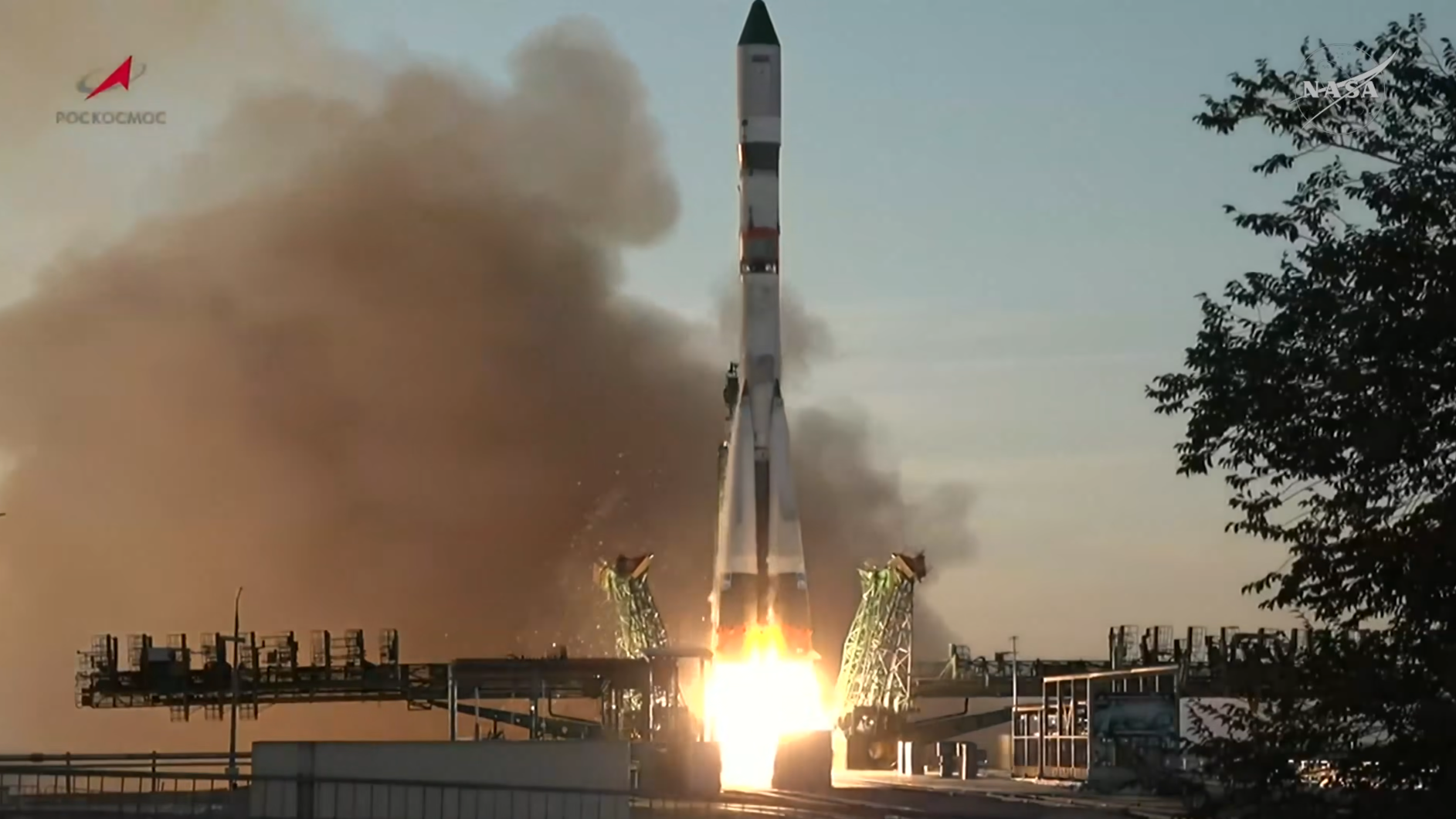
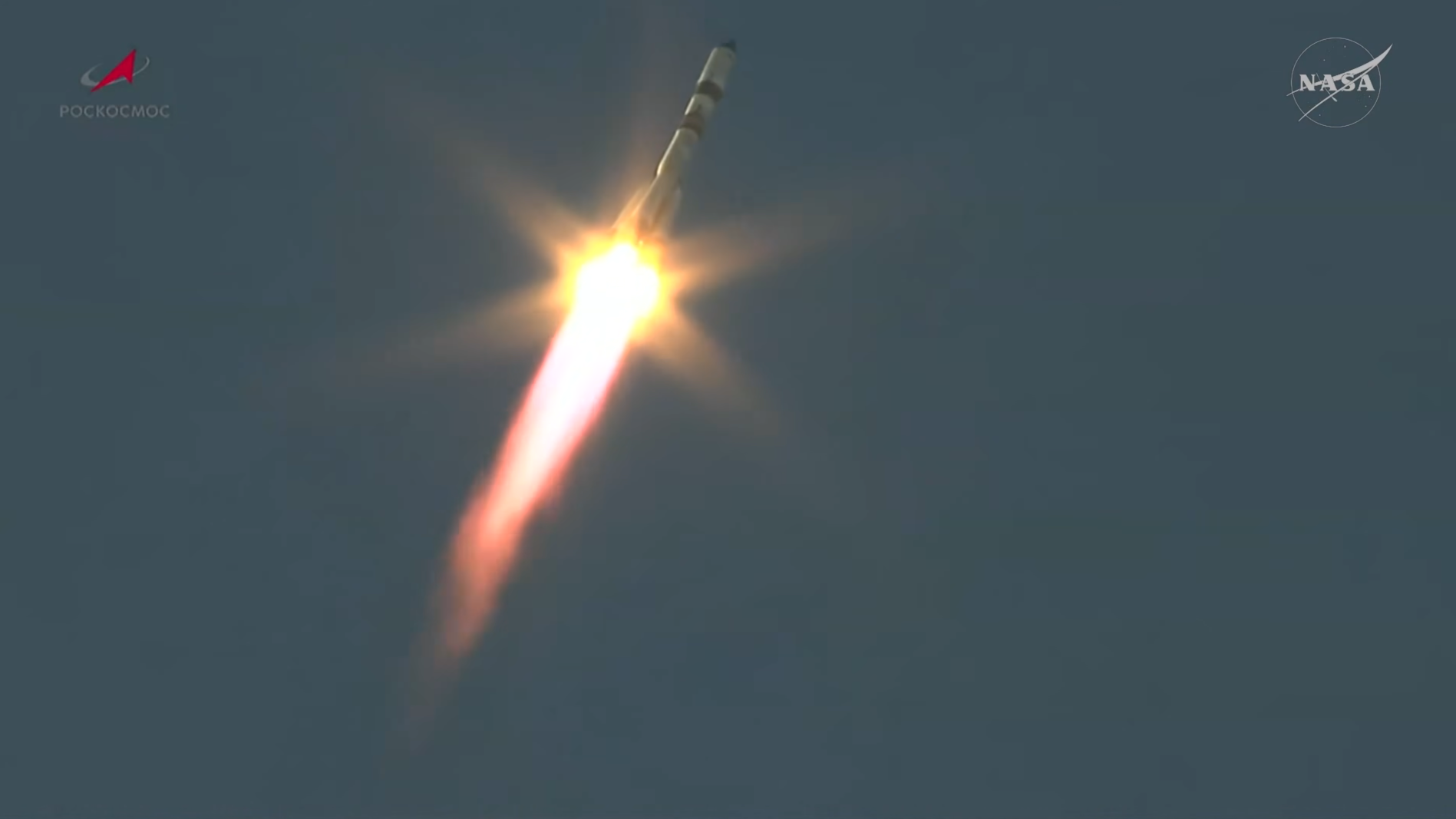
The robotic Progress 96 spacecraft lifted off atop a Soyuz rocket from the Russian-run Baikonur Cosmodrome in Kazakhstan today at 9:33a.m. EDT (1333 GMT).
From engine ignition through solar array deployment on the spacecraft, the Progress 96 launch was completely nominal. It was "a flawless launch," said NASA's Rob Navias during the mission's livestream this morning, with "an excellent climb to orbit by the Soyuz booster."
Roscosmos' Progress 96 cargo spacecraft launches from the Baikanour Cosmodrome on a Soyuz rocket on Sept. 16, 2026. (Image credit: NASA)
Progress 96 is loaded with about 3 tons of food, propellant and other supplies for the astronauts aboard the International Space Station (ISS). The freighter will deliver this cargo three days after launch, if all goes according to plan. You'll be able to watch rendezvous and docking activities when the time comes.
The freighter will remain docked to the orbiting lab for about five months. It will then be loaded up with trash and sent down to a fiery death in Earth's atmosphere over the Pacific Ocean.
The Progress 94 spacecraft met this fate on Sept. 7, departing from ISS' Poisk module to make room for Progress 96.
(Image credit: NASA)
Progress is one of four spacecraft that fly operational cargo missions to the ISS these days, along with Japan's HTV-X, SpaceX's Dragon capsule and Northrop Grumman's Cygnus. All but Dragon are expendable, burning up in our air when their time in orbit is up.
There are currently seven people living aboard the ISS — NASA astronauts Jack Hathaway, Jessica Meir and Anil Menon; the European Space Agency's Sophie Adenot, who last month became the first French woman ever to perform a spacewalk; and Pyotr Dubrov, Andrey Fedyaev and Anna Kikina of the Russian space agency Roscosmos.
Editor's note: This story was updated at 10 a.m. ET on Sept. 16 with news of successful launch.
NASA astronaut Jessica Meir just shared some tips for controlling curls in the tough environment of microgravity — and it was a big deal for curly-haired people like me.
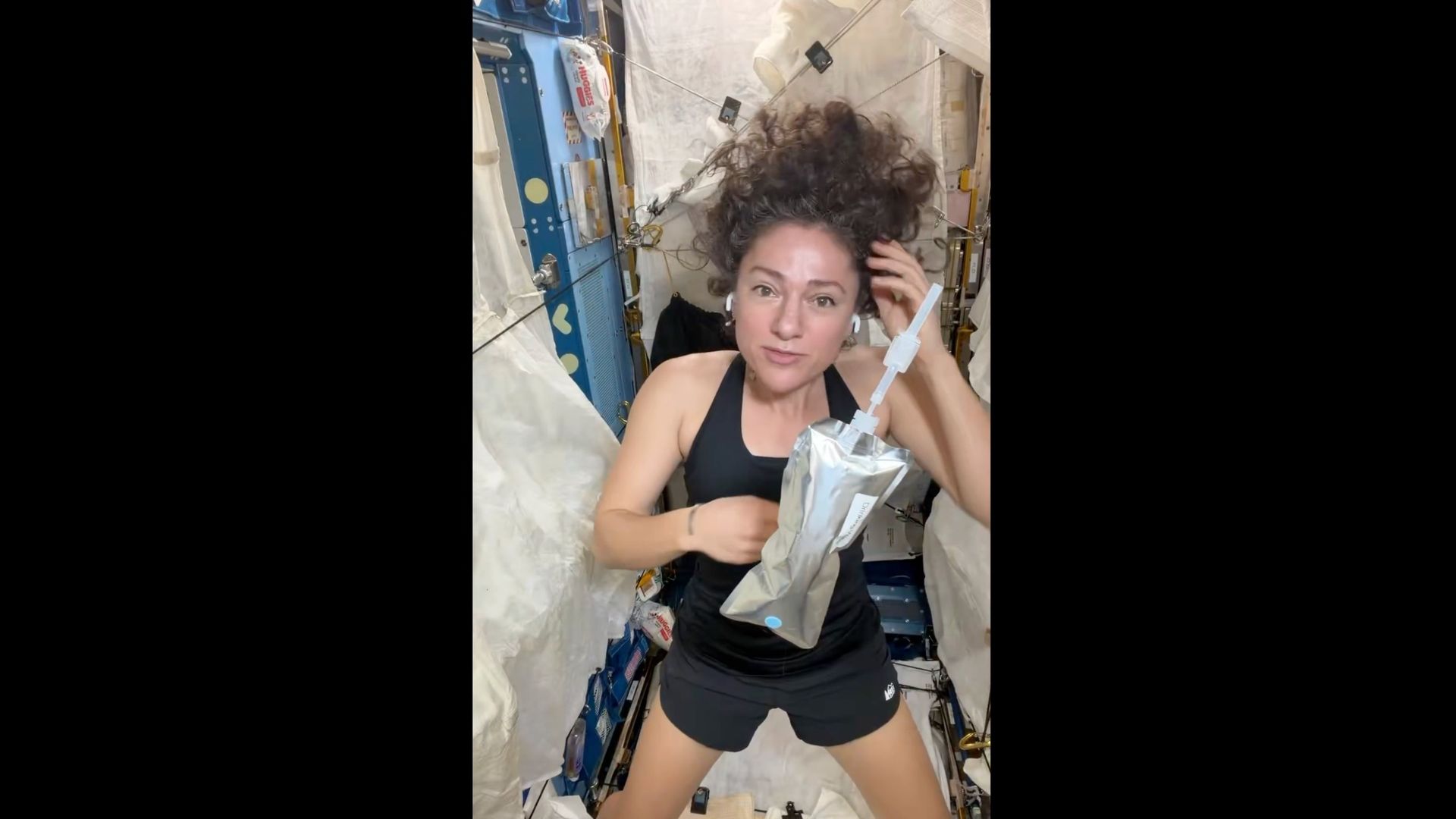
Meir's hair-care advice came Wednesday (Sept. 9) in a 5.5-minute video she posted to X from the International Space Station (ISS), where everything floats and "where curls are even more free to be what they want to be," the Expedition 75 astronaut wrote.
And if you think all this talk about hair care sounds frivolous, take it from a fellow curly: the representation matters. More on that in a moment, but first, let's see how Meir takes care of her curly hair in microgravity.
In a video she posted to X on Sept. 9, 2026, NASA astronaut Jessica Meir provided tips for caring for curly hair in space. (Image credit: Jessica Meir/NASA)
According to Meir, washing in orbit requires no-rinse shampoo, especially focusing on the scalp, where sweat and salt build up. She has less access to hair products than we do here on Earth, as you would imagine, so she keeps it simple: a careful squeeze of her pouch of water, then working the expelled water along her hair roots, and also rubbing it on the scalp. Meir then uses a "dedicated T-shirt" to dry her hair, which she described as thick as well as curly.
In between treatments, Meir avoids brushes (for pretty obvious reasons of frizz) and uses her hands and fingers instead to "work" her hair. Luckily, humidity is not much of an issue on the ISS, but she does use leave-in conditioner: "My Earthly 3a curls become more like 3c," she said. Meir has been on the ISS since February, and she said she's looking forward to having an actual shower when she gets back home to Earth.
OK, so about that representation. My editor asked me to talk not only about Meir's video but also my own connections to her words, which brings up some teenage angst. In the 1990s, I was (then, as now) a curly-haired person who was just (bitterly) old enough to remember all the curly rock stars of my childhood in the '80s. But dare to wear curls in my school in like, 1994? As if! Lame!
All the young women around me were rocking the flat-haired "Rachel from 'Friends'" lookthat would take thick-haired curlies like me forever to achieve. I couldn't be bothered — I like sleep! Which apparently was enough for my classmates (of any gender) to deliver unprintable and sometimes racist insults, or to hide their faces from me because I was "ugly," or to spread rumors that I carried hair lice, and so forth. I couldn't believe it; other kids were sporting awesome and stand-out 'dos like mullets and mushroom cuts, so what was wrong with curls?
To be clear, as a 40-something I now have perspective: I later learned that some of my classmates had complex (even tragic) issues of their own contributing to the bullying, and I have no idea how other kids in my classes fared with their hairdos. The real lesson learned is that representation matters, inclusivity is possible and inclusivity matters across multiple dimensions. While looks may not sound important, at first glance, they really are: curly hair is a dimension of diversity. (I know I am just one female voice, with white U.K. ancestry; other people with curly hair will have different perspectives.)
So, back to the curly-hair-space-care routine: as a fellow curly, can I confirm that it stands up? Yes it does. While I'm no astronaut like Meir, I can offer you an analog: the two weeks I spent in 2014 at the Mars Society's Mars Desert Research Station in rural Utah, during which my crew was able to shower every two days, if we were lucky.
On that simulated Red Planet mission, I also used no-rinse shampoo to save on water, only combed(never brushed) my hair when it was wet, and mostly wore it bun-style to protect the curls in the meantime. While it took me two showers to feel normal when I at last reached a hotel room with running water, my hair bounced — so to speak — back quickly. That shows my curls are resilient, and since my 20s I've felt lucky to have them; my hair takes me a minimum of work or styling besides a quick wash and comb, and — as long as I don't touch my hair after it's wet — it's happy.
And to all those kids teasing me back in the day, allow me a moment of moon joy: NASA's Christina Koch sported curly hair during NASA's Artemis II lunar mission earlier this year. Koch herself, by the way, later spoke about her moon-mission braids at an event in my literal city in Canada (as, speaking of representation, I'm Canadian). Yes, of course there was more to this historic mission than hair: I covered Artemis II's science and activities at numerous in-person events for three-plus years, and some of its crew members for 17 years. But to see curls on a person looping around the moon? Bonus.
Every curly-haired person's experience is different, however, so I'd like to hear from you. There's a comment section with this article to chat about microgravity (or analog) curly-hair care, other curly-haired astronauts, or similar topics. Let us know your thoughts.

 Login