❌

Reading view

FAST telescope completes survey, mapping 156,411 galaxies in largest hydrogen gas atlas

In one of the most ambitious mapping efforts in the history of radio astronomy, China’s Five-hundred-meter Aperture Spherical radio Telescope — better known as FAST — has delivered a cosmic atlas of staggering proportions. The FASHI team, headquartered at the National Astronomical Observatories of the Chinese Academy of Sciences (NAOC), has announced the second data release of the FAST All Sky HI Survey, published as a cover story in the journal Science China Physics, Mechanics & Astronomy. Just two years after the survey’s first data release catalogued 41,741 galaxies, the new edition explodes that figure to 156,411 extragalactic sources detected in neutral hydrogen — nearly a fourfold leap that firmly establishes FASHI as the largest census of atomic hydrogen gas in galaxies ever compiled.

The scale of the achievement is difficult to overstate. FASHI DR2 now spans roughly 19,500 square degrees of sky, equivalent to 47.3 percent of the entire celestial sphere, and reaches out to redshifts below z = 0.09 — distances of well over a billion light years. For comparison, the previous benchmark in this field, the ALFALFA survey conducted with the now-collapsed Arecibo telescope in Puerto Rico, charted approximately 31,500 hydrogen-bearing galaxies across about 7,000 square degrees. FASHI DR2 has thus quintupled the galaxy count of its Arecibo predecessor while covering nearly three times the sky area, and it has done so with a sensitivity roughly 0.7 times deeper than ALFALFA’s, measured as a median noise level of 0.57 mJy per beam at a velocity resolution of 6.4 kilometers per second. In radio astronomy, lower numbers mean better sensitivity — and FASHI’s numbers are among the best ever achieved in a blind, wide-area survey.

The engine behind this performance is FAST itself. With its 500-meter dish nestled in the karst hills of Guizhou Province, the telescope remains the most sensitive single-dish radio instrument on Earth at the 21-centimeter wavelength of neutral hydrogen. The survey exploited a 19-beam receiver array, allowing the telescope to sweep the sky in an efficient drift-scan mode that turned routine transits of the sky above the dish into a torrent of data. Crucially, the instrument maintained exceptional stability across five full years of observing, from August 2020 through July 2025. In surveys of this kind, calibration drifts and instrumental fluctuations can quietly corrupt weak extragalactic signals; FAST’s long-term steadiness meant that faint hydrogen emission from distant galactic disks could be stacked, averaged and trusted.

Neutral hydrogen — the primordial fuel of star formation — is invisible to optical telescopes. The 21-centimeter spectral line, produced when the electron in a hydrogen atom flips its spin relative to the proton’s, provides the only direct tracer of the cold atomic gas from which galaxies build their stars. Detecting this feeble signal across cosmological distances requires both enormous collecting area and exquisite receiver stability. A blind HI survey, unlike targeted observations, simply listens to every direction on the sky and catalogs whatever whispers back, making it an unbiased inventory of gas-rich galaxies regardless of their optical brightness, dust content or morphology. That is precisely why such surveys are prized: they catch the dim, gas-dominated dwarfs and bloated hydrogen clouds that optical catalogs systematically miss.

To give the hydrogen detections physical meaning, the FASHI team cross-matched their radio catalog with the two great optical spectroscopic endeavors of the current era: the Dark Energy Spectroscopic Instrument survey and the Sloan Digital Sky Survey. This cross-identification yielded precise optical counterparts for approximately 64,000 sources, anchoring the hydrogen detections to galaxies with measured distances, stellar masses and star-formation rates. From these matches the team constructed a completeness-corrected statistical sample of more than 109,000 galaxies — a sample robust enough to push fundamental measurements into territory previously beyond reach.

The flagship result of the release is a new measurement of the HI mass function, the statistical distribution describing how many galaxies of a given hydrogen mass populate the local universe. Thanks to the sheer sample size and FAST’s depth, the team extended the reliable measurement range of this function down to hydrogen masses of about one million solar masses — roughly 10 to the power 6.2 in solar mass units — a regime where only the faintest dwarf galaxies live. These smallest gas reservoirs are the building blocks of galaxy evolution, the raw material that hierarchically assembles larger systems, and their census has long been fragmentary. Equally striking is the derived cosmic density of neutral hydrogen: Ω_HI equals (4.71 ± 0.03 statistical ± 0.40 systematic) × 10⁻⁴ in units of h₇₀³ Mpc⁻³ dex⁻¹. The statistical uncertainty is a mere 0.6 percent — the most precise determination of the universe’s atomic hydrogen budget ever made at low redshift.

Why does such a number matter? The cosmic HI density tracks how much raw fuel exists for future star formation, and comparing its evolution across cosmic time constrains how galaxies acquire and exhaust their gas. Because atomic hydrogen sits at the interface between the intergalactic medium and the star-forming interstellar medium, its abundance is a sensitive probe of gas accretion onto dark matter halos and of the feedback processes that heat or expel gas from galaxies. Baryonic matter, after all, is hidden in far more places than stars: cold gas, warm gas, plasma in and around halos. A precision measurement of the hydrogen component anchors models of where ordinary matter resides within the cosmic web of dark matter.

The applications of the new catalog ripple far beyond that single number. For galaxy evolution studies, the 156,411 detections provide direct observational constraints on gas accretion, star formation feedback and galaxy transformation — the processes that turn blue, gas-rich spirals into passive red systems. For cosmology, the HI mass function tests galaxy formation models within the prevailing dark matter framework. For large-scale structure work, the survey complements optical galaxy catalogs to trace the so-called HI cosmic web, revealing how diffuse gas threads through filaments and pools in voids — architecture that optical surveys alone can only infer. The dataset will also aid gravitational-wave and transient science: rapid localization of the host galaxies of gravitational-wave events depends on accurate galaxy catalogs, and an inventory of hundreds of thousands of nearby galaxies sharpens those host identifications. Finally, FASHI serves as a pathfinder for the Square Kilometre Array, the giant interferometric observatory under construction in Australia and South Africa, providing benchmark samples against which next-generation interferometric surveys will calibrate their systems and select their targets.

The trajectory of the project tells its own story. When FASHI DR1 appeared, it broke ALFALFA’s long-standing record for the largest blind HI survey. With DR2, the team argues, FASHI has moved from record-breaking to benchmark-setting — a transition that observers of Chinese radio astronomy describe as the shift from follower to leader in 21-centimeter science. The cover of the journal issue reinforces the mood: a warm sunset scene evoking the faint 21-centimeter photons from distant galaxies arriving at FAST after journeys of billions of light years, messengers of the cold gas that permeates the universe.

The survey’s story is also one of institutional perseverance. The work is led by NAOC in collaboration with the Guizhou Radio Astronomical Observatory, the Shanghai Astronomical Observatory, the CAS South America Center for Astronomy, Peking University and other partner institutions, with funding from the National Natural Science Foundation of China, the Chinese Academy of Sciences and the Ministry of Science and Technology of China. Sustained national investment in a single flagship instrument has now produced a dataset whose statistical power no other facility can currently match at these wavelengths.

The full FASHI DR2 source catalog has been released to the public through the FAST data portal, a decision that will likely seed hundreds of follow-up studies in the coming years, from targeted observations of hydrogen-rich dwarfs to statistical analyses of gas in galaxy groups and environmental studies of gas stripping in clusters. As the SKA era approaches, FASHI DR2 stands as both a scientific foundation and a demonstration: that a single dish, used patiently and precisely over five years, can still redraw the map of the gaseous universe. With nearly half the sky covered and a quarter of a million more square degrees potentially within reach, the question is no longer whether FAST will extend the hydrogen frontier, but how far.

Subject of Research: The FAST All Sky HI Survey (FASHI) second data release — a blind survey of extragalactic neutral hydrogen (21 cm) sources using the FAST telescope, measuring the HI mass function and cosmic HI density.

Article Title: FAST All Sky HI Survey completes “two-step leap” — from 41,741 to 156,411 galaxies, China’s FAST telescope maps the largest cosmic gas atlas

Article References: FAST All Sky HI Survey completes “two-step leap” — from 41,741 to 156,411 galaxies, China’s FAST telescope maps the largest cosmic gas atlas. https://doi.org/10.1007/s11433-026-3072-1 Original publication

Image Credits: AI Generated

DOI: 10.1007/s11433-026-3072-1

Keywords: FAST telescope, FASHI survey, neutral hydrogen, HI mass function, cosmic web, galaxy evolution, 21 cm line, ALFALFA, radio astronomy, Square Kilometre Array, dark matter halos, cosmology

  •  

Extreme weather reshapes how soils store and release carbon

Beneath every step we take, soils hold one of the planet’s largest reservoirs of carbon, a vast, slow-moving bank of organic matter that quietly regulates how much of the world’s carbon stays locked away and how much escapes into the atmosphere as greenhouse gas. Now a sweeping new review warns that climate-driven extremes, droughts, floods, and wildfires, are rewriting the rules of that subterranean economy in ways that conventional models and land-management practices have not yet caught up with. The analysis, led by environmental scientist Nanthi Bolan of the University of Western Australia and colleagues, including a corresponding authorship by Bolan himself, synthesizes a substantial body of global evidence on how extreme weather reshapes carbon inputs to soil, microbial processing, erosion, and the sequestration of carbon that underpins soil health, water retention, nutrient cycling, and agricultural productivity.

The work, published in the journal Carbon Research, is notable for the scale of its underlying evidence base. On 14 January 2026, the authors searched Google Scholar, PubMed, and Web of Science using terms spanning climate change, extreme weather, soil carbon, microbial activity, decomposition, erosion, dissolved organic matter, and leaching. The initial sweep returned 14,218 records; after removing duplicates and screening for eligibility, 3,754 articles remained for bibliometric and qualitative analysis. From those, 187 publications were selected for detailed synthesis based on relevance, methodological rigor, and the substantive quality of their findings. Keyword co-occurrence patterns were mapped with VOSviewer, a bibliometric tool that reveals the intellectual architecture of a research field. The result is a critical review grounded in structured literature screening rather than new experimental data, but its synthesis offers one of the most comprehensive maps yet of how extremes rearrange the soil carbon cycle.

The review’s central finding is that no two extremes act alike. Drought, the most widespread disturbance, operates largely through the plant side of the equation. When rainfall fails, photosynthesis slows, plant biomass production falls, and the total flux of carbon entering soils through roots, residues, and litter declines. There is a nuance here: under moderate water stress, plants may temporarily shift a greater proportion of their fixed carbon belowground, investing in roots to chase moisture. But prolonged drought overwhelms that compensatory response. Microbial biomass shrinks, litter decomposition stalls, and the living engine of the soil carbon cycle idles. Then comes the deceptive twist: when rain finally returns, rewetting triggers a rapid pulse of carbon dioxide as starved soil microbes seize upon the accumulated substrates left behind by months of suspended activity. That post-drought CO₂ flush, the review emphasizes, can erase much of the apparent “savings” that accumulated during the dry period. Across the assembled evidence, repeated and multi-year drought was consistently associated with declining soil organic carbon, with grasslands and arable croplands showing particularly pronounced losses, ecosystems that happen to anchor much of the world’s food production.

Flooding tells the opposite story, but it ends in many of the same places. Water saturation chokes off oxygen diffusion through soil pores, forcing microbial metabolism into anaerobic pathways. That shift changes everything downstream. Prolonged waterlogging can drive the chemical reduction of iron oxyhydroxides, minerals that in oxygenated conditions act as microscopic glues binding organic carbon to soil particles. When those minerals dissolve, the carbon they held is released as dissolved organic carbon, which can then be stripped away by erosion and leaching and exported to rivers, lakes, and ultimately the ocean. The review stresses, however, that flooding is not unambiguously a carbon loss story. Wetlands and other periodically inundated ecosystems can accumulate and retain enormous carbon stocks precisely because water constrains decomposition. Whether a flood event releases carbon or banks it depends on the interplay between plant inputs, oxygen availability, and hydrological transport, a delicate balance that shifting rainfall regimes are actively destabilizing.

Wildfire is the most dramatic and immediately visible of the three forces, and its effects cascade on multiple timescales. Combustion directly strips vegetation, litter, and soil organic matter, transferring carbon to the atmosphere in hours. But fire also rearranges the physical and biological landscape of the soil in subtler ways: it can increase erosion by removing protective ground cover, alter soil wettability in ways that change hydrological behavior, restructure microbial communities, and expose previously protected carbon, once shielded inside aggregates or mineral associations, to fresh decomposition. There is a paradoxical bright spot. Pyrogenic carbon, the charcoal-like residue of incomplete combustion, is chemically recalcitrant and can persist in soils for centuries or millennia, functioning as a long-term carbon sink. Whether a fire leaves a landscape as a net carbon source or stabilizes some of its carbon in pyrogenic form depends on fire severity, soil moisture, fuel load, ecosystem type, and the trajectory of post-fire recovery. The review is clear that this balance cannot be predicted from fire alone; it is contingent, site by site, on conditions that vary widely across the globe.

Perhaps the most consequential theme running through the synthesis is that carbon responses cannot be inferred from the type of extreme event alone. Land use, soil mineralogy, hydrology, salinity, vegetation composition, microbial community makeup, and the timing of events within a season all determine whether carbon ends up stored, mobilized, or released. Iron and aluminum oxyhydroxides and clay minerals, for instance, provide mineral protection that can shield organic matter even under stress, while sandy or low-clay soils offer little such refuge. Managed croplands respond differently from native grasslands; saline coastal soils behave differently from acidic forest soils. And compound events, drought followed by wildfire, or alternating drought and flooding in rapid succession, may produce effects that are qualitatively different from those of isolated disturbances, as when a dried landscape burns more intensely, or when post-fire soils, stripped of vegetation, wash away in the first heavy rain. The review argues that the climate science and soil science communities have largely studied these disturbances one at a time, while the real world increasingly delivers them in combination.

The implications for climate mitigation and adaptation are substantial. Soil organic carbon is frequently invoked in national climate pledges and voluntary carbon markets as a bankable sink, yet the review suggests that the security of that bank depends heavily on how often and how severely extremes strike. If multi-year droughts steadily drain carbon from grasslands and croplands, or if fires repeatedly reset accumulation cycles, the effective permanence of soil carbon storage becomes far more fragile than many accounting frameworks assume. Conversely, protecting and rebuilding soil carbon delivers benefits well beyond climate: it improves water retention in drought-prone regions, supports nutrient cycling, stabilizes soil structure against erosion, and sustains the microbial diversity on which fertility depends. Carbon stewardship, in other words, is not separable from food security or ecosystem resilience; it is the same problem viewed from different angles.

The authors are candid about the limits of the current evidence base. The article does not report newly generated datasets and does not present a dedicated limitations section, and its conclusions rest on a qualitative synthesis of selected publications. Consequently, they call for improved and more consistent evidence across soil types, land uses, and both terrestrial and aquatic environments, and across multiple temporal scales, from the instantaneous CO₂ pulse after rewetting to the multi-decadal trajectory of carbon storage. Standardizing measurements of carbon pools, microbial functions, and event intensity, they argue, would make results comparable across ecosystems and enable more confident generalization, something the field currently struggles to achieve given heterogeneous methods and site-specific reporting.

Looking forward, the review sketches a research agenda that is as technologically ambitious as it is mechanistically focused. The authors recommend integrating high-resolution remote sensing with ground observations, advanced spectroscopy, molecular analyses, and integrated modeling to track carbon as it moves through soils and into waterways. They single out several priorities: characterizing microbial genomic and functional diversity as it responds to stress, quantifying carbon stoichiometry, probing the interactions between organic matter and iron and aluminum oxyhydroxides, understanding clay-mineral protection mechanisms, tracking long-term storage outcomes, and systematically studying the sequencing of compound extreme events. Each of these threads addresses a gap in the mechanistic chain that links a weather event in the atmosphere to a molecule of carbon, stabilized or released, in the soil.

What emerges from the review is a picture of the soil carbon cycle not as a stable background process but as a dynamic, contested system whose behavior under climate extremes is far less predictable than once assumed. The same storm that floods a rice paddy and exports carbon to a river delta may, a few hundred kilometers away, end a drought and briefly green a grassland, with opposite consequences for the atmosphere. As extremes grow more frequent and more compound, the review makes the case that understanding, and safeguarding, the carbon held beneath our feet will require science that is as interconnected and as restless as the weather itself.

Keywords

soil organic carbon, extreme weather, drought, flooding, wildfire, carbon sequestration, microbial activity, dissolved organic carbon, erosion, pyrogenic carbon, climate change, soil health

Subject of Research: Impacts of climate change-induced extreme weather events (drought, flooding, wildfire) on carbon dynamics in soil

Article Title: Impacts of climate change-induced extreme weather events on carbon dynamics in soil

Article References: Bolan, N., Messiga, A. J., Sharma, S., Mukherjee, S., Bolan, S., Salehin, S. M. U., Rupngam, T., Rajan, N., Zhang, T., Yang, Y., Jagadesh, M., & Siddique, K. H. M. (2026). Impacts of climate change-induced extreme weather events on carbon dynamics in soil. Carbon Research, 5(1), Article 58. https://doi.org/10.1007/s44246-026-00300-5

Image Credits: AI Generated

DOI: 10.1007/s44246-026-00300-5

Keywords: adaptation of land management practices to climate extremes, challenges to conventional soil carbon models, Climate change impacts on soil carbon storage, effects of droughts and floods on soil microbial activity, global evidence on soil carbon dynamics, implications for greenhouse gas emissions, influence of extreme weather on nutrient cycling and water retention, resilience of soil carbon reservoirs to climate, review of climate-driven soil carbon processes, soil erosion and carbon loss due to extreme weather, soil health and agricultural productivity under climate stress, wildfire influence on soil organic matter

  •  

Interview: Lava MD outlines UK plan after mid-tier device launch

Indian smartphone manufacturer Lava International made its debut in the UK at the end of August with a mid-tier offering. To coincide with the launch MD Sunil Raina caught up with Mobile World Live to discuss how he hopes it can stand out in its first market in the West.

Lava is positioning the AGNI 4N smartphone as having the highest build and component quality available in the mid-range, with the added benefit of no so-called “bloatware”. It is priced around the £500 mark.

The company’s foray into the UK comes after 17 years of supplying feature phones and then smartphones in its home market, where it also manufacturers the handsets.

It has a presence in over 20 countries, but Raina noted the UK would be its first “Western” venture.

The executive highlighted the business has “continuously grown in smartphones over the last 5 years,” though from a relatively small base, in an era of flat conditions for the overall market.

This factor “typically means that you are able to take share” from larger rivals; something the company aims to do in its new mature market.

Rear view of a grey Lava 5G smartphone angled diagonally against a soft beige gradient background. The device features a large pill-shaped dual-camera module with two prominent lenses and an LED flash, a matte finish, and subtle Lava branding on the back. The phone appears suspended above a light-coloured surface under studio lighting.

Raina believes there is an opportunity in the UK’s Android segment given the high market penetration of Samsung and few alternatives in the mid-tier gaining significant traction.

He noted there was a relatively low penetration rate of Chinese brands in some Western markets, including the UK, companies which are stronger in this mid-range elsewhere in the world.

Lava’s origins, he hopes, will provide an advantage given India’s trustworthy status in the UK and the fact “there’s also a huge diaspora” who “I think would perhaps like to carry one of our products”.

Its debut device in the country is being sold initially through online channels. Subsequent releases are likely to be at the same or lower tier than the AGNI 4N.

“Because this is our first foray into a Western market we would like to gauge how it goes, take the first few steps wisely and cautiously,” Raina said, noting over the years it has learnt how to survive in a challenging and always shifting industry, building a brand for the long term.

“Very few companies who started around the same time we started could manage to survive in this industry,” he added, pointing to former big names who have come and gone include BlackBerry and HTC.

Youthful outlook
Lava intends to position its debut UK release at the “mid belly” of the market primarily to an audience of young people.

Promoted points include a lack of already installed apps and other “bloatware” on the device when people buy it and use of high-quality components for its price.

Raina noted there was a trend for some makers of Android-based phones to install “dozens of applications” before sale, which consume valuable memory and potentially raise security issues, as well as being a general inconvenience for the consumer.

Lava promotes supplying a “very clean” version of the operating system.

The executive noted it delivers a high build quality and performance levels at the upper end of the mid-range.

Its AGNI 4N has an aluminium alloy metal frame, glass back and uses a MediaTek Dimensity 8350 chipset, alongside AI and camera features similar to those frequently promoted in the mid-tier.

“Below a certain price point there are a lot of compromises that brands make in terms of the build quality of the phone,” he asserted, stating many around the mid-price were “more plasticy” than its offering.

Quote Icon

Below a certain price point there are a lot of compromises that brands make in terms of the build quality of the phone

Sunil Raina, MD Lava International

Raina argues some brands which also sell at higher tiers have a vested interest in making their top products “more aspirational and therefore compromise at the lower level”.

In terms of its audience, the device is aimed primarily at a younger demographic who want high performance to suit popular applications such as gaming, but may not have a premium budget.

“It’s in a sweet spot where young people will be able to do high performance tasks, but at a price point which is good for their pockets as well”.

“We believe this device will be able to do a lot more things that other devices cannot at this price segment,” he concluded.

The post Interview: Lava MD outlines UK plan after mid-tier device launch appeared first on Mobile World Live.

  •  

Voici la quantité exacte de sport à faire chaque semaine pour réduire votre tension

L'hypertension artérielle, un fléau silencieux qui touche des milliards de personnes dans le monde. Et si la solution résidait dans une activité physique régulière ? Une étude révolutionnaire menée sur plus de 5 000 individus dévoile l'importance cruciale de l'exercice dès le plus jeune âge....

  •  

The Krapof Auto Clean Self Empty Slim Power Vac is remarkably lightweight — but, despite industry-leading suction — it fails to impress

Krapof Auto Clean Self Empty Slim Vac review

The first I heard of Kleva Range was earlier this year, when a colleague mentioned it has a heck of a lot of home appliances and kitchenware in its catalogue. As a floorcare expert, the Krapof Auto Clean Self Empty Slim Power Vac caught my attention, especially since it listed an industry-leading spec — a whopping 450AW of suction, which beats out Samsung Bespoke Jet AI Ultra with its 400AW. Other powerful cordless stick vacuums I've tested are the Dreame Z50 Station with 330AW of suction, while the Dyson V16 Piston Animal has 315AW.

With the Krapof (surely that's a tongue-and-cheek take on a name?), it's not the suction that stands out, but how compact and lightweight it actually is. The vacuum weighs 2.3kg with the floorhead attached, while the self-cleaning docking station adds just another 5kg. That's a very lightweight package. It's also very compact, with the appliance taking up an area of just 25.5cm x 21.7cm — about the same footprint as Samsung's Clean Station but smaller than Dreame's Z-series auto-emptying docks or some free-standing docks like Dyson's.

Krapof Auto Clean Slim Power Vac

(Image credit: Sharmishta Sarkar / TechRadar)

While the Krapof Slim Vac (as I shall call it from here on in) is quite short, even for short people like me (I stand just five-feet tall), thankfully the wand is telescopic and should suit most people.

Otherwise it's not all that different from so many other self-emptying stick vacuums on the market. However, unlike many of them, the dock has options for you to set auto self-emptying when the stick vac is placed back for charging or trigger it manually, although the former didn't always work during my testing, requiring me to press the Start/Stop button on top of the dock.

Krapof Auto Clean Slim Power Vac
Sharmishta Sarkar / TechRadar
Krapof Auto Clean Slim Power Vac
Sharmishta Sarkar / TechRadar

You can, however, empty it manually as well as directly into a bin if you wish, which could save you cash in the long run on buying replacement dust bags — just keep the self-emptying function in the dock turned off and press a button on the lower part of the dust canister in the handheld unit to lower the trapdoor.

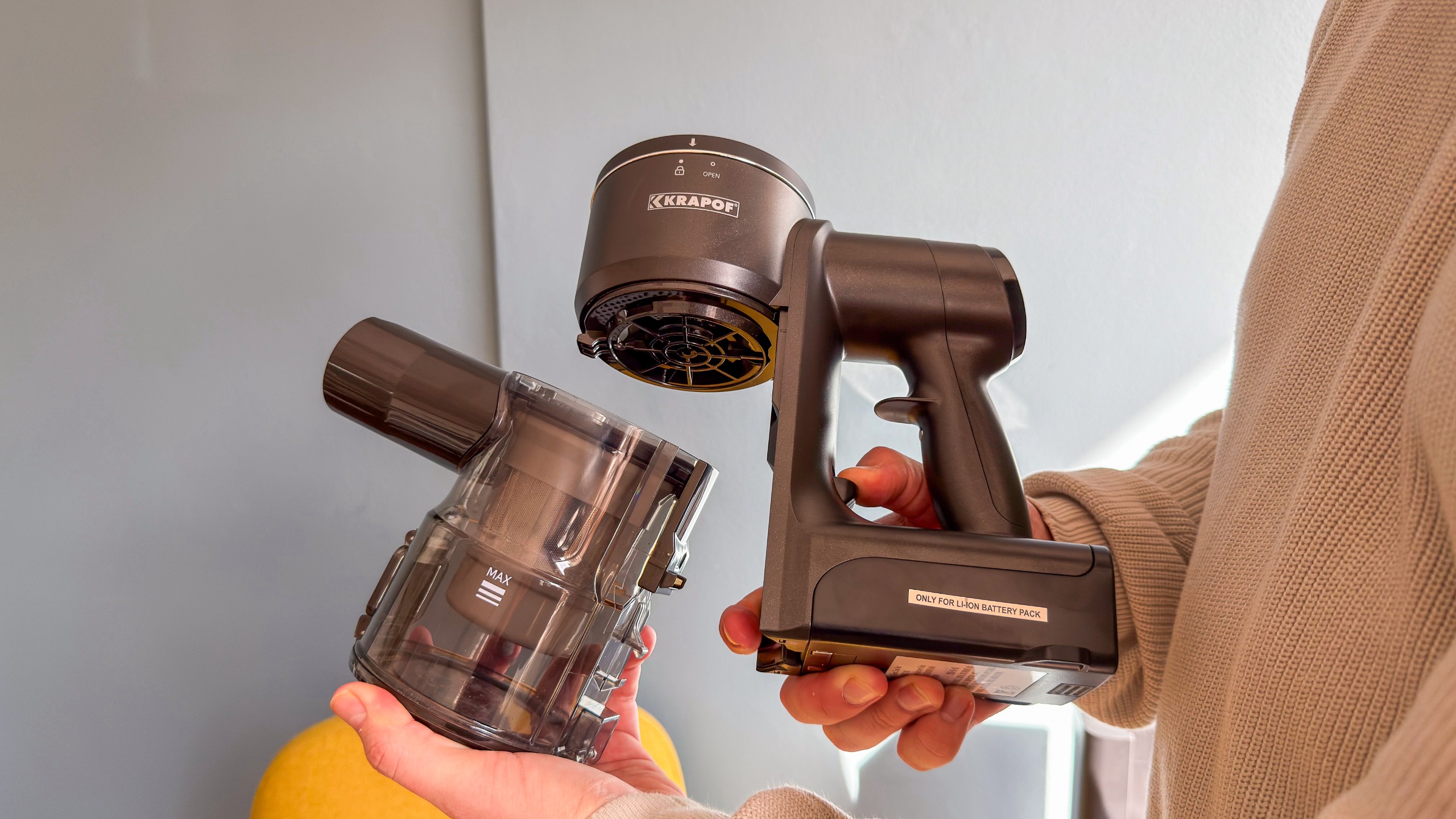
You can also clean out the inside by twisting the top to remove and access the filter. Dismantling fully isn't the easiest task, though, but it at least means you can maintain the vacuum well to increase its lifespan and keep it in tiptop condition.

Krapof Auto Clean Slim Power Vac
Sharmishta Sarkar / TechRadar
Krapof Auto Clean Slim Power Vac
Sharmishta Sarkar / TechRadar

One thing to note about the stick vacuum while it's docked and charging is that the top display will be upside down when you stand before the appliance, but it's fine when you take off the dock to use. So if you see the percentage sign of the battery indicator before a number like 85, assume it means it's a 58%.

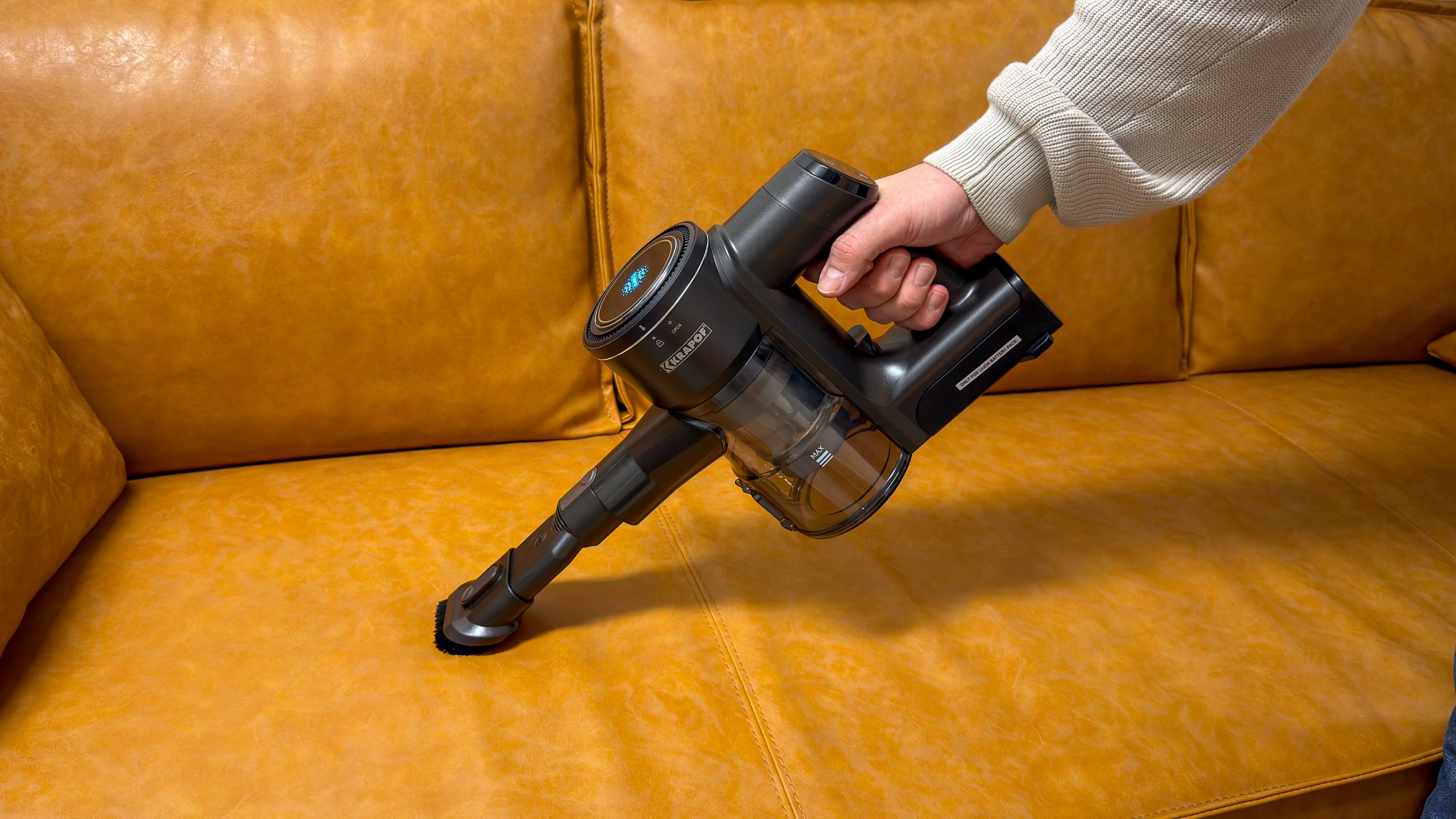
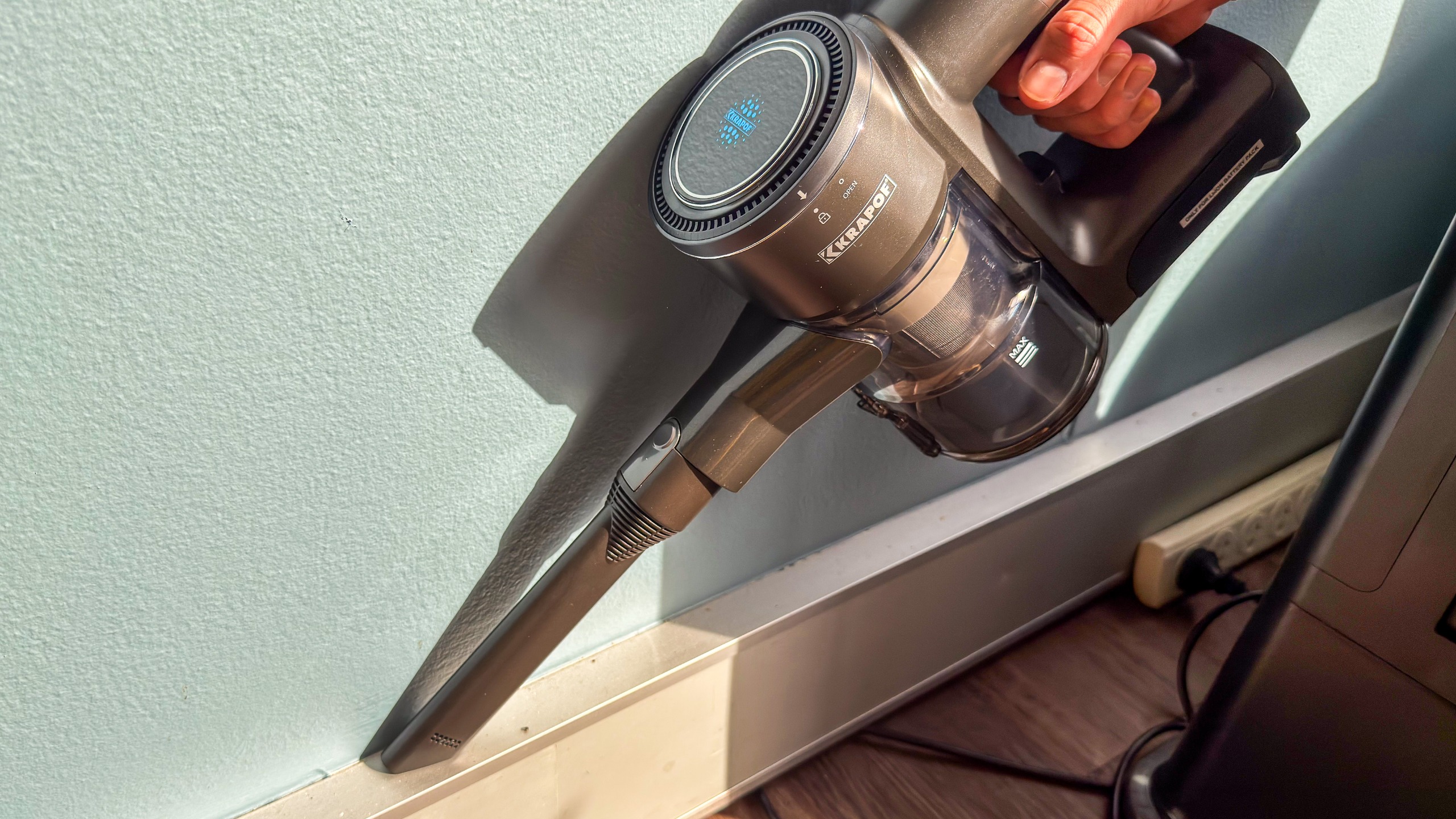
What I do appreciate about the self-emptying charging station is that it has dedicated space to store the two extra attachments that ship with the vacuum (a crevice tool and a brush) — they just clamp onto two stumps on the side of the dock's base.

Krapof Auto Clean Slim Power Vac
Sharmishta Sarkar / TechRadar
Krapof Auto Clean Slim Power Vac
Sharmishta Sarkar / TechRadar
Krapof Auto Clean Slim Power Vac
Sharmishta Sarkar / TechRadar
Krapof Auto Clean Slim Power Vac
Sharmishta Sarkar / TechRadar

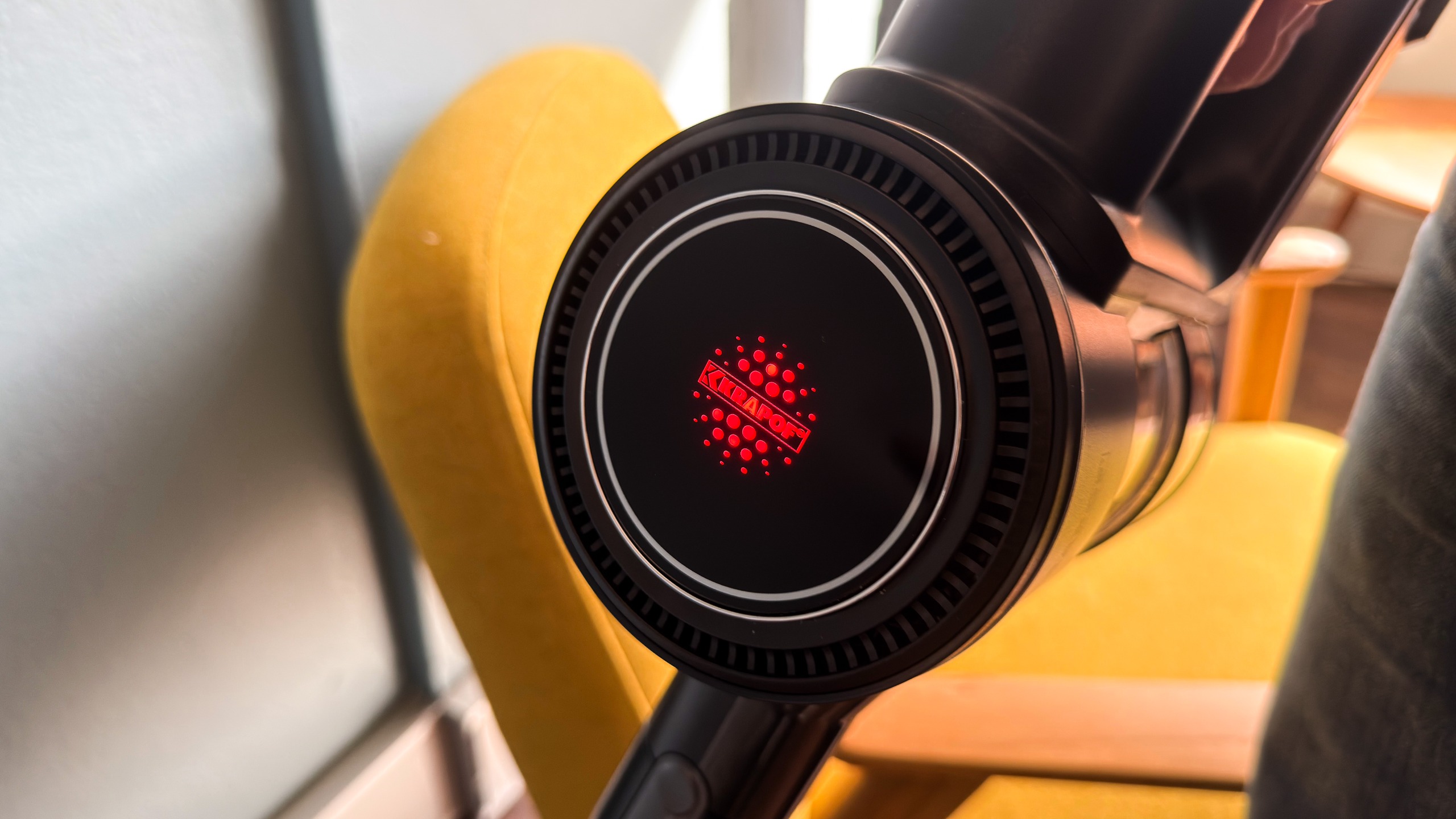
The Krapof Slim Power Vac has three suction settings, which can be accessed by pressing the +/- icon on the touchscreen when needed, but in its default Auto settings, dynamic suction sets in and the power increases or decreases depending on how much dirt the vacuum senses. The change in suction in denoted by the colour of the Krapof logo on the front of the handheld unit, going from green to blue to red as you shift from lowest to highest power settings.

Interestingly, despite claiming to have a whopping 450AW of suction, the Krapof Slim Power Vac is not very loud and, to be honest, it doesn't even perform as well as the 400AW Samsung Bespoke Jet AI Ultra or the 280AW Dyson Gen5detect. I suspect a lot of that has to do with the overall design of the stick vacuum, which also means its disappointing performance is down to a floorhead that tends to scatter visible particles, even those as small as chia seeds.

Krapof Auto Clean Slim Power Vac
Sharmishta Sarkar / TechRadar
Krapof Auto Clean Slim Power Vac
Sharmishta Sarkar / TechRadar
Krapof Auto Clean Slim Power Vac
Sharmishta Sarkar / TechRadar

So while it's perfectly good for invisible dust, other household spills like cereal (even small bits of oats), tea leaves, grains of rice or other dry spills get pushed around by the edges of the floorhead (as you can see from the video below). That means you're cleaning parts of the floor you've probably already vacuumed, doubling your work and making cleaning more of a chore than it really ought to be.

The scattering happens on both hard floors and carpets, so it's really not dependent on floor type and definitely got to do with the design. Furthermore, the floorhead's best suction is the forward motion, which is disappointing given its price tag and the fact that other models that cost about the same can suck equally well when moving front or back.

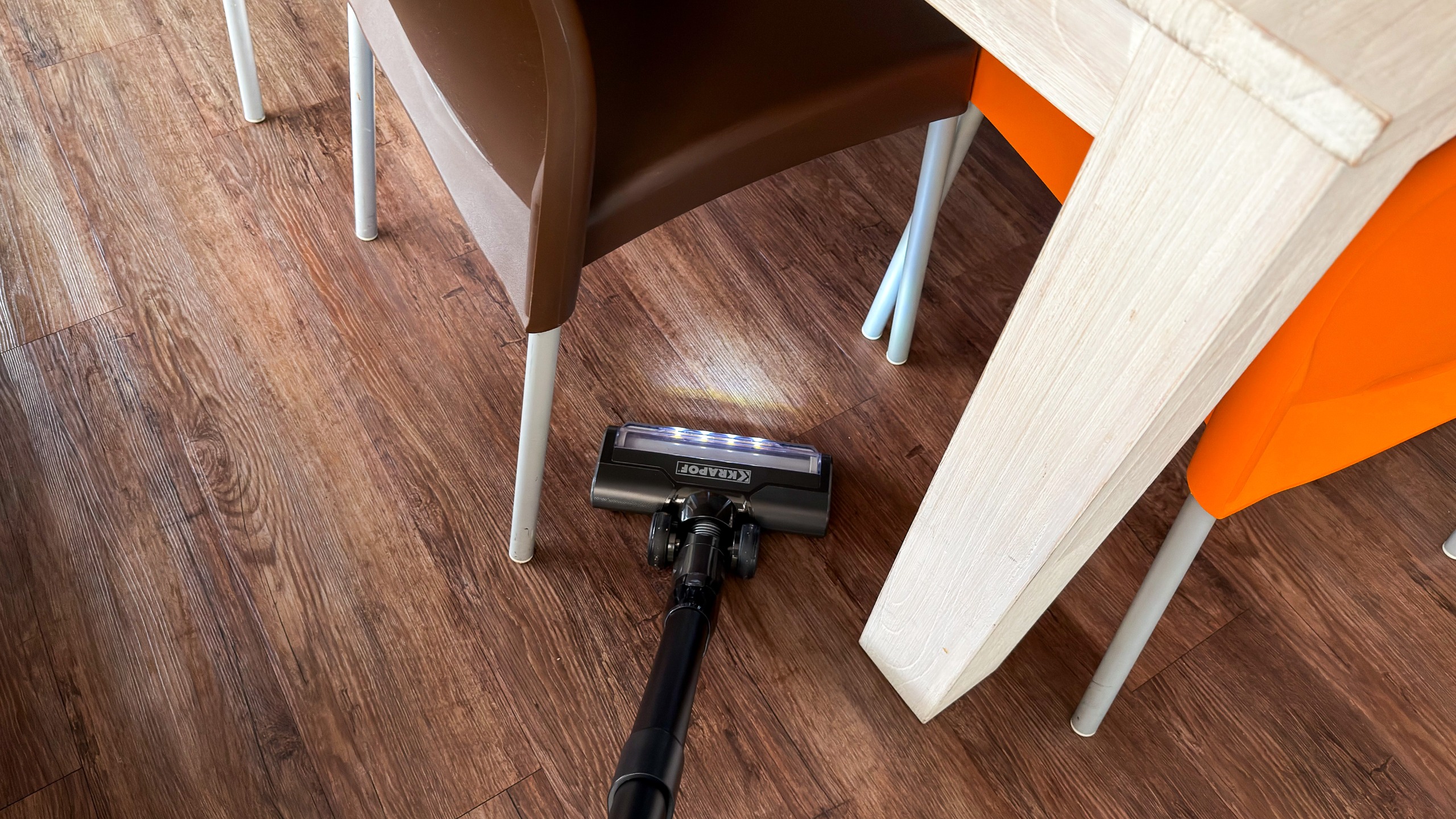
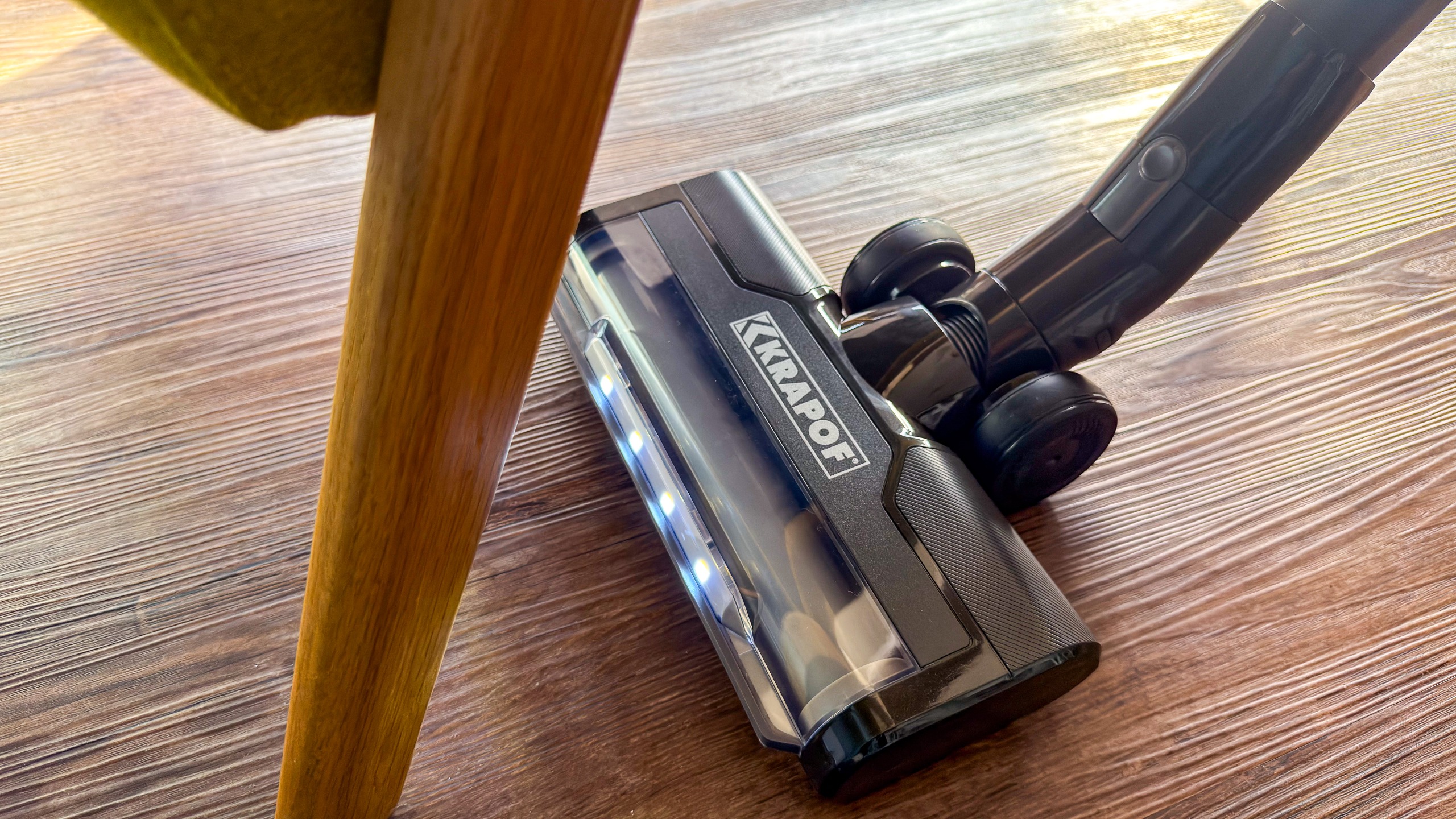
The floorhead has headlights built in, but they're not very bright and, in a well-lit room, aren't useful at all. Even under furniture, I didn't think the lights helped illuminate dust but highlighted long-forgotten lost items under furniture.

Krapof Auto Clean Slim Power Vac
Sharmishta Sarkar / TechRadar
Krapof Auto Clean Slim Power Vac
Sharmishta Sarkar / TechRadar

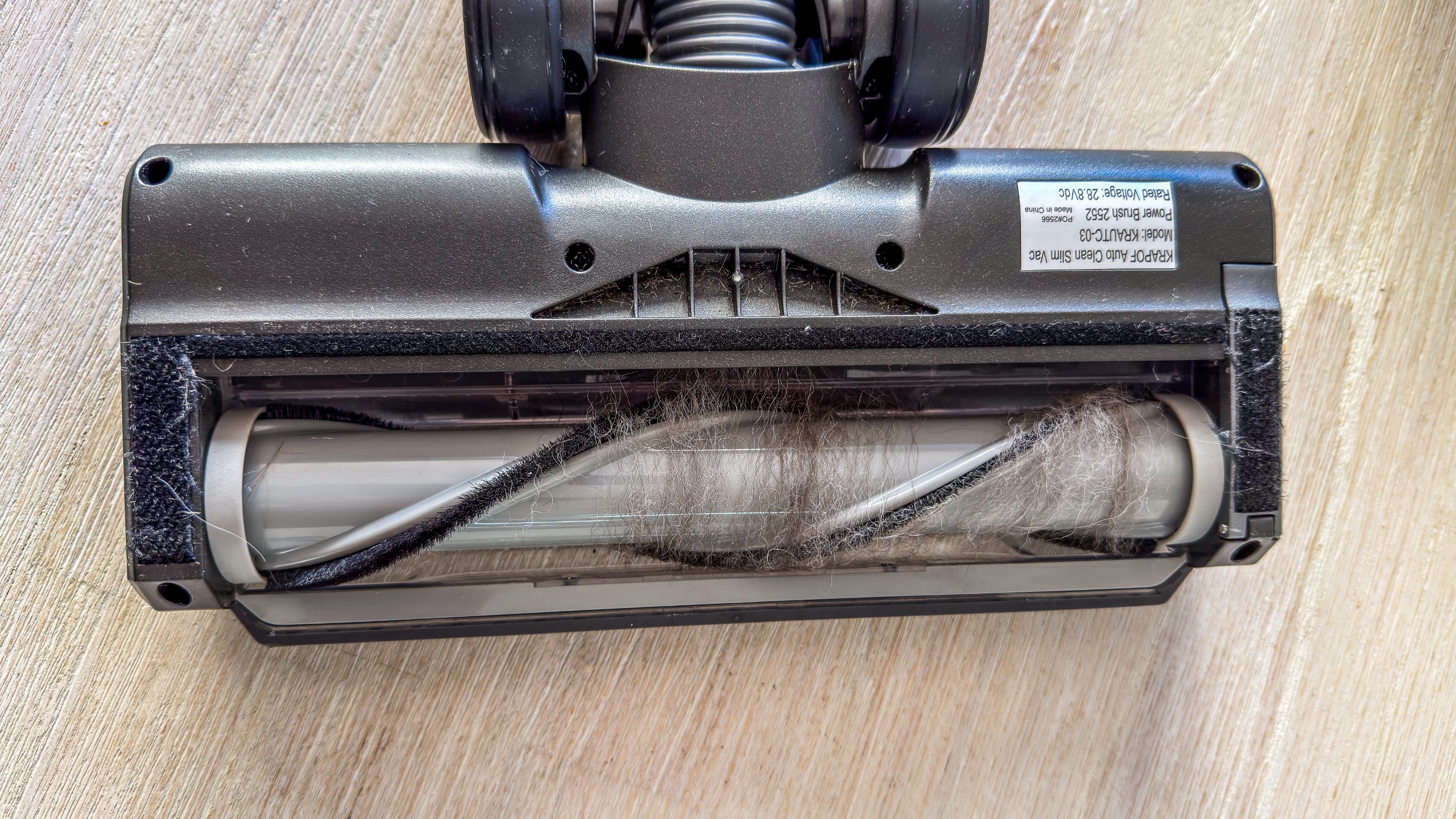
Another disappointing aspect of the main floorhead is the amount of hair and fur that gets entangled in the bristles. So if you have pets, I definitely wouldn't recommend it. That said, if you exclusively have just hard floors, a separate roller is included in the box that can be used in the floorhead to avoid bristle damage if your wood floors are sensitive, and this minimises the entanglements, but you will need to clean out the brush if you use the main floorhead as your primary cleaning tool.

This also means that your regular maintenance of the appliances increases as performance will be affected if you don't keep the floorhead free of human hair and pet fur.

Krapof Auto Clean Slim Power Vac

(Image credit: Sharmishta Sarkar / TechRadar)

As disappointing as I may have found the scattering of dirt and the hair tangles, battery life at least is quite standard here. Depending on how often dynamic suction gets triggered, you can eke out about 35 minutes of vacuuming on the default Auto mode, but if it's just daily dust, you can get a more with the LED floorhead attached.

This matches Kleva's claims of getting up to 30 minutes on the 'standard' setting, but switch to the non-motorised attachments and you'll get up to 80 minutes on the lowest Eco power setting.

Decent battery life, however, does not make up for the fact that this vacuum cleaner, while fine for some basic tasks, will struggle and make you work harder rather than easing the task of cleaning your floors. At the end of the day, I found it to be a frustrating experience overall and, for its price, find it hard to recommend over options like the Samsung Jet 95S or the Shark PowerDetect Clean & Empty if you really want a self-emptying option. In fact, I would even recommend a discounted Dyson V8 Cyclone and the additional purchase of the Auto-empty Dok. Despite lower suction, any of these three will offer a much smoother experience.

What surprises me even more is the number of glowing user reviews online, but the vast majority on Product Review seem to be incentivised ones, so please don't fall for the hype.

Krapof Auto Clean Slim Power Vac

(Image credit: Sharmishta Sarkar / TechRadar)

Krapof Auto Clean Self Empty Slim Vac review: price & availability

  • Only available directly from Kleva Range
  • List price of AU$899 but usually discounted to around AU$649

For a stick vacuum that claims to offer industry-leading suction and a self-empty function, the Krapof Slim Power Vac is well priced even at its RRP of AU$899. However, it's only directly sold via the Kleva Range website and is typically available with a discount that saves you AU$250.

However, given its design flaws that affect the overall user experience, even the discounted price of AU$649 is a bitter pill to swallow as you can opt for a lower-specced and more reliable vacuum for about the same price or lower.

Take, for example, the Dyson V8 Cyclone which, with its 150AW of suction feels overpriced at AU$649 and no self-emptying. However, it regularly drops to around the AU$450 mark, then add on the cost of purchasing Dyson's Auto-empty Dok for about AU$250 and you'll get just as good a clean with a much easier vacuuming experience for AU$700.

Shark has a lot of options too, all of which have lower suction than what the Krapof lists in its spec sheet, yet do a better job. In fact, the Shark PowerDetect Clean & Empty can be had for around the AU$650 often on Amazon, giving you a self-emptying charging dock that doesn't even need replacement dust bags.

If I had to score the Krapof on value alone, it'd be a rather low number.

Krapof Auto Clean Slim Power Vac

(Image credit: Sharmishta Sarkar / TechRadar)

Krapof Auto Clean Self Empty Slim Vac review: specs

Weight:

2.3kg (with LED floorhead)

Dimensions (vacuum + dock):

95 × 25.5 × 21.7 cm

Bin capacity:

0.5L

Max suction:

450AW

Max runtime:

80 minutes

Charge time:

5 hours

Attachments:

Crevice tool, Duster brush

Should I buy the Krapof Auto Clean Self Empty Slim Vac?

Buy it if...

You need a vacuum for just daily dust pickup

For tackling the easy tasks, this stick vac is well equipped and even comes with different brushes to help suck up dust from hard floors and carpets.

You need a lightweight stick vacuum

At about 2.3kg with the floorhead attached, it's even lighter than the Samsung Jet 95S that I claimed was a pleasure to use for being lightweight. The Krapof Slim Power Vac is also easy to manoeuvre, although note that the handheld part pivots more than the floorhead, so it may not always go in the direction you want it to.

Don't buy it if...

You have pets that shed

It's hard to recommend the Krapof Slim Power Vac for a pet-friendly home as the floorhead tangles both fur and human hair, requiring constant maintenance to keep the appliance clean.

You have messy kids or butter fingers

If you're home is prone to crumbs, scattered kitty litter or any dry spill with particles larger than dust, you'll find the scattering frustrating.

Krapof Auto Clean Self Empty Slim Vac review: alternatives

Shark PowerDetect Clean & Empty

It's been our top pick for the best stick vacuum in Australia for a long time until Samsung's Jet 95S dethroned it, but the latter is now harder to find on the market. For about the same price as the Krapof, you won't get the 450AW of suction, but you will get a good clean and self-emptying. Sadly, though, this Shark is a relatively heavy one.
Read our in-depth Shark PowerDetect Cordless review for more information

Dyson V8 Cyclone

It might have only 150AW of suction, but if you wait for a good discount (which is gets often these days) and then use the savings to buy the optional Auto-empty Dok, you'll get a very capable stick vacuum with self-emptying that works well on both carpets and hard floors, plus has no issues tackling hair or fur.
Read our full Dyson V8 Cyclone review to learn more

How I tested the Krapof Auto Clean Self Empty Slim Vac

Krapof Auto Clean Self Empty Slim Power Vac

(Image credit: Sharmishta Sarkar / TechRadar)

The Krapof Auto Clean Self Empty Slim Power Vac was tested in TechRadar's Sydney office which has large open spaces of hard floors and low-pile carpet. While regular dust suction was tested every two days on hard floors where particles are more visible then on darker carpet, I also used mixtures of various pantry staples to emulate different particle sizes. Tea from a bag is fine dust, while chia seeds are small. Along with them, I added in quick-cook oats which are smaller than regular rolled oats, plus pieces of freeze-dried raspberries.

One of my colleagues also kindly brought in fur from her two dogs for me to test this vacuum for pet households, which I scattered on both the hard floor and on the low-pile carpet in the office.

Battery tests were conducted with the main motorised floorhead with dynamic suction and without by leaving the machine running in one spot. The latter was also done using the crevice tool attached to the handheld unit.

[First reviewed September 2026]

  •  
❌