❌

Reading view

Missing decay at BESIII points to long-sought glueball

Physicists at China’s BESIII experiment in Beijing have found the strongest evidence yet for the existence of glueballs – subatomic particles made of gluons alone. The glueball-like particle is called X(2370) and it was first spotted at BESIII 15 years ago.

Gluons carry the strong nuclear force that binds quarks into protons and neutrons. Gluons also pull on each other as hard as they pull on quarks, which means they ought to be able to clump into particles called glueballs.

“So far, all ordinary matter that we know of is composed of quarks and leptons,” says Colin Morningstar of Carnegie Mellon University, whose 1990s supercomputer simulations helped predict what glueballs should look like. “A glueball is a totally new form of matter made up entirely of gluons – no quarks, no leptons,” explains US-based Morningstar, who is not a member of the BESIII team.

For four decades, detecting glueballs have been an important goal of BESIII and its predecessor – according to Shan Jin of China’s Nanjing University. BESIII is on the BEPCII accelerator, where electrons collide with positrons to create large numbers of J/ψ particles. A J/ψ can sometimes decay by shedding a flash of light and dumping the rest of its energy into gluons. The gluons could then bunch together to create a glueball.

Lightest glueball

In 2011, Yanping Huang was Jin’s PhD student and observed the production of the short-lived X(2370) particle at BESIII. “The most important next step was to determine its spin-parity quantum numbers, and it turned out to be one of the most difficult steps for us due to large background processes,” says Huang, now at China’s Institute of High Energy Physics in Beijing. Those numbers describe how a particle behaves when turned around and seen in a mirror – a kind of fingerprint. Only in 2024, with an exceptionally clean chain of decays and all 10 billion J/ψ particles, could the team read it, and it matched the prediction for the lightest glueball.

Now, Huang, Jin and the rest of the BESIII team have gone further and searched in vain for a specific X(2370) decay channel. They argue its absence suggests that X(2370) contains no quarks and the lightest glueball is its dominant constituent.

Quarks come in several types, or flavours, and a glueball contains none, so it cannot favour one flavour over another. That even-handedness forbids the X(2370) from breaking up into a particular pair of kaons, which are lightweight particles carrying a strange quark. BESIII looked for that break-up and found that the decay occurs at a rate that is at most 8% of the rate of a much more common X(2370) decay channel.

Huang explains that an ordinary quark-based particle should undergo the kaon-pair decay far more often. “The lightest glueball is essential for a natural and complete explanation of all these properties, while all other interpretations can hardly explain them simultaneously”.

Like a duck

Francesco Giacosa at Jan Kochanowski University in Poland is enthusiastic about the BESIII research, which he was not involved with. “We have an object, X(2370), that walks like a duck, quacks like a duck and, in addition, does not do something that the duck we are searching for should not do.”

Jin says that the BESIII result has important implications. “This is the direct proof of self-coupling among gluons predicted by QCD about 50 years ago,” where QCD is quantum chromodynamics, the theory of the strong force. It also illuminates the origin of mass, “since the gluon mass is zero and the glueball mass is totally from the strong interaction”. Glueballs, he says, are “a unique kind of matter made of pure force”.

Morningstar observes, “The results are the strongest evidence yet that particles dominated by a glueball component can exist in nature. This work is certainly an experimental triumph.”

Not everyone is ready to call the 50-year search over. “In my opinion, an independent experimental confirmation would be extremely important,” says Giacosa. A glueball can also blend with ordinary quark particles, he notes, so “even if X(2370) is predominantly a glueball, we do not know precisely how large its non-glueball component is”.

Upgrade needed

Gentler collisions elsewhere could shed further light on this, says Jin, “but it seems difficult for them to collect 10 billion J/ψ events to perform systematic studies as BESIII in a short time, unless we upgrade BEPCII itself again”.

That upgrade is on the collaboration’s wish list. Huang plans further measurements of the particle’s properties, which “will also certainly help us to identify more glueballs”. Reaching them may take ten times more data.

Morningstar also looks forward to further discoveries, “Our theoretical computations have suggested other glueballs that might exist, so with this successful study, I believe the search for other glueballs will intensify”.

Giacosa thinks the prize is worth it. “Glueballs are, in my view, among the most fascinating composite objects predicted within the Standard Model,” he says, meaning physicists’ theory of the fundamental particles and forces. “Establishing one experimentally would be much more than adding one more particle to the list – it would confirm one of the most remarkable predictions of the theory of the strong interaction.”

The results were presented in August at the International Conference on High Energy Physics and are described in a preprint on arXiv.

The post Missing decay at BESIII points to long-sought glueball appeared first on Physics World.
  •  

'There is no conflict between quantum physics and gravity': Physicists prove Einstein's 'happiest thought' holds true at quantum scales

For the first time, physicists have measured the tiny quantum shift an object acquires by falling through Earth's gravity — an effect of Einstein's relativity that was predicted almost a century ago but never observed.

Researchers placed ultracold rubidium atoms into a superposition, a quantum state in which a single particle takes two paths at once. In this experiment, one path put the atom in free fall while the other kept it motionless. Recombining the atoms revealed an almost imperceptible difference between the two paths.

The measurement, published Sept. 2 in the journal Science Advances, shows that Einstein's equivalence principle — the idea at the heart of general relativity — still holds when it is pushed into the quantum world, creating a small but tantalizing link between relativity and quantum mechanics.

"The principle says that acceleration and gravity cannot be distinguished locally," Vlatko Vedral, a physicist at the University of Oxford and a co-author of the new study, told Live Science via email.

Einstein's happiest thought

The classic illustration of the equivalence principle is a thought experiment known as Einstein's elevator. A person sealed in a windowless elevator cannot tell whether the floor is pressing against their feet because the elevator is parked motionless on Earth or because it is being accelerated through empty space. Einstein called that realization the "happiest thought" of his life and built general relativity around it.

For heavy, everyday objects, the equivalence principle has been tested to extraordinary precision. Quantum objects are a different matter. They behave like waves, and each wave carries a quantity called phase — essentially, where its crests and troughs sit. Phase cannot be seen directly, but when two versions of the same particle are recombined, any mismatch between their phases shows up as an interference pattern. The two waves reinforce each other in some places and cancel each other out in others, thereby changing the odds of where the particle turns up.

Theory says that a wave in free fall should build up phase relative to an identical wave held still and that this phase should grow with the cube of the falling time. Therefore, doubling the fall time multiplies the effect eightfold. Charles Galton Darwin, a grandson of the famous naturalist, and Earle Kennard both documented this prediction in 1927 ‪—‬ but no one had measured it until now.

An atom that falls and stays still at once

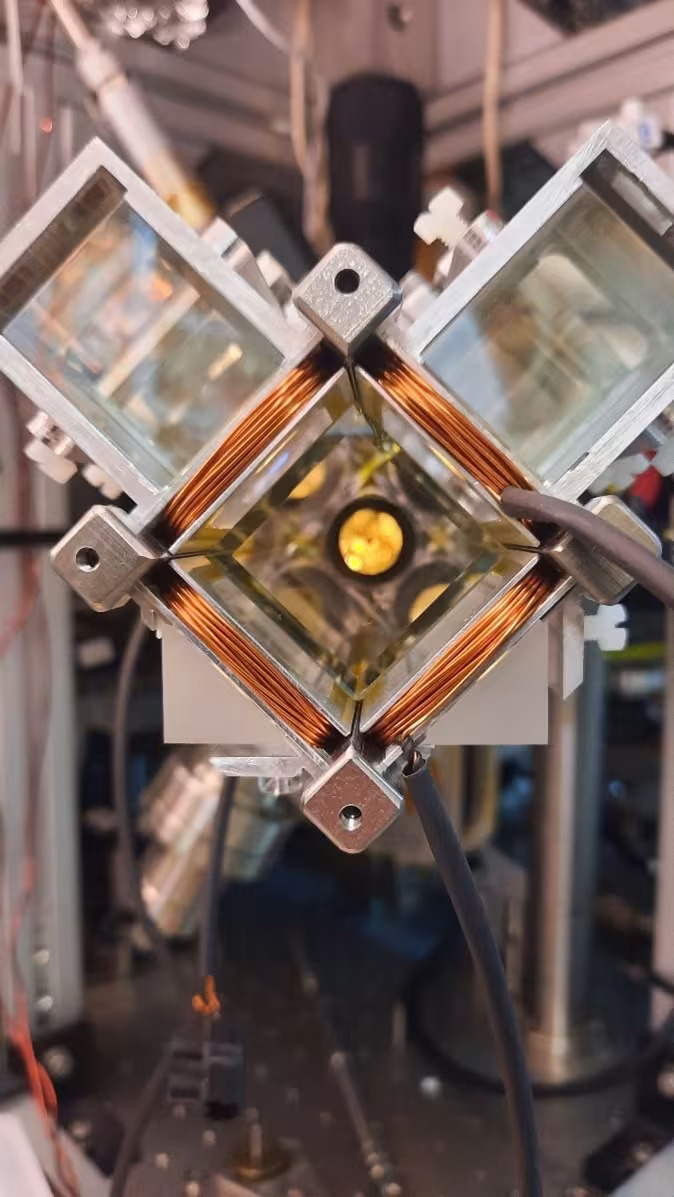
A square of copper coil held up by a series of metal bolts.

This apparatus, called 2D MOT, feeds the science chamber with cold atoms. (Image credit: Or Dobkowski)

Catching the effect required an instrument with one arm genuinely at rest with respect to Earth and the other in genuine free fall ‪—‬ something no previous experiment could supply. Matter-wave experiments going back to the neutron interferometry of the 1970s had measured gravity in other ways, but never with that pair of trajectories.

The team behind the new study, led by physicist Ron Folman at Ben-Gurion University of the Negev in Israel, chilled roughly 20,000 rubidium atoms into an exotic state of matter called a Bose-Einstein condensate, released them from their magnetic trap and ran the interferometer about 113 micrometers beneath an "atom chip" patterned with gold wires only 2 micrometers thick.

Radio and microwave pulses put each atom into a superposition of two magnetic states. A magnetic kick launched one of them upward, and a fraction of a millisecond later, a second pulse made that half insensitive to magnetic fields so that it rose and fell under gravity alone. The other half remained magnetically sensitive and felt a force tuned to cancel gravity exactly, leaving it suspended in place.

At the top of the arc, the two halves of a single atom stood about 7.5 micrometers apart ‪—‬ about seven times the width of the atomic wave itself — before the sequence was reversed to bring them back together. The team named the device the quantum Galileo interferometer, after the scientist who first argued that all objects fall at the same rate.

"Two different accelerations can be superposed, zero [acceleration] and the Earth's gravitational acceleration, and the resulting quantum interference measured," Vedral said.

A phase predicted almost 100 years ago

The researchers tracked the interference signal as they stretched the free-fall time to about 2.4 milliseconds. Across 633 runs over 5.3 hours, they recorded 13 complete oscillations, each one a full cycle of phase built up between the two halves of the atom. The growth followed the cube of the falling time, matching the theoretical model to within about 2.5%.

"The phase between the two elements of the superposition, which grows as the cube of the duration of the experiment and which was predicted a long time ago, in 1927, has now finally been observed for the first time," Vedral said.

The result matters because the same phase can be derived in two completely different ways: One treats gravity as a force acting on a quantum wave; the other moves into the falling frame, where gravity vanishes, and invokes the equivalence principle. Both give the same answer, and that agreement is what allows quantum mechanics and general relativity to coexist.

"They tell us that, at this level of accuracy, there is no conflict between quantum physics and gravity," Vedral said. "In other words, the equivalence principle is perfectly compliant with quantum mechanics."

The difficulty of bringing the two halves back together

The hardest part of the experiment was the recombination. Because the two halves of the atom end up moving at very different speeds, returning them to overlap in both position and motion is extremely demanding. Physicists Marlan Scully, Berthold-Georg Englert and Julian Schwinger named the problem the "Humpty-Dumpty effect." The magnetic fields also curve across the atom cloud, distorting the two halves in different ways.

The contrast of the interference fringes started at 80% for short runs and faded to 20% for the longest run, setting a practical ceiling on how long the experiment can run. The authors also cautioned that their measurement does not rule out every theory in which the equivalence principle breaks down, because some of those theories predict the same phase.

What comes next

The team now wants to test the equivalence principle under more general conditions, such as the "same experiment in a rotating frame," Vedral said. "Even more interestingly, performing an experiment in which two such systems are superposed and can gravitationally affect one another" would further test the results, he added.

That last idea points toward one of the field's central open questions. Scaling up the technique from atoms to far heavier objects, such as nanodiamonds, would let physicists ask whether gravity itself follows quantum rules and would open a route to testing the conjecture — championed by study co-author and Nobel laureate Roger Penrose — that gravity is what destroys quantum superpositions in the first place.

See how much you know about Albert Einstein with our Albert Einstein quiz!

  •  
❌