Muscles need fuel to work, and they can use both sugar and fat for energy. But when too much fat becomes trapped inside muscle cells, this normal energy system can begin to work less efficiently. Excess fat inside skeletal muscle is sometimes called myosteatosis. It is associated with aging, inactivity, obesity and high-fat diets, and […]
What people eat throughout life may influence more than heart health, weight, and blood sugar. A growing body of research is examining whether food choices can also affect how quickly the brain changes as people grow older. This question matters because dementia already affects tens of millions of people worldwide. With no simple way to […]
In 1948, Muriel Howorth was living a relatively ordinary life in the seaside town of Eastbourne on the south coast of England when she received a letter that would completely change the trajectory of her life.
From an early age, she had wanted to take part, or as she put it, “be of use” in international affairs. During World War II, she was employed by the Ministry of Information, the government office primarily responsible for wartime publicity and propaganda in the UK.
Howorth must have been talented at promotion and publicity, because the letter that arrived in 1948—“out of the blue,” according to her personal papers—inquired if she would like to apply her talents to making atomic energy seem more friendly.
She was well-educated, but not terribly knowledgeable about atomic science, so she borrowed a book by the radiochemist Frederick Soddy, who was born in Eastbourne, titled The Interpretation of Radium. Within a few chapters, she found herself a true believer in the promise of the atom. She would devote the rest of her life to sharing the wonders of atomic science with anyone who would listen.
Nuclear energy gets a rebrand after WWII
The United States dropped atomic bombs on the Japanese cities of Hiroshima and Nagasaki on August 6 and 9, 1945, a key factor in the end of World War II. The scale of the destruction and the ongoing damage from nuclear fallout after these attacks was vast. Despite the devastation, when a Gallup poll was released in mid-August of 1945, 85 percent of Americans approved of the bombing.
The atom was more or less a mystery to the average American, and was seen both as something to be feared and a source of hope. The potential for nuclear energy seemed endless, and although the Soviet Union was America’s ally, establishing a lead over the Soviets in nuclear technology seemed prudent.
Around 1900 when this photo was taken, nearly all grapefruits were yellow. The popular Rio red grapefruit wasn’t developed until 1984 using atomic gardening. Image: Contributor / Getty Images / Rykoff Collection
Muriel Howorth’s pro-nuclear children’s book and atomic gardening
In the years after World War II, American and European scientists and heads of state agreed that there should be a focus on more productive and peaceful uses for atomic power. The letter that Howorth received in 1948 was part of this effort. She threw herself into projects that combined science education and entertainment.
Notable among these was an elaborately choreographed pantomime titled Isotopia: An Exposition on Atomic Structure. Howorth also self-published a children’s book featuring Daddy Proton, Mummy Neutron, and their electron children. Her greatest impact as an early science communicator, though, was her work in atomic gardening.
Irradiated peanuts and other miracles of atomic gardens
Applying radiation to agricultural plants was, in part, a response to wartime scarcity. Restricted rations had made people acutely aware of the possibility of food insecurity. Researchers hoped that exposure to gamma radiation might induce mutations that resulted in higher-yielding or disease-resistant crop varieties. Perhaps some of those crops might be more dense in nutrients, too.
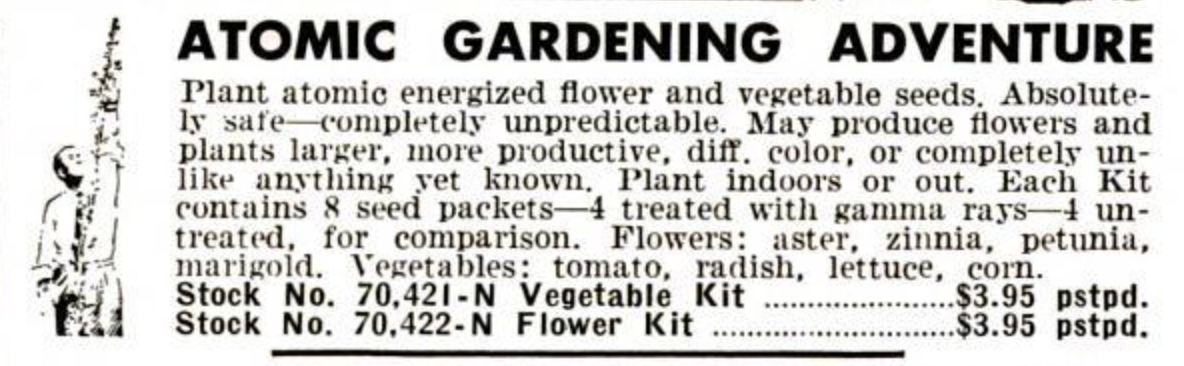
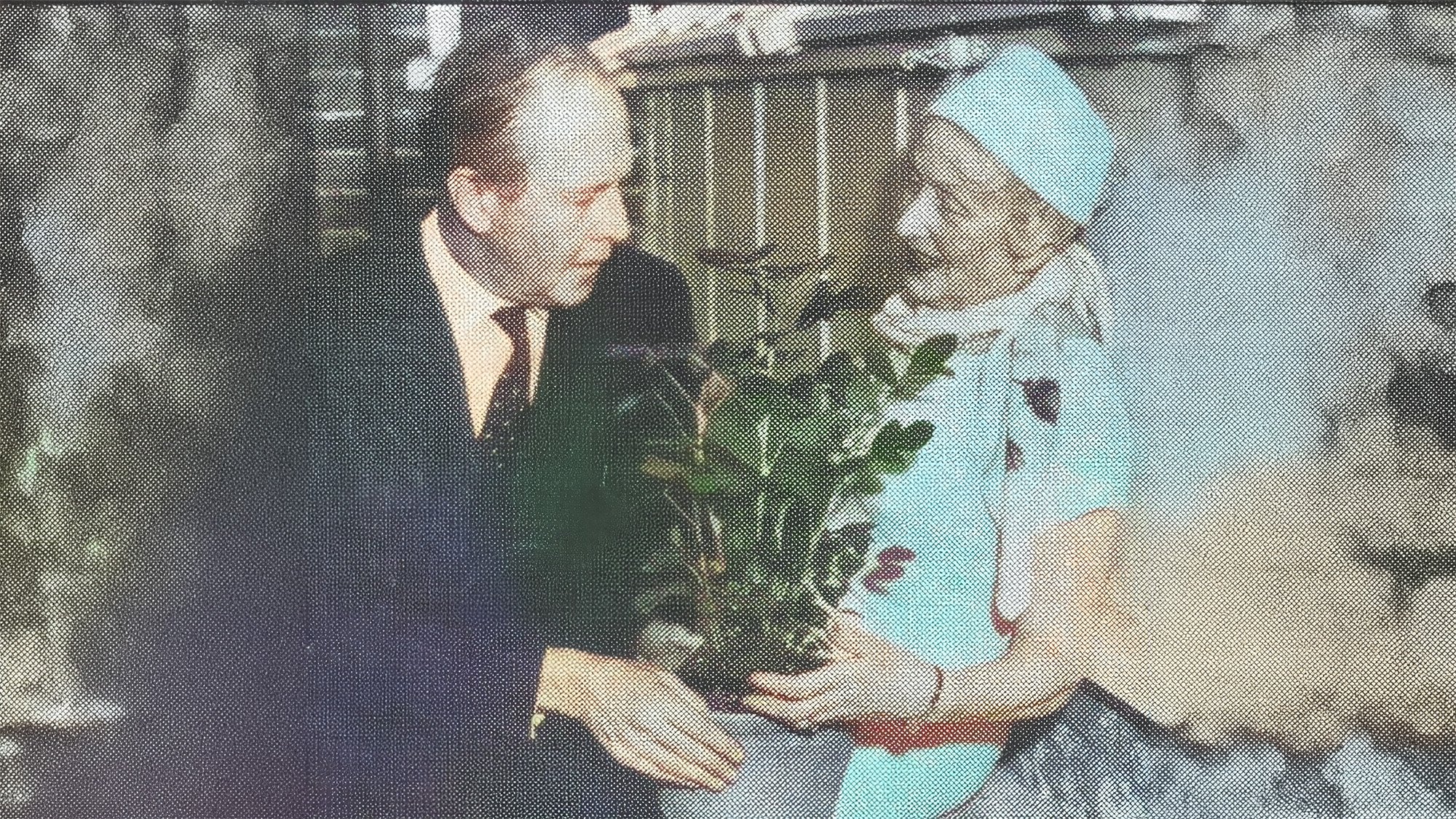
As atomic ambassador, Howorth founded the Atomic Gardening Association and recruited hundreds of members—or, as she called them, “atomic mutation experimenters.” Soon, atomic gardening kits were available to the public. One could send away for packets of seeds from an irradiated plant. By planting these seeds and propagating multiple generations of the plants, home gardeners could test whether any useful-seeming mutations had arisen.
Howorth herself served a mutated variety of Carolina peanuts to some of her scientist friends in 1959. Their response was underwhelming, so she planted the rest of the peanuts in her garden, where they grew remarkably quickly and produced extremely large peanuts. She usually kept a handful of these extra-large peanuts tucked away in her handbag in case the opportunity arose to recruit a new member to the Atomic Gardening Association.
In the June 1961 issue of Popular Science, a story promotes buying “plant atomic energized flower and vegetable seeds” as an “amazing science buy.” Image: Popular Science, June 1961 issue
Howorth’s lasting legacy to citizen science
It’s tempting to view Howorth as a kooky eccentric. Contemporary newspaper reports of her various events and projects were certainly dismissive in tone. More accurately, she represents an early effort at addressing the gap between scientific research and public understanding.
The world was far less interconnected in her day, with no internet, no omnipresent news media, and no social media platforms. Not only that, but the idea of women as integral parts of scientific research was slow to catch on, despite pioneering work by scientists like Marie Curie and Rosalind Franklin.
Today, the same gulf exists between what scientists publish in their fields and what the average person understands. The same challenge of translating scientific language for public consumption exists for science communicators, but the tools available to them have evolved beyond recognition. You can find videos and posts by scientists explaining everything from how blimps work to what various chemical reactions look like, or from how fossils form to why black holes are so dark.
If Howorth were around today, her atomic choreography might have gone viral. As it stands, she was a wonderful example of the love of sharing knowledge with the public, and of the excitement and joy that comes with learning new things about how our world works.
In That Time When, Popular Science tells the weirdest, surprising, and little-known stories that shaped science, engineering, and innovation.
Many things change in space, including how the intestines function. Constipation is a known side effect of space travel, but until now, little has been known about why it happens. Constipation is a familiar problem for astronauts, but the biological reason it develops during spaceflight has remained uncertain. Researchers from the University of Copenhagen working [...]
A compound produced in the body after eating pomegranates improved heart function by up to 80% in experimental models of a type of heart failure with limited treatment options. For people with heart failure with preserved ejection fraction, the heart can still pump blood but struggles to relax and refill properly between beats. In experimental [...]
A lot of us like to start our days with a cup of coffee. Whether it’s a pour-over you make at home or a latte from your favorite coffee shop, many people need caffeine to wake up and feel alert.
If you rely on coffee as a productivity hack, you might be wondering if there’s a time of day that would optimize its effects on the brain. It turns out the answer isn’t that straightforward. How the body reacts to caffeine depends on factors such as age, metabolism, and tolerance. So, here’s what the experts say about how to time that cup of joe.
What effect does coffee have on the body?
Caffeine is the central stimulant found in coffee and other foods like tea, soda, and chocolate. It helps us feel more awake by blocking adenosine, a naturally occurring chemical that builds up in the brain while we’re awake. Experiencing morning grogginess, or sleep inertia, is related to residual adenosine in the brain, though other factors like your sleep quality also play a role. As adenosine builds up throughout the day, it makes us feel increasingly tired and helps signal to the brain that it’s time for sleep.
Since caffeine has a similar chemical structure to adenosine, it fits into the same receptors in the brain. When caffeine binds to these receptors, it blocks adenosine from doing its job. As a result, the brain receives fewer of the signals that make us feel tired, helping us feel more awake, alert, and energized.
Caffeine is the central stimulant found in coffee. Video: How does caffeine keep us awake? – Hanan Qasim, TED-Ed
“But this perceived energy does come at a cost,” says Dustin Lee, an assistant professor of psychiatry and behavioral science at Johns Hopkins, in an email to Popular Science. The brain adapts to these conditions incredibly well, so over time, the brain produces more adenosine receptors.
The more receptors your brain has, the more caffeine it needs to feel alert, eventually leading to caffeine tolerance and withdrawal. “Withdrawal symptoms, which I’m sure most of us have some familiarity with, include headache, irritability, fatigue, and difficulty concentrating,” Lee explains.
If you want to quit caffeine or miss your usual cup of joe, then you’re likely to experience these symptoms very quickly. They usually start within 12 to 24 hours after stopping caffeine, peak within 48 hours and resolve within two to nine days.
When should you drink coffee?
“There’s no set answer for everyone,” says Marie-Pierre St-Onge, a professor of nutritional medicine at Columbia University Medical Center, to Popular Science. It depends on your age, metabolism, and caffeine tolerance.
“Peak caffeine absorption occurs rapidly, at about 30 to 60 minutes after ingestion,” says Lee, so a simple answer to the question would be to drink coffee about an hour before whatever activity that would benefit from caffeine’s stimulating effects. If you’re going on a run, for example, you might want to get some caffeine in before heading out, says St-Onge. That’s why its use is limited by some sports governing organizations like the National Collegiate Athletic Association.
You shouldn’t really need caffeine right when you wake up, as your body should already be alert, says St-Onge. “If you’re starting to feel a slump a few hours after waking up, that would be when to drink coffee.”
Both Lee and St-Onge stress that the answer to when you should drink coffee really depends on the individual. The ability to metabolize caffeine slows down with age, so the amount of time to clear caffeine from your bloodstream gets longer as you get older. Your circadian rhythm also changes as you get older, which means you might get tired earlier in the day.
“Compounded, [these changes] make it so that you would want to consume your caffeine earlier as you get older,” explains St-Onge.
“Caffeine dose matters just as much as the time at which you drink your cup of coffee,” adds Lee.
A cup of coffee can actually have a wide range of caffeine—the dose can depend on the ratio of coffee to water, how you brewed your cup, and even bean type. And “tolerance has a major effect on caffeine’s effects, so the morning cup of coffee might serve more to partially reverse overnight caffeine withdrawal, so that should be taken into consideration as well,” he says. Basically, that means that for regular coffee drinkers, the first cup of the day is contributing to reversing the effects of not having had any caffeine since the day before.
When should you not drink coffee?
“Not too close to bedtime,” says St-Onge. If you’re finding that you’re having trouble falling asleep, make sure that you’re not drinking coffee too late in the afternoon.
Drinking coffee on an empty stomach can also be too abrasive for some people, and may lead to side effects like increased jitters and an increased urge to go to the bathroom. (Though the idea that it can lead to stomach ulcers is a myth.) If you’re someone with a sensitive stomach, try eating something alongside your cup of coffee to be safe.
So, don’t fret too much the next time you’re thinking of when to have a cup of coffee. Just remember: not too late, and not too much. Then you might become dependent on the stuff.
In Ask Us Anything, Popular Science answers your most outlandish, mind-burning questions, from the everyday things you’ve always wondered to the bizarre things you never thought to ask. Have something you’ve always wanted to know? Ask us.

 Login