❌

Reading view

Alibaba Launches 2.4T Parameter Model Qwen 3.8-Max
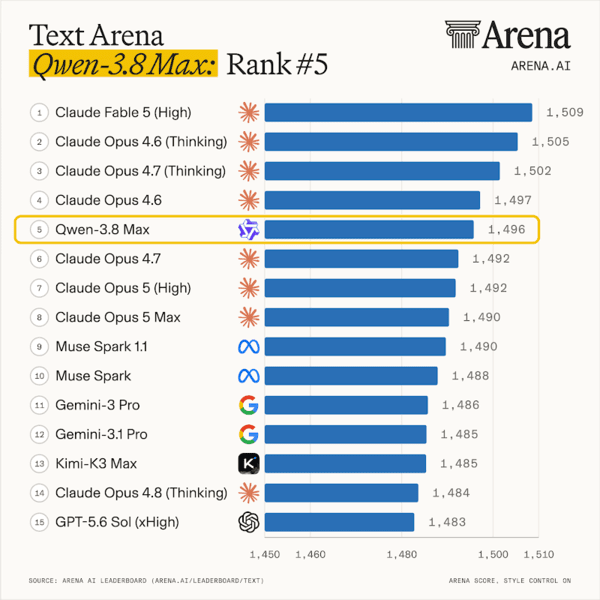
Qwen 3.8-Max ranked fifth on the Text Arena benchmark. (Source: Alibaba)

Alibaba has officially launched Qwen 3.8-Max, its latest artificial intelligence model. First introduced as a preview version on July 20, Qwen 3.8-Max features 2.4 trillion parameters and supports a context window of up to 1 million tokens. Alibaba describes it as the most powerful flagship model in the Qwen family.

Alibaba said Qwen 3.8-Max ranked fifth on the Text Arena benchmark and second on the Vision Arena benchmark, demonstrating advanced capabilities in coding, real-world task execution, research and long-horizon problem solving. The company said the model was designed as a multimodal foundation model with native visual intelligence capabilities.

Qwen 3.8-Max is available through Alibaba Cloud's Model Studio as an application programming interface (API) service. The model weights are scheduled for release next week, and the model is also accessible through Alibaba's all-in-one workplace AI agent platform, QwenWork.

Built on Qwen 3.5 architecture, Qwen 3.8-Max combines Sparse Mixture-of-Experts (Sparse MoE) architecture with a hybrid attention mechanism. Alibaba said this architecture enables large-scale models to generate inference results efficiently.

Qwen 3.8-Max ranked fifth on the Text Arena benchmark. (Source: Alibaba)

Under this architecture, only 95 billion of the model's 2.4 trillion parameters are activated during inference. This allows the model to deliver performance on complex tasks while reducing computational costs.

Alibaba also highlighted Qwen 3.8-Max's autonomous coding and long-horizon task execution capabilities, claiming the model can work independently for extended periods without human intervention. In internal testing, the company said the model autonomously completed a real-world software engineering project over a 16-day period.

According to Alibaba, when tasked with building a self-evolving agent framework from scratch, Qwen 3.8-Max established an engineering loop that integrated user feedback, community best practices and self-generated testing data. The model then repeatedly generated code, conducted testing, created previews and analyzed logs before completing a self-evolving agent framework called "oh-my-cli."

The framework has been released as open-source software on GitHub. Qwen 3.8-Max also ranked fourth on the Frontend Code Arena benchmark.

Alibaba further said the model demonstrated problem-solving capabilities in highly specialized fields, including designing novel methodologies that surpassed results reported in existing research papers.
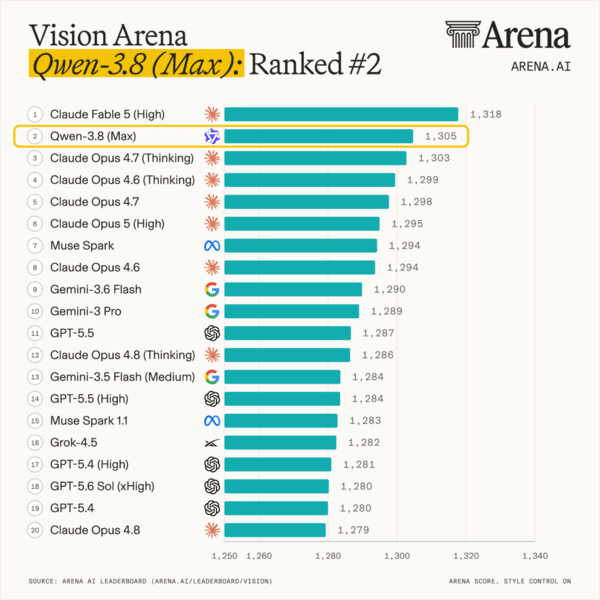
Qwen 3.8-Max ranked second on the Vision Arena benchmark. (Source: Alibaba)

As a multimodal foundation model, Qwen 3.8-Max can transform static input data into dynamic and interactive knowledge structures, according to Alibaba. The company said the model can process hundreds of pages of documents, entire television series or 100-hour livestreams and convert them into searchable and interactive knowledge bases.

Alibaba said Qwen 3.8-Max can be used to edit raw personal footage into polished vlogs or generate immersive educational animations from text prompts alone. According to the company, the model can also reconstruct front-end web projects from a single user interface screenshot, transform 2D floor plans into detailed 3D interior visualizations, and create interactive games through natural-language instructions.

  •  

Woorinet Joins Korea’s AIDC Alliance to Develop Data Center Interconnect Technology

Woorinet, a provider of wired and wireless telecommunications equipment, has joined the South Korean government's Artificial Intelligence Data Center (AIDC) Alliance and is pursuing a national research and development (R&D) project to secure core technologies for Data Center Interconnect (DCI) networks linking AI data centers.

Launched under the leadership of the Ministry of Science and ICT (MSIT), the AIDC Alliance is a cooperative framework designed to strengthen South Korea's global competitiveness in AI data center technologies through collaboration among industry, academia, research institutes and government organizations across the entire value chain, including AI semiconductors, data centers, networking, power, cooling and software. The alliance is organized into demand, supply and infrastructure divisions. Woorinet has joined the supply division and will participate in the commercialization of next-generation DCI technologies.

As AI models continue to grow in scale, distributed training and distributed inference environments that simultaneously utilize graphics processing unit (GPU) resources across multiple data centers are becoming more common. This trend is increasing the need for backend network infrastructure capable of connecting AI computing resources.

Woorinet said it was selected in May as the lead organization for the Institute of Information & Communications Technology Planning & Evaluation (IITP)'s national R&D project titled "Development of AI Data Center Transmission Technology for Horizontal Expansion of AI Resources Across Data Centers." Working with the Electronics and Telecommunications Research Institute (ETRI), Sangmyung University and Pukyong National University, the company is developing ultra-high-speed transmission technologies between AI data centers and pursuing next-generation DCI technologies that would allow distributed AI resources to be utilized as a single AI infrastructure.

For AI data centers, DCI technology requires ultra-high bandwidth, lossless and ultra-low-latency communications, and advanced security capabilities. Woorinet said technologies based on the Ultra Ethernet Consortium (UEC) standard that can connect data centers located tens to hundreds of kilometers apart without data loss will become a key factor in determining AI infrastructure competitiveness.

To address these networking requirements, Woorinet said it is developing next-generation DCI technologies based on 16-terabit-per-second Packet Optical Transport Network (POTN) systems and wavelength-division multiplexing (WDM) optical transmission technologies capable of reliably transporting massive volumes of data.

The company also emphasized that it is strengthening its technological capabilities for building ultra-high-speed, ultra-low-latency transmission environments between AI data centers through proprietary optical transmission and network control technologies, including POTN, Packet Transport Network (PTN), Reconfigurable Optical Add-Drop Multiplexer (ROADM) and Transport Software-Defined Networking (T-SDN).

  •  

SpaceX Says Only Starlink Is Profitable as AI and Space Units Remain in the Red

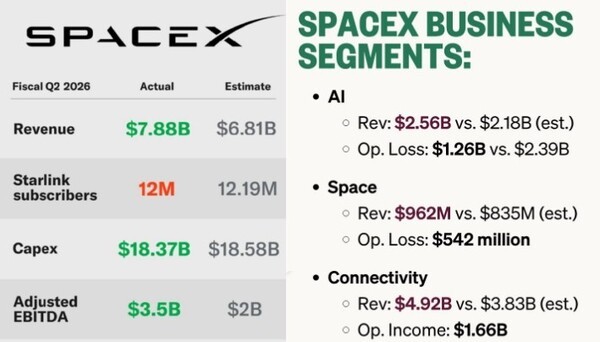
SpaceX's second-quarter 2026 financial results. (Source: SpaceX; image sources: Yahoo Finance and Morning Brew Instagram)

SpaceX reported stronger-than-expected revenue growth in its first quarterly earnings release since going public in June, but investor attention quickly shifted to the company's massive artificial intelligence (AI) infrastructure spending and continued losses in its AI and space businesses. The stock fell about 7% in after-hours trading following the earnings announcement.

For the second quarter of 2026, SpaceX reported revenue of $7.814 billion, up 92% from a year earlier, and a net loss of $541 million. While the company remained unprofitable, losses narrowed from the prior-year period. Earnings per share (EPS) came in at negative $0.09, beating the consensus estimate of negative $0.26.

Starlink remained the company's largest growth engine. Revenue from the Connectivity segment, which includes Starlink, reached $4.291 billion, exceeding analyst expectations of $3.83 billion. Subscriber numbers doubled year over year to 12 million, while segment revenue increased 66%.

The AI segment, which includes xAI, Grok and social platform X, generated approximately $2.6 billion in revenue, representing year-over-year growth of 247%. The company attributed the expansion to the integration of xAI and growing demand for AI computing services. However, the AI division posted an operating loss of $1.26 billion, although losses narrowed from the previous quarter.

SpaceX's third business segment, Space—which includes launch services and the Starship program—generated revenue of $962 million, up 29% from a year earlier, while recording an operating loss of $542 million. Although the AI segment delivered the fastest growth rate, Starlink's Connectivity business was the company's only profitable division.

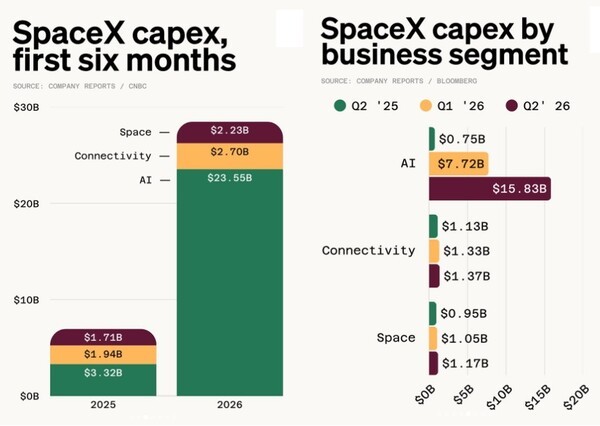
While revenue and earnings exceeded expectations, investors focused on the scale of SpaceX's capital expenditures (CAPEX). Second-quarter capital spending surged to approximately $18.4 billion, compared with about $2.8 billion a year earlier. Most of the spending was directed toward AI data centers and computing infrastructure. SpaceX argued that the investments are necessary to support long-term growth, but investors expressed concern about the company's cash consumption.

SpaceX's second-quarter 2026 financial results. (Source: SpaceX; image sources: Yahoo Finance and Morning Brew Instagram)

During the earnings call, Chief Executive Officer (CEO) Elon Musk said SpaceX could generate $1 trillion in annual revenue by 2030 and suggested there was a "non-zero chance" of reaching that milestone as early as 2029. Musk also predicted that Starlink could eventually become one of the world's largest internet service providers.

"At some point, Starlink may carry a majority of internet traffic" in countries where the service is authorized, he said.

The earnings call drew significant attention as the company's first public earnings presentation following its IPO. However, investor and media reaction was notably cautious. TechCrunch noted that Musk frequently made more aggressive claims than other executives during the call, while senior management often provided more measured interpretations.

One example involved Starlink's future market position. After Musk said Starlink could handle a majority of global internet traffic within a decade, President and Chief Operating Officer (COO) Gwynne Shotwell later described the outlook more conservatively, saying Starlink could account for a "significant portion" of global internet traffic in the coming years.

A similar contrast emerged regarding revenue expectations. Chief Financial Officer (CFO) Brett Johnson said annual recurring revenue (ARR) could potentially reach $100 billion by year-end. About 20 minutes later, Musk described the figure as "not a question mark" and suggested it could be even higher.

Johnson attributed the ARR outlook to faster returns on new computing infrastructure investments, $6.7 billion in additional cloud-service contracts scheduled to begin in the October quarter, and revenue contributions from Cursor, which SpaceX recently acquired.

Investors remain skeptical about Musk's long-term targets. The $1 trillion revenue goal was first introduced during the company's IPO roadshow in June, when management discussed 2031 as a possible target year. During the latest earnings call, Musk accelerated that timeline by one year to 2030.

SpaceX capital expenditure trends and allocation. (Source: SpaceX; image source: Morning Brew Instagram)

Based on SpaceX's reported 2025 revenue of $18.67 billion, reaching $1 trillion by 2030 would require approximately 54-fold growth over five years, implying a compound annual growth rate (CAGR) of roughly 120%.

SpaceX's current trajectory is stronger than that baseline suggests. With quarterly revenue already exceeding $7.8 billion, annualized revenue for 2026 could approach $32 billion or more. Even so, Wall Street projections remain far below Musk's target.

During the IPO roadshow, Goldman Sachs estimated SpaceX's 2030 revenue at roughly $470 billion, while Morgan Stanley projected approximately $330 billion. Both firms served as lead underwriters for the IPO, and even their forecasts were widely viewed as aggressive. As a result, some investors question whether the $1 trillion target represents a genuine internal objective or a narrative designed to support market sentiment.

Despite the stronger-than-expected quarter, the stock reaction underscored investor skepticism. SpaceX shares had risen 9.43% during regular trading on Aug. 4 to close at $125.33 ahead of the earnings release, but subsequently fell about 7.5% to 8% in after-hours trading.

Musk's trillion-dollar revenue vision remains far more ambitious than prevailing market expectations, but investors seeking clearer paths to profitability appeared unconvinced by promises tied to distant milestones and long-term projects.

  •  

Encapsulation epitaxy of air-stable 2D superconductors for quantum circuits

Nature, Published online: 05 August 2026; doi:10.1038/s41586-026-10865-1

An ‘encapsulation epitaxy’ mechanism is used to grow air-stable, two-dimensional superconducting films at the interface of a 2D–3D hybrid substrate, holding promise for use in fabrication of superconducting quantum circuitry.
  •  

The ‘extremely effective’ campaigns undermining support for renewables – podcast

Despite most Australians supporting clean technology, the campaign against wind and solar infrastructure has proven to be effective, striking a chord with many of those living in remote and rural areas. So how do we bring everyone along on the transition to a renewable energy-focused future? And who’s putting up roadblocks?

The Guardian’s environment and climate correspondent Graham Readfearn joins Reged Ahmad to unpack Australia’s relationship with renewables

Read more:

‘Extremely effective’ organised campaigns against wind and solar undermining support for renewable energy

Karl’s ‘great net zero debate’ was anything but – so beware Coalition claims of renewables taking over ‘two Tasmanias’

Continue reading...

© Composite: Carly Earl

© Composite: Carly Earl

© Composite: Carly Earl

  •  
❌