Kakao Games has partnered with The Grimm Entertainment to develop games based on popular webtoon intellectual property (IP).
Kakao Games said on Aug. 4 that it signed a memorandum of understanding (MOU) with The Grimm Entertainment covering the development and publishing of games based on webtoon IP.
The Grimm Entertainment is a webtoon production company founded by webtoon creator Park Tae-jun. The company owns a number of webtoon IPs that have gained popularity in both domestic and global markets, including Lookism and Manager Kim.
Under the agreement, Kakao Games will be able to utilize comic and webtoon IPs owned by The Grimm Entertainment for game development and publishing. The two companies also plan to expand competitive content IP into games and pursue cooperation in global publishing initiatives.
NEXUS said it returned to profitability in the first half of the year, supported by gains related to its acquisition of One Store, while accelerating efforts to expand its platform business and build an artificial intelligence (AI) and blockchain gaming ecosystem.
The company said on Aug. 4 that, under consolidated K-IFRS standards, it recorded second-quarter revenue of 5.8 billion won, an operating loss of 5.3 billion won and net income of 8.08 billion won. Compared with the same period a year earlier, revenue declined 37.8%, operating profit swung to a loss and net income returned to positive territory.
NEXUS said the quarter reflected a 15.7 billion won gain arising from the acquisition of One Store, as well as higher platform revenue generated through participation in network operations as a validator. Cumulative first-half revenue reached 17.42 billion won, up 9.4% from a year earlier. Net income totaled 5 billion won, compared with a loss in the same period last year.
On June 29, NEXUS acquired an 89.03% stake in One Store for 62.6 billion won. Following the acquisition, the company reorganized its ecosystem under the "ONE" brand, renaming its mainnet from CROSS to ONEchain and changing its native token from $CROSS to $ONE. It also unified its payment infrastructure around $ONEUSD.
The company plans to expand its AI and blockchain gaming platform centered on One Store. This month, it will launch an AI Games section featuring AI-powered gaming services. In mid-August, it plans to integrate its embedded wallet, ONEpocket, into the One Store application. Later this month, the company will launch a global version of One Store in 124 countries using a single-build deployment model, expanding its international gaming platform business.
NEXUS is also strengthening its content portfolio. Through cooperation with Chinese technology company Tencent, One Store plans to introduce a series of mini-games on its ONEPlay platform, including Run for Survival, Legend of Divine Artifact and Oh! The Cat Is Here. The company also plans to add AI and blockchain games as it seeks to differentiate its content offerings.
Slides from Netmarble's second-quarter 2026 earnings presentation (Source: Netmarble)
Slides from Netmarble's second-quarter 2026 earnings presentation (Source: Netmarble)
Slides from Netmarble's second-quarter 2026 earnings presentation (Source: Netmarble)
Slides from Netmarble's second-quarter 2026 earnings presentation (Source: Netmarble)
Netmarble is revising its long-standing strategy of releasing multiple new titles each year, opting instead for a more focused approach centered on operational efficiency and selective investment in high-potential games.
Speaking during the company's earnings conference call on Aug. 5, Chief Executive Officer Kim Byung-kyu acknowledged that several new titles released during the first half of the year failed to meet market expectations.
"We pursued a strategy of driving growth through the launch of multiple games," Kim said. "However, the performance of our new titles in the first half fell short of expectations."
He added that the company understands investor concerns regarding the visibility of its growth outlook for the second half of this year and beyond 2027.
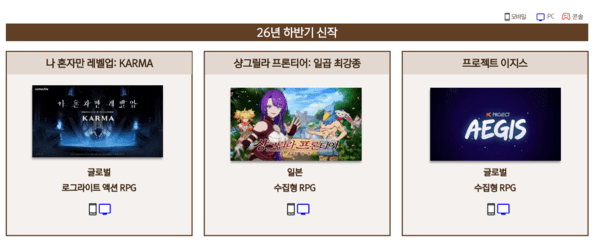
As a result, Netmarble has reduced its planned 2026 new game lineup from five titles to three. The company now intends to release Solo Leveling: Karma, Shangri-La Frontier: The Seven Colossi and Project Aegis during the second half of the year.
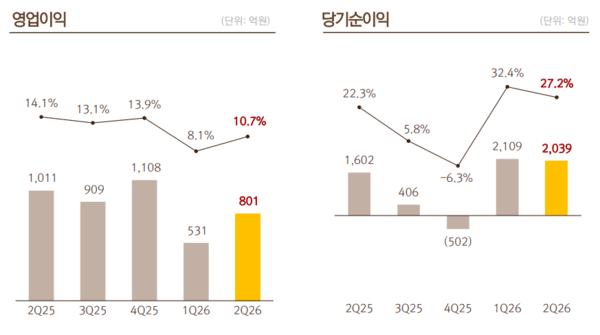
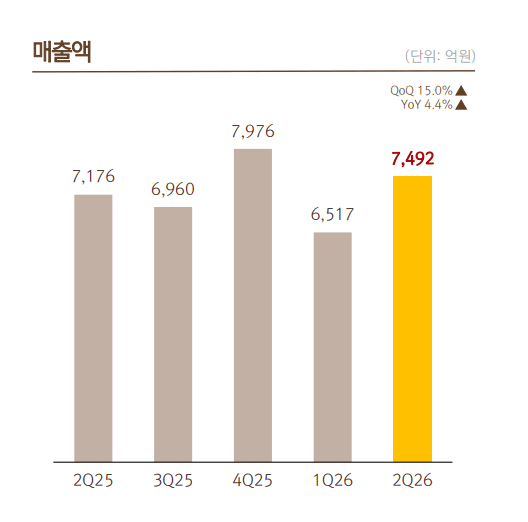
Netmarble reported second-quarter consolidated revenue of 749.2 billion won, operating profit of 80.1 billion won and net profit of 203.9 billion won.
Compared with the same period last year, revenue increased 4.4% and net profit rose 27.3%, while operating profit declined 20.8%.
The company attributed revenue growth to ongoing updates for The Seven Deadly Sins: Origin and the initial contribution from newly launched massively multiplayer online role-playing game (MMORPG) SOL: enchant.
Overseas revenue reached 580.8 billion won during the quarter, accounting for 78% of total sales. International revenue increased 22.6% year over year and 13.4% from the previous quarter.
By region, North America represented 39% of revenue, followed by South Korea at 22%, Europe at 13%, Southeast Asia at 10%, Japan at 9% and other markets at 7%.
By genre, role-playing games accounted for 42% of revenue, casual games for 35%, MMORPGs for 17% and other genres for 6%.
For the first half of 2026, Netmarble generated cumulative revenue of 1.4009 trillion won, operating profit of 133.2 billion won and net profit of 414.8 billion won.
Compared with the same period last year, revenue increased 4.4% and net profit rose 72.5%, while operating profit declined 11.7%.
Going forward, the company said it will focus on strengthening the performance of existing live-service games while pursuing a more selective new-title strategy aimed at improving earnings stability and sustaining long-term growth.
Internal investigations and external forensic analysis related to the Coupang customer data leak incident found that information from approximately 3,000 accounts had been stored, with no evidence of external transmission or additional data leakage. (Photo: Coupang)
Internal investigations and external forensic analysis related to the Coupang customer data leak incident found that information from approximately 3,000 accounts had been stored, with no evidence of external transmission or additional data leakage. (Photo: Coupang)
Coupang Inc., the US-listed parent company of South Korean e-commerce giant Coupang, reported its largest-ever quarterly operating and net losses since its New York Stock Exchange listing, as a massive privacy-related regulatory fine outweighed continued revenue growth.
According to a consolidated earnings report filed with the US Securities and Exchange Commission (SEC) on Aug. 4, Coupang generated revenue of $8.856 billion in the second quarter of 2026, while recording an operating loss of $556 million and a net loss of $570 million.
Revenue increased 4% from $8.524 billion in the same period last year. On a constant-currency basis, revenue grew 10%.
Despite higher sales, profitability deteriorated sharply after the company recognized a regulatory fine imposed by South Korea's Personal Information Protection Commission.
Coupang said that excluding the approximately $410 million administrative penalty imposed in South Korea, second-quarter operating loss would have been $146 million, while net loss would have been $160 million.
The company swung from an operating profit of $149 million in the year-earlier period to an operating loss. Net income also reversed from a profit of $31 million a year earlier to a loss.
The second-quarter operating loss and net loss were the largest on a quarterly basis since Coupang's NYSE listing in 2021. The previous records were set in the second quarter of 2021, when the company posted an operating loss of $514.9 million and a net loss of $518.6 million.
The latest quarterly operating loss exceeded Coupang's full-year 2025 operating profit of $473 million. Its net loss was approximately 2.7 times larger than the company's full-year 2025 net income of $214 million.
Coupang had already reported an operating loss of $242 million in the first quarter of 2026. With losses continuing for a second consecutive quarter, first-half operating loss widened to $798 million, while cumulative net loss reached $836 million.
This marks the first time that both first-half operating loss and net loss have exceeded 1 trillion won. The first-half operating loss was nearly equal to the combined operating profit of $909 million generated during 2024 and 2025.
Global user-generated content contest image. (Image: Krafton)
Global user-generated content contest image. (Image: Krafton)
Krafton announced on Aug. 5 that PUBG: Battlegrounds and modding platform CurseForge will jointly host a global user-generated content (UGC) contest.
The competition will be divided into three categories: Combat, Survival and Creative. Participants may submit one or more entries and are allowed to enter multiple works across different categories.
A total of 30 winning entries, including the top 10 creations from each category, will be officially featured in PUBG: Playgrounds. The new creative-mode hub will become available through the PUBG: Battlegrounds play menu starting Aug. 12.
The contest offers a total prize pool of $95,000. First-place winners in each category will receive $10,000. Additional cash prizes will be awarded to six community-selected entries and 10 mid-competition standout creations.
Submissions will be accepted from Aug. 12 through Sept. 2. Following community voting, the final winners will be announced on Sept. 14.
JoyCity said on Aug. 5 that it will begin a Prime Open Beta Test (OBT) for Freestyle Football 2, a new soccer game being developed by its subsidiary URE, on Sept. 4.
The upcoming test is intended to serve as a final validation of cross-platform gameplay between console and PC environments before the game's official launch.
The open beta will run for five days, from Sept. 4 through Sept. 8, Korea time. Players can register in advance through the game's official website.
Participants will be able to access the test through PC platforms including Steam, as well as console platforms such as Xbox and PlayStation.
JoyCity also said it will showcase the game at PAX West 2026, one of North America's largest gaming exhibitions, during the testing period.
The company plans to use the open beta and its participation at PAX West to further refine the game and strengthen its position in the global market.
FOW Games, a subsidiary of Neowiz, said on Aug. 5 that it has launched its new mobile massively multiplayer online role-playing game (MMORPG), Kingdom 2: Burning Battlefield.
Kingdom 2 is a traditional MMORPG centered on character progression through field hunting, alongside cooperative and competitive gameplay content. The game became available at noon through Google Play, One Store, Apple's App Store and a dedicated PC client.
Players can freely combine three playable races—Human, Elf and Belkan—with five weapon types: one-handed swords, greatswords, bows, staffs and spears.
Each race possesses unique skills, allowing players using the same weapon type to adopt different combat strategies depending on their race and build combinations.
The game also features a variety of progression systems, including runes, mana infusion, artifacts and Monster Souls. FOW Games said these systems were designed to provide greater depth and differentiation in character development.
"Magic Dust," a resource obtained when equipment is destroyed or dismantled, can also be used as a material for character growth and enhancement.
Guild-focused content includes housing, research, storage facilities and raid activities. Players can also challenge high-difficulty content such as World Bosses, the Infinite Tower and party dungeons.
To celebrate the launch, FOW Games will hold a 28-day server-level ranking event. Players who achieve high rankings will receive rewards including Legendary Summon Selection Tickets and summon vouchers.
Additional promotional events will be held through the game's official community café and KakaoTalk channel, including strategy-guide contests and channel-subscription campaigns.
Summary of Kakao Games' second-quarter 2026 results. (Image: Kakao Games IR materials)
Summary of Kakao Games' second-quarter 2026 results. (Image: Kakao Games IR materials)
Kakao Games said it has no plans to pursue a merger, comprehensive stock swap or any other business combination with Line Games, emphasizing that enhancing shareholder value remains its top priority. The company, however, left open the possibility of future business cooperation between the two game developers.
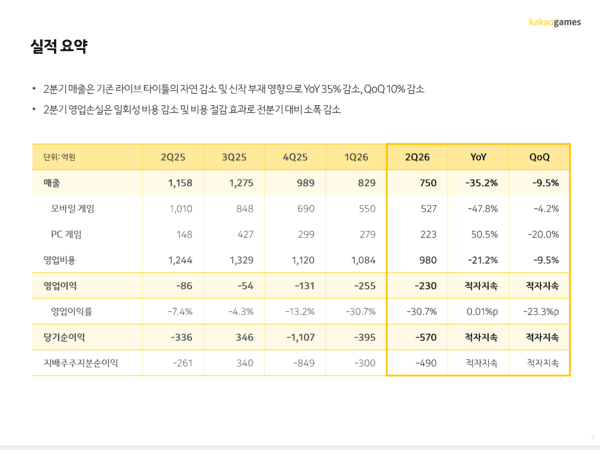
The comments were made during the company's second-quarter earnings conference call on Aug. 5, where Kakao Games reported preliminary consolidated revenue of 75 billion won and an operating loss of 23 billion won.
Revenue declined 35.2% from a year earlier, while the operating loss widened by 14.4 billion won. The loss, however, narrowed from 25.5 billion won in the previous quarter due to lower one-time expenses and cost-cutting measures.
Management attributed the weak performance to declining revenue from existing live-service titles and the absence of major new game launches.
Mobile game revenue fell 47.8% year over year to 52.7 billion won, while PC game revenue rose 50.5% to 22.3 billion won. Operating expenses decreased 21.2% from a year earlier to 98 billion won.
The company also addressed market speculation regarding a potential merger with Line Games following recent changes in its governance structure. Co-Chief Executive Officer Kim Tae-hwan dismissed the possibility.
"As our chief financial officer stated at the extraordinary shareholders' meeting, Kakao Games has no plans to pursue a merger, comprehensive stock exchange or any other business combination with Line Games. That position remains unchanged," Kim said.
"However, we may consider opportunities for business cooperation that can create synergies. Such cooperation would fall within the scope of ordinary business partnerships," he added.
Kim also stressed that management would place shareholder value at the center of any decision-making process.
"We want to reiterate that, under any circumstances, management will make decisions based on what best enhances shareholder value at Kakao Games," he said.
The company added that Line Yahoo has a strong interest in increasing Kakao Games' corporate value given the significant capital it has invested in transactions involving the company.
Kakao Games also outlined measures aimed at strengthening management accountability and improving shareholder returns. The company plans to secure additional capacity for share repurchases through a reduction of capital reserves.
Separately, senior executives will purchase a combined 500 million won worth of company shares.
The company will also introduce a Restricted Stock Unit (RSU) program for employees. Under the plan, executives will directly purchase shares while employees receive stock-based compensation through RSUs, aligning the interests of management, employees and shareholders.
Kim said the company's performance appears to have reached a bottom and that a recovery is expected to begin with new game launches in the fourth quarter.
"The business is moving past its low point, and we are preparing for a rebound through new title launches starting in the fourth quarter," he said. "The new management team will restore market trust through execution rather than promises."
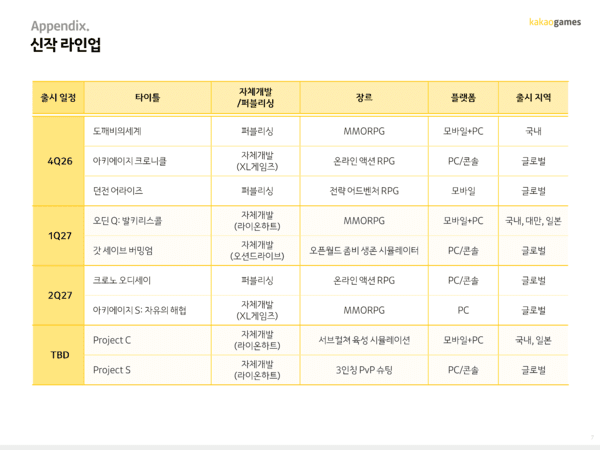
Kakao Games' upcoming game lineup. (Image: Kakao Games IR materials)
Kakao Games plans to stagger the release of its key strategic titles beginning with World of Dokkaebi in October.
The company expects to launch three titles in the fourth quarter of 2026, including ArcheAge Chronicles and Dungeon Arise.
In the first quarter of 2027, it plans to release three additional titles, including Odin Q: Valkyrie Rise and God Save Birmingham. The company said the launch timing was selected to maximize the likelihood of success amid a highly competitive MMORPG market.
AhnLab said on Aug. 5 that it has been recognized as the recipient of the Competitive Strategy Leadership award in the Asia-Pacific endpoint security sector as part of Frost & Sullivan's 2026 Best Practices Awards.
The company was selected for the first time as a Competitive Strategy Leadership winner in Frost & Sullivan's evaluation of the Asia-Pacific endpoint security market.
Frost & Sullivan annually assesses companies based on the innovativeness of their business strategies and their ability to create customer value, selecting industry leaders in various sectors.
AhnLab was recognized for its platform-based approach to integrated security operations, its efforts to embed artificial intelligence (AI) across products and services, and its ability to build a threat intelligence-centered security ecosystem.
The evaluation also highlighted AhnLab's transition away from managing individual security products separately toward a unified platform architecture that integrates multiple security functions, including endpoint protection.
Under this framework, threat intelligence generated across different security domains can be shared and utilized collectively, while newly identified threats can be rapidly incorporated into products and services.
The company also received high marks for its AI-driven security operations strategy. Rather than limiting AI to specific features, AhnLab has embedded AI capabilities throughout its product and service portfolio to enhance automation and intelligence across security operations.
Naru Security participates in KISA's Regional Cyber Incident Victim Detection and Vulnerability Assessment project. (Image: Naru Security)
Naru Security participates in KISA's Regional Cyber Incident Victim Detection and Vulnerability Assessment project. (Image: Naru Security)
Naru Security said on Aug. 5 that it will work with the Korea Internet & Security Agency (KISA) to detect cyber threats and assess security vulnerabilities at small and medium-sized enterprises (SMEs) and microbusinesses across South Korea.
The company has been selected to carry out KISA's "Regional Cyber Incident Victim Detection and Vulnerability Assessment" project.
The initiative is designed to continuously monitor enterprise networks and identify signs of cyber intrusions and security weaknesses at an early stage. Based on the findings, participating companies will receive assessments of their security posture and recommendations for tailored response measures.
As part of the project, Naru Security will collect network communication data to detect threats across regions and identify threat actors, operational infrastructure, attack origins, affected companies and the scope of incidents.
The company will also analyze hacking infrastructure and suspicious internet protocol (IP) addresses and validate the likelihood of actual compromise by combining the findings with its proprietary threat intelligence platform.
Internet telemetry and network flow data will also be utilized. By tracing communications between domestic companies and known malware distribution sites or attack infrastructure worldwide, the company aims to identify organizations that may have been exposed to cyberattacks.
Naru Security said it will leverage operational experience from its cyber breach assessment service, ZeroTiCA.
The platform distinguishes between legitimate and malicious network traffic and analyzes connections to command-and-control (C&C) servers, attacker activity within networks, lateral movement paths, the scope of impact and residual threats to determine whether an actual compromise has occurred.
The company added that experts with experience supporting KISA's cyber incident investigation and response operations will contribute their expertise to provide security recommendations tailored to smaller businesses.
Naru Security said cybersecurity at SMEs is critical to the safety of supply chains and the broader national industrial ecosystem. The company plans to apply knowledge accumulated through field operations to help prevent cyber incidents, strengthen corporate security capabilities and improve cyber resilience across South Korea's industrial sectors.
Through the project, Naru Security also plans to expand its breach assessment capabilities beyond large enterprises and further develop customized cyber threat response models for regional SMEs.

 Login