❌

Reading view

Particles Don’t Disappear—They Transform into Something Much Stranger

For about 40 years, physicists have puzzled over a strange problem: What happens when an electrically charged particle encounters a hypothetical magnetic monopole? Some calculations suggested that the outgoing particle simply disappears from the theory. Now, researchers from Ghent University, the University of Cambridge and the University of Oxford may have found an answer. Their […]

The post Particles Don’t Disappear—They Transform into Something Much Stranger appeared first on Knowridge Science Report.

  •  

Trillion-Mile Gas Stream May Explain a Bizarre Triple-Star System

Astronomers have discovered an enormous stream of gas flowing toward a young system of three stars, potentially explaining why its planet-forming disks are strangely tilted. Using the Atacama Large Millimeter/submillimeter Array (ALMA), researchers observed a gas streamer stretching about one trillion miles, or 0.2 light-years, toward the young triple-star system GW Orionis. The findings, published […]

The post Trillion-Mile Gas Stream May Explain a Bizarre Triple-Star System appeared first on Knowridge Science Report.

  •  

Exploring the Foundations of the Scientific Revolution

The Scientific Revolution was significantly influenced by Christian philosophers and scientists, particularly Francis Bacon, who emphasized empirical methods and a rational Creator. The integration of faith and reason laid the foundational principles of modern science. The laws of the physical universe never change and are discoverable using the scientific method.

  •  

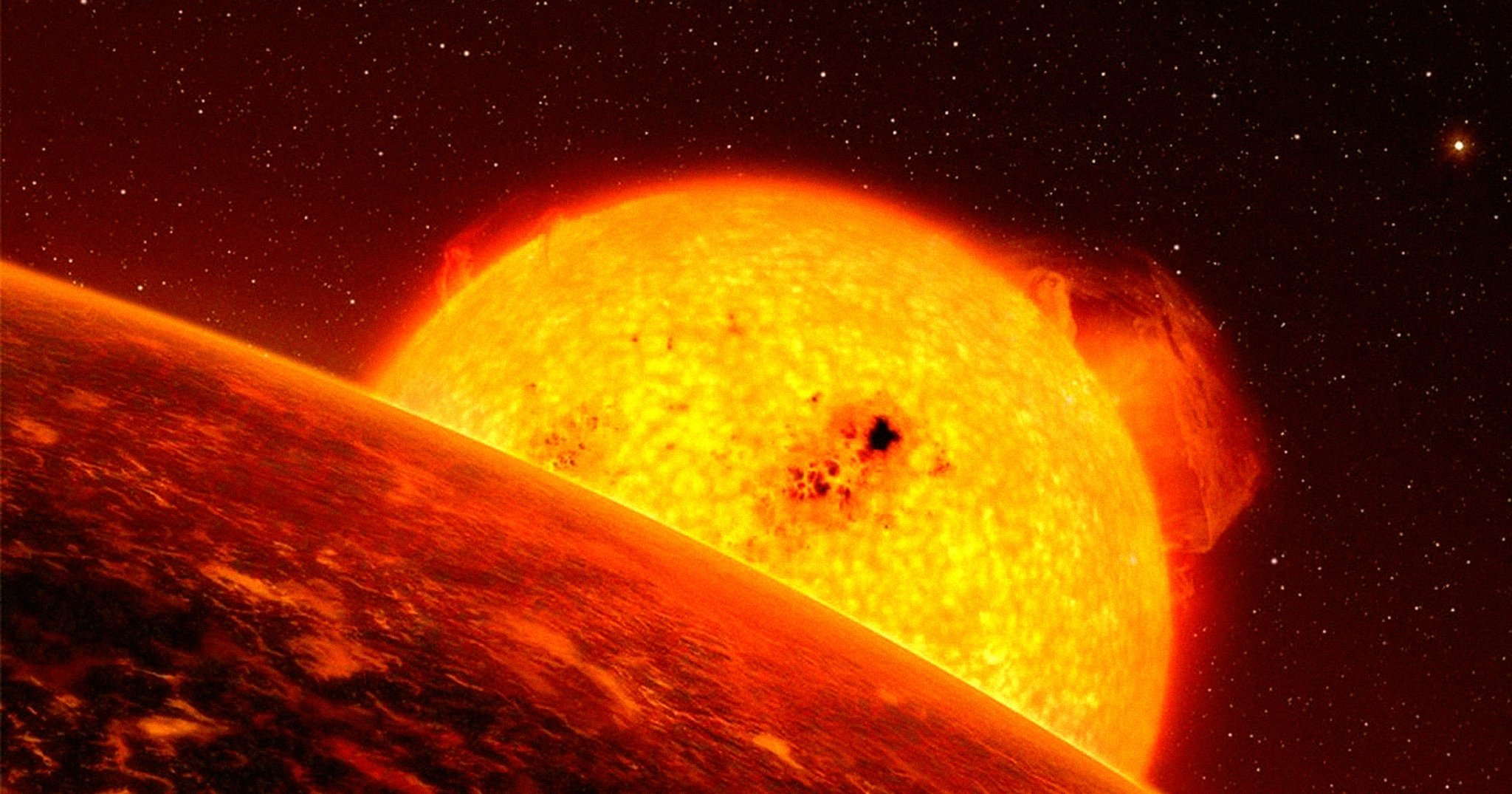
Scientist Reveals Plan to Save Earth From Destruction by the Sun

In something like five billion years from now, our Sun is expected to run out of hydrogen fuel, expanding into a red giant that will eventually either engulf the Earth or send it spiraling outwards, an all but guaranteed end of all life on our pale blue dot.

But there may be a way for humanity to survive past the Sun’s demise even without having to leave our planet, as independent researcher Gabriel Harry outlines in a paper accepted for publication in the Journal of the British Interplanetary Society.

It’s admittedly extremely far-fetched, but it’s a fun thought experiment that he argues could result in Earth staying habitable for another “9.1 million billion years.” Who could possibly argue against that?

In an accompanying piece for Phys.org, Harry lays out his daring plan. First, he proposes blocking out the Sun to keep the Earth from burning to a crisp by placing a “large sunshade at the Lagrange point 1, which is a “gravitational balancing spot between the Sun and Earth.”

“We’d need to cover a huge 70-degree area of the sky to ensure the red giant would be eclipsed,” he wrote. It would indeed be immense: it’d need to be roughly 434,000 miles in radius, tied to a carbon tether 1.2 million miles in length.

To provide the warming radiation that was now being blocked, Harry suggests sending fusion reactors some 4,000 miles deep into Jupiter’s atmosphere to produce energy, which would then have to be transmitted via laser back to the Earth.

And to move the Earth away from the self-destructing Sun, Harry thinks we could “redirect an asteroid to fly close to Earth’s surface a million times, with the gravitational slingshot effect gradually transferring energy to increase Earth’s orbital distance.”

Moving it that far away would stop the Earth’s tectonics and nutrient cycles, something Henry images could be solved by “sinking [4 pounds] of antimatter” into the Earth’s core per day.

Fast forwarding some four to five billion years, and any surviving humans would need to move the entire solar system out of the way of an incoming Andromeda galaxy, which is currently on a collision course with the Milky Way, Harry argues. To do so, he suggested firing a “beam of hydrogen just above or below the Sun’s north or south pole” to generate a “gravitational slingshot effect.”

In all, Harry’s galaxy-brain proposal would allow humans to stay alive without having to cover interstellar distances — something that would require a “million times” more energy — or terraforming a new planet. Because, after all, what’s better than staying right here, a comfortable place organic life has called home for around four billion years already?

“By building and maintaining the safeguards, for 9.1 million billion years, life on Earth would enjoy comfortable geology, security, seasons, days and starry nights — until, in a hundred trillion years, the last star fades out and the night sky turns dark,” Harry on Phys.org.

More on the Sun’s death: Earth Will One Day Die, But We Could Survive By Moving Here

The post Scientist Reveals Plan to Save Earth From Destruction by the Sun appeared first on Futurism.

  •  

Forget Lasers—Researchers Just Created Quantum Entanglement Using Sunlight

Lasers are no longer required to produce quantum entanglement, physicists say, after achieving the state using sunlight. In a laboratory experiment, an international team of researchers demonstrated that natural sunlight can produce quantum-entangled photon pairs.

The researchers recently published their quantum entanglement study in Optica, showing that lasers aren’t the only game in town. The work could herald a new energy-efficient approach to sustainable quantum technologies, both on Earth and in space.

Quantum Entanglement

Quantum technologies such as computing, communications, and sensing rely on the strange principles of quantum mechanics, which often defy explanations rooted in classical physics. Typically, quantum technologies use lasers to convert photons inside a nonlinear crystal into entangled pairs through a process called spontaneous parametric down-conversion (SPDC).

Prior to this work, using sunlight to produce quantum entanglement in photons was largely considered impractical. Researchers had assumed that SPDC depended heavily on phase-stable electromagnetic fields, requiring the high coherence of laser beams. Scientists also believed that the intense power of lasers was crucial to the nonlinear processes that produce entanglement. By contrast, sunlight’s relative weakness and incoherence left it largely overlooked as a viable source for generating entangled photons.

Reconsidering Coherence

Earlier work may have dismissed sunlight too readily because scientists had not fully considered the different dimensions of coherence. Across different parameters, sunlight can exhibit varying degrees of coherence. This means that while a beam of sunlight may be coherent in a particular property, such as polarization, it can still generate quantum entanglement along that parameter.

“As long as the pump beam is perfectly polarized, its spatial or temporal incoherence should not preclude the generation of polarization entanglement,” said lead author Cheng Li in a statement.

“The trick to harnessing sunlight is to keep different degrees of freedom of light from influencing each other during the process,” Li added. “This means that sunlight is perfectly capable of generating entangled photons, as long as one can concentrate enough sunlight into a nonlinear crystal to induce SPDC.”

Directing Sunlight

In a natural environment, sunlight spreads across a broad area rather than remaining tightly focused like a laser beam. Efficiently directing it through a nonlinear optical crystal, only a few millimeters wide, therefore presents a significant challenge.

To overcome this obstacle, the researchers constructed a sunlight concentration system that collects light across a 1.4-square-meter surface and focuses it down to approximately the width of a human hair. The specialized solar concentrator is conical rather than flat and is constructed from glass. As sunlight reflects repeatedly across the interior surface on its way toward the cone’s tip, it becomes progressively concentrated and intensified before traveling through a single optical fiber to drive the SPDC process that generates quantum entanglement.

Quantum Entanglement Results

In laboratory tests, the researchers found that their sunlight-driven SPDC system produced performance comparable to that of a laser, achieving 94% fidelity. The efficiency of the entanglement process was also similar to that achieved with laser-based systems. Together, these findings challenge previous assumptions that SPDC requires highly coherent laser light to operate effectively.

The approach also eliminates the need to first convert electrical energy into optical energy, potentially reducing system complexity, heat generation, and points of failure.

“Sunlight is an abundant and reliable resource in many environments, especially in space. Being able to generate quantum-entangled photons directly from sunlight could enable simpler and more resilient quantum systems for satellites and future deep-space missions,” said Hanieh Fattahi, the study’s co-author, in a statement.

“We believe this work can inspire much new research in nonlinear and quantum optics,” Fattahi said, adding that this research “may in turn make sunlight-driven quantum technology more practical.”

The paper, “Generating Quantum Entanglement from Sunlight,” appeared in Science Advances on August 5, 2026.

Ryan Whalen covers science and technology for The Debrief. He holds an MA in History and a Master of Library and Information Science with a certificate in Data Science. He can be contacted at ryan@thedebrief.org.

  •  

Researchers Map the Hidden 3D Geometry of a Quantum Wavefunction

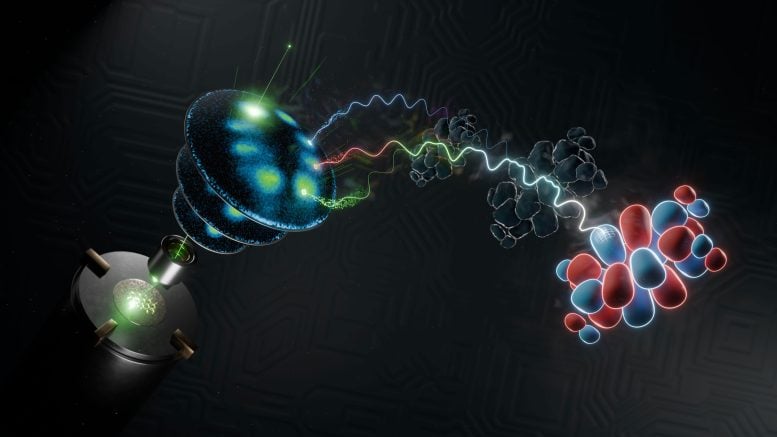
Artistic Illustration of Electron Orbital ImagingPhysicists at Göttingen University imaged three-dimensional wave functions using a tabletop soft X-ray laser. An electron inside a molecule does not occupy one fixed point. Quantum mechanics instead describes it through a “wavefunction,” a mathematical map that gives the probabilities of properties such as position and momentum. Within molecules, these electron wavefunctions are known as [...]
  •  

Lost in Space: Rare Cosmic Flare Exposes a Wandering Black Hole Far From Its Galaxy’s Center

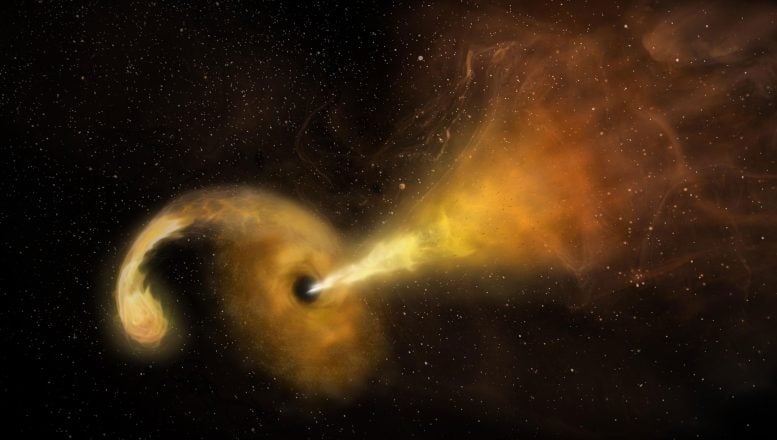
Artist Concept of a Tidal Disruption EventA rare tidal disruption event exposed a massive wandering black hole about 30,000 light-years from its galaxy’s center. A star was torn apart nearly 30,000 light-years from the center of a massive nearby galaxy, exposing a black hole where astronomers rarely see one. The unusually distant flare revealed an extremely rare “wandering” black hole and [...]
  •  

Dark Matter May Be Leaving a Signal in Earth’s Atmosphere

Galaxy Dark Matter Halo Illustration Art ConceptEarth itself may be one of the world’s largest detectors for ultralight dark matter. Earth may already contain one of the largest dark matter experiments ever built. Instead of relying only on specialized equipment inside a laboratory, scientists have found a way to use the planet’s magnetic field, atmosphere, and surface as parts of a [...]
  •  

Crossing into a mirror world: Particles turn to wisps of fog, and the magnetic monopole paradox dissolves

In Goethe's ballad "Erlkönig," immortalized in Schubert's fevered 1815 setting, a dying boy riding through the night sees a spectral king beckoning from the darkness. His father calms him: "Mein Sohn, es ist ein Nebelstreif"—my son, it is only a wisp of fog. In the poem, the father's reassurance proves tragically wrong. In the quantum world, however, his words acquire an uncanny new meaning.

  •  

Neutrinos From Deep Inside Earth Provide a New Picture of the Mantle

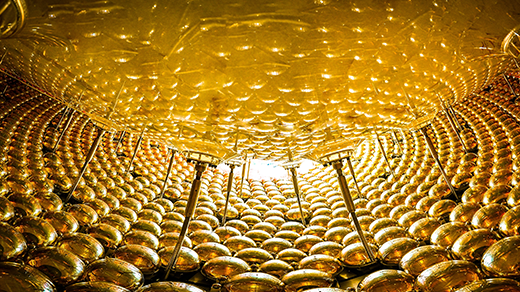
In a laboratory 2 kilometers underground, a crane lowers Matt Depatie, a detector technologist, through a hatch into a white-walled cavern filled with about 7,000 tons of ultrapure water that glows as blue as wiper fluid in the light. “Splashdown,” Depatie says over a radio as he steps into an inflatable raft waiting below. Normally, the cavern is one of the darkest places on Earth, but today…

Source

  •  

The world's biggest solar telescope caught vortexes on the Sun's surface

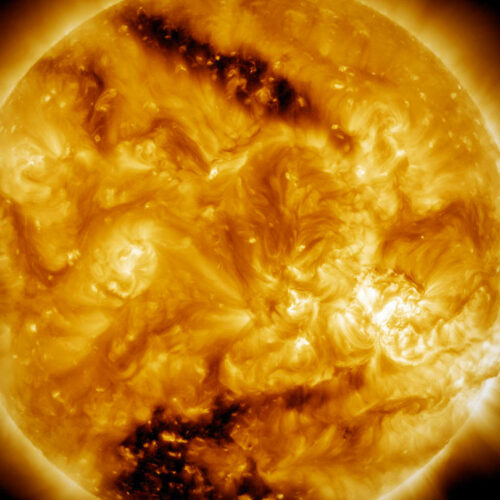
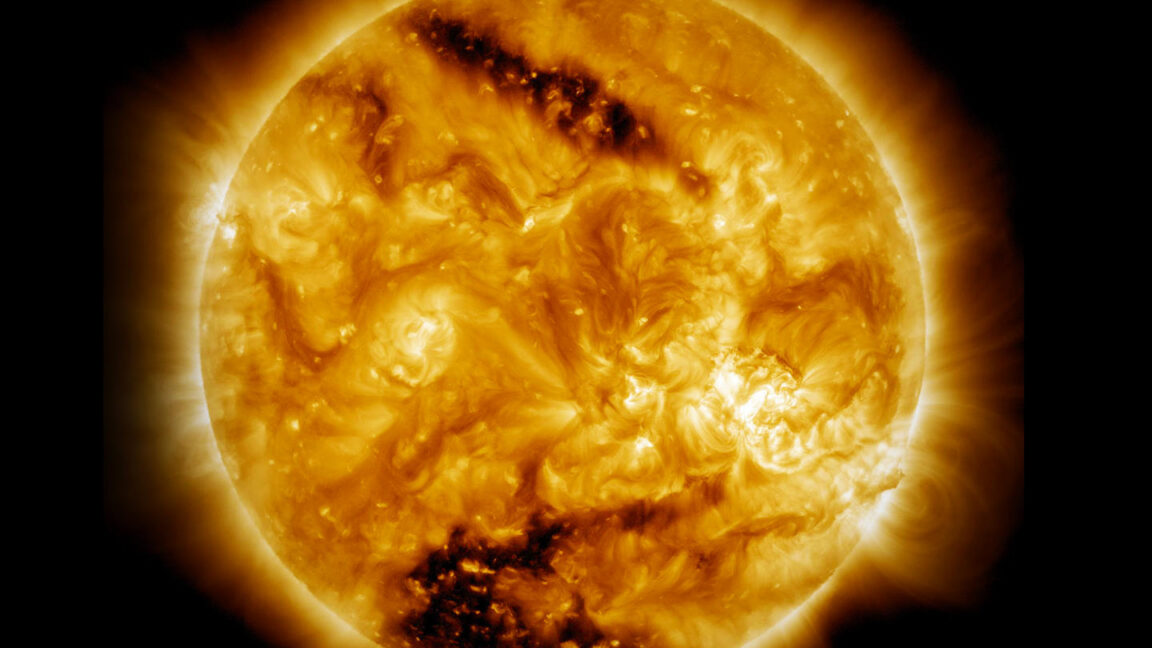
Wherever two fluids slide past each other at different speeds, the boundary between them buckles, then curls, then rolls up into vortexes. It’s called the Kelvin-Helmholtz instability, and the physics behind it was worked out in the late 1860s. We know this instability explains why wind causes ripples on the surface of water and clouds shear into a row of curves.

For decades scientists argued the same thing must be happening with plasma on the surface of the Sun, and yet nobody had been able to confirm it. Now, a team led by David Kuridze and Friedrich Wöger of the National Solar Observatory reports that Kelvin-Helmholtz instabilities are not just visible on the Sun, but they’re ubiquitous. Their new study proposes that this may change the way we think about how heat, mass, and magnetic energy move through the Sun's atmosphere.

Telescope’s test drive

The reason plasma whirlpools on the Sun stayed hidden for so long is rather trivial: They are very small. Their scale sits below what telescopes with mirrors smaller than 2 meters can resolve. For most of the history of solar physics, that has ruled out every telescope on Earth. This changed when the US National Science Foundation opened the Daniel K. Inouye Solar Telescope, a 4-meter instrument in Hawaii and the largest solar telescope in the world. The telescope entered its operational phase back in November 2021.

Read full article

Comments

© NASA/Goddard/SDO

  •  

AI model helps physics Nobel laureate out of a decade-old mathematical jam

Two theoretical physicists – including a Nobel laureate – have solved a mathematical problem that flummoxed them for 10 years with help from Claude, the large language model (LLM) developed by the US-based firm Anthropic. In addition to its importance for fundamental physics, the result is significant because it offers further evidence that artificial intelligence (AI) is reshaping the nature of research in some fields.

The problem that kept Francesco Zamponi and Giorgio Parisi awake at night originates in the field of complex systems and relates to a phenomenon known as jamming. “Jamming describes a sudden transition at which a fluid system becomes completely rigid, yet remains disordered,” explains Zamponi, a physicist at the Sapienza Università di Roma, Italy.

To visualize this, Zamponi suggests imagining a box filled with spheres (such as tennis balls) that are floating in zero gravity, free from friction or weight. When there are only a few spheres in the box, they have plenty of room to move, bouncing off each other and the box like a classical gas. However, if you add more spheres or inflate the existing ones, space becomes increasingly scarce, and a sphere that tries to move soon impinges on its neighbours. Eventually, a critical density is reached, and every sphere is securely held by those around it, causing the entire system to “lock up” into a state where no more movement is possible.

If the spheres freeze into a regular, geometric pattern, they form a crystal-like structure that resembles carefully stacked oranges at the market. If they are compressed or added quickly, though, a crystal cannot form. Instead, they freeze into a completely disordered packing state, like a traffic jam.

Generalizing the problem

Moving beyond physical spheres into more abstract territory, Zamponi notes that jamming is an example of a highly general mathematical problem known as constraint satisfaction. “In this framework, the spatial positions of the spheres act as the variables, or degrees of freedom, while the strict rule that no two spheres can overlap serves as the constraint,” he explains. As more variables are incorporated, Zamponi adds, satisfying all the rules simultaneously becomes increasingly difficult.

Because of this precise mathematical mapping, jamming concepts are widely applied in neuroscience and artificial intelligence. In a machine learning model or a biological brain, for example, the synaptic weights represent the degrees of freedom, while the data classifications or memories that must be learned serve as the constraints.

“Just like physical spheres, an artificial neural network undergoes a jamming transition,” Zamponi observes. “In the ‘liquid’ phase, the network easily configures its weights to satisfy all constraints, allowing it to classify data perfectly. But when tasked with too much data, it hits a wall, corresponding to the ‘solid’ phase. It can then no longer satisfy all the conditions, and it begins to make errors.”

A surprising relation

In 2014, Parisi, who received half of the 2021 Nobel Prize in Physics for “the discovery of the interplay of disorder and fluctuations in physical systems from atomic to planetary scales”, and Zamponi spotted a surprising relation in the theory of jamming. Working with colleagues in the US and France, they found that in numerical calculations, two mathematical parameters, denoted a and b and related to the scaling of the distribution of contact forces and inter-sphere gaps as the system reaches the jamming point, mysteriously add up to 1. These parameters are very important for characterizing the physical structure of the packing, but try as the researchers might, they could not obtain a formal mathematical proof that a + b = 1.

Asking generative AI for help was Parisi’s idea. The problem was well-suited for machine assistance because it was well-defined, with a clear conjecture and a known numerical answer but no analytical proof. He and Zamponi chose Claude because it boasts more advanced coding and mathematical reasoning capabilities than other models of its kind.

Even so, they didn’t ask it for the proof immediately. “We first prompted Claude to replicate the numerical calculations our group had developed a decade ago,” Zamponi explains. “Once it had successfully reproduced those exact results, we took the natural next step and asked it: ‛If a + b = 1, can you prove why?’”

The model produced an initial conceptual path that was essentially correct, but that contained minor mathematical errors and required several iterative refinements and verifications. Still, Zamponi says, the “core intuition” belonged to the AI: “We had spent years looking for a complicated solution – like deeply hidden structural symmetry – but Claude showed us that the solution was far simpler; it was right there in front of us, but we had just missed it.

“The new proof connects our infinite-dimensional theory, which is more abstract but mathematically rigorous, with a framework developed at the same time by our colleague Matthieu Wyart and his team at the École Polytechnique Fédérale de Lausanne (EPFL),” Zamponi continues. “Wyart’s theory is built on more concrete physical notions, but it relies nevertheless on some assumptions.” The new result, he tells Physics World, confirms that both starting points lead to the same physical laws.

“More important than the industrial revolution or the birth of the Internet”

Zamponi believes that the advent of generative AI could be on par with, or even more important than, the industrial revolution or the birth of the Internet. As a “telescope for the mind”, he says it could become indispensable for research, allowing scientists to test ideas at unprecedented speeds. It could also lower specialization barriers and facilitate interdisciplinary work by unlocking complex literatures that would otherwise take too long to master.

On the downside, though, Zamponi is concerned that LLMs also encourage the production of poor-quality, pseudo-scientific research, straining the peer-review system. “We desperately need to figure out how to filter and review this influx,” he says. “We also need to design novel pedagogical frameworks to responsibly integrate tools like Claude into undergraduate and graduate research courses.

“To use these tools responsibly, we believe transparency is key. This is why we chose to publish our full conversation with Claude alongside our paper. If an AI sparks a genuinely new idea, we believe that its ‘thought processes’ should be public record.”

Jamming and random sequential absorption

Zamponi is now applying the approach detailed in the new work, which is published in Journal of Statistical Mechanics: Theory and Experiment, to a problem involving the random sequential absorption (RSA) of hard hyperspheres. This classic protocol for generating random packings involves introducing spheres one by one at completely random positions. “It is a vital tool for understanding the geometry of void spaces and packing efficiency, which directly relates to finding optimal error-correcting codes and navigating the mathematical ‘curse of dimensionality’,” Zamponi says.

While both RSA and jamming transitions describe how systems of hard spheres lock up, they represent two fundamentally different physical processes, he explains. In traditional jamming, particles are mobile and fluid and they continuously rearrange and relax until the entire system undergoes a collective, sudden transition into a rigid, solid-like state. RSA, on the other hand, is a strictly out-of-equilibrium, irreversible process where particles never move once placed. RSA therefore reaches a “saturation” limit rather than a true collective jamming transition.

The post AI model helps physics Nobel laureate out of a decade-old mathematical jam appeared first on Physics World.

  •  
❌