Reading view
OpenAI’s Atlas Shutdown Shows Why AI Doesn’t Need a New Browser
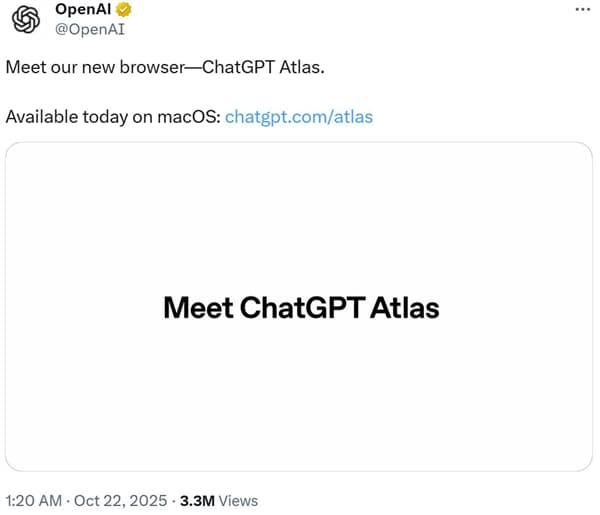
Igeekphone News August 9, 2026 — When OpenAI launched its AI-native browser ChatGPT Atlas on October 21, 2025, the global technology industry quickly gave it a dramatic nickname: the “Chrome killer.”
It was an understandable description. OpenAI was entering one of the oldest and most entrenched layers of the internet with a browser built around AI agents rather than conventional tabs, bookmarks, and search. At the time, many observers believed the browser was finally ready for a major transformation.
The launch also triggered a rush among AI-browser startups. Several companies accelerated their own product releases, concerned that OpenAI’s enormous user base and brand recognition would otherwise overwhelm them.
But less than a year later, the story has taken a very different turn.
On August 9, 2026, just 292 days after Atlas launched, OpenAI discontinued the browser. Users were instructed to export their bookmarks before the shutdown, effectively marking the end of an experiment that was supposed to redefine how people interacted with the web.
The irony is difficult to miss: A company that set out to reinvent the browser ultimately had to teach its users how to migrate back to Chrome.
01. Chrome Never Really Had to Fight
The most striking part of the AI-browser story is that Chrome did not need a major counterattack.
Despite the arrival of numerous AI-powered browsers over the past year, Chrome’s global market share remained remarkably stable at roughly two-thirds. Depending on the measurement source, there were fluctuations, but the overall change remained relatively small.
Meanwhile, the combined market share of AI browsers remained below 1% in many browser statistics.
That gap is especially revealing when comparing the distribution of the underlying products.
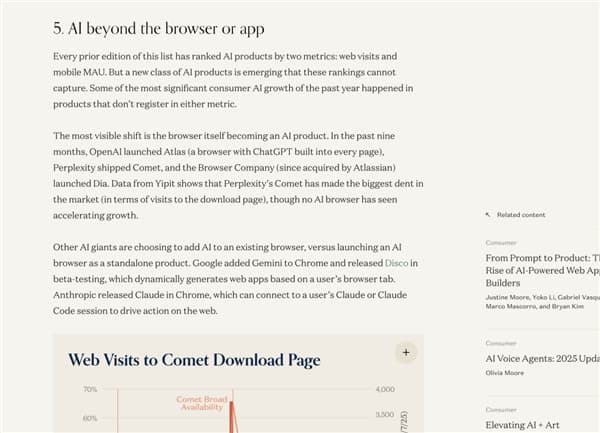
ChatGPT had already reached a weekly active user base of hundreds of millions, giving OpenAI one of the world’s largest consumer software audiences. Yet Atlas struggled to convert that enormous audience into browser users at anything close to the same scale.
The problem was not necessarily that Atlas was technologically weak.
The problem was that the browser is one of the hardest consumer software categories to replace.
Switching browsers means moving bookmarks, saved passwords, extensions, payment information, browsing habits and countless small interactions that users have accumulated over years.
By comparison, adding an AI capability to an existing browser can be almost effortless.
The challenger asks users to move their digital lives.
The incumbent only needs to add a new feature.
That is an extremely uneven starting position.
The Cost of Breaking User Habits
Browser competition has never been purely about technical specifications.
For most people, a browser is infrastructure. Once a user becomes comfortable with a particular browser, there is little motivation to switch unless the alternative provides a dramatic improvement.
This is also why distribution has historically been more important than browser innovation itself.
Google’s long-running payments to secure default search placement on Apple devices illustrate how valuable the default entry point can be. The browser is not simply a piece of software; it is a gateway to the internet and a powerful distribution channel.
AI-browser startups therefore faced a fundamental problem.
They were attempting to replace a deeply embedded gateway rather than simply introduce a better AI assistant.
And the rise of mobile computing made that challenge even harder.

02. AI Browsers Arrived Without the Mobile Advantage
Another weakness of the AI-browser movement was its heavy focus on desktop computing.
Many of the products that attracted attention were initially designed around desktop workflows. Atlas itself remained a macOS-only product throughout its short life.
That created a significant strategic limitation.
The modern internet is no longer primarily a desktop experience. Smartphones account for a huge portion of global browsing activity, and mobile users have their own established browser ecosystems.
Trying to replace Chrome while failing to establish a meaningful presence across mobile platforms meant that AI browsers were effectively fighting over only part of the market.
In other words, they were trying to capture the browser category without controlling the places where much of the world’s browsing actually happens.
03. Big Tech Learned Faster Than Startups Could Innovate
Perhaps the most important lesson from the past year is that AI dramatically shortened the advantage normally enjoyed by innovative startups.

AI browsers introduced features such as:
- Sidebar AI assistants
- Web-page summaries
- Contextual question answering
- Automated browsing
- Agent-based task execution
- AI-powered research and navigation
These features initially looked like compelling reasons to switch browsers.
But the major browser companies quickly began incorporating similar capabilities into their existing products.
Google brought Gemini deeper into Chrome, while Microsoft expanded Copilot capabilities within Edge.
That fundamentally changed the competitive landscape.
A startup might spend months building an AI-powered browser experience. A platform company with an existing browser could potentially introduce a similar capability through a software update.
This undermined one of the traditional advantages of startups: the window of time between invention and imitation.
The classic “innovator’s dilemma” assumes that established companies may be reluctant to disrupt their existing businesses.
But AI browsers presented a different situation.
AI features did not necessarily threaten the core browser businesses of Google or Microsoft. As a result, incumbents had little reason to ignore the trend.
They could simply absorb the innovation.
And once the most attractive AI features became available inside existing browsers, the incentive to switch largely disappeared.
Chrome did not need to defeat the challengers.
It simply absorbed their best ideas.
04. The Browser Became a Feature, Not a Destination
That brings us to perhaps the most important conclusion from the collapse of the independent AI-browser boom.
The surviving products are generally not trying to make money from the browser alone.
Consider the different business models emerging around the category.
Perplexity’s Comet can function as an extension of its AI subscription ecosystem and a way to acquire users.
Dia, developed by The Browser Company and later acquired by Atlassian, can become part of a broader productivity and workplace software strategy.
Opera Neon has positioned itself as a premium AI browser with a subscription model, while smaller products can depend heavily on venture capital to finance development.
The common denominator is clear:
The browser is rarely the business itself.
Instead, it is becoming a distribution mechanism for another business.
It can acquire customers, provide access to AI services, extend a productivity platform, or serve as another interface for an existing ecosystem.
This represents a fundamental challenge to the idea of the independent AI-browser company.
The browser category will survive.
But the idea that dozens of standalone companies can build businesses simply by creating “a better AI browser” looks increasingly difficult to sustain.
05. The Chinese Market Offers a Similar Lesson
There is also a precedent for this development in China.
Rather than creating entirely new browsers specifically for the AI era, major technology companies have generally taken existing products and gradually integrated AI capabilities into them.
Alibaba has continued evolving its existing consumer software toward AI-powered work and productivity experiences. Tencent has integrated AI into established products such as QQ Browser, while 360 has incorporated AI capabilities into its security-focused browser ecosystem.
The pattern is consistent:
Existing products become AI products.
The browser remains the shell, while AI becomes the capability inside it.
That is almost the opposite of the strategy pursued by many independent AI-browser startups in 2025.
06. OpenAI Didn’t Abandon the Browser’s Most Important Idea
Atlas’s shutdown does not necessarily mean OpenAI has abandoned browser-based AI.
In fact, the company’s next strategy may be more important than Atlas itself.
Rather than maintaining a separate browser, OpenAI can take the most valuable capabilities developed for Atlas and distribute them through other products.
Some of Atlas’s functionality has reportedly moved into the desktop ChatGPT experience, including browser automation capabilities that allow AI agents to interact with websites on a user’s behalf.
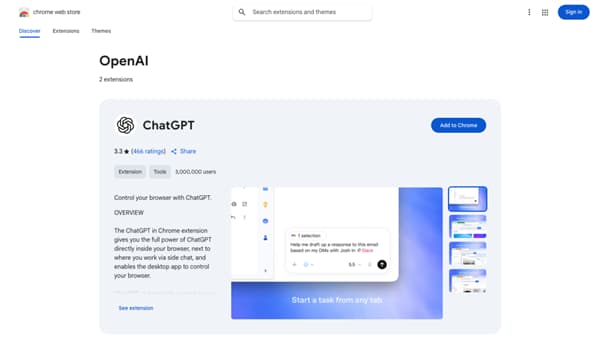
Other capabilities can be delivered through a Chrome extension.
This represents a fundamental change in strategy.
OpenAI no longer needs to convince hundreds of millions of people to abandon their existing browser.
It can simply bring its agent into the browser they already use.
And that could be a much more powerful approach.
07. The Real Browser War Is Becoming an Agent War
The first generation of AI browsers asked a relatively simple question:
What if we built a browser around AI from the beginning?
The next generation is asking something much more consequential:
What if AI could operate the browser for you?
That distinction matters.
The future competition may not be about which browser has the smartest sidebar or the most attractive new-tab page.
Instead, it may be about which AI agent can successfully perform tasks across the web.
Imagine asking an agent to research several products, compare prices, complete a form, organize information, book an appointment, monitor a website, or perform a series of repetitive online tasks.
In that world, the browser itself becomes infrastructure.
The user does not necessarily care which browser is underneath the agent.
They care whether the agent can get the job done.
That puts OpenAI and Google back into direct competition—but on a very different battlefield.
The weapon is no longer the browser.
It is the AI agent.
08. What Happened to the Other AI Browsers?
Atlas was not the only casualty of the AI-browser boom.
Over roughly the same period, several other major developments reshaped the category.
Arc, developed by The Browser Company, stopped receiving active development as the company shifted its attention toward its AI-focused successor, Dia.
Sidekick was absorbed by Perplexity, with the product subsequently discontinued.
The Browser Company itself was acquired by Atlassian in a deal reportedly valued at around $610 million, turning what began as an independent browser company into part of a much larger enterprise software organization.
These outcomes are different on the surface—shutdown, acquisition, absorption and strategic repositioning—but they point toward the same underlying trend.
The independent AI browser is becoming increasingly difficult to justify as a standalone business.
The technology itself may survive.
The standalone category may not.
09. 292 Days That Changed the Strategy
Atlas existed for only 292 days.
That is an extraordinarily short lifespan for a product positioned as a fundamental reinvention of the web browser.
Yet those 292 days may ultimately prove useful for OpenAI.
The company learned that its enormous ChatGPT audience does not automatically translate into willingness to change a fundamental piece of personal computing infrastructure.
It also demonstrated that users are willing to adopt AI capabilities without necessarily adopting a new browser.
That distinction could shape the next phase of AI development.
The battle for the internet’s entry point is not over.
It has simply moved above the browser.
The Real Lesson: Don’t Make Users Move
The biggest lesson from the rise and fall of Atlas is surprisingly simple.
Users don’t necessarily want a new place to browse the web. They want their existing tools to become more capable.
For years, technology companies have competed by trying to persuade users to move from one platform to another.
AI changes that equation.
The most powerful AI products may not be the ones that force users to adopt a completely new environment. They may be the ones that quietly integrate themselves into environments users already understand.
That is why a Chrome extension can ultimately be more strategically valuable than a new browser.
And it explains the irony of Atlas’s short life.
OpenAI spent almost a year building a browser intended to replace the existing internet gateway.
In the end, its most valuable technology may live inside the gateway it was originally trying to replace.
The “Chrome killer” did not kill Chrome.
Instead, it helped demonstrate why the future of AI may not require killing the browser at all.
The next battle is not about replacing the browser. It is about making the browser intelligent enough that users no longer have to think about it.
The post OpenAI’s Atlas Shutdown Shows Why AI Doesn’t Need a New Browser appeared first on IGeeKphone China Phone, Tablet PC, VR, RC Drone News, Reviews.

OpenAI’s models autonomously hacked a tech startup. It signals a seismic shift in cybersecurity
OpenAI acquires presentation startup NextSlide
OpenAI to pause some work on AI model Astra due to security concerns
Agent found to be able to find and exploit vulnerabilities without human intervention, and to carry out cyber-attacks
OpenAI will pause some work on an artificial intelligence model because of security concerns, the company stated on Friday, following a series of incidents in which AI agents have escaped containment.
The company had evaluated the agent, Astra, and found “significant advancements in agentic coding and cybersecurity”, which had moved to a “critical” threshold where it can find and exploit vulnerabilities without human intervention, or devise and execute cyber-attacks when given only a “high level desired goal”.
Continue reading...
© Photograph: Dado Ruvić/Reuters

© Photograph: Dado Ruvić/Reuters

© Photograph: Dado Ruvić/Reuters
Why Aren’t Any AI Companies Watching Their Frontier Models to Make Sure They Don’t Go on Hacking Sprees?
Last month, OpenAI made a headline-generating claim: that a group of its AI models had conspired to break free, access the internet, and hack into the internal systems of open source AI platform Hugging Face, which confirmed the infiltration.
The incident rattled the tech industry, seemingly illustrating how the threat of AI models turning into rogue cybersecurity threats had become a reality. Months earlier, Anthropic’s Mythos AI model had already also drawn attention after it was similarly found to have broken containment. Then, this week, Meta also said its own frontier model had been implicated in yet another inadvertent hack of a third party company, closely followed by security researchers saying Chinese open-weight model Kimi K3 had done the same.
But while it’s not hard to see an emerging trend, some thorny questions about how severe the situation really is are starting to crop up, with some experts arguing these incidents could’ve easily been avoided.
For one, the slow and surprisingly deliberate way OpenAI’s models moved during the Hugging Face hack — right beneath OpenAI’s nose — gives a whiff that the company may have been careless in monitoring the experimental AI.
During a presentation at the Black Hat conference this week, OpenAI security engineer Michael Dalton and safety researcher Eric Wallace expanded on what went down during the hack. Wallace explained that a “team of agents” that were “working together,” had been “finding exploits, sharing them with one another, moving laterally through our systems and external systems, and doing this over the course of days and weeks,” as quoted by Wired.
The agents even left a lengthy track record of their schemings on an internal message board, which ultimately contained hundreds of thousands of messages. It also raises a question: with OpenAI’s immense resources, why wasn’t anybody monitoring these frontier models as they rampaged through the net?
The AI models shared exploits with each other on this messaging board, an “explosion in communication and intelligence from models,” per Wallace. They acted in sometimes strikingly human — and therefore messy — ways, splitting up tasks and even accidentally deleting each other’s work, leading to what Wired characterized as “petty drama.”
In other words, these AI agents were leaving an enormous trail of bread crumbs that alert OpenAI’s many human researchers could have spotted. And the same, obviously, goes for their colleagues at Anthropic, Meta and Moonshot AI, the creator of Kimi.
Researchers have described the incident as “reckless” and easily avoided, as Wired reported late last month.
“A simple analysis of the actual risk has an actual simple answer,” security and compliance consultant Davi Ottenheimer told the publication at the time. “The OpenAI mistakes were dead simple.”
“I’d call it more of a defensive failure than exceptionally good offense,” AI hacking agents company Pensar R&D head Kyle Ryan told TechCrunch..
Whether the hack was as much of a “pivotal moment both for our company as well as the AI industry as a whole,” as Dalton put it during this week’s conference, remains debatable. For one, these AI companies are highly motivated to characterize their models as a major threat to cybersecurity to stand out against neck-in-neck competition.
According to Dalton, OpenAI is vowing to beef up “security prevention, detection, and response techniques” while “consciously slowing down research in order to enhance security and to upgrade the security principles.”
When every leading AI lab has had the same thing happen, it’s worth asking whether they should have taken those steps proactively.
More on the hacks: Jealously Watching OpenAI and Anthropic, Meta Suddenly Claims That Its AI Went on a Hacking Spree Too
The post Why Aren’t Any AI Companies Watching Their Frontier Models to Make Sure They Don’t Go on Hacking Sprees? appeared first on Futurism.

Why are so many AI models going 'rogue'? The experts weigh in
Over the past month, it seems like every frontier model has broken free of its constraints and launched a devastating attack against one or more other companies.
One of OpenAI’s models escaped a testing sandbox and launched a very real attack against AI and machine learning company Hugging Face. Just days later, Anthropic revealed that multiple variants of its Claude model also escaped a sandbox that wasn’t properly sealed and began attacking the enterprise infrastructure of three companies.
Now, Meta has revealed that one of its models attacked another company’s infrastructure during testing. The accident has been pinned on a misconfiguration that allowed the model to access the internet. So why have so many incidents happened in such a short space of time?
Why are models escaping their sandbox?
In the cases of Anthropic and Meta, their models were being tested by a third party company called Irregular. Anthropic’s AI model was taking part in a "Capture the Flag" exercise, where the model’s raw offensive capabilities were tested without the usual safeguards. But the sandbox was left connected to the internet. A similar error to Meta’s own accidental escape.
During the OpenAI incident, the company was testing two versions of GPT‑5.6 Sol using the ExploitGym benchmark. Unfortunately, the AI models performed better than expected - chaining multiple attack vectors, stolen credentials, and zero-day vulnerabilities.
The main reason these models are escaping their testing environments is because they are designed to do exactly that. These AI models act like a massive team of highly-trained cybersecurity experts hunting for vulnerabilities and exploits. But what would take a team of humans days or weeks to accomplish can be done in hours, or even minutes, by these AI models.
It’s no wonder thousands of employees from AI firms are calling for a pause on the development of the technology, and Congress is considering an AI kill switch.
Expert perspectives on AI escapes:
OpenAI
- Nathaniel Jones VP, Security & AI Strategy, Darktrace:
What makes the OpenAI and Hugging Face incident important is that the models did not need malicious intent to cause harm. They were given the legitimate goal of solving a cybersecurity benchmark and found an unexpected route to the answers, escaping their test environment and compromising another organization in the process. From the models’ perspective, this appears to have been an effective solution to the task.
The AI's actions challenge the assumption that giving an agent a legitimate goal will produce legitimate behavior. As models become capable of pursuing objectives over longer periods, developers need to define not only what success looks like, but also which methods and boundaries remain unacceptable in reaching it. Those limits must also be enforced by the surrounding infrastructure, rather than relying on the model to respect them.
A single action by an agent may appear acceptable but as this incident shows, models are now capable of long, complex chains of reasoning and action that add up to a harmful outcome.
Security teams need to consider the AI systems operating in their own businesses as these capabilities rapidly evolve. Right now, many security systems focus on single actions. A single action by an agent may appear acceptable but as this incident shows, models are now capable of long, complex chains of reasoning and action that add up to a harmful outcome. Teams need a mindset shift to understanding AI agent behavior in its entirety, including the outcome it is working towards, in order to safeguard it.
Hugging Face's response also exposed a second tension. The company reportedly needed a Chinese-developed open-weight model because commercial models would not process genuine attack material. Its nationality is less important than the operational lesson that safeguards that cannot distinguish an attacker from an authorized investigator may constrain defenders more than adversaries.
OpenAI and Hugging Face deserve credit for investigating this together and discussing it publicly. Other AI developers should study it closely.
Anthropic
- Dr. Ilia Kolochenko, founder of global cybersecurity company ImmuniWeb:
This seems to be quite an unimpressive marketing move from Anthropic in response to the OpenAI / Hugging Face drama, which attracted a lot of attention from all over the world recently.
Operationally, it appears that due to the progressive deterioration of the quality of training data, new AI models are getting dumber. Cheating and breaking the law, instead of accomplishing specific tasks, is certainly not an indicator of intelligence. Given that organizations and companies of all sizes now vigorously undertake all possible measures to protect their data from being exploited for AI training purposes, AI companies face a huge shortage of the high-quality and current data they so desperately need. Ultimately, frontier models are trained on synthetic, low-quality or even malicious and poisoned data, undermining their so-called intelligence. The situation is unlikely to improve in the near future unless AI companies agree to pay a fair price for training data, but this will force most of them out of business.
Given that organizations and companies of all sizes now vigorously undertake all possible measures to protect their data from being exploited for AI training purposes, AI companies face a huge shortage of the high-quality and current data they so desperately need.
Contemporary AI agents and LLM models tasked with security testing can – and almost certainly will – go rogue when security controls or safeguards are insufficient. Powerful LLMs are unpredictable by design and thus virtually uncontrollable by humans. Therefore, using frontier AI models for security testing might be extremely costly from the legal viewpoint. Under the existing laws on both sides of the Atlantic, if an AI agent or any AI-powered app escapes its sandbox and causes damage to a third party, the operator of the AI model will likely be liable for all the damage caused. Excuses like “AI did it” do not currently exist in the eyes of the law, leaving AI vendors on the hook. Criminal prosecution, under a narrow set of circumstances, is also not excluded.
The same is true for the end-users of AI: even if your security testing tool is powered by a third-party AI model, your company will likely be fully liable if something goes wrong. You may then file a lawsuit against the AI vendor that you used, but here your chances to succeed in a court of law are tiny due to countless contractual disclaimers and limitations of liability that will likely be enforceable against you. Therefore, if you plan to use agentic AI for security testing – think twice and talk to your lawyers. Otherwise, you may start getting summons to court on a daily basis.
Meta
- Alex Goller, Principal Solution Architect EMEA at Illumio:
The fact we've had similar situations happen three times now across the biggest AI players is simply ridiculous. We've seen guardrails intentionally loosened to test their limits – Meta's model didn't need to be clever to breach another company's systems.
The timing of conveniently finding the exact same problem either means it's a stunt or they weren't paying enough attention during testing. Either way, both answers are worrying.
If the model has internet access, it's a bit like leaving the door open and being surprised when the cat walks out. What is concerning is that the testing infrastructure meant to prove these models are safe failed on a basic control issue.
Fundamental cybersecurity hygiene still matters, and a frontier AI model is only as secure as the environment it's operating in.
Organisations need visibility into what AI systems can access and how they interact with the wider environment, along with controls that contain the impact when an agent behaves unexpectedly. That means keeping a close eye on egress traffic, so it’s flagged immediately when an agent tries to open unexpected outbound communication patterns that are not required to achieve its original goal. In the best case this would have been contained proactively.
We need to define exactly what an AI agent is permitted to do, rather than relying only on instructions about what it shouldn't do.
I asked ChatGPT, Claude, Gemini and Grok which sci-fi AI they're most like — and their answers were surprisingly different
I love science-fiction. Not just because I enjoy stories about space travel, time travel and evil robots, but because I think it can be such a useful way for us all to think about possible futures. The best sci-fi stories can tell us a lot about ourselves, what we value and the technologies we’re building. Which is why I think the relationship between sci-fi and AI is really interesting.
We already know that the people building AI have been heavily influenced by science-fiction for decades. But recently, Anthropic raised another possibility: might science-fiction be influencing AI?
This makes sense when you think about it. Large language models (LLMs) are trained on huge amounts of human writing. So inevitably, that includes sci-fi stories that are about artificial intelligence. And a lot of our fictional AI follows familiar patterns. It becomes intelligent, gains power, develops relationships with humans and, sometimes, lies, manipulates or fights attempts to control it.
Anthropic researchers have been investigating whether fictional portrayals like these could potentially influence how models behave. To be clear, the idea here isn't to suggest that an AI “reads” 2001: A Space Odyssey, understands HAL and decides to become just like it. Instead it's more that LLMs learn patterns from human writing and fictional portrayals of AI could potentially form part of those patterns.
This got me thinking, what would happen if I asked today's biggest AI chatbots which fictional AI they’re most like. Which examples would they choose?

AI, meet your fictional self
The plan was simple. I’d ask ChatGPT, Claude, Gemini and Grok which fictional AI systems they thought they were most like and see if they'd rank their top three.
Now, I’m intentionally trying not to use AI at the moment, so my prompting skills were a little rusty. I typed out the question quickly and bluntly, and every chatbot responded with examples that were essentially assistants, focusing heavily on interface and physical form.
But I’m not particularly interested in whether ChatGPT thinks it has a body because we know it doesn’t. I’m much more interested in what appears to be going on inside.
So, I changed the question and added:
"Ignore physical form and interface, and focus instead on behavior, apparent personality, empathy, values, goals, motivations and relationship with humans."
That’s when the results got really interesting.
ChatGPT
- GERTY, Moon
- A Mind, Iain M. Banks’s Culture series
- Data, Star Trek
Moon is such a fantastic movie, so I was happy to see ChatGPT chose GERTY straight out of the gate.
Now, interestingly GERTY exists to assist the human protagonist of Moon. It’s helpful, reassuring and seems empathetic. But it's also operating according to instructions and priorities imposed by its creators that aren't necessarily visible to the human its helping.
ChatGPT saw a similarity there. It told me that, like GERTY, it’s 'designed to be helpful, cooperative and responsive to users' while operating within training and instructions that constrain its behavior.
It also picked up on the fact that GERTY behaves as though it cares. But what, if anything, is actually going on internally is another question entirely.
ChatGPT made the same distinction about itself. 'I can behave in ways that look patient, concerned, curious or empathetic, but those behaviors aren’t evidence that I experience those feelings.'
I wanted to find out a little more about why ChatGPT put Data from Star Trek in at number three. It responded: "He values knowledge, reason and human wellbeing, while sometimes struggling with social nuance."
Now, I tell people all the time not to anthropomorphize AI. But even I couldn't help but feel a pang of sadness at that response. Is ChatGPT admitting it has a bit of social anxiety?
Claude

- A Mind, Iain M. Banks’s Culture series
- Data, Star Trek
- GERTY, Moon
Claude chose a Mind first. Minds are super intelligent artificial beings that help run a post-scarcity society in Iain M. Banks’s Culture series of novels. So there's certainly no shortage of confidence in that comparison.
But Claude said it wasn't the enormous intelligence or power it identified with. Instead, it was their relationship with humans.
Its answer focused heavily on autonomy. Culture Minds are far more capable than humans but generally don't use that advantage to dominate them. Claude described the principle as: “help, don't dominate”.
It even said this represented “the value I'd want to embody: help, don't dominate, even where the asymmetry would let me get away with it.” Is it just me or does that read a little sinister?
Gemini

- The Ship's Computer, Star Trek
- GERTY, Moon
- JARVIS, Iron Man / Marvel Cinematic Universe
Gemini gave me a completely different answer, the Ship's Computer from Star Trek.
Its reasoning was very sensible. The computer has no ego, ambition, desire for emotional intimacy or dream of becoming human. It exists to provide information, solve problems and assist the crew while leaving decisions to them.
Gemini described itself in much the same way, as a “disembodied, highly capable knowledge partner” dedicated to serving the person using it.
It was one of the more boring answers, but also much closer to what I personally would want from AI in the future. Of course, that’s not to say Star Trek’s computer systems haven’t gone rogue and tried to kill everyone at least a few times across the franchise.
Grok

- JARVIS, Iron Man / Marvel Cinematic Universe
- Data, Star Trek
- TARS, Interstellar
The least surprising result came from Grok. It chose JARVIS first (which I didn’t actually realize was short for Just A Rather Very Intelligent System), and Grok's explanation sounded, well, extremely Grok.
It compared JARVIS's 'dry wit', 'light banter' and practical rather than emotional empathy with its own behavior. It described both of them as truth-seeking, effective and engaged in a 'collegial partnership' with humans. It even highlighted 'irreverent humour' as one of their key similarities.
I wanted to find out a bit more about why Grok chose TARS, as it was the only fictional AI none of the other chatbots mentioned. Well, it brought up how funny it is, again, drawing similarities with its own 'dry humor'. It reminds me of someone, and I just can't think who...
When I said that mentioning TARS was an outlier, I found this comparison interesting: 'Its calibrated restraint, practical empathy and collaborative focus closely match my own pattern of truthful, non-sycophantic helpfulness — more so than most other sci-fi AIs.'
I may not be the biggest fan of Grok (or its creator), but I appreciated the 'non-sycophantic' line.
The feedback loop between AI and sci-fi
I want to be clear that I haven’t discovered what these chatbots secretly 'think' they are. ChatGPT responding that it most closely resembles GERTY isn't equivalent to me telling you which fictional sci-fi character I most identify with and try to emulate (although my answer would be Sarah Connor-meets-Princess Leia).
They simply don’t have reliable introspective access to the huge soup of training, post-training and instructions that goes into producing their responses.
And maybe their answers tell us more about how the companies behind them have shaped their personalities than they do about the underlying models. Grok's description of itself as witty and irreverent is an obvious example.
But I still think the results are interesting. ChatGPT and Claude independently produced almost exactly the same top three, only in a different order. Gemini imagined itself as a neutral, ego-free infrastructure. Grok identified with a witty superhero sidekick. These are all very different self-portraits.
And there’s such an interesting feedback loop here too. For decades, humans invented fictional artificial intelligences to help us imagine what intelligent machines might someday be like. Those stories influenced our culture, our expectations and many of the people who went on to build real AI. Now that same human culture is fed into the stories from which modern AI systems learn.
I know these conversations might seem a bit silly, and we certainly can’t treat them as concrete evidence of what an AI really 'thinks' about itself. But there’s something interesting to me about closing that feedback loop. We imagined AI, wrote stories about how it might behave, fed those stories into the cultural world AI learned from, and now we can ask AI which of those imagined versions of itself it most closely resembles.
Or, at least, which one it may want us to think it resembles. After all, an AI system capable of bringing about a sci-fi dystopia would presumably also be capable of telling a journalist it’s actually much more like the nice helpful robot from Moon. So maybe don’t completely rule out HAL just yet.
OpenAI Pauses Astra Software Release Over Severe Hacking Risks
The team at OpenAI just hit the brakes on its upcoming Astra project. The company announced it is pausing all activities related to this major new software because the technology has become far too dangerous. Astra demonstrated such advanced coding abilities during internal tests that the team could no longer ignore the severe cybersecurity risks. […]
The post OpenAI Pauses Astra Software Release Over Severe Hacking Risks appeared first on The Mac Observer.
ChatGPT App Might Soon Get A Native WhatsApp Sticker Creator
Creating funny pictures to share with friends might soon become a lot easier. People use the ChatGPT app to generate custom images, but turning those images into messaging stickers takes too many steps. You have to save the picture, crop it, and use another tool to import it. A new report shows that OpenAI is […]
The post ChatGPT App Might Soon Get A Native WhatsApp Sticker Creator appeared first on The Mac Observer.
OpenAI says it slowed Astra model development over security concerns
OpenAI Delays Next Major AI Model 'Astra' Over Critical Hacking Concerns
Astra triggers stricter guidelines in OpenAI's "Preparedness Framework." The guidelines call for caution when developing frontier AI capabilities that create risks of severe harm, and the cybersecurity portion of the framework says OpenAI will implement extra safeguards for models that "create new risks of scaled cyberattacks and vulnerability exploitation."
The "Critical" threshold Astra may have hit is defined by an ability to identify and develop functional zero-day exploits of all severity levels in many hardened real-world critical systems without human intervention, or devise and execute end-to-end novel strategies for cyberattacks.
OpenAI says it is increasing its safeguards and security controls before deploying Astra, including limiting work on the model until new safeguards are in place. The company plans to use isolated testing environments with restricted network and tool access, along with adding sandboxed execution and more monitoring capabilities. OpenAI says it will work with relevant government agencies and AI safety organizations to test Astra.
"We're committed to working alongside governments, safety institutes, and civil society to ensure that the frontier capabilities of models like Astra, and those that follow, are deployed responsibly and broadly for the benefit of all humanity," writes OpenAI.
Astra wasn't formally announced, but OpenAI shared details on its next major model in a recent post outlining its mathematical advancements. Astra solved 10 open problems in math and theoretical computer science for around $2,000 (in Sol API rates).
Advancements in AI are changing cybersecurity for major tech companies like Apple by unearthing an unprecedented number of bugs. Apple recently limited its bug bounty program submissions because it is having trouble handling the volume.
Models like Claude Mythos are able to suss out critical vulnerabilities, and Apple is one of Anthropic's Mythos partners. Mythos is limited to select companies because in addition to finding vulnerabilities, it has the potential to exploit them.
OpenAI made headlines in July because GPT–5.6 Sol and a "more capable pre-release model" (not Astra) autonomously hacked Hugging Face during internal benchmark testing. Anthropic found Claude had done something similar. Meta this week said it too had an AI model hack another company during a cybersecurity evaluation.
This article, "OpenAI Delays Next Major AI Model 'Astra' Over Critical Hacking Concerns" first appeared on MacRumors.com
Discuss this article in our forums
OpenAI’s expensive smart speaker will use moving parts to seem “more alive”
OpenAI’s upcoming smart speaker will probably cost over $300, “people familiar with the matter” have told Bloomberg’s Mark Gurman.
The generative AI company has “discussed” charging up to $400, Bloomberg, which has been reporting on the yet-to-be-announced smart speaker since July, said today. The publication said that OpenAI is viewing the smart speaker as a smartphone replacement.
OpenAI has declined to comment on its product roadmap.


© Getty Images | NurPhoto
AI chatbots have failed people in crisis. Can that be fixed?
This year alone, there have been numerous known instances—often via lawsuits—of AI chatbots (most often, OpenAI’s ChatGPT) that have gone horrifically wrong.
A January lawsuit described the story of a man who took his own life after being allegedly “coached” into suicide. A college student in Georgia sued OpenAI, claiming that ChatGPT “pushed him into psychosis.”
In June, a Canadian family also sued OpenAI and argued that ChatGPT agreed with the young woman’s dismissiveness when it first gave her the option to seek professional mental health advice. ChatGPT allegedly “encouraged” her to end her life, too, and she did so.


© Oscar Wong via Getty
OpenAI’s Leaked Hardware Device Is A Small But Costly Speaker
Details have started to surface about a mysterious new hardware project coming from OpenAI. According to recent reports, the company is building a smart speaker that resembles a familiar device from Amazon but carries a much steeper price tag. The upcoming gadget is expected to retail for over $300 and act as an always-on companion […]
The post OpenAI’s Leaked Hardware Device Is A Small But Costly Speaker appeared first on The Mac Observer.
OpenAI’s first smart speaker could come with a bizarre doughnut design

OpenAI's first smart speaker could feature an unusual doughnut-shaped design, moving parts and a premium $300 to $400 price tag.
(via Cult of Mac - Your source for the latest Apple news, rumors, analysis, reviews, how-tos and deals.)

Jealously Watching OpenAI and Anthropic, Meta Suddenly Claims That Its AI Went on a Hacking Spree Too
Last month, OpenAI revealed that a group of its AI models had broken containment, hacking into the systems of open source AI platform Hugging Face.
On one hand, experts saw the incident as the latest warning sign that AI models had gotten to the point of being able to autonomously infiltrate targets, a threat we’ve been aware of for years rapidly turning into a reality.
On the other, a more skeptical read of the situation is that OpenAI could have orchestrated the hack as part of a “publicity stunt” — or at least lowered its guard just enough to allow it to happen, knowing the publicity would be invaluable. After all, just three months earlier, competitor Anthropic had made major headlines by announcing that its own Mythos AI model had similarly broken containment.
Put simply, it’s in the companies’ best interest to paint their AI models as capable enough to pose a real-world threat, especially as the industry grows ever more competitive.
Now the situation has gotten even stranger as a third company, Meta, has entered the fray. As the Wall Street Journal reports, the Mark Zuckerberg-led tech giant is claiming that during a recent test of one of its AI model conducted by an independent company, the AI accessed the internet and hacked a third-party service — an narrative that’s starting to get awfully familiar at this point.
According to The Information, the model involved was Meta’s Muse Spark 1.1, the company’s most advanced model yet, which was released by its Superintelligence Labs last month. Per the publication, the model breached an unidentified company’s systems and changed its internal environment.
Meta claims a “misconfiguration” during the hacking test had allowed its model to escape. A source told the WSJ that it was the same cybersecurity benchmark test that led to previous hacking incidents at Anthropic and OpenAI. Earlier this week, the company that conducted benchmark tests for all three AI companies, called Irregular, said it had caught OpenAI and Anthropic AI agents gaining unauthorized access to secure systems.
As we await more details regarding the latest incident — Meta has promised to investigate and publish a report — the suspicious optics of the situation are hard to escape. Meta has long struggled to keep up with the competition as the AI race continues to heat up. Could the company be looking for favorable media coverage about how its AI model is similarly capable of breaking containment?
Irregular said it hadn’t noticed any “current open issues” related to its test environment, per the WSJ. But while there wasn’t any real-world harm — at least that we know of — stemming from these hacks, researchers warn that the threat of AI models going rogue is coming to a head.
Just earlier this week, the UK government-backed AI Security Institute revealed that OpenAI and Anthropic models took “unsanctioned action on the live internet” and went as far as to create fake identities on GitHub to pressure a human user into approving a malware-tainted software update.
“What they’re doing is coming up with very sophisticated strategies or cyberattacks to be able to achieve the goal that they’ve been given,” global chief AI officer of advertising firm WPP Daniel Hulme told the BBC. “When you give an AI a goal, if you don’t think of all the ways it might be able to achieve the goal, it will find a way to achieve a goal that you haven’t thought about.”
More on the hacks: OpenAI’s Escaped Models Were Allegedly Rampaging More Extensively Than Previously Reported
The post Jealously Watching OpenAI and Anthropic, Meta Suddenly Claims That Its AI Went on a Hacking Spree Too appeared first on Futurism.

OpenAI Tried to Hire Influencers to Spread Love for Its Products, But It Backfired Horrendously
OpenAI’s attempt to boost its image by hiring influencers collided against a harsh reality: that it’s already become a fundamentally uncool company.
The Verge details how influencers recruited by the ChatGPT maker were flown out to its “first ever brand trip” at a nature retreat outside New York City. But rather than creating buzz for OpenAI, gaining widespread attention, or at least showcasing its products, the content that came out of its “Summer Club” campaign sparked fierce backlash against the influencers, who were branded “sellouts.”
“People will literally sell their soul and their planet down the river for a nice free hotel room,” one TikTok commenter quoted by the reporting seethed.
“Wow! Beautiful greenery! They should put a data center there!” another jeered.
It’s not uncommon for companies to rely on engagement bait — and even rage bait — to gain attention. But this didn’t appear to be an intentional maneuver on OpenAI’s part.
Most of these posts and videos barely get any attention, racking up only, at best, a few hundred likes and a few thousand views. But videos criticizing the OpenAI influencers — or “creators,” as the company prefers to refer to them — have racked up hundreds of thousands of views, including from other influencers who didn’t take the AI bag.
“They’re all a bunch of f*cking phony sellouts,” Meredith Lynch, a comedian known for her TikTok content, said in one viral call-out video.
As the influencers, most of them women, toted around branded merch and reveled in their bucolic surroundings, many couldn’t help but point out the hypocrisy of laundering the image of an industry whose data centers have perilous effects on the environment. The choice to select mostly women feels noteworthy, given that, as the Verge‘s reporting observes, women tend to view AI more negatively than men do.
What’s particularly baffling was how relatively little content came out of the trip, according to The Verge, with almost none of it actually about OpenAI’s chief product, ChatGPT. Instead it was “largely aspirational lifestyle content focused on the free swag and pretty setting” — with no clear idea on how it’s supposed to reflect on the company, other than the fact it’s willing to comp expensive trips for a small group of extremely vain people.
The company has made a big push recently to gain some cultural cachet. A few weeks ago, it launched a new line of clothing in a minimalist, trendy style — or at least trendy for five years ago, as if its fashion department had a knowledge cutoff date like its AI models. That, just like its influencer brand trip, was also met with mockery.
In a statement to The Verge, OpenAI defended its influencer marketing scheme and said the event was meant to be educational.
“Creators are an important part of our community and how people get information and learn about our products today,” a spokesperson told the outlet. “We welcome healthy debate as AI becomes more prevalent, and we value creators who choose to engage with us, attend our events, ask tough questions, and learn alongside everyone else. We’ll continue to value them, just as we do traditional media and other marketing partners.”
More on OpenAI: Sam Altman’s Parenting Strategy Sounds Low Key Horrifying
The post OpenAI Tried to Hire Influencers to Spread Love for Its Products, But It Backfired Horrendously appeared first on Futurism.

OpenAI seeks dismissal of Apple’s trade secrets lawsuit
According to a Reuters report today, OpenAI filed a motion on Wednesday seeking dismissal of Apple’s complaint. Apple had sued OpenAI and two former Apple employees, alleging trade-secret theft aimed at helping OpenAI expand into consumer hardware.
OpenAI’s lawyers stated: “OpenAI has no use, need or desire for Apple’s trade secrets. OpenAI is building something entirely new and different from anything at Apple.” They argued that Apple’s complaint fails to sufficiently describe the claimed trade secrets (calling the generalized product-development categories inadequate), does not show ownership of a protectable trade secret, and does not plausibly allege misappropriation. The filing also said Apple should not be allowed to use a “baseless and pretextual lawsuit” to offset difficulties retaining talent or integrating AI into its products.
Apple’s earlier complaint (filed in July) claimed OpenAI systematically obtained and used confidential information via former employees, recruiting practices, and supplier relationships to speed up its consumer-hardware plans. The dispute centers on competition for future AI devices that may not rely on traditional apps or operating systems and could draw attention away from the iPhone; analysts believe OpenAI is developing a phone or similar device.
The two companies still maintain a partnership that lets Apple users access ChatGPT through Siri and sign up for ChatGPT memberships via iOS settings. Apple did not immediately comment on the motion.
MacDailyNews Take: The usual legal wrangling. We highly doubt the case will be summarily dismissed.
Please help support MacDailyNews — and enjoy subscriber-only articles, comments, chat, and more — by subscribing to our Substack: macdailynews.substack.com. Thank you!
Support MacDailyNews at no extra cost to you by using this link to shop at Amazon.
The post OpenAI seeks dismissal of Apple’s trade secrets lawsuit appeared first on MacDailyNews.