❌

Reading view

The August 12 Total Solar Eclipse: Where to See Itβ€”and Why NASA Is Flying Through Its Shadow

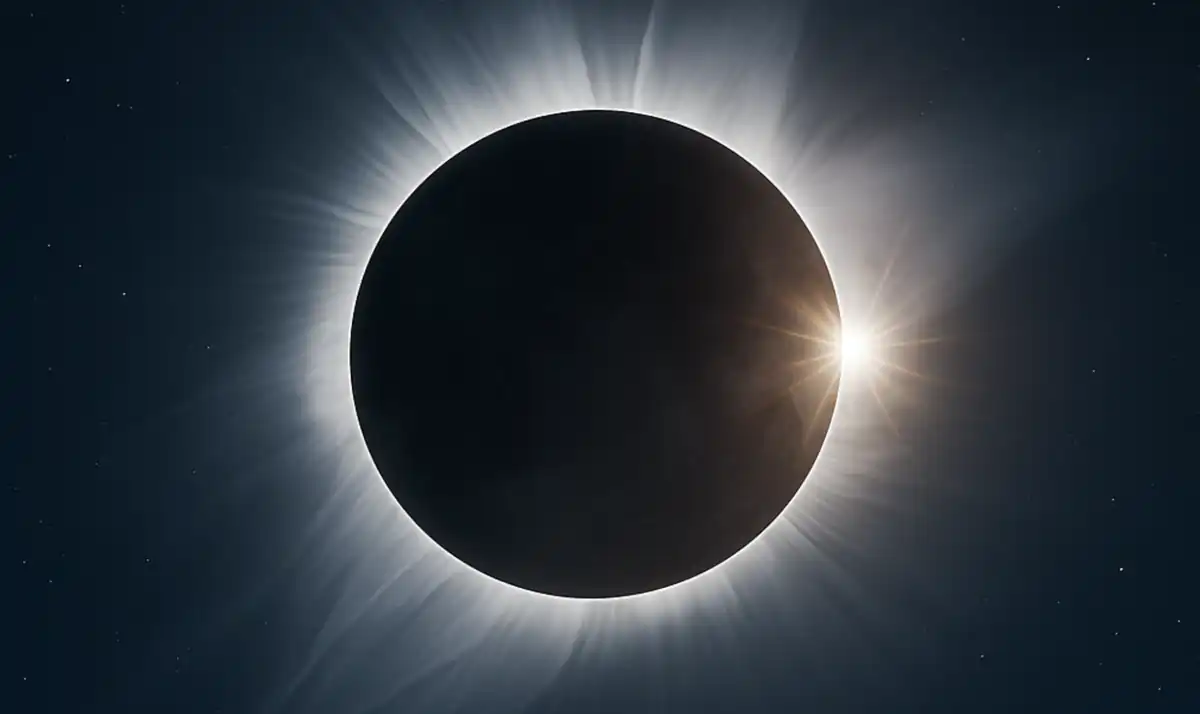
On Wednesday, August 12, the Moon’s shadow will sweep across a narrow stretch of the Northern Hemisphere. Greenland, Iceland, northern Russia, the Atlantic, Spain and a small corner of Portugal lie in the path of totality. Much of Europe, northwestern Africa, Canada and parts of the United States will see a partial eclipse. It is […]

The post The August 12 Total Solar Eclipse: Where to See Itβ€”and Why NASA Is Flying Through Its Shadow appeared first on Curiosmos.

  •  

Inouye Solar Telescope Discovers Hidden Plasma Vortices on Sun

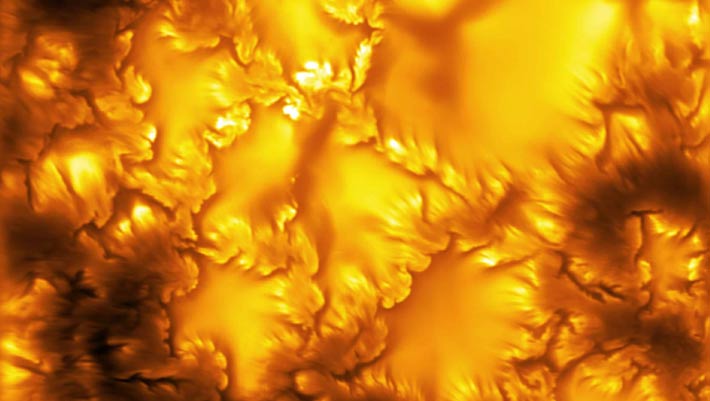
The highest-resolution image of the Sun’s surface (photosphere) ever captured, taken at 416 nm by the Inouye Solar Telescope; it reveals deformed boundaries of magnetic elements and ultra-fine scale stripes, both associated with Kelvin-Helmholtz instability. Image credit: NSF / NSO / AURA / MPS.

Astronomers using the 4-m Daniel K. Inouye Solar Telescope in Hawaii have detected tiny plasma vortices on the Sun’s surface (photosphere) for the first time, revealing a long-suspected process that could transport energy into the million-degree corona.

The post Inouye Solar Telescope Discovers Hidden Plasma Vortices on Sun appeared first on Sci.News: Breaking Science News.

  •  

Featured Image: Citizen Science and Solar Structure

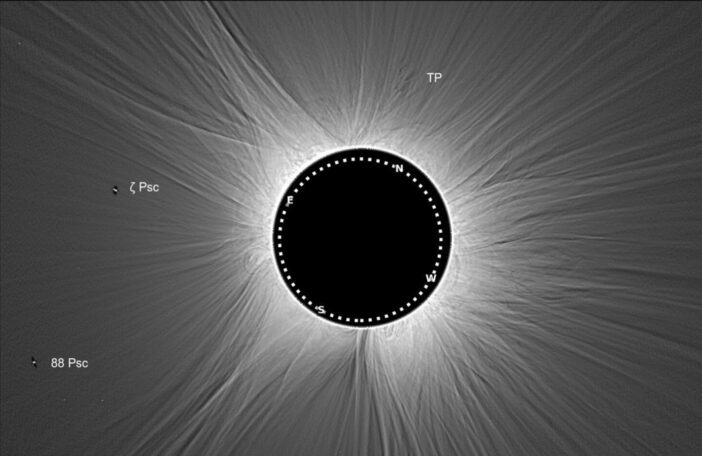
solar corona during a solar eclipse

During the 8 April 2024 solar eclipse, the path of totality swept across North America, dazzling millions of skygazers. Scattered along this path were 82 viewing sites of the Dynamic Eclipse Broadcast Initiative citizen science project, which aimed to observe the dynamics of the tenuous solar corona. Though poor weather dashed many observers’ hopes, the project managed to collect data at 11 sites spanning 2,700 kilometers, capturing 49 minutes of coronal behavior. The image above shows the solar corona as seen during totality from one of the DEB Initiative sites. In a recent research article, Matthew J. Penn (Southern Illinois University Carbondale; Tucson Amateur Astronomy Association) and collaborators described the results of the Initiative’s viewing efforts, including identification of downflows and outflows, plumes, coronal loops, and apparent motion of background stars. To learn more about these observations of the solar corona, be sure to check out the full article linked below.

Citation

β€œStructure and Dynamics of the Inner Corona Measured from the DEB Initiative 2024 Eclipse Image Sequence,” Matthew J Penn et al 2026 ApJL 1006 L25. doi:10.3847/2041-8213/ae8797

The post Featured Image: Citizen Science and Solar Structure appeared first on AAS Nova.

  •  
❌