
❌

Reading view

Samsung Galaxy SmartTag 3 Leak Suggests New Rounded-Square Design Ahead of Expected Year-End Launch

Igeekphone News: August 2, 2026 – Samsung is reportedly preparing to introduce the Galaxy SmartTag 3, the next generation of its Bluetooth tracking accessory, with a redesigned appearance that aligns more closely with the company’s current hardware and software design language.

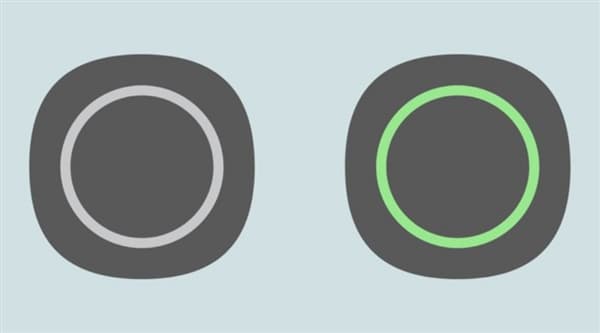
According to recent leaks, the upcoming smart tracker will feature an all-new rounded-square design, marking a significant departure from its predecessor while maintaining familiar functionality.

A Return to Samsung’s Family Design Language

Based on the leaked information, the Galaxy SmartTag 3 adopts a shape that sits between a square and a circle, featuring gently rounded corners that mirror the aesthetic of One UI app icons and Samsung’s latest wearable devices, including the Galaxy Watch 9.

The redesign represents another evolution in the SmartTag series’ appearance:

  • Galaxy SmartTag (1st generation): Rounded-square design
  • Galaxy SmartTag 2: Capsule-inspired shape with an integrated keyring opening
  • Galaxy SmartTag 3: Refined rounded-square design that emphasizes visual consistency across Samsung’s ecosystem

The updated design appears intended to create a more cohesive look alongside Samsung’s expanding portfolio of Galaxy devices.
Lanyard Hole May No Longer Be Built In

One notable change suggested by the leak is the apparent removal of the integrated lanyard or keyring hole found on the previous generation.

If accurate, users who want to attach the tracker to keys, backpacks, luggage, or other personal belongings may need to purchase a dedicated protective case or accessory with a built-in attachment point.

While this approach could improve the overall aesthetics of the device, it may reduce convenience for users who prefer attaching the tracker directly without additional accessories.

Physical Button Returns for Quick Controls

The leaked design also shows the return of a central physical button, continuing a feature introduced in earlier SmartTag models.

The button is expected to support multiple shortcuts, including:

  • Single press: Ring a connected Galaxy smartphone to help locate it nearby.
  • Double press: Trigger user-defined automation routines through Samsung’s Modes and Routines feature (formerly known as Bixby Routines).

This functionality allows the tracker to serve not only as a location device but also as a convenient smart home or productivity shortcut.

Expected Features

Although Samsung has yet to announce official specifications, the Galaxy SmartTag 3 is expected to retain the core technologies that power previous models, including:

  • Bluetooth connectivity
  • Ultra-Wideband (UWB) support for precise directional tracking (on compatible Galaxy devices)
  • Compatibility with Samsung’s SmartThings Find network
  • Dust and water resistance rated at IP67 or possibly IP68

Some reports also suggest the new tracker could adopt Bluetooth 6.0, potentially improving location accuracy, connection stability, and power efficiency. However, it remains unclear whether battery life will improve over the previous generation.

Expected Launch Timeline

Samsung has not officially confirmed the Galaxy SmartTag 3, but current reports suggest the accessory could debut before the end of 2026.

Industry observers expect it may launch alongside other upcoming Galaxy devices, including the rumored Galaxy S26 FE smartphone and the Galaxy Tab S12 tablet series, as part of Samsung’s year-end product lineup.

Final Thoughts

The leaked Galaxy SmartTag 3 appears to focus on refining Samsung’s existing smart tracking platform rather than introducing major functional changes. A redesigned rounded-square form factor, continued support for Bluetooth and UWB tracking, SmartThings Find integration, and programmable physical controls suggest Samsung is prioritizing design consistency and everyday usability.

If the reported specifications prove accurate, the Galaxy SmartTag 3 could become a compelling option for Galaxy users seeking a reliable item tracker that integrates seamlessly with Samsung’s broader ecosystem. More details, including pricing, battery performance, and regional availability, are expected to emerge closer to the product’s official launch.

The post Samsung Galaxy SmartTag 3 Leak Suggests New Rounded-Square Design Ahead of Expected Year-End Launch appeared first on IGeeKphone China Phone, Tablet PC, VR, RC Drone News, Reviews.

  •  

New Observations Reveal the Staggering Scale of the Universe’s Largest Galaxy

As new observations reveal the outer edges of IC 1101 for the first time, scientists have confirmed it is the largest known galaxy. The galaxy’s statistics are staggering, containing an estimated 3.4 trillion solar masses of stars and spanning roughly 1.7 million light-years, eclipsing every other known galaxy.

IC 1101 belongs to a class known as brightest cluster galaxies (BCGs), which form as massive galaxies spend billions of years absorbing smaller neighboring galaxies.

The new images are the deepest ever taken of the galaxy, and were revealed in a recent paper accepted for publication in a future issue of Astronomy and Astrophysics, but available now in preprint form on the arXiv server.

Blending into the Cosmic Background

Despite their enormous sizes, BCGs are notoriously difficult for astronomers to study. Because they are built through the gradual merger of many smaller galaxies, their outer regions are extremely faint, containing diffuse stellar halos and tidal tails left behind by ancient collisions. These wispy edges often blend into the free-floating gas and stars that fill galaxy clusters, making it difficult to determine precisely where the galaxy ends and the surrounding cluster begins.

Carlos Marrero-de la Rosa of the Astrophysical Institute of the Canary Islands led the new study, focusing on IC 1101, the dominant galaxy at the center of the Abell 2029 galaxy cluster.

The research relied on ultra-deep images captured with the Wide Field Camera at the Isaac Newton Telescope, allowing astronomers to resolve the galaxy’s diffuse outer boundary in unprecedented detail.

IC1101 galaxy composite
Applying a star subtraction algorithm to the composite image of the IC 1101 galaxy provides a new level of detail and contrast. Credit: Carlos Marrero-de la Rosa et al. (2026)

Battling Light Pollution

With the number of satellites orbiting Earth increasing dramatically in recent years, astronomers have raised concerns about artificial light pollution. In this case, however, the researchers faced interference from a far more distant source: foreground stars within our own galaxy.

These stars, located between Earth and IC 1101, scatter light across telescope images, washing out the extremely faint structures astronomers are attempting to detect. Since the galaxy’s outermost regions are already difficult to distinguish, any additional scattered light significantly reduces image contrast.

To overcome this problem, the researchers constructed a detailed model of how the telescope spreads light using dozens of calibration stars. The model allowed the team to accurately subtract scattered light from more than 250 foreground stars, bringing IC 1101’s faintest structures into much sharper contrast and enabling a more precise measurement of its true extent.

The Largest Known Galaxy

IC 1101’s immense scale becomes even more striking when compared with our own Milky Way. The astronomers measured IC 1101 at roughly 520 kiloparsecs across—about 17 times wider than the Milky Way’s approximately 30-kiloparsec diameter. Even after accounting for all forms of mass, including elusive dark matter, scientists estimate that the Milky Way contains only about 1 to 1.5 trillion solar masses of material, compared with the 3.4 trillion solar masses contained in the stars of IC 1101 alone.

Researchers also found evidence that the giant galaxy continues to grow. They identified eight structures beyond its main edge, two of which align with previously observed X-ray disturbances that suggest ongoing accretion. According to the team, IC 1101 likely collided with another galaxy group between two and three billion years ago, producing a merger that continues to shape the galaxy today.

The paper, “How Large Can Galaxies Be? Ultra-Deep Imaging of IC 1101, the Most Extended Known Galaxy,” is available on arXiv, ahead of later publication in Astronomy and Astrophysics.

Ryan Whalen covers science and technology for The Debrief. He holds an MA in History and a Master of Library and Information Science with a certificate in Data Science. He can be contacted at ryan@thedebrief.org.

  •  

Astronomers Spot Wandering Supermassive Black Hole Far From Its Galaxy’s Heart

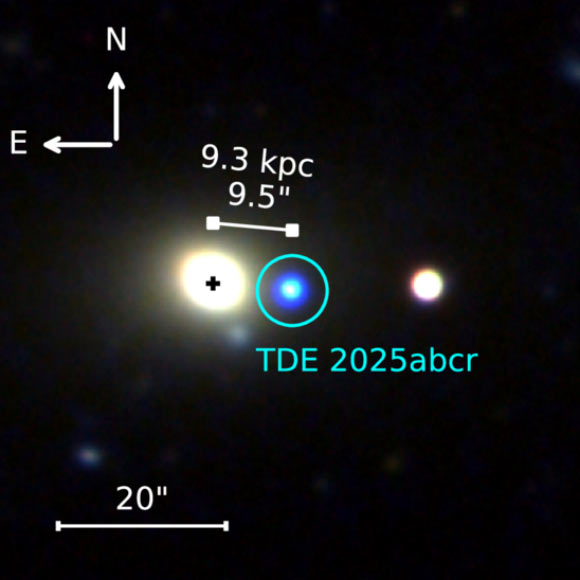
TDE 2025abcr. Image credit: Stein et al., doi: 10.3847/2041-8213/ae77f3.

Astronomers have discovered a dormant supermassive black hole 30,000 light-years from the center of WISEA J014656.04-152214.7 -- a massive galaxy located about 750 million light-years away in the constellation of Cetus -- after it briefly lit up by tearing apart a star.

The post Astronomers Spot Wandering Supermassive Black Hole Far From Its Galaxy’s Heart appeared first on Sci.News: Breaking Science News.

  •  

Hubble Spots Spiral Galaxy Warped by Cosmic Forces

This Hubble image shows NGC 4654, an intermediate spiral galaxy some 55 million light-years away in the constellation of Virgo. Image credit: NASA / ESA / Hubble / D. Thilker / J. Lee / PHANGS-HST Team.

A stunning new image captured by the NASA/ESA Hubble Space Telescope shows the lopsided intermediate spiral galaxy NGC 4654, whose unusual shape was sculpted by both a close encounter with another galaxy and a headlong plunge through the hot gas of the Virgo Cluster.

The post Hubble Spots Spiral Galaxy Warped by Cosmic Forces appeared first on Sci.News: Breaking Science News.

  •  
❌