❌

Reading view

Stock market turmoil sheds stark light on the opaque AI economy

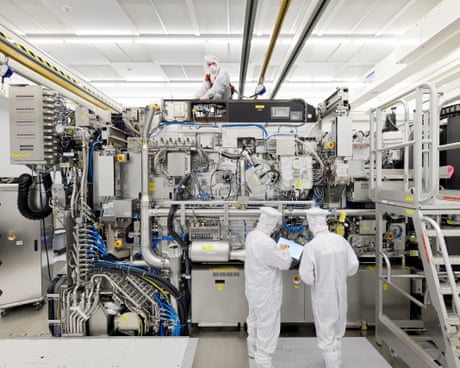
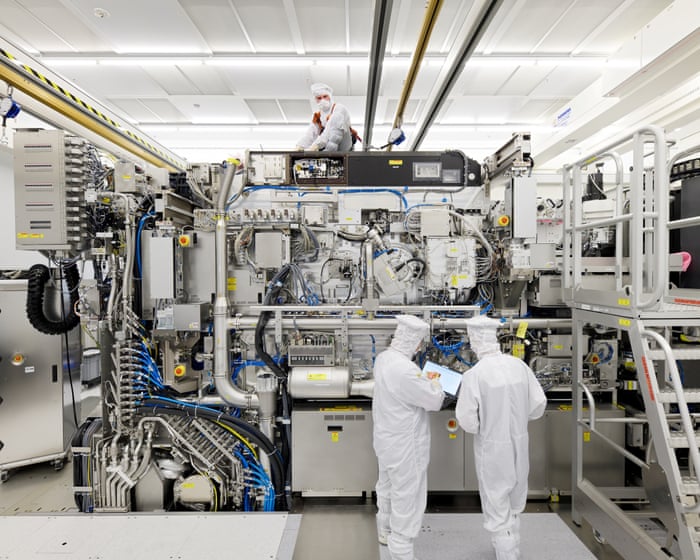
Investors scramble to make sense of a shock Chinese challenge to the dominance of western chipmakers

Even for the rollercoaster world of AI, last week was particularly volatile as investors scrambled to keep up with developments that threatened the dominance of the largest western chipmakers.

It began with a double whammy. On Monday, the Chinese memory chipmaker CXMT floated on the Shanghai stock market, soaring by 466% in value to 3.3tn yuan (£365bn).

Continue reading...

© Photograph: Bart van Overbeeke Fotografie/AS/Reuters

© Photograph: Bart van Overbeeke Fotografie/AS/Reuters

© Photograph: Bart van Overbeeke Fotografie/AS/Reuters

  •  

Reporter’s notebook: In Dubai’s sun and sand, AI, server farms, and optimism bloom

Walking around Dubai, it’s hard to believe a war is still going on in neighboring countries.

No missiles have struck the city, and it was clear during a recent visit that local residents are keeping to their routines. The biggest public worry, as it has been in many parts of the world, is the extreme heat. (The high today is around 106 degrees.)

Dubai, one of seven emirates in the United Arab Emirates (UAE), continues to emerge as a major global tech hub and is on the verge of becoming a major AI powerhouse. Each of the emirates has their own laws and traditions, with Dubai and Abu Dhabi — the UAE capitol — the most prominent.

Other nations recognize the region’s potential and Dubai’s position. The US, for instance, showed interest in currying favor with the UAE by sending a CIA spy to vet the emirate’s top AI firm, paving the way for future chip and AI deals. That outreach, highlighted in a report in The Wall Street Journal, was a hot topic in the local tech community.

These days, Dubai and Abu Dhabi hope to position themselves as hubs where people and companies go for AI. It’s location makes it an excellent place to do business with connections to Asia, Europe and Africa.

Broadly speaking, the UAE wants to be something of a Switzerland for AI, or “a neutral AI corridor between East and West,” Mahmood Abdulla, a regional technology expert, explained in a 2025 LinkedIn entry.

Data center buildouts

While states like New York are putting a moratorium on the construction of data centers in the US, the UAE is moving in the opposite direction; an aggressive AI data center buildout has government backing.

Stargate UAE, a data center project that involves top tech firms such as OpenAI and Oracle, is being built in Abu Dhabi. The city has essentially planned out a business model designed to turn AI into hard cash with a focus on the energy resources that will play a major role in the effort.

The plan is to redirect Abu Dhabi’s vast energy resources — it has up to 100 billion barrels of known oil reserves — to data centers generating AI tokens. Those tokens can then be sold as compute resources to produce revenue.

With oil markets volatile because of ongoing conflicts and the worldwide rise of renewables, pushing energy use to AI data centers might be a more reliable form of revenue long term.

Will it work? That remains to be seen. But unlike the US backlash against data centers construction in many place, a ban here seems unlikely.

The entrepreneurial spirit

Technological innovations from entrepreneurs have been at the core of Dubai’s rapid growth in recent years as a global business center. Here, AI is already quietly woven into daily life, much as it is in China, where AI is already in factories, homes, and infrastructure.

One founder told me that naming his company to include “AI” is more of a US thing. UAE companies focus less on boasting about AI models and superintelligence; they tend to emphasize user experiences.

On a separate track, Dubai is already targeting the launch later this year of robotic air taxis flying from the airport into the city. (That’s ahead of New York City, where electric air taxis are still being tested.)

Still, Dubai is behind the US when it comes to autonomous ground transport. The first autonomous taxis hit Dubai streets just last year, and there are a limited number operating in tourist areas.

A complicating face tor for the area remains the Iran war. Dubai’s Internet City, a hub with buildings belonging to the likes of Microsoft, Oracle and IBM, largely emptied when the war started in late February. Foreign tech workers left, and property prices declined.

But the real estate market is booming as opportunistic investors buy low. Their bet: the US-Iran war won’t stop the UAE’s growth.

Money is flowing into the area in other ways. Heavy tax burdens in Western countries are pushing wealthy founders to move businesses to Dubai’s tax-free environments. And Dubai is opening the door to those with digital nomad and freelance visas. Although visas can cost thousands of dollars a year, lower rent and healthcare costs compared to the US can offset those costs.

Rivals are emerging, too

UAE’s economic rival, Saudi Arabia is also rising as a tech powerhouse. Riyadh has undertaken reforms at a rapid pace to become an attractive place to do business under its Vision 2030 program.

Saudi Arabia requires corporations to have regional headquarters in the country to win government contracts, a policy that challenges Dubai’s status as a regional business hub.

The UAE also relies heavily on immigrants and human labor, which can be both a plus as well as a challenge. There is no pathway for entrepreneurs or long-time tech workers to retire here, which can undermine worker motivations to stay.

Still, the attractive business environment, combined with local infrastructure and a skilled labor force, make this area appealing. As one founder told me, if the US doesn’t want its most skilled immigrants, the UAE will be happy to welcome them with open arms.

  •  

Data center developer eyes disused newpaper printing plant

As newspapers move online, the buildings that once housed their printing presses need new occupants.

The Minnesota Star Tribune has just sold its old printing plant on the edge of Minneapolis to the aptly named property developer Legacy Investing, which plans to create a new data center there. has found the ideal way to bring them back to life.

This is the second such move by Legacy. It has already bought a building in downtown Minneapolis that it has transformed into a data center for artificial intelligence and cloud computing.

These old buildings, already connected to power, are an attractive option for developers — especially with some grid operators threatening power cuts for new-build data centers during power shortages.

Legacy is taking a small-is-beautiful approach rather than replicating the massive data centers being built for Big Tech firms. Those are the size of small towns and consume huge volumes of water and hundreds of megawatts of power, while the capacity of Legacy’s downtown building is about 30 MW, and it expects the Star Tribune site to host around 20 MW of data center equipment.

The scaled-down approach may well be an attractive option for operators in the future.

This article first appeared on Network World.

  •  

Microsoft’s Nadella calls out Big AI for hypocrisy — but what about his own company?

The 19th-century French novelist Honore de Balzac is believed to have said that behind every great fortune lies a great crime.

That’s even more true today than it was 200 years ago — just look at how Big AI, including Anthropic, OpenAI, Google, and others have built their trillion-dollar fortunes. 

They all use vast amounts of copyrighted material to train their large language models (LLMs) without paying the copyright holders. In other words, they steal it. They don’t call it stealing, though. They call it “fair use,” which in this case amounts to the same thing.

Generative AI (genAI) training requires massive amounts of text. The better-written and more information-dense that text is, the more it helps. AI gets a lot smarter a lot faster when it’s trained on well-written books and magazine and newspaper articles than when it’s trained on social media banter (or most everything else you find on the internet).

Since the dawn of AI, companies have been hoovering up copyrighted material wherever they find it — on the open web, behind paywalls, even in manually scanned books — and then used the scanned text. And they do it all without asking authors’ or publishers’ permissions, and without paying them.

It’s the greatest intellectual property theft in history by a long shot — billions and billions of dollars worth. Books, articles, music, photographs, artwork, you name it. If a human being has created it, Big AI has likely grabbed it and ingested it without asking, then made big profits off it.

I know this from personal experience; I’ve got skin in the game. Big AI companies have used at least 30 of my books to train their models without asking.  And that’s only what I’ve confirmed. Big AI might well have stolen even more. And it also might have stolen many of the thousands of articles I’ve written through the years.

For the AI bigwigs, it’s standard operating procedure. So it was surprising to see Microsoft CEO Satya Nadella calling out Big AI for its hypocrisy in using other people’s intellectual property without paying, then crying foul when small AI companies use Big AI’s work to train their own models using a technique called distillation.

He wrote on X: “While the great innovation that comes from model providers having fair use rights to train models on public data is needed, I find it ironic that the status quo is to then turn around and impose restrictive terms on distillation, and to reserve the right to learn from customer usage and interaction data.” 

One important note here: Nadella believes Big AI should be allowed to steal copyrighted material for training purposes. He makes that clear by his mention of “fair use.” His issue is that he believes smaller AI companies should be able to use Big AI’s work to train their models — and Big AI doesn’t want to let them do it.

Alistar Barr, in Business Insider, makes a related point: “Anthropic, OpenAI, and Google are discovering what the rest of the internet has already learned through painful experience: once you put something online, people will find ways to use it in ways you don’t like and can’t stop.” 

Before we look at whether Nadella is right in calling Big AI’s actions hypocritical, let’s examine the technique at the heart of the issue: distillation.

The lowdown on distillation

Distillation refers to an AI training technique in which you take outputs from one AI model, such as the answer to a prompt, and use that output to train your own model. AI companies do that quite frequently and have been doing so for a long time.

Barr explains distillation this way: “Distillation looks an awful lot like what AI companies have been doing to the rest of the internet. Scrape web content for free and without permission. Turn it into a product you sell. Argue it’s fair use. Hope the lawyers sort out the details later.”

Elon Musk has admitted his company xAI used distillation techniques to take output from competitor OpenAI to train xAI’s Grok chatbot. He explained, “Generally AI companies distill other AI companies.”

Analysts point out the AI industry is built on distillation. Neil Shah, vice president of research at Counterpoint Research says, “The reality is none of the models is an island and the entire industry has mostly evolved based on recursive learning. The newer entrants are in many instances going through the same routes of ‘distillation’ and ‘optimization.’”

It’s only become an issue now because Chinese AI companies have been using distillation techniques to catch up to American AI companies.

OpenAI CEO Sam Altman has been pressuring the US to take legal action against the Chinese companies.  Anthropic has piled on as well, saying the fight against distillation requires a coordinated response across the AI industry, cloud providers, and policymakers.

Hypocrisy or fair use?

So are OpenAI, Anthropic and other big US AI firms hypocritical, as Nadella claims? Absolutely. They’ve built their businesses on the theft of billions of dollars of stolen intellectual property and call it fair use. Now, they’re playing the victims when competitors do the same to them. (They’re also in some cases paying up; Anthropic just last week settled a copyright suit, paying out $1.5 billion.)

It’s good to see Nadella call out their hypocrisy. But Microsoft is as guilty of intellectual theft as the others — its AI Copilot is powered by OpenAI’s and Anthropic’s chatbots. The company faces major lawsuits for intellectual property theft. Among them is one by the New York Times, New York Daily News, and Center for Investigating Reporting, another by 400 local and regional newspapers, and another by 11 authors, including Pulitzer Prize winners Kai Bird, Jia Tolentino, and Daniel Okrent.

So, don’t praise Nadella for speaking out. Criticize him (and other AI tech leaders) for stealing billions of dollars in intellectual property from countless writers and publishers and calling it fair use.

  •  
❌