Login

Privacy OLED Panels Cost Over 10% More Than Standard LTPO Displays
Samsung Electronics' privacy OLED panel used in the Galaxy S26 Ultra is estimated to cost more than 10% more to manufacture than a conventional low-temperature polycrystalline oxide (LTPO) OLED panel, according to industry sources.
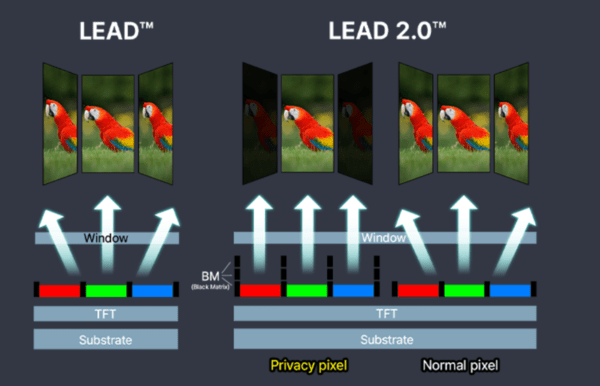
The Galaxy S26 Ultra's OLED panel adopts a dual-pixel architecture, in which each pixel contains separate red, green, and blue (RGB) sub-pixels for wide-viewing-angle mode and narrow-viewing-angle privacy mode. Market research firm Counterpoint Research estimates that the panel's overall production cost is about 10% higher than that of a comparable LTPO OLED panel.
In standard mode, the display operates using the wide-viewing-angle pixels, whereas privacy mode primarily drives the narrow-viewing-angle pixels. The panel achieves its privacy function through a multilayer black matrix (BM) structure formed deeply around the narrow-viewing-angle pixels, allowing light to pass directly toward the user while blocking light emitted at wider angles. Alignment accuracy between the light-emitting area and the black matrix affects brightness, viewing-angle control performance, and manufacturing yield.
Manufacturing complexity has increased further through the use of Color Filter on Encapsulation (CoE) technology, which eliminates the polarizer layer by forming color filters and black matrix structures directly on top of the OLED encapsulation layer. While CoE helps reduce panel thickness and improve light efficiency, the privacy OLED design requires the integration of additional pixels and multilayer black matrix structures, adding to process complexity.
The number of thin-film transistor (TFT) masks required for CoE integration has increased significantly compared with the OLED panel used in the Galaxy S25 Ultra, resulting in higher manufacturing costs. Additional masks also increase exposure, etching, and deposition processes, along with equipment utilization time and material consumption.
Specific panel supply prices have not been disclosed. However, industry estimates place display costs at approximately $84 for the Galaxy S23 Ultra, $88 for the Galaxy S24 Ultra, and $80–87 for the Galaxy S25 Ultra. The Galaxy S26 Ultra's display cost is estimated at approximately $88–96.
Demand for privacy OLED technology is expected to grow. Market research firm Sigmaintell forecasts that smartphone shipments featuring privacy-mode displays will increase from 1 million units in 2025 to 21 million units in 2026, before reaching 29 million units in 2027.
Samsung Electronics is also expected to expand the technology beyond the Galaxy S26 Ultra. Privacy displays are planned for all four Galaxy S27 models—Base, Plus, Pro, and Ultra—scheduled for release next year. Meanwhile, privacy displays for foldable devices remain under development and have not yet been implemented in mass-production specifications.
An industry source noted that privacy OLED technology involves more than simply adding a light-blocking layer. “It requires simultaneous changes to pixel layouts, optical structures, and driving circuits,” the source said. “As production volumes increase, simplifying mask processes and improving yields will be critical to reducing cost increases.”