Com2uS Holdings announced on July 22 that it has launched Fading Echo, a new action-adventure game, on Steam and the Epic Games Store.
The title was developed by Emeteria, a studio under French game publisher New Tales. The game supports subtitles in nine languages, including Korean, English, Japanese, Chinese, German and French, while in-game voice acting is available in English.
The voice cast features several internationally recognized actors, including Samantha Béart, Jasmine Bhullar, Laura Bailey and Liam O'Brien, who are known for their work on titles such as Baldur's Gate 3, The Last of Us Part II and World of Warcraft.
Fading Echo follows the adventure of a young hero named One, who wields the power of water as she travels between the desert planet Corel and the parallel realm known as the Shadows. The game is set in the Echoverse, a shared universe spanning multiple worlds.
Players can manipulate water and steam in combat while taking advantage of an environmental system in which different elemental forces interact dynamically, creating distinctive combat encounters and exploration experiences.
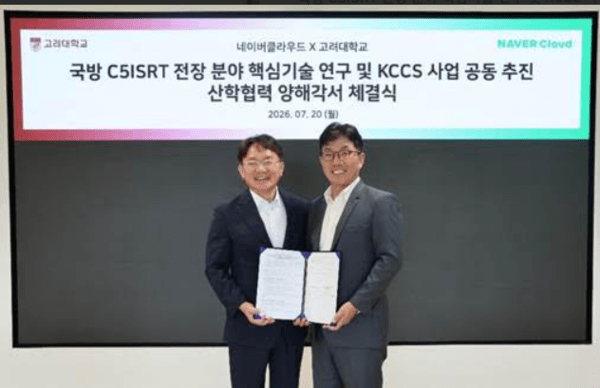
Naver Cloud signed a memorandum of understanding with Korea University's C5ISRT Convergence Research Center to jointly conduct research on core battlefield technologies and collaborate on the KCCS project. Pictured are Prof. Kang Seok-joong of Korea University's Graduate School of Management of Technology (left) and Naver Cloud Chief Executive Officer Kim Yoo-won. (Photo: Naver Cloud)
Naver Cloud signed a memorandum of understanding with Korea University's C5ISRT Convergence Research Center to jointly conduct research on core battlefield technologies and collaborate on the KCCS project. Pictured are Prof. Kang Seok-joong of Korea University's Graduate School of Management of Technology (left) and Naver Cloud Chief Executive Officer Kim Yoo-won. (Photo: Naver Cloud)
Naver Cloud and Korea University's C5ISRT Convergence Research Center will jointly pursue defense artificial intelligence projects worth a combined 20 billion won, including preparations for South Korea's next-generation joint command-and-control system.
Naver Cloud announced on July 20 that it signed a memorandum of understanding with the C5ISRT Convergence Research Center under the Department of Defense Technology Management at Korea University's Graduate School of Management of Technology to strengthen industry-academia cooperation in defense C5ISRT technologies.
C5ISRT refers to an integrated military command-and-battlefield awareness framework encompassing Command, Control, Communications, Computers, Cyber, Intelligence, Surveillance, Reconnaissance and Targeting, which forms the foundation of modern military operations.
The Korea University research center is led by Prof. Kang Seok-joong, a defense technology expert with nearly four decades of research experience in defense technology management.
Under the agreement, the two organizations will jointly pursue several initiatives, including participation in the Joint Chiefs of Staff Military-Industry-Academia Cooperation Center, collaborative research on hyperscale AI-based command-and-control technologies, and advance development of core technologies for the Korea Joint Command and Control System (KCCS) project scheduled for 2027.
The Joint Chiefs of Staff Military-Industry-Academia Cooperation Center is one of five regional defense AI hubs being established by South Korea's Ministry of National Defense to promote civil-military AI collaboration using defense data. The initiative will establish AI transformation (AX) hubs in Yongsan (Joint Chiefs of Staff), Pangyo and Daejeon (Army), Yangjae (Air Force), and Busan (Navy and Marine Corps).
"Modern battlefields are rapidly evolving toward AI- and data-driven intelligent C5ISRT systems," said Prof. Kang Seok-joong. "To keep pace with this trend, South Korea's military needs projects that combine advanced AI technologies with deep expertise in the Korean Peninsula's security environment."
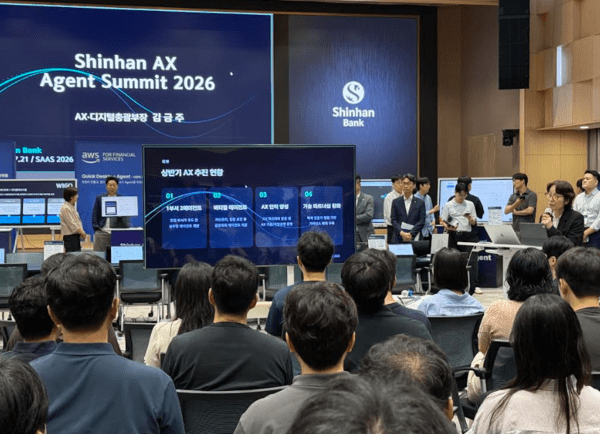
Kim Geum-ju, head of AX and Digital at Shinhan Bank, speaks during the Shinhan AX Agent Summit 2026 held at the bank's headquarters in central Seoul on July 21. (Photo: Shinhan Bank)
Kim Geum-ju, head of AX and Digital at Shinhan Bank, speaks during the Shinhan AX Agent Summit 2026 held at the bank's headquarters in central Seoul on July 21. (Photo: Shinhan Bank)
Shinhan Bank held its Shinhan AX Agent Summit 2026 on July 21 at its headquarters in Seoul, bringing together employees from across the Shinhan Financial Group, domestic and international technology companies, and academic experts to discuss the future of AI in financial services.
The event was designed to objectively assess the bank's current AI agent capabilities, compare them with global technologies and financial industry use cases, and identify future priorities for advancing AI transformation (AX) in banking.
The exhibition was organized into five zones, allowing participants to explore the latest AI technologies from domestic and international companies alongside Shinhan Financial Group's own AI agent developments.
The bank showcased the latest AI agent technologies and deployment cases from global financial institutions, while also exhibiting 18 AI agents developed by Shinhan Bank's AX Innovation Leaders and business units using the bank's proprietary AI platform. An additional three AI agents developed by affiliated companies within the Shinhan Financial Group were also on display.
"Financial AI transformation is not simply about adopting new technologies," a Shinhan Bank official said. "What matters more is objectively evaluating the current state of AI and continuously validating that it can be used safely and effectively in real business operations."
The official added that the bank plans to identify areas for improvement through feedback from external experts and frontline employees while continuing to enhance its financial AI agents.
SK Telecom has launched SKTCH with AI, a startup acceleration program aimed at discovering and nurturing artificial intelligence startups, with applications open from July 21 through Aug. 18.
SKTCH, a combination of SKT and Tech, is the company's platform for identifying startups and expanding collaboration opportunities. Through SKTCH with AI, SK Telecom aims to connect startups with its AI technologies, infrastructure and business capabilities to foster mutual growth.
The company plans to select 15 startups based on factors including the competitiveness of their AI technologies and their potential for collaboration with SK Telecom.
Selected companies will receive a six-month support package that includes mentoring and seminars led by industry experts, assistance with joint business development projects with SK Telecom, opportunities to participate in domestic and international exhibitions, office space and other business infrastructure, and access to investment opportunities with venture capital firms and related organizations.
The selection process will also incorporate SK Telecom's AI evaluation agent, an AI agent developed by the company to assist with startup assessments. SK Telecom said the system is expected to accelerate the review process while improving evaluation consistency.
The company said it plans to further enhance the AI agent so that it can independently handle areas where objective assessments are possible, allowing human reviewers to focus on applications requiring more detailed evaluation.
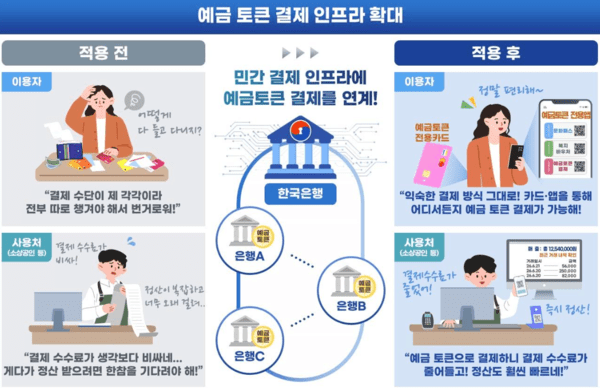
The South Korean government said on July 22 that it will accelerate the rollout of blockchain-based digital payment infrastructure. (Image: Korea Internet & Security Agency)
The South Korean government said on July 22 that it will accelerate the rollout of blockchain-based digital payment infrastructure. (Image: Korea Internet & Security Agency)
South Korea's government has launched a project to expand blockchain-based digital payment infrastructure centered on deposit tokens, aiming to reduce payment processing costs for small businesses while accelerating the adoption of digital financial services.
The Korea Internet & Security Agency (KISA) and the Ministry of Science and ICT announced on July 22 that they held a joint launch ceremony at KISA's Seoul headquarters for the Deposit Token-Based Payment Infrastructure Expansion Project, one of this year's selected Blockchain Innovation Leading Projects. The initiative is intended to accelerate the deployment of blockchain-based digital payment infrastructure.
The project is part of the government's demonstration program to identify and promote blockchain-based services with significant economic and social impact, including support for local businesses and the creation of new markets. This year's open competition selected the deposit token payment infrastructure project, which seeks to ease payment fee burdens for small merchants, following evaluation by an external panel of experts. To expand the use of deposit tokens and maximize the project's impact, the government will collaborate with related organizations, including the Ministry of Finance and Economy and the Bank of Korea.
The Korea Financial Telecommunications & Clearings Institute (KFTC) will serve as the lead organization, working with a private-sector consortium comprising nine commercial banks, eight payment service providers and two major merchant partners. KFTC will connect the existing payment infrastructure with the Bank of Korea's Project Hangang platform to enable deposit token payments while overseeing service development and pilot operations. The total project budget is 9.6 billion won.
The project's primary objective is to extend the institutional experience gained through the Bank of Korea's Project Hangang, which demonstrated central bank digital currency (CBDC)-based deposit tokens, into consumer-facing payment services. The government expects the initiative to deliver tangible benefits, including lower payment costs for small businesses. In addition, KFTC plans to work with the Ministry of Finance and Economy to expand the use of deposit tokens into public-sector financial activities, such as government operating expenses.
A key feature of the initiative is that it leverages existing payment infrastructure rather than requiring an entirely new payment network. By integrating with current payment terminals and online payment systems, consumers will be able to make payments using bank-issued deposit tokens through dedicated digital wallet applications. Authorities are also considering the introduction of physical payment cards. Merchants, including small businesses, will be able to accept deposit token payments without replacing their existing payment terminals.
The government expects that establishing a deposit token-based payment and settlement system will improve settlement speed and operational efficiency, enabling lower merchant transaction fees and reducing financial burdens on small business owners.
The Ministry of Finance and Economy also plans to incorporate deposit tokens into a pilot program for government business expenses. Looking ahead, the ministry intends to work with the Ministry of Planning and Budget's fiscal management organizations, including the Korea Public Finance Information Service, to develop a treasury management model linked to the government's dBrain digital fiscal management system for broader public fund administration.
The Ministry of Science and ICT said the project will create practical blockchain applications that the public can directly experience while expanding opportunities for blockchain companies—including small and medium-sized enterprises, startups and information technology firms—to participate in system development, operation and commercialization, thereby strengthening South Korea's blockchain ecosystem. Of the project's 9.6 billion won budget, approximately 3 billion won will be allocated to development, operations and promotional activities involving SMEs, startups and IT companies. Participating commercial banks and other consortium members also plan to undertake related projects worth approximately 4.5 billion won alongside the main initiative.
SK Telecom, KT and LG Uplus have entered the AI smart glasses market, expanding device competition beyond smartphones as all three carriers begin offering Ray-Ban Meta smart glasses bundled with mobile service discounts and installment payment plans.
The three mobile carriers announced on July 22 that they have started selling Ray-Ban Meta Wayfarer (Gen 2) smart glasses.
The product was jointly developed by Meta and eyewear manufacturer EssilorLuxottica. Meta began selling the glasses in South Korea through department stores, duty-free shops and optical retailers on May 25, and the carriers' launch broadens distribution by combining the device with mobile subscription benefits.
Ray-Ban Meta features a 12-megapixel ultra-wide camera, five microphones and open-ear speakers that leave the user's ears uncovered. Users can capture photos and videos by pressing a button on the frame or by saying, "Hey Meta." The glasses support first-person photography, record video at up to 3K Ultra HD resolution, and also provide music playback and hands-free calling.
Users can also interact with Meta AI in Korean, asking questions, identifying nearby objects, receiving recommendations and using real-time translation features. The glasses weigh approximately 50 grams, carry an IPX4 water-resistance rating, offer up to eight hours of battery life on a single charge, and up to 48 hours when used with the charging case.
However, the version sold in South Korea is not an augmented reality (AR) display device that projects maps, text or video onto the lenses. Instead, it functions primarily as a voice-first AI wearable, recognizing the surrounding environment through its camera and microphones while delivering Meta AI responses through the built-in speakers.
The device has also raised privacy concerns because of its built-in camera. Although an LED indicator on the front of the glasses illuminates whenever photos or videos are being recorded to alert people nearby, the product closely resembles ordinary eyewear, making it difficult to distinguish from conventional glasses.

 Login