
❌

Reading view

Nanopositioning, customization and control: opening new frontiers in optical computing
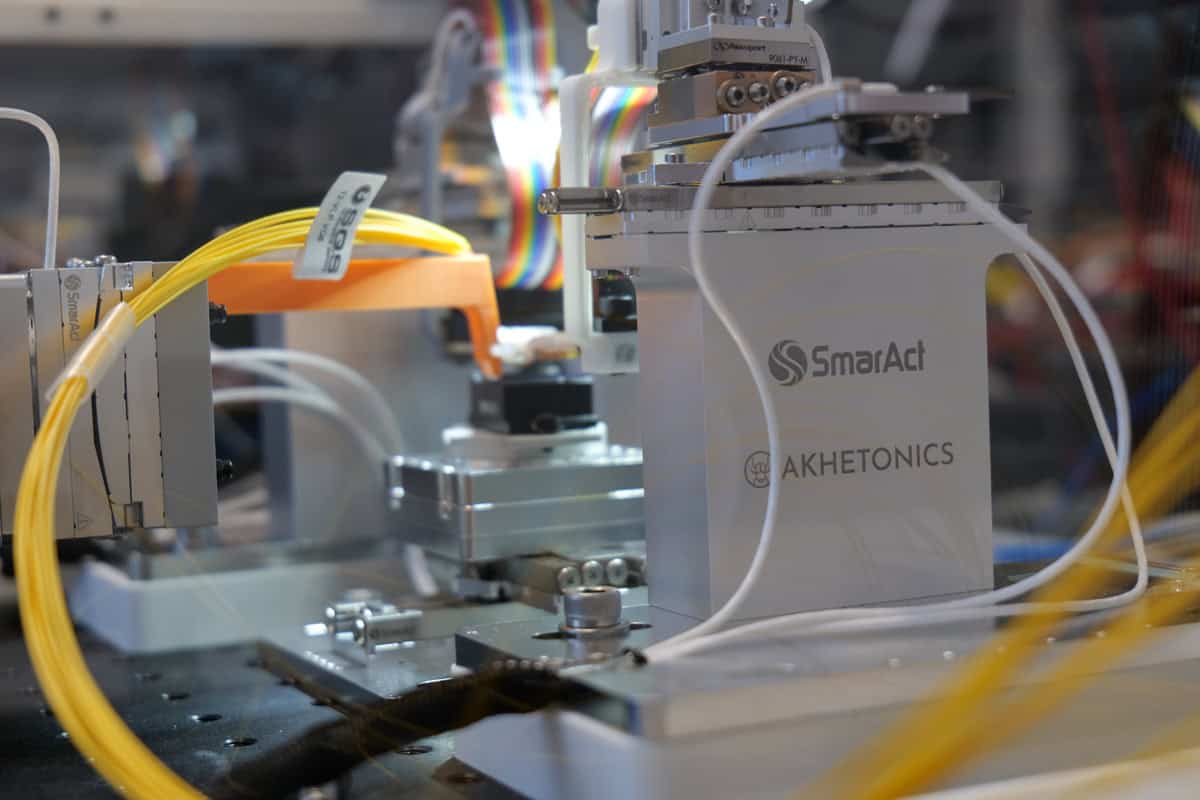
Photonics reimagined SmarAct and Akhetonics worked together to build a versatile optical test set-up to characterize next-generation photonic integrated circuits (PICs). SmarAct’s nanopositioning systems form the precision-motion core of the test workstation, while the positional reproducibility allows Akhetonics to map the full optical chip and evaluate large grids of test components rapidly and reliably. (Courtesy: Akhetonics)

German technology start-up Akhetonics is reimagining the future of high-performance computing (HPC), deploying its proprietary know-how in photonic-design automation and photonic integrated circuits (PICs) to realize the first all-optical digital computation devices. The end-game: an all-optical digital processor – what Akhetonics calls its reasoning processing unit (RPU) – that will fundamentally transform the way that data is processed, transmitted and stored at every level of the HPC stack.

While the anticipated upsides of photonic computing are compelling – think bandwidth scaling, energy-efficiency and reduced latency – the translation of Akhetonics’ R&D effort and early-stage PIC designs into at-scale implementation is still in its infancy. What’s evident even now, though, is that the start-up’s progress is being accelerated by collaboration, interdisciplinary expertise and innovation spanning photonic system design and precision-motion and control technologies.

Collaboration, co-development, customization

A case study in this regard is Akhetonics’ partnership with SmarAct, a German manufacturer and developer of specialist products for nano- and picometre-precise positioning, metrology and automated assembly. Both companies are shaping the future of photonics, albeit along complementary tracks: Akhetonics with its vision of a full-stack photonic computing architecture; SmarAct with a portfolio of enabling technologies that’s helping to make next-generation optical computing a practical proposition.

The two vendors began working together after an initial meeting four years ago at the European Conference on Optical Communication (ECOC 22) in Basel, Switzerland. Top of the Akhetonics shopping list: a versatile optical test system to characterize its advanced PICs.

Versatility is the key Leonardo Del Bino, Akhetonics’ CTO. (Courtesy: Akhetonics)

“There are off-the-shelf PIC characterization systems on the market, but they all impose constraints on our design options,” explains Leonardo Del Bino, co-founder and chief technology officer (CTO) at Akhetonics. “Instead, we teamed up with SmarAct to co-develop a compact and modular test architecture built to our exacting specifications. The resulting set-up gives us the flexibility to evaluate and optimize all sorts of innovative PIC designs.”

At the heart of the Akhetonics optical testing workstation sit two discrete nanopositioning subsystems: an XY-Rz chip platform (itself comprising three nanopositioning stages offering horizontal translation along the X and Y axes and rotation limited to the Z axis) and a Z-Rx-Ry “pivot” for an optical probe (where translation occurs only along the Z axis, with simultaneous angular rotation around the X and Y axes). The test set-up (which also incorporates a digital microscope for PIC inspection and alignment) can be used without restriction in every degree of freedom, with the two subsystems working in tandem to ensure precise multi-axis positioning for optical coupling and electro-optic characterization tasks.

On a more granular level, each nanopositioning subsystem is based on SmarAct positioners equipped with integrated optical encoders (SmarAct’s METIRIO® sensors with a resolution of 1 nm) along all six axes of motion. The first subsystem provides three degrees of freedom for lateral alignment (with 49 mm travel in both X and Y, 360° rotation around Rz and a unidirectional positional repeatability of ±40 nm per linear axis). The second subsystem provides vertical and angular alignment (with 31 mm travel in Z, ±5° tilt around Ry, ±45° rotation around Rz and a unidirectional positional repeatability of ±40 nm for the linear Z axis).

To evaluate new PIC designs, Akhetonics’ optical test routines focus primarily on measuring and minimizing insertion losses between input/output fibres and on-chip planar waveguides. Typical measurements include wavelength- and polarization-dependent coupling losses (for example, when a fibre array couples laser light into a series of on-chip grating couplers or when light is coupled from a planar waveguide back into an optical fibre). The subsequent integration of electrical probes into the test system (using two separate XYZ probe towers) supports electro-optic characterization of key on-chip building blocks like optical modulators and photodetectors.

“The requirements for the electro-optical testing are nothing crazy,” says Del Bino. On-chip electrical contacts are in the ballpark of 100 μm x 100 μm, so Akhetonics engineers need positional and alignment precision an order-of-magnitude better than that for their electrical probes. “On-chip optical testing is a different story,” he adds. “A fibre-waveguide mismatch of 1 μm means significant coupling losses, so we need positional accuracy and repeatability of tens of nm or less.”

The rewards of reciprocity

Operationally, the custom test system is the result of ongoing collaboration between the engineering team at Akhetonics and the product development team at SmarAct. After firming up performance requirements, the two vendors iterated back-and-forth with 3D CAD drawings before converging on a final agreed system design.

Line-of-sight Max Trippel, SmarAct’s business development manager for photonic applications. (Courtesy: SmarAct)

“We supplied the nanopositioning stages that form the precision-motion core of the workstation,” explains Max Trippel, SmarAct’s business development manager for photonic applications. Akhetonics then integrated these modules into its own test environment, including the fibre and fibre-array-unit holders; the required optical and electrical measurement equipment; and the software routines for photonic characterization. “This approach gives Akhetonics the flexibility to build exactly the test workflow it needs, while relying on a stable and repeatable positioning platform,” Trippel adds.

Crucially, the SmarAct software “ecosystem” and Python interface make it easy to integrate the nanopositioning stages within Akhetonics’ PIC test routines. That software application platform, known as the SmarAct Control and Process Environment (SCoPE), also creates opportunities for continuous process improvement and product innovation (for example, the ability to develop custom routines for fast calibration and alignment on all axes).

In this way, SCoPE will be a natural fit as Akhetonics transitions its PIC testing programme from an R&D setting through small-batch production runs and, ultimately, to volume manufacturing capability (see “SCoPE in brief”, below). “Our goal with SCoPE is to provide customers with easy access for system development, whether that’s for the testing or assembly of photonic components,” says Trippel. “SCoPE is a living platform and we’re constantly integrating novel functionalities and application-specific plug-ins as well as features to facilitate control of third-party devices.”

Strategically, the SmarAct-Akhetonics partnership is shaping up as a win-win for the long term, with the latter’s growth trajectory and evolving platform technologies feeding into SmarAct’s product development roadmap. “Our customers’ success is our success,” Trippel concludes. “Working in this way with Akhetonics and its peers means we have line-of-sight on ‘what’s next’ in photonic computing. Watch this space: the last word has not been spoken.”

SCoPE in brief

The SmarAct Control and Process Environment (SCoPE) is a modular and extensible software application platform that combines visual process modelling, Python scripting and hardware integration. SCoPE enables customers to develop, control and run automated processes in a unified environment that offers…

Reciprocal benefits The custom test system is the result of an ongoing collaboration between the engineering team at Akhetonics and the product development team at SmarAct. (Courtesy: SmarAct)
  • Process modelling and automation: visual drag-and-drop process editor enables intuitive creation, control and execution of automation workflows. Live process display gives users direct feedback during execution.
  • Python scripting backend: integrated Python scripting allows developers to extend workflows with custom logic, algorithms and third-party devices to create advanced automation scenarios. Package and dependency management are built-in.
  • Device control and hardware integration: native support for SmarAct hardware such as positioning systems, controllers, grippers and interferometers through specialized plug-ins.
  • Custom user interfaces: flexible Qt widget integration makes it possible to build tailored graphical user interfaces for specific applications.
  • Data visualization and imaging: configurable plotting widgets, real-time data visualization, process messaging and an integrated image processing pipeline support instant process feedback and image-based automation tasks.
  • Plug-in architecture: the modular plug-in system enables SmarAct and third parties to extend SCoPE with additional functions, algorithms, hardware integrations or communication interfaces.

The post Nanopositioning, customization and control: opening new frontiers in optical computing appeared first on Physics World.


  •  

Structured light could deliver a new method for diagnosing eye disease

By controlling a type of polarized light widely used in quantum optics, researchers have transformed subtle optical patterns in our peripheral vision into vibrant, easily perceptible shapes. Led by Dusan Sarenac at the University of Waterloo, Canada, the team showed for the first time that the “Boehm’s brushes” perceived by participants can be altered by adjusting the topology of spin-orbit coupled light. Their results, reported in Proceedings of the National Academy of Sciences, could lead to promising new techniques for checking our eye health.

For the most part, human eyes are incapable of detecting polarization in visible light. But in some rare cases, structures inside the eye itself can scatter light in different ways depending on its polarization, creating subtle yet perceivable “entoptic” patterns. Perhaps the best-known examples of these are “Haidinger’s brushes”: hourglass-shaped patterns that can form in our central vision, but only when viewing linearly polarized light at blue wavelengths.

In 1940, Swiss biophysicist Gundo Boehm discovered another example: a two-lobed, bowtie-shaped entoptic pattern that forms when viewing linearly polarized light in the peripheral vision as it scatters from subcellular structures in the inner retina. Unlike Haidinger’s brushes, this lesser-known effect is driven by angular variations in scattering strength relative to the polarization direction.

But as Sarenac explains, these ethereal shapes are more than just a curiosity. “Because retinal disease may alter a person’s ability to perceive the pattern, researchers have long considered whether Boehm’s brushes could serve as a biomarker of retinal health,” he says. “However, their weak visibility has limited practical use.”

Whereas previous studies simply asked participants to passively observe the effect, Sarenac’s team considered what would happen if the light’s polarization was constantly varied. To explore this possibility, the researchers created a beam of spin-orbit coupled light, in which polarization is linked to the light’s orbital angular momentum – a property describing how the wavefront twists as the beam travels – so that the polarization direction rotates steadily across the beam.

In quantum optics, these structured waveforms are already being widely explored for their possibilities in imaging, communication and information processing. But for the first time, Sarenac’s team considered how our eyes could actually perceive this light. “We engineered the spatial polarization of the light to match the symmetry of the retinal scattering response,” Sarenac describes. “This allowed many weak local contributions to reinforce one another.”

The researchers then projected this structured light through a ring-shaped aperture, targeting specific regions in the periphery of participants’ retinas, which could also be adjusted to target varying distances from the centre of vision. Using an automated test, they measured how much contrast participants needed to reliably distinguish a Boehm’s brush from the background at these varying distances.

Based on the subject’s responses, Sarenac’s team determined that the use of spin-orbit coupled light not only made Boehm’s brushes appear far more vivid to the participants, it also transformed the bowtie shape into a multi-lobed pattern, with the number of lobes varying depending on the topology of the light’s twisting polarization.

“Across 11 participants, detection thresholds improved exponentially away from the centre of vision, and the pattern became robustly visible at approximately one degree of retinal angular distance,” Sarenac describes. These results reveal a fascinating link between human vision and quantum mechanics, which the team hope could be harnessed in practical healthcare. With further studies involving patients with retinal disease, they now envisage eye tests where retinal conditions could be diagnosed in people who can’t clearly perceive vibrant, multi-lobed Boehm’s brushes in their peripheral vision.

“In the longer term, these patterns may provide a non-invasive functional probe of retinal integrity because their shape and visibility can be measured across different retinal locations,” Sarenac says.

The post Structured light could deliver a new method for diagnosing eye disease appeared first on Physics World.

  •  

Sunlight can produce correlated pairs of photons

Producing pairs of correlated or entangled photons usually requires a complex laser system. Now, however, researchers at China’s Xiamen University have shown that these crucial ingredients in quantum optics experiments can come from a far more basic source: sunlight. The discovery could simplify optical systems that rely on a process known as spontaneous parametric down-conversion (SPDC), allowing the technology to be deployed in space and other locations with limited or no access to electricity.

SPDC occurs when a short-wavelength photon passes through a nonlinear crystal and gets converted into twin photons with a longer wavelength. Traditionally, the initiating (pump) photon in this paired-photon source comes from a coherent laser. However, recent research suggested that fully coherent light sources might not be strictly necessary, and that partially coherent sources might also be able to drive SPDC.

A Sun-tracking system

In the new work, researchers led by Wuhong Zhang and Lixiang Chen took this idea even further. Could sunlight – which is inherently incoherent – also drive SPDC?

In principle, Zhang and Chen suspected the answer was “yes”. After all, a ray of sunlight, like a laser beam, is just a stream of photons. The problem is that unlike photons from a laser, the brightness and incidence angle of solar photons is constantly changing. This makes it difficult to collect enough pump photons to produce correlated photon pairs at high rates.

To overcome this problem, the researchers installed a Sun-tracking system on the roof of their laboratory building. This was essentially a telescope mount that moves with the Sun to collect light continuously throughout the day. They then worked out how to efficiently couple this collected sunlight into a multi-mode fibre and transmit it into their laboratory. There, they used the light to pump a nonlinear crystal made of periodically poled potassium titanyl phosphate (PPKTP). Within this crystal, the SPDC process converted pump photons into correlated photon pairs, demonstrating that it is indeed possible to use sunlight to generate photon pairs with strong position correlations.

The team faced numerous challenges along the way. The low spatial coherence and temporal instability of sunlight needed to be mitigated, and the coupling into the fibre needed to be very efficient. However, Chen notes that sunlight does have one advantage over traditional laser sources. “Sunlight is inherently broadband in its spectrum, so it can precisely provide any favourable wavelength,” he says. “This means it could be adapted to diverse application scenarios.”

Towards laser-free and electricity-independent SPDC light sources

According to Zhang, the team’s work shows that laser-free and electricity-independent SPDC light sources are possible. Potential applications could include correlation-enhanced sensing in remote areas and space-based quantum key distribution and teleportation, and he tells Physics World that one of the team’s next goals is to test the system in outdoor environments.

Chen adds that the system, which is described in Advanced Photonics, could also become a platform for fundamental studies of how the coherence of light affects the photon-splitting process in SPDC. He and his colleagues are now focusing on improving the efficiency of their sunlight collection system; optimizing the design of their nonlinear crystal so that it is better adapted to the Sun’s broadband spectrum; and implementing advanced image reconstruction techniques such as compressed sensing. “We think that introducing AI technologies such as artificial neural networks and deep learning into such imaging systems will be a key priority in going forward,” Chen says. “They will inform us on how to exploit sunlight more efficiently to implement various advanced quantum information protocols.”

The post Sunlight can produce correlated pairs of photons appeared first on Physics World.

  •  

What happens when you try to chop a photon in half?

A photon is a single particle of light, and under normal circumstances, it can't be divided. But a photon is also not a particle, in the sense that it does not have a specific location. Instead, it is an extended object.

So if a photon is only partway through the process of reflecting from a perfect mirror and you yank the mirror away, what happens? The answer, from a trio of Norwegian physicists, turns out (arxiv.org link) to be more complex than I expected.

A photon divided?

Let’s first talk briefly about dividing and combining photons. If this were a common experience in our lives, then shining a single color of light through a piece of glass or reflecting it from a surface might cause photons to divide or combine. This would lead to an amazing array of colors: Our universe would be the most fantastic and legal LSD trip you could imagine. But this doesn't generally happen, hence LSD.

Read full article

Comments

© DrPixel

  •  
❌