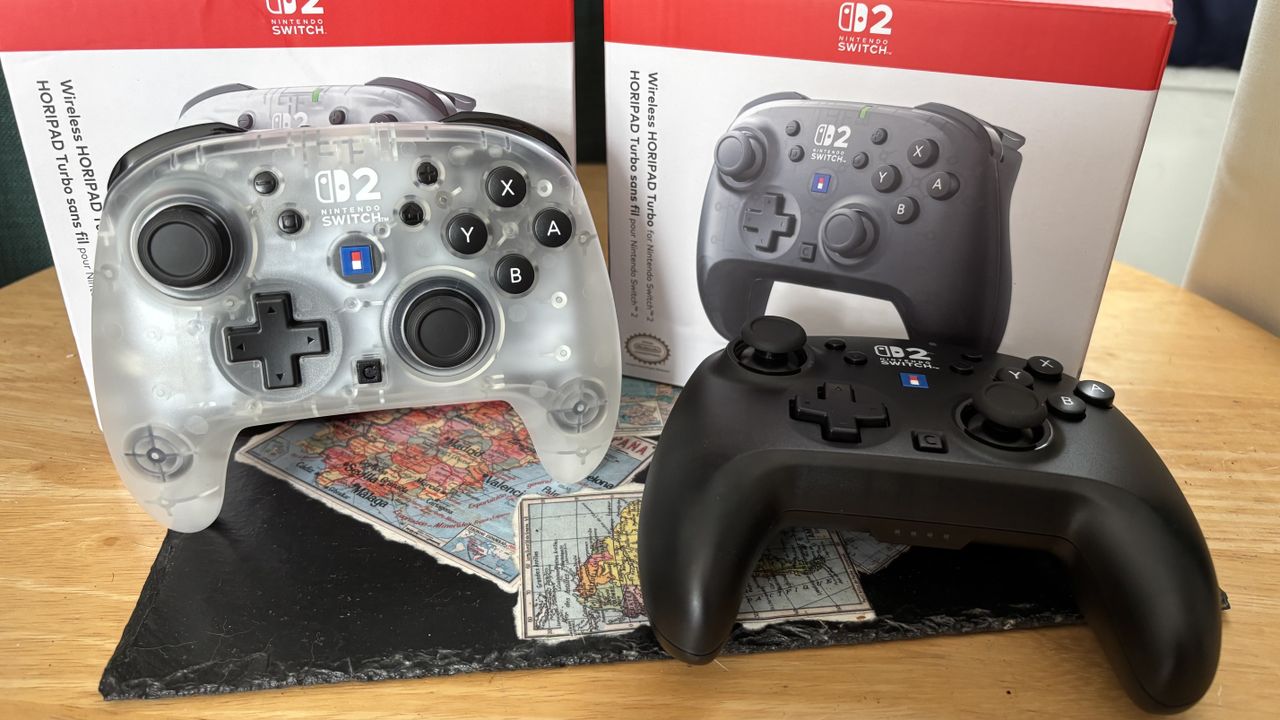
After I reviewed the frankly terrible Horipad for Steam, I didn't have high hopes for the Wireless Horipad Turbo. I've been rendered pleasantly surprised, as there is plenty to like about the brand's latest Nintendo-facing controller. There are a decent number of features for the price, and build quality is generally solid. It's just a shame that a few limitations and design quirks stop it short of an outright recommendation.
(Image credit: Future)
Let's frontload the review with the good, though. Hori has opted for anti-drift thumbsticks that feel great and ensure longevity. That's something the Wireless Horipad Turbo has over the Switch 2 Pro Controller, which utilizes traditional analog sticks and is thus more likely to develop stick drift over time.
Build quality is generally nice, too. While larger than the Pro Controller (and thus better suited to big adult hands), it feels solid enough, and a selection of colorways is always really nice to see.
I'm a fan of the feature set, too, with the Wireless Horipad Turbo offering a robust Turbo button option, as well as two remappable rear buttons and a button lock switch that disables utility buttons like Start, Select, Home, and Capture (for taking screenshots). There's even a GameChat button for quick access to social gaming sessions.
It's a shame, then, that the Wireless Horipad Turbo doesn't quite stick the landing in a few key areas. Battery life is paltry, falling well short of the Switch 2 Pro Controller's 40- to 50-hour gold standard. The d-pad and triggers, specifically, aren't the best—feeling incredibly mushy during play, which really isn't something you want for digital triggers in particular.
Lastly, a lack of PC compatibility means this is strictly a Nintendo Switch 2 controller. That's not necessarily a bad thing if that's solely what you're after (and it's likely a result of this being an officially licensed Nintendo product). But it does make it a less versatile controller than the likes of the 8BitDo Pro 3.
(Image credit: Future)
Wireless Horipad Turbo for Nintendo Switch 2: Price and availability
Costs $64.99 / £54.99 (around AU$93)
Available to buy now at Hori's store page, Amazon, or local retailers
Cheaper than the Switch 2 Pro Controller, and offers several colorways
The Wireless Horipad Turbo for Nintendo Switch 2 is available to buy now, and you've got options as to where you purchase it from. You can get it directly from Hori, Amazon, or local retailers based on your region, such as Best Buy in the US and Argos in the UK.
It'll run you $64.99 / £54.99 (around AU$93), which is a good deal cheaper than the Nintendo Switch 2 Pro Controller ($89.99 / £74.99 / AU$119.95). You'll also find a healthy amount of colorways to choose from. Hori sent me the standard Black and Frost variants for review, but there's also an Aqua model, as well as special liveries based on Nintendo properties like Kirby and Super Mario.
Wireless Horipad Turbo for Nintendo Switch 2: Specs
Wireless Horipad Turbo for Nintendo Switch 2
Price
$64.99 / £54.99 (around AU$93)
Weight
8.3oz / 235g
Dimensions
5.7 x 4.5 x 2.2in / 145 x 114 x 57mm
Compatibility
Nintendo Switch 2
Connection type
Wireless (Bluetooth)
Battery life
10 hours
Wireless Horipad Turbo for Nintendo Switch 2: Design and features
Eye-catching translucent design
Handy Turbo and button lock features
Generally solid build quality
One way for a controller to win me over is if it sports a translucent design. It's a style I'm happy to see come in vogue again over the last few years, at least when it comes to controllers, and it helps the Wireless Horipad Turbo for Nintendo Switch 2 really stand out. I'm a huge fan of the crystal-clear Frost colorway, especially.
It doesn't just win out in the looks department, though. Build quality is really solid here; a huge step up from the listless Horipad for Steam, which I reviewed prior to this. It's not as premium as the Nintendo Switch 2 Pro Controller, but the Wireless Horipad Turbo feels really solid and secure in the hands, with just the right amount of weight to it.
(Image credit: Future)
The titular 'Turbo' feature is niche; not everyone will find a use for it, but it's a nice-to-have for retro games or ones that require frequent, rapid button presses. Holding down the central Hori logo button in tandem with 'A' will then let you assign a button for the Turbo input. You can also press the Start and Select buttons to adjust the speed of the Turbo setting by three increments, too.
Another feature I quite like (but again, it is probably quite niche) is the button lock switch. It's off by default, but one setting completely disables the Hori, Home, and Capture buttons, while another turns those off in addition to Start and Select.
I know I've accidentally hit the Home button instead of Start more times than I care to admit on the Pro Controller, so this is a thoughtful addition. The button lock switch doesn't extend to the pair of remappable buttons on the rear, but you can just leave these unassigned if you prefer.
Wireless Horipad Turbo for Nintendo Switch 2: Performance
Performant TMR thumbsticks
Poor battery life
Weak-feeling triggers and mushy d-pad
Controllers that make use of TMR (that's tunneling magnetoresistance) thumbsticks are a dime a dozen in today's gaming hardware marketplace. It's more common to find them than not now, but this is the first time I've tested a Hori controller with TMR. And I'm glad the brand has opted for them with the Wireless Horipad Turbo. They feel fantastically smooth during play, and as it's a form of Hall effect technology, it should ensure the pad's longevity for years to come.
Otherwise, this is a fairly unremarkable but inoffensive controller purely from a play standpoint. It lacks things like HD Rumble, an NFC touchpoint for amiibo scanning, and 'press to wake' functionality for the console itself. However, as these are niceties reserved for Nintendo's own hardware, it's hard to leverage this as a complaint at Hori. The lack of a 3.5mm port for wired headphones does irk me, though, because wireless audio via Bluetooth on Switch 2 is shoddy at best.
I'm also not a big fan of the controller's d-pad. It feels rather mushy to press, which at worst can often lead to inputs very occasionally not registering. Much the same is true of the triggers, which are supposed to be digital, but kind of feel like they're made of sponge.
Thankfully, connectivity isn't an issue. The controller paired immediately to my Switch 2 console, and I never experienced dropouts or noticeable input delay. And that's for the best, as this is a wireless-first controller.
You can still plug in the controller via the included USB-C for charging purposes and carry on playing. And you might be doing that frequently, as the Wireless Horipad Turbo tops out at just 10 hours of charge. That's not much better than PlayStation's DualSense Wireless Controller, and falls well short of the Switch 2 Pro Controller's monster 40-hour battery life.
Lastly, it is unfortunate that the Wireless Horipad Turbo can't be used for PC gaming. The Switch 2 Pro Controller can't either, so I suspect this is a Nintendo-issued requirement, as the Turbo bears the company's seal of approval. It just means that it's not as versatile as third-party pads from the likes of 8BitDo and GameSir.
(Image credit: Future)
Should I buy the Wireless Horipad Turbo for Nintendo Switch 2?
Buy it if…
You want a performant Switch 2 controller that's built to last TMR sticks will ensure this controller's longevity, and as a result, it shouldn't fall victim to stick drift even after months or years of usage.
You don't have the budget for a Switch 2 Pro Controller The Wireless Horipad Turbo is significantly cheaper than the console's official gamepad option. And with nice colorways and some neat features, it's really not a bad fallback option.
Don’t buy it if…
You want beefier battery life At just 10 hours of charge, you'll be topping this thing up very frequently if you regularly play your Switch or Switch 2 in docked mode.
You want something multiplatform If you like to game on multiple devices away from your Switch or Switch 2 (like PC or mobile), you might want to look elsewhere as this is strictly a Nintendo-facing pad.
Also consider...
If the Wireless Horipad Turbo has a few too many issues for your liking, consider the following alternatives.
Wireless Horipad Turbo for Nintendo Switch 2
Nintendo Switch 2 Pro Controller
8BitDo Pro 3
Price
$64.99 / £54.99 (around AU$93)
$89.99 / £74.99 / AU$119.95
$59.99 / £40 (around AU$84)
Weight
8.3oz / 235g
8.3oz / 235g
8.5oz / 242g
Dimensions
5.7 x 4.5 x 2.2in / 145 x 114 x 57mm
5.8 x 4.1 x 2.4in / 148 x 105 x 60mm
6.1 x 3.9 x 2.6in / 154 x 101 x 65mm
Compatibility
Switch 2, Switch
Switch 2
Switch, Switch 2, PC, iOS, Android
Connection type
Wireless (Bluetooth)
Wireless (Bluetooth), Wired (USB Type-C)
Wireless (2.4GHz, Bluetooth), Wired (USB-C)
Battery life
10 hours
Around 40 hours
15-20 hours
Nintendo Switch 2 Pro Controller Still the premium standard on Switch 2 more than a year on from release. And it's little wonder; Nintendo's official pad has a luxurious feel, and is stuffed with features including HD Rumble, NFC, remappable buttons, and enviable battery life.
8BitDo Pro 3 My favorite Nintendo Switch 2 controller, and one that's very hard to argue with at its budget-friendly price point. Honestly, it does everything the Wireless Horipad Turbo does, but better, and more besides.
How I tested the Wireless Horipad Turbo for Nintendo Switch 2
Tested for one week
Tested on Nintendo Switch 2 with a variety of modern and retro titles
Used features like the Turbo functionality and button lock switch
For this review, I tested the Wireless Horipad Turbo for Nintendo Switch 2 on the console of the same name for about a week. I played a good mix of modern and old-school titles with the controller, including Star Fox, Street Fighter 6, Rhythm Heaven Groove, as well as Ridge Racer 64 and Super Mario 64 via Nintendo Switch Online's N64 library.
During testing, I made use of the Turbo functionality to enable easier, rapid button presses in classic titles like Metal Slug 3. Meanwhile, I went back and forth with the button lock switch, and I can confidently say it stopped me from accidentally backing out to the Home dashboard on a few occasions. I'd love to see this feature make a comeback for future Hori products.
What Surrounds Us takes its title literally. You play as a circle surrounding a hole in its middle - it looks like a donut with frosting. You work together with other sentient moving circles, sometimes helping them joyfully meet with others. And you traverse a large map that's composed entirely of, you guessed it, a series of circles. But the circles everywhere aren't just an artistic choice; they underscore the game's themes about working in connection with the environment and the things around us.
Despite the trippy design, What Surrounds Us has a familiar format. I kept feeling echoes of The Legend of Zelda as I trekked across three dist …
It's finally happening! Valve's long-awaited Steam Machine has landed at last, promising to bring gaming-PC-level performance to an ultra-compact console-style device ideal for couch gamers who want to dip their toes into PC gaming for the first time. This is Valve's second run at the console-style PC market, and the gaming giant seems a lot more committed this time around.
And... well, I'm not entirely underwhelmed by it, but it's also not overwhelmingly impressive. I guess you could say I'm distinctly whelmed by the Steam Machine; it's a lovingly crafted piece of hardware that arguably achieves what it sets out to do, but falls down in two extremely important areas.
As you might have already guessed, those areas are performance and pricing. At the default 1080p resolution, it's a capable little machine that should be able to give you a good gaming experience with minimal fuss, but anyone expecting beefy 4K performance on par with the existing slate of top-tier home consoles is going to be disappointed.
Of course, this boils down to what sort of games you want to play. If you've got a 4K TV in your living room and want a compact PC specifically so you can enjoy older games, or the sort of indie game experiences that aren't so freely available on consoles – I'm talking the low-budget viral titles that so frequently dominate TikTok and Instagram Reels – then the Steam Machine might actually be an excellent choice.
Another key aspect of Valve's new console-PC hybrid is SteamOS, the recently updated operating system designed to provide a more console-like experience than conventional platforms like Windows and macOS. It's already available for anyone to put on their own PC, and of course powers Valve's own Steam Deck handheld. In a break from tradition for PC reviews, I've added an extra section to this review to specifically discuss SteamOS, but for now all I'll say is that it gets the job done well.
(Image credit: Future)
Moving on to pricing, it's painfully clear that the ongoing RAM crisis has taken a toll on the Steam Machine's value proposition. Starting at $1,049 / £879 / AU$1,609, it's a fair bit more costly than the PS5 Pro, which my esteemed colleague Rob Dwiar already noted was "too expensive" for the average gamer in his review here on TechRadar - and that was before Sony hiked the price of its home consoles earlier this year.
Considering that the Steam Machine was widely expected to represent an accessible path into the world of PC gaming for those who have previously not ventured beyond the confines of the console market, that price tag is sure to upset some gamers who were eagerly awaiting Valve's return to the console market. Hell, you might even be better off building your own Steam Machine killer.
But it's important to remember that the Steam Machine was probably never going to live up to the price-to-performance ratio of modern home consoles like the PS5 and Xbox Series X, even though it is ostensibly using newer, better hardware. This is due to the game development process and how developers implement platform optimization; if you're making a game for PS5, you're just making a game for PS5. You'll have to take the Pro model's specs into account now too, but at the end of the day you only need to optimize your game's performance for a specific set of hardware components with clearly defined limitations.
On the other hand, optimizing a game for PC means optimizing it for the uncountable millions of possible hardware configurations that exist across pre-built and custom gaming PCs, plus every gaming laptop on the market, plus handheld gaming PCs, and now plus the Steam Machine. It's a wildly different ballgame, and while some developers might skimp on good PC optimization, it's borderline impossible to get a game running consistently well on PC versus a specific console.
Does this entirely excuse the lackluster bang for your buck the Steam Machine offers? No, probably not. It's a mitigating factor that I have taken into account for this review – but quite frankly, I think Valve's second attempt at bringing PC gaming to the masses has slightly missed the mark.
Valve Steam Machine review: Price & availability
(Image credit: Future)
Starts at $1,049 / £879 / AU$1,609
Available now in the US, UK, and Australia
Steam Controller can be added as a bundle
As I mentioned already, the Steam Machine starts at a rather steep $1,049 / £879 / AU$1,609, which gets you the standard configuration with no controller and 512GB of high-speed SSD storage. The actual performance spec doesn't change if you upgrade to the 2TB SSD model for $1,349 / £1,149 / AU$2,109, so you're essentially just paying for the extra storage – and even by current component pricing standards, that's an expensive upgrade.
Whether you pick the 512GB or 2TB model – and despite the price, I'd definitely recommend the latter if you play triple-A PC games, since install sizes have become frighteningly bloated as of late – you get the same semi-custom AMD Zen 4 CPU and discrete AMD RDNA 3 GPU, along with 16GB of RAM and a separate 8GB of GDDR6 VRAM.
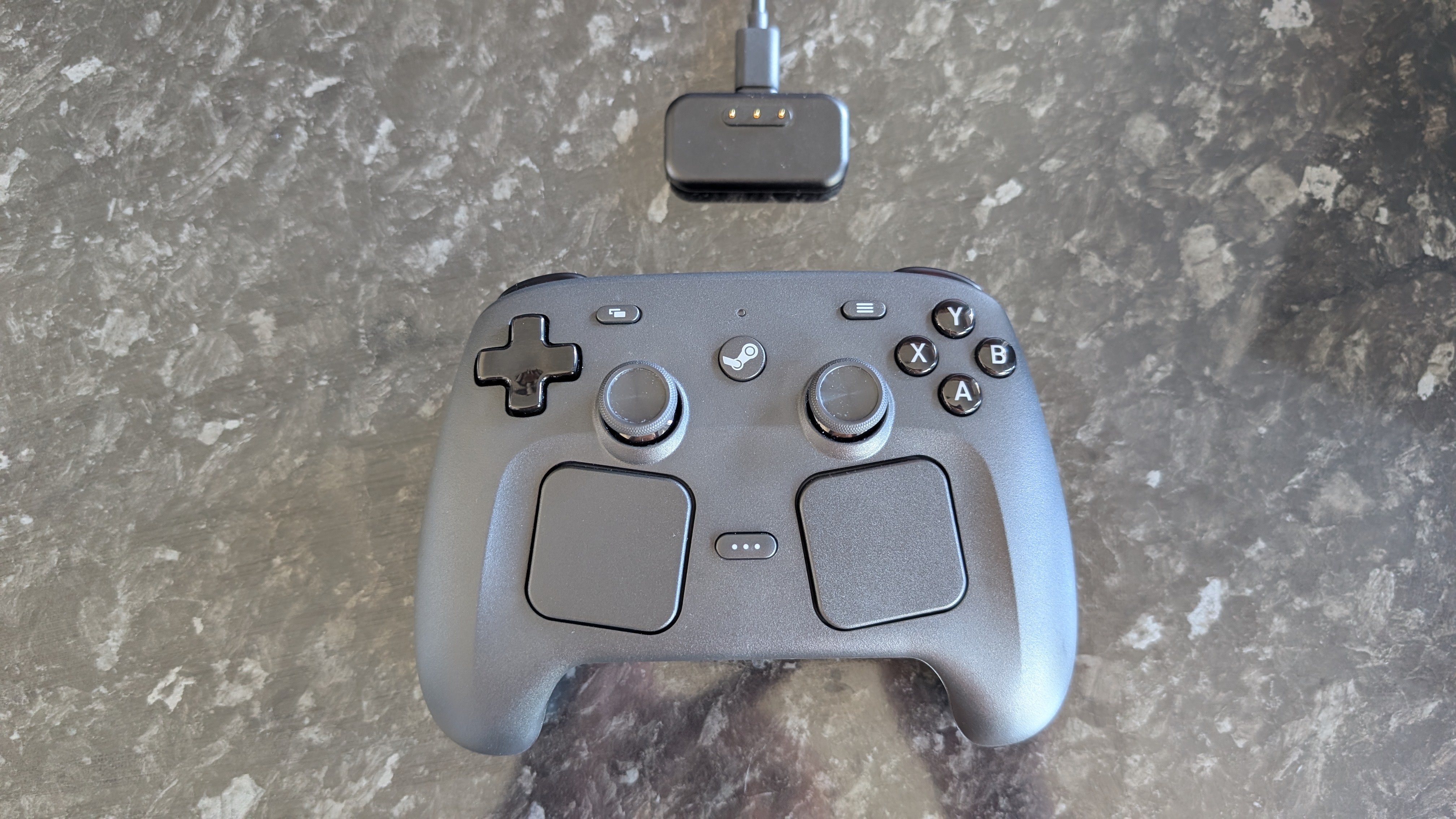
Both models can also be bundled with Valve's Steam Controller (which also comes with a charging 'puck' and USB cable), which adds $79 / £59 / AU$119 to the base price of either model. This is actually a pretty decent add-on, since the Steam Controller is a genuinely good gamepad and normally costs $99 / £85 / AU$149 direct from Valve if you buy it separately. Unless you already own one of the best PC controllers, I'd strongly recommend getting the bundle.
It's also worth noting that pre-orders for the Steam Machine sold out almost immediately, so if you want to get your hands on one, you'll have to sign up for the waitlist directly through Steam.
Somewhat limited port selection compared to most PCs
For a product that I found a little disappointing overall, I have to say that I have very little to criticize when it comes to the physical design of the Steam Machine.
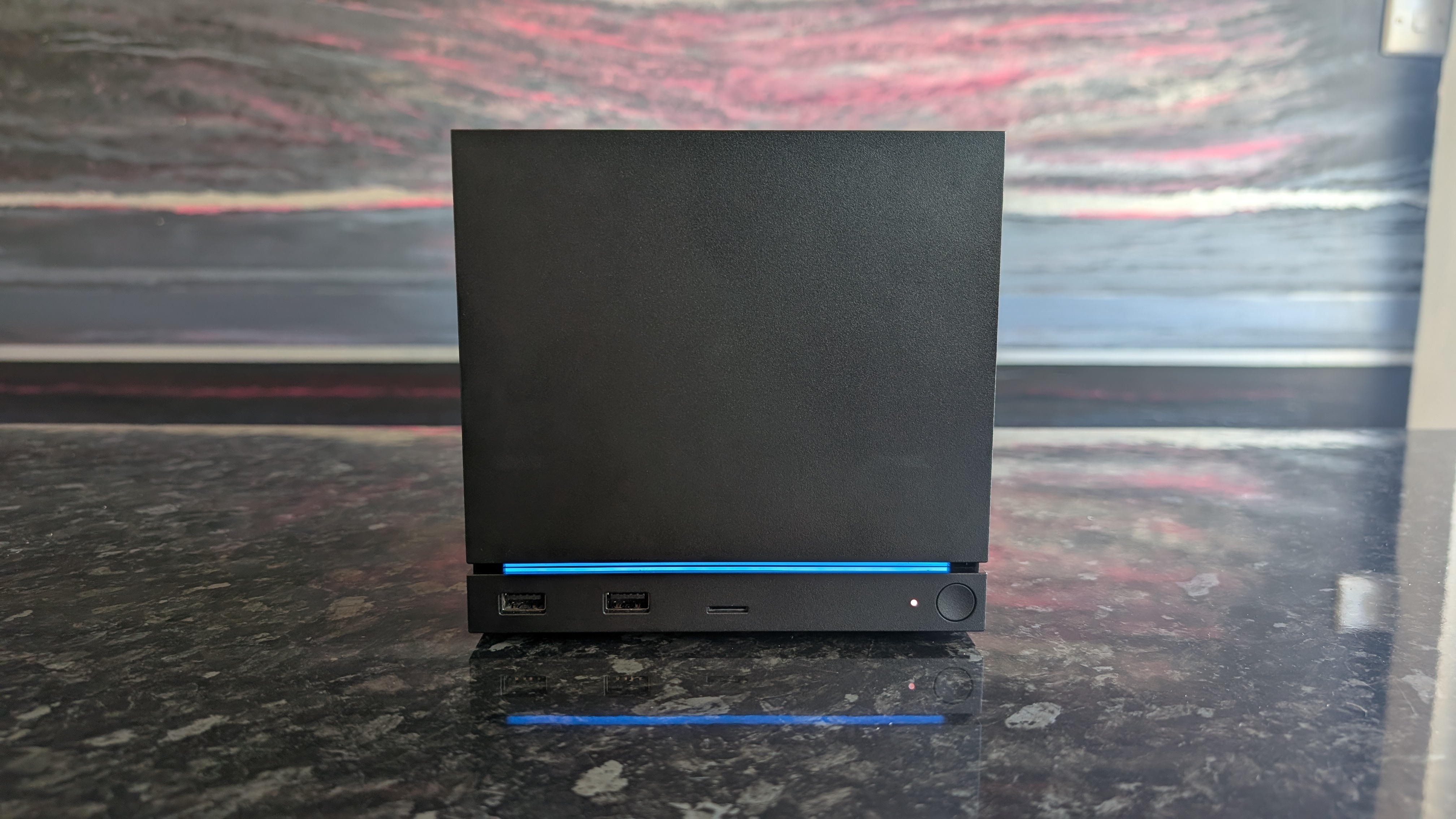
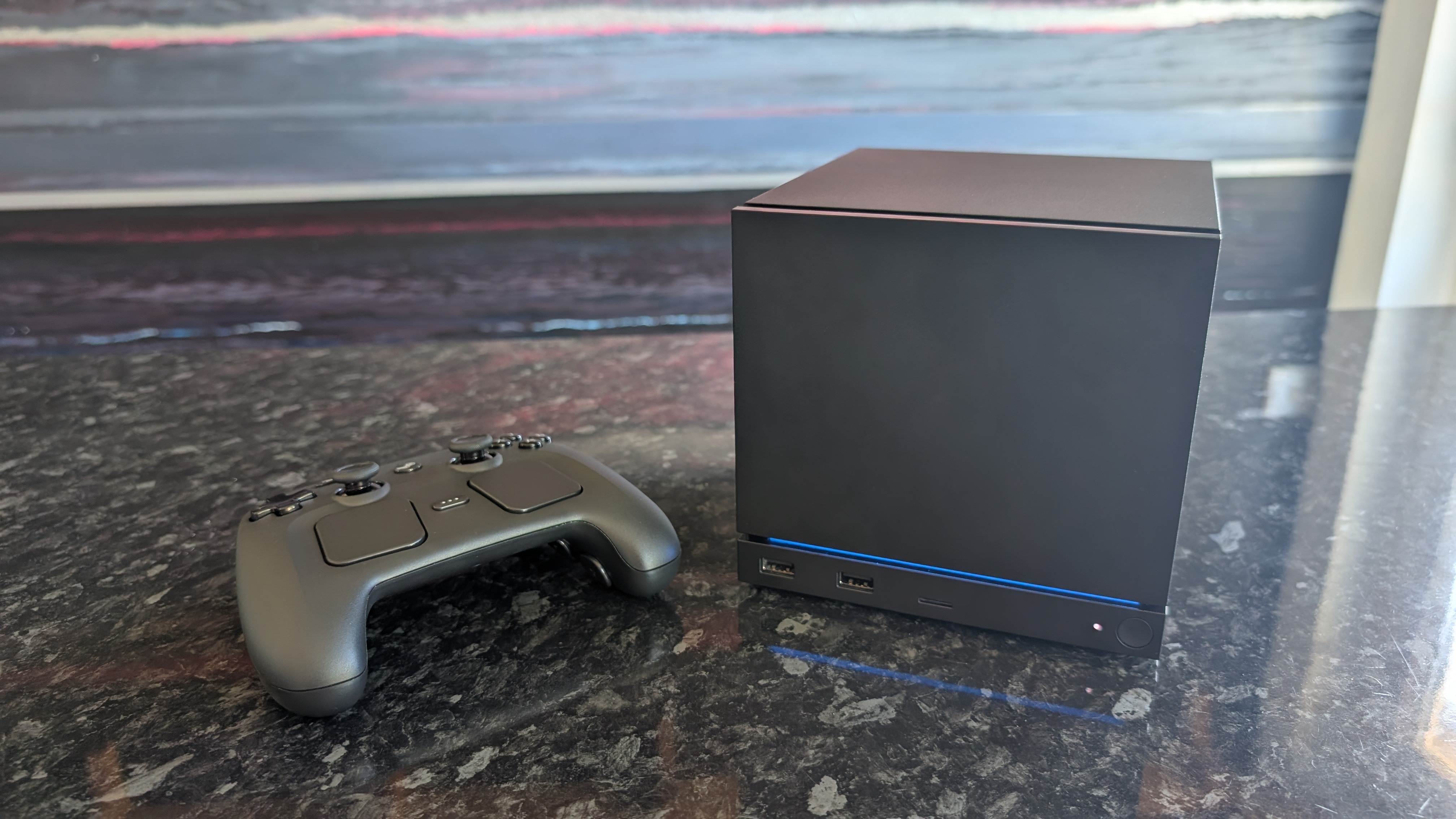
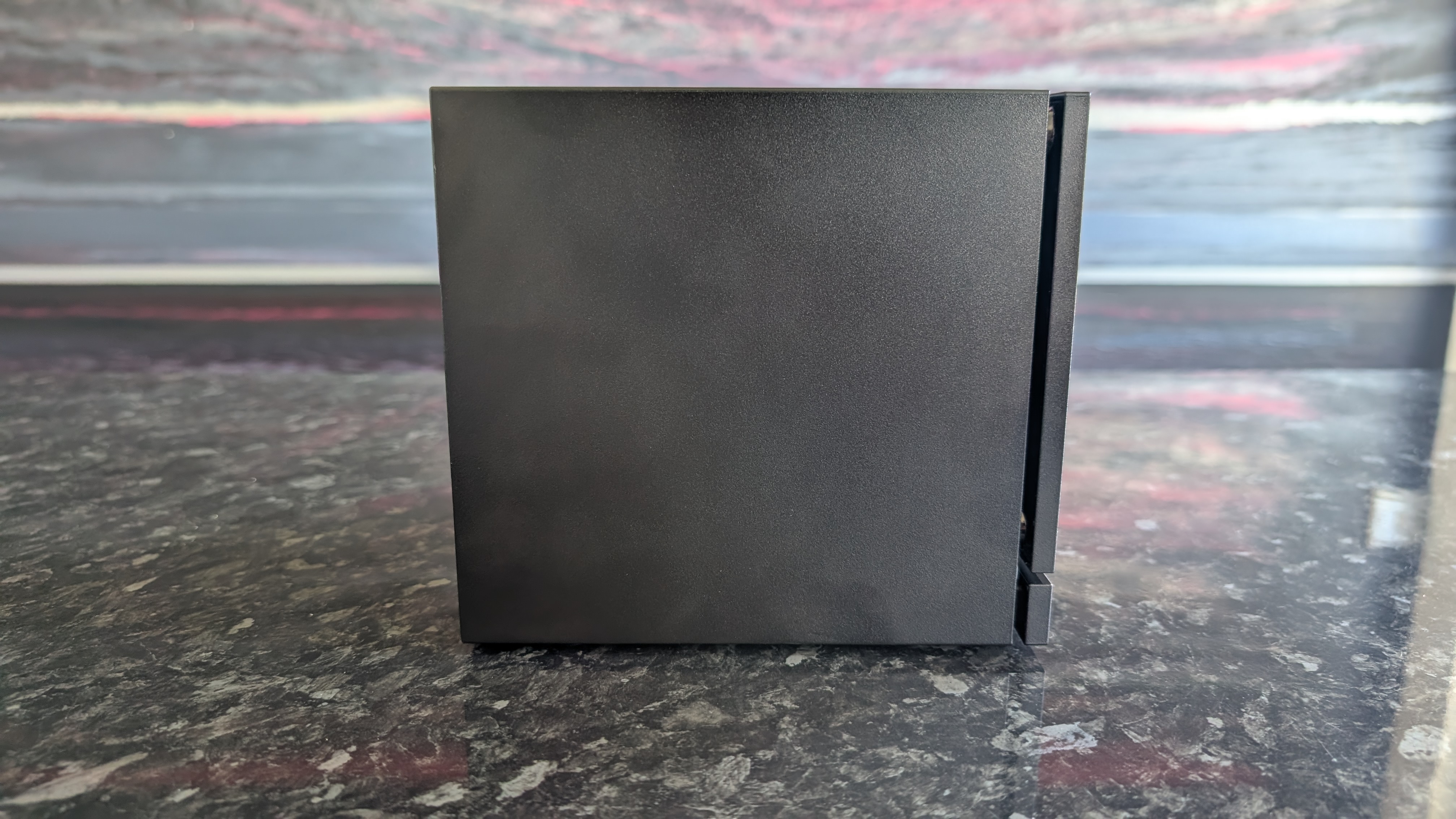
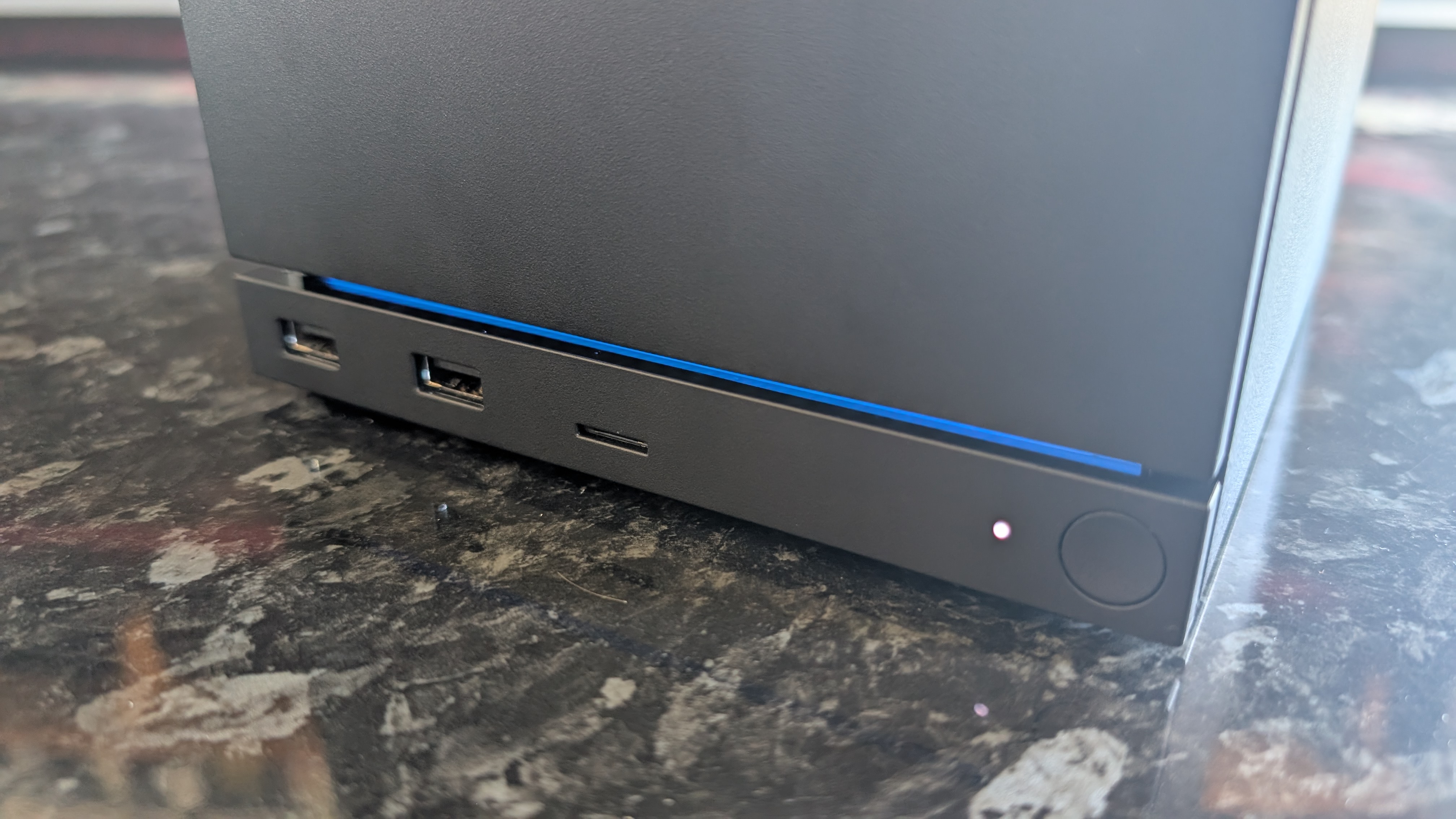
Simply put, it looks great. The whole unit is a neat black cube of matte metal measuring roughly six inches along each edge and weighing a little under six pounds, with a thin indentation near the base on the front side, inside which nestles a bright LED lightbar. Beneath this, there's a power button with an additional LED (which stays illuminated while the Steam Machine is in sleep mode) along with two USB-A ports and a microSD card slot for easily adding extra storage. The cube sits atop four small rubber feet, which feel quite durable.
The 17-LED lightbar is more than just a simple power indicator, which I quite like. If your Steam Machine is downloading a game, it 'fills' from left to right to indicate the download's progress, and you can customize it with extra colors and functions in SteamOS too.
(Image credit: Future)
It's significantly smaller than any current-gen home console and the vast majority of pre-built gaming PCs, and certainly a lot smaller than any custom desktop PC the average system-builder could assemble - you'd need to be seriously confident with graphics card disassembly and custom cooling to even get close to something this small.
In fact, it's immediately reminiscent of the Nintendo GameCube I treasured in my teenage years, though I promise I haven't let nostalgia cloud my opinion here. The closest you're likely to get to this sort of compact gaming PC now is probably the Asus ROG NUC that I personally reviewed last year - and while that offers far superior performance, it's also so eye-wateringly expensive that it makes the Steam Machine look cheap.
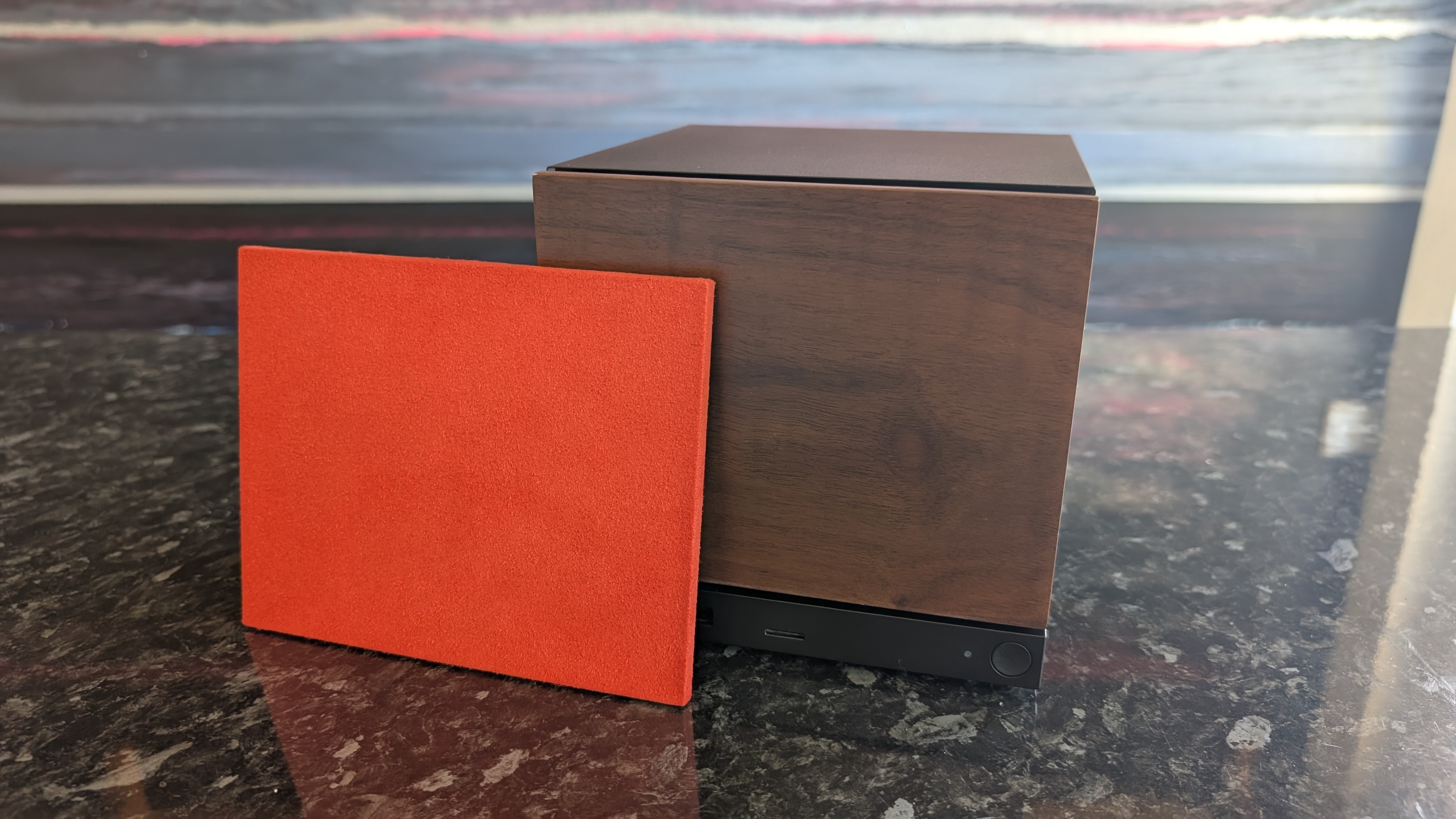
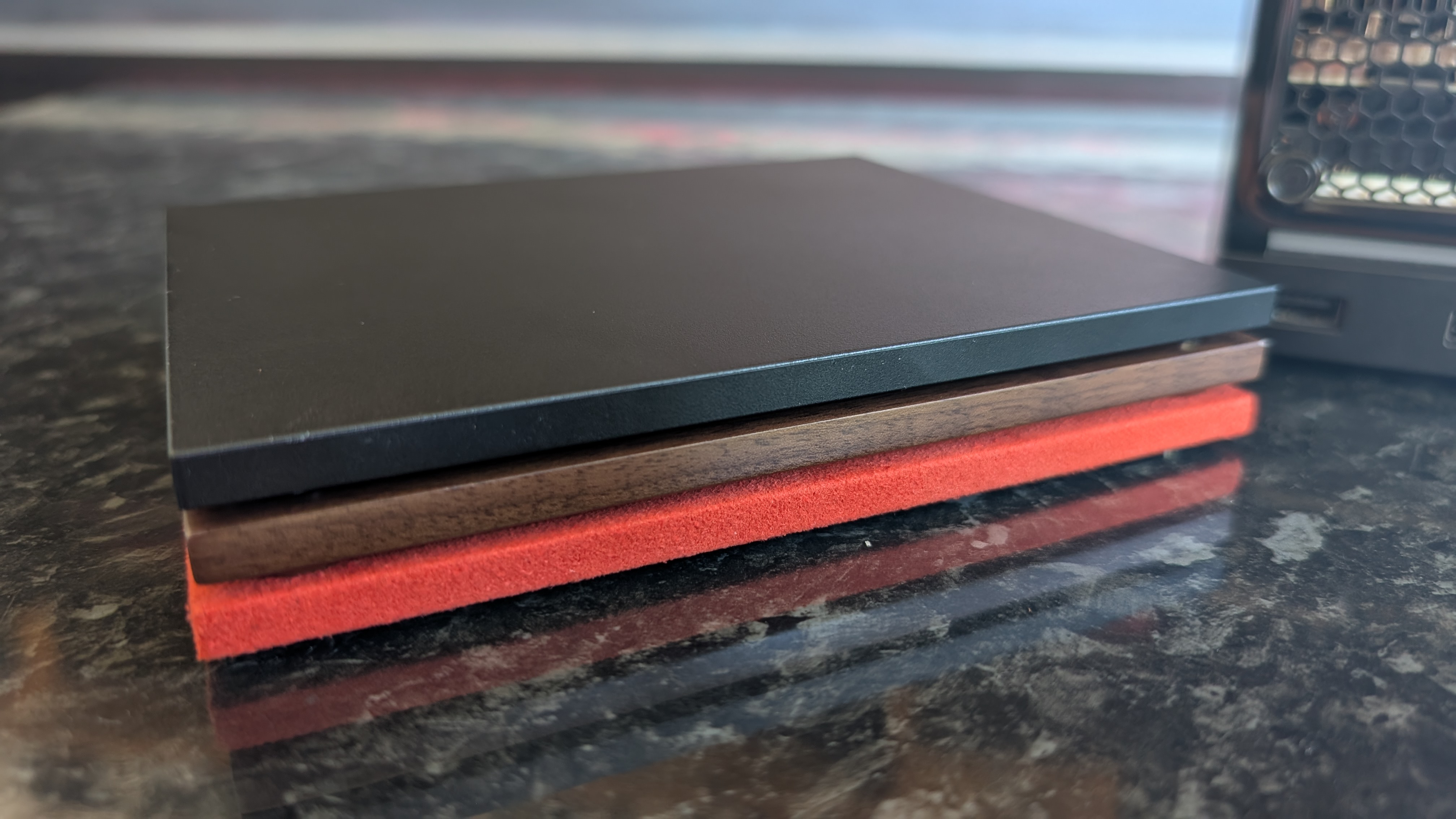
The front panel is removable and can be easily swapped out with magnetic faceplates. If you spring for the 2TB model, you get two of these included: a red felt fabric one and a rather nice wood-effect one that matches my TV stand perfectly... it looks right at home there, actually. Wink wink, nudge nudge, Valve.
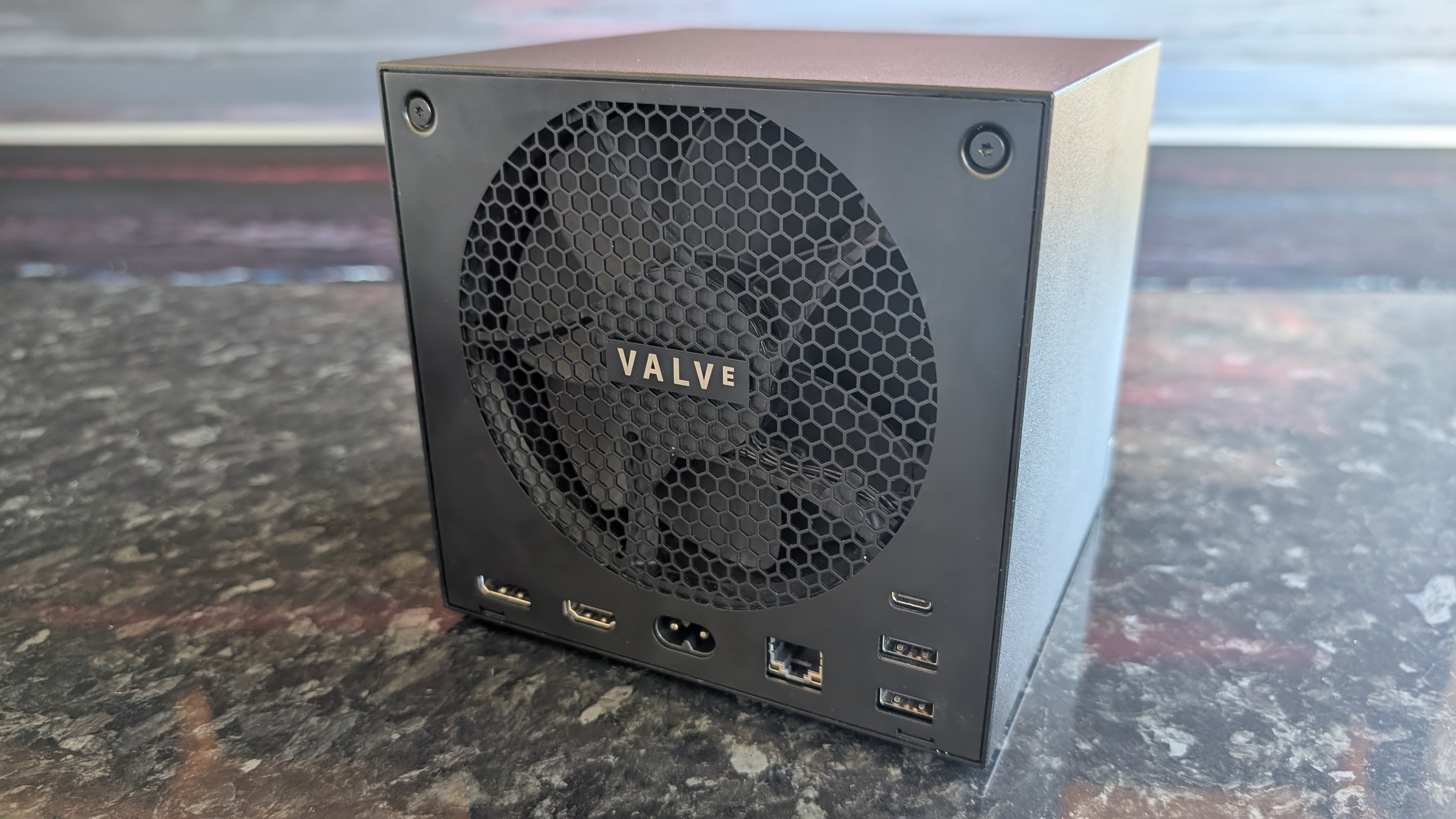
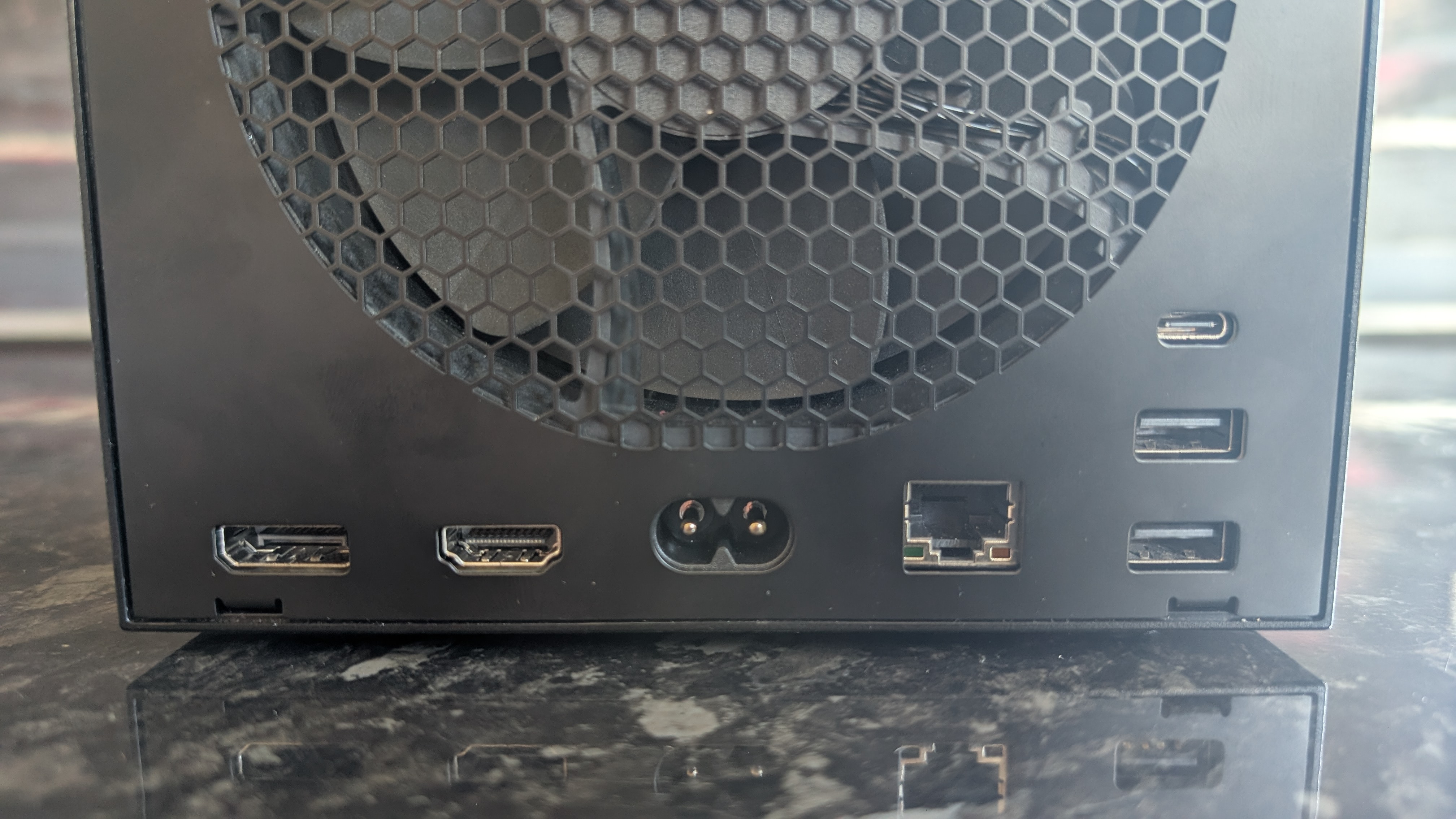
The power supply is (somehow) built into the breathtakingly compact chassis, meaning there's no chunky adapter brick here either - just a regular cable with a two-pin power connector. This is included in the box, along with an HDMI cable (though the rear I/O also features a DisplayPort 1.4 output, which may be preferable if you're connecting it to a desktop monitor rather than a TV).
(Image credit: Future)
That rear I/O is where you'll find the rest of the ports: the aforementioned HDMI and DisplayPort, along with an RJ-45 Ethernet port, two USB-As, and one USB-C. I'll confess that as a fan of physical connectivity, I find this port selection a little lacking, but it's realistically going to be plenty for the target audience of the Steam Machine. It might be less than a fully-fledged desktop PC, but it's comparable to any modern home console. Wireless connectivity uses Wi-Fi 6E and Bluetooth 5.3 – I would've liked to see Wi-Fi 7 here, but it's not a dealbreaker.
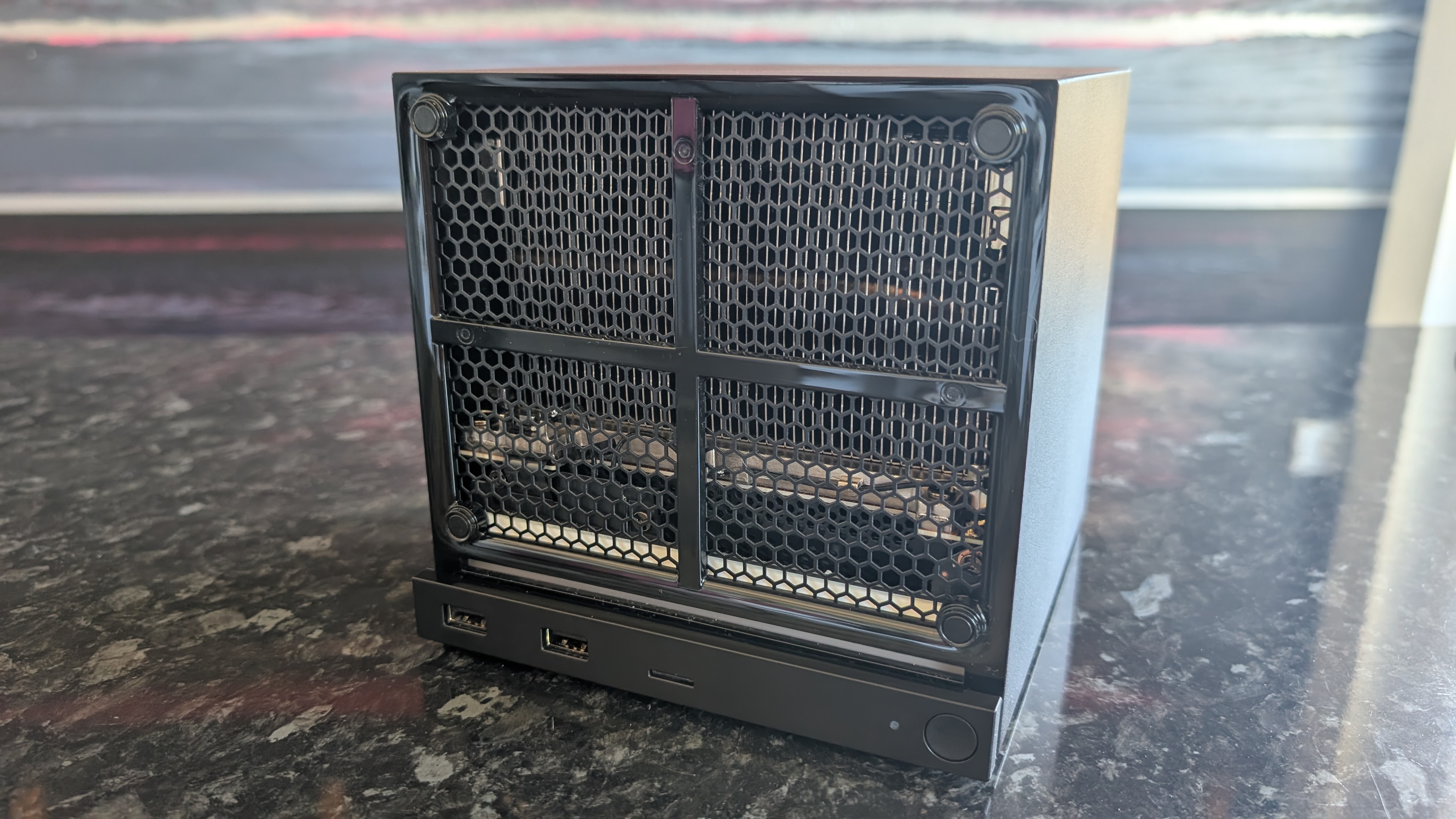
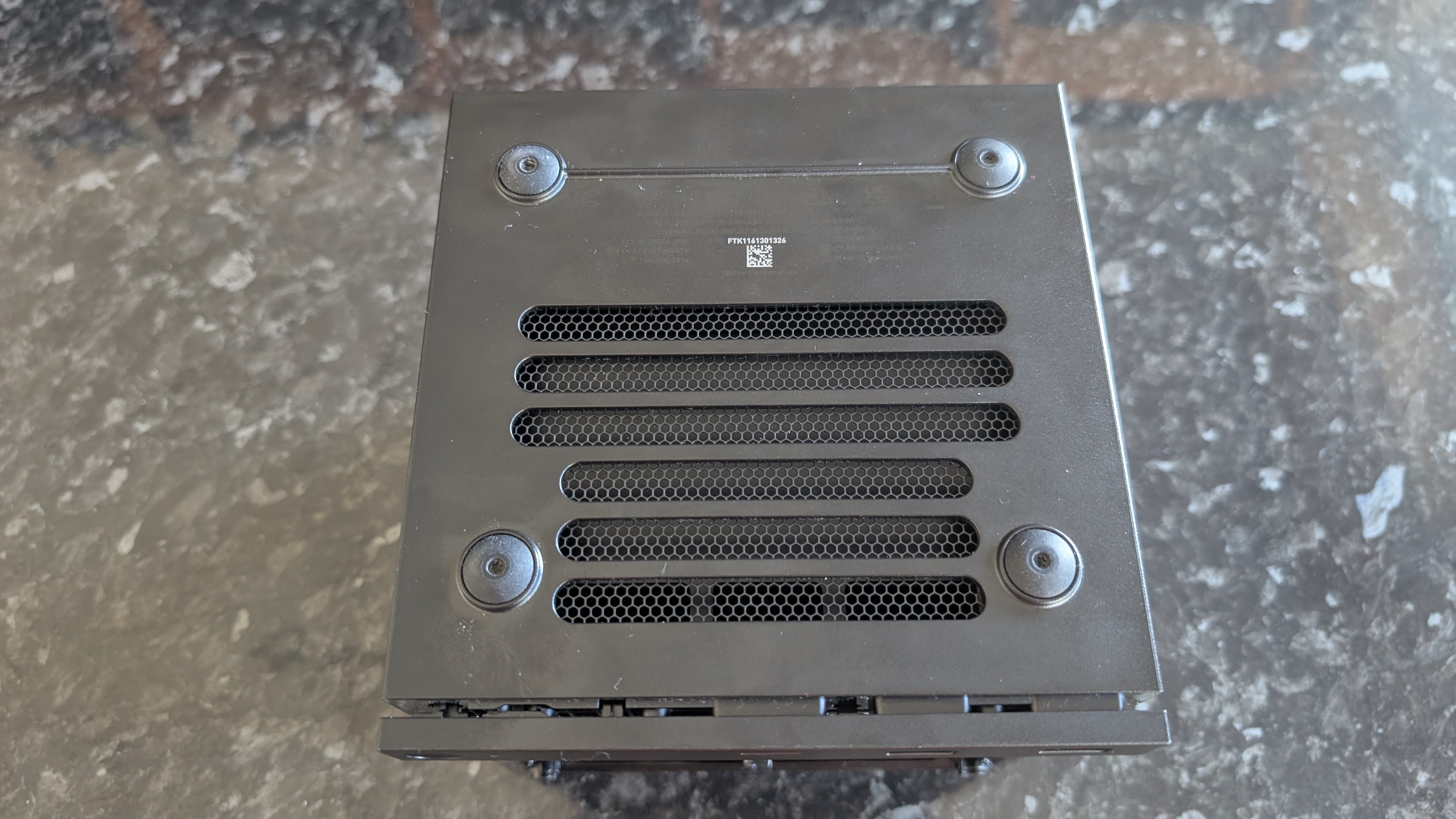
The internals are very tidy, with a large air intake grille behind the magnetic faceplate behind which sits the mainboard. A single large upright fan draws air through and out of the rear exhaust. This is (surprisingly) an upgradable system, though it's more along the lines of a gaming laptop than the average desktop PC; you can swap out the M.2 SSD and the RAM, but that's it.
(Image credit: Future)
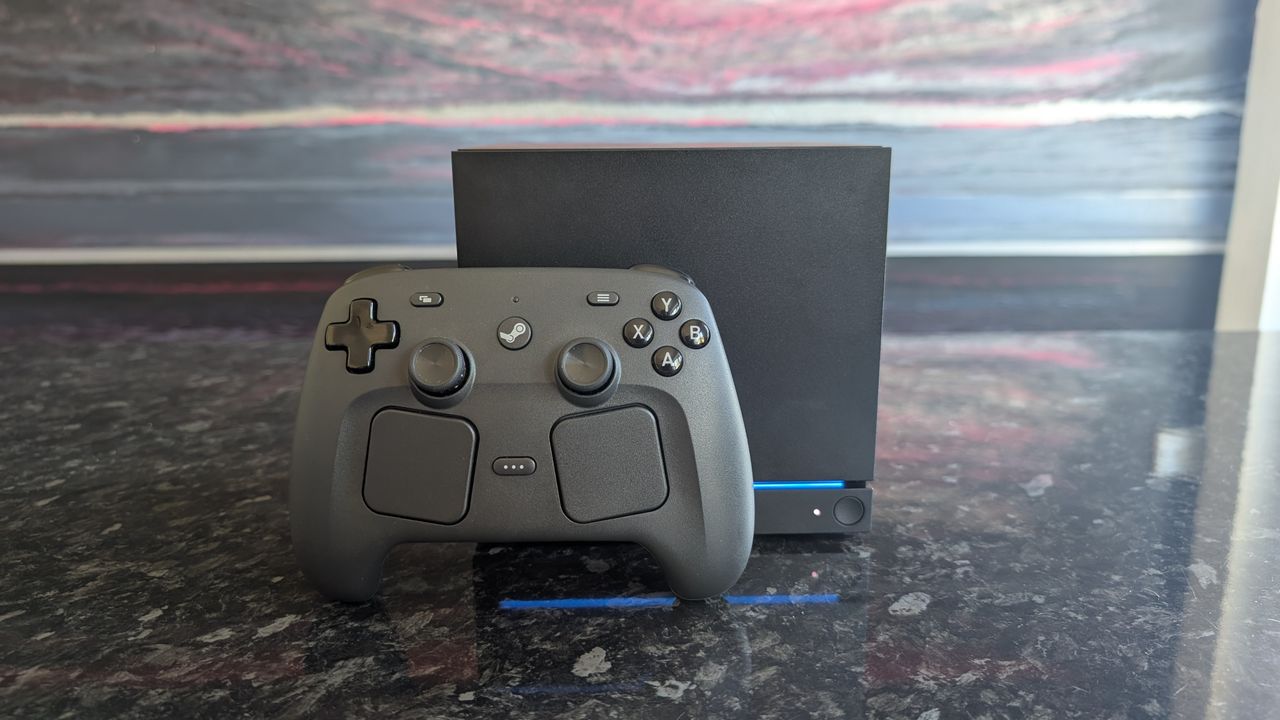
Lastly, I'll briefly touch on the new Steam Controller. We reviewed it separately here, so I won't go into too much detail, but it's certainly good (if overpriced, like the Steam Machine itself). Pairing the pad and the 'puck' that doubles as a wireless transmitter and charging dock is a seamless process, and the controller itself feels good to use in games. The lack of an audio jack, as seen on other mainline console controllers, is a bit of a shame, however.
I have to admit that I really, genuinely love the design of the Steam Machine. My only real criticism here (and the only thing stopping me from giving it a perfect score in this section) is that it only has one single USB-C port, and it's on the rear. This is a minor gripe, though; for the most part, this is a very well-designed piece of hardware.
Design: 4.5 / 5
Valve Steam Machine review: Performance
(Image credit: Future)
Strong gaming performance at 1080p
Cracks start to show at 1440p; falls apart completely at 4K
No resolution upscaling or frame generation modes are used unless otherwise specified.
Benchmarking the Steam Machine was... interesting, to say the least. I had hoped to mostly stick to our usual suite of tests used for benchmarking the best gaming PCs and best gaming laptops, but the vast majority of those systems are running on Windows 10 or 11. SteamOS, while a very solid platform these days, simply doesn't have the same degree of flexibility as Microsoft's flagship operating system.
For starters, the Steam Machine locks itself to a maximum framerate based on the refresh rate of the monitor it's connected to, which meant I had to seek out a different high-refresh-rate display to get accurate results. Notably, the Steam Deck does something similar with its built-in 60/90Hz screen, so I suspect that this is a SteamOS quirk rather than any hardware-imposed limitation, but I wasn't able to find any way to disable it.
Then I got to the compatibility issues. Half the tests we usually run (most pertinently Geekbench and 3DMark) simply can't be installed and run natively in SteamOS's default Big Picture Mode, so I had to cut down my testing selection fairly significantly. To compensate (and to provide a better idea of how well the Steam Machine can actually handle gaming), I expanded my gaming tests to include more graphical configurations than usual.
Furthermore, you have to dig into the settings of SteamOS itself to uncap the resolution, which is set to FHD 1080p by default. Eagle-eyed gamers clocked prior to the Steam Machine's release that Valve had quietly lowered expectations by adjusting the language used in the product's store page from "4K gaming at 60 FPS" to "Up to 4K gaming with FSR", crushing hopes that it would be a true competitor to the likes of the PS5 Pro. Clearly, 1080p is the ideal target, which will no doubt be a disappointment for some potential customers.
(Image credit: Future)
Anyway, let's talk about the actual performance. At 1080p with graphical settings maxed out, the Steam Machine can handle almost anything you throw at it; the discrete semi-custom AMD RDNA 3 GPU inside this little black box was able to crack 60fps in most games I tested at FHD resolution (sometimes requiring the use of AMD's FSR upscaling tech, though this had virtually zero impact on visual fidelity), with the exception of titles that use ray tracing.
With ray tracing turned off, you'll be fine; turn it on, and you can expect framerates to tank even if you also switch on FSR. Cyberpunk 2077 looked and played great at 1080p Ultra settings with no upscaling, but switching to the Ray Tracing Ultra preset (with AMD FSR 3 set to Balanced) saw my average framerate drop to a little over 30 in the built-in benchmark, while actual in-game performance was even choppier.
Annoyingly, some games don't seem to properly support the most recent version of FSR on SteamOS; while I've been able to use it in games like Civilization VII and Shadow of the Tomb Raider while testing Windows-based gaming laptops and PCs, FSR 3 was conspicuously absent from the settings menu of both games on the Steam Machine - Civilization would only let me select FSR 1, while Shadow had no upscaling options available at all.
(Image credit: Future)
Once I started to crank things up to 1440p and 4K resolution, though, the cracks started to show. Older titles (and 2D games, like my current obsession, Slay the Spire 2) largely run fine at higher resolutions - but unfortunately, I could probably say the same about any home console and plenty of cheaper desktop PCs.
Modern triple-A games start to struggle a little at 1440p, but remain playable provided you're willing to tone down the settings a bit. I've only included the full suite of 1080p and 4K results in the results box above, but to give you a few quick examples: Cyberpunk 2077 remained playable with an average framerate of 68fps at 1440p Ultra with FSR 3 set to balanced (no ray tracing), while Total War: Warhammer III dropped to 45fps at Ultra - but could be salvaged to a stable 63fps with the Medium graphical preset.
At 4K, don't expect to be playing the latest hit games at high framerates; at least, not without some very significant graphical tweaks. The now eight-year-old Shadow of the Tomb Raider was the only game I tested that made it above 60fps at 4K resolution, and that was with the graphical settings turned down significantly.
As for more demanding titles, just don't bother. Total War: Warhammer III barely made it above a 30fps average at Low settings, with frequent drops into sub-30 territory, while Cyberpunk 2077 gave abysmal benchmarking at anything above the lowest possible graphical settings, even with FSR upscaling turned on, and struggled heavily to maintain a consistent framerate during actual gameplay. Turning on FSR frame generation did technically give a stable 30fps at 4K Ultra, but with the added issue of some visual tearing and artifacting, especially during busy scenes.
(Image credit: Future)
I also experienced a small number of crashes during my testing process, specifically in Total War: Warhammer III and Marathon. It's possible that these were merely down to game instability rather than any specific fault with the Steam Machine or SteamOS (I've personally had Marathon crash at least once on my Windows 10 gaming desktop), so I won't mark it down for this, but I've opted to include it for the sake of comprehensiveness.
Lastly, I'd like to briefly discuss the thermal performance of the Steam Machine, which is a shining beacon amidst the otherwise fairly underwhelming overall performance. The large cooling fan at the rear of this little cube was whisper-quiet throughout all my testing, and the casing barely got more than a little warm. Whatever thermal wizardry Valve pulled off here, it clearly works.
Performance: 3 / 5
Valve Steam Machine review: SteamOS
SteamOS 3 is a very solid operating system
Accessible for newcomers, but still packs advanced features
Optional Linux desktop mode
A bonus section appears! Yes, I'm going to take a moment here to discuss SteamOS, since it's arguably the linchpin of the Steam Machine's whole 'console rival' mission statement. Does it really make PC gaming more accessible? I'm pleased to say yes, it certainly does.
An Arch Linux-based operating system, SteamOS is now in its third main iteration, and it's improved greatly from its humble beginnings as the full-screen version of the Steam desktop app. It's easy to set up and offers a pleasingly straightforward interface that even a gaming rookie should be able to navigate, while also packing the full suite of settings found in the Windows desktop version of Steam.
One nifty feature is the optional Linux desktop mode. It's quite effective, if basic, letting you install Linux-compatible programs like LibreOffice and the Firefox browser. It's neat, but it's a feature that will likely only be used by a small subset of buyers since it doesn't really offer anything for pure gaming users.
(Image credit: Future)
Naturally, you can connect a keyboard and mouse as well as a controller, which is useful for games where typing is necessary, but it turned out to be even more vital. I wasn't actually able to complete the SteamOS setup without first connecting a mouse to select the system language, and when playing some other games after my initial benchmarking process, I found that I couldn't complete the initial setup for Forza Horizon 5 using just the Steam Controller, which was annoying.
As effective as SteamOS is, compatibility issues are an inevitability when dealing with a Linux-based system. While the vast majority of games on Steam are fully compatible, there will be specific outliers, and there are plenty of non-gaming programs that aren't available. And of course, you can't play games from other storefronts like Epic and GOG, unless you decide to go the whole hog and install Windows 11 on it instead - which is an option!
Should I buy the Valve Steam Machine?
Valve Steam Machine: Scorecard
Attributes
Notes
Rating
Value
The Steam Machine is an expensive product for the specs and experience it offers, to the point where it struggles to compete with mainstream home consoles.
2.5 / 5
Design
A durable, high-quality chassis with an impressively compact design. The port selection is decent for a console-style device, and the swappable faceplates add a bit of visual flair.
4.5 / 5
Performance
1080p performance is great, but triple-A games start to struggle at 1440p and 4K. Considering the price, the gaming quality is decidedly lackluster, and you may encounter some compatibility issues with SteamOS.
3 / 5
Total Score
I really want to love the Steam Machine, and it arguably achieves its goal of competing with living room consoles, but the asking price is just a bit too high for what it offers.
3.33 / 5
Buy the Valve Steam Machine if…
You want living-room PC gaming The compact design and straightforward functionality of the Steam Machine make it great for a couch gaming setup.
You're looking to make the jump to PC gaming Want to ditch your PS5 in the wake of Sony's new digital-only game policy? The Steam Machine offers a very accessible way to enter the PC gaming space without the complexities of PC-building.
Don't buy it if…
You're on a budget While you could easily spend a lot more on a compact gaming PC, the price of the Steam Machine is unfortunately a little too high to be appealing.
You want to play games from multiple storefronts The best experience you'll get here is by sticking with SteamOS, but that will lock you out of playing games from other storefronts like Epic and Prime Gaming.View Deal
Valve Steam Machine review: Also consider
Alienware Aurora It's a bit more expensive than the Steam Machine, but if you want a pre-built gaming PC that can comfortably tackle 1440p and potentially even 4K gaming, the more affordable configurations of the Alienware Aurora are a solid choice. Read our full Alienware Aurora review.
Asus ROG NUC If money is no object, the latest Asus ROG NUC gaming PC is unquestionably the one to pick if you want a compact system for a living-room gaming setup. This NUC probably has the best performance-to-size ratio of any gaming PC on the market right now. Read our full Asus ROG NUC review.
How I tested the Valve Steam Machine
(Image credit: Future)
Ran multiple PC game benchmarks
Connected to my TV to use for 'couch gaming'
8+ years of experience reviewing dozens of laptops and PCs
My review process for the Steam Machine was a little different from how I'd usually approach a gaming PC or laptop review, due largely to SteamOS's Big Picture Mode not supporting our non-gaming tests.
Still, I ran the Machine through all the usual gaming tests, then took it downstairs to my living room and set it up on my TV stand to use it for some good old-fashioned couch gaming. As someone who was raised on Nintendo consoles but made the jump to PC gaming in my teens, I was keen to get the full intended experience out of the Steam Machine.
In addition to our usual game tests, I played a bunch of other games over a full weekend spent rigorously testing (read: having lots of fun with) the Steam Machine. These included Marathon, Warframe, Ratchet & Clank: Rift Apart, and the frighteningly addictive Slay the Spire 2.
I've been testing and reviewing computer hardware for almost a decade, and I've been a gamer for much longer than that. Before joining the TechRadar team, I worked at the PC-building hobbyist magazine Maximum PC, so you can trust that I'm putting every ounce of knowledge and experience at my disposal into bringing you high-quality, insightful, and non-biased reviews.
A new NYT Connections puzzle appears at midnight each day for your time zone – which means that some people are always playing 'today's game' while others are playing 'yesterday's'. If you're looking for Friday's puzzle instead then click here: NYT Connections hints and answers for Friday, July 24 (game #1139).
Good morning! Let's play Connections, the NYT's clever word game that challenges you to group answers in various categories. It can be tough, so read on if you need Connections hints.
What should you do once you've finished? Why, play some more word games of course. I've also got daily Strands hints and answers and Quordle hints and answers articles if you need help for those too, while Marc's Wordle today page covers the original viral word game.
SPOILER WARNING: Information about NYT Connections today is below, so don't read on if you don't want to know the answers.
NYT Connections today (game #1140) - today's words
(Image credit: New York Times)
Today's NYT Connections words are…
STEAK
LEONE
PRIMO
MALL
MADRE
MIST
POKER
CHOKE
CLUB
RAND
TEAR
NAIRA
HIJO
KWANZA
WELL
ABUELA
NYT Connections today (game #1140) - hint #1 - group hints
What are some clues for today's NYT Connections groups?
YELLOW: Family members in another language
GREEN: Sob
BLUE: Money on the second largest continent
PURPLE: Begin with a word that rhymes with “dip”
Need more clues?
We're firmly in spoiler territory now, but read on if you want to know what the four theme answers are for today's NYT Connections puzzles…
NYT Connections today (game #1140) - hint #2 - group answers
What are the answers for today's NYT Connections groups?
YELLOW: SPANISH RELATIVES
GREEN: START TO CRY, WITH "UP"
BLUE: AFRICAN CURRENCIES
PURPLE: STRIP____
Right, the answers are below, so DO NOT SCROLL ANY FURTHER IF YOU DON'T WANT TO SEE THEM.
NYT Connections today (game #1140) - the answers
(Image credit: New York Times)
The answers to today's Connections, game #1140, are…
YELLOW: SPANISH RELATIVES: ABUELA, HIJO, MADRE, PRIMO
GREEN: START TO CRY, WITH "UP": CHOKE, MIST, TEAR, WELL
Well this was annoying. As I was submitting AFRICAN CURRENCIES I couldn’t help but think to myself “I bet this bit of knowledge is worth a purple”, but no.
Sadly, knowing that KWANZA is used in Angola, the RAND in South Africa, LEONE in Sierra Leone, and NAIRA in Nigeria was only worth a blue. So where was the purple?
The answer came in the form of, in my view, the far easier thread of STRIP____.
I ended without any mistakes on what felt like a tricky game, so I’m not that annoyed really.
Yesterday's NYT Connections answers (Friday, July 24, 2026, game #1139)
YELLOW: TALK AT LENGTH: BABBLE, DRONE, RAMBLE, YAK
GREEN: OUTCOMES FOR A BATTER: HOME RUN, SINGLE, STRIKEOUT, WALK
BLUE: BRING TO MIND, AS A MEMORY: JOG, PROMPT, REFRESH, SPARK
PURPLE: HOMOPHONES OF RELIGIOUS ROLES: CANTER, FRYER, LLAMA, NONE
What is NYT Connections?
NYT Connections is one of several increasingly popular word games made by the New York Times. It challenges you to find groups of four items that share something in common, and each group has a different difficulty level: green is easy, yellow a little harder, blue often quite tough and purple usually very difficult.
On the plus side, you don't technically need to solve the final one, as you'll be able to answer that one by a process of elimination. What's more, you can make up to four mistakes, which gives you a little bit of breathing room.
It's a little more involved than something like Wordle, however, and there are plenty of opportunities for the game to trip you up with tricks. For instance, watch out for homophones and other word games that could disguise the answers.
It's playable for free via the NYT Games site on desktop or mobile.
The player character Hawks will be played by Jonathan Freeman (masculine) and Erica Luttrell (feminine)
The Clone Wars stars Matt Lanter and Dee Bradley Baker will also return to voice Anakin Skywalker and a new Clone Trooper, Trick, respectively
Bit Reactor and Lucasfilm Games have revealed the stacked cast for Star Wars Zero Company, featuring some very familiar, fan-favorite voice actors from The Clone Wars.
Announced ahead of San Diego Comic Con on StarWars.com, it's confirmed that the player character, Hawks, will be played by Goliath actor Jonathan Freeman (masculine) and Erica Luttrell (feminine), who has also starred in another Star Wars game in the past, Squadrons.
"As the leader of Zero Company, an unconventional outfit of professionals for hire from across the galaxy, which includes a Clone Trooper, a Mandalorian, a Jedi Padawan and more, players must hunt down and stop Kundri Fathom (Rekha Sharma), the ruthless leader of the Separatist-aligned cult known as the Infinite Coil," a press release informs us.
In Zero Company, players will meet a collection of characters beyond their team members, and they're all played by some amazing talent.
Some of these characters include Kabb Uppercut, played by Arcane's JB Blanc; Jae Mordant, played by Judy Alice Lee of Marvel Rivals; and Neesh Renark, played by Marvel's Spider-Man 2's Jim Pirri. There's also D.C. Douglas, best known for Mass Effect 2 and Star Wars Jedi: Survivor, who will play M-3VO ('Meevo').
The game will also feature two veteran Star Wars voice cast performers, Matt Lanter and Dee Bradley Baker. Lanter played Anakin Skywalker in the hit animated series The Clone Wars and will reprise this role in Zero Company.
Baker is best known for voicing the Clone Troopers in the show, including Captain Rex and Commander Cody, as well as others in The Bad Batch, but will star in Zero Company as the Clone Trooper, Trick.
Guillemot's comment comes from an earnings call following the release of its first-quarter 2026-27 sales (via VGC), during which the CEO was asked if Sony's plan to end disc production starting January 2028 could have a positive or negative effect on the future of the games industry.
"What we saw on the PC is that it helped to grow the market," Guillemot said. "There’s also some pressure for the future on the cost of machines, and being able to be only digital will help to have a more accessible machine, I would think.
"As you said, there are pluses and minuses, but I think it will not disturb the industry too much."
Sony announced its plan earlier this month and saw overwhelming backlash from fans. According to Wedbush Securities managing director of strategic planning Michael Pachter, Sony's plan to phase out discs in two years is now a threat to the used game market.
"Realistically, at least one-third of games have been sold historically as used, and the games that were sold also provided currency to the gamer who traded them in as cash to pay for new games," Pachter said. "Brick and mortar game retail is doomed."
"If they’re going to go as far as eliminating physical packages, they may as well eliminate the hardware too," Niikawa said. "A television would be enough. Why would you need the console? If you’re going to get rid of physical games, you may as well go all the way."
Anunciado na Computex 2026 e disponível desde 16 de julho, o novo processador de gaming da AMD traz os 96 MB de cache 3D V-Cache por 354,90 euros. Mas enfrenta um dilema de posicionamento, o mais rápido Ryzen 7 7800X3D está agora disponível pelo mesmo preço em algumas lojas.
Allier une fréquence d'affichage fluide de 240 Hz, une dalle Fast IPS réactive à 0,5 ms et une excellente fidélité des couleurs pour moins de 100 € relève souvent du défi. C'est pourtant la promesse tenue par le moniteur Dell SE2426HG grâce à une remise de 15 % proposée par le fabricant lui-même.
Com2uS Holdings announced on July 22 that it has launched Fading Echo, a new action-adventure game, on Steam and the Epic Games Store.
The title was developed by Emeteria, a studio under French game publisher New Tales. The game supports subtitles in nine languages, including Korean, English, Japanese, Chinese, German and French, while in-game voice acting is available in English.
The voice cast features several internationally recognized actors, including Samantha Béart, Jasmine Bhullar, Laura Bailey and Liam O'Brien, who are known for their work on titles such as Baldur's Gate 3, The Last of Us Part II and World of Warcraft.
Fading Echo follows the adventure of a young hero named One, who wields the power of water as she travels between the desert planet Corel and the parallel realm known as the Shadows. The game is set in the Echoverse, a shared universe spanning multiple worlds.
Players can manipulate water and steam in combat while taking advantage of an environmental system in which different elemental forces interact dynamically, creating distinctive combat encounters and exploration experiences.
NEOWIZ said on July 22 that it has begun pre-registration for Kingdom 2: Blazing Battlefield ("Kingdom 2"), a new mobile massively multiplayer online role-playing game (MMORPG) developed by its subsidiary FOW Games.
Unlike conventional class-based combat systems, Kingdom 2 allows players to combine races and weapons to create their own combat style. Players can choose one of three races and one of five weapon types, enabling a total of 15 different character combinations.
The game features a variety of content, including field hunting, party dungeons, the Tower of Infinity and world boss battles. Players can also strengthen their characters through rune upgrades, mana infusion and artifacts. Cooperative content includes guild housing, research and festivals.
Players who pre-register will receive a summon voucher that can be used to obtain a rare-grade armor appearance, along with enhancement materials and in-game gold. NEOWIZ will also hold a prize drawing offering Samsung Galaxy S26+ smartphones and Google Play Gift Cards to selected participants.
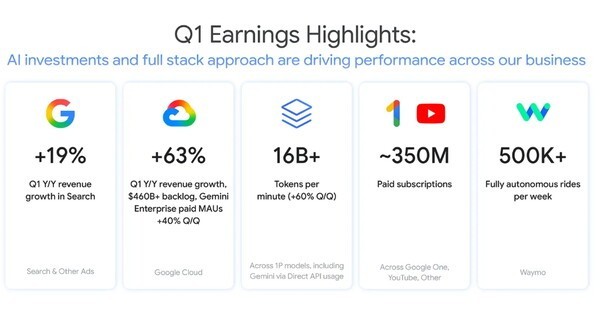
Highlights from Alphabet's first-quarter earnings. (Source: Alphabet)
Investor attention is focused on Alphabet's second-quarter earnings report, with markets looking for evidence that the company's aggressive artificial intelligence (AI) investments are translating into sustainable revenue growth.
Alphabet is scheduled to report its second-quarter results after US markets close on July 22 (around 5:00 a.m. Korea time on July 23). While the company's strong first-quarter performance reassured investors, the second quarter has raised fresh concerns over delays to the flagship Gemini 3.5 Pro AI model, the departure of key AI researchers and rising infrastructure investment costs.
Alphabet will webcast its earnings conference call at 5:30 a.m. Korea time on July 23 through its investor relations website and YouTube channel. According to Reuters, investors are primarily looking to determine whether Alphabet's record data center investments and Gemini AI strategy are generating tangible financial returns. As a result, growth in the company's cloud business has become the most closely watched metric.
Cloud revenue expected to grow 64% year over year
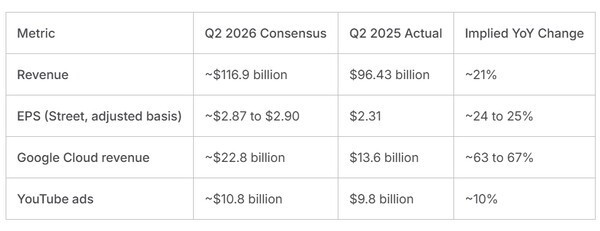
According to estimates from LSEG, Alphabet is expected to post revenue of $116.93 billion for the April-June period, up 21.3% from a year earlier. Google Cloud revenue is forecast to increase 64%, while advertising revenue is expected to grow 13.7%.
Other market consensus estimates are broadly similar. FactSet expects revenue of about $117 billion, with Google Cloud revenue growing 63% to 70%. Visible Alpha forecasts revenue of $117.19 billion, representing growth of more than 20%, while projecting Google Cloud revenue of approximately $22.5 billion, up more than 65%, and advertising revenue from Search and related businesses of roughly $63.29 billion.
Advertising, including Google Search and YouTube, remains Alphabet's largest source of revenue, generating more than three times the sales of its cloud business. Nevertheless, investors are paying closer attention to cloud growth because Alphabet's enormous capital expenditures (CAPEX) must ultimately be justified by accelerating revenue. The company has guided for $180 billion to $190 billion in CAPEX this year.
Even if consensus expectations are met, representing growth from both a year earlier and the previous quarter, investors are likely to demand more. Market participants expect that even a solid earnings report could disappoint if Google Cloud's growth rate fails to exceed expectations.
Cloud performance seen as a barometer of the global AI investment cycle
The results are also expected to influence sentiment across the broader AI ecosystem. If Google Cloud growth surpasses expectations, investors may interpret that as confirmation that the AI infrastructure investment cycle remains intact, supporting continued demand for graphics processing units (GPUs) and benefiting suppliers of optical modules and networking equipment.
The key question is whether Alphabet has maintained investor confidence in its AI strategy. During the earnings call, analysts are expected to ask whether management will maintain its full-year CAPEX guidance. Investors are also seeking updates on the launch schedule for Gemini 3.5 Pro, Google Cloud's order backlog and expansion of the company's in-house AI processors, or tensor processing units (TPUs).
Highlights from Alphabet's first-quarter earnings. (Source: Alphabet)
Consensus estimates for Alphabet's second-quarter results compiled from analyst forecasts by LSEG, Yahoo Finance and Google Finance on July 20-21. (Source: INDmoney)
A significant portion of Alphabet's massive CAPEX is being directed toward AI model development. On July 16, reports that Google had delayed the launch of a new version of Gemini, the centerpiece of its AI strategy, sent Alphabet shares down nearly 4%.
Investor sentiment failed to recover afterward, with the stock falling another 2.2% in the following trading session on July 17. Some analysts estimated that Alphabet's market capitalization declined by roughly $200 billion on July 16 alone.
The decline reflected not only concerns over the Gemini delay but also broader investor anxiety about intensifying AI competition and the scale of Alphabet's AI-related capital spending.
At Google I/O 2026 in May, Google introduced the lightweight Gemini 3.5 Flash model and said Gemini 3.5 Pro, its flagship model, would launch in June. The product, however, has yet to be released, with its launch repeatedly delayed.
While Google has rolled out lighter and lower-cost models, including Gemini 3.6 Flash, Gemini 3.5 Flash-Lite and Gemini 3.5 Flash Cyber, the flagship Gemini 3.5 Pro remains unavailable. Bloomberg and other media outlets have reported that the delay could extend for several months.
Gemini flagship delayed over coding performance
The primary reason for the delay is believed to be coding performance. According to Bloomberg and Reuters, internal testing showed that Gemini 3.5 Pro failed to meet Google's expectations in coding tasks, prompting the company to postpone its release. Coding capability has become a defining benchmark for frontier AI models because it is closely linked to agentic AI functionality.
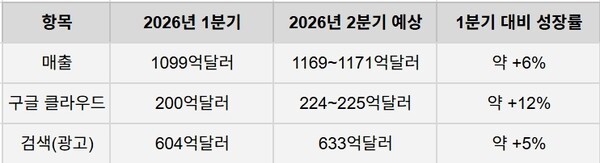
Comparison of Alphabet's expected second-quarter results with its first-quarter performance. (Source: THE ELEC)
Google is therefore believed to be delaying the launch until the model reaches its internal performance targets.
Adding to investor concerns has been the recent departure of several key AI researchers.
While movement of AI talent between major technology companies and startups is common, one of the most significant departures was Noam Shazeer, one of the co-leaders of the Gemini project. Shazeer joined OpenAI, prompting Reuters to describe the move as the loss of a key leader behind Gemini.
Another high-profile departure was John Jumper, chief scientist at Google DeepMind, who joined Anthropic. Jumper shared the 2024 Nobel Prize in Chemistry with Google DeepMind CEO Demis Hassabis for developing the AI protein-structure prediction system AlphaFold.
In addition, two core Gemini researchers, Jonas Adler and Alexander Pritzel, joined Anthropic in June. Combined with the delay of Gemini 3.5 Pro, these departures have intensified investor scrutiny of Google's competitiveness in AI models at a time when rivals continue introducing increasingly capable systems.
Following Anthropic's Claude Fable 5, competitors including OpenAI with its GPT-5.6 family, xAI with Grok 4.5 and Meta with Muse Spark 1.1 have released US models with significantly enhanced coding and agentic capabilities, while China's Moonshot AI unveiled Kimi K3 on July 16, sending shockwaves through the US AI industry. Gemini 3.5 Pro will need to demonstrate performance at least on par with those offerings.
AI search impact on advertising also under scrutiny
Another major topic expected to dominate the earnings call is the outlook for Alphabet's advertising business.
Advertising remains the company's primary revenue source. Revenue from Search, YouTube and related businesses is expected to approach $70 billion this quarter, although growth is projected at only 13% to 14%. Investors are increasingly focused on whether AI-powered search features, including AI Overviews and AI search advertising, are cannibalizing Google's traditional advertising business or creating new monetization opportunities.
One potential catalyst for improving investor sentiment is Google's next-generation AI chip strategy. According to The Information, Alphabet is developing a new AI server chip under the codename Frozen v2.
The chip is reportedly not a direct successor to Google's existing TPUs but a specialized processor designed to complement them by improving inference performance for Gemini models.
According to The Information, Frozen v2 is intended to implement certain Gemini functions directly in silicon, allowing AI models to run more efficiently on hardware. Reuters reported that Google declined to comment on the report.
Wall Street analysts continue to view Alphabet's greatest competitive advantage as its full-stack AI ecosystem and consumer base. The company uniquely combines Search, YouTube and Android with a vast global consumer base, proprietary AI models, Google Cloud and custom AI chips under one roof. Analysts argue that no other AI or cloud provider—including Amazon Web Services (AWS), Microsoft, Meta, OpenAI or Anthropic—currently possesses such a comprehensive and integrated AI ecosystem.
Naver Cloud signed a memorandum of understanding with Korea University's C5ISRT Convergence Research Center to jointly conduct research on core battlefield technologies and collaborate on the KCCS project. Pictured are Prof. Kang Seok-joong of Korea University's Graduate School of Management of Technology (left) and Naver Cloud Chief Executive Officer Kim Yoo-won. (Photo: Naver Cloud)
Naver Cloud signed a memorandum of understanding with Korea University's C5ISRT Convergence Research Center to jointly conduct research on core battlefield technologies and collaborate on the KCCS project. Pictured are Prof. Kang Seok-joong of Korea University's Graduate School of Management of Technology (left) and Naver Cloud Chief Executive Officer Kim Yoo-won. (Photo: Naver Cloud)
Naver Cloud and Korea University's C5ISRT Convergence Research Center will jointly pursue defense artificial intelligence projects worth a combined 20 billion won, including preparations for South Korea's next-generation joint command-and-control system.
Naver Cloud announced on July 20 that it signed a memorandum of understanding with the C5ISRT Convergence Research Center under the Department of Defense Technology Management at Korea University's Graduate School of Management of Technology to strengthen industry-academia cooperation in defense C5ISRT technologies.
C5ISRT refers to an integrated military command-and-battlefield awareness framework encompassing Command, Control, Communications, Computers, Cyber, Intelligence, Surveillance, Reconnaissance and Targeting, which forms the foundation of modern military operations.
The Korea University research center is led by Prof. Kang Seok-joong, a defense technology expert with nearly four decades of research experience in defense technology management.
Under the agreement, the two organizations will jointly pursue several initiatives, including participation in the Joint Chiefs of Staff Military-Industry-Academia Cooperation Center, collaborative research on hyperscale AI-based command-and-control technologies, and advance development of core technologies for the Korea Joint Command and Control System (KCCS) project scheduled for 2027.
The Joint Chiefs of Staff Military-Industry-Academia Cooperation Center is one of five regional defense AI hubs being established by South Korea's Ministry of National Defense to promote civil-military AI collaboration using defense data. The initiative will establish AI transformation (AX) hubs in Yongsan (Joint Chiefs of Staff), Pangyo and Daejeon (Army), Yangjae (Air Force), and Busan (Navy and Marine Corps).
"Modern battlefields are rapidly evolving toward AI- and data-driven intelligent C5ISRT systems," said Prof. Kang Seok-joong. "To keep pace with this trend, South Korea's military needs projects that combine advanced AI technologies with deep expertise in the Korean Peninsula's security environment."
LG CNS announced on July 21 that it is launching an AI Transformation (AX) Training Program aimed at preparing job seekers for careers in artificial intelligence through hands-on industry training.
The program is part of the government's K-Digital Training (KDT) AI Campus initiative, which is backed by a 130 billion won investment to train 10,000 AI engineers. Overseen by the Ministry of Employment and Labor, the initiative selected LG CNS as one of its training providers, with courses scheduled to begin on July 28.
LG CNS will offer two specialized tracks: a Model Context Protocol (MCP)-based Agentic AI Service Developer course and a Knowledge Graph-based AI Data Engineer course.
The Agentic AI Service Developer program is designed to teach participants how to build enterprise-grade agentic AI services using advanced AI technologies, including large language models (LLMs) and retrieval-augmented generation (RAG).
The AI Data Engineer course focuses on applying knowledge graph technology to structure enterprise data so that AI systems can utilize it more effectively.
LG CNS said its AI specialists will serve as mentors throughout both programs, providing participants with practical expertise and hands-on experience that can be applied directly in industrial settings.
"We will actively contribute to nurturing future talent equipped with practical AX capabilities through the AI Campus," said Lee Ho-goon, executive vice president in charge of LG CNS's Public, Telecom and Education AX Business. "Building on the AX technology expertise we have accumulated across diverse industries, we will continue expanding our business-specialized AX training programs."
SGA Solutions announced on July 21 that it has been selected as a solution provider for South Korea's ICT SME Information Security Support Program.
The program, jointly administered by the Ministry of Science and ICT and the Korea Internet & Security Agency (KISA), is designed to help small and medium-sized enterprises strengthen their cybersecurity capabilities, particularly those with limited security personnel and investment resources.
SGA Solutions will participate in the Honam regional consortium led by Piolink, providing endpoint security solutions including VirusChaser 10 AI, VirusChaser MyPC Guardian and PatchChaser.
The company will be responsible for strengthening endpoint security for participating SMEs. Endpoints include user devices connected to corporate networks, such as desktop PCs, laptops and smartphones.
VirusChaser 10 AI is an AI-powered antivirus solution that uses a deep learning engine to detect previously unknown and emerging malware variants. VirusChaser MyPC Guardian is a diagnostic solution that assesses the security status of individual PCs and identifies vulnerabilities. PatchChaser enhances endpoint security by identifying vulnerabilities and applying operating system and software patches before they can be exploited.
SGA Solutions said it expects the project to improve the overall endpoint security posture of SMEs across the Honam region.
Gunship Battle: Total Warfare launches a collaboration with Robotech. (Image: Joycity)
Gunship Battle: Total Warfare launches a collaboration with Robotech. (Image: Joycity)
Joycity announced on July 21 that its mobile military strategy game Gunship Battle: Total Warfare is launching a collaboration with the global science fiction animation franchise Robotech.
Robotech is a science fiction series centered on the transformable Veritech Fighter and an interstellar war. The collaboration will be rolled out in two phases. The first phase will run from July 29 through Aug. 26, with the second phase scheduled to begin after the first campaign concludes.
During the event, players will be able to experience an exclusive storyline in which they repair the legendary space battleship SDF-1 while fighting against the Zentradi forces.
The collaboration will also introduce a new shooting mini-game, Veritech Interception, along with exclusive fighter aircraft and squadron skins based on the VF-1A and VF-1J Veritech Fighters.
Additional Robotech-themed content, collaboration events and special missions will also be available throughout the campaign.
SK Telecom has launched SKTCH with AI, a startup acceleration program aimed at discovering and nurturing artificial intelligence startups, with applications open from July 21 through Aug. 18.
SKTCH, a combination of SKT and Tech, is the company's platform for identifying startups and expanding collaboration opportunities. Through SKTCH with AI, SK Telecom aims to connect startups with its AI technologies, infrastructure and business capabilities to foster mutual growth.
The company plans to select 15 startups based on factors including the competitiveness of their AI technologies and their potential for collaboration with SK Telecom.
Selected companies will receive a six-month support package that includes mentoring and seminars led by industry experts, assistance with joint business development projects with SK Telecom, opportunities to participate in domestic and international exhibitions, office space and other business infrastructure, and access to investment opportunities with venture capital firms and related organizations.
The selection process will also incorporate SK Telecom's AI evaluation agent, an AI agent developed by the company to assist with startup assessments. SK Telecom said the system is expected to accelerate the review process while improving evaluation consistency.
The company said it plans to further enhance the AI agent so that it can independently handle areas where objective assessments are possible, allowing human reviewers to focus on applications requiring more detailed evaluation.
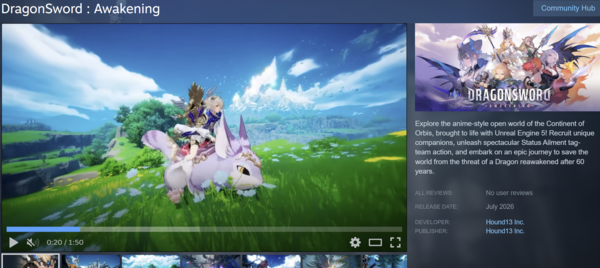
The Steam product page for Dragon Sword: Awakening. Hound 13 is listed as both developer and publisher instead of Webzen. (Source: Steam)
A South Korean court has dismissed Webzen Inc.'s request for a preliminary injunction seeking to block game developer Hound 13 Inc. from independently publishing its game Dragon Sword. As a result, Hound 13 will proceed with the release of Dragon Sword: Awakening on Steam as scheduled.
According to legal sources on July 23, the Civil Agreement Division 60 of the Seoul Central District Court dismissed Webzen's injunction application against Hound 13 on July 22.
The conflict between the two companies escalated following the launch of Dragon Sword. Released on Jan. 21 as a free-to-play online game, the title underperformed relative to market expectations. The companies subsequently blamed each other for prolonged development cycles and disappointing financial performance, with publisher Webzen and developer Hound 13 offering conflicting accounts.
Hound 13 initially declared the publishing agreement terminated, asserting that Webzen failed to pay 60% of the minimum guarantee (MG) due after launch and attempted to acquire the developer at a depressed valuation.
Webzen countered that Hound 13 unilaterally announced the agreement's termination without meeting legal requirements and publicly disclosed the dispute. Webzen subsequently paid the remaining MG balance specified in the contract.
In a statement issued on July 23, Hound 13 said, "The court determined that Webzen failed to fulfill its contractual obligations within the agreed deadline and expressed a clear intention to refuse payment. Consequently, the court ruled that Hound 13's termination of the agreement was lawful and valid."
The company added, "The court also found that Webzen failed to provide sufficient evidence regarding alleged unauthorized use of localization materials. It further ruled that the launch of Dragon Sword: Awakening would not cause irreparable harm to Webzen."
With the injunction denied, Hound 13 will launch Dragon Sword: Awakening globally on Steam on July 23. The title was developed as a single-player buy-to-play package after Hound 13 concluded the publishing agreement had been legally terminated.
Unlike the original Dragon Sword, which featured a gacha monetization model, Dragon Sword: Awakening was redesigned into a Japanese role-playing game (JRPG) style. Players progress through story content by collecting and team-building characters, with enhanced console user interface features and revamped character designs.
Meanwhile, Webzen stated its intention to appeal the court's decision.
"The company plans to file an immediate appeal to seek a renewed judicial determination on key factual and legal matters," a Webzen representative said.
A Hound 13 representative remarked, "The court's decision on the preliminary injunction validated most of our arguments, and we expect a consistent outcome in future proceedings." The representative added, "The original Dragon Sword is currently operated by a third-party service provider outside our control. We have requested service termination and asset transfer, but the process remains stalled."
GITSN Inc. returned to profitability in the second quarter of 2026, driven by growing sales of its Alpha-H wireless backdoor hacking detection system.
The company said on July 23 that it recorded KRW 4.9 billion in consolidated revenue and KRW 460 million in operating profit for the second quarter.
Revenue surged 82% from KRW 2.69 billion a year earlier. Operating profit turned around from an operating loss of KRW 1.14 billion in the same period last year, while net profit reached KRW 390 million.
First-half cumulative revenue increased 50.8% year over year to KRW 7.36 billion. Sales of Alpha-H increased roughly sevenfold, leading the earnings recovery. First-half Alpha-H revenue was more than double the company's total wireless backdoor security revenue for all of last year.
"The increase in sales of our proprietary systems translated directly into stronger profitability and top-line growth," GITSN said. The company attributed the performance to rising adoption of 24/7 continuous monitoring security systems among government agencies, corporations, and financial institutions.
Alpha-H has expanded beyond initial deployments in the financial sector into broader commercial adoption. The platform is currently deployed across 26 domestic organizations and exported to customers in five countries, including the United States, the United Kingdom, Singapore, and Malaysia.
In South Korea, the system is utilized by commercial banks, securities firms, credit card issuers, insurers, public institutions, defense organizations, semiconductor manufacturers, and information technology (IT) companies. Last month, GITSN secured supply agreements with global semiconductor manufacturers, while approximately 20 additional entities, including telecommunications operators and electric utilities, are evaluating system implementation.
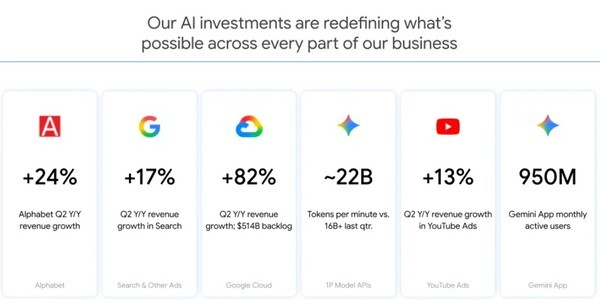
Alphabet Inc. reported second-quarter revenue of $119.8 billion, slightly ahead of market expectations and up 24% from a year earlier. Revenue from its closely watched cloud business reached $24.8 billion, posting 82% growth and significantly exceeding analysts' consensus estimates. Despite the strong results, Alphabet shares fell about 4% during trading after the company announced plans to further increase capital expenditures (CAPEX).
During its second-quarter earnings conference call, which began at 5:30 a.m. on July 23, Alphabet raised its full-year CAPEX outlook to $195 billion-$205 billion, up by $15 billion from its previous guidance of $180 billion-$190 billion.
Alphabet shares initially fluctuated following the earnings release and traded little changed before declining nearly 5% in after-hours trading after the increased investment plan was announced. Reuters reported that investor concerns were driven not only by the higher CAPEX outlook but also by continued delays to the company's flagship artificial intelligence (AI) models.
Chief Financial Officer Anat Ashkenazi defended the increase in capital spending, saying demand continues to exceed the company's investment pace. She said aggressive investment in AI data centers enabled Alphabet to secure computing capacity faster than expected, helping Google Cloud achieve its strongest quarterly growth on record.
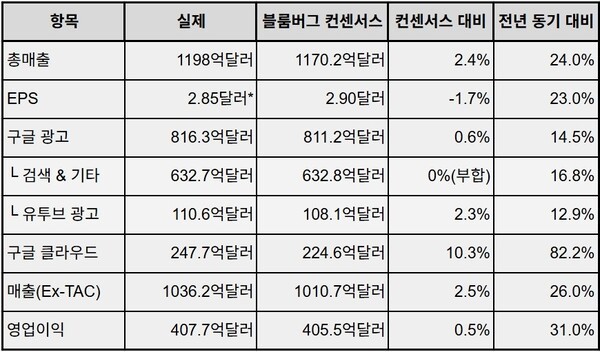
Alphabet's second-quarter revenue of $119.8 billion exceeded the LSEG consensus estimate of $116.9 billion and the FactSet and Visible Alpha forecasts of $117.0 billion-$117.1 billion by about 2.3%. Total advertising revenue came in at $81.6 billion, slightly above the LSEG estimate of $81.1 billion.
Alphabet reported its second-quarter financial results. (Source: Alphabet)
second-quarter earnings compared with the Bloomberg consensus. Adjusted EPS; revenue (Ex-TAC) excludes Traffic Acquisition Costs (TAC). (Compiled by THE ELEC.)
Google Cloud significantly outperformed analysts' expectations, with revenue rising 82% year over year to $24.77 billion, representing a 10.3% upside surprise. The advertising business remained solid and largely met consensus expectations.
However, Alphabet's Free Cash Flow (FCF) turned negative for the first time. FCF is calculated by subtracting CAPEX from Operating Cash Flow (OCF), which represents cash generated from the company's core business operations.
Alphabet consumed $5.9 billion in cash during the quarter. Reuters cited Thomas Monteiro, Senior Analyst at Investing.com, as saying that increasing capital expenditures after posting the company's first negative FCF was inappropriate.
During the conference call, Alphabet also highlighted the commercialization of its Tensor Processing Unit (TPU). According to Ashkenazi, the company generated its first TPU sales revenue during the quarter, although meaningful revenue from commercial contracts is expected to begin next year.
Business Insider reported on Alphabet's second-quarter earnings. Alphabet Chief Executive Officer Sundar Pichai said the Gemini app now has 950 million monthly active users, approaching the scale of OpenAI's ChatGPT.
Business Insider's coverage of Alphabet's second-quarter earnings. CEO Sundar Pichai said the Gemini app has reached 950 million monthly active users, approaching the scale of OpenAI's ChatGPT. (Source: Business Insider website)
Reuters reported that while Google Cloud has positioned Alphabet as one of the primary beneficiaries of the AI boom, investors remain concerned about delays in the rollout of Gemini's latest AI models and increasing competition from rival systems. Analysts also directed numerous questions during the conference call regarding Alphabet's AI strategy.
Pichai acknowledged, as previously reported by international media, that the company still needs to improve coding performance.
"We continue to lead in many frontier areas," Pichai said. "There are also areas where we believe further improvement is needed, particularly coding and agentic coding."
He added that Alphabet continues testing Gemini 3.5 Pro while training Gemini 4, saying, "We are dedicating significant computing resources and effort to Gemini to maintain our competitiveness."
Pichai also said the Gemini app has reached 950 million monthly active users, while daily active users have tripled over the past year.
Meanwhile, Microsoft Corp. and Amazon.com Inc. are scheduled to report quarterly earnings next week.

 Login