Com2uS Holdings announced on July 22 that it has launched Fading Echo, a new action-adventure game, on Steam and the Epic Games Store.
The title was developed by Emeteria, a studio under French game publisher New Tales. The game supports subtitles in nine languages, including Korean, English, Japanese, Chinese, German and French, while in-game voice acting is available in English.
The voice cast features several internationally recognized actors, including Samantha Béart, Jasmine Bhullar, Laura Bailey and Liam O'Brien, who are known for their work on titles such as Baldur's Gate 3, The Last of Us Part II and World of Warcraft.
Fading Echo follows the adventure of a young hero named One, who wields the power of water as she travels between the desert planet Corel and the parallel realm known as the Shadows. The game is set in the Echoverse, a shared universe spanning multiple worlds.
Players can manipulate water and steam in combat while taking advantage of an environmental system in which different elemental forces interact dynamically, creating distinctive combat encounters and exploration experiences.
NEOWIZ said on July 22 that it has begun pre-registration for Kingdom 2: Blazing Battlefield ("Kingdom 2"), a new mobile massively multiplayer online role-playing game (MMORPG) developed by its subsidiary FOW Games.
Unlike conventional class-based combat systems, Kingdom 2 allows players to combine races and weapons to create their own combat style. Players can choose one of three races and one of five weapon types, enabling a total of 15 different character combinations.
The game features a variety of content, including field hunting, party dungeons, the Tower of Infinity and world boss battles. Players can also strengthen their characters through rune upgrades, mana infusion and artifacts. Cooperative content includes guild housing, research and festivals.
Players who pre-register will receive a summon voucher that can be used to obtain a rare-grade armor appearance, along with enhancement materials and in-game gold. NEOWIZ will also hold a prize drawing offering Samsung Galaxy S26+ smartphones and Google Play Gift Cards to selected participants.
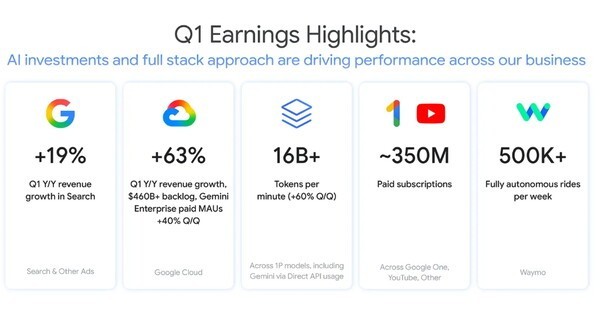
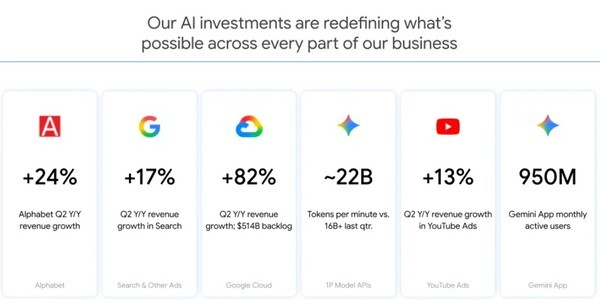
Highlights from Alphabet's first-quarter earnings. (Source: Alphabet)
Investor attention is focused on Alphabet's second-quarter earnings report, with markets looking for evidence that the company's aggressive artificial intelligence (AI) investments are translating into sustainable revenue growth.
Alphabet is scheduled to report its second-quarter results after US markets close on July 22 (around 5:00 a.m. Korea time on July 23). While the company's strong first-quarter performance reassured investors, the second quarter has raised fresh concerns over delays to the flagship Gemini 3.5 Pro AI model, the departure of key AI researchers and rising infrastructure investment costs.
Alphabet will webcast its earnings conference call at 5:30 a.m. Korea time on July 23 through its investor relations website and YouTube channel. According to Reuters, investors are primarily looking to determine whether Alphabet's record data center investments and Gemini AI strategy are generating tangible financial returns. As a result, growth in the company's cloud business has become the most closely watched metric.
Cloud revenue expected to grow 64% year over year
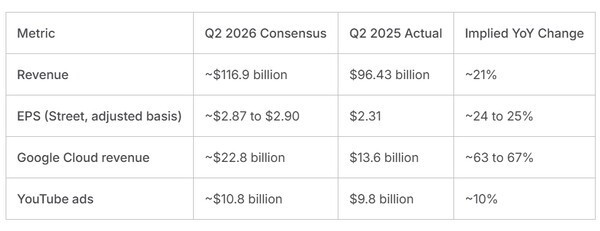
According to estimates from LSEG, Alphabet is expected to post revenue of $116.93 billion for the April-June period, up 21.3% from a year earlier. Google Cloud revenue is forecast to increase 64%, while advertising revenue is expected to grow 13.7%.
Other market consensus estimates are broadly similar. FactSet expects revenue of about $117 billion, with Google Cloud revenue growing 63% to 70%. Visible Alpha forecasts revenue of $117.19 billion, representing growth of more than 20%, while projecting Google Cloud revenue of approximately $22.5 billion, up more than 65%, and advertising revenue from Search and related businesses of roughly $63.29 billion.
Advertising, including Google Search and YouTube, remains Alphabet's largest source of revenue, generating more than three times the sales of its cloud business. Nevertheless, investors are paying closer attention to cloud growth because Alphabet's enormous capital expenditures (CAPEX) must ultimately be justified by accelerating revenue. The company has guided for $180 billion to $190 billion in CAPEX this year.
Even if consensus expectations are met, representing growth from both a year earlier and the previous quarter, investors are likely to demand more. Market participants expect that even a solid earnings report could disappoint if Google Cloud's growth rate fails to exceed expectations.
Cloud performance seen as a barometer of the global AI investment cycle
The results are also expected to influence sentiment across the broader AI ecosystem. If Google Cloud growth surpasses expectations, investors may interpret that as confirmation that the AI infrastructure investment cycle remains intact, supporting continued demand for graphics processing units (GPUs) and benefiting suppliers of optical modules and networking equipment.
The key question is whether Alphabet has maintained investor confidence in its AI strategy. During the earnings call, analysts are expected to ask whether management will maintain its full-year CAPEX guidance. Investors are also seeking updates on the launch schedule for Gemini 3.5 Pro, Google Cloud's order backlog and expansion of the company's in-house AI processors, or tensor processing units (TPUs).
Highlights from Alphabet's first-quarter earnings. (Source: Alphabet)
Consensus estimates for Alphabet's second-quarter results compiled from analyst forecasts by LSEG, Yahoo Finance and Google Finance on July 20-21. (Source: INDmoney)
A significant portion of Alphabet's massive CAPEX is being directed toward AI model development. On July 16, reports that Google had delayed the launch of a new version of Gemini, the centerpiece of its AI strategy, sent Alphabet shares down nearly 4%.
Investor sentiment failed to recover afterward, with the stock falling another 2.2% in the following trading session on July 17. Some analysts estimated that Alphabet's market capitalization declined by roughly $200 billion on July 16 alone.
The decline reflected not only concerns over the Gemini delay but also broader investor anxiety about intensifying AI competition and the scale of Alphabet's AI-related capital spending.
At Google I/O 2026 in May, Google introduced the lightweight Gemini 3.5 Flash model and said Gemini 3.5 Pro, its flagship model, would launch in June. The product, however, has yet to be released, with its launch repeatedly delayed.
While Google has rolled out lighter and lower-cost models, including Gemini 3.6 Flash, Gemini 3.5 Flash-Lite and Gemini 3.5 Flash Cyber, the flagship Gemini 3.5 Pro remains unavailable. Bloomberg and other media outlets have reported that the delay could extend for several months.
Gemini flagship delayed over coding performance
The primary reason for the delay is believed to be coding performance. According to Bloomberg and Reuters, internal testing showed that Gemini 3.5 Pro failed to meet Google's expectations in coding tasks, prompting the company to postpone its release. Coding capability has become a defining benchmark for frontier AI models because it is closely linked to agentic AI functionality.
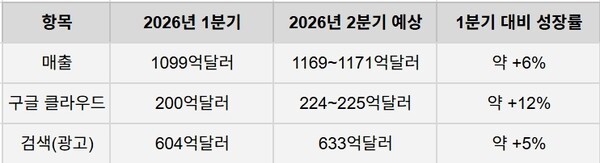
Comparison of Alphabet's expected second-quarter results with its first-quarter performance. (Source: THE ELEC)
Google is therefore believed to be delaying the launch until the model reaches its internal performance targets.
Adding to investor concerns has been the recent departure of several key AI researchers.
While movement of AI talent between major technology companies and startups is common, one of the most significant departures was Noam Shazeer, one of the co-leaders of the Gemini project. Shazeer joined OpenAI, prompting Reuters to describe the move as the loss of a key leader behind Gemini.
Another high-profile departure was John Jumper, chief scientist at Google DeepMind, who joined Anthropic. Jumper shared the 2024 Nobel Prize in Chemistry with Google DeepMind CEO Demis Hassabis for developing the AI protein-structure prediction system AlphaFold.
In addition, two core Gemini researchers, Jonas Adler and Alexander Pritzel, joined Anthropic in June. Combined with the delay of Gemini 3.5 Pro, these departures have intensified investor scrutiny of Google's competitiveness in AI models at a time when rivals continue introducing increasingly capable systems.
Following Anthropic's Claude Fable 5, competitors including OpenAI with its GPT-5.6 family, xAI with Grok 4.5 and Meta with Muse Spark 1.1 have released US models with significantly enhanced coding and agentic capabilities, while China's Moonshot AI unveiled Kimi K3 on July 16, sending shockwaves through the US AI industry. Gemini 3.5 Pro will need to demonstrate performance at least on par with those offerings.
AI search impact on advertising also under scrutiny
Another major topic expected to dominate the earnings call is the outlook for Alphabet's advertising business.
Advertising remains the company's primary revenue source. Revenue from Search, YouTube and related businesses is expected to approach $70 billion this quarter, although growth is projected at only 13% to 14%. Investors are increasingly focused on whether AI-powered search features, including AI Overviews and AI search advertising, are cannibalizing Google's traditional advertising business or creating new monetization opportunities.
One potential catalyst for improving investor sentiment is Google's next-generation AI chip strategy. According to The Information, Alphabet is developing a new AI server chip under the codename Frozen v2.
The chip is reportedly not a direct successor to Google's existing TPUs but a specialized processor designed to complement them by improving inference performance for Gemini models.
According to The Information, Frozen v2 is intended to implement certain Gemini functions directly in silicon, allowing AI models to run more efficiently on hardware. Reuters reported that Google declined to comment on the report.
Wall Street analysts continue to view Alphabet's greatest competitive advantage as its full-stack AI ecosystem and consumer base. The company uniquely combines Search, YouTube and Android with a vast global consumer base, proprietary AI models, Google Cloud and custom AI chips under one roof. Analysts argue that no other AI or cloud provider—including Amazon Web Services (AWS), Microsoft, Meta, OpenAI or Anthropic—currently possesses such a comprehensive and integrated AI ecosystem.
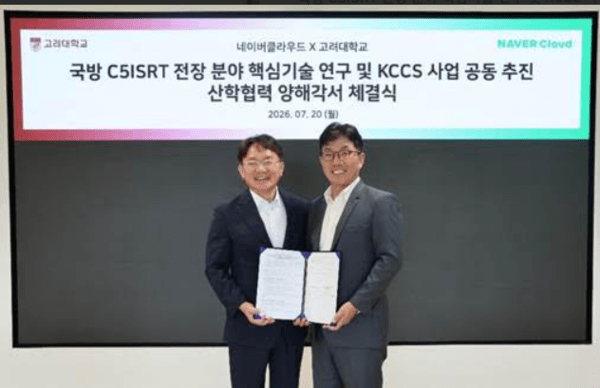
Naver Cloud signed a memorandum of understanding with Korea University's C5ISRT Convergence Research Center to jointly conduct research on core battlefield technologies and collaborate on the KCCS project. Pictured are Prof. Kang Seok-joong of Korea University's Graduate School of Management of Technology (left) and Naver Cloud Chief Executive Officer Kim Yoo-won. (Photo: Naver Cloud)
Naver Cloud signed a memorandum of understanding with Korea University's C5ISRT Convergence Research Center to jointly conduct research on core battlefield technologies and collaborate on the KCCS project. Pictured are Prof. Kang Seok-joong of Korea University's Graduate School of Management of Technology (left) and Naver Cloud Chief Executive Officer Kim Yoo-won. (Photo: Naver Cloud)
Naver Cloud and Korea University's C5ISRT Convergence Research Center will jointly pursue defense artificial intelligence projects worth a combined 20 billion won, including preparations for South Korea's next-generation joint command-and-control system.
Naver Cloud announced on July 20 that it signed a memorandum of understanding with the C5ISRT Convergence Research Center under the Department of Defense Technology Management at Korea University's Graduate School of Management of Technology to strengthen industry-academia cooperation in defense C5ISRT technologies.
C5ISRT refers to an integrated military command-and-battlefield awareness framework encompassing Command, Control, Communications, Computers, Cyber, Intelligence, Surveillance, Reconnaissance and Targeting, which forms the foundation of modern military operations.
The Korea University research center is led by Prof. Kang Seok-joong, a defense technology expert with nearly four decades of research experience in defense technology management.
Under the agreement, the two organizations will jointly pursue several initiatives, including participation in the Joint Chiefs of Staff Military-Industry-Academia Cooperation Center, collaborative research on hyperscale AI-based command-and-control technologies, and advance development of core technologies for the Korea Joint Command and Control System (KCCS) project scheduled for 2027.
The Joint Chiefs of Staff Military-Industry-Academia Cooperation Center is one of five regional defense AI hubs being established by South Korea's Ministry of National Defense to promote civil-military AI collaboration using defense data. The initiative will establish AI transformation (AX) hubs in Yongsan (Joint Chiefs of Staff), Pangyo and Daejeon (Army), Yangjae (Air Force), and Busan (Navy and Marine Corps).
"Modern battlefields are rapidly evolving toward AI- and data-driven intelligent C5ISRT systems," said Prof. Kang Seok-joong. "To keep pace with this trend, South Korea's military needs projects that combine advanced AI technologies with deep expertise in the Korean Peninsula's security environment."
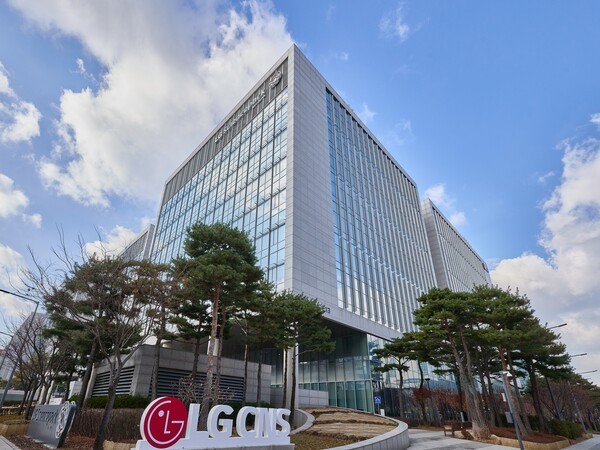
LG CNS announced on July 21 that it is launching an AI Transformation (AX) Training Program aimed at preparing job seekers for careers in artificial intelligence through hands-on industry training.
The program is part of the government's K-Digital Training (KDT) AI Campus initiative, which is backed by a 130 billion won investment to train 10,000 AI engineers. Overseen by the Ministry of Employment and Labor, the initiative selected LG CNS as one of its training providers, with courses scheduled to begin on July 28.
LG CNS will offer two specialized tracks: a Model Context Protocol (MCP)-based Agentic AI Service Developer course and a Knowledge Graph-based AI Data Engineer course.
The Agentic AI Service Developer program is designed to teach participants how to build enterprise-grade agentic AI services using advanced AI technologies, including large language models (LLMs) and retrieval-augmented generation (RAG).
The AI Data Engineer course focuses on applying knowledge graph technology to structure enterprise data so that AI systems can utilize it more effectively.
LG CNS said its AI specialists will serve as mentors throughout both programs, providing participants with practical expertise and hands-on experience that can be applied directly in industrial settings.
"We will actively contribute to nurturing future talent equipped with practical AX capabilities through the AI Campus," said Lee Ho-goon, executive vice president in charge of LG CNS's Public, Telecom and Education AX Business. "Building on the AX technology expertise we have accumulated across diverse industries, we will continue expanding our business-specialized AX training programs."
SGA Solutions announced on July 21 that it has been selected as a solution provider for South Korea's ICT SME Information Security Support Program.
The program, jointly administered by the Ministry of Science and ICT and the Korea Internet & Security Agency (KISA), is designed to help small and medium-sized enterprises strengthen their cybersecurity capabilities, particularly those with limited security personnel and investment resources.
SGA Solutions will participate in the Honam regional consortium led by Piolink, providing endpoint security solutions including VirusChaser 10 AI, VirusChaser MyPC Guardian and PatchChaser.
The company will be responsible for strengthening endpoint security for participating SMEs. Endpoints include user devices connected to corporate networks, such as desktop PCs, laptops and smartphones.
VirusChaser 10 AI is an AI-powered antivirus solution that uses a deep learning engine to detect previously unknown and emerging malware variants. VirusChaser MyPC Guardian is a diagnostic solution that assesses the security status of individual PCs and identifies vulnerabilities. PatchChaser enhances endpoint security by identifying vulnerabilities and applying operating system and software patches before they can be exploited.
SGA Solutions said it expects the project to improve the overall endpoint security posture of SMEs across the Honam region.
Gunship Battle: Total Warfare launches a collaboration with Robotech. (Image: Joycity)
Gunship Battle: Total Warfare launches a collaboration with Robotech. (Image: Joycity)
Joycity announced on July 21 that its mobile military strategy game Gunship Battle: Total Warfare is launching a collaboration with the global science fiction animation franchise Robotech.
Robotech is a science fiction series centered on the transformable Veritech Fighter and an interstellar war. The collaboration will be rolled out in two phases. The first phase will run from July 29 through Aug. 26, with the second phase scheduled to begin after the first campaign concludes.
During the event, players will be able to experience an exclusive storyline in which they repair the legendary space battleship SDF-1 while fighting against the Zentradi forces.
The collaboration will also introduce a new shooting mini-game, Veritech Interception, along with exclusive fighter aircraft and squadron skins based on the VF-1A and VF-1J Veritech Fighters.
Additional Robotech-themed content, collaboration events and special missions will also be available throughout the campaign.
SK Telecom has launched SKTCH with AI, a startup acceleration program aimed at discovering and nurturing artificial intelligence startups, with applications open from July 21 through Aug. 18.
SKTCH, a combination of SKT and Tech, is the company's platform for identifying startups and expanding collaboration opportunities. Through SKTCH with AI, SK Telecom aims to connect startups with its AI technologies, infrastructure and business capabilities to foster mutual growth.
The company plans to select 15 startups based on factors including the competitiveness of their AI technologies and their potential for collaboration with SK Telecom.
Selected companies will receive a six-month support package that includes mentoring and seminars led by industry experts, assistance with joint business development projects with SK Telecom, opportunities to participate in domestic and international exhibitions, office space and other business infrastructure, and access to investment opportunities with venture capital firms and related organizations.
The selection process will also incorporate SK Telecom's AI evaluation agent, an AI agent developed by the company to assist with startup assessments. SK Telecom said the system is expected to accelerate the review process while improving evaluation consistency.
The company said it plans to further enhance the AI agent so that it can independently handle areas where objective assessments are possible, allowing human reviewers to focus on applications requiring more detailed evaluation.
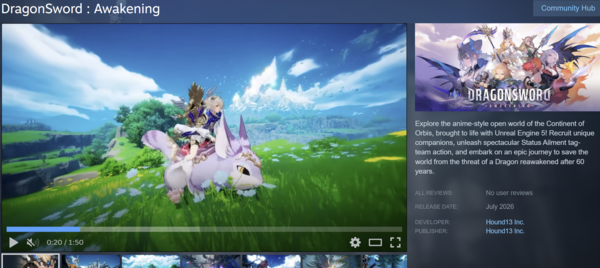
The Steam product page for Dragon Sword: Awakening. Hound 13 is listed as both developer and publisher instead of Webzen. (Source: Steam)
A South Korean court has dismissed Webzen Inc.'s request for a preliminary injunction seeking to block game developer Hound 13 Inc. from independently publishing its game Dragon Sword. As a result, Hound 13 will proceed with the release of Dragon Sword: Awakening on Steam as scheduled.
According to legal sources on July 23, the Civil Agreement Division 60 of the Seoul Central District Court dismissed Webzen's injunction application against Hound 13 on July 22.
The conflict between the two companies escalated following the launch of Dragon Sword. Released on Jan. 21 as a free-to-play online game, the title underperformed relative to market expectations. The companies subsequently blamed each other for prolonged development cycles and disappointing financial performance, with publisher Webzen and developer Hound 13 offering conflicting accounts.
Hound 13 initially declared the publishing agreement terminated, asserting that Webzen failed to pay 60% of the minimum guarantee (MG) due after launch and attempted to acquire the developer at a depressed valuation.
Webzen countered that Hound 13 unilaterally announced the agreement's termination without meeting legal requirements and publicly disclosed the dispute. Webzen subsequently paid the remaining MG balance specified in the contract.
In a statement issued on July 23, Hound 13 said, "The court determined that Webzen failed to fulfill its contractual obligations within the agreed deadline and expressed a clear intention to refuse payment. Consequently, the court ruled that Hound 13's termination of the agreement was lawful and valid."
The company added, "The court also found that Webzen failed to provide sufficient evidence regarding alleged unauthorized use of localization materials. It further ruled that the launch of Dragon Sword: Awakening would not cause irreparable harm to Webzen."
With the injunction denied, Hound 13 will launch Dragon Sword: Awakening globally on Steam on July 23. The title was developed as a single-player buy-to-play package after Hound 13 concluded the publishing agreement had been legally terminated.
Unlike the original Dragon Sword, which featured a gacha monetization model, Dragon Sword: Awakening was redesigned into a Japanese role-playing game (JRPG) style. Players progress through story content by collecting and team-building characters, with enhanced console user interface features and revamped character designs.
Meanwhile, Webzen stated its intention to appeal the court's decision.
"The company plans to file an immediate appeal to seek a renewed judicial determination on key factual and legal matters," a Webzen representative said.
A Hound 13 representative remarked, "The court's decision on the preliminary injunction validated most of our arguments, and we expect a consistent outcome in future proceedings." The representative added, "The original Dragon Sword is currently operated by a third-party service provider outside our control. We have requested service termination and asset transfer, but the process remains stalled."
GITSN Inc. returned to profitability in the second quarter of 2026, driven by growing sales of its Alpha-H wireless backdoor hacking detection system.
The company said on July 23 that it recorded KRW 4.9 billion in consolidated revenue and KRW 460 million in operating profit for the second quarter.
Revenue surged 82% from KRW 2.69 billion a year earlier. Operating profit turned around from an operating loss of KRW 1.14 billion in the same period last year, while net profit reached KRW 390 million.
First-half cumulative revenue increased 50.8% year over year to KRW 7.36 billion. Sales of Alpha-H increased roughly sevenfold, leading the earnings recovery. First-half Alpha-H revenue was more than double the company's total wireless backdoor security revenue for all of last year.
"The increase in sales of our proprietary systems translated directly into stronger profitability and top-line growth," GITSN said. The company attributed the performance to rising adoption of 24/7 continuous monitoring security systems among government agencies, corporations, and financial institutions.
Alpha-H has expanded beyond initial deployments in the financial sector into broader commercial adoption. The platform is currently deployed across 26 domestic organizations and exported to customers in five countries, including the United States, the United Kingdom, Singapore, and Malaysia.
In South Korea, the system is utilized by commercial banks, securities firms, credit card issuers, insurers, public institutions, defense organizations, semiconductor manufacturers, and information technology (IT) companies. Last month, GITSN secured supply agreements with global semiconductor manufacturers, while approximately 20 additional entities, including telecommunications operators and electric utilities, are evaluating system implementation.
Alphabet Inc. reported second-quarter revenue of $119.8 billion, slightly ahead of market expectations and up 24% from a year earlier. Revenue from its closely watched cloud business reached $24.8 billion, posting 82% growth and significantly exceeding analysts' consensus estimates. Despite the strong results, Alphabet shares fell about 4% during trading after the company announced plans to further increase capital expenditures (CAPEX).
During its second-quarter earnings conference call, which began at 5:30 a.m. on July 23, Alphabet raised its full-year CAPEX outlook to $195 billion-$205 billion, up by $15 billion from its previous guidance of $180 billion-$190 billion.
Alphabet shares initially fluctuated following the earnings release and traded little changed before declining nearly 5% in after-hours trading after the increased investment plan was announced. Reuters reported that investor concerns were driven not only by the higher CAPEX outlook but also by continued delays to the company's flagship artificial intelligence (AI) models.
Chief Financial Officer Anat Ashkenazi defended the increase in capital spending, saying demand continues to exceed the company's investment pace. She said aggressive investment in AI data centers enabled Alphabet to secure computing capacity faster than expected, helping Google Cloud achieve its strongest quarterly growth on record.
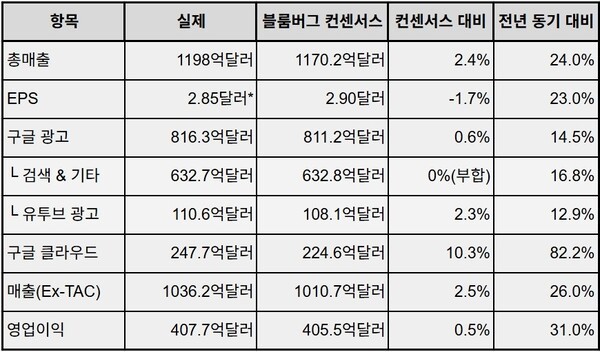
Alphabet's second-quarter revenue of $119.8 billion exceeded the LSEG consensus estimate of $116.9 billion and the FactSet and Visible Alpha forecasts of $117.0 billion-$117.1 billion by about 2.3%. Total advertising revenue came in at $81.6 billion, slightly above the LSEG estimate of $81.1 billion.
Alphabet reported its second-quarter financial results. (Source: Alphabet)
second-quarter earnings compared with the Bloomberg consensus. Adjusted EPS; revenue (Ex-TAC) excludes Traffic Acquisition Costs (TAC). (Compiled by THE ELEC.)
Google Cloud significantly outperformed analysts' expectations, with revenue rising 82% year over year to $24.77 billion, representing a 10.3% upside surprise. The advertising business remained solid and largely met consensus expectations.
However, Alphabet's Free Cash Flow (FCF) turned negative for the first time. FCF is calculated by subtracting CAPEX from Operating Cash Flow (OCF), which represents cash generated from the company's core business operations.
Alphabet consumed $5.9 billion in cash during the quarter. Reuters cited Thomas Monteiro, Senior Analyst at Investing.com, as saying that increasing capital expenditures after posting the company's first negative FCF was inappropriate.
During the conference call, Alphabet also highlighted the commercialization of its Tensor Processing Unit (TPU). According to Ashkenazi, the company generated its first TPU sales revenue during the quarter, although meaningful revenue from commercial contracts is expected to begin next year.
Business Insider reported on Alphabet's second-quarter earnings. Alphabet Chief Executive Officer Sundar Pichai said the Gemini app now has 950 million monthly active users, approaching the scale of OpenAI's ChatGPT.
Business Insider's coverage of Alphabet's second-quarter earnings. CEO Sundar Pichai said the Gemini app has reached 950 million monthly active users, approaching the scale of OpenAI's ChatGPT. (Source: Business Insider website)
Reuters reported that while Google Cloud has positioned Alphabet as one of the primary beneficiaries of the AI boom, investors remain concerned about delays in the rollout of Gemini's latest AI models and increasing competition from rival systems. Analysts also directed numerous questions during the conference call regarding Alphabet's AI strategy.
Pichai acknowledged, as previously reported by international media, that the company still needs to improve coding performance.
"We continue to lead in many frontier areas," Pichai said. "There are also areas where we believe further improvement is needed, particularly coding and agentic coding."
He added that Alphabet continues testing Gemini 3.5 Pro while training Gemini 4, saying, "We are dedicating significant computing resources and effort to Gemini to maintain our competitiveness."
Pichai also said the Gemini app has reached 950 million monthly active users, while daily active users have tripled over the past year.
Meanwhile, Microsoft Corp. and Amazon.com Inc. are scheduled to report quarterly earnings next week.
CocktailIO, an artificial intelligence (AI) and cloud computing company, has been selected as a consulting provider for the advanced consulting track of the South Korean government's 2026 Cloud Service Adoption and Expansion Program for Small and Medium-sized Enterprises, led by the Ministry of Science and ICT and the National IT Industry Promotion Agency (NIPA).
The company said it has already completed its first consulting match following its designation as a program provider, demonstrating the competitiveness of its cloud consulting capabilities at an early stage.
Building on its experience in infrastructure optimization, CocktailIO plans to offer end-to-end cloud services spanning consulting, solution deployment and operational management. The company aims to help participating businesses implement cloud migration strategies tailored to their individual operating environments.
Under the program, CocktailIO will provide advanced consulting by conducting detailed analyses of each company's business environment and developing optimized cloud adoption strategies. Participating SMEs will be able to reduce consulting costs through government support while using the recommendations to accelerate AI transformation (AX) initiatives and improve business operations.
The company said it plans to leverage the project to expand customized technical support and advanced consulting services for enterprises preparing to adopt AI-driven digital transformation, further strengthening its cloud and AI business.
South Korea's appeals court has declined to call HYBE Chairman Bang Si-hyuk as a witness in the appeal of Kakao founder Kim Beom-su, who is accused of manipulating the stock price of SM Entertainment during the company's 2023 takeover battle.
Prosecutors had sought Bang's testimony to reinforce allegations that Kim conspired to manipulate SM's share price and obstruct HYBE's tender offer—claims that the trial court found insufficiently supported. With the witness request denied, the appeal is expected to proceed based primarily on existing evidence and legal arguments.
The Seoul High Court held the second appellate hearing on July 22 in Kim's case involving alleged violations of the Capital Markets Act. During the hearing, the court considered the prosecution's witness requests alongside the defense's arguments but declined to summon Bang.
The case centers on whether Kakao artificially drove up SM Entertainment's share price during the 2023 battle for control of the entertainment company to derail HYBE's tender offer. Prosecutors argue that Kakao's stock purchases constituted market manipulation, while Kim's defense maintains that the transactions were legitimate acquisitions made in the course of a normal merger and acquisition contest.
The management dispute began after SM Entertainment unveiled its "SM 3.0" strategy, ending the management structure centered on former executive producer Lee Soo-man. Lee subsequently sold his 14.8% stake in SM to HYBE, which launched a tender offer to acquire an additional 25% stake from public shareholders at 120,000 won per share.
Kakao initially sought to acquire newly issued shares and convertible bonds in cooperation with SM's management. However, those plans were blocked after a court granted Lee's request for an injunction prohibiting the share issuance. Kakao then began purchasing SM shares directly in the open market.
As SM's share price climbed above HYBE's 120,000 won tender offer price, HYBE acquired only about 0.98% of additional shares instead of its targeted 25% stake.
The takeover battle concluded in March 2023 when HYBE withdrew its bid for SM. Kakao subsequently launched its own tender offer at 150,000 won per share and became SM's largest shareholder. HYBE tendered all of its holdings into Kakao's offer but was left with a residual stake because the offer was oversubscribed. It later sold its remaining shares to Tencent Music Entertainment in 2025.
Prosecutors allege that Kakao conspired with private equity firm Oneasia Partners, investing approximately 240 billion won to keep SM's share price above 120,000 won and thereby frustrate HYBE's tender offer. They claim Kakao's internal "Project S Team" purchased SM shares at prices above the tender offer price on 553 occasions during the offer period in coordination with Oneasia Partners.
Kim's defense argues that SM's shares were already trading above the tender offer price at the time and that Kakao's purchases were legitimate transactions necessary to secure management control. The defense also maintains there is no evidence that Kim directed or conspired to manipulate the stock price.
The trial court acquitted Kim, acknowledging Kakao's acquisition efforts and the activities of Project S Team but concluding that prosecutors had failed to prove Kim recognized an intent to manipulate the market, directed the transactions or conspired with others to commit market manipulation.
On appeal, prosecutors continue to challenge that ruling by focusing on Kim's reporting and approval process and the purpose of the stock purchases. With Bang's testimony excluded, the appellate court is expected to determine whether the existing evidence—including meeting records, messages and trading data—is sufficient to establish Kim's involvement and an intent to manipulate SM's share price.
Lenovo Korea has completed the deployment of a Lenovo ThinkAgile HX hyperconverged infrastructure (HCI) solution powered by Nutanix at Jangan University, helping the institution modernize its IT infrastructure while improving service continuity.
Jangan University needed a highly reliable and easy-to-manage platform capable of delivering uninterrupted digital services to students and faculty despite having limited IT personnel. To replace its aging infrastructure, the university deployed a Nutanix HCI solution built on Lenovo ThinkAgile HX650 V3 nodes.
According to Lenovo Korea, the infrastructure modernization has significantly improved system uptime while reducing unexpected service interruptions, minimizing disruptions to the university's academic administration systems. The deployment has also reduced platform management and administrative workloads by approximately 30%, allowing IT staff to focus on more strategic initiatives.
The Lenovo ThinkAgile HX650 V3 integrates computing, storage and virtualization into a single platform and is powered by 5th Gen Intel Xeon Scalable processors. Lenovo said the system's highly scalable architecture enables organizations to expand infrastructure without disrupting existing operations, making it well suited for future growth.
ARGOS Identity, an AI-powered identity platform company, has been selected for the 2026 Future Industry-Based Enterprise Activation Support Program (Open Innovation) jointly operated by Gangnam-gu and The Invention Lab.
The program is an open innovation initiative designed to foster collaboration between large and mid-sized enterprises and startups. It supports proof-of-concept (PoC) projects and commercialization through business diagnostics, key performance indicator (KPI) development, one-on-one matching with corporate partners, investor presentations and demo days. A total of 108 companies applied, with eight ultimately selected.
Through the program, ARGOS Identity plans to expand the commercial adoption of Omni, its AI agent-based operations automation platform, by validating its use across multiple industries, including telecommunications and retail.
In the telecommunications sector, the company aims to automate document review during customer subscription and service activation. In retail, it plans to standardize unstructured data collected from physical stores and online channels before integrating the information into enterprise systems. In financial services, ARGOS Identity will explore automating Know Your Business (KYB) and Anti-Money Laundering (AML) review processes for global corporate customers.
According to the company, Omni automates repetitive document review and data verification tasks using AI agents. The platform analyzes external documents—including business registration certificates, contracts, application forms and supporting documents—verifies them against enterprise-defined policies, and transfers validated information into internal systems. Cases requiring additional review are routed to human operators through a human-in-the-loop (HITL) workflow.
ARGOS Identity said it has strengthened its AI-powered document analysis and identity verification technologies by supplying electronic Know Your Customer (eKYC) solutions to customers across financial services, fintech, commerce and ticketing industries. Through the new program, the company plans to expand beyond identity verification into AI agent-driven enterprise document automation.
SK Telecom, KT and LG Uplus have entered the AI smart glasses market, expanding device competition beyond smartphones as all three carriers begin offering Ray-Ban Meta smart glasses bundled with mobile service discounts and installment payment plans.
The three mobile carriers announced on July 22 that they have started selling Ray-Ban Meta Wayfarer (Gen 2) smart glasses.
The product was jointly developed by Meta and eyewear manufacturer EssilorLuxottica. Meta began selling the glasses in South Korea through department stores, duty-free shops and optical retailers on May 25, and the carriers' launch broadens distribution by combining the device with mobile subscription benefits.
Ray-Ban Meta features a 12-megapixel ultra-wide camera, five microphones and open-ear speakers that leave the user's ears uncovered. Users can capture photos and videos by pressing a button on the frame or by saying, "Hey Meta." The glasses support first-person photography, record video at up to 3K Ultra HD resolution, and also provide music playback and hands-free calling.
Users can also interact with Meta AI in Korean, asking questions, identifying nearby objects, receiving recommendations and using real-time translation features. The glasses weigh approximately 50 grams, carry an IPX4 water-resistance rating, offer up to eight hours of battery life on a single charge, and up to 48 hours when used with the charging case.
However, the version sold in South Korea is not an augmented reality (AR) display device that projects maps, text or video onto the lenses. Instead, it functions primarily as a voice-first AI wearable, recognizing the surrounding environment through its camera and microphones while delivering Meta AI responses through the built-in speakers.
The device has also raised privacy concerns because of its built-in camera. Although an LED indicator on the front of the glasses illuminates whenever photos or videos are being recorded to alert people nearby, the product closely resembles ordinary eyewear, making it difficult to distinguish from conventional glasses.

 Login