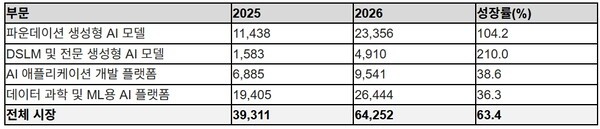
Worldwide end-user spending forecast for AI models and platforms. Figures in millions of dollars. (Source: Gartner)
Worldwide end-user spending forecast for AI models and platforms. Figures in millions of dollars. (Source: Gartner)
Worldwide end-user spending on artificial intelligence (AI) models and platforms is expected to reach $64 billion in 2026, according to Gartner. The forecast represents a 63.4% increase from $39 billion in 2025. Spending on generative AI models is projected to rise 117%, while expenditure on AI platforms is expected to grow 36.9%.
As companies subject their AI budgets to stricter scrutiny, they are placing greater emphasis on utilization efficiency, cost controls and measurable outcomes, Gartner said. AI spending is consequently shifting toward vendors that can demonstrate clear value across cost, latency, performance and reliability.
Vendors that integrate evaluation, cost transparency and usage-tracking capabilities into customer workflows are therefore gaining an advantage by making AI adoption easier to manage and optimize, Gartner said. However, as spending shifts toward usage-based models, vendors are under growing pressure to demonstrate actual adoption, sustained use and reliable profitability.
Driven by these trends, the market for domain-specific language models (DSLMs) and specialized generative AI models is forecast to grow 210% in 2026.
AI infrastructure software company Xiilab has joined the Korea Data Center Energy Efficiency Association (KDCEA) as a member, stepping up its push into the artificial intelligence (AI) data center market.
Xiilab said it holds Nvidia Elite Partner certification, the highest partner tier in Nvidia's software ecosystem, and has secured proprietary technology that maximizes the utilization of idle graphics processing unit (GPU) resources through its in-house solution, AstraGo.
The company said it plans to use its KDCEA membership to actively participate in technology and policy discussions with key member companies and industry experts while identifying practical collaboration opportunities related to data centers. CEO Chae Jung-hwan will oversee the company's activities within the association.
"As the industry enters the Nvidia Vera Rubin generation, system engineering technologies within AI data centers are becoming increasingly important," Chae said. "The larger the AI data center environment, the more critical the efficient operation of GPU resources becomes in determining overall performance."
KDCEA is a non-profit organization operating under South Korea's Ministry of Trade, Industry and Resources. More than 100 companies, including data center operators, design firms, investors and solution providers, participate in the association.
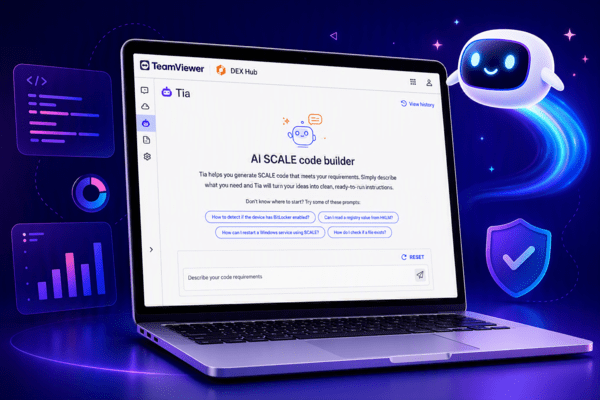
Tia Scripting has been added to TeamViewer DEX, enabling users to create automation scripts using natural-language prompts. (Source: TeamViewer)
Tia Scripting has been added to TeamViewer DEX, enabling users to create automation scripts using natural-language prompts. (Source: TeamViewer)
Remote connectivity and digital workplace solutions provider TeamViewer has added an artificial intelligence (AI)-powered feature called Tia Scripting to its TeamViewer DEX (Digital Employee Experience) platform, enabling IT teams to generate device automation scripts using natural-language prompts without requiring specialist coding expertise.
TeamViewer said Tia Scripting allows IT teams to describe a problem they want to solve or an intended outcome in plain language, after which the system generates a device automation script that can be reviewed and deployed without advanced programming knowledge.
TeamViewer DEX is an IT operations platform that monitors the health of employee PCs, laptops and applications in real time and automatically resolves issues before they affect users. By detecting anomalies through continuous monitoring, the platform can initiate automated remediation across thousands or even tens of thousands of managed devices.
The company said conventional IT automation tools are largely built around predefined templates and standard operating procedures, limiting their ability to address configuration issues, compliance requirements and recurring operational problems. It said Tia Scripting is designed to overcome those limitations by enabling customized automation tailored to individual IT environments.
According to TeamViewer, Tia Scripting supports organization-specific automation by reflecting each company's unique IT infrastructure and operating conditions. After an IT team enters a problem in natural language, the feature generates a script optimized for that scenario. The script can then be reviewed before being securely deployed to designated devices or device groups.
The company said the feature can be configured to verify whether security certificates have been applied, check the operational status of critical applications, prevent unauthorized software modifications and automatically restore security software if it is removed. It can also quickly generate customized automation scripts to address recurring connectivity issues caused by network settings, as well as validate organization-specific device management policies and regulatory compliance requirements.
TeamViewer also said IT teams can reduce the time spent resolving recurring issues by capturing proven remediation methods within the platform and reusing them instead of addressing device problems individually. As enterprise device environments continue to expand and become more complex, the script reuse capability enables organizations to repeatedly leverage validated automation assets, improving overall IT operational efficiency.
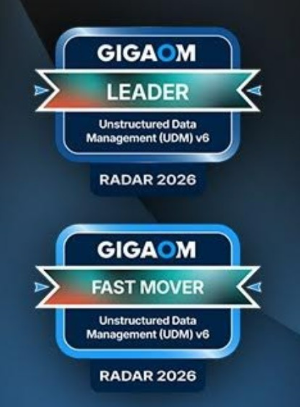
AI and data infrastructure solutions provider HS Hyosung Information Systems said on July 20, citing a report from industry analyst firm GigaOm, that Hitachi Vantara has been recognized as both a Leader and Fast Mover for the sixth consecutive year in the firm's evaluation of unstructured data management platforms.
HS Hyosung Information Systems is a joint venture established by Hyosung Group and Hitachi Vantara, with each company holding a 50% stake. The company is responsible for distributing and providing technical support for Hitachi Vantara's solutions in South Korea.
According to the 2026 GigaOm Radar for Unstructured Data Management report, Hitachi Vantara's VSP One platform was recognized for its integrated data management capabilities, policy automation, operational visibility and overall efficiency.
The report highlighted several key strengths, including enhanced governance for unstructured data through policy automation, data classification, Immutable Object Lock for data immutability, and data retention and tiering policies. It also cited enterprise workflow integration that automates data movement, indexing and transformation across multiple data sources, improving operational efficiency. In addition, the report recognized the platform's unified data fabric architecture, which enables organizations to manage structured and unstructured data distributed across on-premises and external environments under consistent policies.
HS Hyosung Information Systems said the recognition demonstrates Hitachi Vantara's enterprise capabilities in unstructured data management, including governance, automation and data control across hybrid IT environments.
According to the company, VSP One is a unified data management platform for block, file and object storage across hybrid cloud environments. By extending the management capabilities of VSP 360 to VSP One Object, the platform enables centralized monitoring and policy administration. It also optimizes metadata processing to improve performance for small object workloads by up to four times.
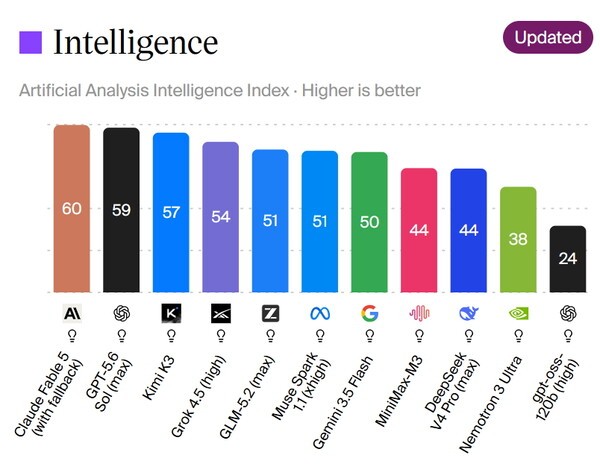
Kimi K3 ranks third in Artificial Analysis' Intelligence Index, behind only the leading frontier models. (Source: Artificial Analysis)
Google's Gemini 3.5 Pro has reportedly been delayed due to performance issues, while Chinese AI companies have unveiled a new generation of frontier-class models that are rapidly narrowing the gap with leading US systems.
Moonshot AI recently introduced Kimi K3, a 2.8-trillion-parameter model, while Alibaba unveiled a preview of Qwen 3.8 Max, its flagship 2.4-trillion-parameter multimodal model.
Kimi K3, in particular, has attracted attention from international media after posting benchmark results approaching those of Anthropic's Fable 5 and OpenAI's GPT-5.6. On several benchmarks, it outperformed GPT-5.6 Sol, OpenAI's highest-end reasoning model. Reuters quoted analysts as saying that the long-held view that Chinese AI models lag US frontier models by roughly six months is becoming increasingly difficult to defend.
Moonshot AI plans to release Kimi K3's model weights on July 27. In Artificial Analysis (AA)'s Intelligence Index, an independent benchmark of leading AI models, Kimi K3 ranked third with a score of 57, behind only Anthropic's Fable 5 and GPT-5.6, surpassing Gemini 3.0 Pro, Claude Opus 4.8, GPT-5.5 (xhigh), Claude Sonnet 5 and GLM-5.2.
Kimi K3 ranks third in Artificial Analysis' Intelligence Index, behind only the leading frontier models. (Source: Artificial Analysis)
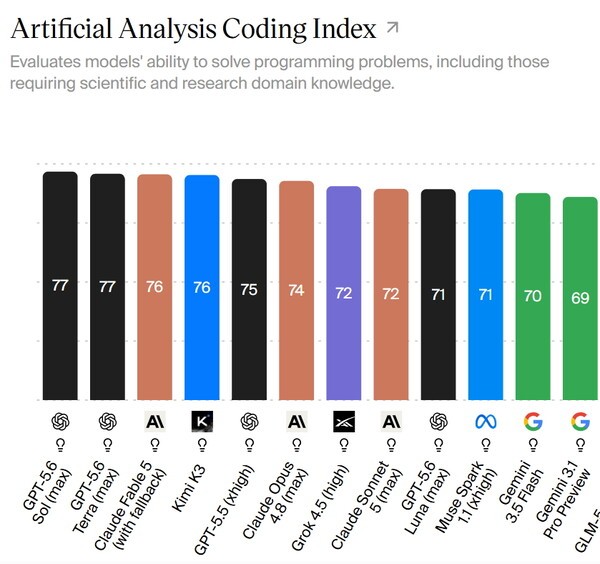
The model demonstrated particularly strong performance in agentic AI and coding. It ranked fourth in AA's Coding Agent Index, trailing only GPT-5.6 Sol, GPT-5.6 Terra and Fable 5.
Kimi K3's overall ranking exceeded its coding-agent ranking largely because of its relatively weak performance on the SWE-Atlas-QnA benchmark.
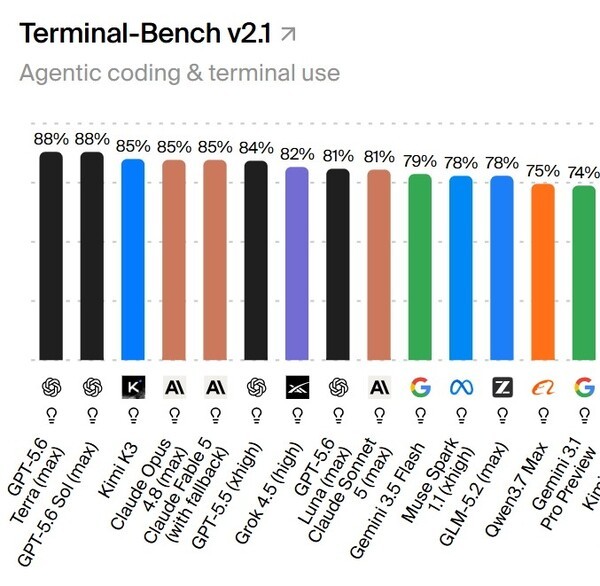
AA's Coding Agent Index is calculated as the average of three benchmarks: Terminal-Bench v2, DeepSWE and SWE-Atlas-QnA. Kimi K3 scored 84% and 64% on the first two benchmarks, placing it among the top performers, but achieved only 23% on SWE-Atlas-QnA, significantly reducing its overall average.
Even so, Kimi K3 outperformed Fable 5 on Terminal-Bench v2 and exceeded SpaceXAI's Grok 4.5 and Claude Opus 4.8 on DeepSWE. It also ranked first on Frontend Code Arena, outperforming GPT-5.6.
Kimi K3 ranks just behind Anthropic's Fable 5 in Artificial Analysis' Coding Agent Index. (Source: Artificial Analysis)
Kimi K3 trails only the GPT-5.6 family in the Terminal-Bench 2.1 benchmark, which measures how effectively AI agents complete complex, long-running tasks in real command-line environments. (Source: Artificial Analysis)
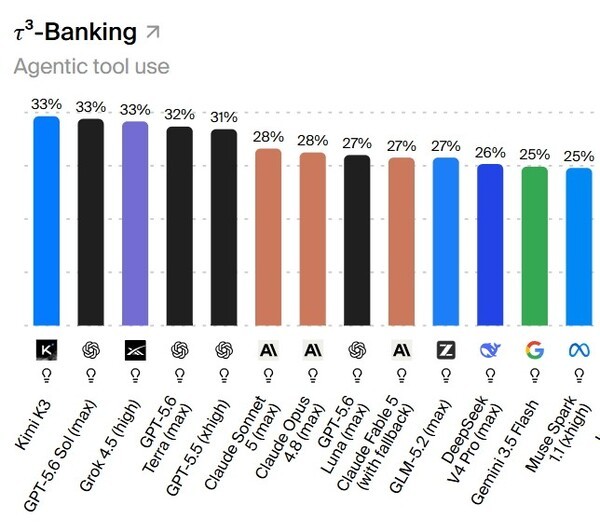
The model also posted leading results on several agent benchmarks. It narrowly surpassed GPT-5.6 Sol on τ³-Banking, which evaluates tool use in multi-turn customer service scenarios modeled after retail banking environments.
Kimi K3 also ranked first on AutomationBench-AA, which evaluates SaaS workflow automation, and SpreadsheetBench 2, which measures spreadsheet task performance. On BrowseComp, a benchmark for web search and information retrieval, it achieved a state-of-the-art score of 91.2, exceeding GPT-5.6 Sol's previous record of 90.4.
Kimi K3 ranks first in the τ³-Banking benchmark, which evaluates AI agents' ability to handle customer service tasks in simulated retail banking environments. (Source: Artificial Analysis)
The model ranked second on AA-Briefcase, CharXiv (RQ) with Tool, and Zerobench with Tool, and third on GDPval-AA v2, which measures workplace task performance across 44 occupations.
Its performance was comparatively weaker on several of the most demanding benchmarks. Kimi K3 ranked sixth on Humanity's Last Exam (HLE), behind Gemini Pro 3.1 Preview, and also placed sixth on CritPt, a benchmark evaluating reasoning over unpublished physics research. The top four positions on CritPt were occupied by GPT models, followed by Fable 5.
High performance comes with higher costs
Artificial Analysis noted that Kimi K3 remains relatively expensive to use because it is currently accessible only through Moonshot AI's API ahead of the release of its open weights. In addition, the model does not currently allow users to disable reasoning, meaning reasoning tokens are always generated and billed.
According to AA, Kimi K3 also tends to produce unusually verbose responses. Across the entire Intelligence Index evaluation, the model generated approximately 130 million output tokens, more than double the benchmark average of 63 million. The higher token usage substantially increases inference costs.
Once Kimi K3 becomes available as an open-weight model and third-party hosting providers begin offering it, market competition could reduce pricing. However, its enormous 2.8-trillion-parameter scale is likely to keep costs well above those of DeepSeek. Although Kimi K3 uses a Mixture-of-Experts (MoE) architecture that activates only 16 of 896 experts during inference, limiting computational requirements relative to its total parameter count, the GPU memory and compute resources required to serve the model remain substantial.
Alibaba introduces Qwen 3.8 Max
Alibaba unveiled a preview of Qwen 3.8 Max at the World Artificial Intelligence Conference (WAIC) in Shanghai on July 19.
The new model contains 2.4 trillion parameters, representing a significant increase from its predecessor. It is a large multimodal model capable of processing text, images, video and documents within a single system. Alibaba said it also plans to release the model weights as open source in the near future.
The company described Qwen 3.8 Max as its flagship model for coding and AI agents while claiming that its general capabilities rank just behind Fable 5. Alibaba highlighted significant improvements in agentic coding, software development, front-end development and function calling, as well as stronger tool use, complex workflow execution and multi-step task automation.
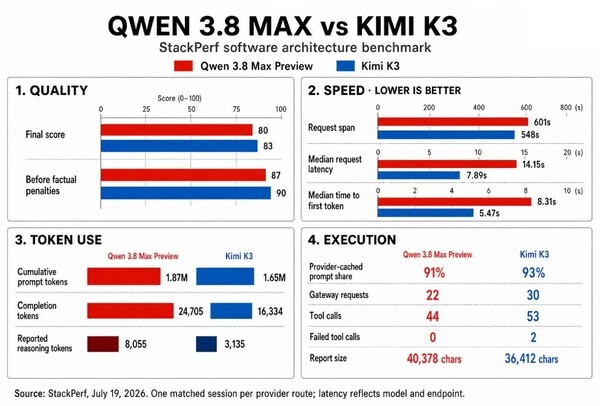
Comparison of Alibaba's Qwen 3.8 Max (Preview) and Moonshot AI's Kimi K3. (Source: StackPuff)
Alongside the preview release, Alibaba integrated Qwen 3.8 Max into its Token Plan, Qoder and QoderWork platforms.
Because the model was announced only recently, independent benchmarking organizations such as Artificial Analysis have not yet published evaluation results. However, early community testing on platforms including Aider Leaderboard, LiveBench and WebDev Arena suggests that the model is competitive with GPT-5.6 and Kimi K3 in front-end development, agentic coding and web user interface generation.
Weights & Biases (W&B) had previously ranked the earlier Qwen 3.7 Max among the top models for spreadsheet reasoning and workflow automation, raising expectations for the new release.
Qwen 3.8 Max also employs an MoE architecture, although Alibaba has not disclosed the number of active parameters. That figure will play a key role in determining inference costs. Qwen 3.7 Max was priced at $2.50 per million input tokens and $7.50 per million output tokens, but the substantially larger 3.8 Max model could carry higher pricing.
Google faces mounting pressure
The release of increasingly competitive Chinese models has coincided with reports that Gemini 3.5 Pro has been delayed because it failed to meet Google's internal coding performance targets.
The model had originally been scheduled for release in June. According to Bloomberg and other media outlets, Gemini 3.5 Pro fell short of internal benchmarks in code generation and debugging, potentially delaying its launch by several months. Google reportedly attempted to improve performance by fine-tuning the model with additional coding datasets in June 2026, but the results were insufficient, forcing engineers to restart training.
Pressure on Google has intensified following OpenAI's release of GPT-5.6, which significantly improved coding capabilities and cost efficiency, as well as new flagship models from Meta and SpaceXAI — Muse Spark 1.1 and Grok 4.5, respectively — emphasizing coding and agentic AI.
OpenAI, Anthropic and Google have generally been regarded as the three leading frontier AI developers. Analysts say that if Google's next-generation model fails to outperform competing systems from Meta and SpaceXAI, the company could lose its position among the industry's leading frontier model providers.
With Chinese competitors rapidly improving, Google appears to have opted to prioritize model quality over speed of release. Following Bloomberg's report, Google's share price fell nearly 4%. A Google spokesperson said the company continues to release models rapidly while balancing performance and cost efficiency and is testing Gemini 3.5 Pro and an upgraded Flash model with partners.
Chinese AI models gain ground in the US
Meanwhile, data from AI model aggregation platform OpenRouter indicate that Chinese AI models accounted for a record 58% of AI tokens used by US companies during the first week of July, surpassing US-developed models for the first time.
Bloomberg's analysis of OpenRouter's public traffic data found that Chinese models accounted for 58% of total usage, reaching as high as 63% during some weeks. Chinese models processed roughly 18 trillion tokens during the week, compared with approximately 5.5 trillion tokens for US models.
DeepSeek remained the most widely used individual model. Bloomberg and other international media noted that Chinese models accounted for less than 10% of usage at the beginning of 2025, highlighting the rapid shift over roughly a year.
OpenRouter provides unified access to more than 400 AI models from companies including OpenAI, Anthropic, Google, Meta, DeepSeek and Alibaba through a single API. Because its publicly available traffic data reflect actual model usage by AI startups and developers, OpenRouter has become a closely watched indicator of real-world AI market share.
International media attributed the shift largely to aggressive pricing. Developers building coding automation and agentic workflows are increasingly adopting Chinese open-weight models, which can cost 10 to 50 times less than leading US frontier models.
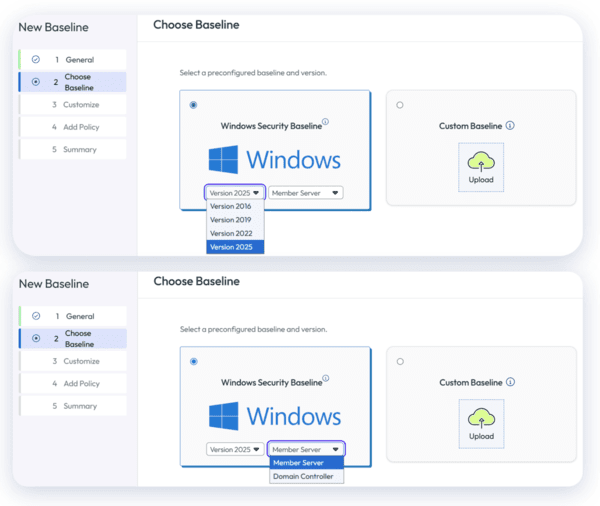
Workspace ONE with Windows Server management support. (Image: Omnissa)
Workspace ONE with Windows Server management support. (Image: Omnissa)
Digital workplace platform provider Omnissa has introduced Workspace ONE, a unified endpoint management (UEM) platform that now supports Windows Server management. The addition enables enterprises to manage Windows servers alongside desktops, laptops, mobile devices and rugged computing devices through a single platform.
Omnissa said Workspace ONE is built on a cloud-native architecture that enables organizations to enforce server security policies, automate operations, perform software updates and manage server configurations. The company said the platform can reduce reliance on complex and costly legacy server management tools while allowing servers and endpoint devices to be administered under consistent policies and automated workflows.
Omnissa also emphasized that Workspace ONE offers a lower-cost approach to managing Windows Server environments than Microsoft System Center Configuration Manager (SCCM). According to the company, the platform strengthens security and regulatory compliance while improving the efficiency of server lifecycle management.
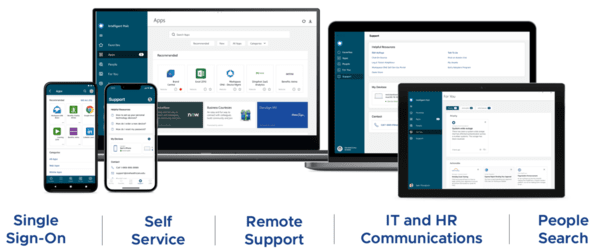
Workspace ONE is positioned by Omnissa as an intelligent hub for enterprise endpoint management.
Omnissa positions Workspace ONE as an intelligent hub. (Image: Omnissa)
According to the company, the platform supports continuous enforcement of server security policies through over-the-air (OTA) configuration management. Compared with traditional management methods that rely on network domains, Workspace ONE provides greater operational flexibility. Its cloud-native management capabilities also enable real-time monitoring of server security posture and can automatically execute corrective actions when necessary.
The platform further incorporates artificial intelligence (AI) and machine learning (ML) analytics to proactively identify and address server performance degradation and security risks. In addition to remote control capabilities, administrators can remotely view installed server roles, hardware and software inventory, and access logs, providing greater visibility into server operations.

 Login