❌

Reading view

Apple Services Price Hikes 2026

Chance Miller:

Here are the new monthly prices for Apple Music and Apple One as of today:

Apple Music

Apple One

The price increases for Apple Music come after Spotify announced its own round of price hikes earlier this year, which Apple poked fun at on social media. Even with today’s price hikes, though, Apple Music remains cheaper than Spotify.

Lee Peterson:

Apple Music no longer makes sense when I’m already paying for YouTube Premium. Apple Music goes up to £11.99, YouTube Premium is £12.99 and on top of a good music service you get no ads on YouTube.

Mike Rockwell:

Distilling my longtime argument down to its simplest bit, I’d ask “do you want to pay $10 a month for music for the rest of your life?”

But truly, it was never going to just be $10 per month. The price was going to go up over time. It was going to get more expensive to have access to the same music.

If you purchase your music, though, I think most people would reach a point in their life where they stop buying new music entirely or they’re only buying a few albums per year. The cost of music would go down for you over time.

That was my thinking, too, but then I found that music I’ve purchased from Apple won’t work on my HomePod. I refuse to condone that behavior, so now I have two solid reasons not to subscribe to Apple Music.

Joe Rossignol:

While the monthly and annual prices of AppleCare+ plans for Macs and iPads received a slight increase this week, AppleCare One continues to start at $19.99 per month in the U.S., making the multi-device plan even more valuable.

Previously:

  •  

Apple Financial Statements: Products vs. Services

John Gruber (Mastodon, 2):

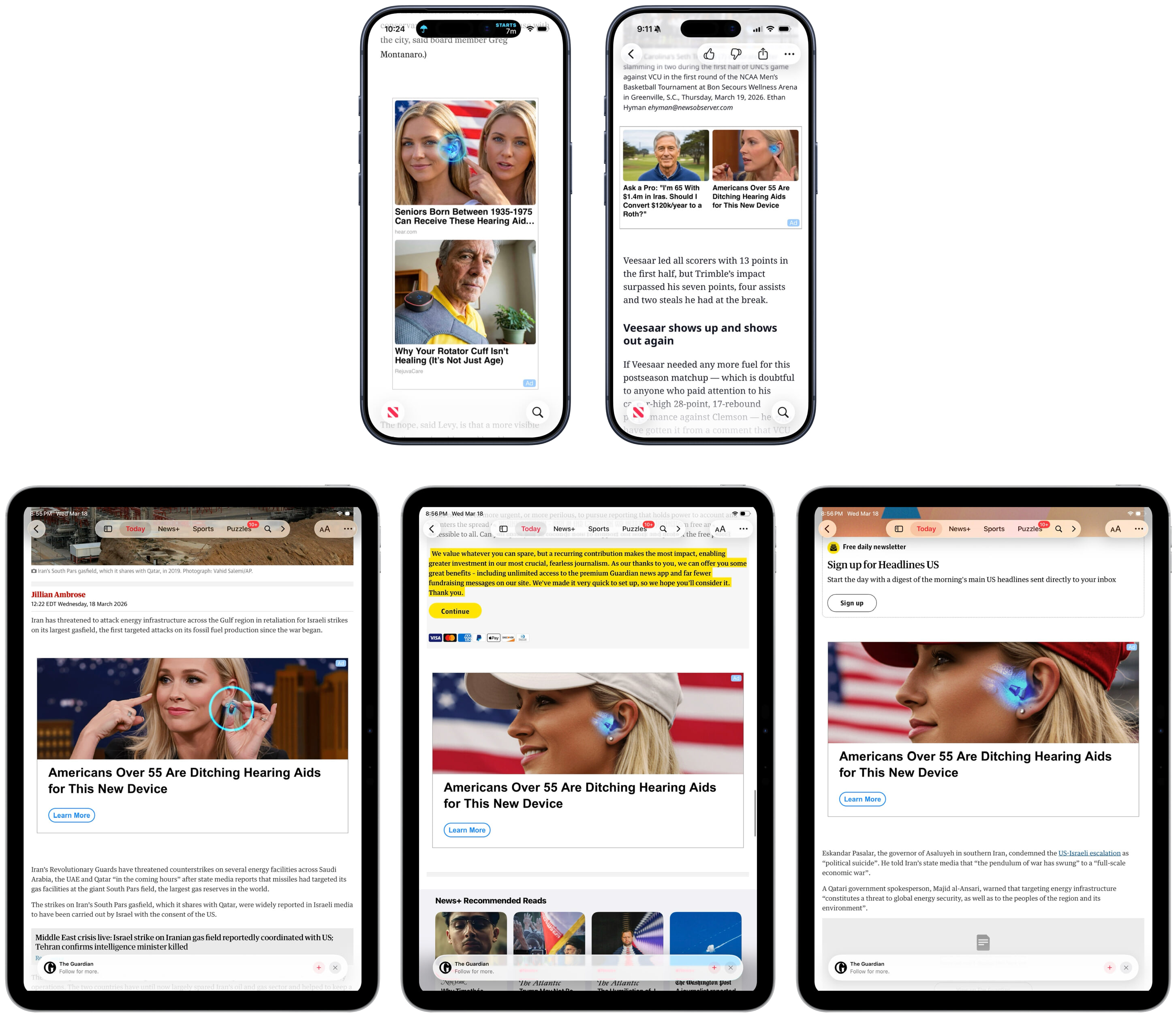
Some of [Cook’s letter] remains true, but has lost some truthiness — and truthiness matters. But some of it is no longer true, period. It’s no longer just “one small part” of Apple’s business that serves advertisers. Here in 2026, search results in the App Store not only show paid ads — frequently for casinos — but the search results are visually dominated by paid ads now that Apple has added a second ad to results. Apple News+ is a paid subscription that offers a genuinely great value for the number of paywalled publishers whose content it includes, but articles on the News app tend to include the weirdest AI-generated ads on the Internet. (How many young blond women am I supposed to believe need hearing aids?) And — at this writing, still “coming soon” — Apple is launching ads on Apple Maps. Apple Maps remains free of charge to use, so according to Tim Cook, we’re not the customer. We’re the product. Or, if you prefer, our frustration is the product.

[…]

The ratio of ads to organic results in App Store search — especially when measured in screen area — is clearly not aligned with Cook’s 2014 statement that “Our software and services are designed to make our devices better. Plain and simple.” Obviously not. App Store search today is designed primarily to generate more revenue for Apple. That’s not criminal, but it’s a change.

[…]

What gave Tim Cook’s privacy letter heft in 2014 wasn’t just the clarity of its plain language, but the fact that you didn’t have to take his word for it that the ads Apple showed you respected your privacy, because Apple didn’t show you ads in 2014. Apple today can’t say that.

[…]

John Ternus should return Apple’s privacy policy to its 2014 clarity. The trust Apple would earn from such a move would far out-value whatever revenue these ads pad to their already hefty and ever-increasing quarterly Services numbers.

I wish that were the case, but I fear this is kind of a Hotelling’s Law situation, where Apple can get most of the benefit by being just slightly better on this axis. Where else do its customers have to go?

Jeff Johnson (Mastodon):

In the second fiscal quarter of 2018, services generated $9 billion in revenue (net sales), whereas in Q2 2026, that amount had grown to $31 billion! In this blog post, I want to focus on understanding the relative financial importance of products and services for Apple.

[…]

In 2025, services were 42% of Apple gross margin. How does 26% of net sales become 42% of gross margin? The explanation is that services have a much lower cost of sales. The products gross margin was 37% of products net sales, while the services gross margin was an astonishing 75% of services net sales. In other words, Apple services are almost pure profit!

Does this 75% account for TV and movie production costs?

With persistent general inflation, consumers do not have unlimited money to spend on Apple products. At least in the near future, it’s reasonable to question how much further room is available for growth in profits from Apple products. To satisfy the demands of investors, Apple executives including CEO-elect John Ternus may be forced to rely even more than before on growth in services, which do not face as much pressure on cost of sales as hardware products.

Previously:

  •  

Golden Gate Sidebars and Toolbars

Joe Rossignol:

macOS Golden Gate also has design changes. For example, apps now have a unified toolbar at the top, and the sidebar now expands to the edge of the window.

Hartley Charlton:

Sidebar behavior is also being updated. Sidebars will now expand to the full edge of the window, with refraction effects continuing beneath them rather than cutting off at the sidebar boundary. Sidebar icons will also retain their color, a change that addresses a common complaint about the original Liquid Glass implementation.

I’m really happy for these changes, but it’s not clear to me that they’re improvements over what we had pre-Tahoe or, especially, pre-Big Sur.

John Siracusa:

Oh thank god! No more margins around sidebars on macOS!

Benjamin Mayo:

sidebars now work how they used to!

Mario Guzmán:

I just love that toolbars have clear/strict dividers again in #macOS27.

Whoever said your content and UI should blend is a liar.

What a wonderful and welcome fix in #macOS27.

Betamagic:

Instead of properly fixing the Liquid Glass implementation of NSToolbar buttons in macOS 27 Golden Gate, Apple decided to simply place an ugly, semi-transparent macOS 15-ish background bar behind the buttons, which makes Liquid Glass completely useless in the toolbar.

João Pavão:

macOS 26 should have never been more than one developer seed release, with these changes taking place before the actual public release.

It’s sad that we had to endure this crap of a UI for a full year and now have to maintain apps for it for I don’t know how much longer.

Previously:

Update (2026-06-12): Norbert Heger:

Why has nobody told me this before?

defaults write -g NSSplitViewItemSidebarDefaultsToFloatingAppearance -bool NO

Look at this gorgeously clean sidebar on macOS Tahoe!

Jesper:

The macOS standard sidebars don’t live in a blob with very uncomfortable margins (which were required for there to be a layer fit in between the “traffic light” window controls and the window’s edge).

Update (2026-06-16): Mark Sokolovsky has screenshots of the sidebars in recent macOS versions.

Update (2026-07-22): Mario Guzmán:

No more progressive blur for scroll edges in System Settings on macOS. This is definitely a very welcome change and overall one of the many little enhancements -- driving the entire UI in the right direction. Love it.

  •  

Topological Jackiw-Rebbi States in Photonic Van der Waals Heterostructures

A new study is turning an elegant quantum idea into a practical platform for light. In research published in Light: Science & Applications, physicists report “topological Jackiw–Rebbi” states engineered inside photonic van der Waals heterostructures—systems built by stacking atomically thin materials with precisely tailored interfaces. The result is a photonic phenomenon that echoes how particles can be trapped at boundaries where the rules of their governing equations change.

The work builds on the classic Jackiw–Rebbi mechanism, originally proposed for relativistic particles. In those models, a localized mode appears when a mass term flips sign, effectively creating a domain wall. The authors translate this concept into optics by designing photonic structures where an effective “mass” characterizing light propagation changes across an interface.

What makes the platform especially compelling is the van der Waals architecture. Unlike conventional fabrication routes that can introduce disorder, the layered nature of these materials enables sharp, controllable boundaries and tunable photonic band structures. By adjusting the stacking and interlayer optical responses, the researchers create conditions in which topological modes become robust against typical imperfections.

The study emphasizes that these states are not merely conventional guided resonances. Instead, they are tied to topology: the light modes are associated with an invariant property of the band structure. As a consequence, the Jackiw–Rebbi-like photonic states are expected to persist even when the system’s details vary, so long as the relevant symmetry and band configuration remain intact.

Topological protection is more than a slogan. In photonics, it can translate into reduced sensitivity to fabrication tolerances and a pathway toward devices that rely on stable boundary transport. The paper therefore positions these localized states as building blocks for future optical components that route signals along designed interfaces.

The authors demonstrate the concept theoretically and connect it to experimental observables by focusing on how the interface should host modes localized near the domain wall region. Such localization is a hallmark of the Jackiw–Rebbi scenario, now realized in a controllable, designer photonic environment.

Beyond fundamental interest, the approach could influence the design of reconfigurable photonic circuits. Because van der Waals stacks can be combined and adjusted, the same topology-driven logic may be extended to new material systems, wavelengths, and device geometries.

Overall, the report signals a broader trend: using topological field-theory ideas to engineer light–matter behavior in atomically precise platforms, potentially enabling the next generation of robust, interface-based photonic technologies.

Subject of Research: Topological photonic states (Jackiw–Rebbi) in van der Waals heterostructures.

Article Title: Topological Jackiw-Rebbi states in photonic Van der Waals heterostructures.

Article References: Randerson, S.A., Bouteyre, P., Hu, X. et al. Light Sci Appl 15, 323 (2026). https://doi.org/10.1038/s41377-026-02392-5

Image Credits: AI Generated

DOI: 10.1038/s41377-026-02392-5

Keywords:

  •  

Factors Influencing Elderly Preference for Dental Services

A new study highlights what shapes how older adults choose dental services, offering insights that could help clinicians and policymakers make care more reachable for aging populations. Published in BMC Geriatrics, the research examines preferences from the perspective of elderly people, focusing on the practical and psychological drivers behind where they seek treatment.

Researchers report that dental service choice is not determined by clinical need alone. Instead, older participants weigh multiple factors, including perceived quality, trust in providers, and the comfort they expect during visits. Such preferences can influence whether seniors present early for care or delay until symptoms become more severe.

The analysis also underscores the role of access-related conditions. Transportation difficulties, scheduling constraints, and the overall convenience of clinics can strongly affect whether elderly adults follow through on appointments. In practice, even when dental services are available, logistical friction can reduce uptake.

Cost perception emerges as another key theme. The study points to the way affordability, expected out-of-pocket expenses, and insurance-related clarity can shape willingness to seek preventive services. When costs feel uncertain, older adults may prioritize only urgent needs rather than routine checkups.

Beyond logistics and economics, communication quality matters. Participants appear to value providers who explain procedures clearly, demonstrate patience, and treat them with respect. For many seniors, feeling heard can improve satisfaction and reinforce continued engagement with dental care.

The findings also suggest that health-related experiences influence preference. Prior dental outcomes, fear of pain, and past interactions with the healthcare system can steer individuals toward specific service settings. This is particularly relevant for older adults who have accumulated years of unmet needs or negative impressions.

Importantly, the study frames these determinants as modifiable targets. By improving appointment accessibility, strengthening patient-provider communication, and ensuring transparent pricing, dental programs could better align services with senior expectations.

As populations age worldwide, these behavioral insights may help reduce barriers to oral healthcare. The research calls for strategies that address both the measurable elements of service delivery and the lived concerns of older adults deciding where to go for treatment.

Subject of Research: Factors influencing elderly preferences for dental services

Article Title: Factors related to the preference for dental services from the perspective of the elderly

Article References: Shirzadi, Z., Moeini, M., Shojaei Barjoei, N. et al. BMC Geriatrics (2026). https://doi.org/10.1186/s12877-026-07982-x

Image Credits: AI Generated

  •  
❌