Scientists have discovered an abundance of molecules in the cosmos, but for the first time ever, they were able to detect one in interstellar space very familiar to us here on Earth: sugar.
The discovery, made in the vast clouds of gas and dust between stars, could help scientists better understand how some of the chemical ingredients necessary for life formed long before Earth existed.
Researchers at the Centro de Astrobiología, part of the Spanish National Research Council (CSIC), identified the sugar molecule erythrulose within the interstellar medium.
Sugars are considered fundamental building blocks of life. On Earth, they play vital biological roles, including forming the backbone of RNA and contributing to the chemistry that ultimately supports DNA, while also serving as an important source of energy. Scientists studying the origins of life have long sought to understand how the first sugars formed, since they are essential ingredients in the molecules associated with life’s earliest development.
“The detection of erythrulose is very exciting because it opens up the possibility of discovering in space other sugars such as ribose, which is part of RNA, and other important molecules for the origin of life,” says Carlos Briones, co-author of the study, in a statement.
Even so, one major question remains: where did the first biologically important sugars originate?
Previous studies have identified sugars such as ribose and glucose in meteorites and asteroid samples, suggesting that some organic compounds may have been delivered to the early Earth from space. Until now, however, no sugar had been directly detected in the cold molecular clouds where stars and planets form.
The newly identified molecule, erythrulose, was found in the molecular cloud G+0.693−0.027 near the center of the Milky Way. On Earth, erythrulose is a naturally occurring four-carbon ketose sugar.
The discovery was made using highly sensitive radio astronomy observations from the Yebes Observatory’s 40-meter radio telescope and the 30-meter telescope operated by the Institute for Radio Astronomy in the Millimeter Range. Researchers analyzed the unique radio signatures, or spectral fingerprints, emitted by molecules in space.
The team identified 12 spectral lines matching laboratory measurements of erythrulose, confirming the molecule’s presence.
The findings also challenge some existing ideas about how complex molecules form in space. Scientists have generally proposed that interstellar chemistry builds larger molecules by gradually adding carbon atoms. Yet erythrulose proved to be more abundant than related three-carbon sugars that researchers expected would appear first.
“This finding was unexpected, as the prevailing view in astrochemistry is that interstellar molecules grow in size through the sequential addition of carbon atoms,” said Izaskun Jimenez Serra (CAB), the lead author of the recent study.
Instead, the researchers found that erythrulose could form inside icy dust grains from simpler two-carbon alcohols and aldehydes. These frozen environments may function as natural chemical laboratories, allowing increasingly complex organic molecules to develop over time.
The team estimates that during the Late Heavy Bombardment—roughly 4.1 to 3.8 billion years ago, when Earth experienced intense asteroid and comet impacts—between 500,000 and 50 million tonnes of erythrulose may have been delivered to the planet’s surface.
The discovery adds another piece to the puzzle of life’s origins, suggesting that some of its essential ingredients may have arrived with something surprisingly sweet.
Chrissy Newton is a PR professional and the founder of VOCAB Communications. She currently appears on The Discovery Channel and Max and hosts the Rebelliously Curious podcast, which can be found on YouTube and on all audio podcast streaming platforms. Follow her on X: @ChrissyNewton, Instagram: @BeingChrissyNewton, and chrissynewton.com. To contact Chrissy with a story, please email chrissy @ thedebrief.org.
The conversion van experts at Vantrack say they’re ready to deliver on the promise of Kia’s own WKNDR concept with a new electric camper van based on the popular Kia PV5 Passenger – but unlike the concept that inspired it, this van is headed for production.
The mystery of life's origin on Earth remains unsolved. With modern biochemistry tools scientists are no closer to synthesizing life from non-living chemicals despite advanced knowledge and technology, let alone understanding how it could have arisen abiogenetically. The rejection of the Creator has led to foolishness in the wise.
Harvard astrophysicist Avi Loeb has been appointed as the head of a new White House group to study unidentified anomalous phenomena or UAP, a new catch-all term for UFOs that might appear not just in the air but also in space or underwater. Loeb says the group is focused on evidence, instrumentation, data analysis and collection standards.
Loeb co-founded and leads the Galileo Project, designed to bring the search for extraterrestrial technological signatures of extraterrestrial technological civilizations "from accidental or anecdotal observations and legends to the mainstream of transparent, validated and systematic scientific research."
As chair of the just-formed UAP Science Advisory Council, Loeb has built a team of researchers that he describes as "an amazing A-team of exceptional scientists and experts."
Members of the group come from a wide range of disciplines from data science and instrumentation to biology, oceanography, anthropology and psychology.
The council's stated purpose is to help government agencies study the nature of UAP through rigorous scientific methods, with an emphasis on collecting and analyzing higher-quality data rather than relitigating older material that cannot be independently verified.
Meet the team
But first things first.
What is the current membership makeup of Loeb's Council? It's quite a mix of talent to undertake a new look at UAP:
Liberty Capito is a professor of practice in data science at the Olin Business School at the Washington University in St. Louis.
Carol Cleland is a professor in the Department of Philosophy at the University of Colorado Boulder.
Richard Cloete is a computer scientist at Harvard University and a member of Loeb's Galileo Project.
Omer Eldadi is in the department of psychology at Reichman University, Herzliya, Israel.
Tim Gallaudet is a retired Navy admiral and oceanographer.
Robin Hanson is an associate professor of economics at George Mason University statistics and economics.
Ross Howard is producer of John Michael Godier's Event Horizon podcast that explores the technosignatures of alien technology. He is also with the Sol Foundation aimed at addressing the UAP issue and preparing society for its social implications.
Kevin Knuth is a professor of physics at the University at Albany.
Ravi Kopparapu is a NASA Goddard Space Flight Center expert having research interests in extrasolar planet habitability, atmosphere modeling and characterization.
Ben Lamm is the co-founder and CEO Of Colossal Biosciences, the world's first de-extinction company.
Jacob Haqq Misra, of Blue Marble Space, is a meteorology and astrobiology specialist.
Devesh Nandal is a Swiss National Science Foundation postdoctoral fellow at the Center for Astrophysics at Harvard and Smithsonian.
Garry Nolan is professor in the Department of Pathology at Stanford University School of Medicine and is executive director of the board of the Sol Foundation.
Michael Shermer is the founding publisher of Skeptic magazine and an educator on critical thinking.
Peter Skafish is a sociocultural anthropologist and secretary of the Sol Foundation.
Matthew Szydagis is an associate professor in the Department of Physics at the University at Albany.
Jennice Vilhauer is a clinical psychologist with expertise in quantitative psychology and the psychological dimensions of potential disclosure.
Data-driven, physics-based
Space.com reached out to several of the UAP Council members to get their personal views on this new study approach.
"I expect the council and myself to follow methods and techniques deeply rooted in the scientific principles," said Devesh Nandal.
"The UAP Science council in particular is focused on a data-driven and physics-based approach on the topic of UAP," said Nandal. "We approach this topic with the same rigor we apply in our respective scientific fields and we hope to provide an unbiased analysis on this topic."
Nandal said his role is to help with quantitative data analysis and apply his expertise in astrophysics to help the council decipher the origin of UAPs.
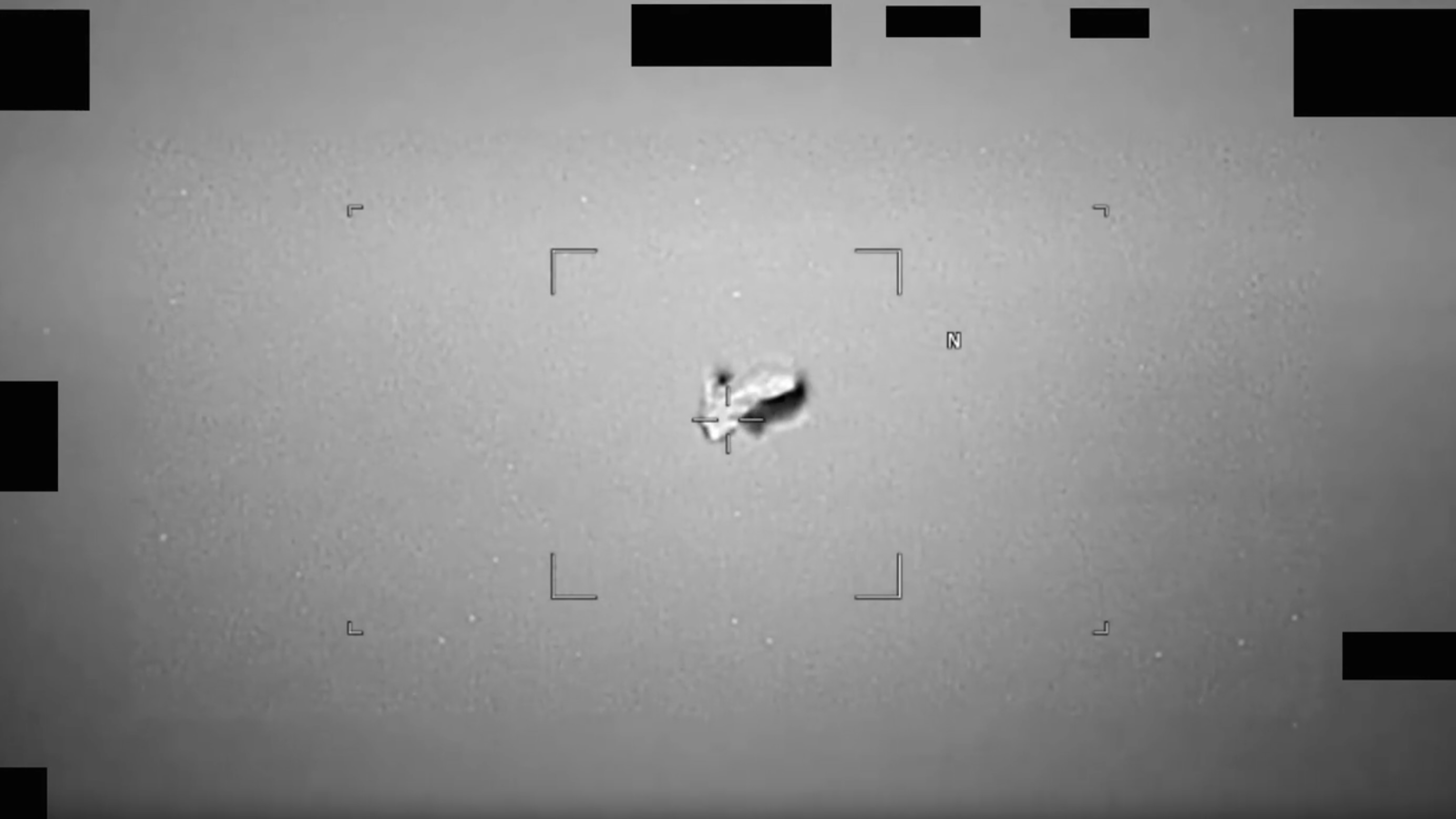
A "football-shaped" UAP (unidentified anomalous phenomenon) observed by an infrared sensor on a U.S. military platform in 2024. The Pentagon released this observation on May 8, 2026. (Image credit: U.S. Deparment of War)
"My first and foremost passion is in stellar astrophysics where I study the life and death of massive and supermassive stars," Nandal said. "I also find the anomalous nature of UAP sightings to be quite intriguing, and whether these events are of terrestrial or extraterrestrial origin, I am excited to apply my understanding of physics to decipher their true nature," he said.
If such events can be explained using known principles, "that's excellent," Nandal advised, as this gives him a chance to test the laws of physics to explain a phenomenon that is captivating fellow humans.
"If such events are beyond our current understanding, I see this as a brilliant opportunity to learn all that I can about the Universe and share my findings with everyone," Nandal concluded.
Public trust in science
Council memberLiberty Capito said she's honored to be a part of the study group.
"Avi is one of the most brilliant scientists of our time and what he has put together, is what I believe to be a blueprint for re-establishing the public's trust in science by having people with vastly different views, beliefs and science on it," Capito said.
From Council member, Robin Hanson: "It's an honor to be invited, and it's a great cause. I worried at first if we could find much useful to do, but it seems that we do have some promising ideas."
Another member of the UAP Council is Carol Cleland, a professor in the Department of Philosophy at the University of Colorado Boulder. She is a Search for Extraterrestrial Intelligence Institute Affiliate and a member of CU Boulder's Center for Astrobiology.
"I anticipate having a council of outside experts will pressure the government to be more open about releasing information and allowing members of the council to interview UAP witnesses," Cleland told Space.com.
Potential positive
Identifying the unidentified deserves a high priority within the U.S. government and the scientific community, explains Loeb.
Nevertheless, for organizations that also continue to diligently sort out what's behind unidentified flying objects (UFOs) in the past and the current UAP tag line, they are taking a cautiously optimistic attitude.
"The involvement of serious, independent scientists is a potential positive development, and the government requires that for any thorough and credible investigation of UAP," said Mark Rodeghier, president and scientific director of the J. Allen Hynek Center for UFO Studies since 1986.
The key issue is not the credentials of the people involved, Rodeghier said, but the structure they are working within.
"If the Council lacks a clear mandate, access to relevant data, a collaborative relationship with those actually grappling with the UAP problem in the government, and then a path for public reporting, its practical value may be quite limited," Rodeghier told Space.com.
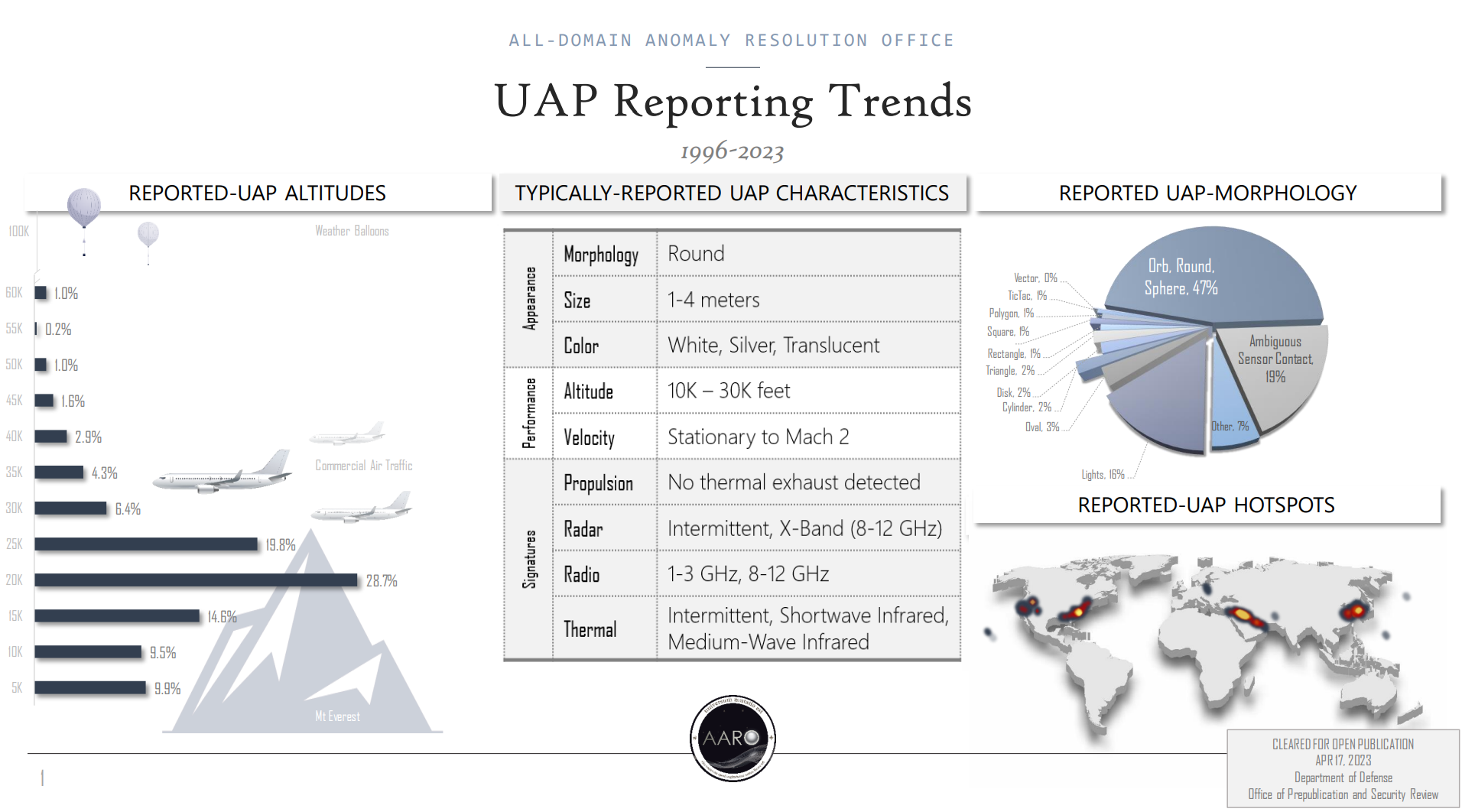
A slide released by the Pentagon's All-Domain Anomaly Resolution Office (AARO) in 2023 detailing trends in UAP reports. (Image credit: U.S. Dept. of Defense/AARO)
Wait and see
Robert Powell, an executive board member of the Scientific Coalition for UAP Studies, said he's adopting a "wait and see" attitude regarding the UAP Council at this point in time.
"Since the UAP Council seems to have the ear of some in Congress," Powell told Space.com, "I hope that they will spend some of their time advocating that Congress appropriate funding specific to the study of UAP through the National Science Foundation."
In SCU board meetings, Powell added, they are a strong proponent of making funding available to the scientific community and academia.
"We never know from where a breakthrough may occur in the study of UAP," Powell said, "and the more scientists involved from all areas of research, the better."
Researchers have developed the first entirely artificial cell, made completely from non-living chemical components, which they say is even capable of replicating.
A team of researchers at the University of Minnesota, Twin Cities, College of Biological Sciences, has described their syntheticcell, which they call SpudCell, in a recent preprint. SpudCell marks the first time scientists have replicated elements of life, such as energy use, reproduction, growth, and development, in a synthetic biological organism.
The Secrets of Life
While many mysteries of life and death remain for science, the team’s achievement represents a significant breakthrough, moving a concept once relegated only to science fiction into science fact. The team is hopeful that new solutions to medical and engineering problems will also arise from their achievement.
“This is likely the most exciting project I’ve ever worked on,” said co-author Kate Adamala. “We’ve replicated in chemistry what only used to be possible in biology: the complete set of behaviors of a cell. It proves that the most fundamental functions of life, like growth and replication, do not need a mysterious magical spark.”
Fluorescent microscopy of SpudCell undergoing division (Image Credit: Kate Adamala, Adamala LabCredit: Kate Adamala, Adamala Lab).
The artificial SpudCell performs some of the most complex activities of its biological counterparts, including selection, genome replication, genetically encoded division, resource acquisition via feeding, and growth.
Like a Cell, Yet Different
Although the synthetic cell copies many biological functions, there are some differences. It lacks the internal scaffolding, called a cytoskeleton, which natural cells use to divide. Instead, SpudCell crowds proteins together on its membrane surface until enough mechanical stress builds up to cause the membrane to split.
In addition to being slightly different from a biological cell, the team refined SpudCell throughout their research, at one point altering the cell’s genetics to increase fusion protein production. With this change, the cells grew faster and produced more offspring, outcompeting the original variant in five generations. In a demonstration of the system’s selection and competition, the genetically modified advantage further increased when the team changed conditions to make nutrients scarcer.
The cell’s genetic code is relatively simple. There are about three million kilobase pairs in the human genome, and likely around 113 pairs in a single cell. SpudCell contains a mere 90, encoded on seven DNA plasmids, instead of a single chromosome. This encoding solution offers benefits, allowing researchers to program cellular functions more easily by simply touching a single piece of the modular system. They say this will enable them to continue increasing SpudCell’s complexity.
Moving Forward on Synthetic Cells
“This work is just the beginning,” said Adamala, who, along with several partners, is founding a research and engineering institution called Biotic, which will focus on further advancements in synthetic cell research, keeping its findings open source.
“We are showing it’s possible to engineer the basic functions of the cell,” Adamala added. “To fully realize the promise of this technology – to make it robust and practical – we need combined international effort.”
“The role of Biotic is to focus engineering efforts and make them compatible with a shared chassis. SpudCell is that chassis, and with Biotic setting the protocols for collaboration, we are eager to start applying this technology to serious challenges.”
The next steps for Biotic will be to combine SpudCell’s seven DNA plasmids into a single genome and build more molecular machinery. One of the greatest challenges they are preparing to confront is standardization, as many labs use different standards. To achieve true growth in this sector, Biotic aims to develop modular standards that will apply across the entire field.
SpudCell could provide a revolutionary new basis for manufacturing, allowing cells to naturally develop properties that typically require difficult and expensive molecular transformations, and even open up possibilities beyond what those transformations can offer. This could enable major improvements in medicine by using amino acids that are never used in nature.
Ryan Whalen covers science and technology for The Debrief. He holds an MA in History and a Master of Library and Information Science with a certificate in Data Science. He can be contacted at ryan@thedebrief.org, and follow him on Twitter @mdntwvlf.
In February 2026, President Trump directed the U.S. government to release documents on UFOs, UAPs, and alien life. Questions arise about the nature of these phenomena, ranging from interdimensional entities to possible deceptions involving spiritual beings, echoing long-standing debates on extraterrestrial existence and their implications for faith.
Evidence for possible life on Mars in the ancient past continues to build, thanks to a recent discovery by NASA’s Perseverance rover that identified complex carbon in two mudstones.
As detailed in a recent paper published in Science Advances, Perseverance collected samples in the Jezero crater, a location that has continued to yield possible biosignatures of life on Mars in the ancient past.
In the same region, scientists reported potential evidence of microbial activity on ancientMars, adding to a growing list of circumstantial evidence for one of the most intriguing possibilities in modern space exploration: the prospect that Earth may not have been the only planet in our Solar System that has held the potential to host life.
A Prime Location for Life on Mars
Among the study’s most significant findings is that complex macromolecular carbon was discovered alongside other potential biosignatures. Jezero Crater, a 28-mile-wide impact basin on the Martian surface, once contained flowing water roughly 3.5 billion years ago, making it one of the most promising locations in the search for ancient life. Water is essential to all known life on Earth, serving as a universal solvent and playing a critical role in biological processes.
“Jezero Crater was selected as a landing site due, in part, to its past evidence of aqueous activity and potential to preserve organic material,” co-lead author Kyle Uckert, a research scientist at NASA’s Jet Propulsion Laboratory, told The Debrief. “The Perseverance Rover’s exploration of Jezero Crater helps us understand the past habitability of Mars.”
Perseverance targeted a distinctive geological feature known as the Bright Angel outcrop, where the samples were collected. The outcrop consists of mudstones deposited in the dry bed of an ancient river that once flowed into Jezero Crater. Comparable sedimentary deposits on Earth are often associated with environments capable of preserving evidence of microbial life.
Analyzing Samples
Determining the origin of the organic carbon preserved within these Martian rocks is key to understanding whether the Red Planet ever supported life.
Using its onboard Raman spectrometer, Perseverance mapped the distribution of the rocks’ organic matter. One sample contained organic carbon within a primary silicate-dominated matrix, while another preserved carbon within secondary carbonate and sulfate minerals.
Notably, the carbon appears to have remained remarkably well preserved despite billions of years of exposure to the harsh Martian environment. Researchers suggest its limited weathering may indicate that the material is resistant to radiation and oxidation—possibly because it is mixed with iron-rich regolith or protected by clay minerals—or that it was only recently exposed at the surface through erosion.
The researchers are quick to point out that their findings do not determine whether the carbon originated through biological or non-biological processes. Nevertheless, the discovery adds another intriguing piece of evidence to the ongoing search for ancient life on Mars.
“Macromolecular carbon may be delivered to Mars via meteorites, or may have formed through hydrothermal geologic processes,” Uckert said.
Continuing to Explore Life on Mars
According to the researchers, determining the true origin of the carbon will ultimately require returning Martian samples to Earth, where they can be examined using far more sophisticated laboratory instruments than those carried aboard Perseverance.
“Further constraining the origin, distribution, and alteration history of the MMC observed in the Neretva Vallis mudstones requires high-resolution and high-sensitivity analyses in terrestrial laboratories, which can be facilitated by the return of the Cheyava Falls rock core, ‘Sapphire Canyon’ to Earth,” explained co-lead author Ashley Murphy, a postdoctoral research scientist at the Planetary Science Institute.
“The Perseverance Rover science payload is not designed to determine whether martian organic molecules were created by biologic or geologic processes, and our study is unable to make this distinction,” Uckert added.
The researchers say that future sample-return missions, combined with advanced laboratory analyses on Earth, may finally help resolve one of planetary science’s most enduring questions.
“The Perseverance Rover collects samples of scientifically compelling martian rocks for potential return to Earth,” Uckert concludes.“Using high-resolution terrestrial instruments to analyze these rock samples, particularly the Sapphire Canyon core collected on the Cheyava Falls rock, may provide more compelling evidence for a biologic or abiotic origin of this organic matter.”
Ryan Whalen covers science and technology for The Debrief. He holds an MA in History and a Master of Library and Information Science with a certificate in Data Science. He can be contacted at ryan@thedebrief.org, and follow him on Twitter @mdntwvlf.

 Login