A new NASA orbital image captures Perseverance after completing a marathon across the surface of Mars. NASA’s Perseverance rover has completed the equivalent of a full marathon on Mars, reaching 26.2 miles (42.195 kilometers) after five years and four months of driving across the Red Planet. The milestone came on the 1,890th Martian day, or [...]
That visitor—a robotic rover named Perseverance—has been conducting investigations on Mars since February 18, 2021, and the new aerial images reveal its current location in an area that mission specialists have dubbed “Arbot.”
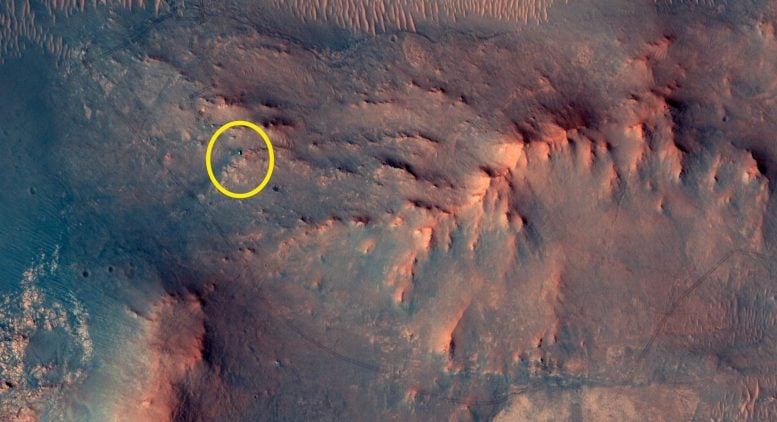
While Perseverance’s latest appearance reveals little more than a greenish spec on the planet’s rust-colored surface, also visible in the new images are the long path its formidable tires have left in the Martian soil as the robotic explorer has trekked west of its initial landing site.
The new images, captured on June 13, 2026, were taken just one day before Perseverance broke the previous distance record held by a robotic explorer on Mars: NASA’s Opportunity rover.
However, Perseverance completed this phase of its journey in record time compared to its predecessor, which took more than 11 years to traverse a similar distance. Perseverance, by contrast, covered the same distance in less than half that time, with just five years and four months of travel now behind it.
In the image above, NASA’s Perseverance Rover appears in the center of the image as a small, greyish-green reflective spot. Also visible are the impressions left by its all-terrain tires, revealing the robotic rover’s long path over the last several years of Martian exploration (Image Credit: Credits: NASA/JPL-Caltech/University of Arizona)
The images were made possible by the MROs’ High-Resolution Imaging Science Experiment (HiRISE) camera, which also captured surface features in the Arbot area that include ridges and windswept areas along Mars’ rugged exterior.
Built and operated by the University of Arizona, HiRISE captures images with resolutions as fine as about 25 centimeters (10 inches) per pixel, allowing researchers to distinguish features roughly the size of a kitchen table from orbit. The camera has returned hundreds of thousands of detailed images since the MRO arrived at Mars two decades ago, contributing to a growing data set that has transformed scientists’ understanding of the Red Planet.
Documenting everything from active dust avalanches and shifting dunes to fresh impact craters, the unprecedented resolution its imagery provides has made HiRISE one of the most powerful planetary imaging instruments ever deployed.
Last year, the MRO’s HiRISE camera also successfully captured images of the interstellar comet 3I/ATLAS as it made its way past Mars during its trip through our Solar System. Although the HiRISE images weren’t the clearest images of the interstellar visitor obtained during its visit, they did help demonstrate just how formidable NASA’s MRO and its suite of instruments are.
Micah Hanks is the Editor-in-Chief and Co-Founder of The Debrief. A longtime reporter on science, defense, and technology with a focus on space and astronomy, he can be reached atmicah@thedebrief.org. Follow him on X @MicahHanks, and at micahhanks.com.

 Login

 A new NASA orbital image captures Perseverance after completing a marathon across the surface of Mars. NASA’s Perseverance rover has completed the equivalent of a full marathon on Mars, reaching 26.2 miles (42.195 kilometers) after five years and four months of driving across the Red Planet. The milestone came on the 1,890th Martian day, or [...]

