❌

Reading view

Are CAPTCHAs obsolete in the age of AI?

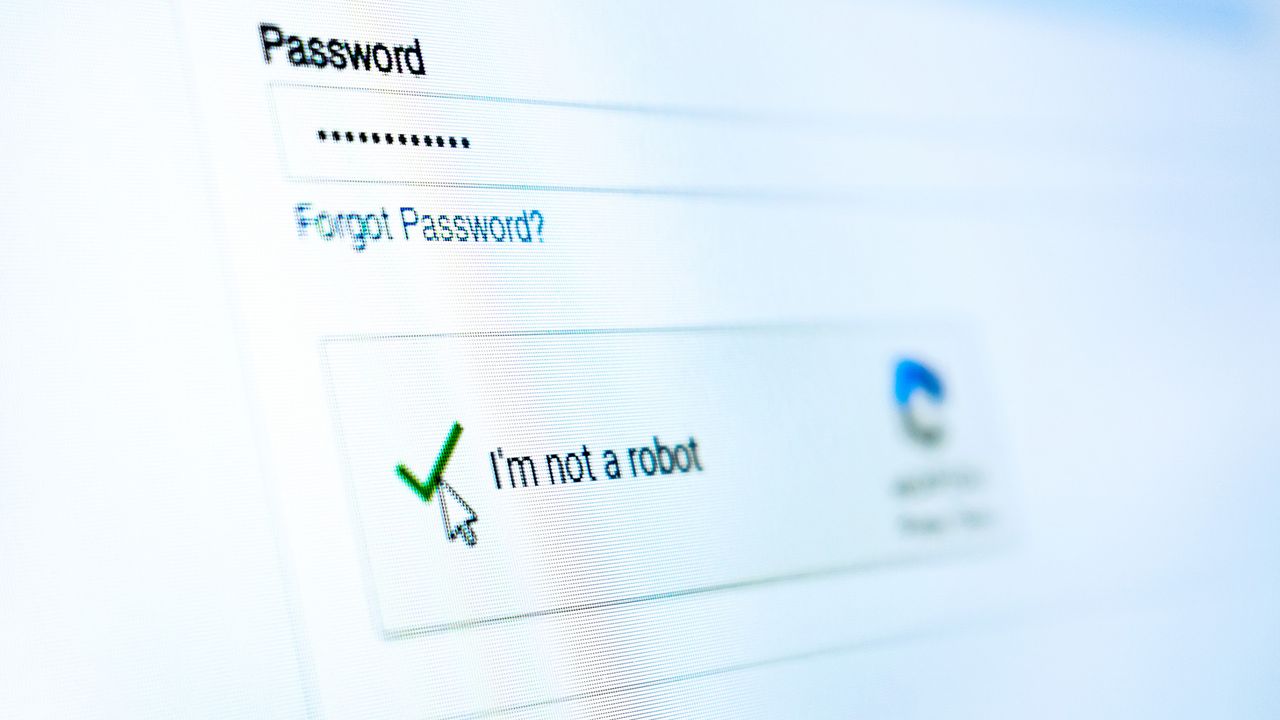
When you click to enter a website or try to log in or fill out a form, you may be asked to identify motorcycles from a grid of grainy images, decipher a string of convoluted characters, or click a box that states "I am not a robot."

These tests are called CAPTCHAs, which stands for "Completely Automated Public Turing test to tell Computers and Humans Apart." As their name suggests, they are meant to help a website distinguish if an action is coming from a human or a bot, since the aforementioned tasks are theoretically easy for a human and difficult for automated software to perform. This, in turn, blocks bots from spamming comments, downloading files, taking over accounts, or executing any other action on a website.

But as computer models increasingly gain the ability to solve CAPTCHAs, thanks to advancing artificial intelligence (AI) β€” and with puzzles getting weirder and more difficult for humans to complete β€” does this mean CAPTCHAs are still useful?

Sign up for our newsletter

Life's Little Mysteries logo with a question mark in a magnifying glass

(Image credit: Marilyn Perkins / Future)

Sign up for our weeklyΒ Life's Little Mysteries newsletterΒ to get the latest mysteries before they appear online.

CAPTCHAs were introduced in the late 1990s to address "a very simple, but very difficult problem," Andreas Plesner, a computer scientist at ETH Zurich, told Live Science. "If I don't interact with a person physically … is it a computer? Or is it human?" Some of the first CAPTCHAs, still common on websites today, were composed of distorted text, since text-reading software at that time had trouble interpreting warped words.

But over time, text-reading software improved and new types of CAPTCHAs were developed. For instance, reCAPTCHA, one of the most popular CAPTCHA services, has an image-based test that asks users to identify objects such as traffic lights, motorcycles or bicycles from a grid of Google Street View photos. This was developed after Google acquired the service in 2009.

"The bet was that recognizing objects in messy, real-world photos was still a uniquely human skill," Ng Chong, chief of information technology and director of United Nations University's Campus Computing Centre in Tokyo, told Live Science in an email.

As time went on, CAPTCHA design continued to advance. In 2014, Google came out with reCAPTCHA v2, which analyzed computer mouse behavior by asking people to click a checkbox to test if a user was human. If the behavior is deemed suspicious, determined by factors like how a user interacts with the site beforehand or the timing of their click, the street-image grid pops up as an additional puzzle.

However, more recently, technology has improved to a point where image recognition is no longer a human-specific skill. As early as 2016, researchers found that low-cost deep learning technologies could solve reCAPTCHAv2 around 70% of the time. By 2024, Plesner and his colleagues developed an AI model that could solve the puzzles correctly 100% of the time. Earlier in 2026, Chong noted that he built a tool that could mimic human-like browsing behavior and sometimes bypass reCAPTCHA v2 without triggering the image grid at all. When the grid was triggered, the tool used AI to solve it within a few tries.

"When both the challenge and the behavioral layer are defeated by commodity tools running on a single laptop, the fundamental premise of CAPTCHA, that there are tasks humans can do but machines can't, stops holding," Chong wrote.

A woman stands next to a rectangle in front of a white car.

"Real World Captchas" appeared in major cities around the world in April 2025. (Image credit: Gerald Matzka / Stringer via Getty Images)

Looking ahead

So does that mean CAPTCHAs are completely obsolete? Not quite. Although the model Plesner and his colleagues developed breezed past reCAPTCHAv2, "there were a lot of the safety measures that were not tied to being able to solve it, but more tied to how you solve it," he said. For example, while conducting their research, Plesner noted that his team used a virtual private network (VPN) that changed IP addresses for each test, since a single IP address with a high volume of solved CAPTCHAs faced tasks with increasing difficulty, or got blocked entirely.

Modern CAPTCHAs focus on these background clues and tactics, rather than the puzzle itself. This includes Google's reCAPTCHA v3, Friendly CAPTCHA, hCAPTCHA and Cloudflare's Turnstile, among others, which run without sending a puzzle at all. They instead look at whether the action is coming from a real attested device (rather than from automated code), whether an IP address has had a high volume of automated requests in the past, how a user navigates a webpage, what the user's cookie history is, and a slew of other factors to determine possible malicious intent.

As the tug-of-war continues, CAPTCHA puzzles are still widespread. After all, they’ve been the status quo for decades, are easy to set up and are relatively cost-effective, Chong said. But these tasks have some other drawbacks. Although bots can increasingly solve the puzzles with ease, CAPTCHAs can be a headache to get through for humans and can be seen as discriminatory against those with disabilities, notably visual disabilities, as a researcher noted in a 2022 conference paper.

The crescendoing complexity of CAPTCHA puzzles has even been the subject of parody, with developer Neal Agarwal creating a free satirical game called "I'm Not a Robot." Users must solve a series of increasingly convoluted verification checks β€” scoring a point for each stage they pass, which eventually transcend into the absurd.

So, as machines get smarter, the answer may not be to find more difficult puzzles. "If a CAPTCHA can only be solved by someone with a Ph.D. in mathematics, then it's not very useful," Plesner said. "The internet needs to be used by everyone."

Can you match these ancient devices to their pictures? Find out with our computing quiz!
  •  

Dead-end bitcoin mining wastes as much energy as Switzerland's entire hydropower generation capacity

Network latency in bitcoin mining is driving massive energy waste β€ͺ—‬ the annual equivalent of the total generation capacity of Switzerland's entire hydroelectric power system, scientists say. This wasted energy results from inefficiencies in the mining process and increasing competition among bitcoin miners.

In a new study published May 26 in the journal PNAS Nexus, the researchers aimed to provide a theoretical model to measure patterns within the networks powering bitcoin's distributed ledger system.

But they also calculated that in 2025, around 16,000 megawatts was wasted by fruitless bitcoin mining attempts, where competing mining efforts exert massive computational power to obtain the same units of bitcoin. This is roughly equivalent to the total generation capacity of Switzerland's 701 hydropower plants, according to statistics from the Swiss Federal Office of Energy.

It's important to note that this figure differs from the total energy consumed by bitcoin mining activity, estimated by researchers to stand at an annual level of 138 terawatt-hours, as of June 2024. This is higher than the annual energy consumption of several developed countries including Norway and the Netherlands.

Energy-guzzling crypto

Concerns around the environmental impact of bitcoin and other proof-of-work blockchain technologies have abounded in recent years.

In 2021, for example, bitcoin mining's water usage, primarily for liquid-cooled computer equipment, equated to more than the domestic water use of 300 million people in rural sub-Saharan Africa, according to a 2023 U.N. report.

Bitcoin is underpinned by a distributed ledger system, called a blockchain, which operates on a "proof-of-work" model. For a new unit of the digital currency to be generated, computing power must be used to solve a digital puzzle. In theory, the first entity to successfully "solve" the problem adds a new "block" of transactions to the ongoing chain and is granted a set quantity of bitcoin in return.

However, due to the explosion of interest in bitcoin as a financial trading asset, the competition for who can be the first to complete a block and claim the rewards has become incredibly fierce. A solution to the puzzle is based on computational power, with specialized hardware providing a greater advantage in speed. It has driven commercial entities to invest in building specialized data centers dedicated to such mining operations.

Because the race to be the first to mine a block is so competitive, the difference between first and second place can be just tiny fractions of a second. This often results in "accidental forks" β€” where two competing blocks are registered at almost exactly the same time.

In this scenario, the block with the longest chain of subsequent blocks built on top of it will eventually become a verified and legitimate part of the blockchain β€” earning its miners the bitcoin reward β€” while the competing block will be seen as invalid and worth nothing.

The energy needed to solve the proof of work and generate these "orphaned blocks" in the first place β€” as well as any subsequent blocks built on top of them before the winner is decided β€” is ultimately wasted.

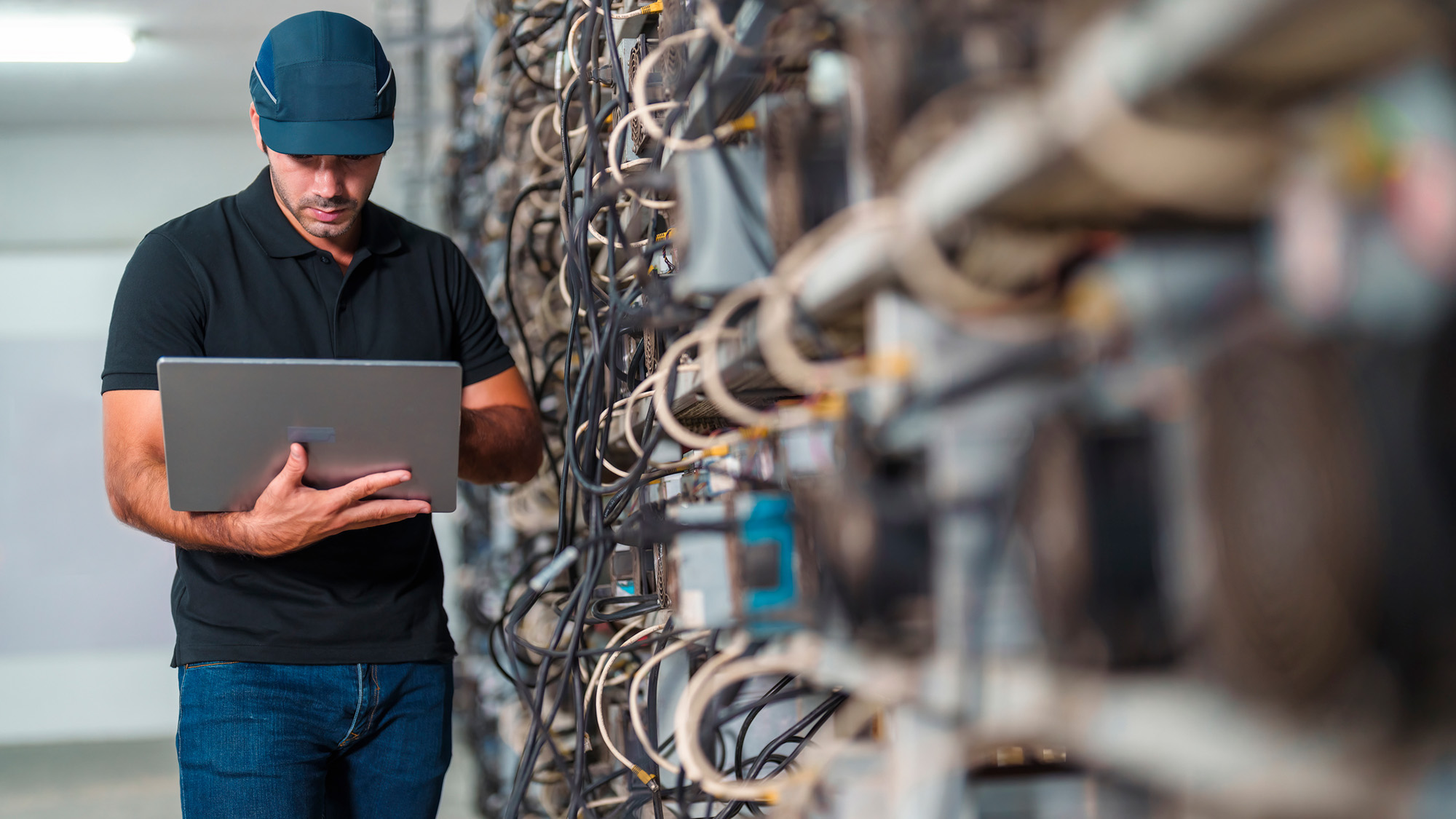
A man wearing a gray shirt and blue baseball cap stands next to a wall of computers

An engineer stands next to a bitcoin mine. (Image credit: PixeloneStocker via Getty Images)

"Despite their indication of a distributed network, accidental forks are an inefficiency of the Bitcoin protocol that leads to wasted computational resources (and thus energy), increasing the cost of network operations and its environmental impact to maintain a given level of security," the researchers wrote in the study.

According to the Crypto Carbon Ratings Institute (CCRI), a cryptocurrency analysis firm, bitcoin is the most dominant cryptocurrency by far, with a market capitalisation of more than $1.1 trillion β€” more than 80% larger than the next most popular currency, Ethereum. However, instead of proof-of-work, Ethereum uses a different form of consensus mechanism to establish block authorship, called "proof-of-stake," which is significantly less computationally intensive.

While other cryptocurrencies apart from bitcoin also use proof-of-work methods, bitcoin is around twice as large as its next nearest rival in this category, making it orders of magnitude more power-hungry.

Who rules the pool

Whereas previous models for analyzing fork rates treated all miners in the network as equal, this study considered elements such as network latency and geographic distribution, aiming to provide a "null model" β€” a baseline which can be used as a starting point to inform future analysis.

The model also allowed the researchers to quantify other notable trends, such as the distribution of "mining pools" β€” consortiums in which mining operators pool their efforts to maximize their potential success. They identified a decline in the dominance of Chinese mining pools from 2022 following the country's ban on bitcoin mining while also discovering high levels of consolidation at the upper level of the bitcoin mining industry.

The report found that just three mining pools produce over 50% of new bitcoin blocks. This is a problem because it risks a "51% attack," whereby unscrupulous miners enter fraudulent information into the blockchain by ensuring that they always produce the longest chain and, therefore, become validated.

This level of consolidation distorts the market for processing fees that bitcoin users pay to have their transactions included in the next block, the researchers added, and could thus allow miners to arbitrarily delay the inclusion of specific transactions.

  •  

Scientists figured out how to shrink huge ultrafast lasers so they fit on a tiny chip β€ͺβ€ͺ—‬ the 'holy grail' of the field

A breakthrough in photonic chips could make large, costly, ultrafast lasers dramatically smaller, leading to portable and affordable imaging, diagnostic and information-processing devices, researchers say.

By using a decades-old overlooked laser architecture, scientists managed to fit an ultrafast laser onto a tiny photonic chip β€” a chip that uses light, rather than electricity, for computing operations.

In a new study published June 3 in the journal Nature, the team demonstrated that a tiny laser on the photonic chip could deliver 1.05 nanojoules of energy in 147-femtosecond (147 quadrillionths of a second) bursts β€” thereby competing with the output of laboratory-class ultrafast lasers.

Ultrafast lasers are used in a variety of applications, from precision manufacturing and eye surgery to biological imaging and atomic clocks, but the systems needed to power them tend to take up whole tabletops in labs or factories. Yet the powerful output of these laser pulses made them difficult to miniaturise onto photonic chips.

"For more than twenty years, a high-pulse-energy femtosecond laser on chip was widely regarded as a holy grail of integrated photonics," Tobias Kippenberg, a photonics professor at the Swiss Federal Institute of Technology(EPFL), said in a statement.

"Our result shows that it is not only possible, but that it can be achieved with a surprisingly elegant architecture that the integrated-photonics community had overlooked."

Forward-thinking breakthrough comes from looking back

Photonic chips manipulate light by using microscopic structures called waveguides β€” usually in the form of optical fibers or etched cavities β€” to carry information. They aren't particularly novel, and can be found in fiber-optic communications, medical sensors and lidar systems.

But photonic chips have previously struggled when handling high-powered, ultrafast lasers. That's because they need to contain light to extremely small waveguides, leading the light to interact strongly with itself and destabilizing the laser pulses.

To tackle this problem, the researchers looked at a laser architecture called the Mamyshev oscillator, created in 1998 by Pavel V. Mamyshev, a physicist and engineer at Bell Labs.

A close up of a chip on a metal platform.

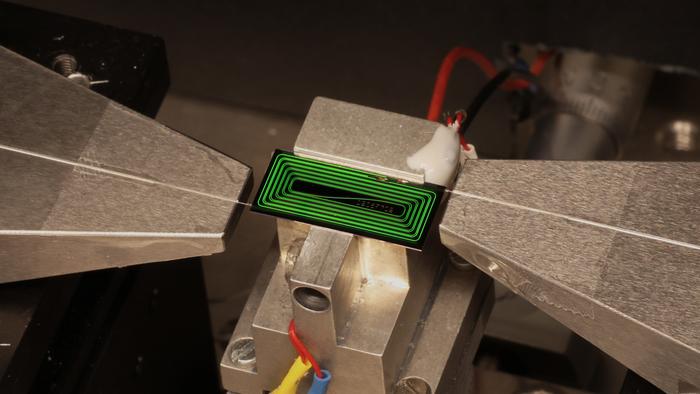
EPFL's chip-based ultrafast laser operates in a testing set up. (Image credit: Zheru Qiu/EPFL)

This oscillator, which has received little attention in the world of photonic chips, works by placing a nonlinear waveguide between two optical filters. This causes a high-intensity laser pulse to expand into a broader range of colors that can then pass through both filters while weaker light, which can cause laser destabilization, is blocked out. This technique essentially means that a high-intensity laser pulse can be maintained.

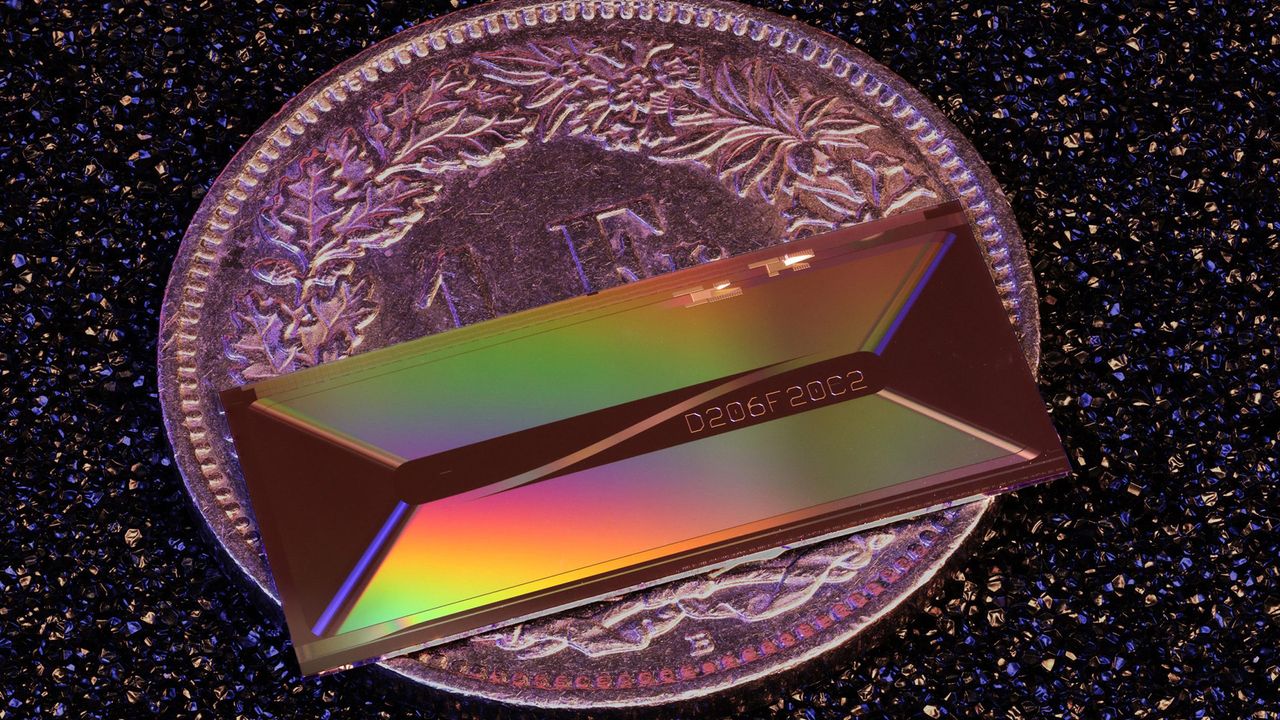
Because the Mamyshev oscillator doesn't require extra components to manufacture on a chip, it presents an attractive design for use on photonic chips. And although the laser cavity needed to direct an ultrafast laser is 16.5 inches (42 centimeters) long, it can be folded to occupy around the same area as a match head. This can't be done with conventional fiber-optic-based lasers, often used in photonic chips.

That takes care of the size, but the cost of ultrafast laser systems is another challenge. But because photonic chips can be fabricated using silicon wafers in the same fashion as computer chips, more than 1,000 laser cavities could potentially be produced in a single batch, the researchers said. As such, photonic chips with ultrafast laser capabilities could be produced at scale, in turn reducing manufacturing costs and even expanding their use.

Photonic chips capable of handling ultrafast lasers could, in the future, lead to portable tools for tasks like detecting pollutants or performing advanced medical diagnostics in the field, the researchers noted in the study. The technology also opens the door to smaller atomic clocks that can benefit navigation and future communications.

  •  

Chinese supercomputer leapfrogs best US machines to be ranked world's fastest

A Chinese system has become the world’s most powerful supercomputer, surpassing American machines for the first time since 2021.

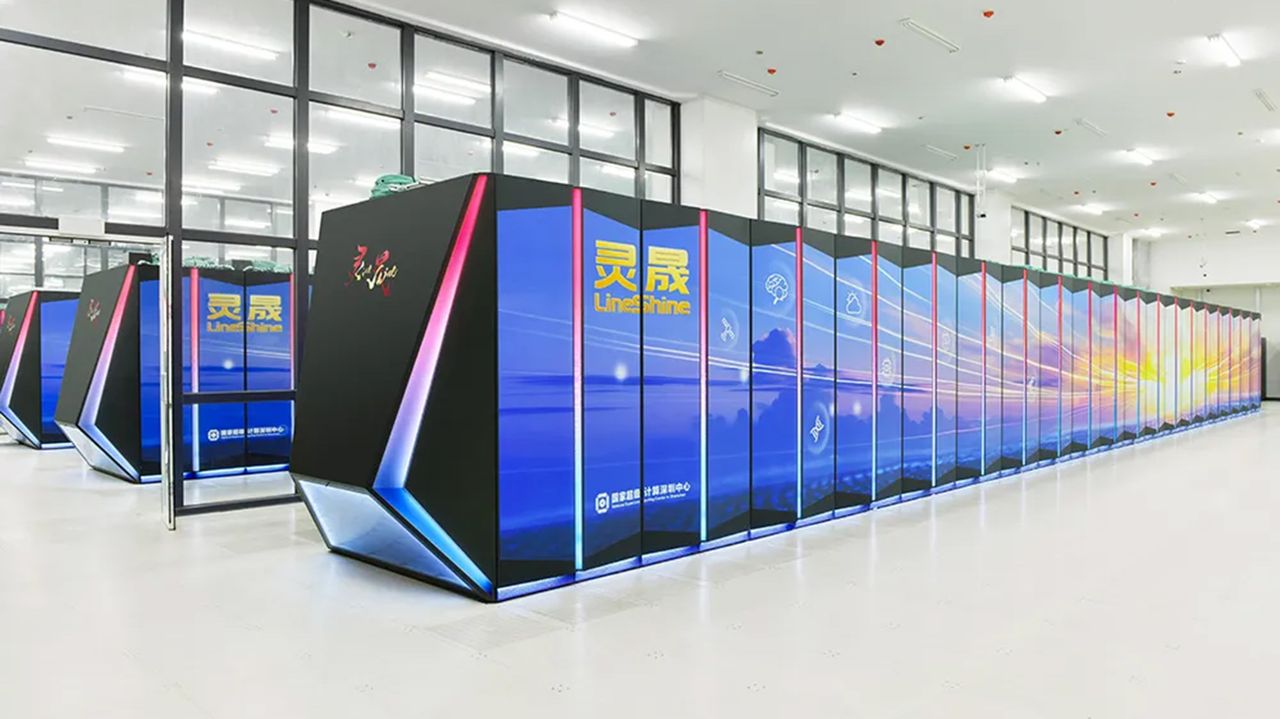
LineShine, installed at China’s National Supercomputing Center in Shenzhen, clinched the top spot in the 67th TOP500 ranking of the world’s most powerful supercomputers. The new system has already been used in a range of fields, giving developers another route to achieve supercomputing power.

The machine, which came online in the first half of 2026, can reach speeds of 2.198 exaFLOPS β€” where 1 exaFLOP is 1 quintillion (1018) floating-point operations, or mathematical calculations, per second (FLOPs) β€” making it the only supercomputer on the planet to exceed 2 exaFLOPS per second. It's also the first time China has hosted the world's fastest supercomputer since 2017.

A FLOP is a type of calculation used to benchmark computing performance. Exascale supercomputers can perform more than 1 quintillion of these operations every second. In comparison, home computers can perform roughly 5 trillion FLOPS.

According to TOP500, LineShine can achieve speeds about 22% faster than El Capitan, a supercomputer housed at Lawrence Livermore National Lab in California that had previously held the top spot since November 2024.

The system’s computing power is the result of "a comprehensive breakthrough in a series of core technological barriers," according to a translated statement from China's National Supercomputing Center.

Unlike many other supercomputers, LineShine uses only central processing units (CPUs) to perform calculations. Other systems rely on both CPUs and graphics processing units(GPUs), which run many jobs simultaneously by dividing tasks among smaller, specialized cores.

Since 2018, the U.S. government has restricted exports of semiconductor chips to China, including GPUs. However, startups such as DeepSeek have wrangled other technological advancements to train artificial intelligence (AI) models with fewer and less powerful GPUs than comparable systems such as ChatGPT.

LineShine "represents a historic leap forward for China's supercomputing field, breaking through foreign technological blockades and building an independent and controllable software and hardware system," the statement read.

The system has already been used on projects in multiple research areas, including atmospheric science, drug discovery and AI, according to the National Supercomputing Center. In general, supercomputers perform extremely complex calculations at speeds much faster than traditional computers can handle, allowing them to solve problems that would otherwise take too long or cost too much to address.

The fastest supercomputers utilize a range of different designs and processors, showing that high-performance computing doesn’t rely on any one single method.

"The list demonstrates that there is no single dominant technology path to leadership-class computing; instead, vendors are pursuing a variety of CPU, GPU, APU, and custom-accelerator approaches coupled with different interconnect and system designs," TOP500 representatives said in a statement.

Following LineShine and El Capitan, two supercomputers at U.S. national laboratories and one in Germany claimed spots three through five on the TOP500 list. Machines in Italy, Switzerland, Japan and the U.S. round out the top 10.

Can you match these ancient devices to their pictures? Find out with our computing quiz!
  •  
❌